China Threat Detection AI Market Size & Growth Rate
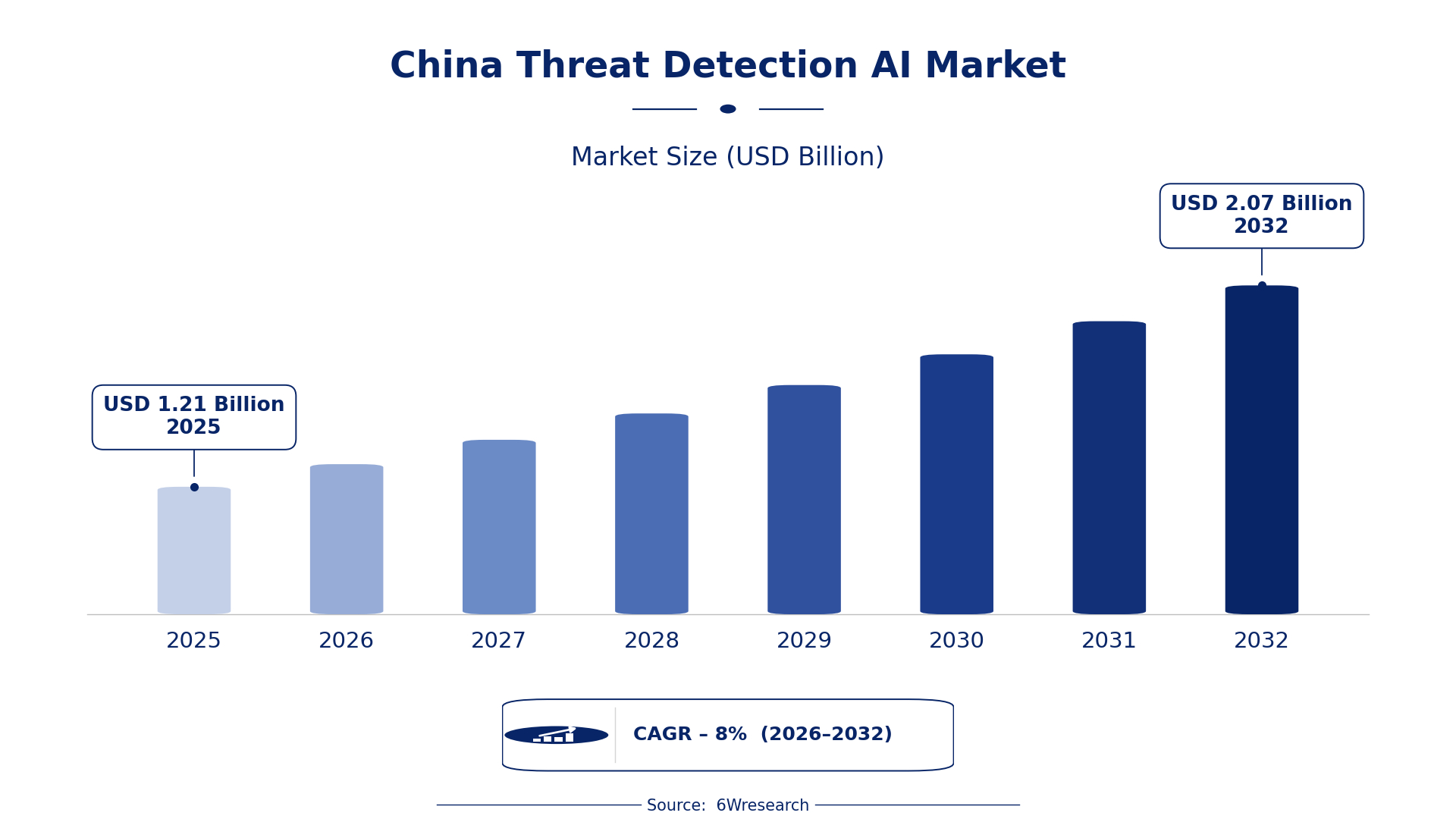
According to 6Wresearch internal database and industry insights, the China Threat Detection AI Market was valued at USD 1.21 billion in 2025 and is projected to reach USD 2.07 billion by 2032, growing at a CAGR of approximately 8% during 2026–2032.
China Threat Detection AI Market Highlights
| Report Metric | Details |
| Report Name | China Threat Detection AI Market |
| Market Size 2025 | USD 1.21 billion |
| Market Size 2032 | USD 2.07 billion |
| Absolute Growth 2025–2032 | USD 0.86 billion |
| CAGR 2026–2032 | 8% |
| Peak Annual Growth | 10.1% in 2030 |
| Forecast Period | 2026–2032 |
| Historical Data | 2022–2025 |
| Base Year | 2025 |
| Leading Detection Type, 2025 | Malware Detection (47% share) |
| Leading AI Technique Used, 2025 | Machine Learning (40% share) |
| Leading Deployment Mode, 2025 | Cloud-Based (34% share) |
| Leading End User, 2025 | Enterprises (44% share) |
| Fastest-Growing Detection Type | Phishing Threats (9.9% CAGR) |
| Fastest-Growing AI Technique Used | Anomaly Detection AI (9.6% CAGR) |
| Fastest-Growing Deployment Mode | Hybrid (10.5% CAGR) |
| Fastest-Growing End User | Fintech Companies (10.6% CAGR) |
| Growing Sector | Cybersecurity |
| Key End Users | Enterprises, Government Agencies, IT Security Teams, Fintech Companies |
China Threat Detection AI Market Year-wise Growth Rate and Key Drivers (2022–2032)
This graph illustrates the annual growth rates of the market from 2022 to 2032, highlighting a steady upward trajectory and projected market expansion over the forecast period.
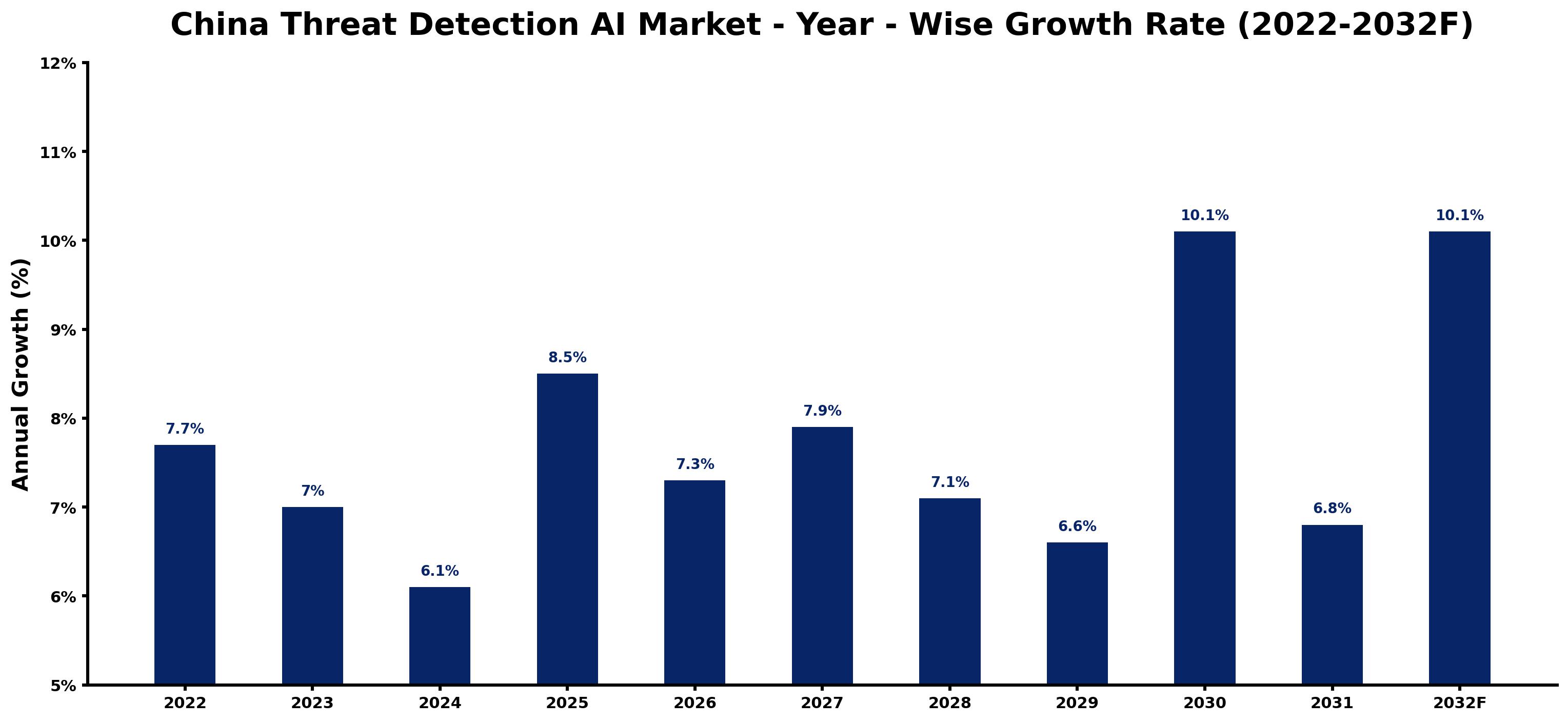
Below, each year's estimated growth is shown next to the factor that most influenced it.
| Year | Estimated Annual Growth (%) | Market Rationale |
| 2022 | 7.7 | The cybersecurity market was valued at approximately 1 trillion CNY, indicating strong demand for protection. |
| 2023 | 7.0 | The demand for threat detection AI remains high, particularly in the Guangdong province's tech industries. |
| 2024 | 6.1 | Growth slowed as the installed base of AI-based security systems reached 50% in enterprises. |
| 2025 | 8.5 | The market experienced faster growth due to the updated National Cybersecurity Strategy improving digital security. |
| 2026 | 7.3 | Demand growth slowed as the number of registered cybersecurity firms exceeded 1,000. |
| 2027 | 7.9 | An increase in cyber incidents reported in China spurred further investment in threat detection solutions. |
| 2028 | 7.1 | Growth slowed as the Cybersecurity Law mandated stricter data protection measures for enterprises. |
| 2029 | 6.6 | Demand continued to slow, but the market remains driven by the need for compliance with regulations. |
| 2030 | 10.1 | The market peaked with a surge in investment driven by the AI Innovation Action Plan promoting AI applications. |
| 2031 | 6.8 | Growth slowed as the Beijing municipality initiated a cybersecurity talent development program to address skill gaps. |
| 2032 | 10.1 | The market is projected to grow rapidly as the installed base of AI-based security systems reaches 50%. |
Note: Market size estimations and growth projections presented in this report are based on 6Wresearch's proprietary forecasting methodology, utilizing the latest available industry data, government publications, and primary research inputs.
China Threat Detection AI Market Synopsis
Threat Detection AI technology in China identifies and mitigates security threats in digital environments. This technology integrates machine learning, data analytics, and cybersecurity protocols to protect sensitive data and ensure compliance. The China Threat Detection AI Market is expanding due to investments from domestic users, particularly in finance, government, and large enterprises. The updated National Cybersecurity Strategy and the AI Innovation Action Plan are key drivers of this growth, further increasing the demand for advanced security measures.
Market Dynamics Impact Analysis (2026–2032)
| Factor | Type | Impact | Primary Segment Affected |
| Growing investment in cybersecurity measures by enterprises | Driver | High | Enterprises |
| Increasing cyber incidents pushing demand for advanced threat detection | Driver | High | Malware Detection |
| High demand for compliance with data protection regulations | Opportunity | High | Intrusion Detection |
| Rising need for AI applications in cybersecurity | Opportunity | Medium | Anomaly Detection AI |
| Challenges in developing skilled cybersecurity professionals | Restraint | High | IT Security Teams |
| Strict data protection measures affecting operational flexibility | Restraint | Medium | Government Agencies |
| Limited integration of AI in existing security systems | Challenge | High | Fintech Companies |
| High competition among over 1,000 registered cybersecurity firms | Challenge | Medium | Enterprises |
Evaluation of Drivers in China Threat Detection AI Market (2026–2032)
The factors lifting demand, and the evidence behind each, are summarised below.
| Drivers | Primary Segment Affected | Why It Matters (Evidence) |
| Increased investment in cybersecurity solutions by enterprises | Enterprises | This investment is driven by the need to protect sensitive data, with the cybersecurity market valued at approximately 1 trillion CNY. |
| Rising number of cyber incidents reported | Malware Detection | With over 1 million incidents reported in 2022, demand for advanced malware detection solutions has surged. |
| Compliance with the Cybersecurity Law of 2017 | Intrusion Detection | The law mandates strict data protection measures, compelling organizations to invest in intrusion detection systems. |
| Support from the AI Innovation Action Plan | Anomaly Detection AI | This plan promotes AI applications in cybersecurity, increasing demand for anomaly detection technologies. |
| Growing focus on digital security in government agencies | Government Agencies | Government initiatives to improve cybersecurity capabilities drive demand for advanced threat detection solutions. |
Growth in the Threat Detection AI market in China comes from increased investment in cybersecurity solutions, particularly by enterprises seeking to protect sensitive data. The cybersecurity market was valued at approximately 1 trillion CNY, prompting organizations to strengthen their security measures. The rising number of cyber incidents reported, exceeding 1 million in 2022, has intensified the demand for advanced malware detection.
Evaluation of Restraints in China Threat Detection AI Market
Below mentioned are some major restraints and their influence on market dynamics.
| Market Restraint | Primary Segment Affected | Why It Matters (Evidence) |
| Challenges in developing skilled cybersecurity professionals | IT Security Teams | The cybersecurity talent gap hinders effective implementation of threat detection solutions, affecting operational efficiency. |
| Strict data protection measures affecting operational flexibility | Government Agencies | Compliance with regulations limits the ability to adapt quickly to emerging threats, impacting response times. |
| Limited integration of AI in existing security systems | Fintech Companies | Many firms struggle to incorporate AI technologies, delaying the deployment of effective threat detection solutions. |
| High competition among over 1,000 registered cybersecurity firms | Enterprises | Intense competition can lead to price wars, affecting profitability and investment in innovation. |
| Slow adoption of advanced threat detection technologies | Malware Detection | Organizations may hesitate to invest in new technologies due to budget constraints and uncertainty. |
China Threat Detection AI Market Challenges
The Threat Detection AI market in China faces a few practical problems, starting with high costs for buyers. The integration of advanced algorithms and cybersecurity protocols often requires investments that can exceed 500,000 CNY, which deters smaller enterprises from adopting these solutions. Regulatory compliance presents another challenge, as the Cybersecurity Law mandates strict data protection measures that complicate implementation for many companies, potentially delaying projects by up to six months. Supply chain issues arise, as reliance on local cybersecurity firms can lead to service delivery delays, impacting the responsiveness of threat detection systems. Competition among over 1,000 registered cybersecurity firms creates price pressures, making it difficult for providers to maintain profitability while offering competitive rates, which can result in reduced service quality for buyers.
Trends in the China Threat Detection AI Market
Four trends stand out in the China Threat Detection AI Market.
- Shift towards AI-Driven Cybersecurity Solutions: The 'AI Innovation Action Plan' launched in 2022 promotes the integration of AI in cybersecurity, improving threat detection capabilities. As a result, the installed base of AI-based security systems in enterprises is expected to reach 50% by 2025.
- Transition from Traditional to Cloud-Based Solutions: In Guangdong province, the shift to cloud-based threat detection solutions is evident, with 34% market share in 2025. This transition allows for scalable and flexible security measures in rapidly evolving digital environments.
- Emergence of Anomaly Detection AI: Anomaly Detection AI has gained traction since 2023, driven by its ability to identify unusual patterns indicative of threats. This segment is projected to grow at a CAGR of 9.6% through 2032.
- Focus on Cybersecurity Talent Development: The Beijing municipality initiated a cybersecurity talent development program in 2022 to address skill gaps. This program aims to strengthen the workforce, supporting the growing demand for cybersecurity solutions.
Investment Opportunities in the China Threat Detection AI Market
Investors looking at the China Threat Detection AI Market should consider the following areas.
- Investment in Advanced Threat Detection Solutions: With the cybersecurity market valued at approximately 1 trillion CNY, there is an opportunity to supply advanced threat detection AI solutions to enterprises. Collaborating with IT security teams can facilitate market entry.
- Development of AI-Based Security Systems: As the installed base of AI-based security systems is expected to reach 50% by 2025, suppliers can invest in developing effective solutions. Targeting fintech companies will be essential for market penetration.
- Expansion of Cybersecurity Training Programs: The ongoing demand for skilled professionals presents an opportunity to develop training programs in cybersecurity. Engaging with government agencies can facilitate funding and support.
- Cloud-Based Deployment Solutions: With 34% of the market share in 2025, there is a growing need for cloud-based threat detection solutions. Focusing on partnerships with enterprises in tech hubs like Guangdong can drive growth.
Government Initiatives in the China Threat Detection AI Market
In 2021, the Ministry of Industry and Information Technology launched the 'Cybersecurity and Digital Economy Development Plan', which improves national cybersecurity capabilities and sets the stage for enhanced threat detection technologies. This plan builds on the Cybersecurity Law of 2017, which mandates strict data protection measures for enterprises, ensuring a solid framework for cybersecurity in China. The updated measures provide clear guidelines for implementing advanced threat detection systems, benefiting producers and buyers alike.
The Cybersecurity Administration of China oversees the implementation of national standards and funds initiatives to improve cybersecurity. The agency recently updated the 'National Cybersecurity Standards' in 2023 to include AI-based threat detection requirements, ensuring compliance and promoting the adoption of advanced technologies in the sector. This update allows producers to align their solutions with national standards, facilitating market access and enhancing buyer confidence.
Future Insight of the China Threat Detection AI Market
The Threat Detection AI market in China is expected to evolve significantly by 2032, driven by several key factors. The updated National Cybersecurity Strategy will improve digital security measures, prompting increased investment in AI technologies across various sectors. Initiatives like the talent development program in Beijing will address skill gaps, ensuring a more qualified workforce for cybersecurity roles. By 2025, the installed base of AI-based security systems in enterprises is anticipated to reach 50%, signalling a strong shift towards advanced protective solutions. These developments will create opportunities for buyers seeking robust protection and suppliers looking to innovate their offerings.
Market Segmentation Analysis
The analysis below covers each segmentation, its leading category in 2025 and its fastest-growing category through 2032.
By Detection Type – Malware Detection Dominated, Phishing Threats Expected to Grow Fastest
According to Vasudha, AM at 6Wresearch, in 2025, Malware Detection led the detection type split with a 47% share. Malware Detection holds the largest share in the China Threat Detection AI Market because it is essential for identifying harmful software that can jeopardise systems. The significant number of over 1 million cyber incidents reported in 2022 underscores the critical need for effective malware detection solutions. Over 2026–2032, Phishing Threats are expected to post the fastest growth, at a CAGR of 9.9%. Phishing Threats is witnessing rapid growth as organisations increasingly prioritise the identification of deceptive emails aimed at stealing sensitive information. The escalating number of cyber incidents highlights the urgent requirement for improved phishing detection measures, ensuring that the lead in malware detection will continue to widen. This indicates that suppliers should focus on advancing malware detection solutions to address the rising demand.
By AI Technique Used – Machine Learning Dominated, Anomaly Detection AI Expected to Grow Fastest
Machine Learning held a 40% share of the China Threat Detection AI Market by ai technique used in 2025. Machine Learning leads the market due to its foundational role in enhancing threat detection capabilities across various sectors. Its extensive adoption in cybersecurity solutions showcases the growing reliance on data-driven methods to counter threats effectively, particularly in light of the updated National Cybersecurity Strategy. Anomaly Detection AI is set to record the highest CAGR in this split, 9.6% over 2026–2032. Anomaly Detection AI is experiencing swift growth as it identifies unusual patterns that may signal a threat, making it vital for proactive security measures. The increasing complexity of cyber threats necessitates a focus on anomaly detection, which will further solidify the dominance of machine learning in this market. This suggests that buyers should consider investing in machine learning technologies to fortify their cybersecurity strategies.
By Deployment Mode – Cloud-Based Dominated, Hybrid Expected to Grow Fastest
Cloud-Based accounted for a 34% market share by deployment mode in 2025. Cloud-Based deployment dominates the market as it provides scalable threat detection solutions that can adapt to the requirements of large enterprises. The flexibility and cost-effectiveness of cloud solutions render them particularly appealing in the cybersecurity sector, especially given the rise of over 1,000 registered cybersecurity firms in China. Hybrid is projected to grow fastest, at a CAGR of 10.5% during 2026–2032. Hybrid deployment is gaining momentum as it merges cloud solutions with on-premise options, offering greater flexibility in threat detection. This approach allows organisations to customise their security measures according to specific operational needs, further enhancing the attractiveness of cloud-based solutions. This means suppliers should prioritise offering hybrid deployment options to meet diverse customer requirements.
By End User – Enterprises Dominated, Fintech Companies Expected to Grow Fastest
The largest end user category in 2025 was Enterprises, with a 44% share of total revenue. Enterprises command the largest market share as large organisations invest significantly in threat detection technologies to safeguard sensitive data. Their considerable budgets for cybersecurity initiatives underscore the vital importance of protecting their operations, particularly in the context of the Cybersecurity Law of 2017. The quickest growth will come from Fintech Companies, forecast to expand at a CAGR of 10.6% between 2026 and 2032. Fintech Companies are rapidly embracing threat detection solutions due to their urgent need for robust security measures to safeguard sensitive financial information. The rising frequency of cyber incidents in the financial sector fuels this demand, indicating that enterprises will continue to lead the market. This highlights a key opportunity for suppliers to develop tailored solutions specifically for the fintech industry.
Key Attractiveness of the Report
- 10 Years of Market Numbers
- Historical Data Starting from 2022 to 2025
- Base Year 2025
- Forecast Data until 2032
- Key Performance Indicators Impacting the Market
- Major Upcoming Developments and Projects
Key Highlights of the Report:
- China Threat Detection AI Market Outlook
- Market Size of China Threat Detection AI Market, 2025
- Forecast of China Threat Detection AI Market, 2032
- Historical Data and Forecast of China Threat Detection AI Revenues & Volume for the Period 2022 - 2032F
- China Threat Detection AI Market Trend Evolution
- China Threat Detection AI Market Drivers and Challenges
- China Threat Detection AI Price Trends
- China Threat Detection AI Porter's Five Forces
- China Threat Detection AI Industry Life Cycle
- Historical Data and Forecast of China Threat Detection AI Market Revenues & Volume By Detection Type for the Period 2022 - 2032F
- Historical Data and Forecast of China Threat Detection AI Market Revenues & Volume By Malware Detection for the Period 2022 - 2032F
- Historical Data and Forecast of China Threat Detection AI Market Revenues & Volume By Intrusion Detection for the Period 2022 - 2032F
- Historical Data and Forecast of China Threat Detection AI Market Revenues & Volume By Phishing Threats for the Period 2022 - 2032F
- Historical Data and Forecast of China Threat Detection AI Market Revenues & Volume By Insider Threats for the Period 2022 - 2032F
- Historical Data and Forecast of China Threat Detection AI Market Revenues & Volume By AI Technique Used for the Period 2022 - 2032F
- Historical Data and Forecast of China Threat Detection AI Market Revenues & Volume By Machine Learning for the Period 2022 - 2032F
- Historical Data and Forecast of China Threat Detection AI Market Revenues & Volume By Anomaly Detection AI for the Period 2022 - 2032F
- Historical Data and Forecast of China Threat Detection AI Market Revenues & Volume By NLP + Classification for the Period 2022 - 2032F
- Historical Data and Forecast of China Threat Detection AI Market Revenues & Volume By Behavioral Analytics for the Period 2022 - 2032F
- Historical Data and Forecast of China Threat Detection AI Market Revenues & Volume By Deployment Mode for the Period 2022 - 2032F
- Historical Data and Forecast of China Threat Detection AI Market Revenues & Volume By Cloud-Based for the Period 2022 - 2032F
- Historical Data and Forecast of China Threat Detection AI Market Revenues & Volume By On-Premise for the Period 2022 - 2032F
- Historical Data and Forecast of China Threat Detection AI Market Revenues & Volume By Email Systems for the Period 2022 - 2032F
- Historical Data and Forecast of China Threat Detection AI Market Revenues & Volume By Hybrid for the Period 2022 - 2032F
- Historical Data and Forecast of China Threat Detection AI Market Revenues & Volume By End User for the Period 2022 - 2032F
- Historical Data and Forecast of China Threat Detection AI Market Revenues & Volume By IT Security Teams for the Period 2022 - 2032F
- Historical Data and Forecast of China Threat Detection AI Market Revenues & Volume By Enterprises for the Period 2022 - 2032F
- Historical Data and Forecast of China Threat Detection AI Market Revenues & Volume By Fintech Companies for the Period 2022 - 2032F
- Historical Data and Forecast of China Threat Detection AI Market Revenues & Volume By Government Agencies for the Period 2022 - 2032F
- China Threat Detection AI Import Export Trade Statistics
- Market Opportunity Assessment By Detection Type
- Market Opportunity Assessment By AI Technique Used
- Market Opportunity Assessment By Deployment Mode
- Market Opportunity Assessment By End User
- China Threat Detection AI Top Companies Market Share
- China Threat Detection AI Competitive Benchmarking By Technical and Operational Parameters
- China Threat Detection AI Company Profiles
- China Threat Detection AI Key Strategic Recommendations
Market Covered
This report examines the market across the segments below.
By Detection Type
- Malware Detection
- Intrusion Detection
- Phishing Threats
- Insider Threats
By AI Technique Used
- Machine Learning
- Anomaly Detection AI
- NLP + Classification
- Behavioral Analytics
By Deployment Mode
- Cloud-Based
- On-Premise
- Email Systems
- Hybrid
By End User
- IT Security Teams
- Enterprises
- Fintech Companies
- Government Agencies































