Japan Threat Detection AI Market Size & Growth Rate
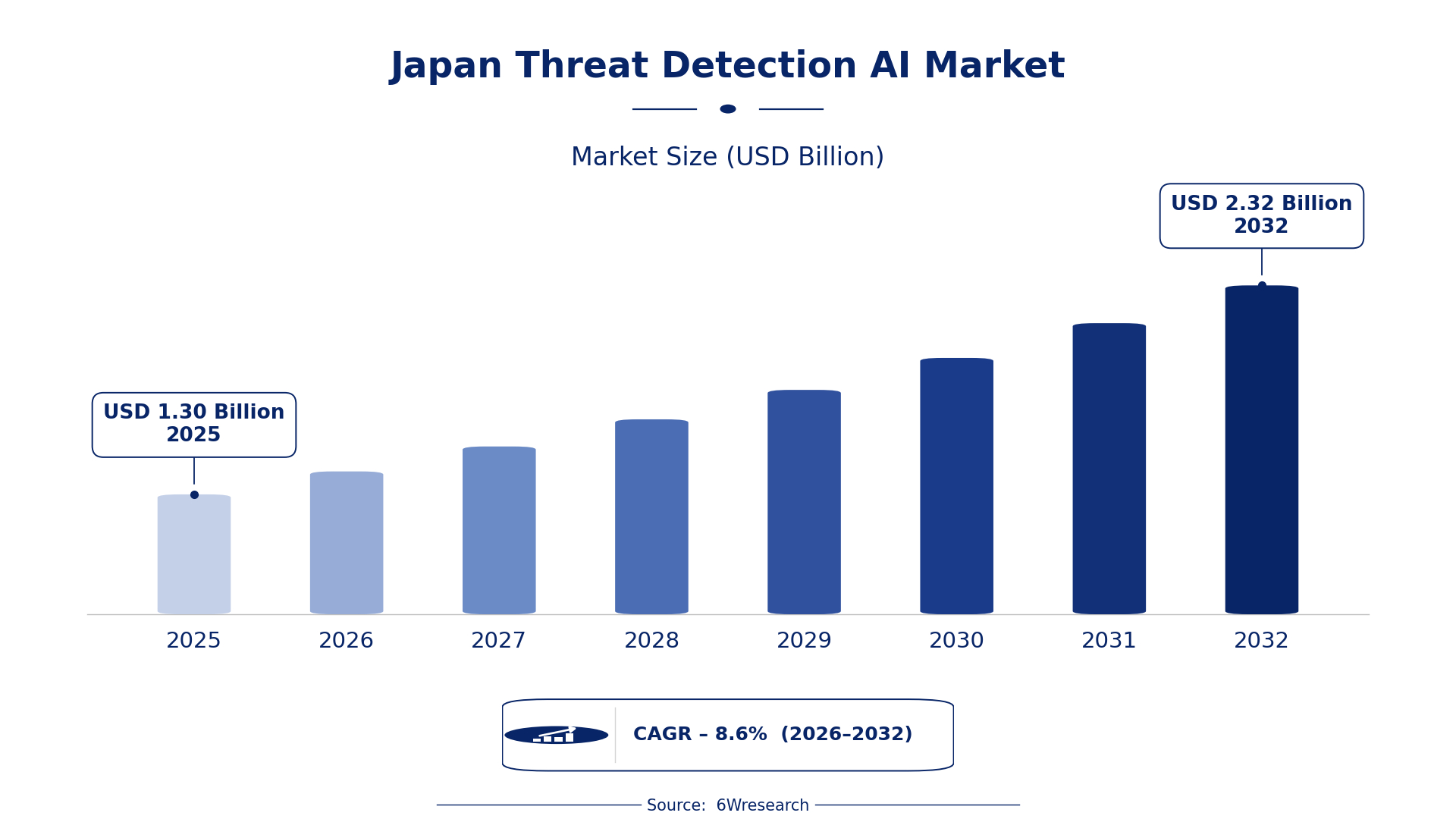
According to 6Wresearch internal database and industry insights, the Japan Threat Detection AI Market was valued at USD 1.30 billion in 2025 and is projected to reach USD 2.32 billion by 2032, growing at a CAGR of approximately 8.6% during 2026–2032.
Japan Threat Detection AI Market Highlights
| Report Metric | Details |
| Report Name | Japan Threat Detection AI Market |
| Market Size 2025 | USD 1.30 billion |
| Market Size 2032 | USD 2.32 billion |
| Absolute Growth 2025–2032 | USD 1.02 billion |
| CAGR 2026–2032 | 8.6% |
| Peak Annual Growth | 10.9% in 2028 |
| Forecast Period | 2026–2032 |
| Historical Data | 2022–2025 |
| Base Year | 2025 |
| Leading Detection Type, 2025 | Malware Detection (49% share) |
| Leading AI Technique Used, 2025 | Machine Learning (34% share) |
| Leading Deployment Mode, 2025 | Cloud-Based (36% share) |
| Leading End User, 2025 | IT Security Teams (45% share) |
| Fastest-Growing Detection Type | Phishing Threats (11.3% CAGR) |
| Fastest-Growing AI Technique Used | Anomaly Detection AI (9.8% CAGR) |
| Fastest-Growing End User | Fintech Companies (10.2% CAGR) |
| Growing Sector | Fintech Companies |
| Key End Users | IT Security Teams, Enterprises, Fintech Companies, Government Agencies |
Japan Threat Detection AI Market Year-wise Growth Rate and Key Drivers (2022–2032)
This graph illustrates the annual growth rates of the market from 2022 to 2032, highlighting a steady upward trajectory and projected market expansion over the forecast period.
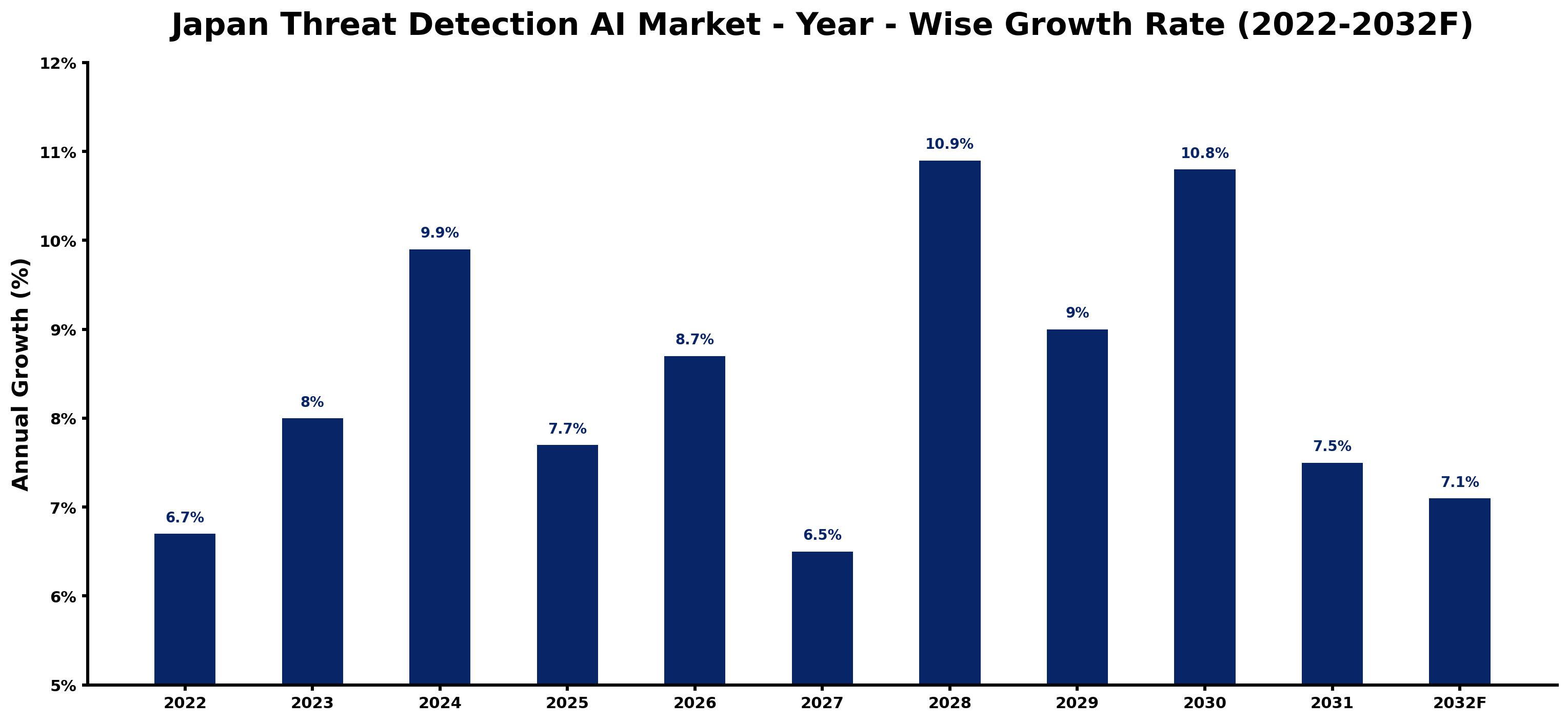
Year by year, the estimates below pair each growth rate with the development that shaped it.
| Year | Estimated Annual Growth (%) | Market Rationale |
| 2022 | 6.7 | The number of reported cyber incidents in Japan increased, indicating a growing need for threat detection solutions. |
| 2023 | 8.0 | Investment in cybersecurity measures accelerated as firms sought to strengthen their protection against rising cyber threats. |
| 2024 | 9.9 | The implementation of the Cybersecurity Strategy prompted increased spending on threat detection technologies across various sectors. |
| 2025 | 7.7 | A slowdown in growth occurred as firms adjusted to previous investments in technology and security measures. |
| 2026 | 8.7 | Demand for advanced threat detection systems is expected to rise as organizations seek to comply with new regulatory standards. |
| 2027 | 6.5 | A slowdown in growth is projected as the market begins to stabilise after rapid expansion in previous years. |
| 2028 | 10.9 | The introduction of new cybersecurity initiatives is expected to drive a surge in demand for threat detection AI solutions. |
| 2029 | 9.0 | Growth is projected to slow as the market matures and firms focus on optimising existing systems rather than new purchases. |
| 2030 | 10.8 | Demand for threat detection AI is expected to increase as organizations adopt more sophisticated cybersecurity measures. |
| 2031 | 7.5 | A slowdown in growth is projected as the market reaches a more stable phase of development. |
| 2032 | 7.1 | Demand remains strong as continuous cyber threats prompt ongoing investments in threat detection technologies. |
Note: Market size estimations and growth projections presented in this report are based on 6Wresearch's proprietary forecasting methodology, utilizing the latest available industry data, government publications, and primary research inputs.
Japan Threat Detection AI Market Synopsis
Threat Detection AI in Japan includes technologies designed to identify and address security threats in digital environments. This technology utilises algorithms developed through machine learning and data analytics to protect sensitive information and avert cyberattacks. The market is expanding due to increased investment in cybersecurity solutions, especially from the finance and government sectors, which are reacting to a 20% rise in reported cyber incidents in 2022. The government allocated ¥50 billion for cybersecurity initiatives in 2023, further boosting demand.
Market Dynamics Impact Analysis (2026–2032)
| Factor | Type | Impact | Primary Segment Affected |
| Increased investment in cybersecurity solutions | Driver | High | Malware Detection |
| Growing number of cyber incidents reported annually | Driver | High | Intrusion Detection |
| Rising demand for compliance with security regulations | Opportunity | High | Phishing Threats |
| Expansion of cybersecurity firms in urban centres | Opportunity | High | IT Security Teams |
| Shortage of skilled cybersecurity professionals | Restraint | High | Fintech Companies |
| High costs associated with implementing advanced systems | Restraint | Medium | Government Agencies |
| Rapid technological advancements in cybersecurity | Challenge | High | Enterprises |
| Evolving nature of cyber threats requiring constant updates | Challenge | Medium | IT Security Teams |
Evaluation of Drivers in Japan Threat Detection AI Market (2026–2032)
The table below links each growth driver to the segment it affects and the evidence for it.
| Drivers | Primary Segment Affected | Why It Matters (Evidence) |
| Increased investment in cybersecurity solutions | Malware Detection | The financial services sector is investing heavily in malware detection, with spending reaching over ¥20 billion in 2022. |
| Rising number of cyber incidents | Intrusion Detection | The increase in reported incidents, with a 20% rise in 2022, has led to higher demand for intrusion detection systems. |
| Compliance with security regulations | Phishing Threats | The Financial Services Agency mandates cybersecurity measures, driving demand for phishing threat detection technologies. |
| Expansion of cybersecurity firms | IT Security Teams | The presence of over 200 cybersecurity firms in Tokyo creates a competitive environment that boosts demand for threat detection solutions. |
| Growing awareness of cyber threats | Fintech Companies | With the installed base of threat detection systems exceeding 5 million units, fintech companies are prioritising cybersecurity investments. |
The Threat Detection AI market in Japan is expanding as end-use demand from sectors like finance and government increases. The number of reported cyber incidents rose by 20% in 2022, prompting firms to invest heavily in malware detection solutions. In 2023, spending on cybersecurity initiatives reached ¥50 billion, reflecting the urgency for effective intrusion detection systems. The rise in regulations is driving demand for phishing threat detection technologies. A vibrant cybersecurity environment, with over 200 firms in Tokyo, supports the market's growth potential.
Evaluation of Restraints in Japan Threat Detection AI Market
The key brakes on demand, and where they bite hardest, are shown below.
| Market Restraint | Primary Segment Affected | Why It Matters (Evidence) |
| Shortage of skilled cybersecurity professionals | Fintech Companies | The number of cybersecurity professionals in Japan is expected to reach only 500,000 by 2025, limiting capacity for growth. |
| High costs of implementing advanced systems | Government Agencies | Government agencies face budget constraints, making it difficult to allocate sufficient funds for advanced threat detection technologies. |
| Complexity of integrating new technologies | Enterprises | Enterprises struggle with the integration of new threat detection systems into existing IT infrastructure, delaying implementation. |
| Regulatory compliance challenges | IT Security Teams | Compliance with various cybersecurity regulations can be cumbersome and costly for IT security teams, hindering adoption. |
| Rapidly evolving cyber threats | Phishing Threats | The constantly changing nature of cyber threats makes it challenging for companies to keep their systems updated and effective. |
Japan Threat Detection AI Market Challenges
Buyers in the Japan Threat Detection AI market face significant technological challenges as many existing systems struggle to keep pace with evolving cyber threats. This technology gap can expose financial institutions to substantial risks, potentially resulting in millions of yen lost due to the 20% increase in reported cyber incidents in 2022. High costs associated with system upgrades hinder many organizations, with initial investments often exceeding ¥10 million. A shortage of skilled professionals complicates matters, as the cybersecurity workforce is projected to reach only 500,000 by 2025, delaying critical implementations. Supply chain issues arise from reliance on a limited number of local technology providers, restricting timely access to essential threat detection solutions for buyers.
Trends in the Japan Threat Detection AI Market
Several trends are reshaping the Japan Threat Detection AI Market; the most important are set out below.
- Shift from On-Premise to Cloud-Based Solutions: In 2023, over 36% of threat detection systems were cloud-based, reflecting a shift towards scalable solutions. This trend is driven by the need for flexibility and cost-effectiveness in cybersecurity.
- Emergence of Anomaly Detection AI: Anomaly Detection AI has gained traction since 2022, with a projected CAGR of 9.8% through 2032. This shift highlights the growing importance of identifying unusual patterns in data for effective threat detection.
- Increased Focus on Compliance Standards: The adoption of ISO/IEC 27001 has accelerated since 2021, with many organizations seeking certification to strengthen their security posture. This trend is vital for meeting regulatory requirements in Japan.
- Growth of Cybersecurity Promotion Programs: The Tokyo Metropolitan Government's Cybersecurity Promotion Program, initiated in 2021, has led to increased collaboration among firms. This initiative has resulted in a 15% rise in cybersecurity investments in the region.
Investment Opportunities in the Japan Threat Detection AI Market
Several openings in the Japan Threat Detection AI Market merit attention from investors.
- Timing for Investment in Cybersecurity: With the number of reported cyber incidents rising by 20% in 2022, there is a pressing need for advanced threat detection solutions. Investing in these technologies can benefit IT security teams across various sectors.
- Expansion in Tokyo's Cybersecurity Market: Tokyo, housing over 200 cybersecurity firms, presents a prime opportunity for investment in threat detection technologies. Local partnerships can facilitate market entry and strengthen service offerings.
- Government Agencies Seeking Compliance Solutions: As government agencies face increasing regulatory pressures, the demand for compliant threat detection systems is growing. Suppliers can enter this market by aligning their products with ISO/IEC 27001 standards.
- Fintech Companies' Growing Security Needs: With fintech companies prioritising cybersecurity, there is a significant opportunity to supply advanced threat detection solutions. Collaborating with local firms can strengthen market penetration.
Government Initiatives in the Japan Threat Detection AI Market
The Digital Agency, established in September 2021, leads government digital transformation and sets common system standards. This measure updates the existing framework provided by the Industrial Standardization Act, which governs product and test standards. By establishing clear guidelines, the Digital Agency promotes the adoption of effective threat detection technologies across various sectors, facilitating compliance with regulations and improving security measures.
Government agencies, particularly in the financial sector, utilise the Cybersecurity Strategy launched in 2021 to strengthen their security measures. This strategy allocates ¥50 billion for cybersecurity initiatives, enabling agencies to invest in advanced threat detection systems and improve their overall security posture.
Future Insight of the Japan Threat Detection AI Market
The Japan Threat Detection AI market is set to transform by 2032, influenced by proactive government initiatives and evolving industry standards. The Ministry of Internal Affairs and Communications' Cybersecurity Strategy will enhance national security and stimulate innovation. The Cybersecurity Promotion Program from the Tokyo Metropolitan Government will strengthen local cybersecurity capabilities, fostering collaboration among firms. With over 5 million threat detection systems currently deployed, the integration of advanced analytics will improve threat mitigation, ensuring enhanced protection for sensitive data across various sectors.
Market Segmentation Analysis
The report offers a comprehensive study of the following market segments and their leading categories in the market.
By Detection Type – Malware Detection Dominated, Phishing Threats Expected to Grow Fastest
According to Vasudha, AM at 6Wresearch, in 2025, Malware Detection led the detection type split with a 49% share. Malware Detection dominates the market share due to its crucial role in identifying widespread malicious software threats in Japan's digital landscape. The installed base of over 5 million threat detection systems exemplifies its importance in safeguarding sensitive information across various sectors. The quickest growth will come from Phishing Threats, forecast to expand at a CAGR of 11.3% between 2026 and 2032. Phishing Threats is rapidly growing as cybercriminals increasingly target users with deceptive online schemes, leading to heightened demand for protective measures. The 20% rise in reported cyber incidents in 2022 highlights the urgent need for enhanced security against these evolving threats. Suppliers should focus on developing solutions specifically targeting phishing threats to align with the increasing demand from users.
By AI Technique Used – Machine Learning Dominated, Anomaly Detection AI Expected to Grow Fastest
Machine Learning took a 34% share of ai technique used in 2025, more than any other category. Machine Learning holds the largest market share as it serves as the foundational technology for effective threat detection algorithms, enabling accurate identification of potential security risks. Its widespread application in critical sectors like finance and government underscores its essential role in enhancing Japan's cybersecurity capabilities. Anomaly Detection AI is set to record the highest CAGR in this split, 9.8% over 2026–2032. Anomaly Detection AI is experiencing rapid growth because it is vital for identifying unusual data patterns, which are key to uncovering sophisticated security threats. With an anticipated increase in cybersecurity professionals to 500,000 by 2025, the demand for advanced detection techniques is set to rise significantly. Buyers should prioritise solutions that leverage anomaly detection to effectively mitigate emerging threats.
By Deployment Mode – Cloud-Based Dominated and Is Expected to Record the Fastest Growth
The largest deployment mode category in 2025 was Cloud-Based, with a 36% share of total revenue. Cloud-Based deployment leads the market share owing to its scalability and flexibility, making it the preferred choice for organisations looking to enhance their cybersecurity measures. This deployment model allows for easier updates and integration of advanced threat detection technologies, which is essential in a rapidly changing threat environment. The same category is also set to grow fastest, at a CAGR of 11.3% during 2026–2032. Cloud-Based deployment is also the fastest-growing segment, as organisations increasingly recognise the benefits of cloud solutions for managing cybersecurity. The ongoing digital transformation across various sectors further propels this growth, ensuring cloud-based services remain at the forefront of the market. Suppliers must tailor their offerings for cloud deployment to seize the opportunities presented by this expanding market.
By End User – IT Security Teams Dominated, Fintech Companies Expected to Grow Fastest
IT Security Teams held a 45% share of the Japan Threat Detection AI Market by end user in 2025. IT Security Teams command the largest market share as they are the primary users of threat detection technologies, responsible for safeguarding organisational assets against cyber threats. Their critical role in implementing cybersecurity measures, especially in sectors like finance, drives the demand for these solutions. Fintech Companies are projected to grow fastest, at a CAGR of 10.2% during 2026–2032. Fintech Companies are the fastest-growing segment, driven by their high need for security in financial transactions and compliance with stringent regulations. The increasing number of cyber incidents in Japan highlights the urgency for fintech firms to adopt advanced threat detection technologies. Suppliers should tailor their solutions to meet the specific needs of fintech companies, capitalising on this growth opportunity.
Key Attractiveness of the Report
- 10 Years of Market Numbers
- Historical Data Starting from 2022 to 2025
- Base Year 2025
- Forecast Data until 2032
- Key Performance Indicators Impacting the Market
- Major Upcoming Developments and Projects
Key Highlights of the Report:
- Japan Threat Detection AI Market Outlook
- Market Size of Japan Threat Detection AI Market, 2025
- Forecast of Japan Threat Detection AI Market, 2032
- Historical Data and Forecast of Japan Threat Detection AI Revenues & Volume for the Period 2022 - 2032F
- Japan Threat Detection AI Market Trend Evolution
- Japan Threat Detection AI Market Drivers and Challenges
- Japan Threat Detection AI Price Trends
- Japan Threat Detection AI Porter's Five Forces
- Japan Threat Detection AI Industry Life Cycle
- Historical Data and Forecast of Japan Threat Detection AI Market Revenues & Volume By Detection Type for the Period 2022 - 2032F
- Historical Data and Forecast of Japan Threat Detection AI Market Revenues & Volume By Malware Detection for the Period 2022 - 2032F
- Historical Data and Forecast of Japan Threat Detection AI Market Revenues & Volume By Intrusion Detection for the Period 2022 - 2032F
- Historical Data and Forecast of Japan Threat Detection AI Market Revenues & Volume By Phishing Threats for the Period 2022 - 2032F
- Historical Data and Forecast of Japan Threat Detection AI Market Revenues & Volume By Insider Threats for the Period 2022 - 2032F
- Historical Data and Forecast of Japan Threat Detection AI Market Revenues & Volume By AI Technique Used for the Period 2022 - 2032F
- Historical Data and Forecast of Japan Threat Detection AI Market Revenues & Volume By Machine Learning for the Period 2022 - 2032F
- Historical Data and Forecast of Japan Threat Detection AI Market Revenues & Volume By Anomaly Detection AI for the Period 2022 - 2032F
- Historical Data and Forecast of Japan Threat Detection AI Market Revenues & Volume By NLP + Classification for the Period 2022 - 2032F
- Historical Data and Forecast of Japan Threat Detection AI Market Revenues & Volume By Behavioral Analytics for the Period 2022 - 2032F
- Historical Data and Forecast of Japan Threat Detection AI Market Revenues & Volume By Deployment Mode for the Period 2022 - 2032F
- Historical Data and Forecast of Japan Threat Detection AI Market Revenues & Volume By Cloud-Based for the Period 2022 - 2032F
- Historical Data and Forecast of Japan Threat Detection AI Market Revenues & Volume By On-Premise for the Period 2022 - 2032F
- Historical Data and Forecast of Japan Threat Detection AI Market Revenues & Volume By Email Systems for the Period 2022 - 2032F
- Historical Data and Forecast of Japan Threat Detection AI Market Revenues & Volume By Hybrid for the Period 2022 - 2032F
- Historical Data and Forecast of Japan Threat Detection AI Market Revenues & Volume By End User for the Period 2022 - 2032F
- Historical Data and Forecast of Japan Threat Detection AI Market Revenues & Volume By IT Security Teams for the Period 2022 - 2032F
- Historical Data and Forecast of Japan Threat Detection AI Market Revenues & Volume By Enterprises for the Period 2022 - 2032F
- Historical Data and Forecast of Japan Threat Detection AI Market Revenues & Volume By Fintech Companies for the Period 2022 - 2032F
- Historical Data and Forecast of Japan Threat Detection AI Market Revenues & Volume By Government Agencies for the Period 2022 - 2032F
- Japan Threat Detection AI Import Export Trade Statistics
- Market Opportunity Assessment By Detection Type
- Market Opportunity Assessment By AI Technique Used
- Market Opportunity Assessment By Deployment Mode
- Market Opportunity Assessment By End User
- Japan Threat Detection AI Top Companies Market Share
- Japan Threat Detection AI Competitive Benchmarking By Technical and Operational Parameters
- Japan Threat Detection AI Company Profiles
- Japan Threat Detection AI Key Strategic Recommendations
Market Covered
The report offers an extensive study of the following market segments.
By Detection Type
- Malware Detection
- Intrusion Detection
- Phishing Threats
- Insider Threats
By AI Technique Used
- Machine Learning
- Anomaly Detection AI
- NLP + Classification
- Behavioral Analytics
By Deployment Mode
- Cloud-Based
- On-Premise
- Email Systems
- Hybrid
By End User
- IT Security Teams
- Enterprises
- Fintech Companies
- Government Agencies































