Philippines Threat Detection AI Market Size & Growth Rate
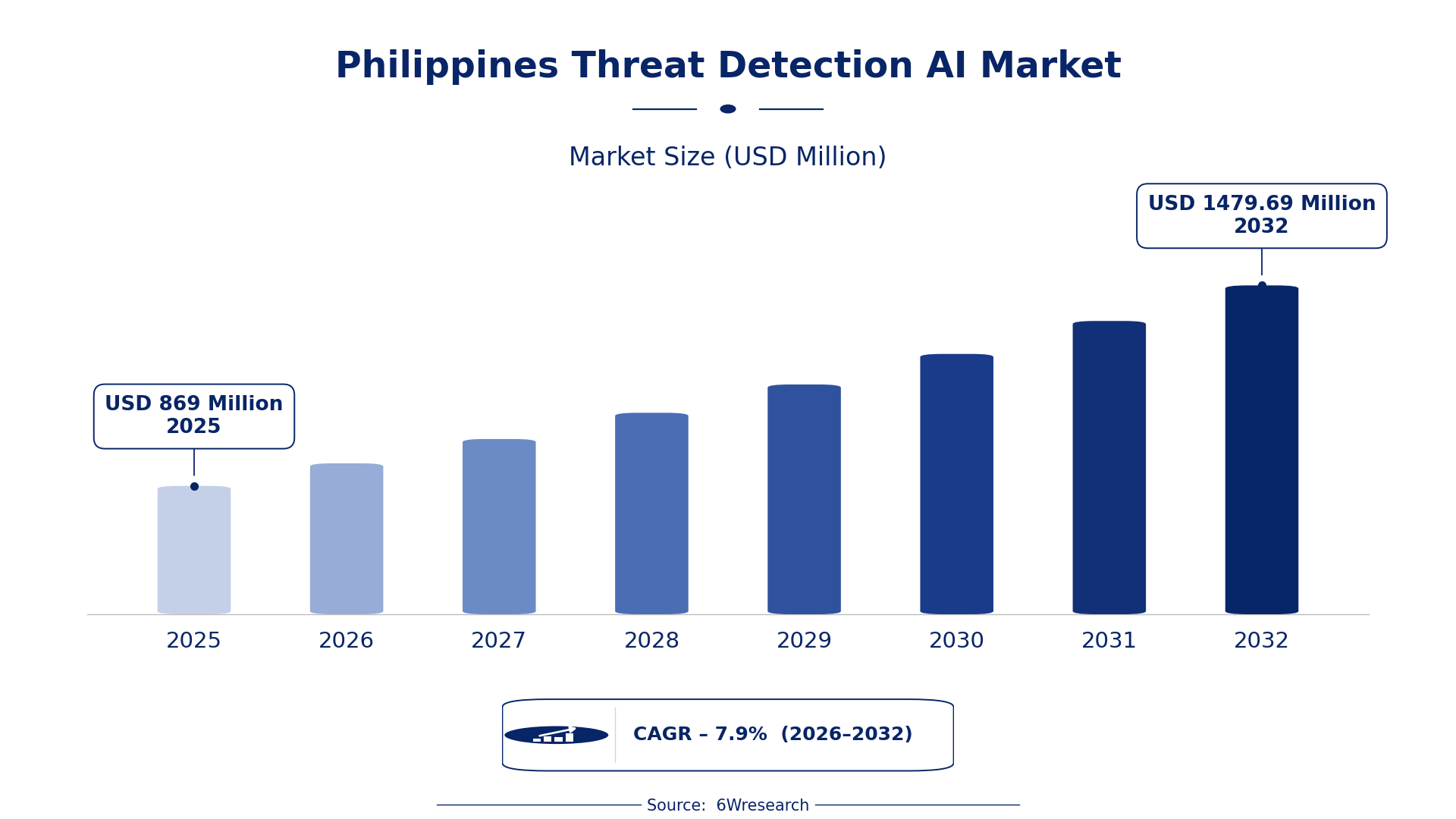
According to 6Wresearch internal database and industry insights, the Philippines Threat Detection AI Market was valued at USD 869.0 million in 2025 and is projected to reach USD 1,479.69 million by 2032, growing at a CAGR of approximately 7.9% during 2026–2032.
Philippines Threat Detection AI Market Highlights
| Report Metric | Details |
| Report Name | Philippines Threat Detection AI Market |
| Market Size 2025 | USD 869.0 million |
| Market Size 2032 | USD 1,479.69 million |
| Absolute Growth 2025–2032 | USD 610.69 million |
| CAGR 2026–2032 | 7.9% |
| Peak Annual Growth | 10.3% in 2027 |
| Forecast Period | 2026–2032 |
| Historical Data | 2022–2025 |
| Base Year | 2025 |
| Leading Detection Type, 2025 | Malware Detection (41% share) |
| Leading AI Technique Used, 2025 | Machine Learning (44% share) |
| Leading Deployment Mode, 2025 | Cloud-Based (40% share) |
| Leading End User, 2025 | IT Security Teams (40% share) |
| Fastest-Growing Detection Type | Intrusion Detection (9.6% CAGR) |
| Fastest-Growing AI Technique Used | Anomaly Detection AI (9.8% CAGR) |
| Fastest-Growing Deployment Mode | On-Premise (10.5% CAGR) |
| Fastest-Growing End User | Enterprises (10.0% CAGR) |
| Growing Sector | IT Security |
| Key End Users | IT Security Teams, Enterprises, Government Agencies, Fintech Companies |
Philippines Threat Detection AI Market Year-wise Growth Rate and Key Drivers (2022–2032)
This graph illustrates the annual growth rates of the market from 2022 to 2032, highlighting a steady upward trajectory and projected market expansion over the forecast period.
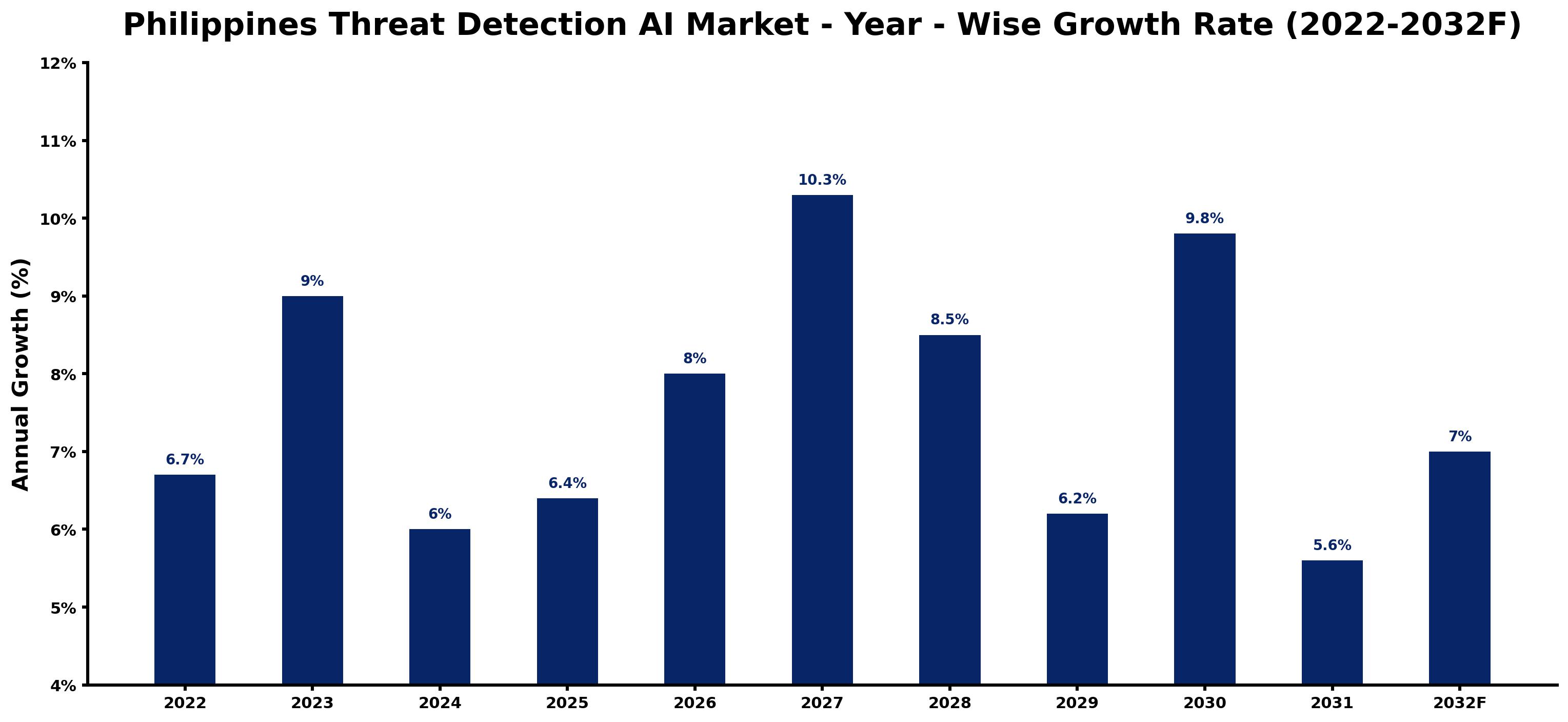
Each row of the following table gives one year's estimated growth and the event or demand shift that explains it.
| Year | Estimated Annual Growth (%) | Market Rationale |
| 2022 | 6.7 | The market experienced steady growth as cybersecurity needs became more apparent, driven by increased awareness among enterprises. |
| 2023 | 9.0 | Increased cybercrime incidents prompted businesses to invest more in threat detection solutions, particularly in the fintech sector. |
| 2024 | 6.0 | Growth slowed slightly as firms adjusted to the new standards set by the National Cybersecurity Plan 2022. |
| 2025 | 6.4 | Demand rose again as the National Cybersecurity Plan 2022 gained traction among enterprises and government agencies. |
| 2026 | 8.0 | The market is expected to see a boost from rising investments in advanced threat detection technologies across sectors. |
| 2027 | 10.3 | Peak growth will be driven by heightened awareness of cybersecurity threats and the need for comprehensive solutions. |
| 2028 | 8.5 | Growth is projected to slow as the market stabilises after rapid expansion in previous years. |
| 2029 | 6.2 | A further slowdown is anticipated as businesses consolidate their cybersecurity investments and focus on efficiency. |
| 2030 | 9.8 | Demand is expected to surge again due to the increasing sophistication of cyber threats and regulatory requirements. |
| 2031 | 5.6 | Growth will decelerate as the market matures and competition intensifies among providers. |
| 2032 | 7.0 | An uptick in demand is expected as new regulations are implemented, encouraging further investment in cybersecurity. |
Note: Market size estimations and growth projections presented in this report are based on 6Wresearch's proprietary forecasting methodology, utilizing the latest available industry data, government publications, and primary research inputs.
Philippines Threat Detection AI Market Synopsis
Threat Detection AI in the Philippines includes technologies that identify and mitigate security threats in digital environments. These solutions employ machine learning algorithms to analyse data patterns, safeguarding sensitive information from cyber threats. The Philippines Threat Detection AI Market is expanding due to the surge in cybercrime incidents and increased investments in cybersecurity solutions. With over 100,000 registered businesses in need of effective protection, demand is driven by government agencies and local enterprises. The implementation of the National Cybersecurity Plan 2022 further supports market growth by establishing a strategic framework for cybersecurity initiatives.
Market Dynamics Impact Analysis (2026–2032)
| Factor | Type | Impact | Primary Segment Affected |
| Rising cybercrime incidents are prompting businesses to invest in advanced security solutions. | Driver | High | Malware Detection |
| Government initiatives are increasing awareness and compliance among enterprises. | Driver | High | Intrusion Detection |
| Increased funding for cybersecurity initiatives creates opportunities for new solutions. | Opportunity | High | Fintech Companies |
| The growth of IT security firms in Metro Manila presents avenues for collaboration. | Opportunity | High | IT Security Teams |
| High costs associated with implementing advanced threat detection systems can deter investment. | Restraint | Medium | Cloud-Based |
| Limited awareness of cybersecurity best practices may hinder widespread adoption. | Restraint | Medium | On-Premise |
| A shortage of skilled cybersecurity professionals affects the implementation of solutions. | Challenge | High | IT Security Teams |
| The complexity of regulatory compliance can delay the deployment of threat detection systems. | Challenge | Medium | Government Agencies |
Evaluation of Drivers in Philippines Threat Detection AI Market (2026–2032)
Below mentioned are some major drivers and their influence on market dynamics.
| Drivers | Primary Segment Affected | Why It Matters (Evidence) |
| Increased investment in cybersecurity solutions by enterprises. | Malware Detection | This investment is motivated by the need to protect sensitive data, with over 100,000 businesses requiring effective solutions. |
| Rising awareness of cyber threats among government agencies. | Fintech Companies | The fintech industry is projected to grow by 20% annually, increasing demand for threat detection solutions. |
| The establishment of the Cybercrime Investigation and Coordination Center. | Government Agencies | This agency enhances threat detection capabilities and promotes cybersecurity initiatives across the country. |
| The average internet penetration rate of 73% increases exposure to cyber threats. | IT Security Teams | Higher internet usage leads to a greater need for effective threat detection solutions. |
| The National Privacy Commission oversees data protection regulations relevant to threat detection AI. | Enterprises | Compliance with these regulations drives businesses to invest in robust threat detection systems. |
Growth across the Threat Detection AI market in the Philippines is anchored in increased investment in cybersecurity solutions, motivated by the need to protect sensitive data. A 30% increase in cybercrime incidents reported in 2023 has further heightened awareness among enterprises. The fintech sector, projected to grow by 20% annually, increasingly relies on threat detection AI to safeguard financial transactions. The establishment of the Cybercrime Investigation and Coordination Center has improved national cybersecurity efforts, compelling IT security teams to adopt more effective protective measures.
Evaluation of Restraints in Philippines Threat Detection AI Market
The table below lists the restraints and the evidence behind each.
| Market Restraint | Primary Segment Affected | Why It Matters (Evidence) |
| High implementation costs of advanced threat detection systems can deter businesses. | Cloud-Based | Many enterprises find the initial investment prohibitive, limiting their adoption of necessary technologies. |
| Limited awareness of cybersecurity best practices hinders widespread adoption of solutions. | On-Premise | Organizations may not fully understand the importance of threat detection, leading to underinvestment. |
| The shortage of skilled cybersecurity professionals affects the implementation of solutions. | IT Security Teams | A lack of qualified personnel can delay the deployment of necessary security measures. |
| Complex regulatory compliance can delay the deployment of threat detection systems. | Government Agencies | Navigating the regulatory framework can slow down the implementation of effective solutions. |
| Market maturity leads to increased competition, impacting profit margins. | Fintech Companies | As more players enter the market, existing firms face pressure to lower prices. |
Philippines Threat Detection AI Market Challenges
The Philippines Threat Detection AI market encounters significant supply chain delays, raising costs for producers as over 100,000 registered businesses urgently require cybersecurity solutions. Regulatory hurdles emerge from strict compliance requirements set by the National Privacy Commission, causing implementation delays for organizations striving to meet standards. Technological advancements lag behind the rapid rise in cyber threats, highlighted by a 30% increase in cybercrime incidents in 2023, leaving many buyers exposed to risks. A lack of skilled cybersecurity professionals complicates recruitment, forcing companies to invest heavily in training, which can extend project timelines and inflate overall costs.
Trends in the Philippines Threat Detection AI Market
Below mentioned are some of the trends shaping the Philippines Threat Detection AI Market growth.
- Shift from On-Premise to Cloud-Based Solutions: The Philippines is transitioning from on-premise threat detection systems to cloud-based solutions. This shift is driven by the need for scalability and flexibility, with 40% of enterprises adopting cloud-based systems by 2025.
- Emergence of Anomaly Detection AI: Anomaly Detection AI is becoming a key focus area, with a projected CAGR of 9.8% from 2026 to 2032. This trend reflects the need for organizations to identify deviations from normal behaviour to enhance security protocols.
- Increased Government Funding for Cybersecurity: In 2023, the Philippine government allocated PHP 1 billion for cybersecurity initiatives. This funding aims to improve threat detection capabilities across public and private sectors, reflecting a strong commitment to national security.
- Rising Demand for Cybersecurity Awareness Programs: The Cybersecurity Awareness Program initiated in 2022 is gaining traction, with many businesses participating. This program aims to educate enterprises on threat detection, resulting in better security practices.
Investment Opportunities in the Philippines Threat Detection AI Market
The following opportunities in the Philippines Threat Detection AI Market pair current demand with a clear way in.
- Metro Manila as a Hub for IT Security Firms: Metro Manila is becoming a central hub for IT security firms, with over 100,000 registered businesses needing cybersecurity solutions. This presents opportunities for partnerships and investments in local firms.
- Enterprises Seeking Advanced Threat Detection Solutions: Enterprises are increasingly looking for advanced threat detection solutions to protect their digital assets. With the fintech sector projected to grow by 20% annually, suppliers can tap into this demand.
- Collaboration with Government Agencies: Collaboration with government agencies, such as the Cybercrime Investigation and Coordination Center, offers opportunities for developing tailored solutions. Suppliers can engage through joint ventures or partnerships to meet specific needs.
- Investment in Cybersecurity Training Programs: Investment in cybersecurity training programs is essential as the market matures. By providing training for IT security teams, suppliers can improve the skill set of professionals in the field.
Government Initiatives in the Philippines Threat Detection AI Market
In 2020, the Philippine government approved the Cybersecurity Act, establishing a legal framework for cybersecurity measures. This law mandates compliance with security standards and encourages the adoption of threat detection technologies. The National Cybersecurity Plan 2022, launched by the Department of Information and Communications Technology, strengthens the country's cybersecurity posture by outlining strategic initiatives to improve security across sectors. This combination of regulations and plans aims to ensure that businesses implement effective threat detection systems to safeguard sensitive information.
The Cybercrime Investigation and Coordination Center, established in 2021, plays a crucial role in enhancing cybersecurity measures. This agency coordinates efforts to combat cybercrime and improve threat detection capabilities. The Cybersecurity Awareness Program initiated in 2022 educates businesses on the importance of threat detection, helping them comply with regulations. By funding training and awareness initiatives, the government supports enterprises in adopting necessary cybersecurity measures.
Future Insight of the Philippines Threat Detection AI Market
The Philippines Threat Detection AI market is set to evolve significantly by 2032, driven by the government's PHP 1 billion allocation for cybersecurity initiatives and the introduction of the Cybersecurity Management System to standardise practices. The anticipated growth of the fintech sector will further increase the demand for robust threat detection solutions. The National Cybersecurity Plan 2022 will strengthen the security framework, ensuring better protection for sensitive data. Rising internet penetration will necessitate the development of more advanced threat detection capabilities.
Market Segmentation Analysis
Each segment group is reviewed below, with the leader by share and the fastest grower by CAGR.
By Detection Type – Malware Detection Dominated, Intrusion Detection Expected to Grow Fastest
According to Vasudha, AM at 6Wresearch, Malware Detection held a 41% share of the Philippines Threat Detection AI Market by detection type in 2025. Malware Detection holds the largest share in the Philippines due to its critical role in identifying malicious software, which is a primary concern for many businesses. The rise in ransomware attacks has heightened the focus on malware detection solutions across various sectors. Intrusion Detection is projected to grow fastest, at a CAGR of 9.6% during 2026–2032. Intrusion Detection is experiencing rapid growth as organisations increasingly recognise the need to monitor network traffic for suspicious activities. The Philippine National Police Cybercrime Group reported a 30% increase in cybercrime incidents in 2023, driving demand for these solutions. Suppliers should prioritise developing advanced intrusion detection systems to meet the growing security needs of businesses.
By AI Technique Used – Machine Learning Dominated, Anomaly Detection AI Expected to Grow Fastest
With a 44% revenue share in 2025, Machine Learning was the largest ai technique used category. Machine Learning holds the largest share as it powers the algorithms essential for effective threat detection systems. This technique is particularly vital for the over 100,000 registered businesses in the Philippines that require robust cybersecurity solutions. Over 2026–2032, Anomaly Detection AI is expected to post the fastest growth, at a CAGR of 9.8%. Anomaly Detection AI is growing rapidly because it identifies deviations from normal behaviour, which is critical for timely threat detection. The rise in ransomware attacks has heightened the need for this specific technique, ensuring its continued relevance in the market. Suppliers should focus on developing advanced anomaly detection capabilities to meet the increasing demand for effective cybersecurity solutions.
By Deployment Mode – Cloud-Based Dominated, On-Premise Expected to Grow Fastest
In 2025, Cloud-Based led the deployment mode split with a 40% share. Cloud-Based solutions command the largest market share, offering scalable and flexible options that meet the needs of numerous businesses in the Philippines. This widespread adoption is driven by the convenience and efficiency of cloud services, particularly for over 100,000 registered businesses requiring cybersecurity solutions. The quickest growth will come from On-Premise, forecast to expand at a CAGR of 10.5% between 2026 and 2032. On-Premise deployment is growing rapidly as some organisations seek local installations for greater control over their security measures. This trend is influenced by the necessity for compliance with stringent data protection regulations enforced by the National Privacy Commission. Suppliers should explore the development of customised on-premise solutions to meet the specific demands of certain enterprises.
By End User – IT Security Teams Dominated, Enterprises Expected to Grow Fastest
IT Security Teams accounted for a 40% market share by end user in 2025. IT Security Teams represent the largest share as they are the primary users of threat detection AI, directly utilising these technologies for monitoring and response. Their critical role in safeguarding digital assets makes them a focal point for cybersecurity investments. Enterprises are set to record the highest CAGR in this split, 10.0% over 2026–2032. Enterprises are rapidly adopting threat detection AI to protect their digital assets, driven by the increasing sophistication of cyber threats. The projected growth of the Fintech industry by 20% annually further fuels this demand. Providers must focus on creating solutions that address the unique security challenges faced by enterprises.
Key Attractiveness of the Report
- 10 Years of Market Numbers
- Historical Data Starting from 2022 to 2025
- Base Year 2025
- Forecast Data until 2032
- Key Performance Indicators Impacting the Market
- Major Upcoming Developments and Projects
Key Highlights of the Report:
- Philippines Threat Detection AI Market Outlook
- Market Size of Philippines Threat Detection AI Market, 2025
- Forecast of Philippines Threat Detection AI Market, 2032
- Historical Data and Forecast of Philippines Threat Detection AI Revenues & Volume for the Period 2022 - 2032F
- Philippines Threat Detection AI Market Trend Evolution
- Philippines Threat Detection AI Market Drivers and Challenges
- Philippines Threat Detection AI Price Trends
- Philippines Threat Detection AI Porter's Five Forces
- Philippines Threat Detection AI Industry Life Cycle
- Historical Data and Forecast of Philippines Threat Detection AI Market Revenues & Volume By Detection Type for the Period 2022 - 2032F
- Historical Data and Forecast of Philippines Threat Detection AI Market Revenues & Volume By Malware Detection for the Period 2022 - 2032F
- Historical Data and Forecast of Philippines Threat Detection AI Market Revenues & Volume By Intrusion Detection for the Period 2022 - 2032F
- Historical Data and Forecast of Philippines Threat Detection AI Market Revenues & Volume By Phishing Threats for the Period 2022 - 2032F
- Historical Data and Forecast of Philippines Threat Detection AI Market Revenues & Volume By Insider Threats for the Period 2022 - 2032F
- Historical Data and Forecast of Philippines Threat Detection AI Market Revenues & Volume By AI Technique Used for the Period 2022 - 2032F
- Historical Data and Forecast of Philippines Threat Detection AI Market Revenues & Volume By Machine Learning for the Period 2022 - 2032F
- Historical Data and Forecast of Philippines Threat Detection AI Market Revenues & Volume By Anomaly Detection AI for the Period 2022 - 2032F
- Historical Data and Forecast of Philippines Threat Detection AI Market Revenues & Volume By NLP + Classification for the Period 2022 - 2032F
- Historical Data and Forecast of Philippines Threat Detection AI Market Revenues & Volume By Behavioral Analytics for the Period 2022 - 2032F
- Historical Data and Forecast of Philippines Threat Detection AI Market Revenues & Volume By Deployment Mode for the Period 2022 - 2032F
- Historical Data and Forecast of Philippines Threat Detection AI Market Revenues & Volume By Cloud-Based for the Period 2022 - 2032F
- Historical Data and Forecast of Philippines Threat Detection AI Market Revenues & Volume By On-Premise for the Period 2022 - 2032F
- Historical Data and Forecast of Philippines Threat Detection AI Market Revenues & Volume By Email Systems for the Period 2022 - 2032F
- Historical Data and Forecast of Philippines Threat Detection AI Market Revenues & Volume By Hybrid for the Period 2022 - 2032F
- Historical Data and Forecast of Philippines Threat Detection AI Market Revenues & Volume By End User for the Period 2022 - 2032F
- Historical Data and Forecast of Philippines Threat Detection AI Market Revenues & Volume By IT Security Teams for the Period 2022 - 2032F
- Historical Data and Forecast of Philippines Threat Detection AI Market Revenues & Volume By Enterprises for the Period 2022 - 2032F
- Historical Data and Forecast of Philippines Threat Detection AI Market Revenues & Volume By Fintech Companies for the Period 2022 - 2032F
- Historical Data and Forecast of Philippines Threat Detection AI Market Revenues & Volume By Government Agencies for the Period 2022 - 2032F
- Philippines Threat Detection AI Import Export Trade Statistics
- Market Opportunity Assessment By Detection Type
- Market Opportunity Assessment By AI Technique Used
- Market Opportunity Assessment By Deployment Mode
- Market Opportunity Assessment By End User
- Philippines Threat Detection AI Top Companies Market Share
- Philippines Threat Detection AI Competitive Benchmarking By Technical and Operational Parameters
- Philippines Threat Detection AI Company Profiles
- Philippines Threat Detection AI Key Strategic Recommendations
Market Covered
The report offers an extensive study of the following market segments.
By Detection Type
- Malware Detection
- Intrusion Detection
- Phishing Threats
- Insider Threats
By AI Technique Used
- Machine Learning
- Anomaly Detection AI
- NLP + Classification
- Behavioral Analytics
By Deployment Mode
- Cloud-Based
- On-Premise
- Email Systems
- Hybrid
By End User
- IT Security Teams
- Enterprises
- Fintech Companies
- Government Agencies































