Qatar Threat Detection AI Market Size & Growth Rate
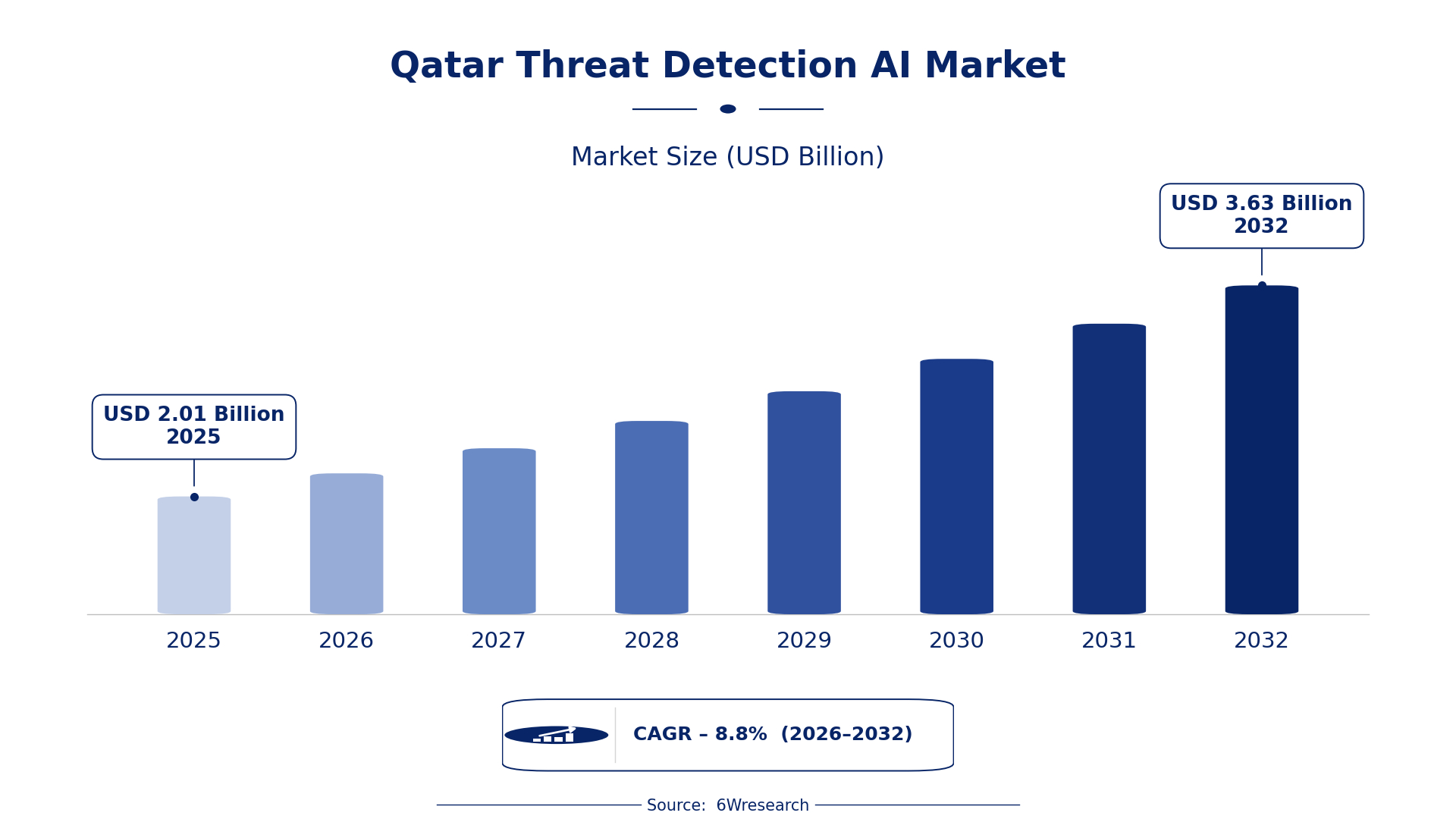
According to 6Wresearch internal database and industry insights, the Qatar Threat Detection AI Market was valued at USD 2.01 billion in 2025 and is projected to reach USD 3.63 billion by 2032, growing at a CAGR of approximately 8.8% during 2026–2032.
Qatar Threat Detection AI Market Highlights
| Report Metric | Details |
| Report Name | Qatar Threat Detection AI Market |
| Market Size 2025 | USD 2.01 billion |
| Market Size 2032 | USD 3.63 billion |
| Absolute Growth 2025–2032 | USD 1.62 billion |
| CAGR 2026–2032 | 8.8% |
| Peak Annual Growth | 11.2% in 2029 |
| Forecast Period | 2026–2032 |
| Historical Data | 2022–2025 |
| Base Year | 2025 |
| Leading Detection Type, 2025 | Malware Detection (40% share) |
| Leading AI Technique Used, 2025 | Machine Learning (39% share) |
| Leading Deployment Mode, 2025 | Cloud-Based (45% share) |
| Leading End User, 2025 | IT Security Teams (39% share) |
| Fastest-Growing Detection Type | Intrusion Detection (11.3% CAGR) |
| Fastest-Growing AI Technique Used | Anomaly Detection AI (11.3% CAGR) |
| Fastest-Growing Deployment Mode | On-Premise (11.1% CAGR) |
| Fastest-Growing End User | Enterprises (10.3% CAGR) |
| Growing Sector | Cybersecurity |
| Key End Users | IT Security Teams, Government Agencies, Fintech Companies, Enterprises |
Qatar Threat Detection AI Market Year-wise Growth Rate and Key Drivers (2022–2032)
This graph illustrates the annual growth rates of the market from 2022 to 2032, highlighting a steady upward trajectory and projected market expansion over the forecast period.
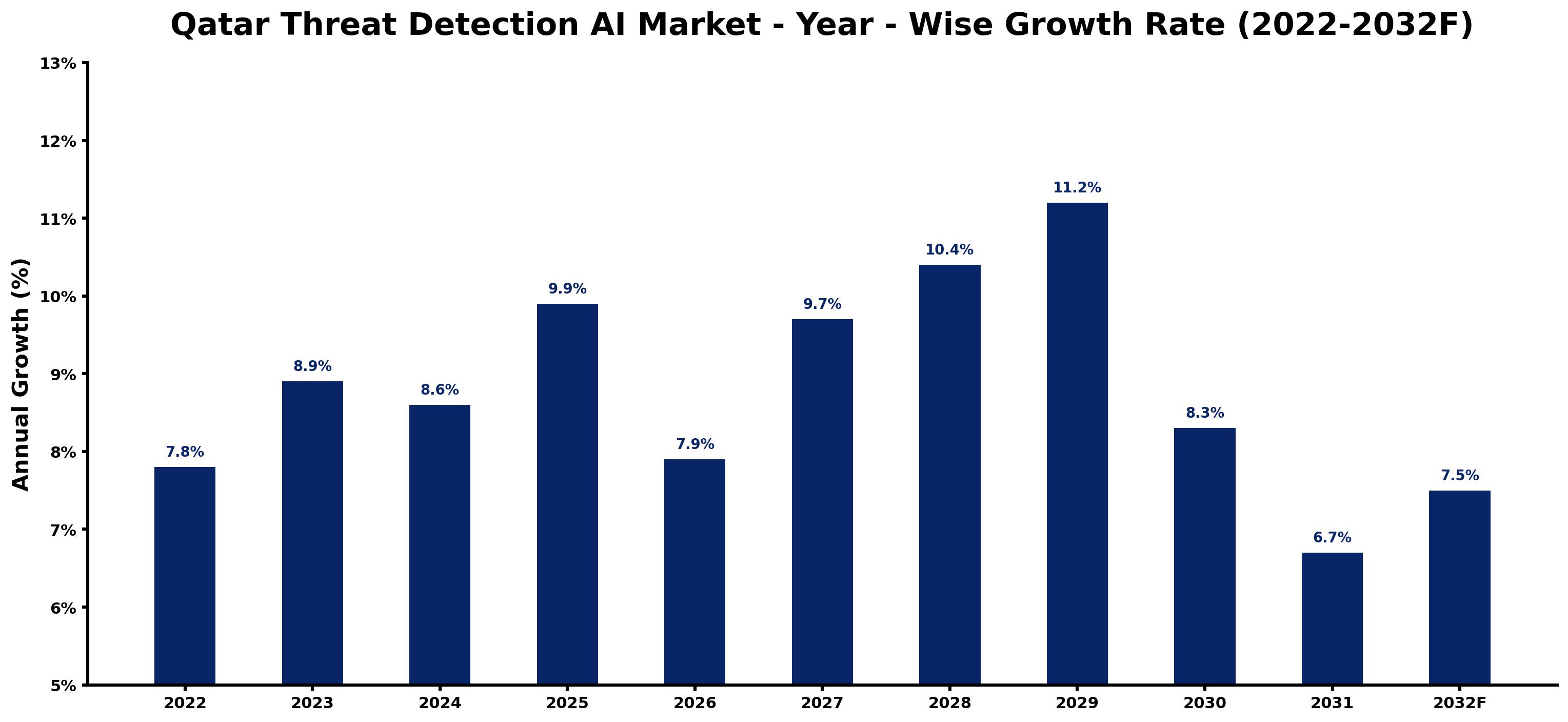
Below, each year's estimated growth is shown next to the factor that most influenced it.
| Year | Estimated Annual Growth (%) | Market Rationale |
| 2022 | 7.8 | The market experienced steady growth due to increasing cybersecurity needs in various sectors. |
| 2023 | 8.9 | Demand for threat detection solutions accelerated, driven by heightened awareness of cyber threats. |
| 2024 | 8.6 | Growth slowed slightly as organizations adjusted their cybersecurity strategies amidst evolving threats. |
| 2025 | 9.9 | The market peaked with significant investments in advanced threat detection technologies and strategies. |
| 2026 | 7.9 | A slight slowdown occurred as companies evaluated their cybersecurity investments and strategies. |
| 2027 | 9.7 | Demand surged again as organizations prioritized robust security measures against rising cyber threats. |
| 2028 | 10.4 | The market continued to grow as more enterprises adopted advanced threat detection solutions. |
| 2029 | 11.2 | Peak growth was achieved as national initiatives further stimulated investment in cybersecurity. |
| 2030 | 8.3 | A slowdown was noted as organizations reassessed their cybersecurity budgets and strategies. |
| 2031 | 6.7 | Growth decelerated as the market matured, with a focus on optimizing existing solutions. |
| 2032 | 7.5 | The market rebounded with renewed investments in advanced threat detection technologies. |
Note: Market size estimations and growth projections presented in this report are based on 6Wresearch's proprietary forecasting methodology, utilizing the latest available industry data, government publications, and primary research inputs.
Qatar Threat Detection AI Market Synopsis
Threat Detection AI in Qatar includes technologies that identify and respond to security threats in digital environments. These systems use algorithms and machine learning to safeguard sensitive information across enterprises and government agencies. The Qatar Threat Detection AI Market is growing due to rising cyber threats and substantial government initiatives. The National Cybersecurity Strategy, launched in 2021, has spurred demand for advanced solutions. In addition, the Cybersecurity Agency's efforts to improve national security have further encouraged investments in this sector.
Market Dynamics Impact Analysis (2026–2032)
| Factor | Type | Impact | Primary Segment Affected |
| Increasing cyber threats necessitate advanced security measures. | Driver | High | Malware Detection |
| Government initiatives promote cybersecurity awareness and technology adoption. | Driver | High | Intrusion Detection |
| Growing demand for cybersecurity solutions in the financial sector. | Opportunity | High | Fintech Companies |
| Rising investments in cybersecurity workforce development programs. | Opportunity | Medium | Government Agencies |
| High costs associated with implementing advanced threat detection solutions. | Restraint | High | IT Security Teams |
| Limited availability of skilled cybersecurity professionals hampers growth. | Restraint | Medium | Enterprises |
| Evolving cyber threats require constant updates to detection technologies. | Challenge | High | Government Agencies |
| Regulatory compliance requirements can complicate technology adoption. | Challenge | Medium | Fintech Companies |
Evaluation of Drivers in Qatar Threat Detection AI Market (2026–2032)
Key forces behind demand, with the segment each one moves most, are listed below.
| Drivers | Primary Segment Affected | Why It Matters (Evidence) |
| Rising cyber threats drive demand for effective malware detection solutions. | Malware Detection | The increasing number of cyber attacks has led enterprises to invest heavily in malware detection technologies. |
| Financial regulations require stringent cybersecurity measures. | Fintech Companies | The heavily regulated financial sector mandates effective threat detection solutions to protect sensitive data. |
| Growing awareness of cybersecurity risks among enterprises. | IT Security Teams | Organizations are prioritizing investments in threat detection technologies to safeguard their operations. |
| Government initiatives promote the adoption of advanced intrusion detection systems. | Intrusion Detection | The National Cybersecurity Strategy encourages organizations to enhance their cybersecurity infrastructure. |
| The Cybersecurity Workforce Development Program is creating a skilled workforce. | Government Agencies | Training initiatives are increasing the availability of professionals in the cybersecurity field. |
The Threat Detection AI market in Qatar is growing on the back of rising cyber threats, government initiatives, and increasing awareness among enterprises. The demand for malware detection solutions surged as cyber attacks became more frequent, prompting organizations to invest heavily in protective technologies. The National Cybersecurity Strategy is driving the adoption of advanced intrusion detection systems, while stringent financial regulations compel fintech companies to implement effective threat detection measures. Investments in the Cybersecurity Workforce Development Program are also creating a skilled workforce, which increases demand for these technologies. In 2023, the market is projected to reach USD 2.01 billion, reflecting the growing emphasis on cybersecurity across various sectors.
Evaluation of Restraints in Qatar Threat Detection AI Market
The following restraints limit how fast demand can grow.
| Market Restraint | Primary Segment Affected | Why It Matters (Evidence) |
| High costs of implementing advanced threat detection solutions limit adoption. | Malware Detection | The financial burden of deploying sophisticated technologies can deter organizations from investing in necessary solutions. |
| Shortage of skilled cybersecurity professionals hampers effective implementation. | Intrusion Detection | Limited availability of trained personnel can slow down the adoption of advanced intrusion detection systems. |
| Regulatory compliance requirements complicate technology integration. | Fintech Companies | Strict regulations may hinder the speed at which fintech companies can adopt new threat detection technologies. |
| Evolving cyber threats require constant updates to detection technologies. | IT Security Teams | The rapid pace of cyber threats necessitates ongoing investments, which can strain budgets. |
| Complexity of integrating new technologies with existing systems. | Government Agencies | Challenges in compatibility can delay the adoption of advanced threat detection solutions. |
Qatar Threat Detection AI Market Challenges
The Qatar Threat Detection AI market encounters a major technology hurdle, as many current systems struggle to keep pace with the evolving nature of cyber threats, putting both public and private sector buyers at risk. Intense competition exists, with numerous local and international players vying for market share, which can dilute solution quality and confuse buyers seeking reliable options. A shortage of skilled cybersecurity professionals is apparent, as the demand for expertise outstrips supply, resulting in project delays for companies looking to bolster their security frameworks. Supply chain challenges arise, as dependence on imported technologies can inflate costs and prolong delivery times for producers in the market.
Trends in the Qatar Threat Detection AI Market
The trends below show where the Qatar Threat Detection AI Market is heading.
- Shift from On-Premise to Cloud-Based Solutions: IT Security Teams in Qatar are increasingly adopting cloud-based threat detection solutions for their scalability. In 2023, cloud-based systems accounted for 45% of the market, reflecting a shift in deployment preferences.
- Growing Focus on Anomaly Detection AI: Enterprises are prioritising anomaly detection AI to identify unusual patterns in data. This trend is clear as the segment is projected to grow at a CAGR of 11.3% from 2026 to 2032, driven by rising cyber threats.
- Increased Investment in Cybersecurity Workforce Development: The Cybersecurity Workforce Development Program aims to train 1,000 professionals by 2025. This initiative reflects a growing emphasis on building a skilled workforce to tackle cybersecurity challenges in Qatar.
- Expansion of Cybersecurity Regulations in the Financial Sector: The Qatar Financial Centre has introduced specific guidelines for cybersecurity in financial services. These regulations ensure that fintech companies adopt strict cybersecurity measures to protect sensitive data.
Investment Opportunities in the Qatar Threat Detection AI Market
Below are the investment opportunities with the strongest case in the Qatar Threat Detection AI Market.
- Investment in Advanced Threat Detection Solutions: The demand for advanced threat detection solutions is rising, with a projected market size of USD 3.63 billion by 2032. Enterprises are seeking effective solutions to safeguard sensitive information, presenting an opportunity for suppliers.
- Supply of Cybersecurity Training Programs: With the Cybersecurity Workforce Development Program aiming to train 1,000 professionals, there is a notable gap in skilled labour. Investing in training programs can help meet this demand and enhance workforce capabilities.
- Partnerships with Government Agencies: Collaborating with government agencies can facilitate access to funding for cybersecurity initiatives. The Cybersecurity Agency is actively promoting public-private partnerships to strengthen national security, creating opportunities for investment.
- Development of Compliance Solutions for Fintech Companies: As fintech companies face strict regulations, there is a growing need for compliance solutions. Suppliers can capitalise on this demand by providing tailored solutions that meet regulatory requirements.
Government Initiatives in the Qatar Threat Detection AI Market
The National Cybersecurity Strategy, launched by the Ministry of Interior in 2021, impacts threat detection AI producers and buyers. This strategy aims to strengthen national security and resilience against cyber threats, requiring organisations to adopt advanced technologies. Compliance with this strategy ensures that enterprises and government agencies are better equipped to handle cybersecurity challenges, promoting a safer digital environment. The Cybersecurity Agency, established in 2020, coordinates national cybersecurity efforts and encourages public-private collaboration, improving the effectiveness of threat detection solutions.
In 2023, the Ministry of Transport and Communications announced a budget of QAR 50 million for cybersecurity awareness programs. The Cybersecurity Agency oversees these initiatives, promoting public-private collaboration and funding projects that enhance national cybersecurity capabilities. This funding supports the development and implementation of advanced threat detection solutions across various sectors.
Future Insight of the Qatar Threat Detection AI Market
The Qatar Threat Detection AI market is set for transformation by 2032, driven by the execution of the National Cybersecurity Strategy that aims to strengthen national defences. Educational programs will cultivate a skilled workforce, enabling suppliers to deliver more advanced solutions. The growing adoption of ISO/IEC 27001 standards will improve the quality and security of threat detection technologies. By 2032, government agencies are expected to invest over QAR 1 billion in protecting critical infrastructure, creating robust demand for advanced threat detection solutions.
Market Segmentation Analysis
The analysis below covers each segmentation, its leading category in 2025 and its fastest-growing category through 2032.
By Detection Type – Malware Detection Dominated, Intrusion Detection Expected to Grow Fastest
According to Vasudha, AM at 6Wresearch, with a 40% revenue share in 2025, Malware Detection was the largest detection type category. Malware Detection leads the market share due to its critical role in identifying malicious software attacks, which are prevalent in Qatar's digital environment. The increasing frequency of such threats across various sectors reinforces its importance in the cybersecurity framework. Over 2026–2032, Intrusion Detection is expected to post the fastest growth, at a CAGR of 11.3%. Intrusion Detection is growing rapidly as organizations focus on monitoring unauthorized access to networks, particularly in response to rising cyber incidents. The heightened emphasis on protecting critical infrastructure in Qatar significantly drives its adoption. Suppliers should enhance their intrusion detection capabilities to meet the growing demand from organizations aiming to strengthen their network security.
By AI Technique Used – Machine Learning Dominated, Anomaly Detection AI Expected to Grow Fastest
The largest ai technique used category in 2025 was Machine Learning, with a 39% share of total revenue. Machine Learning commands the largest market share as it automates threat detection processes, making it essential for effective cybersecurity strategies. Its widespread application across various sectors in Qatar underscores its vital role in addressing the challenges posed by increasing cyber threats. Anomaly Detection AI is projected to grow fastest, at a CAGR of 11.3% during 2026–2032. Anomaly Detection is witnessing swift growth as it is key to identifying unusual data patterns that may indicate potential threats. The complexity of modern cyber threats necessitates advanced detection methods like anomaly detection to bolster security measures. Buyers should invest in anomaly detection technologies to stay ahead of sophisticated cyber threats and ensure robust protection for their assets.
By Deployment Mode – Cloud-Based Dominated, On-Premise Expected to Grow Fastest
Cloud-Based held a 45% share of the Qatar Threat Detection AI Market by deployment mode in 2025. Cloud-Based deployment holds the largest market share due to its scalability and flexibility, appealing to organizations in Qatar seeking to enhance their cybersecurity frameworks. The ease of access and management provided by cloud solutions contributes to their widespread adoption. On-Premise is set to record the highest CAGR in this split, 11.1% over 2026–2032. On-Premise deployment is experiencing the fastest growth as organizations prioritise data control and security, particularly in sensitive sectors like finance. Strict regulatory requirements in Qatar necessitate strong on-premise solutions to ensure compliance and safeguard critical data. Suppliers should focus on developing tailored on-premise solutions to address the rising demand from enterprises concerned with data sovereignty.
By End User – IT Security Teams Dominated, Enterprises Expected to Grow Fastest
IT Security Teams took a 39% share of end user in 2025, more than any other category. IT Security Teams represent the largest market share as they are the primary users of threat detection technologies, crucial for maintaining security within organizations. Their essential role in implementing effective cybersecurity measures drives the demand for these solutions in Qatar. The quickest growth will come from Enterprises, forecast to expand at a CAGR of 10.3% between 2026 and 2032. Enterprises are the fastest-growing segment as they increasingly acknowledge the necessity for robust security measures to protect their operations from cyber threats. The growing awareness of cybersecurity risks among businesses accelerates this rapid adoption. Suppliers must tailor their offerings to meet the specific needs of enterprises, ensuring comprehensive solutions that effectively address their security challenges.
Key Attractiveness of the Report
- 10 Years of Market Numbers
- Historical Data Starting from 2022 to 2025
- Base Year 2025
- Forecast Data until 2032
- Key Performance Indicators Impacting the Market
- Major Upcoming Developments and Projects
Key Highlights of the Report:
- Qatar Threat Detection AI Market Outlook
- Market Size of Qatar Threat Detection AI Market, 2025
- Forecast of Qatar Threat Detection AI Market, 2032
- Historical Data and Forecast of Qatar Threat Detection AI Revenues & Volume for the Period 2022 - 2032F
- Qatar Threat Detection AI Market Trend Evolution
- Qatar Threat Detection AI Market Drivers and Challenges
- Qatar Threat Detection AI Price Trends
- Qatar Threat Detection AI Porter's Five Forces
- Qatar Threat Detection AI Industry Life Cycle
- Historical Data and Forecast of Qatar Threat Detection AI Market Revenues & Volume By Detection Type for the Period 2022 - 2032F
- Historical Data and Forecast of Qatar Threat Detection AI Market Revenues & Volume By Malware Detection for the Period 2022 - 2032F
- Historical Data and Forecast of Qatar Threat Detection AI Market Revenues & Volume By Intrusion Detection for the Period 2022 - 2032F
- Historical Data and Forecast of Qatar Threat Detection AI Market Revenues & Volume By Phishing Threats for the Period 2022 - 2032F
- Historical Data and Forecast of Qatar Threat Detection AI Market Revenues & Volume By Insider Threats for the Period 2022 - 2032F
- Historical Data and Forecast of Qatar Threat Detection AI Market Revenues & Volume By AI Technique Used for the Period 2022 - 2032F
- Historical Data and Forecast of Qatar Threat Detection AI Market Revenues & Volume By Machine Learning for the Period 2022 - 2032F
- Historical Data and Forecast of Qatar Threat Detection AI Market Revenues & Volume By Anomaly Detection AI for the Period 2022 - 2032F
- Historical Data and Forecast of Qatar Threat Detection AI Market Revenues & Volume By NLP + Classification for the Period 2022 - 2032F
- Historical Data and Forecast of Qatar Threat Detection AI Market Revenues & Volume By Behavioral Analytics for the Period 2022 - 2032F
- Historical Data and Forecast of Qatar Threat Detection AI Market Revenues & Volume By Deployment Mode for the Period 2022 - 2032F
- Historical Data and Forecast of Qatar Threat Detection AI Market Revenues & Volume By Cloud-Based for the Period 2022 - 2032F
- Historical Data and Forecast of Qatar Threat Detection AI Market Revenues & Volume By On-Premise for the Period 2022 - 2032F
- Historical Data and Forecast of Qatar Threat Detection AI Market Revenues & Volume By Email Systems for the Period 2022 - 2032F
- Historical Data and Forecast of Qatar Threat Detection AI Market Revenues & Volume By Hybrid for the Period 2022 - 2032F
- Historical Data and Forecast of Qatar Threat Detection AI Market Revenues & Volume By End User for the Period 2022 - 2032F
- Historical Data and Forecast of Qatar Threat Detection AI Market Revenues & Volume By IT Security Teams for the Period 2022 - 2032F
- Historical Data and Forecast of Qatar Threat Detection AI Market Revenues & Volume By Enterprises for the Period 2022 - 2032F
- Historical Data and Forecast of Qatar Threat Detection AI Market Revenues & Volume By Fintech Companies for the Period 2022 - 2032F
- Historical Data and Forecast of Qatar Threat Detection AI Market Revenues & Volume By Government Agencies for the Period 2022 - 2032F
- Qatar Threat Detection AI Import Export Trade Statistics
- Market Opportunity Assessment By Detection Type
- Market Opportunity Assessment By AI Technique Used
- Market Opportunity Assessment By Deployment Mode
- Market Opportunity Assessment By End User
- Qatar Threat Detection AI Top Companies Market Share
- Qatar Threat Detection AI Competitive Benchmarking By Technical and Operational Parameters
- Qatar Threat Detection AI Company Profiles
- Qatar Threat Detection AI Key Strategic Recommendations
Market Covered
This report examines the market across the segments below.
By Detection Type
- Malware Detection
- Intrusion Detection
- Phishing Threats
- Insider Threats
By AI Technique Used
- Machine Learning
- Anomaly Detection AI
- NLP + Classification
- Behavioral Analytics
By Deployment Mode
- Cloud-Based
- On-Premise
- Email Systems
- Hybrid
By End User
- IT Security Teams
- Enterprises
- Fintech Companies
- Government Agencies































