India Touchless Hygiene Market Size & Growth Rate
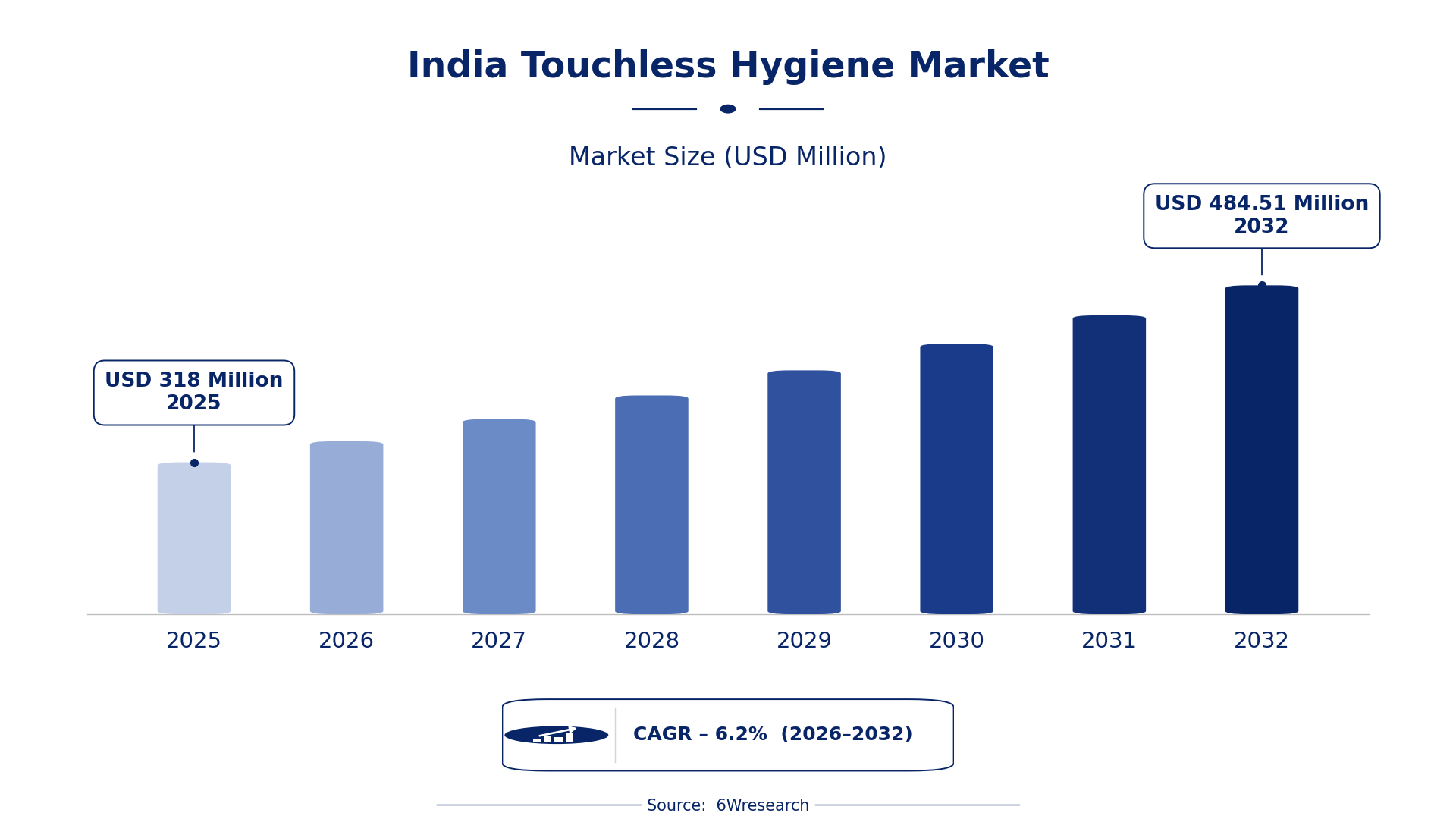
According to 6Wresearch internal database and industry insights, the India Touchless Hygiene Market was valued at USD 318.0 million in 2025 and is projected to reach USD 484.51 million by 2032, growing at a CAGR of approximately 6.2% during 2026–2032.
India Touchless Hygiene Market Highlights
| Report Metric | Details |
| Report Name | India Touchless Hygiene Market |
| Market Size 2025 | USD 318.0 million |
| Market Size 2032 | USD 484.51 million |
| Absolute Growth 2025–2032 | USD 166.51 million |
| CAGR 2026–2032 | 6.2% |
| Peak Annual Growth | 8.3% in 2026 |
| Forecast Period | 2026–2032 |
| Historical Data | 2022–2025 |
| Base Year | 2025 |
| Leading Product Type, 2025 | Sanitizer Dispensers (47% share) |
| Leading Technology Used, 2025 | Motion Sensors (43% share) |
| Leading Use Case, 2025 | Infection Control (38% share) |
| Leading End User, 2025 | Hospitals (55% share) |
| Fastest-Growing Product Type | Touchless Trash Bins (8.0% CAGR) |
| Fastest-Growing Technology Used | Proximity Detection (8.8% CAGR) |
| Fastest-Growing Use Case | Waste Management (8.1% CAGR) |
| Fastest-Growing End User | Clinics (8.2% CAGR) |
| Growing Sector | Healthcare |
| Key End Users | Hospitals, Clinics, Food Service Areas, Healthcare Facilities |
India Touchless Hygiene Market Year-wise Growth Rate and Key Drivers (2022–2032)
This graph illustrates the annual growth rates of the market from 2022 to 2032, highlighting a steady upward trajectory and projected market expansion over the forecast period.
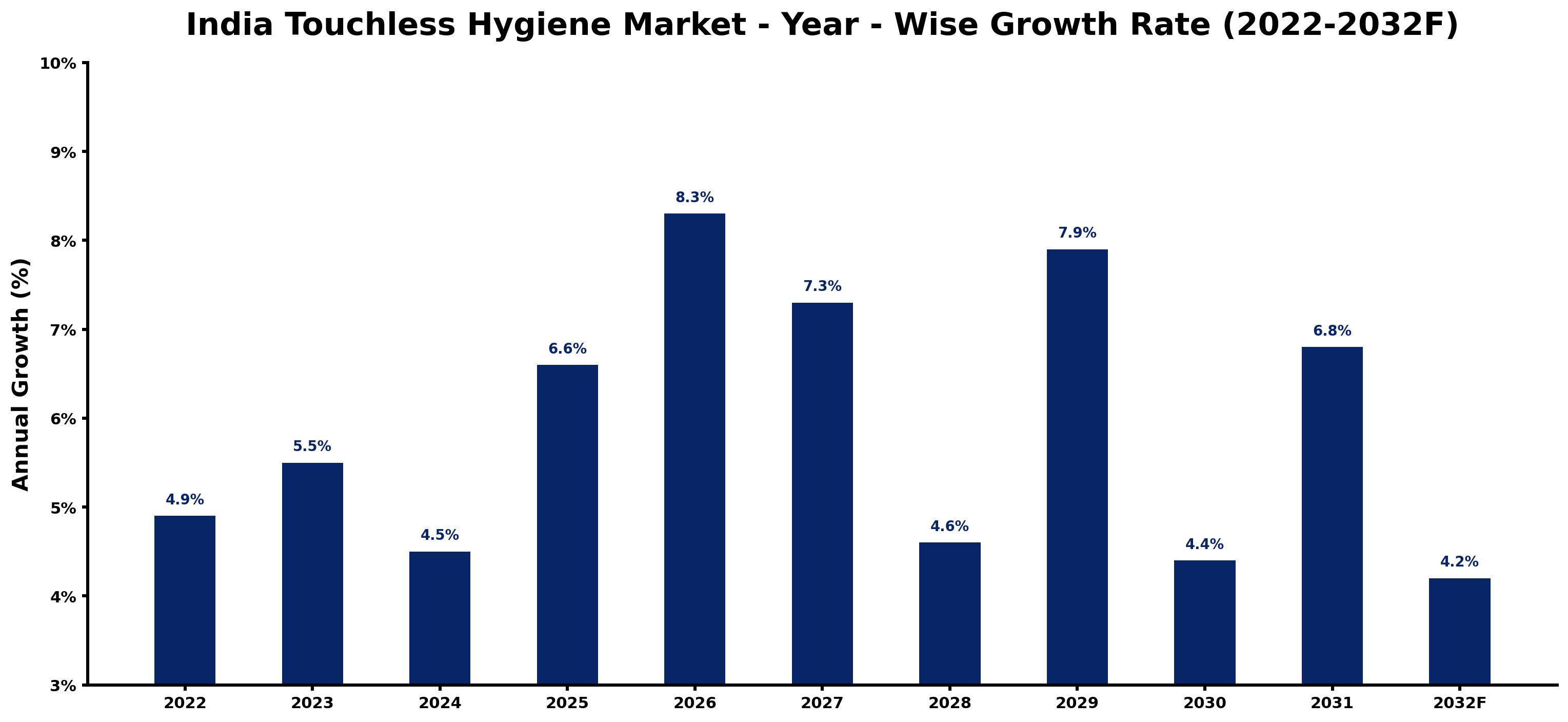
Below, each year's estimated growth is shown next to the factor that most influenced it.
| Year | Estimated Annual Growth (%) | Market Rationale |
| 2022 | 4.9 | Touchless hygiene products gained traction due to the 'Swachh Bharat Mission' promoting sanitation. |
| 2023 | 5.5 | Urban areas like Delhi and Mumbai saw faster adoption of touchless hygiene solutions. |
| 2024 | 4.5 | Growth slowed as demand stabilised following the peak in 2023. |
| 2025 | 6.6 | The market experienced a resurgence as hospitals expanded their touchless installations. |
| 2026 | 8.3 | High demand for touchless hygiene products surged, driven by public health initiatives and the Ministry of Health and Family Welfare's guidelines. |
| 2027 | 7.3 | Growth slowed as the market began to stabilise after the peak in 2026. |
| 2028 | 4.6 | Demand continued to slow, reflecting market maturity and increased integration challenges. |
| 2029 | 7.9 | Faster growth returned as public spaces adopted touchless solutions more widely, particularly in urban centres. |
| 2030 | 4.4 | Growth slowed again as market saturation began to affect purchasing decisions in major cities. |
| 2031 | 6.8 | The market rebounded with renewed investments in touchless technologies, particularly in healthcare facilities. |
| 2032 | 4.2 | Growth is expected to slow as the market approaches maturity. |
Note: Market size estimations and growth projections presented in this report are based on 6Wresearch's proprietary forecasting methodology, utilizing the latest available industry data, government publications, and primary research inputs.
India Touchless Hygiene Market Synopsis
The India Touchless Hygiene Market encompasses products designed to minimise physical contact, including automatic dispensers and touchless trash bins. These products are primarily used in healthcare and public spaces. The market is growing due to increased demand from urban areas and government initiatives like the Swachh Bharat Mission, which promotes hygiene and sanitation. The healthcare sector, with over 1,500 hospitals, drives this growth, alongside food service areas adopting touchless solutions for safety and infection control.
Market Dynamics Impact Analysis (2026–2032)
| Factor | Type | Impact | Primary Segment Affected |
| Increased healthcare expenditure driving demand for hygiene solutions | Driver | High | Sanitizer Dispensers |
| Urbanisation leading to higher installation of touchless systems in public spaces | Driver | High | Touchless Trash Bins |
| Growing need for infection control in healthcare facilities | Opportunity | High | UV Sterilizers |
| Expansion of smart city initiatives promoting touchless hygiene | Opportunity | Medium | Automatic Soap Units |
| High initial investment costs for touchless systems | Restraint | High | Sanitizer Dispensers |
| Limited awareness in rural areas about touchless hygiene benefits | Restraint | Medium | Touchless Trash Bins |
| Integration challenges with existing sanitation infrastructure | Challenge | High | UV Sterilizers |
| Dependence on technology for maintenance and operation | Challenge | Medium | Automatic Soap Units |
Evaluation of Drivers in India Touchless Hygiene Market (2026–2032)
The table below links each growth driver to the segment it affects and the evidence for it.
| Drivers | Primary Segment Affected | Why It Matters (Evidence) |
| Increased healthcare expenditure | Sanitizer Dispensers | Healthcare expenditure in India is projected to reach $372 billion by 2022, driving demand for hygiene solutions. |
| Urbanisation trends | Touchless Trash Bins | Touchless trash bins are being installed in major cities, improving waste management and cleanliness. |
| Government initiatives promoting hygiene | UV Sterilizers | The 'Swachh Bharat Mission' launched in 2020 encourages the adoption of touchless hygiene products. |
| Rising public health awareness | Automatic Soap Units | Touchless dispensers are now standard in over 60% of food service areas across India. |
| Technological advancements in automation | Motion Sensors | Motion sensors are increasingly integrated into touchless hygiene products, improving user experience. |
Urban areas are seeing a marked rise in the use of touchless trash bins, which improve waste management. The 'Swachh Bharat Mission' encourages the use of touchless hygiene products in public spaces, further boosting their adoption. Technological advancements are also facilitating the integration of motion sensors in touchless hygiene products, improving user experience and efficiency. As healthcare expenditure continues to rise, the demand for advanced hygiene solutions is anticipated to increase correspondingly.
Evaluation of Restraints in India Touchless Hygiene Market
The key brakes on demand, and where they bite hardest, are shown below.
| Market Restraint | Primary Segment Affected | Why It Matters (Evidence) |
| High initial investment costs for touchless systems | Sanitizer Dispensers | The upfront costs for installing touchless systems can deter smaller healthcare facilities from adopting these technologies. |
| Limited awareness in rural areas about touchless hygiene benefits | Touchless Trash Bins | Many rural areas lack knowledge about the advantages of touchless hygiene solutions, slowing adoption. |
| Integration challenges with existing sanitation infrastructure | UV Sterilizers | Existing infrastructure may not support the installation of advanced touchless systems without significant modifications. |
| Dependence on technology for maintenance and operation | Automatic Soap Units | Touchless systems require regular maintenance and technical expertise, which may not be readily available. |
| Market saturation in urban areas | Sanitizer Dispensers | As urban areas become saturated with touchless products, growth potential may diminish. |
India Touchless Hygiene Market Challenges
The India Touchless Hygiene Market still has to solve a few problems, and the first is skills shortages among technicians. Many installers lack training in advanced touchless technologies, which delays installations in healthcare facilities and public restrooms. High costs also hinder adoption; touchless solutions can be 30% more expensive than traditional options, making budget-conscious hospitals reluctant to upgrade. Supply chain issues complicate matters, as sourcing components from multiple suppliers can lead to delays of up to three months for producers. Technology integration poses a challenge, with many existing systems incompatible with new touchless products, limiting functionality for buyers.
Trends in the India Touchless Hygiene Market
Four trends stand out in the India Touchless Hygiene Market.
- Launch of the Hygiene Promotion Programme: In 2021, the Ministry of Health and Family Welfare introduced the 'Hygiene Promotion Programme' to improve sanitation practices in healthcare facilities. This initiative has led to a 30% increase in the adoption of touchless solutions in hospitals.
- Shift towards smart city initiatives: The 'Smart Cities Mission' initiated in 2020 includes provisions for touchless hygiene solutions in public restrooms. This shift is expected to increase installations by 25% in urban areas over the next few years.
- Growing focus on infection control: Healthcare facilities are increasingly prioritising infection control measures, resulting in a 40% rise in demand for UV sterilizers since 2020. This trend is evident in hospitals across major cities like Mumbai and Delhi.
- Increased prevalence of touchless dispensers: Since 2022, automatic soap units have become standard in over 70% of public restrooms in urban India, reflecting a notable shift towards touchless hygiene in public spaces.
Investment Opportunities in the India Touchless Hygiene Market
The following opportunities in the India Touchless Hygiene Market pair current demand with a clear way in.
- Urban hospitals expanding touchless solutions: With over 1,500 hospitals in India, there is a growing need for touchless hygiene products. The market is projected to grow as hospitals upgrade their facilities to improve sanitation.
- Installation of touchless systems in public spaces: Food service areas are adopting touchless hygiene solutions, with a notable increase in demand as hygiene standards rise.
- Government support for hygiene initiatives: The National Health Mission is funding touchless hygiene projects, with an allocation of $50 million for improving sanitation in clinics and hospitals.
- Emerging demand for UV sterilizers: With rising health concerns, there is an increasing need for UV sterilizers in healthcare settings, expected to grow substantially in the coming years.
Government Initiatives in the India Touchless Hygiene Market
In 2021, the Ministry of Health and Family Welfare launched the 'Hygiene Promotion Programme' to enhance sanitation practices in healthcare facilities, focusing on touchless solutions. This programme complements existing laws like the 'Swachh Bharat Mission', initiated in 2020, which encourages the adoption of touchless hygiene products in public spaces. Together, these measures aim to improve overall hygiene standards and promote the use of advanced touchless technologies in healthcare settings. The updated 'IS 14700:2020' standard for hand hygiene products also includes touchless dispensers, ensuring compliance with safety protocols. These frameworks collectively support the growth of the touchless hygiene market in India by fostering a more hygienic environment.
The 'Hygiene Promotion Programme' enables hospitals and clinics to access funding for upgrading their sanitation facilities with touchless solutions. The Ministry of Health and Family Welfare oversees this initiative, which aims to improve hygiene practices across healthcare settings. Additionally, the 'National Cleanliness Campaign' introduced in 2022 promotes touchless waste management systems in urban areas, enhancing public sanitation. The 'Smart Cities Mission' further supports the installation of touchless hygiene solutions in public restrooms and healthcare facilities, ensuring that urban areas are equipped with modern hygiene technologies. These initiatives significantly impact how healthcare facilities and public spaces adopt touchless hygiene products.
Future Insight of the India Touchless Hygiene Market
The India Touchless Hygiene Market is expected to develop significantly by 2032, driven by several key factors. The government's commitment to hygiene through initiatives like the 'Swachh Bharat Mission' will promote touchless solutions across urban areas. Increased healthcare expenditure will fuel demand for advanced hygiene products, with spending projected to reach $372 billion. The adoption of ISO 14644 standards will support the implementation of touchless technologies in cleanroom environments, ensuring better infection control in healthcare settings. These developments will create a more supportive environment for buyers and suppliers.
Market Segmentation Analysis
Each segment group is reviewed below, with the leader by share and the fastest grower by CAGR.
By Product Type – Sanitizer Dispensers Dominated, Touchless Trash Bins Expected to Grow Fastest
According to Vasudha, AM at 6Wresearch, Sanitizer Dispensers took a 47% share of product type in 2025, more than any other category. Sanitizer dispensers hold the largest share as they are essential in over 1,500 hospitals across India, playing a vital role in infection control. Their widespread adoption in urban areas like Delhi and Mumbai further solidifies their market position. Touchless Trash Bins are set to record the highest CAGR in this split, 8.0% over 2026–2032. Touchless trash bins are rapidly gaining popularity as urban centres focus on waste management, with significant installations in major cities. This emphasis on cleanliness in public areas is driving their accelerated growth. Suppliers should focus on enhancing the availability of touchless trash bins to meet the rising urban demand.
By Technology Used – Motion Sensors Dominated, Proximity Detection Expected to Grow Fastest
In 2025, Motion Sensors led the technology used split with a 43% share. Motion sensors dominate the market as they are integral to various touchless hygiene devices, enabling seamless interactions. Their extensive application in healthcare settings, especially hospitals, underscores their importance in maintaining hygiene standards. The quickest growth will come from Proximity Detection, forecast to expand at a CAGR of 8.8% between 2026 and 2032. Proximity detection technology is experiencing rapid growth due to its implementation in advanced hygiene solutions, which are increasingly in demand in urban environments. The ability of this technology to enhance user experience is a key factor in its growth. Buyers can anticipate a wider selection of products incorporating proximity detection technology as demand continues to rise.
By Use Case – Infection Control Dominated, Waste Management Expected to Grow Fastest
The largest use case category in 2025 was Infection Control, with a 38% share of total revenue. Infection control holds the largest market share, driven by the essential need for hygiene in hospitals and clinics throughout India. The ongoing focus on sanitation in healthcare environments reinforces the demand for touchless solutions. Waste Management is projected to grow fastest, at a CAGR of 8.1% during 2026–2032. Waste management is emerging as the fastest-growing use case, with public spaces increasingly adopting touchless solutions to uphold cleanliness and hygiene. This trend is particularly pronounced in urban centres where sanitation is a pressing concern. Suppliers should look to expand their product lines in waste management solutions to take advantage of this growth opportunity.
By End User – Hospitals Dominated, Clinics Expected to Grow Fastest
With a 55% revenue share in 2025, Hospitals was the largest end user category. Hospitals command the largest market share as they are the primary users of touchless hygiene products, essential for infection control and patient safety. The substantial healthcare expenditure in India further supports this strong demand. Over 2026–2032, Clinics are expected to post the fastest growth, at a CAGR of 8.2%. Clinics are witnessing the fastest growth as they increasingly adopt touchless solutions to improve patient safety and operational efficiency. The growing number of clinics in urban areas significantly contributes to this trend. Suppliers must tailor their offerings to meet the specific needs of clinics to capitalise on this expanding market segment.
Key Attractiveness of the Report
- 10 Years of Market Numbers
- Historical Data Starting from 2022 to 2025
- Base Year 2025
- Forecast Data until 2032
- Key Performance Indicators Impacting the Market
- Major Upcoming Developments and Projects
Key Highlights of the Report:
- India Touchless Hygiene Market Outlook
- Market Size of India Touchless Hygiene Market, 2025
- Forecast of India Touchless Hygiene Market, 2032
- Historical Data and Forecast of India Touchless Hygiene Revenues & Volume for the Period 2022 - 2032F
- India Touchless Hygiene Market Trend Evolution
- India Touchless Hygiene Market Drivers and Challenges
- India Touchless Hygiene Price Trends
- India Touchless Hygiene Porter's Five Forces
- India Touchless Hygiene Industry Life Cycle
- Historical Data and Forecast of India Touchless Hygiene Market Revenues & Volume By Product Type for the Period 2022 - 2032F
- Historical Data and Forecast of India Touchless Hygiene Market Revenues & Volume By Sanitizer Dispensers for the Period 2022 - 2032F
- Historical Data and Forecast of India Touchless Hygiene Market Revenues & Volume By Touchless Trash Bins for the Period 2022 - 2032F
- Historical Data and Forecast of India Touchless Hygiene Market Revenues & Volume By UV Sterilizers for the Period 2022 - 2032F
- Historical Data and Forecast of India Touchless Hygiene Market Revenues & Volume By Automatic Soap Units for the Period 2022 - 2032F
- Historical Data and Forecast of India Touchless Hygiene Market Revenues & Volume By Technology Used for the Period 2022 - 2032F
- Historical Data and Forecast of India Touchless Hygiene Market Revenues & Volume By Motion Sensors for the Period 2022 - 2032F
- Historical Data and Forecast of India Touchless Hygiene Market Revenues & Volume By Proximity Detection for the Period 2022 - 2032F
- Historical Data and Forecast of India Touchless Hygiene Market Revenues & Volume By Light-Based for the Period 2022 - 2032F
- Historical Data and Forecast of India Touchless Hygiene Market Revenues & Volume By Infrared Activation for the Period 2022 - 2032F
- Historical Data and Forecast of India Touchless Hygiene Market Revenues & Volume By Use Case for the Period 2022 - 2032F
- Historical Data and Forecast of India Touchless Hygiene Market Revenues & Volume By Infection Control for the Period 2022 - 2032F
- Historical Data and Forecast of India Touchless Hygiene Market Revenues & Volume By Waste Management for the Period 2022 - 2032F
- Historical Data and Forecast of India Touchless Hygiene Market Revenues & Volume By Surface Disinfection for the Period 2022 - 2032F
- Historical Data and Forecast of India Touchless Hygiene Market Revenues & Volume By Handwashing Stations for the Period 2022 - 2032F
- Historical Data and Forecast of India Touchless Hygiene Market Revenues & Volume By End User for the Period 2022 - 2032F
- Historical Data and Forecast of India Touchless Hygiene Market Revenues & Volume By Hospitals for the Period 2022 - 2032F
- Historical Data and Forecast of India Touchless Hygiene Market Revenues & Volume By Clinics for the Period 2022 - 2032F
- Historical Data and Forecast of India Touchless Hygiene Market Revenues & Volume By Healthcare Facilities for the Period 2022 - 2032F
- Historical Data and Forecast of India Touchless Hygiene Market Revenues & Volume By Food Service Areas for the Period 2022 - 2032F
- India Touchless Hygiene Import Export Trade Statistics
- Market Opportunity Assessment By Product Type
- Market Opportunity Assessment By Technology Used
- Market Opportunity Assessment By Use Case
- Market Opportunity Assessment By End User
- India Touchless Hygiene Top Companies Market Share
- India Touchless Hygiene Competitive Benchmarking By Technical and Operational Parameters
- India Touchless Hygiene Company Profiles
- India Touchless Hygiene Key Strategic Recommendations
Market Covered
This report examines the market across the segments below.
By Product Type
- Sanitizer Dispensers
- Touchless Trash Bins
- UV Sterilizers
- Automatic Soap Units
By Technology Used
- Motion Sensors
- Proximity Detection
- Light-Based
- Infrared Activation
By Use Case
- Infection Control
- Waste Management
- Surface Disinfection
- Handwashing Stations
By End User
- Hospitals
- Clinics
- Healthcare Facilities
- Food Service Areas































