China Touchless Hygiene Market Size & Growth Rate
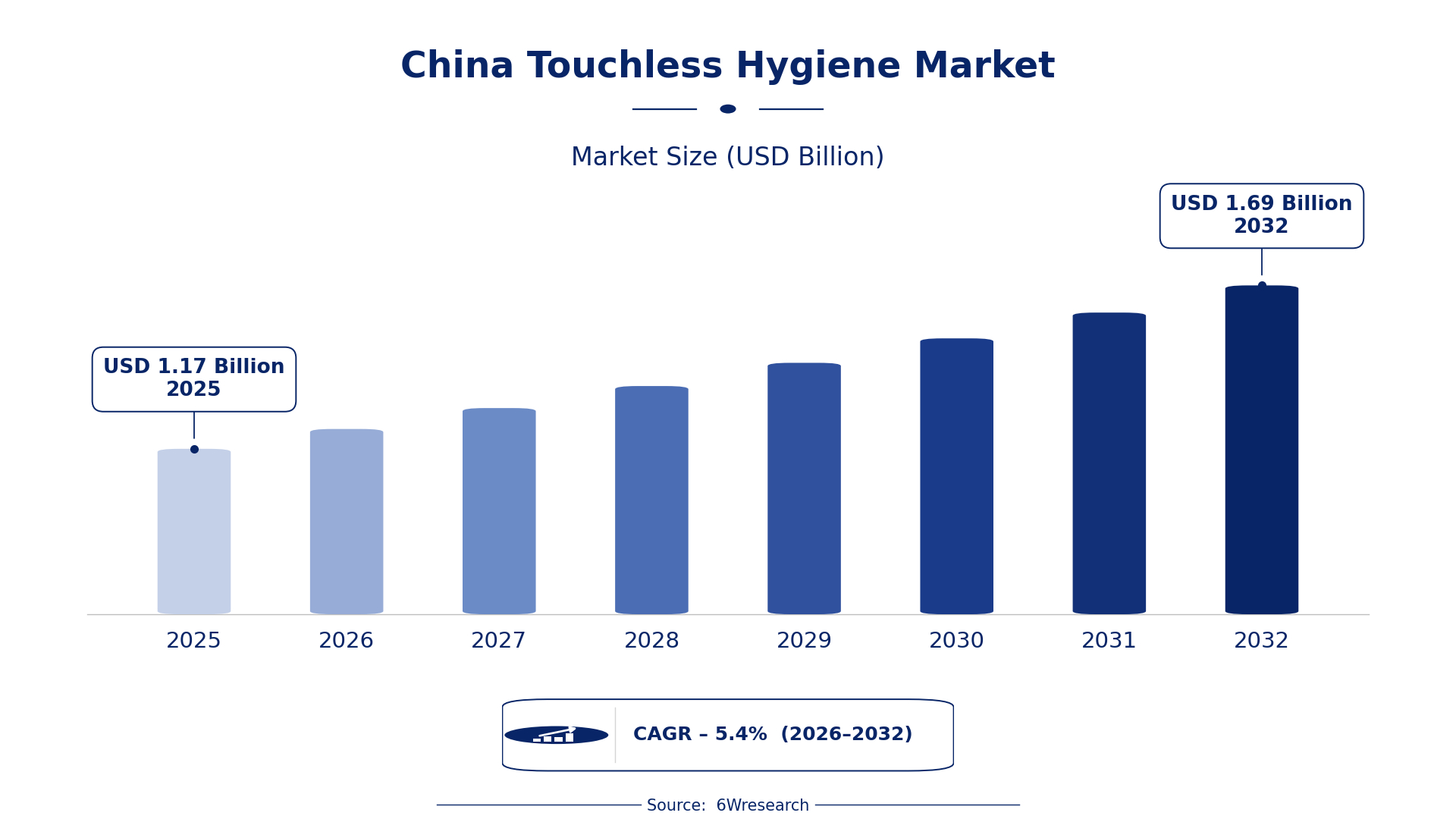
According to 6Wresearch internal database and industry insights, the China Touchless Hygiene Market was valued at USD 1.17 billion in 2025 and is projected to reach USD 1.69 billion by 2032, growing at a CAGR of approximately 5.4% during 2026–2032.
China Touchless Hygiene Market Highlights
| Report Metric | Details |
| Report Name | China Touchless Hygiene Market |
| Market Size 2025 | USD 1.17 billion |
| Market Size 2032 | USD 1.69 billion |
| Absolute Growth 2025–2032 | USD 0.52 billion |
| CAGR 2026–2032 | 5.4% |
| Peak Annual Growth | 7.4% in 2027 |
| Forecast Period | 2026–2032 |
| Historical Data | 2022–2025 |
| Base Year | 2025 |
| Leading Product Type, 2025 | Sanitizer Dispensers (45% share) |
| Leading Technology Used, 2025 | Infrared Activation (34% share) |
| Leading Use Case, 2025 | Infection Control (46% share) |
| Leading End User, 2025 | Hospitals (42% share) |
| Fastest-Growing Product Type | UV Sterilizers (8.0% CAGR) |
| Fastest-Growing Technology Used | Motion Sensors (6.8% CAGR) |
| Fastest-Growing Use Case | Surface Disinfection (7.2% CAGR) |
| Fastest-Growing End User | Food Service Areas (7.7% CAGR) |
| Growing Sector | Healthcare Facilities |
| Key End Users | Hospitals, Clinics, Food Service Areas, Healthcare Facilities |
China Touchless Hygiene Market Year-wise Growth Rate and Key Drivers (2022–2032)
This graph illustrates the annual growth rates of the market from 2022 to 2032, highlighting a steady upward trajectory and projected market expansion over the forecast period.
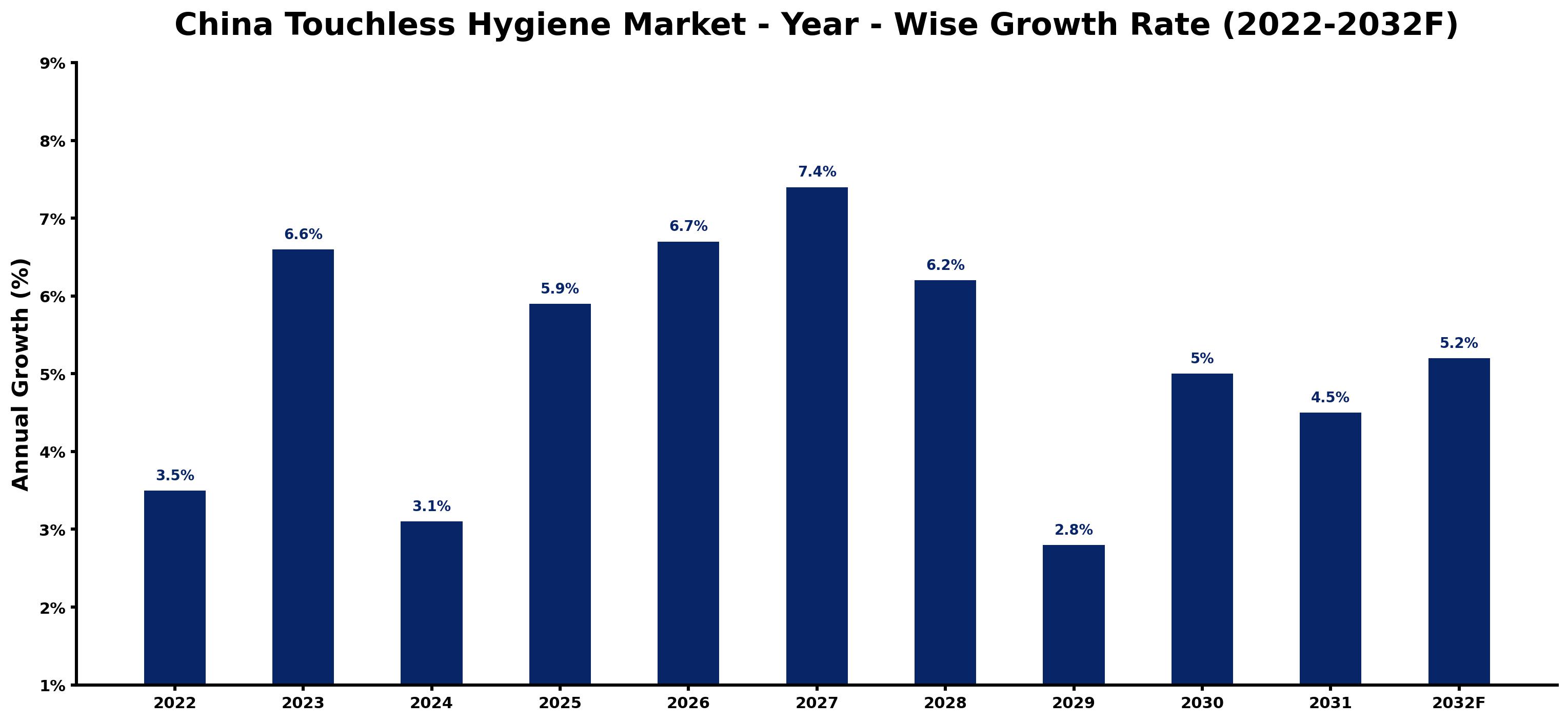
Annual growth estimates for each year appear below with the principal reason behind them, explaining the shifts that set the pace of the market.
| Year | Estimated Annual Growth (%) | Market Rationale |
| 2022 | 3.5 | The healthcare sector showed strong demand for touchless hygiene products, reflecting ongoing public health concerns. |
| 2023 | 6.6 | Increased adoption of touchless hygiene solutions was driven by the 'Public Hygiene Promotion Plan' launched by the Ministry of Health. |
| 2024 | 3.1 | The market experienced a slowdown in growth due to supply chain disruptions affecting product availability. |
| 2025 | 5.9 | Healthcare investments surged, boosting demand for touchless hygiene technologies in hospitals and clinics. |
| 2026 | 6.7 | Urbanisation trends are expected to support the expansion of touchless hygiene solutions in public spaces and food service areas. |
| 2027 | 7.4 | The market is projected to peak as the government promotes hygiene standards through the 'Healthy China 2030' initiative, driving further adoption. |
| 2028 | 6.2 | Demand growth is expected to slow as the market begins to stabilise after rapid expansion in previous years. |
| 2029 | 2.8 | The market will continue to grow, albeit at a slower pace, as consumer preferences shift towards hygiene solutions. |
| 2030 | 5.0 | Increased focus on public health initiatives is anticipated to revitalise demand for touchless hygiene products in various sectors. |
| 2031 | 4.5 | The market is projected to experience a slowdown as competition intensifies among suppliers of touchless hygiene technologies. |
| 2032 | 5.2 | Sustained investments in healthcare and public hygiene are expected to drive renewed growth in the market. |
Note: Market size estimations and growth projections presented in this report are based on 6Wresearch's proprietary forecasting methodology, utilizing the latest available industry data, government publications, and primary research inputs.
China Touchless Hygiene Market Synopsis
Touchless Hygiene in China includes products designed to reduce physical contact and improve cleanliness. These solutions, primarily utilising sensors and automated mechanisms, are extensively adopted in healthcare, food service, and public spaces. The China Touchless Hygiene Market is expanding due to increasing public health standards and urbanisation trends. The healthcare sector, with over 1 million hospital beds, is a major consumer of these products. Initiatives like 'Healthy China 2030' further drive the growing demand for touchless hygiene solutions.
Market Dynamics Impact Analysis (2026–2032)
| Factor | Type | Impact | Primary Segment Affected |
| Rising urbanisation trends are increasing demand for touchless hygiene solutions in public areas. | Driver | High | Touchless Trash Bins |
| The healthcare sector's robust growth drives demand for touchless hygiene products in hospitals. | Driver | High | Infection Control |
| Growing public awareness of hygiene creates opportunities for suppliers of touchless products. | Opportunity | High | Automatic Soap Units |
| The increasing adoption of touchless hygiene measures in food service areas presents a market opportunity. | Opportunity | High | UV Sterilizers |
| Competition among suppliers may limit market share for new entrants in the touchless hygiene segment. | Restraint | Medium | Sanitizer Dispensers |
| High initial costs for touchless hygiene technologies may deter some potential buyers. | Restraint | Medium | Automatic Soap Units |
| The Touchless Hygiene market in China faces challenges related to technology integration in existing facilities. | Challenge | High | Healthcare Facilities |
| Limited consumer awareness regarding the benefits of touchless hygiene solutions can hinder market growth. | Challenge | Medium | Food Service Areas |
Evaluation of Drivers in China Touchless Hygiene Market (2026–2032)
Below mentioned are some major drivers and their influence on market dynamics.
| Drivers | Primary Segment Affected | Why It Matters (Evidence) |
| Increased healthcare investments drive demand for touchless hygiene solutions in hospitals. | Infection Control | With over 1 million hospital beds available, this investment leads to higher purchases of products like automatic soap units and UV sterilizers. |
| Urbanisation trends are pushing the need for touchless hygiene solutions in public spaces. | Touchless Trash Bins | In major cities like Guangdong, as urban populations grow, the demand for hygienic waste management solutions rises. |
| Government initiatives like 'Healthy China 2030' promote hygiene practices, boosting demand for touchless products. | Automatic Soap Units | This initiative encourages healthcare facilities to adopt touchless solutions for improved hygiene. |
| The rise in food service hygiene standards post-2020 has led to increased adoption of touchless hygiene technologies. | UV Sterilizers | Food service areas are investing in touchless solutions to comply with new hygiene regulations. |
| Technological advancements in sensor technology improve the functionality and appeal of touchless hygiene products. | Sanitizer Dispensers | Improved technology attracts more buyers looking for efficient hygiene solutions. |
In 2022, the healthcare sector included over 1 million hospital beds, leading to increased purchases of products like automatic soap units and UV sterilizers. Urbanisation is pushing for hygienic waste management solutions, resulting in higher demand for touchless trash bins. Advancements in sensor technology improve the functionality of products, attracting more buyers seeking efficient solutions.
Evaluation of Restraints in China Touchless Hygiene Market
The key brakes on demand, and where they bite hardest, are shown below.
| Market Restraint | Primary Segment Affected | Why It Matters (Evidence) |
| High initial costs for touchless hygiene technologies may deter some potential buyers, particularly smaller healthcare facilities. | Automatic Soap Units | These costs can restrict procurement budgets for smaller clinics and hospitals. |
| Competition among suppliers may limit market share for new entrants in the touchless hygiene segment, affecting pricing strategies. | Sanitizer Dispensers | Established players dominate the market, making it challenging for newcomers to gain traction. |
| Limited consumer awareness regarding the benefits of touchless hygiene solutions can hinder market growth, particularly in rural areas. | Food Service Areas | This lack of awareness negatively impacts purchasing decisions for touchless products. |
| Regulatory compliance costs for touchless hygiene products can be a barrier for manufacturers entering the market. | UV Sterilizers | Compliance with standards can increase production costs, impacting pricing for buyers. |
| Supply chain disruptions may affect the availability of touchless hygiene products, leading to delays in procurement. | Touchless Trash Bins | These disruptions can result in longer lead times for buyers. |
China Touchless Hygiene Market Challenges
The China Touchless Hygiene Market faces intense competition that drives down prices, resulting in reduced profit margins for producers. Buyers in healthcare settings encounter delays in receiving touchless hygiene products due to logistical inefficiencies, which can compromise infection control efforts across over 1 million hospital beds. Suppliers must keep pace with rapid technological advancements, necessitating continuous investment in new sensor technologies, which raises operational costs significantly. Fluctuating material costs disrupt the supply chain, causing production delays and shortages for end users in hospitals and public spaces, ultimately affecting public health outcomes.
Trends in the China Touchless Hygiene Market
The trends below show where the China Touchless Hygiene Market is heading.
- 'Healthy China 2030' Initiative Promoting Hygiene Practices: The 'Healthy China 2030' initiative is encouraging the adoption of touchless hygiene solutions across healthcare facilities, with a focus on infection control. This programme aims to elevate public health standards, resulting in increased installations of automatic soap units and sanitizer dispensers.
- Shift Towards Improved Public Hygiene: A heightened focus on public hygiene has led to a surge in touchless hygiene solutions in food service areas. Urban restaurants are increasingly implementing UV sterilizers to comply with new health standards, demonstrating a commitment to cleanliness.
- Increased Adoption of Touchless Technologies in Healthcare: Hospitals are integrating touchless hygiene technologies to ensure patient safety and infection control. With over 1 million hospital beds in China, the demand for automatic soap units and touchless trash bins is rising.
- Urban Areas Leading Touchless Hygiene Adoption: Provinces like Guangdong and Jiangsu are leading the way in adopting touchless hygiene products. This trend is supported by urbanisation, with a notable increase in installations of touchless hygiene solutions in public spaces.
Investment Opportunities in the China Touchless Hygiene Market
Some of the investment opportunities in the China Touchless Hygiene Market are mentioned below.
- Urban Hospitals Upgrading Hygiene Standards: Urban hospitals are investing in touchless hygiene technologies, with a target of 30% adoption by 2025. This presents an opportunity for suppliers of automatic soap units and UV sterilizers to enter the market.
- Growing Demand for Touchless Solutions in Food Service: The food service industry is experiencing a surge in demand for touchless hygiene solutions, particularly post-2020. Suppliers can capitalise on this trend by providing touchless trash bins and sanitizer dispensers.
- Healthcare Facilities Seeking Infection Control Solutions: Healthcare facilities are prioritising infection control measures, creating a demand for touchless hygiene products. Collaborating with local partners can facilitate entry into this expanding market segment.
- Government Subsidy Programmes for Touchless Technologies: The government announced a subsidy programme in 2023 to support hospitals upgrading to touchless hygiene technologies. This initiative is expected to drive increased investments in the sector.
Government Initiatives in the China Touchless Hygiene Market
The National Health Commission implements hygiene initiatives and approves funding for healthcare upgrades. In 2023, the government announced a subsidy programme targeting a 30% adoption rate of touchless technologies in hospitals by 2025. Additionally, the Ministry of Health's 'Public Hygiene Promotion Plan' launched in 2022 aims to raise awareness of touchless hygiene solutions, supporting educational campaigns and funding for local health initiatives. These measures collectively improve the market environment for touchless hygiene products.
The Ministry of Health oversees the approval of hygiene standards and funding for local health initiatives. In 2021, the 'Infection Control Guidelines' were introduced to enhance hygiene standards in healthcare facilities, while the 'National Standard for Health and Safety in Food Service' was updated in 2022 to incorporate touchless hygiene measures. These initiatives aim to improve public health through better hygiene practices.
Future Insight of the China Touchless Hygiene Market
The China Touchless Hygiene Market will undergo substantial changes by 2032, driven by the government's 'Healthy China 2030' initiative aimed at improving public health standards. Urbanisation will fuel demand, as China's population of over 1.4 billion increasingly seeks touchless hygiene solutions in public areas. The adoption of ISO 14644 standards will compel suppliers to improve product cleanliness, ensuring higher safety levels in healthcare environments. Advances in automation technology will streamline production processes, enabling producers to effectively meet the growing needs of buyers.
Market Segmentation Analysis
The analysis below covers each segmentation, its leading category in 2025 and its fastest-growing category through 2032.
By Product Type – Sanitizer Dispensers Dominated, UV Sterilizers Expected to Grow Fastest
According to Vasudha, AM at 6Wresearch, in 2025, Sanitizer Dispensers led the product type split with a 45% share. Sanitizer dispensers hold the largest share in the China touchless hygiene market due to their extensive use in over 1 million hospital beds and urban hospitals. These products are essential for hand hygiene practices promoted by the National Health Commission across healthcare facilities. The quickest growth will come from UV Sterilizers, forecast to expand at a CAGR of 8.0% between 2026 and 2032. The rapid adoption of UV sterilizers is driven by their effectiveness in surface disinfection, particularly in hospitals where equipment safety is paramount. The increasing focus on infection control standards has further accelerated this growth. Suppliers should prioritise the development of UV sterilizers to meet the rising demand in healthcare settings.
By Technology Used – Infrared Activation Dominated, Motion Sensors Expected to Grow Fastest
The largest technology used category in 2025 was Infrared Activation, with a 34% share of total revenue. Infrared activation technology holds the largest market share due to its widespread application in touchless hygiene products, particularly in healthcare settings where maintaining cleanliness is crucial. For instance, urban hospitals across China extensively utilise infrared activation in their touchless soap dispensers to enhance hygiene practices. Motion Sensors are set to record the highest CAGR in this split, 6.8% over 2026–2032. Motion sensors are experiencing rapid growth as they offer versatile activation across various touchless hygiene products, making them increasingly vital in public spaces. The rise in urbanisation trends in China is driving the demand for motion sensor technologies, ensuring their prominent role in the market. This trend indicates that suppliers should prioritise the development of motion sensor-based products to align with the growing demand for touchless hygiene solutions in urban environments.
By Use Case – Infection Control Dominated, Surface Disinfection Expected to Grow Fastest
Infection Control accounted for a 46% market share by use case in 2025. Infection control is the primary use case for touchless hygiene products, capturing the largest market share as hospitals prioritise safety and cleanliness. The ongoing emphasis on hand hygiene in healthcare settings underlines the critical role of these products. Surface Disinfection is projected to grow fastest, at a CAGR of 7.2% during 2026–2032. Surface disinfection is rapidly growing as a key use case, particularly in response to heightened awareness of infection prevention in public spaces. The rise of touchless solutions in food service areas further fuels this trend. Suppliers should focus on promoting surface disinfection capabilities to align with the growing demand in various sectors.
By End User – Hospitals Dominated, Food Service Areas Expected to Grow Fastest
With a 42% revenue share in 2025, Hospitals was the largest end user category. Hospitals command the largest market share as they are the primary users of touchless hygiene products, driven by the critical need for effective infection control. The extensive healthcare infrastructure in China, with over 1 million hospital beds, necessitates the adoption of these solutions. Over 2026–2032, Food Service Areas are expected to post the fastest growth, at a CAGR of 7.7%. Food service areas are experiencing the fastest growth due to heightened hygiene standards following 2020, resulting in a notable increase in the adoption of touchless hygiene solutions. This trend reflects a shift in consumer expectations regarding cleanliness in dining settings. Suppliers must adapt their product offerings to address the specific hygiene requirements of food service areas, ensuring alignment with evolving standards.
Key Attractiveness of the Report
- 10 Years of Market Numbers
- Historical Data Starting from 2022 to 2025
- Base Year 2025
- Forecast Data until 2032
- Key Performance Indicators Impacting the Market
- Major Upcoming Developments and Projects
Key Highlights of the Report:
- China Touchless Hygiene Market Outlook
- Market Size of China Touchless Hygiene Market, 2025
- Forecast of China Touchless Hygiene Market, 2032
- Historical Data and Forecast of China Touchless Hygiene Revenues & Volume for the Period 2022 - 2032F
- China Touchless Hygiene Market Trend Evolution
- China Touchless Hygiene Market Drivers and Challenges
- China Touchless Hygiene Price Trends
- China Touchless Hygiene Porter's Five Forces
- China Touchless Hygiene Industry Life Cycle
- Historical Data and Forecast of China Touchless Hygiene Market Revenues & Volume By Product Type for the Period 2022 - 2032F
- Historical Data and Forecast of China Touchless Hygiene Market Revenues & Volume By Sanitizer Dispensers for the Period 2022 - 2032F
- Historical Data and Forecast of China Touchless Hygiene Market Revenues & Volume By Touchless Trash Bins for the Period 2022 - 2032F
- Historical Data and Forecast of China Touchless Hygiene Market Revenues & Volume By UV Sterilizers for the Period 2022 - 2032F
- Historical Data and Forecast of China Touchless Hygiene Market Revenues & Volume By Automatic Soap Units for the Period 2022 - 2032F
- Historical Data and Forecast of China Touchless Hygiene Market Revenues & Volume By Technology Used for the Period 2022 - 2032F
- Historical Data and Forecast of China Touchless Hygiene Market Revenues & Volume By Motion Sensors for the Period 2022 - 2032F
- Historical Data and Forecast of China Touchless Hygiene Market Revenues & Volume By Proximity Detection for the Period 2022 - 2032F
- Historical Data and Forecast of China Touchless Hygiene Market Revenues & Volume By Light-Based for the Period 2022 - 2032F
- Historical Data and Forecast of China Touchless Hygiene Market Revenues & Volume By Infrared Activation for the Period 2022 - 2032F
- Historical Data and Forecast of China Touchless Hygiene Market Revenues & Volume By Use Case for the Period 2022 - 2032F
- Historical Data and Forecast of China Touchless Hygiene Market Revenues & Volume By Infection Control for the Period 2022 - 2032F
- Historical Data and Forecast of China Touchless Hygiene Market Revenues & Volume By Waste Management for the Period 2022 - 2032F
- Historical Data and Forecast of China Touchless Hygiene Market Revenues & Volume By Surface Disinfection for the Period 2022 - 2032F
- Historical Data and Forecast of China Touchless Hygiene Market Revenues & Volume By Handwashing Stations for the Period 2022 - 2032F
- Historical Data and Forecast of China Touchless Hygiene Market Revenues & Volume By End User for the Period 2022 - 2032F
- Historical Data and Forecast of China Touchless Hygiene Market Revenues & Volume By Hospitals for the Period 2022 - 2032F
- Historical Data and Forecast of China Touchless Hygiene Market Revenues & Volume By Clinics for the Period 2022 - 2032F
- Historical Data and Forecast of China Touchless Hygiene Market Revenues & Volume By Healthcare Facilities for the Period 2022 - 2032F
- Historical Data and Forecast of China Touchless Hygiene Market Revenues & Volume By Food Service Areas for the Period 2022 - 2032F
- China Touchless Hygiene Import Export Trade Statistics
- Market Opportunity Assessment By Product Type
- Market Opportunity Assessment By Technology Used
- Market Opportunity Assessment By Use Case
- Market Opportunity Assessment By End User
- China Touchless Hygiene Top Companies Market Share
- China Touchless Hygiene Competitive Benchmarking By Technical and Operational Parameters
- China Touchless Hygiene Company Profiles
- China Touchless Hygiene Key Strategic Recommendations
Market Covered
Segments analysed in this report are listed below.
By Product Type
- Sanitizer Dispensers
- Touchless Trash Bins
- UV Sterilizers
- Automatic Soap Units
By Technology Used
- Motion Sensors
- Proximity Detection
- Light-Based
- Infrared Activation
By Use Case
- Infection Control
- Waste Management
- Surface Disinfection
- Handwashing Stations
By End User
- Hospitals
- Clinics
- Healthcare Facilities
- Food Service Areas































