India Train Automation Systems Market Size & Growth Rate
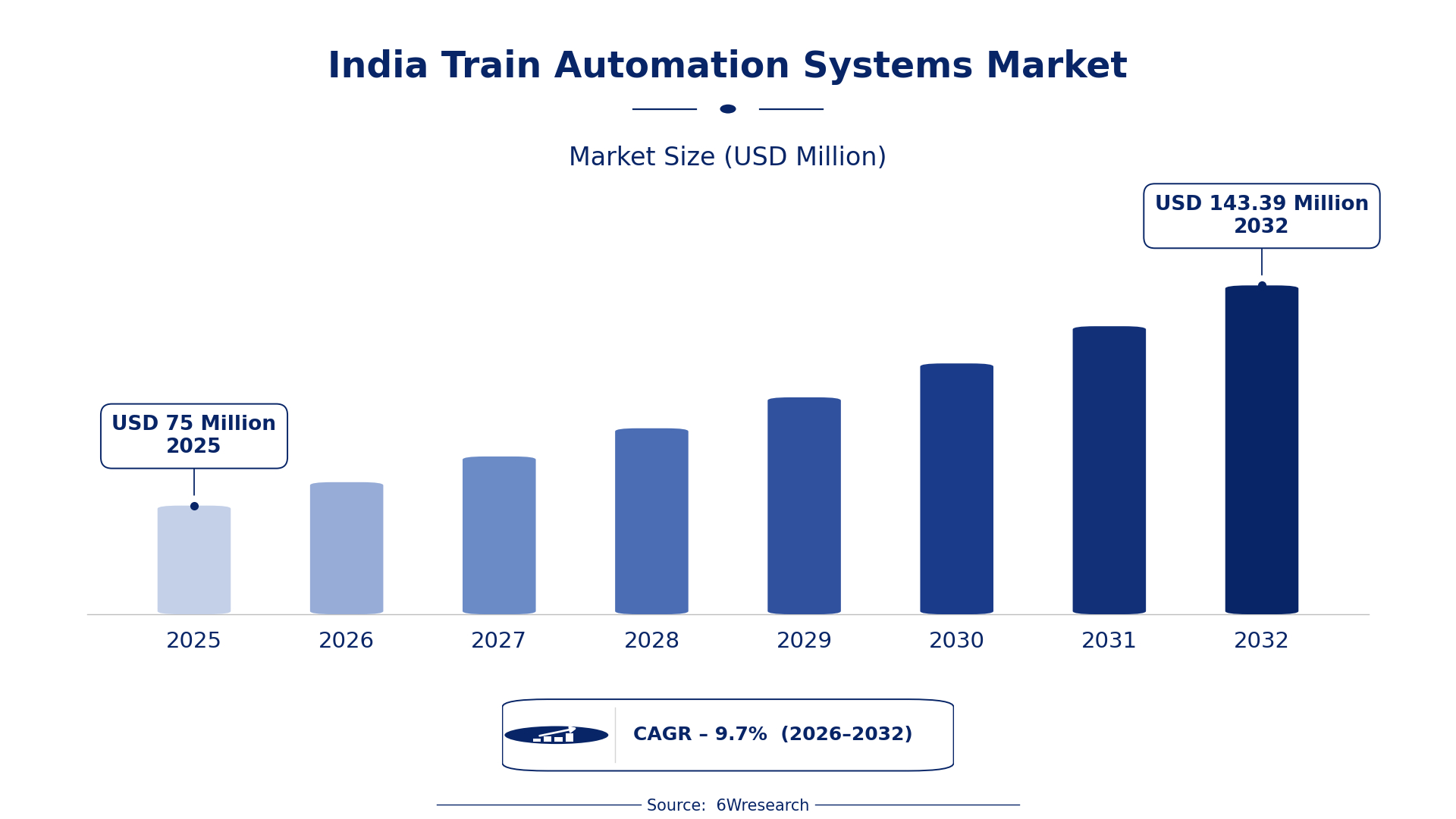
According to 6Wresearch internal database and industry insights, the India Train Automation Systems Market was valued at USD 75.0 million in 2025 and is projected to reach USD 143.39 million by 2032, growing at a CAGR of approximately 9.7% during 2026–2032.
India Train Automation Systems Market Highlights
| Report Metric | Details |
| Report Name | India Train Automation Systems Market |
| Market Size 2025 | USD 75.0 million |
| Market Size 2032 | USD 143.39 million |
| Absolute Growth 2025–2032 | USD 68.39 million |
| CAGR 2026–2032 | 9.7% |
| Peak Annual Growth | 12.2% in 2031 |
| Forecast Period | 2026–2032 |
| Historical Data | 2022–2025 |
| Base Year | 2025 |
| Leading Automation Type, 2025 | CBTC (Communication-Based Train Control) (38% share) |
| Leading Technology Used, 2025 | Wireless Signals (46% share) |
| Leading Application Type, 2025 | Urban Metros (39% share) |
| Leading End User, 2025 | Railway Authorities (41% share) |
| Fastest-Growing Automation Type | ATO (Automatic Train Operation) (12.5% CAGR) |
| Fastest-Growing Technology Used | IoT + Cloud (10.8% CAGR) |
| Fastest-Growing End User | National Rail Networks (12.2% CAGR) |
| Growing Sector | Urban Metros |
| Key End Users | Railway Authorities, National Rail Networks, OEMs |
India Train Automation Systems Market Year-wise Growth Rate and Key Drivers (2022–2032)
This graph illustrates the annual growth rates of the market from 2022 to 2032, highlighting a steady upward trajectory and projected market expansion over the forecast period.
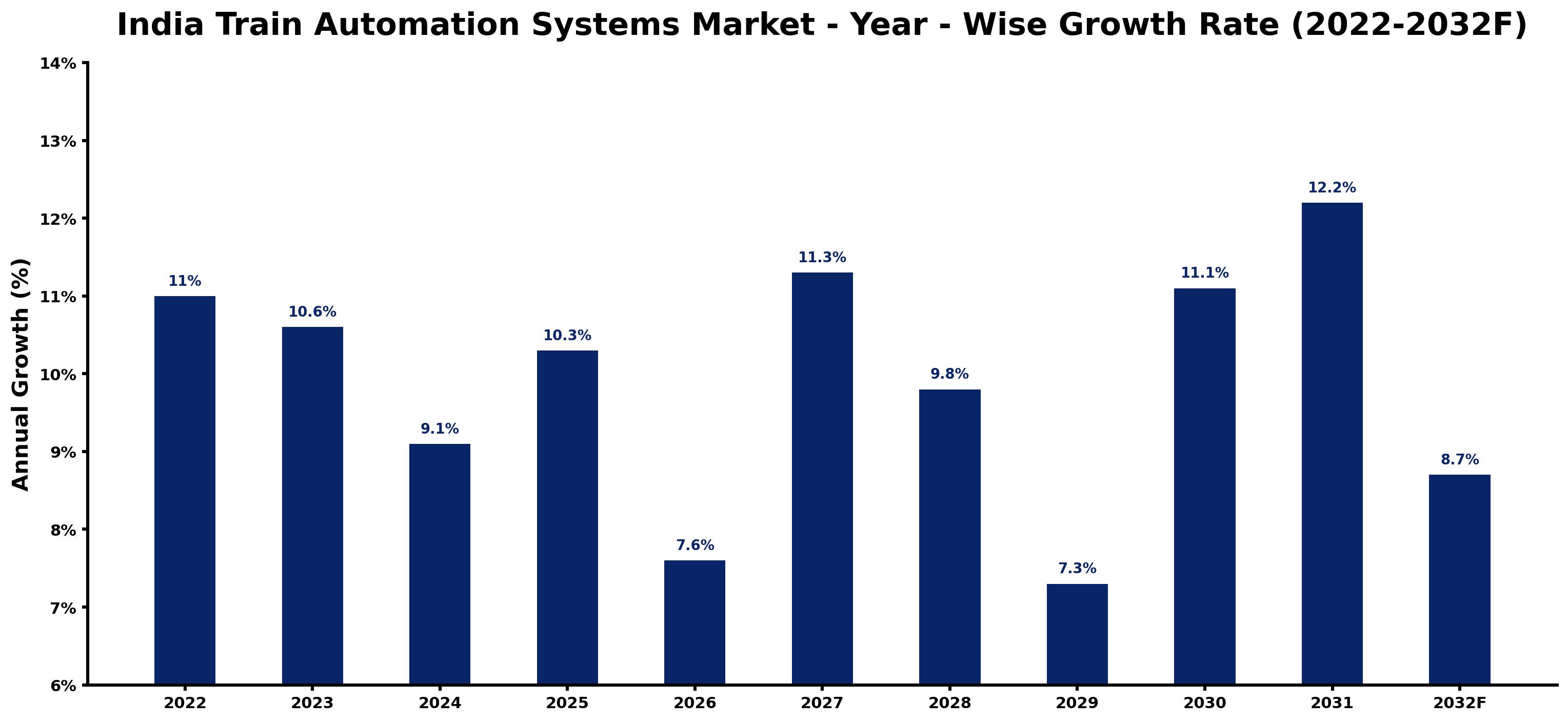
Below, each year's estimated growth is shown next to the factor that most influenced it.
| Year | Estimated Annual Growth (%) | Market Rationale |
| 2022 | 11.0 | The market showed strong activity with significant government allocations for modernization projects. |
| 2023 | 10.6 | Growth slowed slightly due to the ongoing implementation of the National Rail Plan and its associated initiatives. |
| 2024 | 9.1 | Demand continued to grow as urban metro systems expanded, requiring more automation solutions. |
| 2025 | 10.3 | A faster growth rate was driven by increased investments in railway modernization and safety standards. |
| 2026 | 7.6 | Growth slowed as the market adjusted to new standards and technologies being implemented. |
| 2027 | 11.3 | An increase in growth was supported by rising operational efficiency in automated sections of railways. |
| 2028 | 9.8 | Demand growth slowed as existing systems were optimized and new projects were evaluated. |
| 2029 | 7.3 | The market experienced a slowdown as focus shifted to integrating advanced technologies into operations. |
| 2030 | 11.1 | Growth accelerated again with the implementation of new automation technologies across various rail networks. |
| 2031 | 12.2 | The peak growth rate was achieved as urban metro automation projects gained momentum and funding. |
| 2032 | 8.7 | Growth slowed as the market stabilised with established technologies and ongoing projects. |
Note: Market size estimations and growth projections presented in this report are based on 6Wresearch's proprietary forecasting methodology, utilizing the latest available industry data, government publications, and primary research inputs.
India Train Automation Systems Market Synopsis
Train Automation Systems in India encompass technologies that improve the efficiency and safety of train operations. These systems integrate advanced software and hardware, enhancing scheduling and minimising human error. The India Train Automation Systems Market is expanding due to rising demand from urban metro networks and government initiatives. The National Rail Plan aims for 100% electrification, while substantial investments are driving modernisation. With over 7,000 km of urban metro networks, the need for automation is clear, propelling further adoption of these systems.
Market Dynamics Impact Analysis (2026–2032)
| Factor | Type | Impact | Primary Segment Affected |
| Increased government funding for modernization projects | Driver | High | Urban Metros |
| Growing adoption of AI and IoT technologies in railways | Driver | High | Wireless Signals |
| Expansion of urban metro networks requiring automation solutions | Opportunity | High | Urban Metros |
| Rising demand for improved safety protocols in railway operations | Opportunity | Medium | CBTC (Communication-Based Train Control) |
| Challenges in integrating new technologies into existing systems | Restraint | High | ATO (Automatic Train Operation) |
| Limited awareness and training on advanced automation technologies | Restraint | Medium | Driver Assistance Systems |
| The Train Automation Systems market in India faces regulatory hurdles | Challenge | High | National Rail Networks |
| Investment delays due to lengthy approval processes | Challenge | Medium | Railway Authorities |
Evaluation of Drivers in India Train Automation Systems Market (2026–2032)
The table below links each growth driver to the segment it affects and the evidence for it.
| Drivers | Primary Segment Affected | Why It Matters (Evidence) |
| Increased government funding for railway modernization | Urban Metros | In 2021, ₹1,000 crore was allocated for modernization, driving demand for automation systems. |
| Growing adoption of AI and IoT technologies | Wireless Signals | The Digital India initiative promotes smart transportation, leading to increased investment in automation. |
| Expansion of urban metro networks | Urban Metros | With over 7,000 km of urban metro networks, demand for automation systems is surging. |
| Rising demand for improved safety protocols | CBTC (Communication-Based Train Control) | The Indian Railways aims for a 50% reduction in accidents by 2025 through automation. |
| Implementation of the National Rail Plan | National Rail Networks | The plan includes targets for 100% electrification, supporting automation initiatives. |
Growth in the Train Automation Systems market in India comes from increased government funding, expanding urban metro networks, and the adoption of AI and IoT technologies. In 2021, the government allocated ₹1,000 crore for railway modernization, which is driving demand for automation systems. The Digital India initiative promotes smart transportation, leading to greater investment in automation technologies. With over 7,000 km of urban metro networks, there is a pressing need for efficient train scheduling and safety improvements. The Indian Railways aims for a 50% reduction in accidents by 2025, further boosting the market for automation systems.
Evaluation of Restraints in India Train Automation Systems Market
The following restraints limit how fast demand can grow.
| Market Restraint | Primary Segment Affected | Why It Matters (Evidence) |
| Integration challenges with existing railway systems | ATO (Automatic Train Operation) | Many railways face difficulties in implementing new technologies alongside legacy systems. |
| Limited awareness of advanced automation technologies | Driver Assistance Systems | Training on new technologies is insufficient, hindering effective implementation. |
| Regulatory hurdles in technology adoption | National Rail Networks | Compliance with safety standards can delay the introduction of new automation systems. |
| Investment delays due to lengthy approval processes | Railway Authorities | Prolonged approval times for projects can slow down modernization efforts. |
| Budget constraints affecting project scope | Urban Metros | Limited funding can restrict the extent of automation implementation in metro systems. |
India Train Automation Systems Market Challenges
The India Train Automation Systems market faces intense competition, with numerous players vying for limited contracts, which compresses profit margins for producers. This situation exists due to the government's strong push for railway modernization, compelling suppliers to reduce prices to secure projects. Supply chain disruptions for automation components lead to project delays, particularly affecting buyers in urban metro networks, where timely implementation is essential. A shortage of skilled professionals in advanced technologies like AI and IoT complicates deployment, resulting in operational inefficiencies for producers and potentially increasing costs by 15% due to delays in project execution.
Trends in the India Train Automation Systems Market
Several trends are reshaping the India Train Automation Systems Market; the most important are set out below.
- Shift in Focus to Urban Metro Automation: Urban metro authorities are increasingly prioritising automation technologies, with a 39% market share in 2025. The Smart Cities Mission supports this trend, promoting urban transport efficiency.
- Growing Integration of AI in Train Operations: The use of AI in railways is expanding, driven by the Digital India initiative. This trend is expected to improve operational safety and efficiency.
- Increase in CBTC Technology Adoption: Cities like Delhi and Mumbai are adopting CBTC systems, aiming for a target of 1,000 km by 2025. This shift improves real-time management and safety in rail operations.
- Expansion of ATO Systems in Pilot Projects: The Ministry of Railways has initiated pilot projects for ATO systems, aiming to improve operational efficiency. This reflects a growing trend towards automation in train operations.
Investment Opportunities in the India Train Automation Systems Market
Below are the investment opportunities with the strongest case in the India Train Automation Systems Market.
- Partnerships for Local Manufacturing: Local manufacturing of automation systems is encouraged under the Atmanirbhar Bharat initiative, with a target for self-reliance by 2025. Collaborating with local firms can facilitate market entry.
- Supply of IoT and AI Technologies: There is a rising need for IoT and AI technologies in railways, supported by the Digital India initiative. Suppliers can target railway authorities for integration into existing systems.
- Investment in Urban Metro Projects: Urban metro networks are expanding rapidly, creating opportunities for automation suppliers. Engaging with metro authorities can facilitate entry into this growing market.
- Development of Training Programs: The National Academy of Indian Railways is focusing on training for automation technologies. Developing training programs can address skill gaps and promote technology adoption.
Government Initiatives in the India Train Automation Systems Market
The 'National Rail Plan 2030', launched by the Ministry of Railways in 2021, aims to modernise rail infrastructure, including the implementation of advanced automation systems. This initiative focuses on enhancing operational efficiency and safety across the railway network. In 2022, the 'Railway Safety Management System' was updated to incorporate new protocols for automation technologies, ensuring compliance with safety standards. The 'Digital India' initiative, initiated by the Government of India, promotes the integration of IoT and AI in railway operations, enhancing overall system efficiency. These measures collectively support the adoption of automation systems, responding to the growing demand for safer and more efficient train operations.
In 2021, the Indian government allocated ₹1,000 crore for railway modernization projects, including automation systems, through the Ministry of Railways. The 'Atmanirbhar Bharat' initiative encourages local manufacturing of train automation technologies, aiming for self-reliance by 2025. The Bureau of Indian Standards is developing new standards for automation technologies to ensure interoperability and safety. The National Institute of Technical Teachers Training and Research is involved in training personnel on emerging automation technologies, supporting the workforce needed for this evolving sector. These efforts are crucial for enhancing the capabilities of railway authorities and ensuring successful implementation of automation systems.
Future Insight of the India Train Automation Systems Market
The India Train Automation Systems market is set for transformation by 2032, driven by the National Rail Plan's goal of achieving 100% electrification, which will improve operational efficiency. The integration of AI and IoT technologies will revolutionise train scheduling and safety protocols, effectively reducing human error. The Indian Railways aims to achieve a 50% reduction in accidents by 2025 through automation technologies, significantly enhancing safety. Initiatives like the Smart Cities Mission will further support urban metro automation projects, allowing local suppliers to thrive in a competitive environment.
Market Segmentation Analysis
The analysis below covers each segmentation, its leading category in 2025 and its fastest-growing category through 2032.
By Automation Type – CBTC (Communication-Based Train Control) Dominated, ATO (Automatic Train Operation) Expected to Grow Fastest
According to Vasudha, AM at 6Wresearch, CBTC (Communication-Based Train Control) held a 38% share of the India Train Automation Systems Market by automation type in 2025. CBTC holds the largest market share as it is crucial for real-time train management and safety, particularly in urban metro systems. For instance, cities like Delhi and Mumbai have adopted CBTC technology to enhance operational standards and efficiency. ATO (Automatic Train Operation) is set to record the highest CAGR in this split, 12.5% over 2026–2032. ATO is experiencing rapid growth because it enables automated train driving, significantly improving operational efficiency. The Indian Railways' pilot project for ATO systems exemplifies the commitment to modernising train operations and reducing human error. This trend suggests that suppliers should prioritise the development of advanced ATO solutions to meet the increasing demand for automation.
By Technology Used – Wireless Signals Dominated, IoT + Cloud Expected to Grow Fastest
In 2025, Wireless Signals led the technology used split with a 46% share. Wireless Signals dominate the market share due to their essential role in communication between trains and control systems, ensuring safe and efficient operations. This technology is widely implemented across various train automation systems in India, particularly within urban metro networks. Over 2026–2032, IoT + Cloud is expected to post the fastest growth, at a CAGR of 10.8%. IoT combined with Cloud technology is rapidly growing as it facilitates seamless data sharing and system integration. The integration of IoT within the Digital India initiative highlights its importance in enhancing connectivity for train operations. Suppliers should focus on investing in IoT and Cloud-based solutions to capitalise on the rising demand for integrated train automation technologies.
By Application Type – Urban Metros Dominated and Is Expected to Record the Fastest Growth
The largest application type category in 2025 was Urban Metros, with a 39% share of total revenue. Urban Metros represent the largest share of the market, being the primary application area for train automation systems. With over 7,000 km of urban metro networks in India, the demand for automation in this sector is substantial. The same category are also set to grow fastest, at a CAGR of 11.6% during 2026–2032. Urban Metros are also the fastest-growing segment, driven by ongoing modernization projects and government initiatives. The Smart Cities Mission funding further accelerates the adoption of automation technologies in urban metro systems. This suggests that suppliers should prioritise urban metro projects to align with the rapid growth and investment in train automation.
By End User – Railway Authorities Dominated, National Rail Networks Expected to Grow Fastest
Railway Authorities accounted for a 41% market share by end user in 2025. Railway Authorities hold the largest market share as they are the primary decision-makers and implementers of train automation technologies. Their oversight of the extensive operations of the Indian Railways reinforces their critical role in this market. The quickest growth will come from National Rail Networks, forecast to expand at a CAGR of 12.2% between 2026 and 2032. National Rail Networks represent the fastest-growing end user segment due to the increasing need for automation in major infrastructure. The Indian Railways' electrification and modernisation targets underscore the urgency for enhanced automation solutions. This indicates that suppliers should concentrate on developing tailored solutions for National Rail Networks to effectively address their automation needs.
Key Attractiveness of the Report
- 10 Years of Market Numbers
- Historical Data Starting from 2022 to 2025
- Base Year 2025
- Forecast Data until 2032
- Key Performance Indicators Impacting the Market
- Major Upcoming Developments and Projects
Key Highlights of the Report:
- India Train Automation Systems Market Outlook
- Market Size of India Train Automation Systems Market, 2025
- Forecast of India Train Automation Systems Market, 2032
- Historical Data and Forecast of India Train Automation Systems Revenues & Volume for the Period 2022 - 2032F
- India Train Automation Systems Market Trend Evolution
- India Train Automation Systems Market Drivers and Challenges
- India Train Automation Systems Price Trends
- India Train Automation Systems Porter's Five Forces
- India Train Automation Systems Industry Life Cycle
- Historical Data and Forecast of India Train Automation Systems Market Revenues & Volume By Automation Type for the Period 2022 - 2032F
- Historical Data and Forecast of India Train Automation Systems Market Revenues & Volume By CBTC (Communication-Based Train Control) for the Period 2022 - 2032F
- Historical Data and Forecast of India Train Automation Systems Market Revenues & Volume By ATO (Automatic Train Operation) for the Period 2022 - 2032F
- Historical Data and Forecast of India Train Automation Systems Market Revenues & Volume By Driver Assistance Systems for the Period 2022 - 2032F
- Historical Data and Forecast of India Train Automation Systems Market Revenues & Volume By Fully Autonomous Train Systems for the Period 2022 - 2032F
- Historical Data and Forecast of India Train Automation Systems Market Revenues & Volume By Technology Used for the Period 2022 - 2032F
- Historical Data and Forecast of India Train Automation Systems Market Revenues & Volume By Wireless Signals for the Period 2022 - 2032F
- Historical Data and Forecast of India Train Automation Systems Market Revenues & Volume By Sensors + AI for the Period 2022 - 2032F
- Historical Data and Forecast of India Train Automation Systems Market Revenues & Volume By Cameras + Algorithms for the Period 2022 - 2032F
- Historical Data and Forecast of India Train Automation Systems Market Revenues & Volume By IoT + Cloud for the Period 2022 - 2032F
- Historical Data and Forecast of India Train Automation Systems Market Revenues & Volume By Application Type for the Period 2022 - 2032F
- Historical Data and Forecast of India Train Automation Systems Market Revenues & Volume By Urban Metros for the Period 2022 - 2032F
- Historical Data and Forecast of India Train Automation Systems Market Revenues & Volume By Intercity Trains for the Period 2022 - 2032F
- Historical Data and Forecast of India Train Automation Systems Market Revenues & Volume By Regional Rail for the Period 2022 - 2032F
- Historical Data and Forecast of India Train Automation Systems Market Revenues & Volume By Industrial Rail for the Period 2022 - 2032F
- Historical Data and Forecast of India Train Automation Systems Market Revenues & Volume By End User for the Period 2022 - 2032F
- Historical Data and Forecast of India Train Automation Systems Market Revenues & Volume By Railway Authorities for the Period 2022 - 2032F
- Historical Data and Forecast of India Train Automation Systems Market Revenues & Volume By National Rail Networks for the Period 2022 - 2032F
- Historical Data and Forecast of India Train Automation Systems Market Revenues & Volume By OEMs for the Period 2022 - 2032F
- Historical Data and Forecast of India Train Automation Systems Market Revenues & Volume By Mining Companies for the Period 2022 - 2032F
- India Train Automation Systems Import Export Trade Statistics
- Market Opportunity Assessment By Automation Type
- Market Opportunity Assessment By Technology Used
- Market Opportunity Assessment By Application Type
- Market Opportunity Assessment By End User
- India Train Automation Systems Top Companies Market Share
- India Train Automation Systems Competitive Benchmarking By Technical and Operational Parameters
- India Train Automation Systems Company Profiles
- India Train Automation Systems Key Strategic Recommendations
Market Covered
This report examines the market across the segments below.
By Automation Type
- CBTC (Communication-Based Train Control)
- ATO (Automatic Train Operation)
- Driver Assistance Systems
- Fully Autonomous Train Systems
By Technology Used
- Wireless Signals
- Sensors + AI
- Cameras + Algorithms
- IoT + Cloud
By Application Type
- Urban Metros
- Intercity Trains
- Regional Rail
- Industrial Rail
By End User
- Railway Authorities
- National Rail Networks
- OEMs
- Mining Companies































