China Train Automation Systems Market Size & Growth Rate
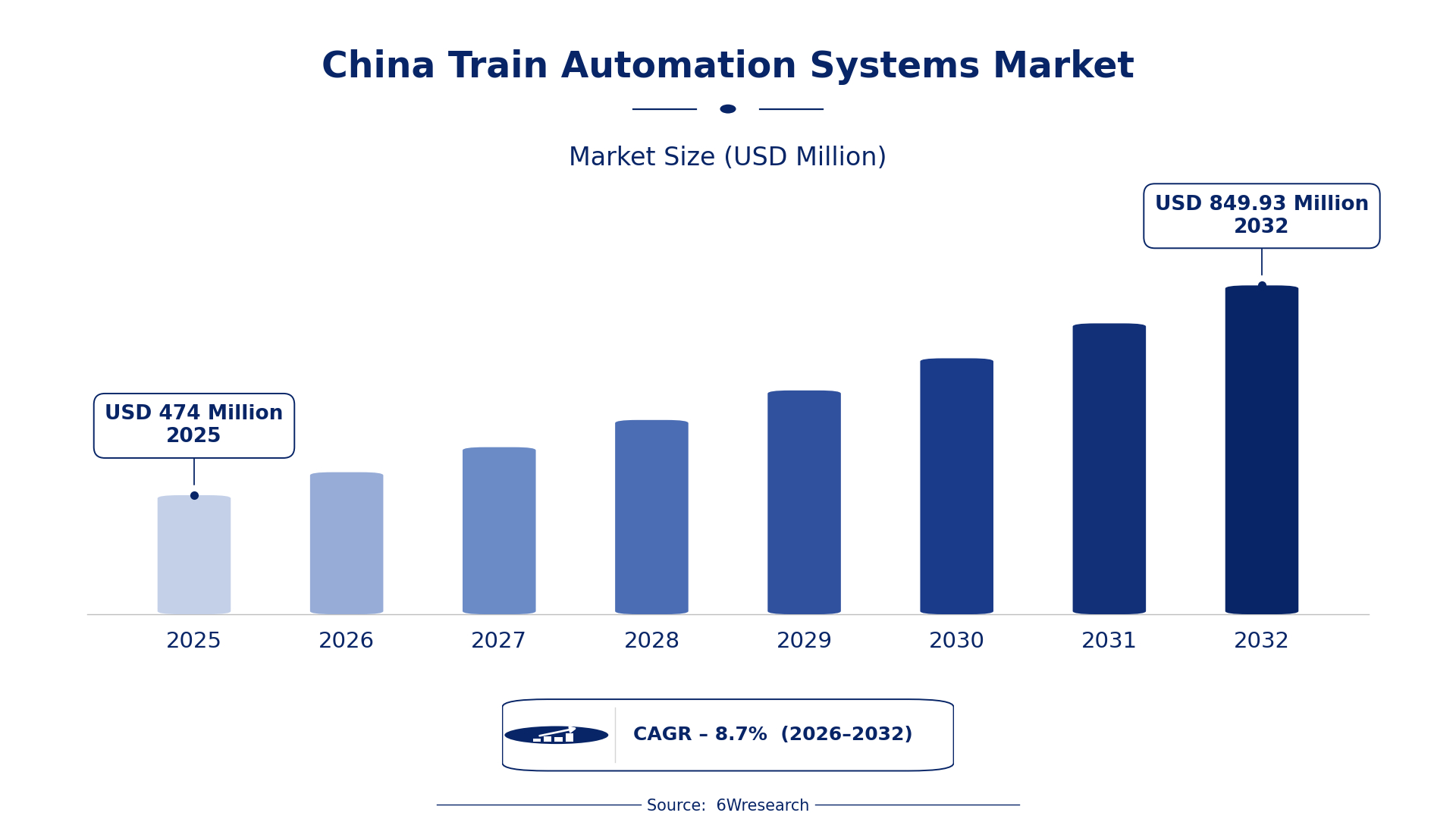
According to 6Wresearch internal database and industry insights, the China Train Automation Systems Market was valued at USD 474.0 million in 2025 and is projected to reach USD 849.93 million by 2032, growing at a CAGR of approximately 8.7% during 2026–2032.
China Train Automation Systems Market Highlights
| Report Metric | Details |
| Report Name | China Train Automation Systems Market |
| Market Size 2025 | USD 474.0 million |
| Market Size 2032 | USD 849.93 million |
| Absolute Growth 2025–2032 | USD 375.93 million |
| CAGR 2026–2032 | 8.7% |
| Peak Annual Growth | 11.1% in 2031 |
| Forecast Period | 2026–2032 |
| Historical Data | 2022–2025 |
| Base Year | 2025 |
| Leading Automation Type, 2025 | CBTC (Communication-Based Train Control) (52% share) |
| Leading Technology Used, 2025 | Sensors + AI (34% share) |
| Leading Application Type, 2025 | Urban Metros (35% share) |
| Leading End User, 2025 | Railway Authorities (43% share) |
| Fastest-Growing Automation Type | ATO (Automatic Train Operation) (9.7% CAGR) |
| Fastest-Growing Application Type | Intercity Trains (10.8% CAGR) |
| Fastest-Growing End User | National Rail Networks (10.3% CAGR) |
| Growing Sector | Urban Rail Systems |
| Key End Users | Railway Authorities, National Rail Networks, OEMs |
China Train Automation Systems Market Year-wise Growth Rate and Key Drivers (2022–2032)
This graph illustrates the annual growth rates of the market from 2022 to 2032, highlighting a steady upward trajectory and projected market expansion over the forecast period.
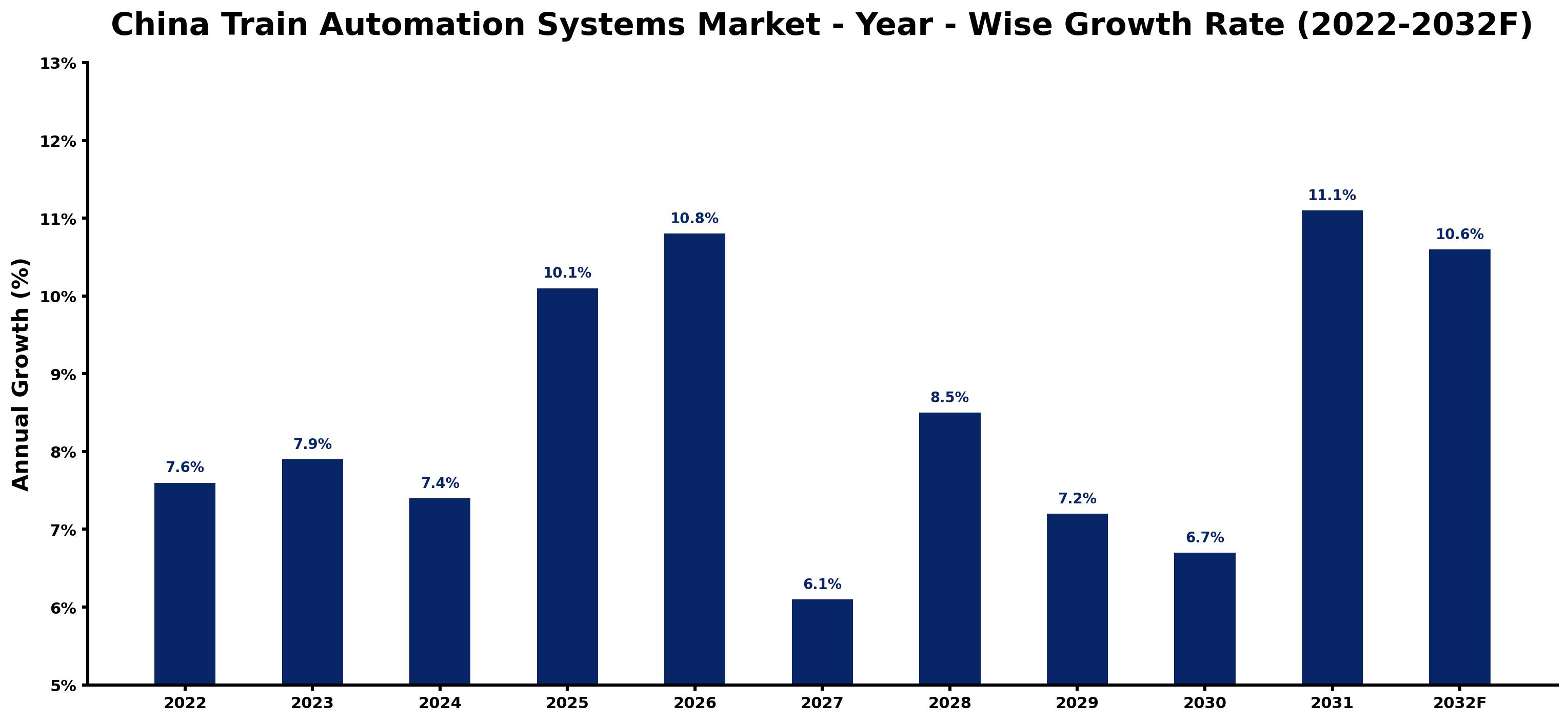
Below, each year's estimated growth is shown next to the factor that most influenced it.
| Year | Estimated Annual Growth (%) | Market Rationale |
| 2022 | 7.6 | The market showed steady growth, reflecting ongoing investments in railway infrastructure. |
| 2023 | 7.9 | Demand increased due to the implementation of advanced automation technologies in urban rail networks. |
| 2024 | 7.4 | Growth slowed as projects reached completion, yet automation remained a priority for railway authorities. |
| 2025 | 10.1 | Strong demand emerged from the completion of new automated lines and systems, particularly in urban metros. |
| 2026 | 10.8 | Continued investment in automation technologies is expected to drive faster growth as infrastructure expands. |
| 2027 | 6.1 | A slowdown is anticipated as market saturation begins to affect new project launches. |
| 2028 | 8.5 | Growth is projected to resume with renewed focus on enhancing operational efficiency in rail systems. |
| 2029 | 7.2 | The market is expected to experience a slowdown as competition intensifies among technology providers. |
| 2030 | 6.7 | Continued investment in safety protocols is projected to contribute to slower growth in automation adoption. |
| 2031 | 11.1 | The peak growth year will be driven by extensive upgrades in train control systems across urban metros. |
| 2032 | 10.6 | A slight slowdown is expected as the market matures, but demand for efficiency remains high. |
Note: Market size estimations and growth projections presented in this report are based on 6Wresearch's proprietary forecasting methodology, utilizing the latest available industry data, government publications, and primary research inputs.
China Train Automation Systems Market Synopsis
Train Automation Systems in China include technologies that enhance safety and efficiency in train operations, such as CBTC, ATO, and driver assistance systems. These technologies improve train scheduling, safety, and operational efficiency across urban and intercity rail networks. The China Train Automation Systems Market is expanding due to significant investments in railway infrastructure and a rising demand for automation technologies. With over 1.4 billion passengers annually, sustained growth is anticipated as authorities implement advanced systems throughout the railway network.
Market Dynamics Impact Analysis (2026–2032)
| Factor | Type | Impact | Primary Segment Affected |
| Growing passenger volume drives demand for efficient train operations. | Driver | High | CBTC (Communication-Based Train Control) |
| Investment in urban metro systems enhances the deployment of automation technologies. | Driver | High | Urban Metros |
| Expansion of railway infrastructure creates opportunities for automation system suppliers. | Opportunity | High | Intercity Trains |
| Increased focus on safety protocols opens avenues for advanced automation solutions. | Opportunity | Medium | Driver Assistance Systems |
| High initial investment costs may deter smaller railway authorities from adopting new systems. | Restraint | High | ATO (Automatic Train Operation) |
| Regulatory compliance requirements can slow down the implementation of new technologies. | Restraint | Medium | Sensors + AI |
| Competition among technology providers may lead to pricing pressures affecting profitability. | Challenge | High | Railway Authorities |
| Technological integration challenges can delay the deployment of automation systems. | Challenge | Medium | National Rail Networks |
Evaluation of Drivers in China Train Automation Systems Market (2026–2032)
Below mentioned are some major drivers and their influence on market dynamics.
| Drivers | Primary Segment Affected | Why It Matters (Evidence) |
| Increased passenger volumes necessitate efficient train scheduling and operations. | CBTC (Communication-Based Train Control) | With over 1.4 billion passengers annually, authorities are investing in real-time management systems. |
| Investment in urban metro systems enhances the deployment of automation technologies. | Urban Metros | China's railway network spans over 77,000 kilometers, supporting extensive metro automation. |
| Government funding for railway projects boosts demand for automation systems. | Intercity Trains | The government plans to invest 800 billion yuan in railway infrastructure by 2025. |
| The introduction of new safety standards encourages the adoption of advanced technologies. | ATO (Automatic Train Operation) | The National Railway Administration issued standards for train automation in 2022. |
| Technological advancements in AI and sensors improve operational efficiency. | Sensors + AI | The average speed of China's high-speed trains is 350 km/h, facilitated by automation. |
The Train Automation Systems market in China is growing on the back of increasing passenger volumes, substantial investments in railway infrastructure, and advancements in technology. With over 1.4 billion passengers annually, railway authorities are adopting CBTC systems for efficient management. The introduction of new safety standards in 2022 encourages the adoption of ATO systems, further driving demand. As a result, the average speed of high-speed trains has reached 350 km/h, demonstrating the impact of these technologies on operational efficiency.
Evaluation of Restraints in China Train Automation Systems Market
The table below lists the restraints and the evidence behind each.
| Market Restraint | Primary Segment Affected | Why It Matters (Evidence) |
| High initial costs deter smaller railway authorities from adopting new systems. | ATO (Automatic Train Operation) | Installation expenses for automation technologies can reach approximately 20% of total project budgets, limiting adoption by smaller authorities. |
| Regulatory compliance requirements can slow down the implementation of new technologies. | Sensors + AI | Complex regulations can delay project approvals by up to six months for suppliers, hindering timely deployment of automation systems. |
| Integration challenges with existing systems can lead to project delays. | CBTC (Communication-Based Train Control) | Legacy systems may not easily accommodate new automation technologies, complicating upgrades and causing delays in implementation. |
| Limited awareness among some railway authorities regarding the benefits of automation. | Driver Assistance Systems | Some authorities may lack the knowledge to implement advanced technologies effectively, hindering adoption and progress in automation. |
| Intense competition among technology providers can lead to pricing pressures affecting profitability. | National Rail Networks | Competition can reduce margins for suppliers in the automation market, impacting their ability to invest in innovation. |
China Train Automation Systems Market Challenges
The China Train Automation Systems market still has to solve a few problems, and the first is regulatory compliance. The National Railway Administration's standards can delay project approvals, causing timelines to extend by up to six months for suppliers. High costs present another challenge, with installation expenses for automation systems reaching approximately 20% of total project budgets, impacting buyers' financial planning. Skills shortages hinder progress, as the industry lacks around 30,000 trained engineers, delaying implementation for producers. Technology integration issues complicate upgrades, with outdated systems stalling projects for urban transport authorities.
Trends in the China Train Automation Systems Market
Four trends stand out in the China Train Automation Systems Market.
- Investment in Urban Metro Automation: China's urban metro systems are increasingly adopting automation technologies, with the Beijing Subway operating 24 lines with advanced systems. The government plans to invest 800 billion yuan by 2025 to support this trend.
- Implementation of New Safety Standards: The National Railway Administration's 2022 standards for train automation are driving improvements in safety protocols. This initiative aims to ensure interoperability and safety across the railway sector, influencing technology adoption among authorities.
- Growing Demand from Railway Authorities: Railway Authorities are prioritising automation to improve operational efficiency and safety. With 1.4 billion passengers annually, the need for advanced systems is clear, pushing for increased investments in automation technologies.
- Integration of AI and Sensors: The use of AI and sensors in train automation is becoming more prevalent. The 'Railway Technology Innovation Action Plan' introduced in 2020 focuses on developing these technologies, improving data collection and processing capabilities.
Investment Opportunities in the China Train Automation Systems Market
The following opportunities in the China Train Automation Systems Market pair current demand with a clear way in.
- Jiangsu Province as a Key Region: Jiangsu province is emerging as a hub for rail automation projects, with significant investments anticipated. The government plans to allocate resources to enhance automation in urban metros, creating opportunities for suppliers.
- Railway Authorities Seeking Advanced Solutions: Railway Authorities are actively searching for advanced automation technologies to improve safety and efficiency. Suppliers can enter this market by forming partnerships with local authorities to implement tailored solutions.
- Supply of Advanced Automation Systems: There is a growing need for advanced automation systems, particularly in intercity trains. Suppliers can capitalise on this demand by offering innovative solutions that meet the latest safety standards.
- Entry through Joint Ventures: Forming joint ventures with local technology providers can facilitate market entry. This approach allows for shared expertise and resources, particularly in regions with ongoing railway infrastructure projects.
Government Initiatives in the China Train Automation Systems Market
The 'Railway Safety Improvement Plan' by the National Railway Administration, launched in 2021, aims to improve automation technologies across the railway sector. This plan mandates the integration of advanced systems to improve safety and operational efficiency. Additionally, the 'Smart Railway Development Plan' initiated in 2022 allocates resources for advanced automation systems, ensuring that railway authorities can implement the latest technologies effectively. These measures support the growth of the train automation systems market in China, promoting safety and efficiency in rail operations.
In 2023, the State Council approved the 'National Rail Transit Safety and Security Plan', which aims to improve safety protocols in automated systems. The Ministry of Transport oversees this initiative, ensuring that funding is allocated for the integration of safety measures in automation technologies. Furthermore, the 'Urban Rail Transit Development Plan' was updated in 2023 to include guidelines for implementing automation in urban metro systems, facilitating the adoption of advanced technologies in key regions.
Future Insight of the China Train Automation Systems Market
The China Train Automation Systems market will undergo transformative changes by 2032, primarily driven by increased government investment in railway infrastructure. The government plans to invest 800 billion yuan by 2025, enhancing system capabilities across the network. The introduction of the 'Smart Railway Development Plan' will promote advanced technologies, improving operational efficiency. By 2032, over 40 operational high-speed rail lines are expected to enhance connectivity, offering buyers more efficient solutions and suppliers greater opportunities for innovation.
Market Segmentation Analysis
Each segment group is reviewed below, with the leader by share and the fastest grower by CAGR.
By Automation Type – CBTC (Communication-Based Train Control) Dominated, ATO (Automatic Train Operation) Expected to Grow Fastest
According to Vasudha, AM at 6Wresearch, in 2025, CBTC (Communication-Based Train Control) led the automation type split with a 52% share. CBTC holds the largest share in the China Train Automation Systems market due to its essential role in real-time train management and safety. The extensive use of CBTC in systems like the Beijing Subway highlights its critical importance in urban rail operations. ATO (Automatic Train Operation) is projected to grow fastest, at a CAGR of 9.7% during 2026–2032. The ATO segment is witnessing rapid growth as it facilitates automated train driving, significantly enhancing operational efficiency. The deployment of ATO systems by the Shanghai Railway Bureau since 2020 illustrates this trend, leading to increased adoption across the nation. Suppliers should prioritise the development of ATO solutions to address the rising demand for efficiency in train operations.
By Technology Used – Sensors + AI Dominated and Is Expected to Record the Fastest Growth
With a 34% revenue share in 2025, Sensors + AI was the largest technology used category. The combination of Sensors and AI commands the largest share in the market, as these technologies are vital for data collection and processing in train automation systems. Their application is crucial for ensuring safety and operational efficiency, making them essential in contemporary railway operations. The same category is also set to grow fastest, at a CAGR of 10.8% during 2026–2032. As Sensors and AI are also the fastest-growing segment, their ongoing advancements will further strengthen their market position. The integration of these technologies is key to the continuous evolution of smart railway systems. Buyers should invest in the latest sensor and AI technologies to maintain competitiveness and enhance operational capabilities.
By Application Type – Urban Metros Dominated, Intercity Trains Expected to Grow Fastest
Urban Metros took a 35% share of application type in 2025, more than any other category. Urban Metros represent the largest share of the market as they are the primary application area for train automation systems. The high passenger volume in major cities like Beijing and Shanghai drives the demand for efficient and safe urban rail solutions. Intercity Trains are set to record the highest CAGR in this split, 10.8% over 2026–2032. Intercity Trains are the fastest-growing segment due to their extensive deployment aimed at improving efficiency in long-distance travel. The ongoing expansion of high-speed rail lines in China supports this growth trajectory. Suppliers must adjust their offerings to meet the increasing demand for automation in intercity train operations.
By End User – Railway Authorities Dominated, National Rail Networks Expected to Grow Fastest
Railway Authorities accounted for a 43% market share by end user in 2025. Railway Authorities dominate the market share as the primary users of train automation systems, responsible for implementing and overseeing these technologies across networks. Their focus on safety and efficiency in rail operations drives substantial investment in automation. Over 2026–2032, National Rail Networks are expected to post the fastest growth, at a CAGR of 10.3%. National Rail Networks are the fastest-growing segment, as they play a vital role in the adoption of advanced automation technologies. Their commitment to enhancing service quality and operational efficiency fuels this growth. Suppliers should align their strategies with the priorities of National Rail Networks to seize emerging opportunities in the market.
Key Attractiveness of the Report
- 10 Years of Market Numbers
- Historical Data Starting from 2022 to 2025
- Base Year 2025
- Forecast Data until 2032
- Key Performance Indicators Impacting the Market
- Major Upcoming Developments and Projects
Key Highlights of the Report:
- China Train Automation Systems Market Outlook
- Market Size of China Train Automation Systems Market, 2025
- Forecast of China Train Automation Systems Market, 2032
- Historical Data and Forecast of China Train Automation Systems Revenues & Volume for the Period 2022 - 2032F
- China Train Automation Systems Market Trend Evolution
- China Train Automation Systems Market Drivers and Challenges
- China Train Automation Systems Price Trends
- China Train Automation Systems Porter's Five Forces
- China Train Automation Systems Industry Life Cycle
- Historical Data and Forecast of China Train Automation Systems Market Revenues & Volume By Automation Type for the Period 2022 - 2032F
- Historical Data and Forecast of China Train Automation Systems Market Revenues & Volume By CBTC (Communication-Based Train Control) for the Period 2022 - 2032F
- Historical Data and Forecast of China Train Automation Systems Market Revenues & Volume By ATO (Automatic Train Operation) for the Period 2022 - 2032F
- Historical Data and Forecast of China Train Automation Systems Market Revenues & Volume By Driver Assistance Systems for the Period 2022 - 2032F
- Historical Data and Forecast of China Train Automation Systems Market Revenues & Volume By Fully Autonomous Train Systems for the Period 2022 - 2032F
- Historical Data and Forecast of China Train Automation Systems Market Revenues & Volume By Technology Used for the Period 2022 - 2032F
- Historical Data and Forecast of China Train Automation Systems Market Revenues & Volume By Wireless Signals for the Period 2022 - 2032F
- Historical Data and Forecast of China Train Automation Systems Market Revenues & Volume By Sensors + AI for the Period 2022 - 2032F
- Historical Data and Forecast of China Train Automation Systems Market Revenues & Volume By Cameras + Algorithms for the Period 2022 - 2032F
- Historical Data and Forecast of China Train Automation Systems Market Revenues & Volume By IoT + Cloud for the Period 2022 - 2032F
- Historical Data and Forecast of China Train Automation Systems Market Revenues & Volume By Application Type for the Period 2022 - 2032F
- Historical Data and Forecast of China Train Automation Systems Market Revenues & Volume By Urban Metros for the Period 2022 - 2032F
- Historical Data and Forecast of China Train Automation Systems Market Revenues & Volume By Intercity Trains for the Period 2022 - 2032F
- Historical Data and Forecast of China Train Automation Systems Market Revenues & Volume By Regional Rail for the Period 2022 - 2032F
- Historical Data and Forecast of China Train Automation Systems Market Revenues & Volume By Industrial Rail for the Period 2022 - 2032F
- Historical Data and Forecast of China Train Automation Systems Market Revenues & Volume By End User for the Period 2022 - 2032F
- Historical Data and Forecast of China Train Automation Systems Market Revenues & Volume By Railway Authorities for the Period 2022 - 2032F
- Historical Data and Forecast of China Train Automation Systems Market Revenues & Volume By National Rail Networks for the Period 2022 - 2032F
- Historical Data and Forecast of China Train Automation Systems Market Revenues & Volume By OEMs for the Period 2022 - 2032F
- Historical Data and Forecast of China Train Automation Systems Market Revenues & Volume By Mining Companies for the Period 2022 - 2032F
- China Train Automation Systems Import Export Trade Statistics
- Market Opportunity Assessment By Automation Type
- Market Opportunity Assessment By Technology Used
- Market Opportunity Assessment By Application Type
- Market Opportunity Assessment By End User
- China Train Automation Systems Top Companies Market Share
- China Train Automation Systems Competitive Benchmarking By Technical and Operational Parameters
- China Train Automation Systems Company Profiles
- China Train Automation Systems Key Strategic Recommendations
Market Covered
This report examines the market across the segments below.
By Automation Type
- CBTC (Communication-Based Train Control)
- ATO (Automatic Train Operation)
- Driver Assistance Systems
- Fully Autonomous Train Systems
By Technology Used
- Wireless Signals
- Sensors + AI
- Cameras + Algorithms
- IoT + Cloud
By Application Type
- Urban Metros
- Intercity Trains
- Regional Rail
- Industrial Rail
By End User
- Railway Authorities
- National Rail Networks
- OEMs
- Mining Companies































