India Transplant Immunosuppressive Drugs Market Size & Growth Rate
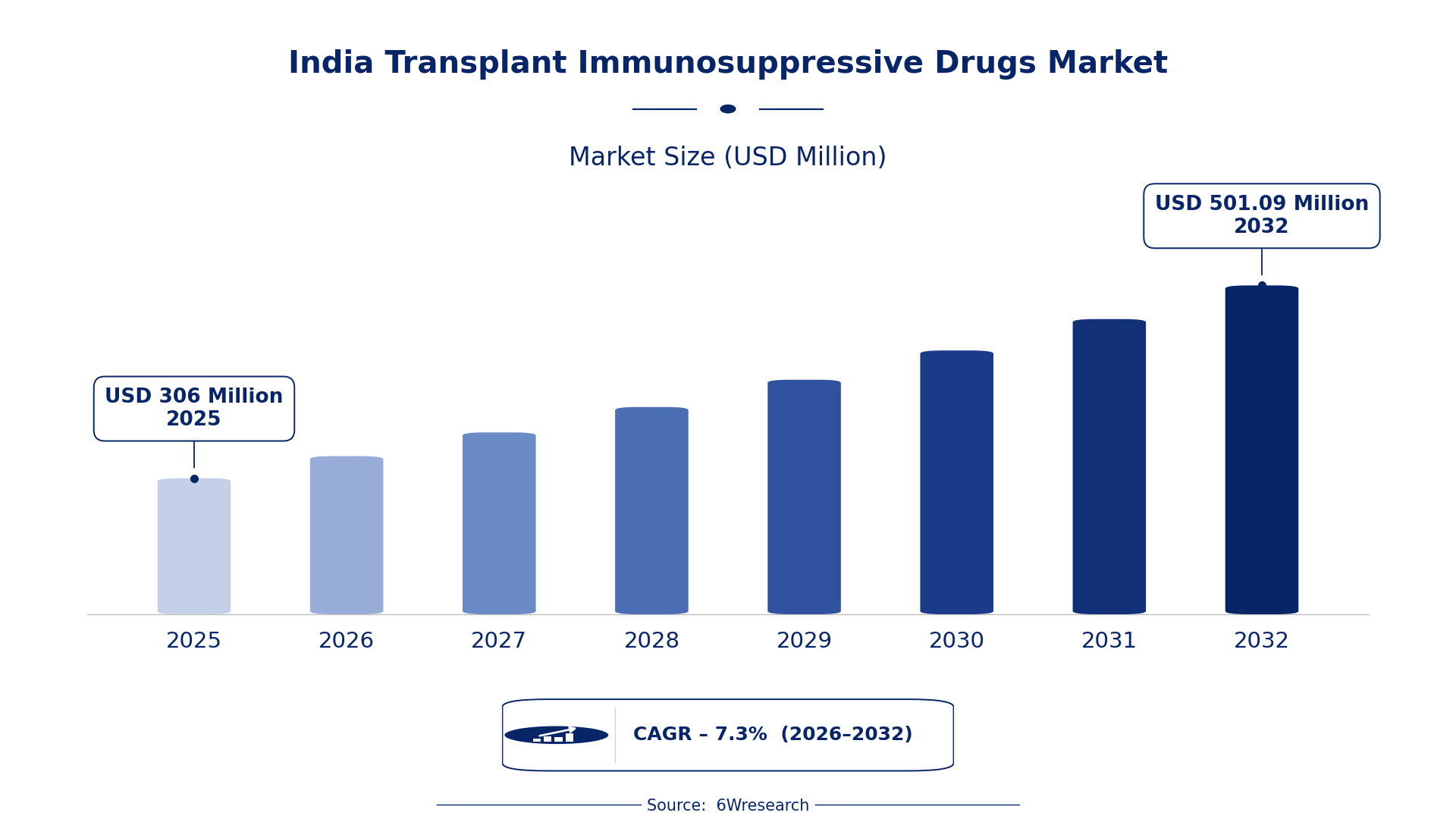
According to 6Wresearch internal database and industry insights, the India Transplant Immunosuppressive Drugs Market was valued at USD 306.0 million in 2025 and is projected to reach USD 501.09 million by 2032, growing at a CAGR of approximately 7.3% during 2026–2032.
India Transplant Immunosuppressive Drugs Market Highlights
| Report Metric | Details |
| Report Name | India Transplant Immunosuppressive Drugs Market |
| Market Size 2025 | USD 306.0 million |
| Market Size 2032 | USD 501.09 million |
| Absolute Growth 2025–2032 | USD 195.09 million |
| CAGR 2026–2032 | 7.3% |
| Peak Annual Growth | 8.7% in 2032 |
| Forecast Period | 2026–2032 |
| Historical Data | 2022–2025 |
| Base Year | 2025 |
| Leading Drug Type, 2025 | Calcineurin Inhibitors (48% share) |
| Leading Mechanism, 2025 | T-cell Suppression (48% share) |
| Leading Transplant Type, 2025 | Kidney (45% share) |
| Leading End User, 2025 | Hospitals (44% share) |
| Fastest-Growing Drug Type | mTOR Inhibitors (9.3% CAGR) |
| Fastest-Growing Transplant Type | Liver (10.0% CAGR) |
| Fastest-Growing End User | Transplant Clinics (8.5% CAGR) |
| Growing Sector | Transplant Clinics |
| Key End Users | Hospitals, Transplant Clinics, Specialty Pharmacies |
India Transplant Immunosuppressive Drugs Market Year-wise Growth Rate and Key Drivers (2022–2032)
This graph illustrates the annual growth rates of the market from 2022 to 2032, highlighting a steady upward trajectory and projected market expansion over the forecast period.
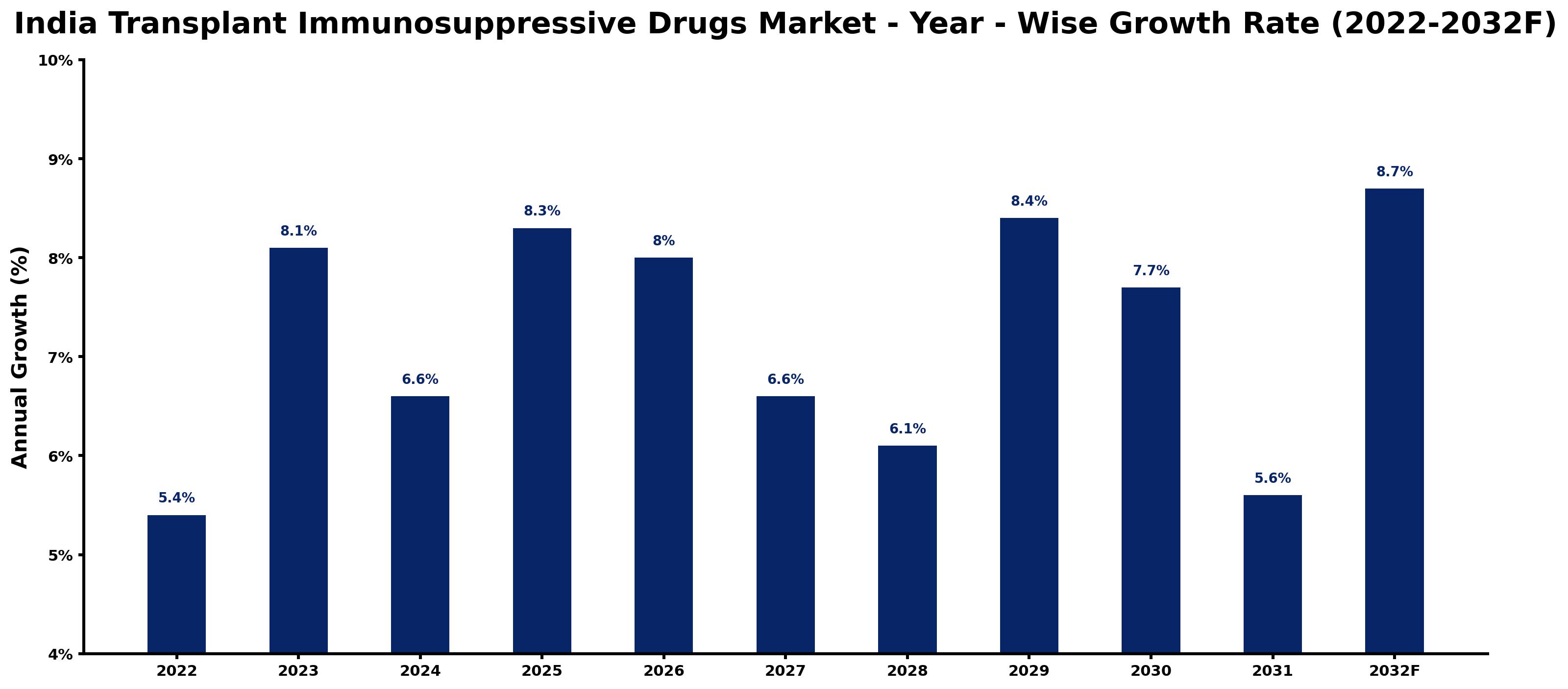
Below, each year's estimated growth is shown next to the factor that most influenced it.
| Year | Estimated Annual Growth (%) | Market Rationale |
| 2022 | 5.4 | The market showed steady growth as transplant surgeries increased across India. |
| 2023 | 8.1 | Demand surged due to a rise in kidney transplants and awareness campaigns. |
| 2024 | 6.6 | Growth slowed as hospitals adjusted to the National Organ Donation Program and new procedures. |
| 2025 | 8.3 | Surgeons performed more kidney transplants, driving demand for immunosuppressive drugs. |
| 2026 | 8.0 | A slight slowdown occurred as the market stabilised after rapid growth. |
| 2027 | 6.6 | Demand continued to rise, despite a further slowdown in growth rate. |
| 2028 | 6.1 | The market saw continued growth as awareness of organ donation increased through government initiatives. |
| 2029 | 8.4 | A rebound in growth occurred as more liver transplants were performed due to rising disease incidence. |
| 2030 | 7.7 | Growth slowed again as hospitals faced resource allocation challenges in meeting transplant needs. |
| 2031 | 5.6 | Demand remained steady, but growth slowed due to market saturation and limited donor availability. |
| 2032 | 8.7 | The market peaked as new transplant centers opened, boosting demand for immunosuppressive drugs. |
Note: Market size estimations and growth projections presented in this report are based on 6Wresearch's proprietary forecasting methodology, utilizing the latest available industry data, government publications, and primary research inputs.
India Transplant Immunosuppressive Drugs Market Synopsis
Transplant Immunosuppressive Drugs in India are pharmaceutical agents that prevent organ rejection in transplant patients. These drugs are synthesized through complex chemical processes and are primarily used in post-transplant care. The India Transplant Immunosuppressive Drugs Market is growing due to an increase in transplant surgeries, especially kidney and liver transplants. In 2022, more than 5,000 kidney transplants were performed, highlighting strong demand. Factors such as heightened awareness through government initiatives and the establishment of additional transplant centres are propelling this growth.
Market Dynamics Impact Analysis (2026–2032)
| Factor | Type | Impact | Primary Segment Affected |
| Growing number of transplant surgeries in hospitals | Driver | High | Kidney |
| Increased awareness of organ donation | Driver | Medium | Liver |
| Expansion of transplant clinics in urban areas | Opportunity | High | Transplant Clinics |
| Rising demand for specialty pharmacies for post-transplant care | Opportunity | Medium | Specialty Pharmacies |
| Limited availability of organ donors | Restraint | High | Kidney |
| Regulatory hurdles in organ transplantation processes | Restraint | Medium | Liver |
| High costs associated with immunosuppressive drugs | Challenge | High | Kidney |
| Long waiting times for organ transplants | Challenge | Medium | Liver |
Evaluation of Drivers in India Transplant Immunosuppressive Drugs Market (2026–2032)
Below mentioned are some major drivers and their influence on market dynamics.
| Drivers | Primary Segment Affected | Why It Matters (Evidence) |
| Increased transplant surgeries | Kidney | Over 5,000 kidney transplants were performed in 2022, driving demand for immunosuppressive drugs. |
| Awareness campaigns | Liver | The National Organ Donation Program has raised awareness, leading to more liver transplants and increased demand for drugs. |
| Growth of transplant clinics | Transplant Clinics | Urban areas are seeing a rise in transplant clinics, increasing access to post-transplant care and medications. |
| Demand for specialty pharmacies | Specialty Pharmacies | Specialty pharmacies are expanding to meet the needs of transplant patients in urban regions, enhancing medication access. |
| Regulatory support for organ donation | Kidney | The National Organ Donation Program aims to increase organ donation rates, boosting demand for immunosuppressive therapies. |
The Transplant Immunosuppressive Drugs market in India is expanding as hospitals perform more transplant surgeries, particularly kidney and liver procedures. Over 5,000 kidney transplants were conducted in 2022, increasing the demand for immunosuppressive drugs. The establishment of transplant clinics in urban areas is improving patient access to post-transplant care. Growth in specialty pharmacies is catering to the specific needs of transplant patients, further driving demand for these essential drugs.
Evaluation of Restraints in India Transplant Immunosuppressive Drugs Market
The following restraints limit how fast demand can grow.
| Market Restraint | Primary Segment Affected | Why It Matters (Evidence) |
| Limited organ donor availability | Kidney | The average waiting time for a kidney transplant is about 3-5 years, constraining market growth. |
| Regulatory hurdles in transplantation | Liver | Complex regulations can delay the approval of new transplant centers and procedures, affecting patient access. |
| High costs of immunosuppressive drugs | Kidney | The high cost of these drugs can limit access for patients needing transplants, particularly in lower-income groups. |
| Insufficient public awareness of organ donation | Liver | Despite efforts, many potential donors remain unaware of the importance of organ donation, limiting donor registration rates. |
| Resource allocation challenges in hospitals | Transplant Clinics | Hospitals often face budget constraints, affecting the availability of transplant services and patient care. |
India Transplant Immunosuppressive Drugs Market Challenges
In the India transplant immunosuppressive drugs market, many hospitals encounter issues due to outdated technology, which limits their ability to perform complex organ transplants. This technological gap delays access to vital immunosuppressive therapies, adversely affecting patient recovery outcomes. High costs present another challenge, as the average monthly price for these drugs can exceed 30,000 INR, straining hospital budgets and restricting treatment options for patients. Supply chain disruptions complicate matters, with inconsistent drug availability leading to treatment interruptions that threaten patient health. Additionally, a shortage of skilled healthcare professionals in transplant centres contributes to an average waiting time of 3-5 years for kidney transplants, complicating patient care further.
Trends in the India Transplant Immunosuppressive Drugs Market
The trends below show where the India Transplant Immunosuppressive Drugs Market is heading.
- Shift towards Increased Awareness of Organ Donation: The National Organ Donation Program, launched in 2021, has raised awareness about organ donation in India. This initiative aims to increase donation rates, contributing to a rise in transplant surgeries by 15%.
- Transition from Traditional to Specialty Pharmacies: Specialty pharmacies are increasingly catering to the needs of transplant patients, particularly in urban areas. The growth of these pharmacies is projected to rise by 20% over the next five years, improving patient access to necessary medications.
- Emerging Focus on Liver Transplants: Liver transplants are gaining attention due to the rising incidence of liver diseases in India. The market for liver transplant drugs is projected to grow by 10% annually, reflecting this shift in focus.
- Expansion of Urban Transplant Clinics: Urban areas are witnessing a rise in specialized transplant clinics, which are essential for post-transplant care. With over 30 dedicated centres, the demand for these clinics is expected to increase significantly.
Investment Opportunities in the India Transplant Immunosuppressive Drugs Market
Below are the investment opportunities with the strongest case in the India Transplant Immunosuppressive Drugs Market.
- Growth of Urban Transplant Clinics: Urban transplant clinics are expanding rapidly, with a projected growth rate of 25%. Investing in these facilities can meet the rising demand for kidney and liver transplants in metropolitan areas.
- Increasing Demand for Specialty Pharmacies: Specialty pharmacies are now essential for providing post-transplant care. With urban areas experiencing a significant rise in demand, suppliers can partner with these pharmacies to ensure medication availability.
- Expansion of Organ Donation Awareness Programs: The National Health Mission's initiative in 2023 aims to raise awareness about organ donation in rural areas. This presents an opportunity for educational campaigns and partnerships to improve donor registration rates.
- Investment in New Transplant Centers: The Ministry of Health's initiative promotes establishing more transplant centres in underserved regions. This presents an opportunity for investment in infrastructure to support growing transplant needs.
Government Initiatives in the India Transplant Immunosuppressive Drugs Market
The Transplantation of Human Organs (Amendment) Bill, 2020, passed by the Ministry of Health and Family Welfare, enhances the organ donation and transplantation processes in India. This amendment aims to streamline the procedures for organ donation, making it easier for hospitals to comply with regulations. It builds upon the foundational Transplantation of Human Organs Act, which has been pivotal in regulating organ transplantation since its inception. The updated legislation encourages more hospitals to participate in organ donation initiatives, ultimately increasing the availability of transplant immunosuppressive drugs for patients. The National Organ Donation Program, launched in 2021, further supports this framework by promoting awareness and increasing organ donation rates across the country.
The National Organ and Tissue Transplant Organization (NOTTO) plays a crucial role in overseeing organ transplantation in India. This agency is responsible for coordinating organ procurement and distribution, ensuring that hospitals have access to the organs needed for transplants. Additionally, the Indian Council of Medical Research (ICMR) provides guidelines for ethical practices in organ transplantation, which are essential for maintaining standards in the industry. The National Health Mission's initiative in 2023 focuses on raising awareness about organ donation in rural areas, which is vital for expanding the donor pool. Together, these agencies and initiatives are instrumental in enhancing the infrastructure and support for transplant immunosuppressive drugs in India.
Future Insight of the India Transplant Immunosuppressive Drugs Market
Several forward-looking factors should support the India transplant immunosuppressive drugs market over the coming years. New transplant centres are being established, which will likely increase the number of procedures performed and heighten demand for these therapies. Awareness initiatives from the National Health Mission are expected to elevate organ donation rates, further driving the need for immunosuppressive treatments. Compliance with guidelines from the Indian Council of Medical Research will improve the standard of care, reassuring patients and encouraging more transplants. By 2032, these developments will create a more responsive market environment.
Market Segmentation Analysis
Each segment group is reviewed below, with the leader by share and the fastest grower by CAGR.
By Drug Type – Calcineurin Inhibitors Dominated, mTOR Inhibitors Expected to Grow Fastest
According to Vasudha, AM at 6Wresearch, Calcineurin Inhibitors took a 48% share of drug type in 2025, more than any other category. Calcineurin Inhibitors command the largest share in India's transplant immunosuppressive drugs market, primarily due to their established use in preventing organ rejection. Their significance is underscored by the over 5,000 kidney transplants performed in 2022, which heavily depend on these agents. The quickest growth will come from mTOR Inhibitors, forecast to expand at a CAGR of 9.3% between 2026 and 2032. mTOR Inhibitors are experiencing the fastest growth as healthcare providers increasingly recognise their effectiveness in preventing rejection. The surge in transplant surgeries, projected to rise further in 2023, is driving demand for these advanced therapies, solidifying their market position. Suppliers should focus on ensuring the availability of mTOR Inhibitors to meet the growing needs of transplant patients in India.
By Mechanism – T-cell Suppression Dominated and Is Expected to Record the Fastest Growth
With a 48% revenue share in 2025, T-cell Suppression was the largest mechanism category. T-cell Suppression leads the market as it is vital for preventing T-cell mediated rejection in transplant patients. This mechanism is widely adopted across India's numerous transplant centres, ensuring its substantial market share. Its lead should widen, with a projected CAGR of 9.8% during 2026–2032, the highest in this split. T-cell Suppression is also the fastest growing mechanism due to its proven effectiveness in recent transplant procedures. As hospitals increasingly adopt advanced techniques, reliance on this mechanism will likely expand further. Suppliers should focus on research and development to support the rising demand for T-cell Suppression therapies in the transplant immunosuppressive drugs market.
By Transplant Type – Kidney Dominated, Liver Expected to Grow Fastest
Kidney accounted for a 45% market share by transplant type in 2025. Kidney transplants dominate the Indian market, accounting for the majority of procedures performed annually. With over 5,000 kidney transplants in 2022, this segment holds a substantial market share due to its prevalence and established protocols. Liver is projected to grow fastest, at a CAGR of 10.0% during 2026–2032. Liver transplants are the fastest growing segment, driven by the increasing incidence of liver diseases in the population. The rising awareness and availability of transplant facilities are contributing to this growth. Suppliers should consider targeting the liver transplant segment to capitalise on the increasing demand for immunosuppressive drugs in this area.
By End User – Hospitals Dominated, Transplant Clinics Expected to Grow Fastest
Hospitals held a 44% share of the India Transplant Immunosuppressive Drugs Market by end user in 2025. Hospitals dominate the market share in the transplant immunosuppressive drugs sector as they are the primary providers of transplant services in India. With over 30 dedicated transplant centres, they are crucial for delivering comprehensive post-transplant care. Transplant Clinics are set to record the highest CAGR in this split, 8.5% over 2026–2032. Transplant Clinics are rapidly gaining traction as specialised facilities for post-transplant care, reflecting a shift in patient management strategies. The increasing number of transplant surgeries is likely to accelerate demand for immunosuppressive drugs in these clinics. Suppliers should enhance collaborations with transplant clinics to ensure a steady supply of immunosuppressive drugs in response to the market's growth.
Key Attractiveness of the Report
- 10 Years of Market Numbers
- Historical Data Starting from 2022 to 2025
- Base Year 2025
- Forecast Data until 2032
- Key Performance Indicators Impacting the Market
- Major Upcoming Developments and Projects
Key Highlights of the Report:
- India Transplant Immunosuppressive Drugs Market Outlook
- Market Size of India Transplant Immunosuppressive Drugs Market, 2025
- Forecast of India Transplant Immunosuppressive Drugs Market, 2032
- Historical Data and Forecast of India Transplant Immunosuppressive Drugs Revenues & Volume for the Period 2022 - 2032F
- India Transplant Immunosuppressive Drugs Market Trend Evolution
- India Transplant Immunosuppressive Drugs Market Drivers and Challenges
- India Transplant Immunosuppressive Drugs Price Trends
- India Transplant Immunosuppressive Drugs Porter's Five Forces
- India Transplant Immunosuppressive Drugs Industry Life Cycle
- Historical Data and Forecast of India Transplant Immunosuppressive Drugs Market Revenues & Volume By Drug Type for the Period 2022 - 2032F
- Historical Data and Forecast of India Transplant Immunosuppressive Drugs Market Revenues & Volume By Calcineurin Inhibitors for the Period 2022 - 2032F
- Historical Data and Forecast of India Transplant Immunosuppressive Drugs Market Revenues & Volume By Corticosteroids for the Period 2022 - 2032F
- Historical Data and Forecast of India Transplant Immunosuppressive Drugs Market Revenues & Volume By mTOR Inhibitors for the Period 2022 - 2032F
- Historical Data and Forecast of India Transplant Immunosuppressive Drugs Market Revenues & Volume By Monoclonal Antibodies for the Period 2022 - 2032F
- Historical Data and Forecast of India Transplant Immunosuppressive Drugs Market Revenues & Volume By Mechanism for the Period 2022 - 2032F
- Historical Data and Forecast of India Transplant Immunosuppressive Drugs Market Revenues & Volume By T-cell Suppression for the Period 2022 - 2032F
- Historical Data and Forecast of India Transplant Immunosuppressive Drugs Market Revenues & Volume By Anti-inflammatory for the Period 2022 - 2032F
- Historical Data and Forecast of India Transplant Immunosuppressive Drugs Market Revenues & Volume By Cell Cycle Control for the Period 2022 - 2032F
- Historical Data and Forecast of India Transplant Immunosuppressive Drugs Market Revenues & Volume By B/T Cell Blockers for the Period 2022 - 2032F
- Historical Data and Forecast of India Transplant Immunosuppressive Drugs Market Revenues & Volume By Transplant Type for the Period 2022 - 2032F
- Historical Data and Forecast of India Transplant Immunosuppressive Drugs Market Revenues & Volume By Kidney, Liver for the Period 2022 - 2032F
- Historical Data and Forecast of India Transplant Immunosuppressive Drugs Market Revenues & Volume By Heart, Lung for the Period 2022 - 2032F
- Historical Data and Forecast of India Transplant Immunosuppressive Drugs Market Revenues & Volume By Pancreas, Intestine for the Period 2022 - 2032F
- Historical Data and Forecast of India Transplant Immunosuppressive Drugs Market Revenues & Volume By Bone Marrow for the Period 2022 - 2032F
- Historical Data and Forecast of India Transplant Immunosuppressive Drugs Market Revenues & Volume By End User for the Period 2022 - 2032F
- Historical Data and Forecast of India Transplant Immunosuppressive Drugs Market Revenues & Volume By Hospitals for the Period 2022 - 2032F
- Historical Data and Forecast of India Transplant Immunosuppressive Drugs Market Revenues & Volume By Transplant Clinics for the Period 2022 - 2032F
- Historical Data and Forecast of India Transplant Immunosuppressive Drugs Market Revenues & Volume By Organ Banks for the Period 2022 - 2032F
- Historical Data and Forecast of India Transplant Immunosuppressive Drugs Market Revenues & Volume By Specialty Pharmacies for the Period 2022 - 2032F
- India Transplant Immunosuppressive Drugs Import Export Trade Statistics
- Market Opportunity Assessment By Drug Type
- Market Opportunity Assessment By Mechanism
- Market Opportunity Assessment By Transplant Type
- Market Opportunity Assessment By End User
- India Transplant Immunosuppressive Drugs Top Companies Market Share
- India Transplant Immunosuppressive Drugs Competitive Benchmarking By Technical and Operational Parameters
- India Transplant Immunosuppressive Drugs Company Profiles
- India Transplant Immunosuppressive Drugs Key Strategic Recommendations
Market Covered
This report examines the market across the segments below.
By Drug Type
- Calcineurin Inhibitors
- Corticosteroids
- mTOR Inhibitors
- Monoclonal Antibodies
By Mechanism
- T-cell Suppression
- Anti-inflammatory
- Cell Cycle Control
- B/T Cell Blockers
By Transplant Type
- Kidney
- Liver
- Heart
- Lung
- Pancreas
- Intestine
- Bone Marrow
By End User
- Hospitals
- Transplant Clinics
- Organ Banks
- Specialty Pharmacies































