China Transplant Immunosuppressive Drugs Market Size & Growth Rate
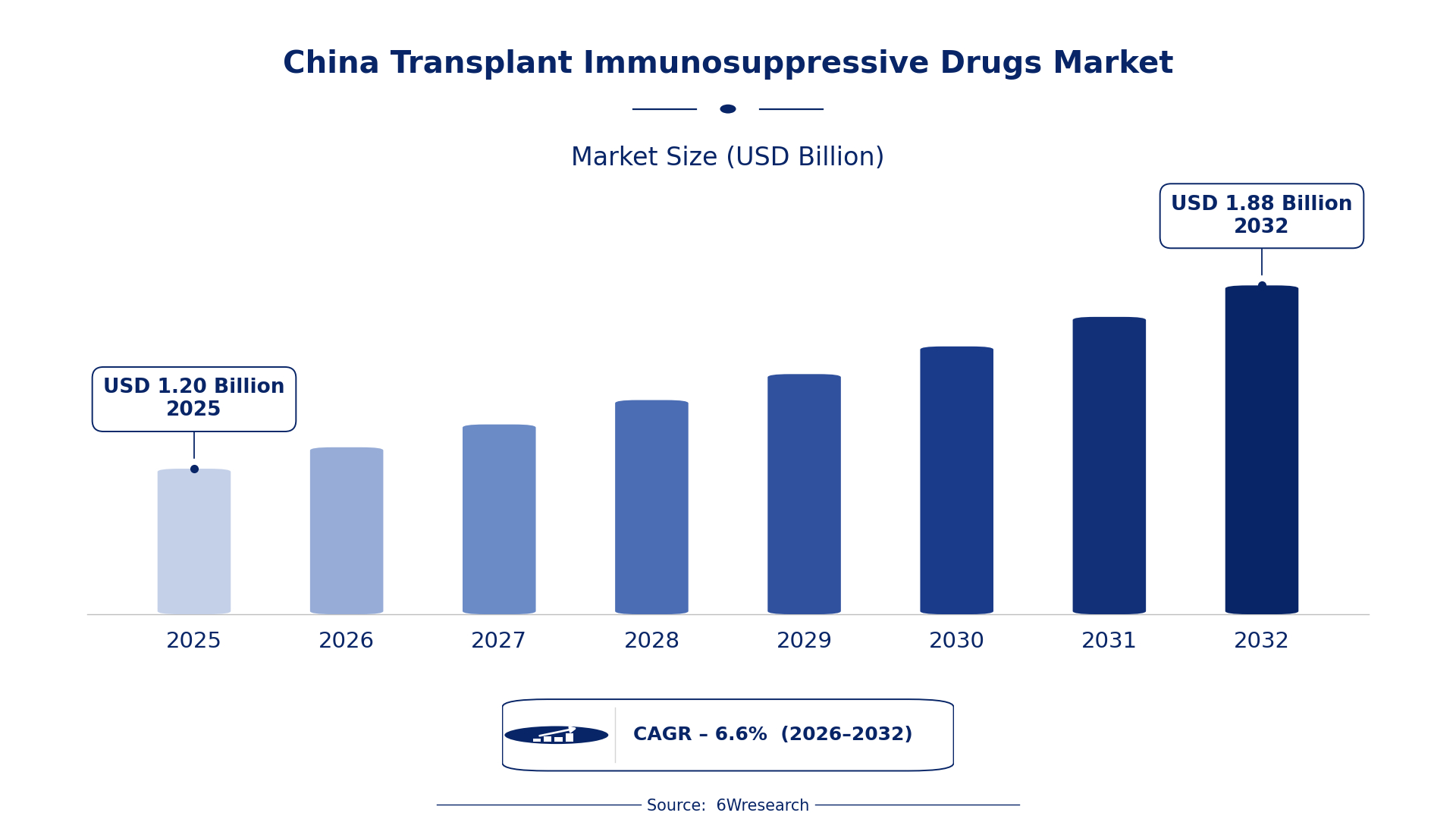
According to 6Wresearch internal database and industry insights, the China Transplant Immunosuppressive Drugs Market was valued at USD 1.20 billion in 2025 and is projected to reach USD 1.88 billion by 2032, growing at a CAGR of approximately 6.6% during 2026–2032.
China Transplant Immunosuppressive Drugs Market Highlights
| Report Metric | Details |
| Report Name | China Transplant Immunosuppressive Drugs Market |
| Market Size 2025 | USD 1.20 billion |
| Market Size 2032 | USD 1.88 billion |
| Absolute Growth 2025–2032 | USD 0.68 billion |
| CAGR 2026–2032 | 6.6% |
| Peak Annual Growth | 8.4% in 2031 |
| Forecast Period | 2026–2032 |
| Historical Data | 2022–2025 |
| Base Year | 2025 |
| Leading Drug Type, 2025 | Calcineurin Inhibitors (40% share) |
| Leading Mechanism, 2025 | T-cell Suppression (42% share) |
| Leading Transplant Type, 2025 | Kidney (37% share) |
| Leading End User, 2025 | Hospitals (46% share) |
| Fastest-Growing Drug Type | mTOR Inhibitors (8.8% CAGR) |
| Fastest-Growing Mechanism | Cell Cycle Control (9.3% CAGR) |
| Fastest-Growing Transplant Type | Liver (8.1% CAGR) |
| Fastest-Growing End User | Transplant Clinics (9.4% CAGR) |
| Growing Sector | Transplant Clinics |
| Key End Users | Hospitals, Transplant Clinics, Organ Banks |
China Transplant Immunosuppressive Drugs Market Year-wise Growth Rate and Key Drivers (2022–2032)
This graph illustrates the annual growth rates of the market from 2022 to 2032, highlighting a steady upward trajectory and projected market expansion over the forecast period.
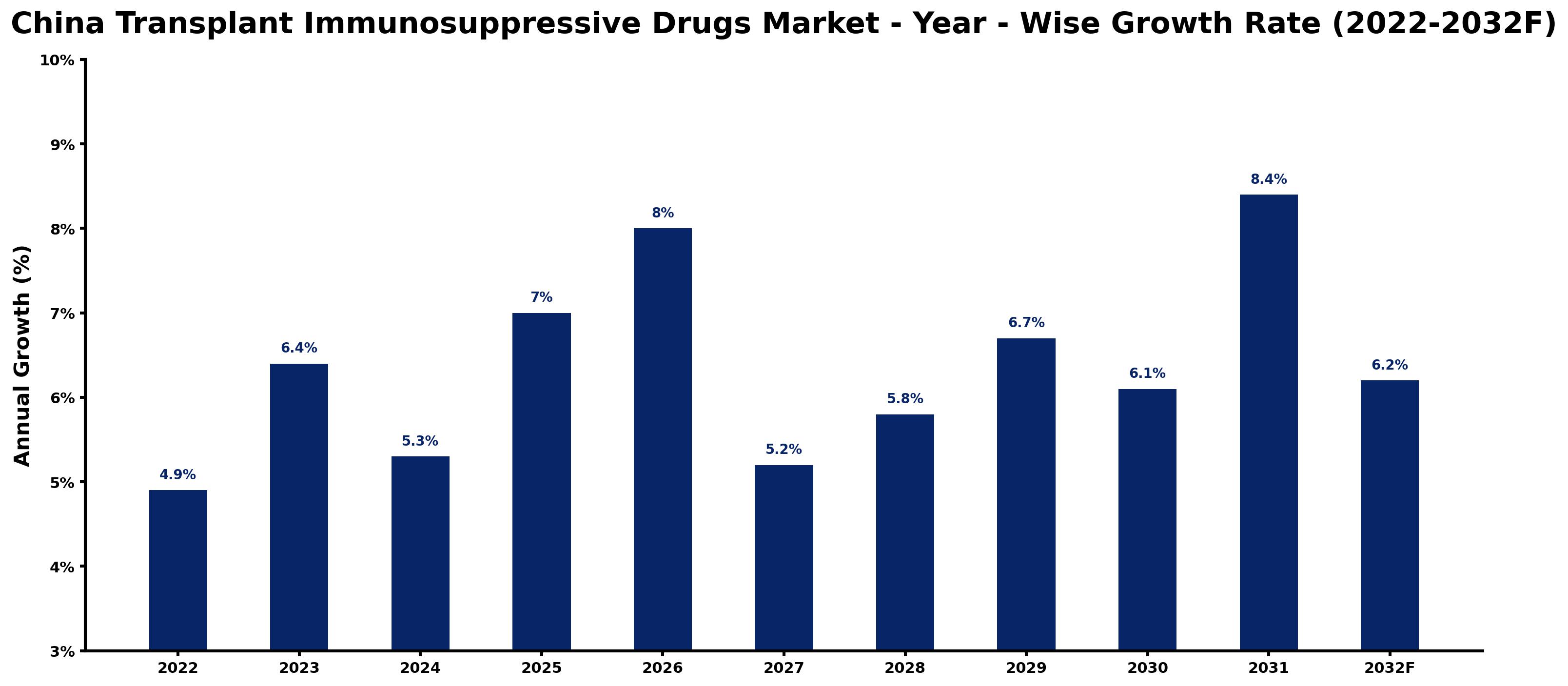
The following table presents the estimated annual growth rate for each year together with the principal factor influencing market performance.
| Year | Estimated Annual Growth (%) | Market Rationale |
| 2022 | 4.9 | The market experienced steady demand from hospitals and transplant clinics. |
| 2023 | 6.4 | Growth was driven by increased kidney transplant procedures across the country. |
| 2024 | 5.3 | A slight slowdown occurred as the market adjusted to regulatory changes. |
| 2025 | 7.0 | Demand surged due to the implementation of new organ donation initiatives. |
| 2026 | 8.0 | The market is expected to see heightened investment in transplant-related healthcare infrastructure. |
| 2027 | 5.2 | A slowdown is noted as the market stabilises after rapid growth. |
| 2028 | 5.8 | Growth is projected to resume with advancements in transplant techniques in major cities. |
| 2029 | 6.7 | Demand is expected to increase as more patients seek kidney transplants. |
| 2030 | 6.1 | A slight slowdown will be observed as the market reaches a mature phase. |
| 2031 | 8.4 | The peak growth year is driven by rising organ transplant numbers due to the National Organ Donation and Transplantation Plan. |
| 2032 | 6.2 | A gradual slowdown reflects market maturity and stabilisation as hospitals adapt to new regulations. |
Note: Market size estimations and growth projections presented in this report are based on 6Wresearch's proprietary forecasting methodology, utilizing the latest available industry data, government publications, and primary research inputs.
China Transplant Immunosuppressive Drugs Market Synopsis
Transplant Immunosuppressive Drugs in China are pharmaceutical agents used to prevent organ rejection in transplant recipients. These drugs are synthesized through complex processes and are essential for maintaining the function of transplanted organs like kidneys and livers. The China Transplant Immunosuppressive Drugs Market is expanding due to rising healthcare needs and increased transplant procedures. In 2022, approximately 30,000 kidney transplants were reported, highlighting the growing demand. Ongoing organ donation campaigns and advancements in transplant techniques are further driving market growth.
Market Dynamics Impact Analysis (2026–2032)
| Factor | Type | Impact | Primary Segment Affected |
| Increased kidney transplant procedures drive demand for immunosuppressive drugs. | Driver | High | Calcineurin Inhibitors |
| Growing awareness and acceptance of organ donation boosts market potential. | Driver | High | Corticosteroids |
| Investment in transplant clinics enhances service delivery and drug access. | Opportunity | High | Transplant Clinics |
| Emerging mTOR Inhibitors present new treatment options for patients. | Opportunity | Medium | mTOR Inhibitors |
| Regulatory changes may impose stricter compliance requirements on producers. | Restraint | High | Monoclonal Antibodies |
| Limited public awareness about organ donation affects donor registration rates. | Restraint | Medium | T-cell Suppression |
| Buyers face challenges in navigating complex regulatory environments. | Challenge | High | Hospitals |
| Suppliers encounter delays in drug approvals affecting market entry. | Challenge | Medium | Transplant Clinics |
Evaluation of Drivers in China Transplant Immunosuppressive Drugs Market (2026–2032)
The table below links each growth driver to the segment it affects and the evidence for it.
| Drivers | Primary Segment Affected | Why It Matters (Evidence) |
| Increased kidney transplant procedures drive demand for immunosuppressive drugs. | Calcineurin Inhibitors | In 2022, approximately 30,000 kidney transplants were reported, leading to higher drug requirements for hospitals. |
| Growing awareness and acceptance of organ donation boosts market potential. | Corticosteroids | The National Organ Donation and Transplantation Plan aims to increase organ donation rates by 20% by 2025, enhancing drug demand. |
| Investment in transplant clinics improves service delivery and drug access. | Transplant Clinics | Transplant clinics in Shanghai and Beijing are leading in advanced techniques, increasing patient intake and drug usage. |
| Emerging mTOR Inhibitors present new treatment options for patients. | mTOR Inhibitors | This segment is projected to grow at 8.8% CAGR, driven by advancements in drug formulations and increased patient needs. |
| Ongoing organ donation campaigns increase public engagement. | Monoclonal Antibodies | The Ministry of Health's 2023 campaign targets urban areas to raise awareness about organ donation, boosting demand for related drugs. |
Expansion of the Transplant Immunosuppressive Drugs market in China is backed by increased investment in healthcare infrastructure and rising kidney transplant procedures, which raise demand for immunosuppressive drugs. In 2022, approximately 30,000 kidney transplants were reported, pushing hospitals to procure more drugs. Growing awareness of organ donation, supported by the National Organ Donation and Transplantation Plan, aims to increase donor rates by 20% by 2025. Investment in transplant clinics, particularly in Shanghai and Beijing, improves service delivery and drug access, increasing patient intake. Emerging mTOR Inhibitors are set to grow significantly, providing new treatment options for patients and stimulating market demand.
Evaluation of Restraints in China Transplant Immunosuppressive Drugs Market
The main factors holding the market back are set out below.
| Market Restraint | Primary Segment Affected | Why It Matters (Evidence) |
| Regulatory changes may impose stricter compliance requirements on producers. | Monoclonal Antibodies | The updated Regulations on the Management of Transplant Immunosuppressive Drugs in 2023 require strict safety standards, affecting production timelines. |
| Limited public awareness about organ donation affects donor registration rates. | T-cell Suppression | The average wait time for a kidney transplant in China is about 3-5 years, indicating a need for more donors to meet demand. |
| Complex regulatory environments hinder procurement processes for buyers. | Hospitals | Hospitals must comply with stringent regulations, which can delay their procurement processes and affect patient care. |
| Delays in drug approvals affect market entry for suppliers. | Transplant Clinics | Lengthy approval processes can hinder the timely introduction of new immunosuppressive drugs, affecting treatment options for patients. |
| High costs associated with advanced transplant techniques limit accessibility for some patients. | Corticosteroids | The annual budget for transplant-related healthcare initiatives is approximately 500 million yuan, restricting available funds for new technologies. |
China Transplant Immunosuppressive Drugs Market Challenges
The China transplant immunosuppressive drugs market encounters fierce competition, which drives down prices and reduces profit margins for producers. This competitive pressure stems from the high demand for transplant drugs, leading to an oversupply that can cut profits by 20% for manufacturers. A shortage of skilled professionals in advanced transplant techniques limits clinics' operational efficiency, causing average kidney transplant wait times to increase by 1-2 years for patients. Regulatory complexities further complicate operations; the National Health Commission's stringent guidelines can delay drug approvals, resulting in potential shortages for hospitals.
Trends in the China Transplant Immunosuppressive Drugs Market
Several trends are reshaping the China Transplant Immunosuppressive Drugs Market; the most important are set out below.
- Launch of the National Organ Donation and Transplantation Plan: The National Health Commission's 2022 initiative aims to increase organ donation rates by 20% by 2025. This campaign is expected to raise public awareness and encourage more registrations, directly impacting the demand for immunosuppressive drugs.
- Shift towards advanced transplant techniques: Transplant clinics in Shanghai and Beijing are adopting advanced techniques that improve patient outcomes. This shift is evidenced by the growing number of successful kidney transplants, which reached approximately 30,000 in 2022.
- Increase in mTOR Inhibitors usage: The adoption of mTOR Inhibitors is rising due to their effectiveness in long-term transplant management. This segment is projected to grow at 8.8% CAGR, reflecting a shift in treatment protocols.
- Growing focus on patient education: Hospitals are increasingly prioritising patient education on organ donation and transplant processes. This trend is supported by the China Organ Transplantation Development Foundation's awareness programs, aiming to boost donor registrations.
Investment Opportunities in the China Transplant Immunosuppressive Drugs Market
Several openings in the China Transplant Immunosuppressive Drugs Market merit attention from investors.
- Investment in Calcineurin Inhibitors: With Calcineurin Inhibitors holding a 40% market share, there is an opportunity to boost production capabilities. Hospitals require these drugs for kidney transplants, making it essential to invest in local manufacturing.
- Expansion of Transplant Clinics: Transplant clinics are expanding their services to accommodate more patients. With the population of patients requiring transplants estimated at over 1 million, there is a pressing need for additional facilities.
- Development of new mTOR Inhibitors: The growing interest in mTOR Inhibitors presents opportunities for research and development. Hospitals and transplant clinics are looking for innovative solutions to improve patient outcomes, driving demand for new products.
- Partnerships for organ donation campaigns: Collaborating with local health authorities for organ donation campaigns can improve outreach. The National Organ Donation and Transplantation Plan provides a framework for partnerships to increase donor registrations.
Government Initiatives in the China Transplant Immunosuppressive Drugs Market
The 'National Organ Donation and Transplantation Plan' launched in 2022 aims to increase organ donation rates by 20% by 2025. This plan mandates hospitals to improve donor registration processes and outreach efforts. Additionally, the 'Transplantation Quality Control Program' introduced in 2021 focuses on ensuring the safety and efficacy of organ transplants, requiring hospitals to adhere to strict quality management standards. These measures collectively improve the operational environment for transplant immunosuppressive drugs and enhance patient care.
Hospitals and transplant clinics benefit from the 'Transplantation Quality Control Program' as it ensures that they meet safety standards for organ transplants. This program, overseen by the National Health Commission, provides guidelines for best practices in transplantation. Furthermore, the Chinese Society of Organ Transplantation supports hospitals in implementing these standards, facilitating compliance and improving patient outcomes. The annual budget for transplant-related healthcare initiatives of approximately 500 million yuan also aids in funding necessary improvements.
Future Insight of the China Transplant Immunosuppressive Drugs Market
Several forward-looking factors should support the China transplant immunosuppressive drugs market over the coming years. The Ministry of Health's new organ donation campaign will likely enhance organ availability, boosting demand for immunosuppressive drugs. Innovations in transplant techniques at leading clinics in Shanghai and Beijing are expected to improve patient outcomes and increase drug consumption. By 2032, the annual budget for transplant-related healthcare initiatives is projected to reach approximately 800 million yuan, strengthening the support infrastructure for transplant patients.
Market Segmentation Analysis
The analysis below covers each segmentation, its leading category in 2025 and its fastest-growing category through 2032.
By Drug Type – Calcineurin Inhibitors Dominated, mTOR Inhibitors Expected to Grow Fastest
According to Vasudha, AM at 6Wresearch, Calcineurin Inhibitors took a 40% share of drug type in 2025, more than any other category. Calcineurin Inhibitors dominate the China Transplant Immunosuppressive Drugs Market due to their critical role in preventing organ rejection, especially in kidney transplants. With over 30,000 kidney transplants performed annually, these drugs are indispensable for ensuring successful outcomes. The quickest growth will come from mTOR Inhibitors, forecast to expand at a CAGR of 8.8% between 2026 and 2032. mTOR Inhibitors are rapidly gaining traction as they are increasingly acknowledged for their effectiveness in long-term management of transplant recipients. The ongoing research and clinical trials are highlighting their potential benefits, driving their adoption in the market. Suppliers should prioritise the availability of mTOR Inhibitors to align with the rising demand in the transplant sector.
By Mechanism – T-cell Suppression Dominated, Cell Cycle Control Expected to Grow Fastest
With a 42% revenue share in 2025, T-cell Suppression was the largest mechanism category. T-cell Suppression holds the largest share in the China Transplant Immunosuppressive Drugs Market due to its essential role in preventing organ rejection. This mechanism is widely utilised across over 50 transplant centres, ensuring a steady demand for related therapies. Cell Cycle Control is projected to grow fastest, at a CAGR of 9.3% during 2026–2032. Cell Cycle Control is experiencing rapid growth, driven by increasing recognition of its role in regulating immune responses among transplant patients. As healthcare providers focus more on this mechanism, the demand for targeted therapies is expected to surge. This trend indicates that suppliers should prepare for an expanding market for therapies focused on Cell Cycle Control, aligning with evolving treatment protocols.
By Transplant Type – Kidney Dominated, Liver Expected to Grow Fastest
Kidney accounted for a 37% market share by transplant type in 2025. Kidney transplants dominate the market, accounting for the majority of procedures performed in China, with over 30,000 cases reported annually. This high volume establishes a strong demand for immunosuppressive drugs tailored for kidney transplant recipients. Liver is set to record the highest CAGR in this split, 8.1% over 2026–2032. Liver transplants are rapidly gaining traction, reflecting a growing recognition of the need for effective treatments for liver transplant patients. The increasing number of liver transplants performed indicates a shift in focus towards this segment. Suppliers should consider expanding their product offerings to cater to the rising demand for liver transplant-related immunosuppressive therapies.
By End User – Hospitals Dominated, Transplant Clinics Expected to Grow Fastest
In 2025, Hospitals led the end user split with a 46% share. Hospitals dominate the market share as they serve as the primary facilities for conducting transplant surgeries and providing ongoing patient care. Their established infrastructure and expertise in managing complex transplant procedures solidify their leading position in the market. Over 2026–2032, Transplant Clinics are expected to post the fastest growth, at a CAGR of 9.4%. Transplant Clinics are the fastest-growing segment, propelled by their specialised focus on post-transplant management and patient follow-up. The increasing emphasis on dedicated care signifies a shift towards improving patient outcomes after surgery. Suppliers must adapt their strategies to effectively engage with transplant clinics, which are becoming pivotal in the continuum of care following transplantation.
Key Attractiveness of the Report
- 10 Years of Market Numbers
- Historical Data Starting from 2022 to 2025
- Base Year 2025
- Forecast Data until 2032
- Key Performance Indicators Impacting the Market
- Major Upcoming Developments and Projects
Key Highlights of the Report:
- China Transplant Immunosuppressive Drugs Market Outlook
- Market Size of China Transplant Immunosuppressive Drugs Market, 2025
- Forecast of China Transplant Immunosuppressive Drugs Market, 2032
- Historical Data and Forecast of China Transplant Immunosuppressive Drugs Revenues & Volume for the Period 2022 - 2032F
- China Transplant Immunosuppressive Drugs Market Trend Evolution
- China Transplant Immunosuppressive Drugs Market Drivers and Challenges
- China Transplant Immunosuppressive Drugs Price Trends
- China Transplant Immunosuppressive Drugs Porter's Five Forces
- China Transplant Immunosuppressive Drugs Industry Life Cycle
- Historical Data and Forecast of China Transplant Immunosuppressive Drugs Market Revenues & Volume By Drug Type for the Period 2022 - 2032F
- Historical Data and Forecast of China Transplant Immunosuppressive Drugs Market Revenues & Volume By Calcineurin Inhibitors for the Period 2022 - 2032F
- Historical Data and Forecast of China Transplant Immunosuppressive Drugs Market Revenues & Volume By Corticosteroids for the Period 2022 - 2032F
- Historical Data and Forecast of China Transplant Immunosuppressive Drugs Market Revenues & Volume By mTOR Inhibitors for the Period 2022 - 2032F
- Historical Data and Forecast of China Transplant Immunosuppressive Drugs Market Revenues & Volume By Monoclonal Antibodies for the Period 2022 - 2032F
- Historical Data and Forecast of China Transplant Immunosuppressive Drugs Market Revenues & Volume By Mechanism for the Period 2022 - 2032F
- Historical Data and Forecast of China Transplant Immunosuppressive Drugs Market Revenues & Volume By T-cell Suppression for the Period 2022 - 2032F
- Historical Data and Forecast of China Transplant Immunosuppressive Drugs Market Revenues & Volume By Anti-inflammatory for the Period 2022 - 2032F
- Historical Data and Forecast of China Transplant Immunosuppressive Drugs Market Revenues & Volume By Cell Cycle Control for the Period 2022 - 2032F
- Historical Data and Forecast of China Transplant Immunosuppressive Drugs Market Revenues & Volume By B/T Cell Blockers for the Period 2022 - 2032F
- Historical Data and Forecast of China Transplant Immunosuppressive Drugs Market Revenues & Volume By Transplant Type for the Period 2022 - 2032F
- Historical Data and Forecast of China Transplant Immunosuppressive Drugs Market Revenues & Volume By Kidney, Liver for the Period 2022 - 2032F
- Historical Data and Forecast of China Transplant Immunosuppressive Drugs Market Revenues & Volume By Heart, Lung for the Period 2022 - 2032F
- Historical Data and Forecast of China Transplant Immunosuppressive Drugs Market Revenues & Volume By Pancreas, Intestine for the Period 2022 - 2032F
- Historical Data and Forecast of China Transplant Immunosuppressive Drugs Market Revenues & Volume By Bone Marrow for the Period 2022 - 2032F
- Historical Data and Forecast of China Transplant Immunosuppressive Drugs Market Revenues & Volume By End User for the Period 2022 - 2032F
- Historical Data and Forecast of China Transplant Immunosuppressive Drugs Market Revenues & Volume By Hospitals for the Period 2022 - 2032F
- Historical Data and Forecast of China Transplant Immunosuppressive Drugs Market Revenues & Volume By Transplant Clinics for the Period 2022 - 2032F
- Historical Data and Forecast of China Transplant Immunosuppressive Drugs Market Revenues & Volume By Organ Banks for the Period 2022 - 2032F
- Historical Data and Forecast of China Transplant Immunosuppressive Drugs Market Revenues & Volume By Specialty Pharmacies for the Period 2022 - 2032F
- China Transplant Immunosuppressive Drugs Import Export Trade Statistics
- Market Opportunity Assessment By Drug Type
- Market Opportunity Assessment By Mechanism
- Market Opportunity Assessment By Transplant Type
- Market Opportunity Assessment By End User
- China Transplant Immunosuppressive Drugs Top Companies Market Share
- China Transplant Immunosuppressive Drugs Competitive Benchmarking By Technical and Operational Parameters
- China Transplant Immunosuppressive Drugs Company Profiles
- China Transplant Immunosuppressive Drugs Key Strategic Recommendations
Market Covered
This report examines the market across the segments below.
By Drug Type
- Calcineurin Inhibitors
- Corticosteroids
- mTOR Inhibitors
- Monoclonal Antibodies
By Mechanism
- T-cell Suppression
- Anti-inflammatory
- Cell Cycle Control
- B/T Cell Blockers
By Transplant Type
- Kidney
- Liver
- Heart
- Lung
- Pancreas
- Intestine
- Bone Marrow
By End User
- Hospitals
- Transplant Clinics
- Organ Banks
- Specialty Pharmacies































