India Transport Automation Market Size & Growth Rate
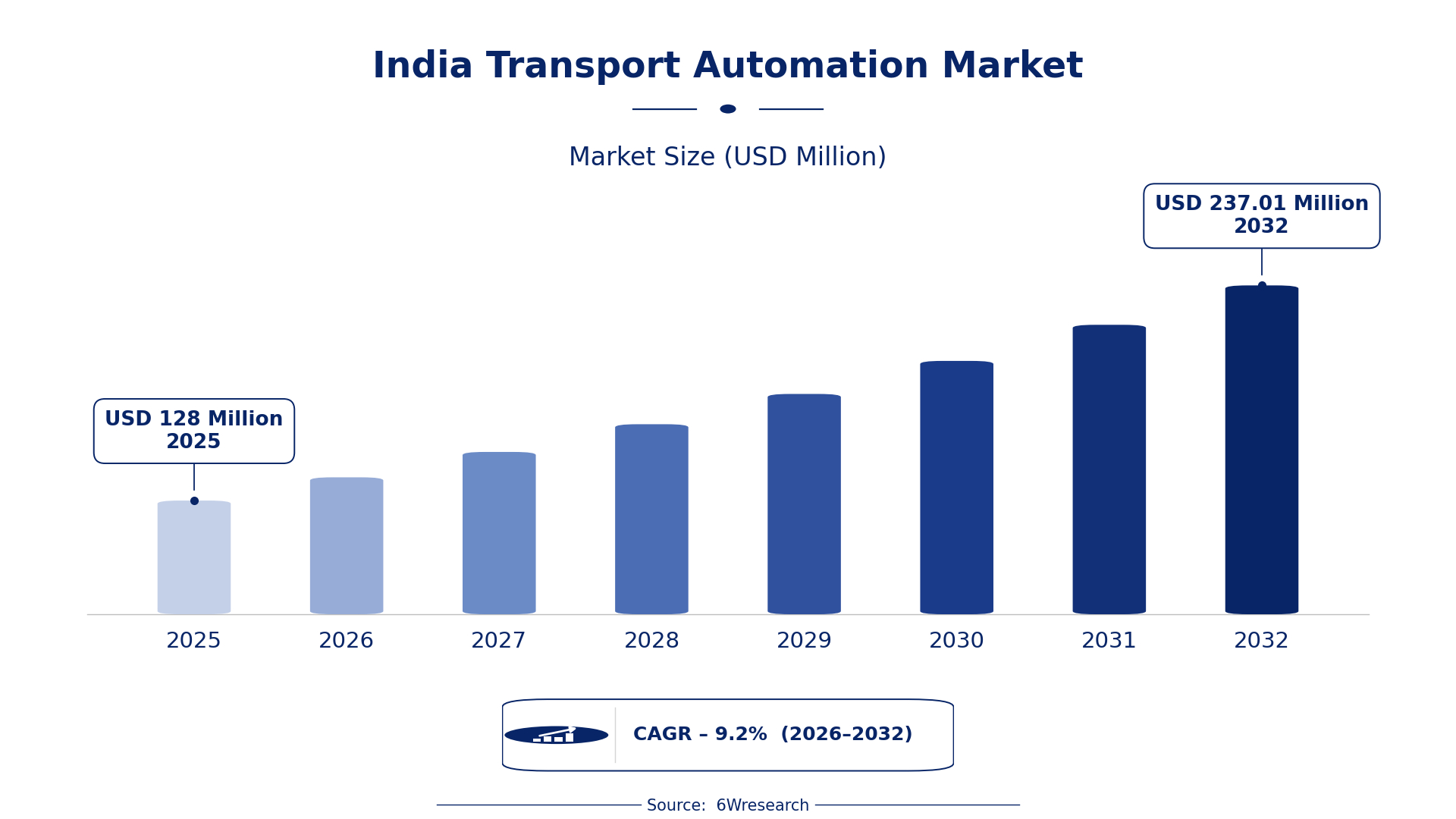
According to 6Wresearch internal database and industry insights, the India Transport Automation Market was valued at USD 128.0 million in 2025 and is projected to reach USD 237.01 million by 2032, growing at a CAGR of approximately 9.2% during 2026–2032.
India Transport Automation Market Highlights
| Report Metric | Details |
| Report Name | India Transport Automation Market |
| Market Size 2025 | USD 128.0 million |
| Market Size 2032 | USD 237.01 million |
| Absolute Growth 2025–2032 | USD 109.01 million |
| CAGR 2026–2032 | 9.2% |
| Peak Annual Growth | 11.7% in 2026 |
| Forecast Period | 2026–2032 |
| Historical Data | 2022–2025 |
| Base Year | 2025 |
| Leading Automation Type, 2025 | Traffic Signal Automation (50% share) |
| Leading Technology Used, 2025 | AI + Camera Sensors (39% share) |
| Leading Application Mode, 2025 | Urban Intersections (45% share) |
| Leading End User, 2025 | City Municipalities (45% share) |
| Fastest-Growing Automation Type | Fleet Automation (11.1% CAGR) |
| Fastest-Growing Technology Used | Telematics + GPS (11.7% CAGR) |
| Fastest-Growing Application Mode | Logistics (10.9% CAGR) |
| Fastest-Growing End User | Delivery Companies (11.7% CAGR) |
| Growing Sector | Logistics |
| Key End Users | Urban Intersections, Logistics, Metro Systems, Container Handling |
India Transport Automation Market Year-wise Growth Rate and Key Drivers (2022–2032)
This graph illustrates the annual growth rates of the market from 2022 to 2032, highlighting a steady upward trajectory and projected market expansion over the forecast period.
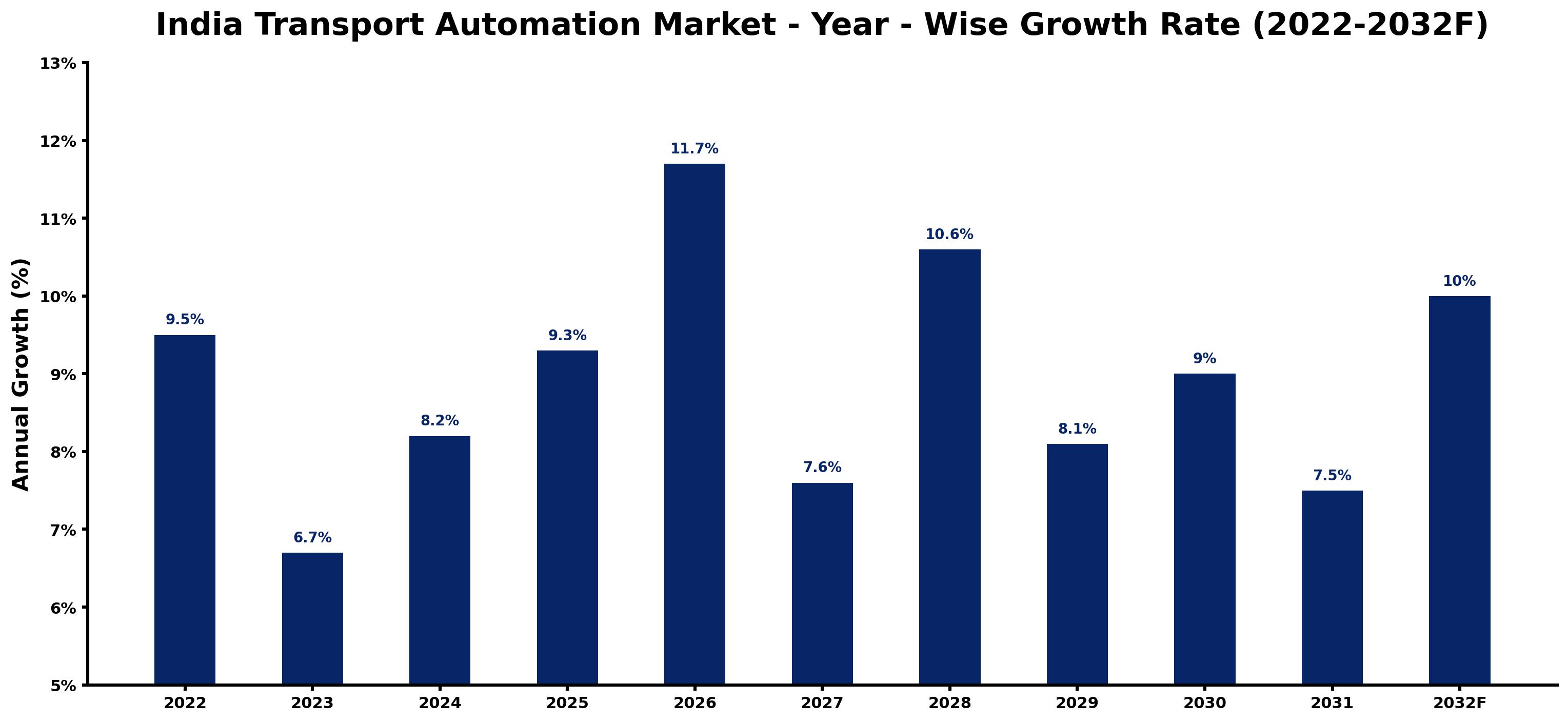
Year by year, the estimates below pair each growth rate with the development that shaped it.
| Year | Estimated Annual Growth (%) | Market Rationale |
| 2022 | 9.5 | The market experienced strong demand from urban municipalities implementing traffic automation systems. |
| 2023 | 6.7 | Growth slowed as some city projects faced delays in implementation and funding. |
| 2024 | 8.2 | Increased investments in logistics automation drove faster growth compared to the previous year. |
| 2025 | 9.3 | The expansion of smart city initiatives led to higher demand for transport automation solutions. |
| 2026 | 11.7 | The peak growth year is driven by substantial government funding for intelligent transport systems. |
| 2027 | 7.6 | A slowdown occurred as the market adjusted to earlier rapid expansions and project completions. |
| 2028 | 10.6 | Renewed interest in logistics automation spurred growth as the sector continued to expand. |
| 2029 | 8.1 | Growth slowed as the Smart Cities Mission began to face challenges in project approvals. |
| 2030 | 9.0 | Increased focus on urban safety measures will lead to renewed demand for traffic automation technologies. |
| 2031 | 7.5 | Growth will slow again as some municipalities complete their initial automation projects. |
| 2032 | 10.0 | The market is projected to rebound with new initiatives aimed at improving urban mobility and safety. |
Note: Market size estimations and growth projections presented in this report are based on 6Wresearch's proprietary forecasting methodology, utilizing the latest available industry data, government publications, and primary research inputs.
India Transport Automation Market Synopsis
Transport Automation in India encompasses technologies that improve the efficiency and safety of transportation networks. This includes traffic signal automation, fleet management, and rail transport systems, utilising AI, IoT, and robotics. The India Transport Automation Market is expanding due to urbanisation, government initiatives, and the need for efficient logistics solutions. With India's urban population projected to reach 600 million by 2031, demand for these technologies is expected to rise sharply. Initiatives such as the Smart Cities Mission are further propelling this growth.
Market Dynamics Impact Analysis (2026–2032)
| Factor | Type | Impact | Primary Segment Affected |
| Urbanisation is increasing the need for efficient traffic management solutions. | Driver | High | Traffic Signal Automation |
| The logistics sector's growth is driving demand for fleet automation technologies. | Driver | High | Fleet Automation |
| The Smart Cities Mission is creating opportunities for automation in urban transport. | Opportunity | High | Urban Intersections |
| Investment in port automation is increasing due to the Sagarmala Programme. | Opportunity | High | Port Automation |
| High initial investment costs can deter municipalities from adopting new technologies. | Restraint | Medium | Traffic Signal Automation |
| Limited infrastructure in some regions hampers the rollout of transport automation. | Restraint | Medium | Fleet Automation |
| Approval delays for new projects slow down market growth in urban areas. | Challenge | High | Rail Transport Automation |
| Competition from traditional transport solutions limits market penetration. | Challenge | Medium | Port Automation |
Evaluation of Drivers in India Transport Automation Market (2026–2032)
Below mentioned are some major drivers and their influence on market dynamics.
| Drivers | Primary Segment Affected | Why It Matters (Evidence) |
| Urban population growth is increasing the demand for automated traffic management. | Traffic Signal Automation | India's urban population is projected to reach 600 million by 2031, necessitating efficient traffic solutions. |
| The logistics sector is expanding, driving fleet automation needs. | Fleet Automation | The logistics sector in India is expected to grow to $215 billion by 2025, increasing demand for automation. |
| Government initiatives are promoting smart city projects that integrate transport automation. | Urban Intersections | The Smart Cities Mission aims to develop 100 smart cities, enhancing urban transport systems including automation. |
| Investment in rail safety technologies is increasing. | Rail Transport Automation | The Railway Safety Fund allocated ₹1 lakh crore for enhancing safety through automation technologies. |
| Port modernization initiatives are driving automation in shipping operations. | Port Automation | The Sagarmala Programme is investing ₹1.5 lakh crore to modernize ports, focusing on automation. |
Urban municipalities are increasingly adopting traffic signal automation to manage congestion effectively, with over 200 intersections automated in Delhi. The logistics sector is projected to grow to $215 billion by 2025, driving fleet automation demand. The Smart Cities Mission focuses on developing 100 smart cities, which promotes urban transport systems, including automation technologies. Investment in rail safety technologies is increasing, with the Railway Safety Fund allocating ₹1 lakh crore to improve safety through automation.
Evaluation of Restraints in India Transport Automation Market
Below mentioned are some major restraints and their influence on market dynamics.
| Market Restraint | Primary Segment Affected | Why It Matters (Evidence) |
| Lengthy approval processes delay project implementation. | Traffic Signal Automation | New technology implementations often face approval delays, extending project timelines by up to 18 months. |
| Skills shortages hinder effective deployment of advanced systems. | Fleet Automation | Producers face increased training costs due to a lack of skilled personnel in the market. |
| Supply chain disruptions increase costs for manufacturers. | Rail Transport Automation | A leading supplier on imported components can raise costs by 15% during global logistics issues. |
| Intense competition drives down prices. | Port Automation | Local firms compete aggressively, impacting profit margins and reducing investment in innovation. |
| Regulatory challenges slow down technology adoption. | Urban Intersections | Compliance with evolving standards can delay the rollout of new automation technologies. |
India Transport Automation Market Challenges
Transport automation in India faces regulatory hurdles, as new technology implementations often encounter lengthy approval processes, which can delay projects by up to 18 months for suppliers. Skills shortages in the workforce impede effective deployment of advanced systems, costing producers time and resources in training personnel. Supply chain disruptions arise from reliance on imported components, which can increase costs by 15% for manufacturers during global logistics issues. Intense competition among local firms drives down prices, impacting profit margins for suppliers and potentially leading to reduced investment in innovation.
Trends in the India Transport Automation Market
Several trends are reshaping the India Transport Automation Market; the most important are set out below.
- Shift Towards Smart City Integration: Cities like Delhi are integrating transport automation into their infrastructure through the Smart Cities Mission, which has a budget of ₹48,000 crore, driving demand for automated solutions.
- Increased Adoption of IoT in Logistics: The logistics sector is rapidly adopting IoT technologies to improve operational efficiency. With the sector projected to grow to $215 billion by 2025, this trend is reshaping logistics operations across the country.
- Focus on Rail Safety Enhancements: The Ministry of Railways is prioritising safety improvements through automation technologies in metro systems. The adoption of AI + CBTC technology is expected to improve safety and efficiency in urban rail transport.
- Modernisation of Port Operations: The Sagarmala Programme is modernising port operations with an investment of ₹1.5 lakh crore, focusing on automation. This initiative aims to streamline operations at major ports, improving efficiency.
Investment Opportunities in the India Transport Automation Market
Below are the investment opportunities with the strongest case in the India Transport Automation Market.
- Investment in Urban Traffic Management: Cities are increasingly seeking advanced traffic management solutions, creating opportunities for suppliers. With India's urban population projected to reach 600 million by 2031, demand for automation technologies is rising.
- Growth in Logistics Automation: The logistics sector's growth to $215 billion by 2025 presents opportunities for fleet automation suppliers. Collaborating with logistics companies can facilitate market entry and enhance service offerings.
- Integration of IoT in Metro Systems: The integration of IoT in metro systems is gaining traction, particularly in cities like Mumbai. Suppliers can explore partnerships with transit authorities to implement IoT + Robotics solutions.
- Modernisation of Port Facilities: Port modernisation initiatives are creating demand for automation technologies. Suppliers can engage with the Indian Ports Association to provide automated container handling systems.
Government Initiatives in the India Transport Automation Market
The 'National Intelligent Transport System Policy' launched by the Ministry of Road Transport and Highways in 2023 promotes smart traffic management solutions, improving urban mobility. This policy encourages the adoption of automated traffic management systems across cities, enhancing efficiency and safety. The 'Smart Cities Mission', with a budget of ₹48,000 crore, aims to integrate transport automation in 100 cities, funding projects that improve urban transport systems through automation. The Ministry of Housing and Urban Affairs oversees this initiative, enabling municipalities to implement advanced traffic solutions.
In 2021, the Ministry of Railways introduced the 'Railway Safety Fund', allocating ₹1 lakh crore for enhancing safety through automation technologies. This fund supports projects aimed at implementing advanced safety measures in rail transport. The Ministry of Shipping's 'Sagarmala Programme' focuses on modernising ports with an investment of ₹1.5 lakh crore, promoting automation in port operations. This initiative allows ports to streamline processes and improve operational efficiency.
Future Insight of the India Transport Automation Market
The transport automation market in India is set for transformation by 2032, driven by initiatives like the Smart Cities Mission, which aims to develop urban transport systems across various cities. The integration of IoT and robotics in metro operations will streamline processes and improve operational efficiency. Government investments, including the ₹1,000 crore allocation for smart transportation systems, will support infrastructure development.
Market Segmentation Analysis
The report offers a comprehensive study of the following market segments and their leading categories in the market.
By Automation Type – Traffic Signal Automation Dominated, Fleet Automation Expected to Grow Fastest
According to Vasudha, AM at 6Wresearch, with a 50% revenue share in 2025, Traffic Signal Automation was the largest automation type category. Traffic signal automation commands the largest share as it is vital for managing urban traffic and enhancing safety. For instance, Delhi's implementation at over 200 intersections highlights its crucial role in improving traffic flow across cities. The quickest growth will come from Fleet Automation, forecast to expand at a CAGR of 11.1% between 2026 and 2032. Fleet automation is witnessing rapid growth, spurred by the logistics sector's anticipated expansion to $215 billion by 2025. This increasing demand for efficient delivery solutions propels the need for advanced fleet management technologies, ensuring sustained growth in this area. Suppliers should focus on developing fleet automation solutions to meet the rising demand from the logistics sector.
By Technology Used – AI + Camera Sensors Dominated, Telematics + GPS Expected to Grow Fastest
The largest technology used category in 2025 was AI + Camera Sensors, with a 39% share of total revenue. AI coupled with camera sensors leads the market due to its effectiveness in real-time monitoring and analysis for traffic management. This technology is particularly essential in urban settings where traffic congestion poses significant challenges. Telematics + GPS is set to record the highest CAGR in this split, 11.7% over 2026–2032. Telematics and GPS are growing swiftly, driven by the urgent need for precise fleet tracking and management within the logistics sector. This technology directly addresses operational challenges faced by delivery companies, enhancing their efficiency. Buyers in logistics should invest in advanced telematics solutions to optimise fleet operations and improve service delivery.
By Application Mode – Urban Intersections Dominated, Logistics Expected to Grow Fastest
Urban Intersections took a 45% share of application mode in 2025, more than any other category. Urban intersections dominate the market as they are the primary beneficiaries of traffic signal automation, facilitating smoother vehicle flow in congested areas. This application is critical for cities aiming to enhance traffic management and safety. Over 2026–2032, Logistics is expected to post the fastest growth, at a CAGR of 10.9%. Logistics is the fastest-growing application mode, driven by the increasing demand for efficient delivery services in the expanding e-commerce sector. The necessity for fleet automation in logistics is becoming essential for operational success. Suppliers should concentrate on innovations in logistics applications to capture the growing market for fleet automation.
By End User – City Municipalities Dominated, Delivery Companies Expected to Grow Fastest
In 2025, City Municipalities led the end user split with a 45% share. City municipalities account for the largest share of the market as they implement transport automation solutions to effectively manage urban traffic. Their commitment to improving public safety and traffic flow drives the adoption of these technologies. Delivery Companies are projected to grow fastest, at a CAGR of 11.7% during 2026–2032. Delivery companies are the fastest-growing end users, increasingly depending on fleet automation to boost operational efficiency and meet rising customer demands. The growth of e-commerce significantly contributes to this trend. Suppliers must tailor their offerings to address the specific needs of delivery companies, ensuring they are equipped for efficient fleet operations.
Key Attractiveness of the Report
- 10 Years of Market Numbers
- Historical Data Starting from 2022 to 2025
- Base Year 2025
- Forecast Data until 2032
- Key Performance Indicators Impacting the Market
- Major Upcoming Developments and Projects
Key Highlights of the Report:
- India Transport Automation Market Outlook
- Market Size of India Transport Automation Market, 2025
- Forecast of India Transport Automation Market, 2032
- Historical Data and Forecast of India Transport Automation Revenues & Volume for the Period 2022 - 2032F
- India Transport Automation Market Trend Evolution
- India Transport Automation Market Drivers and Challenges
- India Transport Automation Price Trends
- India Transport Automation Porter's Five Forces
- India Transport Automation Industry Life Cycle
- Historical Data and Forecast of India Transport Automation Market Revenues & Volume By Automation Type for the Period 2022 - 2032F
- Historical Data and Forecast of India Transport Automation Market Revenues & Volume By Traffic Signal Automation for the Period 2022 - 2032F
- Historical Data and Forecast of India Transport Automation Market Revenues & Volume By Fleet Automation for the Period 2022 - 2032F
- Historical Data and Forecast of India Transport Automation Market Revenues & Volume By Rail Transport Automation for the Period 2022 - 2032F
- Historical Data and Forecast of India Transport Automation Market Revenues & Volume By Port Automation for the Period 2022 - 2032F
- Historical Data and Forecast of India Transport Automation Market Revenues & Volume By Technology Used for the Period 2022 - 2032F
- Historical Data and Forecast of India Transport Automation Market Revenues & Volume By AI + Camera Sensors for the Period 2022 - 2032F
- Historical Data and Forecast of India Transport Automation Market Revenues & Volume By Telematics + GPS for the Period 2022 - 2032F
- Historical Data and Forecast of India Transport Automation Market Revenues & Volume By AI + CBTC for the Period 2022 - 2032F
- Historical Data and Forecast of India Transport Automation Market Revenues & Volume By IoT + Robotics for the Period 2022 - 2032F
- Historical Data and Forecast of India Transport Automation Market Revenues & Volume By Application Mode for the Period 2022 - 2032F
- Historical Data and Forecast of India Transport Automation Market Revenues & Volume By Urban Intersections for the Period 2022 - 2032F
- Historical Data and Forecast of India Transport Automation Market Revenues & Volume By Logistics for the Period 2022 - 2032F
- Historical Data and Forecast of India Transport Automation Market Revenues & Volume By Metro Systems for the Period 2022 - 2032F
- Historical Data and Forecast of India Transport Automation Market Revenues & Volume By Container Handling for the Period 2022 - 2032F
- Historical Data and Forecast of India Transport Automation Market Revenues & Volume By End User for the Period 2022 - 2032F
- Historical Data and Forecast of India Transport Automation Market Revenues & Volume By City Municipalities for the Period 2022 - 2032F
- Historical Data and Forecast of India Transport Automation Market Revenues & Volume By Delivery Companies for the Period 2022 - 2032F
- Historical Data and Forecast of India Transport Automation Market Revenues & Volume By Transit Authorities for the Period 2022 - 2032F
- Historical Data and Forecast of India Transport Automation Market Revenues & Volume By Shipping Terminals for the Period 2022 - 2032F
- India Transport Automation Import Export Trade Statistics
- Market Opportunity Assessment By Automation Type
- Market Opportunity Assessment By Technology Used
- Market Opportunity Assessment By Application Mode
- Market Opportunity Assessment By End User
- India Transport Automation Top Companies Market Share
- India Transport Automation Competitive Benchmarking By Technical and Operational Parameters
- India Transport Automation Company Profiles
- India Transport Automation Key Strategic Recommendations
Market Covered
The report offers an extensive study of the following market segments.
By Automation Type
- Traffic Signal Automation
- Fleet Automation
- Rail Transport Automation
- Port Automation
By Technology Used
- AI + Camera Sensors
- Telematics + GPS
- AI + CBTC
- IoT + Robotics
By Application Mode
- Urban Intersections
- Logistics
- Metro Systems
- Container Handling
By End User
- City Municipalities
- Delivery Companies
- Transit Authorities
- Shipping Terminals































