China Transport Automation Market Size & Growth Rate
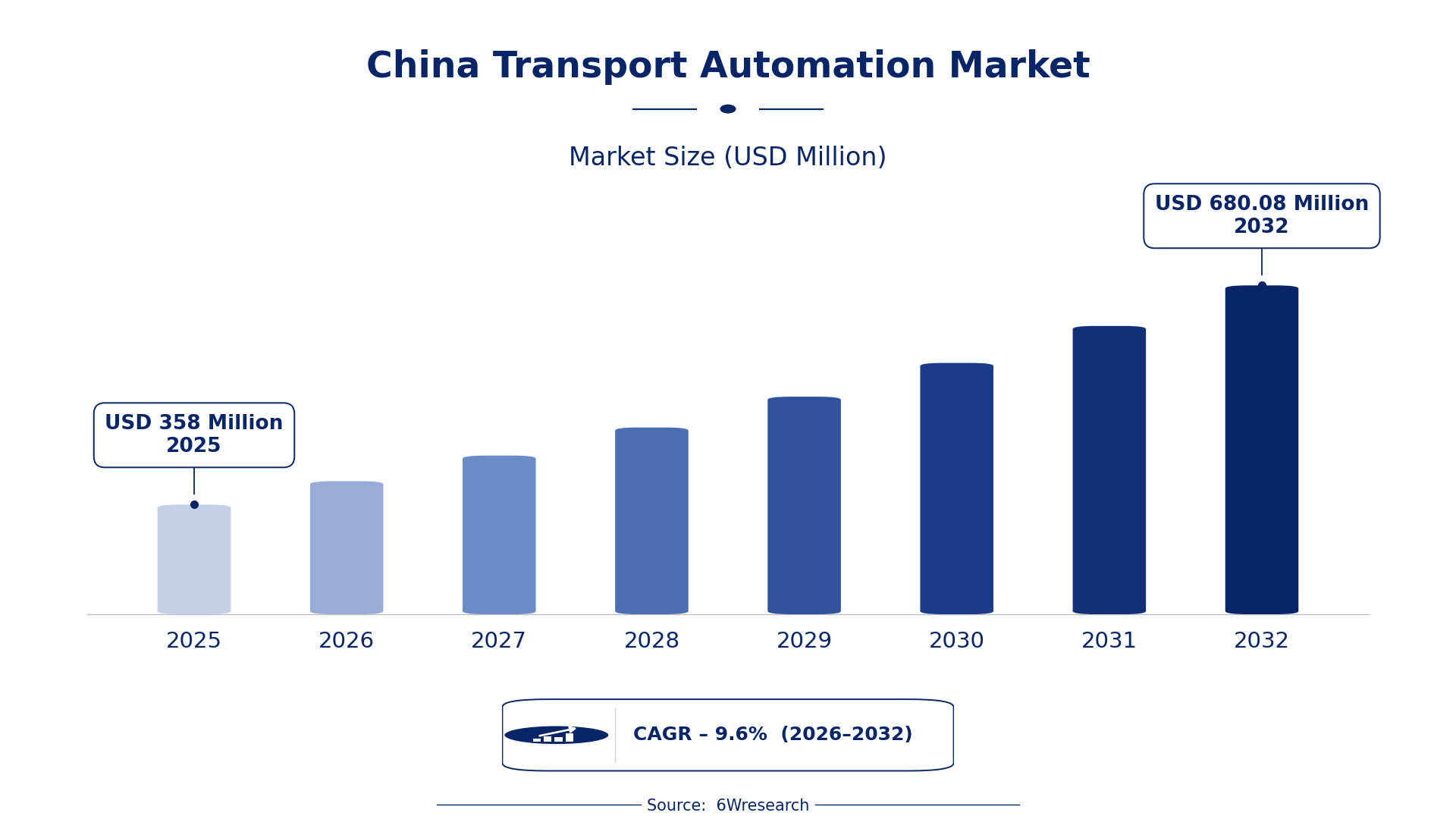
According to 6Wresearch internal database and industry insights, the China Transport Automation Market was valued at USD 358.0 million in 2025 and is projected to reach USD 680.08 million by 2032, growing at a CAGR of approximately 9.6% during 2026–2032.
China Transport Automation Market Highlights
| Report Metric | Details |
| Report Name | China Transport Automation Market |
| Market Size 2025 | USD 358.0 million |
| Market Size 2032 | USD 680.08 million |
| Absolute Growth 2025–2032 | USD 322.08 million |
| CAGR 2026–2032 | 9.6% |
| Peak Annual Growth | 12.2% in 2026 |
| Forecast Period | 2026–2032 |
| Historical Data | 2022–2025 |
| Base Year | 2025 |
| Leading Automation Type, 2025 | Traffic Signal Automation (41% share) |
| Leading Technology Used, 2025 | AI + Camera Sensors (42% share) |
| Leading Application Mode, 2025 | Urban Intersections (56% share) |
| Leading End User, 2025 | City Municipalities (45% share) |
| Fastest-Growing Automation Type | Fleet Automation (11.1% CAGR) |
| Fastest-Growing Technology Used | IoT + Robotics (11.0% CAGR) |
| Fastest-Growing Application Mode | Logistics (11.0% CAGR) |
| Fastest-Growing End User | Delivery Companies (11.5% CAGR) |
| Growing Sector | Logistics |
| Key End Users | City Municipalities, Delivery Companies, Transit Authorities, Shipping Terminals |
China Transport Automation Market Year-wise Growth Rate and Key Drivers (2022–2032)
This graph illustrates the annual growth rates of the market from 2022 to 2032, highlighting a steady upward trajectory and projected market expansion over the forecast period.
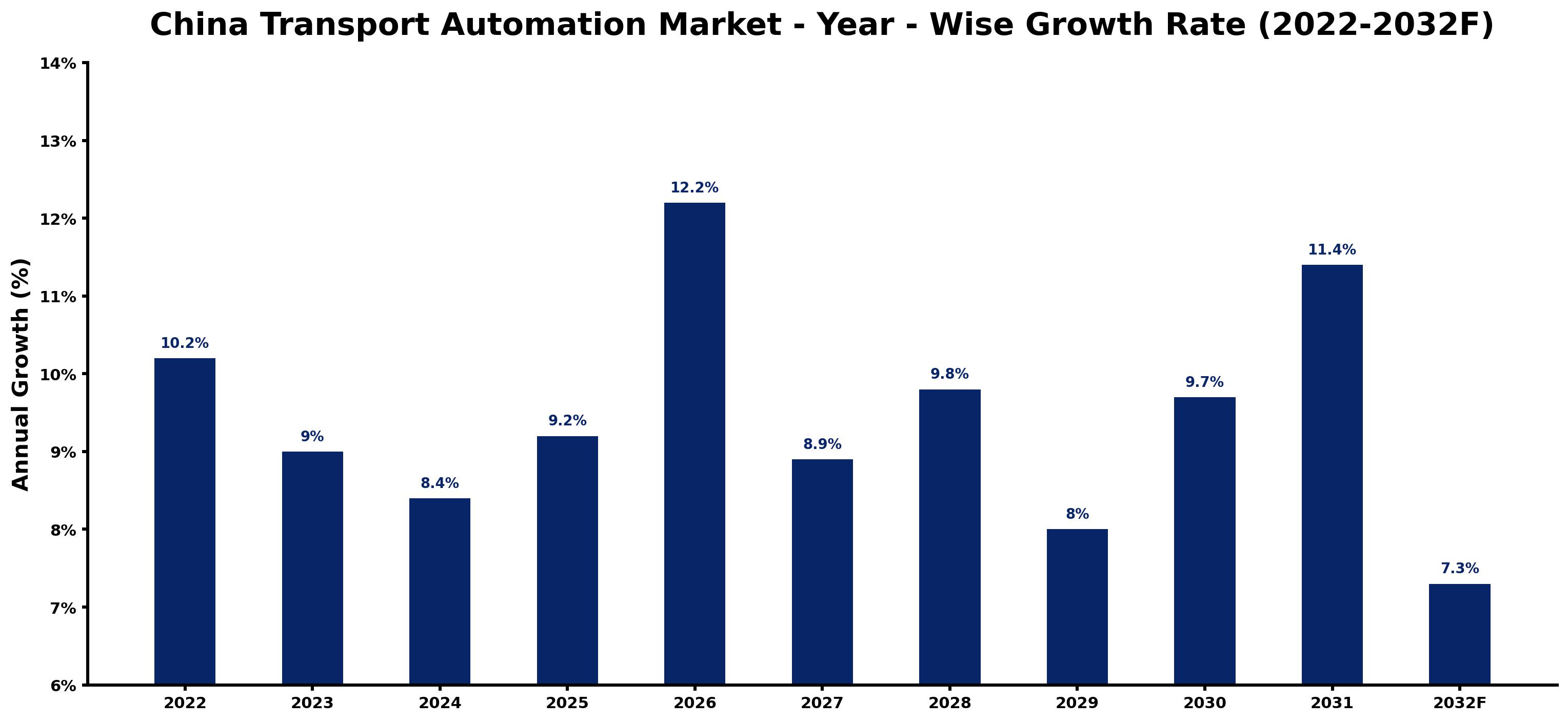
Each row of the following table gives one year's estimated growth and the event or demand shift that explains it.
| Year | Estimated Annual Growth (%) | Market Rationale |
| 2022 | 10.2 | The market experienced strong demand due to urbanization and infrastructure modernization efforts. |
| 2023 | 9.0 | Growth slowed as the market adjusted to previous high levels of investment and implementation. |
| 2024 | 8.4 | Continued urbanization and the need for efficient transport systems supported market growth. |
| 2025 | 9.2 | Demand increased as more cities adopted traffic signal automation technologies for better management. |
| 2026 | 12.2 | The peak growth year is expected to see investments driven by the 'Smart Transportation Development Plan'. |
| 2027 | 8.9 | Growth is projected to slow as the market matures and competition intensifies among automation providers. |
| 2028 | 9.8 | A resurgence in demand is anticipated as cities expand their automation initiatives and infrastructure. |
| 2029 | 8.0 | Market growth is expected to slow as initial implementations reach saturation in major urban areas. |
| 2030 | 9.7 | Growth is projected to pick up again as urban populations increase, driving further automation needs. |
| 2031 | 11.4 | Demand is expected to surge as cities aim to meet the 2025 automation targets set by national plans. |
| 2032 | 7.3 | Growth is projected to slow as the market stabilises after reaching high levels of automation adoption. |
Note: Market size estimations and growth projections presented in this report are based on 6Wresearch's proprietary forecasting methodology, utilizing the latest available industry data, government publications, and primary research inputs.
China Transport Automation Market Synopsis
Transport Automation in China encompasses systems designed to improve the efficiency and safety of transportation networks. These include traffic signal automation and fleet management systems, developed using advanced technologies like AI and IoT. The China Transport Automation Market is growing due to urbanization and government initiatives aimed at modernizing infrastructure. With over 1 billion vehicles in urban areas, the demand for efficient transport solutions is substantial. The 'Smart Transportation Development Plan' launched in 2021 further supports this growth by advancing automation across urban areas.
Market Dynamics Impact Analysis (2026–2032)
| Factor | Type | Impact | Primary Segment Affected |
| Urbanization drives the need for efficient traffic management systems. | Driver | High | Traffic Signal Automation |
| Increasing logistics efficiency through automation enhances fleet operations. | Driver | High | Fleet Automation |
| The current urban population growth creates demand for advanced transport solutions. | Opportunity | High | Rail Transport Automation |
| Investment in port automation technologies is essential for handling increased shipping volumes. | Opportunity | Medium | Port Automation |
| High initial investment costs deter smaller municipalities from adopting automation. | Restraint | High | Traffic Signal Automation |
| Limited technical expertise in smaller cities hampers implementation of advanced systems. | Restraint | Medium | Fleet Automation |
| Competition among technology providers can lead to price wars affecting profitability. | Challenge | High | Rail Transport Automation |
| Rapid technological changes require continuous investment to stay competitive. | Challenge | Medium | Port Automation |
Evaluation of Drivers in China Transport Automation Market (2026–2032)
The factors lifting demand, and the evidence behind each, are summarised below.
| Drivers | Primary Segment Affected | Why It Matters (Evidence) |
| Urbanization increases traffic congestion, driving demand for traffic signal automation systems. | Traffic Signal Automation | In 2022, urban areas in China had over 1 billion vehicles, necessitating better traffic management. |
| Logistics companies are adopting automation to improve delivery efficiency and reduce costs. | Fleet Automation | Telematics systems are used by over 70% of logistics companies in China as of 2023. |
| Government initiatives promote the adoption of automation technologies in public transport systems. | Rail Transport Automation | The 'National Development Plan for Intelligent Transportation' aims for 30% automation by 2025. |
| Port automation technologies improve operational efficiency for shipping terminals. | Port Automation | Shanghai Port is one of the busiest in the world, increasingly adopting automation solutions. |
| AI and IoT technologies are being integrated into transport systems for real-time monitoring. | AI + Camera Sensors | The National Standard for Intelligent Transportation Systems was updated in 2022 to include new technologies. |
In 2022, urban areas had over 1 billion vehicles, creating a pressing need for better traffic management systems. Over 70% of logistics companies adopted telematics systems by 2023, improving fleet operations. The 'National Development Plan for Intelligent Transportation' aims for 30% automation in public transport by 2025, driving demand further. Port automation technologies are vital for handling rising shipping volumes, showcasing the importance of these advancements.
Evaluation of Restraints in China Transport Automation Market
The key brakes on demand, and where they bite hardest, are shown below.
| Market Restraint | Primary Segment Affected | Why It Matters (Evidence) |
| High initial investment costs can limit adoption among smaller municipalities. | Traffic Signal Automation | Many smaller cities struggle to allocate sufficient budgets for advanced traffic management systems. |
| Limited technical expertise in smaller cities hampers the implementation of advanced systems. | Fleet Automation | Smaller municipalities often lack the skilled workforce necessary for effective automation. |
| Competition among technology providers can lead to price wars affecting profitability. | Rail Transport Automation | As more players enter the market, pricing pressures can reduce margins for existing providers. |
| Rapid technological changes require continuous investment to stay competitive. | Port Automation | Providers must frequently upgrade systems to keep pace with evolving automation technologies. |
| Regulatory compliance can be complex and costly for new entrants. | AI + Camera Sensors | Navigating the regulatory framework for new technologies can delay market entry. |
China Transport Automation Market Challenges
Buyers in the China Transport Automation market face a skills shortage, as many workers lack expertise in advanced technologies like AI and IoT, leading to project delays of up to six months. Competition is intense, with numerous local firms entering the market, which drives down prices and reduces profit margins for established suppliers. High implementation costs for new automation systems can consume over 20% of operational budgets, limiting buyers' ability to invest in other critical areas. Regulatory changes, including the updated National Standard for Intelligent Transportation Systems, require extensive compliance efforts, diverting resources and causing further delays for producers.
Trends in the China Transport Automation Market
Below mentioned are some of the trends shaping the China Transport Automation Market growth.
- Shift towards AI-Driven Traffic Management: The 'Smart Transportation Development Plan' launched in 2021 promotes AI technologies for traffic management. By 2023, over 50% of major cities in China implemented traffic signal automation systems, indicating a shift towards AI-driven solutions.
- Increased Adoption of IoT in Logistics: In urban areas, logistics companies are increasingly adopting IoT technologies to improve operational efficiency. As of 2023, IoT adoption in logistics is projected to grow by 25% annually, reflecting a strong trend towards automation.
- Focus on Fleet Automation: Delivery companies are prioritising fleet automation to optimise logistics operations. With a projected CAGR of 11.5% for delivery companies, this trend highlights the need for efficient transport solutions.
- Expansion of Port Automation Technologies: Shanghai Port is improving its operational efficiency through port automation technologies. As one of the busiest ports globally, its adoption of automation solutions is vital for managing increased shipping volumes.
Investment Opportunities in the China Transport Automation Market
Some of the investment opportunities in the China Transport Automation Market are mentioned below.
- Growing Urban Population: With China's urban population expected to reach 1.4 billion by 2030, the demand for transport automation solutions is escalating. City municipalities are key buyers, and forming partnerships can ease market entry.
- Investment in Traffic Signal Automation: Over 50% of major cities have adopted traffic signal automation systems, revealing a market gap. Suppliers can target city municipalities to deliver advanced automation solutions.
- Expansion of Fleet Automation Solutions: The logistics sector increasingly relies on fleet automation technologies, with over 70% of companies utilising telematics. Collaborating with logistics firms can strengthen market presence and drive sales.
- Port Automation Investment Opportunities: With Shanghai Port implementing more automation solutions, there is a clear opportunity for investment in port automation technologies. Partnering with shipping terminals can streamline operations and boost efficiency.
Government Initiatives in the China Transport Automation Market
The 'Smart Transportation Development Plan' introduced by the Ministry of Transport in 2021 aims to advance transport automation across urban areas. This initiative focuses on integrating AI technologies into traffic management, supporting the deployment of advanced systems. Additionally, the 'National Plan for Urban Transport Development' was revised in 2022 to include measures for increasing automation in public transport systems, ensuring that cities can effectively modernise their infrastructure. The 'Intelligent Transportation Systems Standardization Work Plan' released in 2023 establishes standards for automation technologies, promoting consistency and quality across implementations.
The Ministry of Transport supervises the execution of the 'Smart Transportation Development Plan', approving budgets and projects to enhance automation. In 2022, the National Development and Reform Commission allocated $500 million for transport automation systems nationwide, ensuring ample funding for urban projects. The 'Intelligent Transportation Systems Standardization Work Plan' issued in 2023 by the Ministry of Industry and Information Technology sets standards for automation technologies, promoting consistency and quality across implementations. This enables producers and buyers to align with national standards, facilitating smoother market entry.
Future Insight of the China Transport Automation Market
The China Transport Automation market is set to evolve significantly by 2032, driven by urbanisation and government initiatives. The Smart Transportation Development Plan will advocate advanced technologies across urban areas, improving efficiency and safety. By 2025, public transport aims for 30% automation, streamlining operations and enhancing service delivery. IoT adoption in logistics is projected to grow by 25% annually until 2025, indicating a strong shift towards integrated solutions that will create new opportunities for suppliers.
Market Segmentation Analysis
The report offers a comprehensive study of the following market segments and their leading categories in the market.
By Automation Type – Traffic Signal Automation Dominated, Fleet Automation Expected to Grow Fastest
According to Vasudha, AM at 6Wresearch, Traffic Signal Automation held a 41% share of the China Transport Automation Market by automation type in 2025. Traffic signal automation holds the largest market share in China, primarily due to the management of over 1 billion vehicles in urban areas. This technology is essential for city municipalities striving to improve traffic efficiency and safety in densely populated regions. The quickest growth will come from Fleet Automation, forecast to expand at a CAGR of 11.1% between 2026 and 2032. Fleet automation is experiencing rapid growth as logistics companies adopt these systems, with over 70% utilising telematics solutions. This trend will likely continue as urbanisation drives the need for more efficient delivery operations. Suppliers should prioritise the development of advanced fleet automation solutions to meet the rising demands of logistics companies.
By Technology Used – AI + Camera Sensors Dominated, IoT + Robotics Expected to Grow Fastest
In 2025, AI + Camera Sensors led the technology used split with a 42% share. AI combined with camera sensors leads the market share, as they are crucial for real-time traffic monitoring and management. Their integration into traffic systems is vital for city municipalities aiming to optimise traffic flow and enhance safety measures. IoT + Robotics are projected to grow fastest, at a CAGR of 11.0% during 2026–2032. IoT and robotics are the fastest-growing technologies in transport automation, particularly within logistics, where their adoption is set to increase significantly. This growth is fuelled by the need for more efficient operations in the logistics sector. Buyers should invest in IoT and robotics technologies to maintain a competitive edge in the transport automation market.
By Application Mode – Urban Intersections Dominated, Logistics Expected to Grow Fastest
The largest application mode category in 2025 was Urban Intersections, with a 56% share of total revenue. Urban intersections account for the largest share of transport automation applications, as they are critical points for implementing traffic signal systems. The high volume of vehicle movement in these areas necessitates effective traffic management solutions. Logistics is set to record the highest CAGR in this split, 11.0% over 2026–2032. The logistics sector is the fastest-growing application mode, driven by the increasing reliance on fleet automation for operational efficiency. This growth reflects the broader trend of urbanisation and the need for improved logistics solutions. Suppliers must prioritise solutions tailored for logistics to capture the growing demand in this application mode.
By End User – City Municipalities Dominated, Delivery Companies Expected to Grow Fastest
City Municipalities accounted for a 45% market share by end user in 2025. City municipalities represent the largest market share as they implement transport automation for effective urban traffic management. Their investments in these technologies are crucial for enhancing public safety and improving traffic flow in urban environments. Over 2026–2032, Delivery Companies are expected to post the fastest growth, at a CAGR of 11.5%. Delivery companies are the fastest-growing end users, increasingly adopting fleet automation to improve operational efficiency. This trend is expected to accelerate with the growth of e-commerce and the demand for timely deliveries. Suppliers should focus on delivery companies with tailored automation solutions to capitalise on the increasing demand in this sector.
Key Attractiveness of the Report
- 10 Years of Market Numbers
- Historical Data Starting from 2022 to 2025
- Base Year 2025
- Forecast Data until 2032
- Key Performance Indicators Impacting the Market
- Major Upcoming Developments and Projects
Key Highlights of the Report:
- China Transport Automation Market Outlook
- Market Size of China Transport Automation Market, 2025
- Forecast of China Transport Automation Market, 2032
- Historical Data and Forecast of China Transport Automation Revenues & Volume for the Period 2022 - 2032F
- China Transport Automation Market Trend Evolution
- China Transport Automation Market Drivers and Challenges
- China Transport Automation Price Trends
- China Transport Automation Porter's Five Forces
- China Transport Automation Industry Life Cycle
- Historical Data and Forecast of China Transport Automation Market Revenues & Volume By Automation Type for the Period 2022 - 2032F
- Historical Data and Forecast of China Transport Automation Market Revenues & Volume By Traffic Signal Automation for the Period 2022 - 2032F
- Historical Data and Forecast of China Transport Automation Market Revenues & Volume By Fleet Automation for the Period 2022 - 2032F
- Historical Data and Forecast of China Transport Automation Market Revenues & Volume By Rail Transport Automation for the Period 2022 - 2032F
- Historical Data and Forecast of China Transport Automation Market Revenues & Volume By Port Automation for the Period 2022 - 2032F
- Historical Data and Forecast of China Transport Automation Market Revenues & Volume By Technology Used for the Period 2022 - 2032F
- Historical Data and Forecast of China Transport Automation Market Revenues & Volume By AI + Camera Sensors for the Period 2022 - 2032F
- Historical Data and Forecast of China Transport Automation Market Revenues & Volume By Telematics + GPS for the Period 2022 - 2032F
- Historical Data and Forecast of China Transport Automation Market Revenues & Volume By AI + CBTC for the Period 2022 - 2032F
- Historical Data and Forecast of China Transport Automation Market Revenues & Volume By IoT + Robotics for the Period 2022 - 2032F
- Historical Data and Forecast of China Transport Automation Market Revenues & Volume By Application Mode for the Period 2022 - 2032F
- Historical Data and Forecast of China Transport Automation Market Revenues & Volume By Urban Intersections for the Period 2022 - 2032F
- Historical Data and Forecast of China Transport Automation Market Revenues & Volume By Logistics for the Period 2022 - 2032F
- Historical Data and Forecast of China Transport Automation Market Revenues & Volume By Metro Systems for the Period 2022 - 2032F
- Historical Data and Forecast of China Transport Automation Market Revenues & Volume By Container Handling for the Period 2022 - 2032F
- Historical Data and Forecast of China Transport Automation Market Revenues & Volume By End User for the Period 2022 - 2032F
- Historical Data and Forecast of China Transport Automation Market Revenues & Volume By City Municipalities for the Period 2022 - 2032F
- Historical Data and Forecast of China Transport Automation Market Revenues & Volume By Delivery Companies for the Period 2022 - 2032F
- Historical Data and Forecast of China Transport Automation Market Revenues & Volume By Transit Authorities for the Period 2022 - 2032F
- Historical Data and Forecast of China Transport Automation Market Revenues & Volume By Shipping Terminals for the Period 2022 - 2032F
- China Transport Automation Import Export Trade Statistics
- Market Opportunity Assessment By Automation Type
- Market Opportunity Assessment By Technology Used
- Market Opportunity Assessment By Application Mode
- Market Opportunity Assessment By End User
- China Transport Automation Top Companies Market Share
- China Transport Automation Competitive Benchmarking By Technical and Operational Parameters
- China Transport Automation Company Profiles
- China Transport Automation Key Strategic Recommendations
Market Covered
The report offers an extensive study of the following market segments.
By Automation Type
- Traffic Signal Automation
- Fleet Automation
- Rail Transport Automation
- Port Automation
By Technology Used
- AI + Camera Sensors
- Telematics + GPS
- AI + CBTC
- IoT + Robotics
By Application Mode
- Urban Intersections
- Logistics
- Metro Systems
- Container Handling
By End User
- City Municipalities
- Delivery Companies
- Transit Authorities
- Shipping Terminals































