India Trauma Management Market Size & Growth Rate
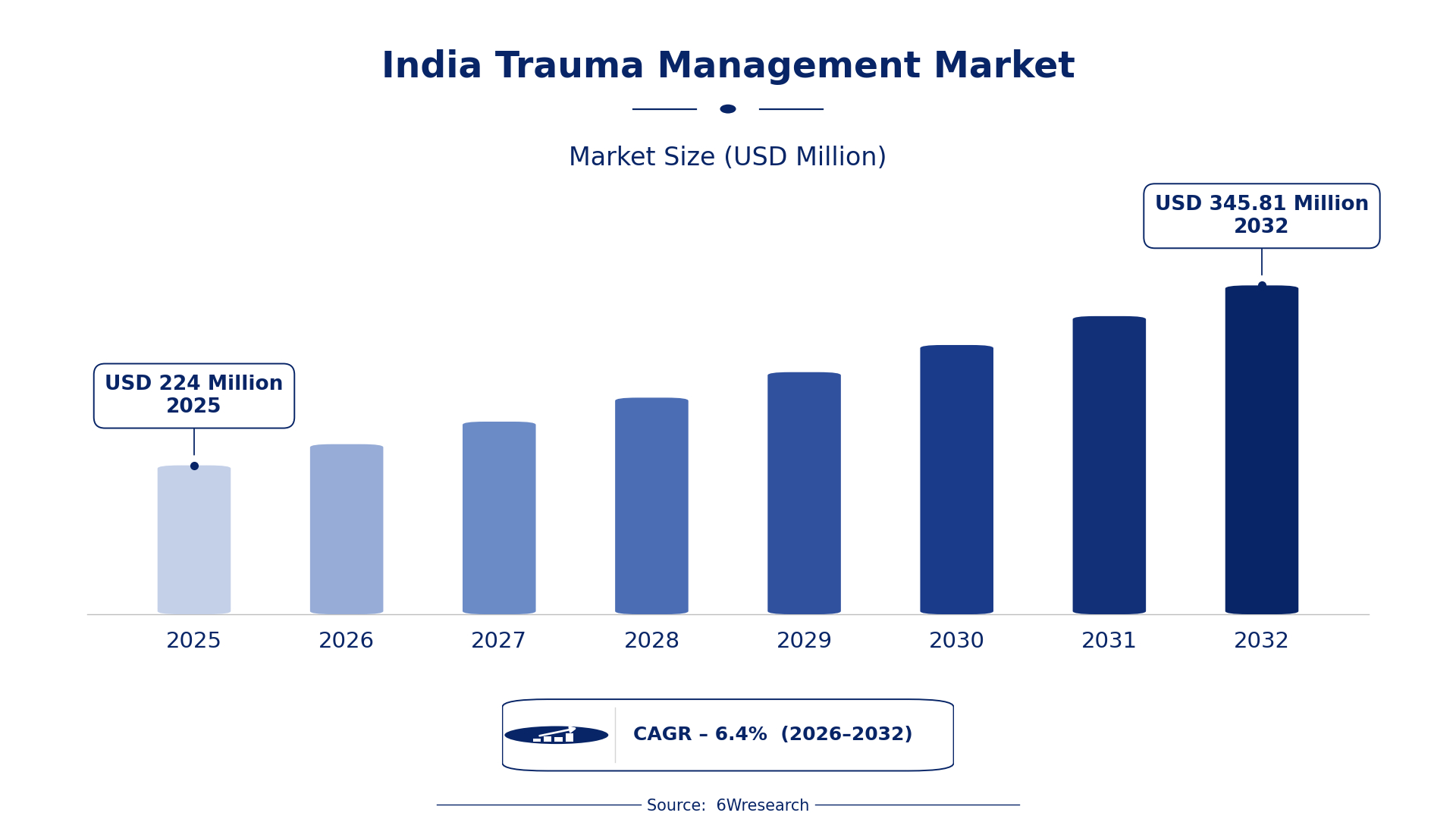
According to 6Wresearch internal database and industry insights, the India Trauma Management Market was valued at USD 224.0 million in 2025 and is projected to reach USD 345.81 million by 2032, growing at a CAGR of approximately 6.4% during 2026–2032.
India Trauma Management Market Highlights
| Report Metric | Details |
| Report Name | India Trauma Management Market |
| Market Size 2025 | USD 224.0 million |
| Market Size 2032 | USD 345.81 million |
| Absolute Growth 2025–2032 | USD 121.81 million |
| CAGR 2026–2032 | 6.4% |
| Peak Annual Growth | 8.2% in 2026 |
| Forecast Period | 2026–2032 |
| Historical Data | 2022–2025 |
| Base Year | 2025 |
| Leading Management Approach, 2025 | Surgical Trauma Care (45% share) |
| Leading Specialty Focus, 2025 | Orthopedic/Neuro (35% share) |
| Leading Delivery Type, 2025 | Inpatient (52% share) |
| Leading End User, 2025 | Hospitals (39% share) |
| Fastest-Growing Management Approach | Non-Surgical Care (8.4% CAGR) |
| Fastest-Growing Specialty Focus | Physiotherapy (7.5% CAGR) |
| Fastest-Growing Delivery Type | Teletherapy (8.1% CAGR) |
| Fastest-Growing End User | Clinics (8.1% CAGR) |
| Growing Sector | Pediatric Trauma Units |
| Key End Users | Hospitals, Clinics, Trauma Survivors, Children's Hospitals |
India Trauma Management Market Year-wise Growth Rate and Key Drivers (2022–2032)
This graph illustrates the annual growth rates of the market from 2022 to 2032, highlighting a steady upward trajectory and projected market expansion over the forecast period.
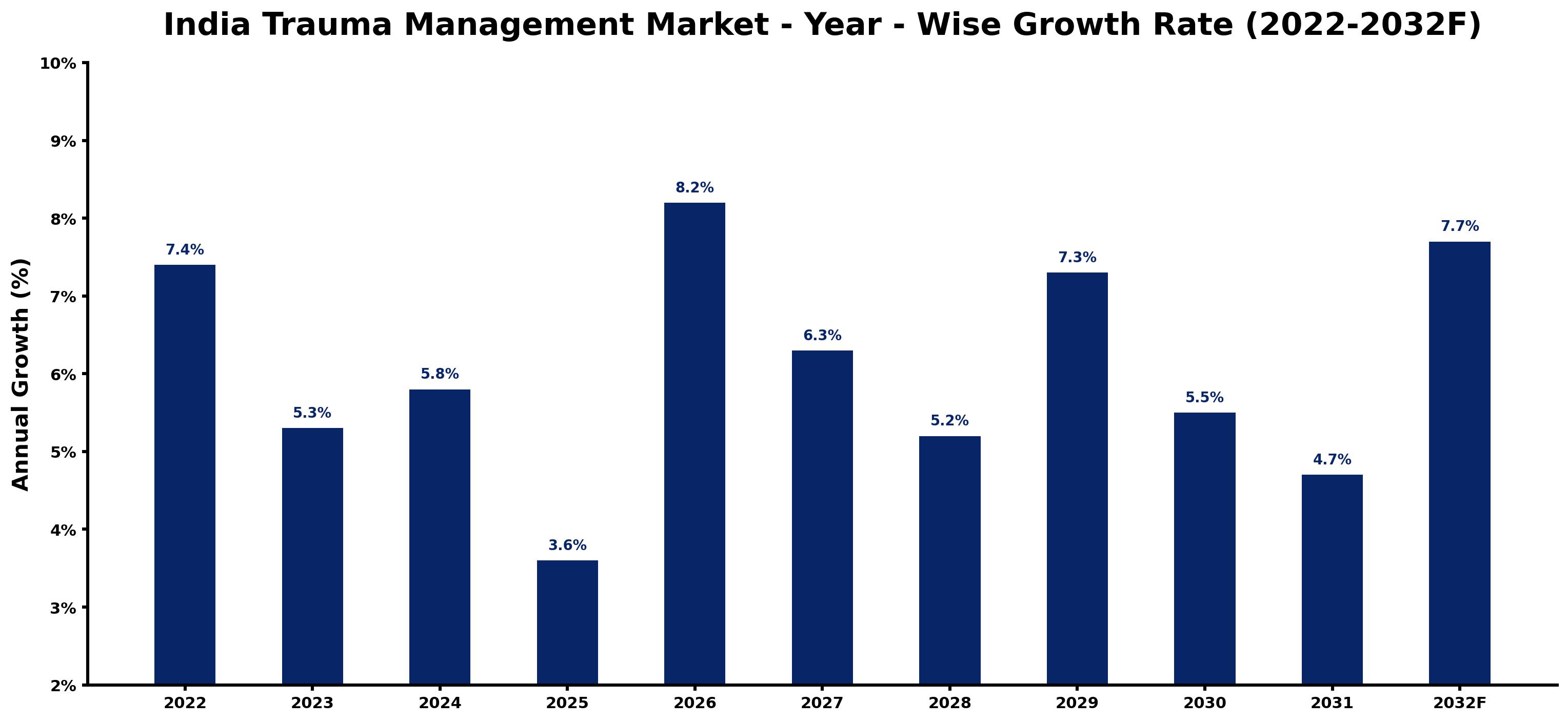
Annual growth estimates for each year appear below with the principal reason behind them, explaining the shifts that set the pace of the market.
| Year | Estimated Annual Growth (%) | Market Rationale |
| 2022 | 7.4 | The market experienced strong demand due to high road traffic accident rates. |
| 2023 | 5.3 | Growth slowed as trauma care initiatives faced implementation challenges. |
| 2024 | 5.8 | Increased focus on mental health services positively impacted demand. |
| 2025 | 3.6 | The market saw slower growth as trauma care facilities struggled with funding. |
| 2026 | 8.2 | Demand surged with the introduction of new trauma care programmes. |
| 2027 | 6.3 | Growth slowed as urban hospitals faced capacity constraints. |
| 2028 | 5.2 | Demand remained steady as mental health awareness continued to rise. |
| 2029 | 7.3 | The market rebounded with improved trauma care infrastructure investments. |
| 2030 | 5.5 | Growth slowed due to ongoing challenges in rural trauma care access. |
| 2031 | 4.7 | Demand decreased as urban hospitals faced resource allocation issues. |
| 2032 | 7.7 | The market is expected to grow as mental health services expand. |
Note: Market size estimations and growth projections presented in this report are based on 6Wresearch's proprietary forecasting methodology, utilizing the latest available industry data, government publications, and primary research inputs.
India Trauma Management Market Synopsis
The Trauma Management Market in India includes a range of medical practices focused on treating both physical and psychological injuries. This encompasses surgical interventions, rehabilitation, and mental health support. Growth in the market is driven by rising road traffic accident rates and a heightened emphasis on mental health services. With over 1,500 trauma centres across the country, the demand for effective trauma care remains high. Government initiatives, such as the National Health Mission's Trauma Care Programme, improve the infrastructure and accessibility of trauma management services.
Market Dynamics Impact Analysis (2026–2032)
| Factor | Type | Impact | Primary Segment Affected |
| Increasing road traffic accidents drive demand for trauma care services. | Driver | High | Surgical Trauma Care |
| Growing emphasis on mental health support boosts demand for psychological trauma care. | Driver | High | Mental Trauma Care |
| Rising investments in trauma care infrastructure create opportunities for service providers. | Opportunity | High | Pediatric Trauma Units |
| Expansion of trauma care facilities in rural areas presents significant investment potential. | Opportunity | Medium | Non-Surgical Care |
| Limited funding for trauma care initiatives restricts growth potential. | Restraint | High | Critical Care |
| Insufficient training for healthcare professionals hampers service quality. | Restraint | Medium | Psychiatry/Psychology |
| Challenges in rural healthcare access slow market expansion. | Challenge | High | Inpatient |
| Resource allocation issues in urban hospitals complicate service delivery. | Challenge | Medium | Outpatient |
Evaluation of Drivers in India Trauma Management Market (2026–2032)
Key forces behind demand, with the segment each one moves most, are listed below.
| Drivers | Primary Segment Affected | Why It Matters (Evidence) |
| High road traffic accident rates increase the need for surgical trauma care. | Surgical Trauma Care | In 2022, India reported approximately 150,000 road traffic accident fatalities, leading to heightened demand for trauma services. |
| Growing mental health awareness drives demand for psychological trauma care. | Mental Trauma Care | The National Mental Health Programme focuses on mental trauma care, promoting services and increasing accessibility. |
| Investment in trauma care infrastructure improves service availability. | Pediatric Trauma Units | In 2023, the government allocated ₹500 crores for upgrading trauma care facilities in rural areas, improving access. |
| Expansion of teletherapy services supports mental health recovery. | Teletherapy | Telemedicine guidelines issued in 2020 facilitate access to mental health support, increasing service uptake. |
| The establishment of trauma centers boosts service capacity. | Critical Care | India has over 1,500 trauma centers, enhancing the availability of critical trauma care services. |
Market growth in India for Trauma Management rests on increasing road traffic accidents, rising mental health awareness, and investments in trauma care infrastructure. In 2022, approximately 150,000 road traffic accident fatalities underscored the urgent need for surgical trauma care. The establishment of trauma centers across India has significantly boosted critical care service capacity, responding to the growing needs of trauma survivors.
Evaluation of Restraints in India Trauma Management Market
Below mentioned are some major restraints and their influence on market dynamics.
| Market Restraint | Primary Segment Affected | Why It Matters (Evidence) |
| Limited funding for trauma care initiatives restricts service expansion. | Critical Care | Insufficient government funding hampers the development of trauma care infrastructure, affecting service delivery. |
| Insufficient training for healthcare professionals hampers service quality. | Psychiatry/Psychology | A lack of trained professionals in trauma care leads to inadequate treatment options for patients. |
| Challenges in rural healthcare access slow market expansion. | Inpatient | Rural areas often lack adequate trauma facilities, limiting access for patients in need of immediate care. |
| Resource allocation issues in urban hospitals complicate service delivery. | Outpatient | Urban hospitals face challenges in managing resources, affecting the quality of outpatient trauma care. |
| High operational costs impact the sustainability of trauma care services. | Non-Surgical Care | The operational costs of maintaining trauma care facilities can be prohibitive, limiting service availability. |
India Trauma Management Market Challenges
The India Trauma Management Market encounters high costs due to inadequate funding for trauma facilities, which restricts access for patients in rural areas. This financial limitation leads to delayed treatments, with only a fraction of the necessary upgrades funded in 2023. Technological challenges hinder effective trauma management, as telemedicine guidelines from 2020 remain largely unutilised, preventing many patients from accessing vital services. Regulatory inconsistencies create difficulties in meeting the standards set by the Indian Orthopaedic Association, resulting in varied treatment quality for producers and negatively impacting patient outcomes. Increased competition among urban hospitals forces providers to cut costs, potentially compromising the quality of trauma care delivered.
Trends in the India Trauma Management Market
The trends below show where the India Trauma Management Market is heading.
- Shift towards Integrated Trauma Care Services: In 2022, the Integrated Trauma Care Initiative was launched to provide trauma care from emergency response to rehabilitation. This approach improves patient outcomes and streamlines service delivery, with a focus on community support.
- Increase in Teletherapy for Mental Health: Since the introduction of telemedicine guidelines in 2020, there has been a rise in teletherapy services for mental health support. This shift has improved access to care, particularly in rural areas, with increasing patient engagement.
- Growth of Pediatric Trauma Units: The establishment of Pediatric Trauma Units in major cities like Delhi and Mumbai has become essential for specialized care. These units cater specifically to children's trauma needs, addressing a critical gap in the healthcare system.
- Expansion of Trauma Awareness Campaigns: The Indian Medical Association has been actively promoting trauma care awareness campaigns since 2020. These initiatives aim to educate the public on trauma prevention and the importance of timely medical intervention.
Investment Opportunities in the India Trauma Management Market
The following opportunities in the India Trauma Management Market pair current demand with a clear way in.
- Investment in Pediatric Trauma Units: With increasing demand for specialised care, there is an opportunity to invest in Pediatric Trauma Units in urban areas. Establishing these units can enhance care for children, addressing a critical need.
- Expansion of Teletherapy Services: As mental health awareness grows, there is a rising need for teletherapy services. Investing in teletherapy platforms can support trauma survivors, particularly in rural regions lacking access to traditional care.
- Development of Non-Surgical Care Facilities: The increasing focus on rehabilitation presents opportunities to develop non-surgical care facilities. Investing in these facilities can improve recovery options for trauma patients, particularly in urban settings.
- Enhancement of Trauma Care Infrastructure: The government's ongoing funding for trauma care upgrades creates opportunities for service providers. Collaborating with local health agencies can facilitate entry into this expanding market.
Government Initiatives in the India Trauma Management Market
The National Health Mission launched the 'Trauma Care Programme' in 2021 to improve emergency response and trauma care facilities across India, with a budget of ₹500 crores. This initiative aims to raise the quality of trauma care services and ensure timely treatment for patients. Additionally, the 'Strengthening of Trauma Care Services' program initiated in 2022 focuses on enhancing trauma care infrastructure in 100 districts, further supporting the development of trauma management capabilities.
The Ministry of Health and Family Welfare oversees the implementation of various trauma care initiatives, including the 'Integrated Trauma Care Initiative' launched in 2022. This initiative provides trauma care from emergency response to rehabilitation, supported by various health agencies. The National Trauma Registry, established in 2021, systematically collects data on trauma incidents and outcomes, aiding in policy formulation and improving service delivery.
Future Insight of the India Trauma Management Market
The India Trauma Management Market is set for substantial change by 2032, driven by increased investment in trauma facilities, particularly in rural areas. The National Trauma Registry, established in 2021, will enhance data collection, facilitating better resource allocation and treatment approaches. Advancements in telemedicine will broaden access to trauma management, enabling more patients to receive timely care. Initiatives from the National Mental Health Programme will further integrate psychological support into trauma management, effectively addressing the mental health needs of survivors.
Market Segmentation Analysis
Each segment group is reviewed below, with the leader by share and the fastest grower by CAGR.
By Management Approach – Surgical Trauma Care Dominated, Non-Surgical Care Expected to Grow Fastest
According to Vasudha, AM at 6Wresearch, in 2025, Surgical Trauma Care led the management approach split with a 45% share. Surgical Trauma Care captures the largest market share as it is vital for addressing severe injuries, particularly in urban trauma centres where high accident rates are common. This approach is indispensable for effective emergency response and recovery, ensuring patients receive timely interventions. Non-Surgical Care is set to record the highest CAGR in this split, 8.4% over 2026–2032. Non-Surgical Care is rapidly gaining traction due to the increasing focus on rehabilitation and recovery, particularly following the National Mental Health Programme's establishment in 2020. This growth reflects a broader trend towards comprehensive care that integrates both physical and psychological recovery, further solidifying Surgical Trauma Care's dominance. Suppliers should enhance non-surgical offerings to align with the growing demand for holistic trauma management solutions.
By Specialty Focus – Orthopedic/Neuro Dominated, Physiotherapy Expected to Grow Fastest
With a 35% revenue share in 2025, Orthopedic/Neuro was the largest specialty focus category. Orthopedic/Neuro specialties hold the largest market share as they are essential for treating specific injury types, especially in urban hospitals where trauma cases are prevalent. The standards established by the Indian Orthopaedic Association underscore the importance of these specialties in delivering high-quality trauma care. Physiotherapy is projected to grow fastest, at a CAGR of 7.5% during 2026–2032. Physiotherapy is experiencing the fastest growth, driven by its critical role in supporting recovery after injuries, reflecting a rising awareness of rehabilitation's importance. This trend aligns with the broader movement towards integrating recovery services into trauma management, complementing the established Orthopedic/Neuro segment. Buyers should invest in physiotherapy services to enhance surgical interventions and improve overall patient recovery outcomes.
By Delivery Type – Inpatient Dominated, Teletherapy Expected to Grow Fastest
Inpatient accounted for a 52% market share by delivery type in 2025. Inpatient care commands the largest share as it is essential for severe trauma cases requiring continuous monitoring and intensive treatment. Hospitals, being the primary providers of inpatient trauma services, ensure patients receive immediate and comprehensive care in critical situations. The quickest growth will come from Teletherapy, forecast to expand at a CAGR of 8.1% between 2026 and 2032. Teletherapy is witnessing rapid growth, driven by the increasing need for accessible mental health support, especially after the Ministry of Health issued telemedicine guidelines in 2020. This delivery method is becoming popular for follow-up care and psychological support, indicating a shift in trauma management service delivery. Providers of trauma management services should integrate teletherapy options to meet the rising demand for remote mental health support.
By End User – Hospitals Dominated, Clinics Expected to Grow Fastest
Hospitals took a 39% share of end user in 2025, more than any other category. Hospitals dominate the market share as they are the primary providers of trauma care, equipped with the necessary facilities and personnel to manage severe cases. With a significant portion of trauma cases treated in urban hospitals, their role is crucial in the trauma management ecosystem, ensuring timely interventions. Over 2026–2032, Clinics are expected to post the fastest growth, at a CAGR of 8.1%. Clinics are experiencing the fastest growth as they play a supportive role in managing minor trauma cases, reflecting a shift towards decentralised healthcare solutions. Their increasing presence highlights the growing recognition of the importance of accessible trauma care across various settings, complementing hospital services. Suppliers should target clinics to expand their reach and enhance access to trauma care services within the community.
Key Attractiveness of the Report
- 10 Years of Market Numbers
- Historical Data Starting from 2022 to 2025
- Base Year 2025
- Forecast Data until 2032
- Key Performance Indicators Impacting the Market
- Major Upcoming Developments and Projects
Key Highlights of the Report:
- India Trauma Management Market Outlook
- Market Size of India Trauma Management Market, 2025
- Forecast of India Trauma Management Market, 2032
- Historical Data and Forecast of India Trauma Management Revenues & Volume for the Period 2022 - 2032F
- India Trauma Management Market Trend Evolution
- India Trauma Management Market Drivers and Challenges
- India Trauma Management Price Trends
- India Trauma Management Porter's Five Forces
- India Trauma Management Industry Life Cycle
- Historical Data and Forecast of India Trauma Management Market Revenues & Volume By Management Approach for the Period 2022 - 2032F
- Historical Data and Forecast of India Trauma Management Market Revenues & Volume By Surgical Trauma Care for the Period 2022 - 2032F
- Historical Data and Forecast of India Trauma Management Market Revenues & Volume By Non-Surgical Care for the Period 2022 - 2032F
- Historical Data and Forecast of India Trauma Management Market Revenues & Volume By Mental Trauma Care for the Period 2022 - 2032F
- Historical Data and Forecast of India Trauma Management Market Revenues & Volume By Pediatric Trauma Units for the Period 2022 - 2032F
- Historical Data and Forecast of India Trauma Management Market Revenues & Volume By Specialty Focus for the Period 2022 - 2032F
- Historical Data and Forecast of India Trauma Management Market Revenues & Volume By Orthopedic/Neuro for the Period 2022 - 2032F
- Historical Data and Forecast of India Trauma Management Market Revenues & Volume By Physiotherapy for the Period 2022 - 2032F
- Historical Data and Forecast of India Trauma Management Market Revenues & Volume By Psychiatry/Psychology for the Period 2022 - 2032F
- Historical Data and Forecast of India Trauma Management Market Revenues & Volume By Pediatric Surgery for the Period 2022 - 2032F
- Historical Data and Forecast of India Trauma Management Market Revenues & Volume By Delivery Type for the Period 2022 - 2032F
- Historical Data and Forecast of India Trauma Management Market Revenues & Volume By Inpatient for the Period 2022 - 2032F
- Historical Data and Forecast of India Trauma Management Market Revenues & Volume By Outpatient for the Period 2022 - 2032F
- Historical Data and Forecast of India Trauma Management Market Revenues & Volume By Teletherapy for the Period 2022 - 2032F
- Historical Data and Forecast of India Trauma Management Market Revenues & Volume By Critical Care for the Period 2022 - 2032F
- Historical Data and Forecast of India Trauma Management Market Revenues & Volume By End User for the Period 2022 - 2032F
- Historical Data and Forecast of India Trauma Management Market Revenues & Volume By Hospitals for the Period 2022 - 2032F
- Historical Data and Forecast of India Trauma Management Market Revenues & Volume By Clinics for the Period 2022 - 2032F
- Historical Data and Forecast of India Trauma Management Market Revenues & Volume By Trauma Survivors for the Period 2022 - 2032F
- Historical Data and Forecast of India Trauma Management Market Revenues & Volume By Children's Hospitals for the Period 2022 - 2032F
- India Trauma Management Import Export Trade Statistics
- Market Opportunity Assessment By Management Approach
- Market Opportunity Assessment By Specialty Focus
- Market Opportunity Assessment By Delivery Type
- Market Opportunity Assessment By End User
- India Trauma Management Top Companies Market Share
- India Trauma Management Competitive Benchmarking By Technical and Operational Parameters
- India Trauma Management Company Profiles
- India Trauma Management Key Strategic Recommendations
Market Covered
The report offers an extensive study of the following market segments.
By Management Approach
- Surgical Trauma Care
- Non-Surgical Care
- Mental Trauma Care
- Pediatric Trauma Units
By Specialty Focus
- Orthopedic/Neuro
- Physiotherapy
- Psychiatry/Psychology
- Pediatric Surgery
By Delivery Type
- Inpatient
- Outpatient
- Teletherapy
- Critical Care
By End User
- Hospitals
- Clinics
- Trauma Survivors
- Children's Hospitals































