India Tropical Fruit Market Size & Growth Rate
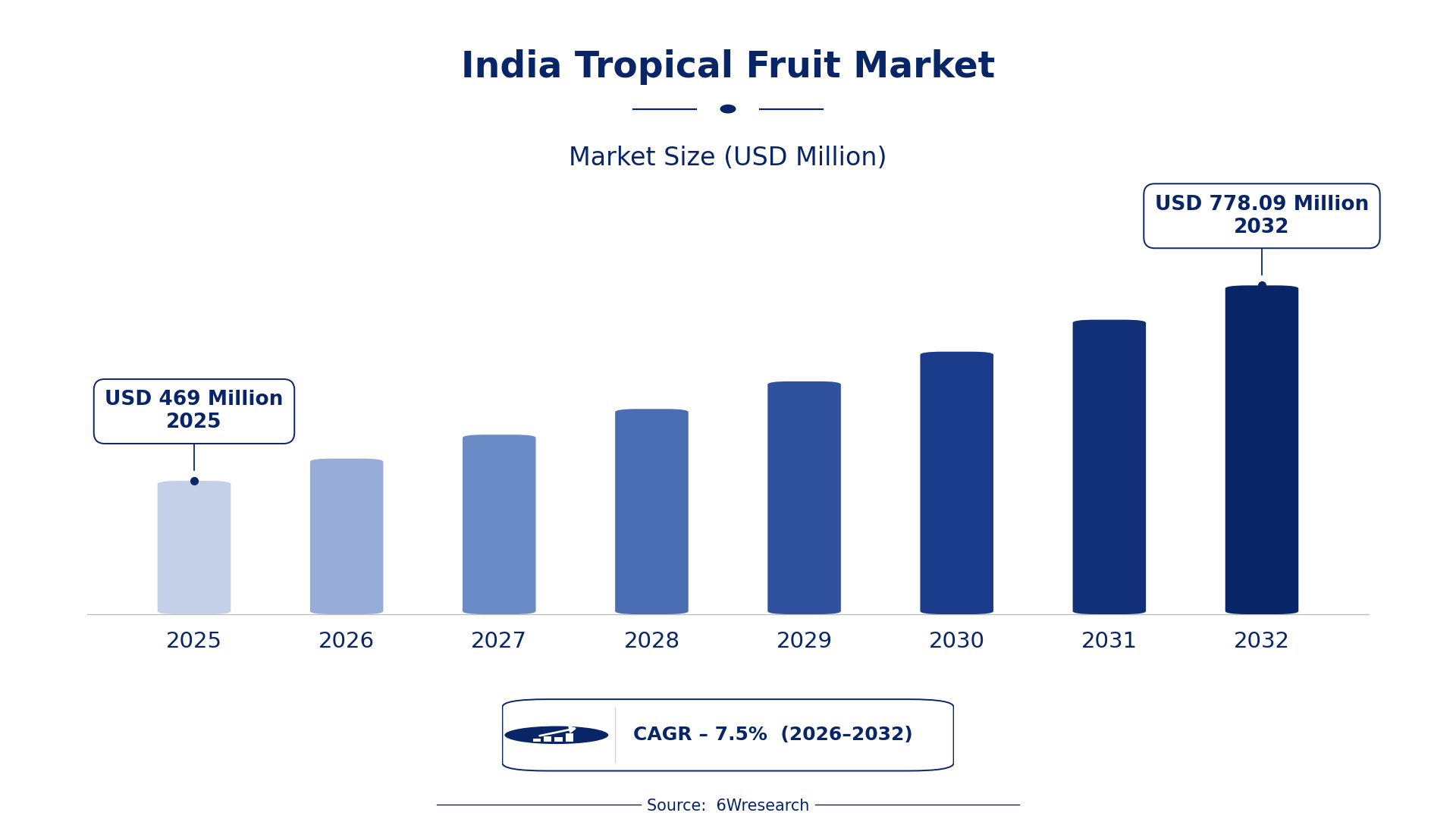
According to 6Wresearch internal database and industry insights, the India Tropical Fruit Market was valued at USD 469.0 million in 2025 and is projected to reach USD 778.09 million by 2032, growing at a CAGR of approximately 7.5% during 2026–2032.
India Tropical Fruit Market Highlights
| Report Metric | Details |
| Report Name | India Tropical Fruit Market |
| Market Size 2025 | USD 469.0 million |
| Market Size 2032 | USD 778.09 million |
| Absolute Growth 2025–2032 | USD 309.09 million |
| CAGR 2026–2032 | 7.5% |
| Peak Annual Growth | 9.2% in 2030 |
| Forecast Period | 2026–2032 |
| Historical Data | 2022–2025 |
| Base Year | 2025 |
| Leading Fruit Type, 2025 | Mango (43% share) |
| Leading Processing Type, 2025 | Fresh / Pulp (39% share) |
| Leading Packaging Type, 2025 | Canned/Juice Pack (44% share) |
| Leading End User, 2025 | Juice Manufacturers (51% share) |
| Fastest-Growing Fruit Type | Papaya (8.8% CAGR) |
| Fastest-Growing Processing Type | Fresh / Dried (9.0% CAGR) |
| Fastest-Growing Packaging Type | Frozen Pouches (9.7% CAGR) |
| Fastest-Growing End User | Foodservice Industry (10.0% CAGR) |
| Growing Sector | Fruit Processing |
| Key End Users | Juice Manufacturers, Retail Supermarkets, Foodservice Industry, Export Traders |
India Tropical Fruit Market Year-wise Growth Rate and Key Drivers (2022–2032)
This graph illustrates the annual growth rates of the market from 2022 to 2032, highlighting a steady upward trajectory and projected market expansion over the forecast period.
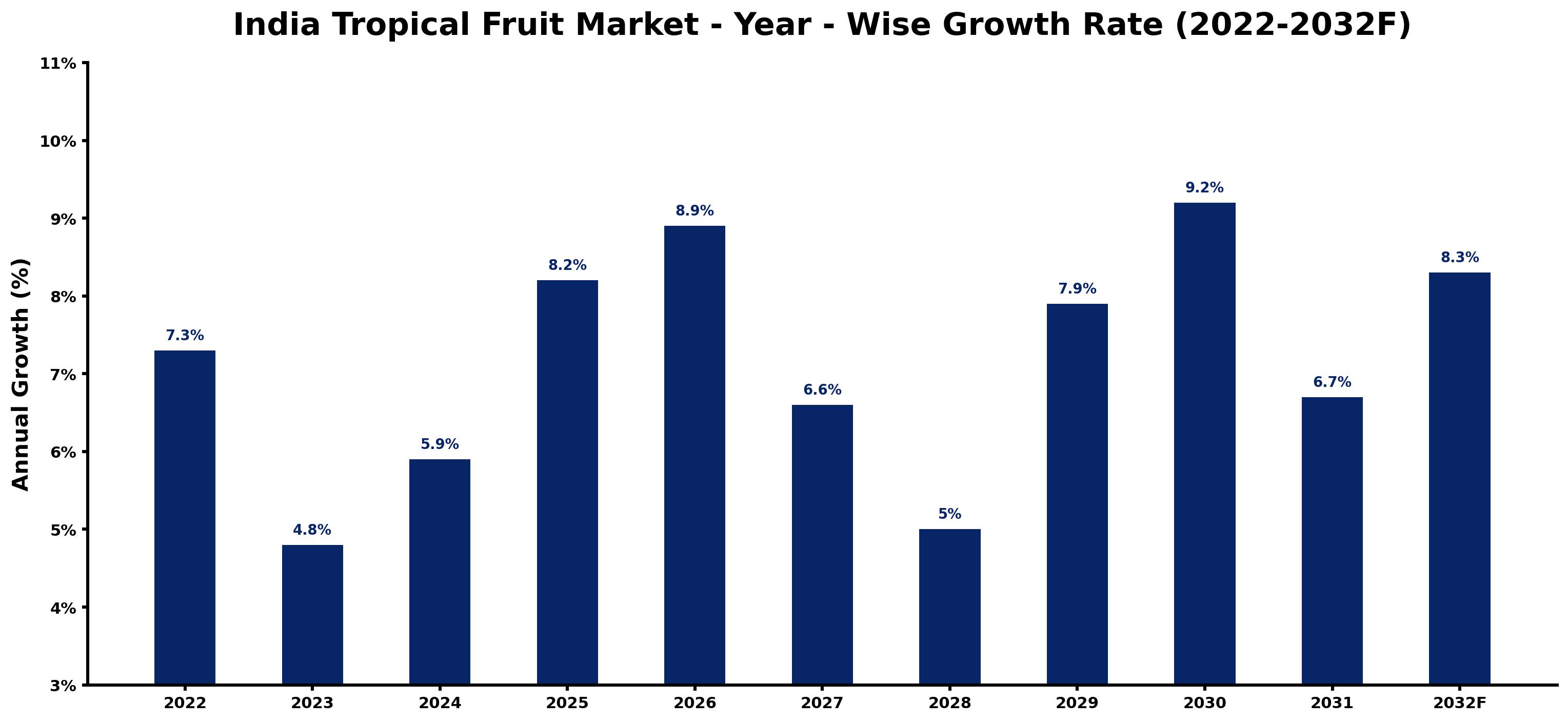
The table below sets out the estimated growth rate for each year and the main factor behind it.
| Year | Estimated Annual Growth (%) | Market Rationale |
| 2022 | 7.3 | The market experienced strong domestic consumption of tropical fruits, particularly mangoes and bananas. |
| 2023 | 4.8 | Growth slowed due to fluctuations in weather affecting crop yields in key producing states. |
| 2024 | 5.9 | Improved export opportunities for mangoes boosted growth as international demand increased. |
| 2025 | 8.2 | The introduction of new cultivation techniques led to higher yields, driving market expansion. |
| 2026 | 8.9 | Growing consumer interest in healthy diets is expected to support demand for fresh tropical fruits. |
| 2027 | 6.6 | Market growth is projected to slow as competition increases among local producers for market share. |
| 2028 | 5.0 | Demand for processed tropical fruits is anticipated to remain steady, contributing to overall market stability. |
| 2029 | 7.9 | Increased exports of papaya to international markets are expected to enhance growth prospects for producers. |
| 2030 | 9.2 | The market is projected to peak as the Food Processing Ministry's initiatives spur investment in processing facilities. |
| 2031 | 6.7 | Growth is expected to slow as supply chain challenges emerge, impacting the availability of fresh fruits. |
| 2032 | 8.3 | Rising health awareness among consumers is projected to further boost demand for tropical fruits. |
Note: Market size estimations and growth projections presented in this report are based on 6Wresearch's proprietary forecasting methodology, utilizing the latest available industry data, government publications, and primary research inputs.
India Tropical Fruit Market Synopsis
These fruits are primarily used for fresh consumption, processing into juices, and export. The market is expanding due to increasing domestic consumption and export opportunities, particularly in states like Maharashtra and Karnataka. In 2022, fresh fruit exports were valued at approximately $1.5 billion, highlighting strong international demand. The National Horticulture Mission continues to promote cultivation, further driving market growth.
Market Dynamics Impact Analysis (2026–2032)
| Factor | Type | Impact | Primary Segment Affected |
| Rising domestic consumption of mangoes and bananas drives demand for fresh tropical fruits. | Driver | High | Fresh / Pulp |
| Growing health awareness among consumers boosts demand for processed tropical fruits. | Driver | High | Fresh / Dried |
| Investment in processing facilities is increasing due to rising demand for convenience products. | Opportunity | High | Canned/Juice Pack |
| Export opportunities for tropical fruits are expanding, particularly for papayas. | Opportunity | High | Export Traders |
| Weather fluctuations can impact crop yields, affecting supply and prices. | Restraint | High | Mango |
| Competition among local producers can lead to price wars, impacting profitability. | Restraint | Medium | Pineapple |
| The market faces challenges related to supply chain disruptions affecting fresh fruit availability. | Challenge | High | Banana (Tropical) |
| Limited access to modern agricultural technology can hinder productivity improvements. | Challenge | Medium | Papaya |
Evaluation of Drivers in India Tropical Fruit Market (2026–2032)
The factors lifting demand, and the evidence behind each, are summarised below.
| Drivers | Primary Segment Affected | Why It Matters (Evidence) |
| Rising domestic consumption of mangoes and bananas | Fresh / Pulp | This increase in consumption drives demand for fresh tropical fruits, with India producing about 40% of global mangoes. |
| Growing health awareness among consumers | Fresh / Dried | Health trends boost the demand for processed tropical fruits, with the processed fruit market expected to reach $10 billion by 2025. |
| Investment in processing facilities | Canned/Juice Pack | The National Horticulture Mission supports investments in processing, enhancing the availability of canned and juice-packed tropical fruits. |
| Expansion of export opportunities | Export Traders | The highly sought-after Alphonso mango increases international market presence, contributing to approximately $1.5 billion in fresh fruit exports. |
| Financial support for farmers | Juice Manufacturers | The Pradhan Mantri Kisan Samman Nidhi scheme provides income support, enabling farmers to produce high-quality fruits for juice manufacturing. |
India is the largest producer of mangoes, contributing about 40% of global production, which boosts local sales. Investment in processing facilities is on the rise, supported by the National Horticulture Mission, which promotes tropical fruit cultivation. Export opportunities for tropical fruits are expanding, particularly for the highly sought-after Alphonso mango, increasing international market presence.
Evaluation of Restraints in India Tropical Fruit Market
The following restraints limit how fast demand can grow.
| Market Restraint | Primary Segment Affected | Why It Matters (Evidence) |
| High production costs in key cultivation regions | Pineapple | Maharashtra, where over 50% of pineapples are grown, faces elevated production costs, impacting pricing for buyers. |
| Inconsistent quality standards | Fresh / Pulp | Quality standards set by the Food Safety and Standards Authority can lead to shipment delays, costing exporters around $1.5 billion annually. |
| Skills shortages in modern agricultural practices | Papaya | Limited skills in modern farming techniques restrict suppliers' capacity to meet rising consumer demand for papayas. |
| Supply chain disruptions due to inadequate infrastructure | Banana (Tropical) | Poor infrastructure can delay the delivery of fresh bananas to market, frustrating suppliers and buyers alike. |
| Regulatory compliance costs | Canned/Juice Pack | Compliance with food safety regulations increases operational costs for producers of canned and juice-packed tropical fruits. |
India Tropical Fruit Market Challenges
High production costs in Maharashtra, where over 50% of the country’s pineapple is grown, can inflate prices for buyers, squeezing profit margins. Buyers also face inconsistent quality standards set by the Food Safety and Standards Authority, leading to shipment delays and rejected batches, which costs exporters around $1.5 billion in potential revenue losses annually. Skills shortages in modern agricultural practices restrict suppliers' ability to meet consumer demand, diminishing production efficiency. Supply chain disruptions, often due to inadequate infrastructure, can delay the delivery of fresh produce to market, causing frustration for both suppliers and buyers.
Trends in the India Tropical Fruit Market
Four trends stand out in the India Tropical Fruit Market.
- Shift towards Organic Farming Practices: The National Organic Farming Policy, introduced in 2021, promotes organic cultivation of tropical fruits, aiming to increase sustainable farming practices across India. This shift is set to boost market demand, with organic fruit sales expected to grow significantly.
- Increase in Online Sales Platforms: The National Agriculture Market (e-NAM) facilitates the sale of tropical fruits through online platforms, making it easier for buyers to access products. This trend is anticipated to increase sales, with a projected rise in online transactions for fresh produce.
- Growing Popularity of Dried Tropical Fruits: The processed fruit market is experiencing a surge in demand for dried tropical fruits, driven by increasing health awareness. This segment is expected to grow rapidly, as health-conscious consumers seek nutritious snack options.
- Expansion of Juice Manufacturing Facilities: Investment in juice manufacturing facilities is on the rise, supported by government initiatives like the PMFME Scheme. This trend is expected to boost production capacity, with the processed fruit industry projected to reach $10 billion by 2025.
Investment Opportunities in the India Tropical Fruit Market
Below are the investment opportunities with the strongest case in the India Tropical Fruit Market.
- Investment in Processing Facilities: Karnataka is witnessing a rise in investment in processing facilities, with the processed fruit market projected to reach $10 billion by 2025. Suppliers can explore local partnerships and certifications to enter this market.
- Expansion of Export Markets: With fresh fruit exports valued at approximately $1.5 billion in 2022, there exists a substantial opportunity for exporters. Engaging with international buyers can broaden market reach.
- Growing Demand for Organic Fruits: The organic tropical fruit market is expanding, driven by health-conscious consumers. Producers can take advantage of the National Organic Farming Policy by transitioning to organic practices.
- Development of Cold Chain Infrastructure: The need for improved cold chain logistics is critical, given the rising demand for fresh tropical fruits. Investments in cold storage facilities can greatly enhance supply chain efficiency.
Government Initiatives in the India Tropical Fruit Market
The Pradhan Mantri Kisan Samman Nidhi scheme, launched by the Ministry of Agriculture in 2020, provides direct income support to farmers cultivating tropical fruits, benefiting millions. This measure improves the financial stability of farmers, enabling them to invest in better farming practices. Additionally, the National Horticulture Mission, updated in 2021, aims to promote the cultivation and export of tropical fruits through financial assistance and training, further supporting farmers in improving productivity and quality.
The Food Safety and Standards Authority of India oversees the PMFME Scheme, initiated in 2020, which supports micro and small enterprises in the tropical fruit processing sector with financial aid. This scheme facilitates the establishment of processing units, increasing value addition in the industry. Furthermore, the Food Safety and Standards Authority of India regulates food safety standards for tropical fruits, ensuring compliance with health regulations and boosting consumer confidence.
Future Insight of the India Tropical Fruit Market
The National Horticulture Mission will continue to promote tropical fruit cultivation, enhancing production capabilities in leading states. The processed fruit sector is projected to grow significantly, with the industry expected to reach $10 billion by 2025, creating new opportunities for suppliers. The Pradhan Mantri Kisan Samman Nidhi scheme will provide ongoing financial support to farmers, ensuring a steady supply of high-quality fruits. The expansion of the National Agriculture Market (e-NAM) will improve access for buyers, streamlining the sale of tropical fruits.
Market Segmentation Analysis
Each segment group is reviewed below, with the leader by share and the fastest grower by CAGR.
By Fruit Type – Mango Dominated, Papaya Expected to Grow Fastest
According to Vasudha, AM at 6Wresearch, the largest fruit type category in 2025 was Mango, with a 43% share of total revenue. With India being the largest producer globally, the demand for mango varieties, particularly Alphonso, remains exceptionally high. Over 2026–2032, Papaya is expected to post the fastest growth, at a CAGR of 8.8%. Papaya is witnessing rapid growth, fuelled by increasing health awareness and the rising popularity of fresh papaya in health products. The average yield of papaya in India, around 20-25 tons per hectare, supports its expanding market presence and consumer interest. This trend suggests that suppliers should enhance their papaya offerings to cater to the growing health-conscious consumer base.
By Processing Type – Fresh / Pulp Dominated, Fresh / Dried Expected to Grow Fastest
In 2025, Fresh / Pulp led the processing type split with a 39% share. Fresh / Pulp commands the largest market share as it is crucial for juice manufacturing, a primary application of tropical fruits in India. The processed fruit market's projected growth to $10 billion by 2025 underscores the significance of fresh pulp in this industry. Fresh / Dried is set to record the highest CAGR in this split, 9.0% over 2026–2032. The Fresh / Dried segment is experiencing the fastest growth, driven by the increasing demand for dried tropical fruits in snacks and health foods. As consumers shift towards healthier snacking options, the demand for fresh and dried products is expected to rise significantly. Suppliers should consider expanding their product lines to include fresh and dried tropical fruits to capitalise on this growing trend.
By Packaging Type – Canned/Juice Pack Dominated, Frozen Pouches Expected to Grow Fastest
Canned/Juice Pack held a 44% share of the India Tropical Fruit Market by packaging type in 2025. Canned/Juice Pack leads the packaging segment as it is the most common packaging for processed tropical fruit products, ensuring convenience and extended shelf life. This packaging type aligns well with the needs of juice manufacturers who require reliable packaging solutions. Frozen Pouches are projected to grow fastest, at a CAGR of 9.7% during 2026–2032. Frozen Pouches are the fastest-growing packaging type, appealing to the foodservice industry for their convenience and suitability for retail. The increasing demand for ready-to-use fruit products in foodservice is propelling this segment's growth. This suggests that suppliers should invest in developing frozen pouch options to cater to the evolving preferences of the foodservice sector.
By End User – Juice Manufacturers Dominated, Foodservice Industry Expected to Grow Fastest
Juice Manufacturers took a 51% share of end user in 2025, more than any other category. Juice Manufacturers represent the largest share of the end-user segment, as they are major consumers of tropical fruits for juice production. The strong demand for tropical fruit juices in India solidifies the position of juice manufacturers within the market. The quickest growth will come from Foodservice Industry, forecast to expand at a CAGR of 10.0% between 2026 and 2032. The Foodservice Industry is the fastest-growing end-user segment, as it incorporates tropical fruits into various menus and beverages. With dining trends increasingly favouring fresh and healthy options, this segment's growth is likely to accelerate further. This trend indicates that suppliers should strengthen their partnerships with foodservice providers to leverage the rising demand for tropical fruits in their offerings.
Key Attractiveness of the Report
- 10 Years of Market Numbers
- Historical Data Starting from 2022 to 2025
- Base Year 2025
- Forecast Data until 2032
- Key Performance Indicators Impacting the Market
- Major Upcoming Developments and Projects
Key Highlights of the Report:
- India Tropical Fruit Market Outlook
- Market Size of India Tropical Fruit Market, 2025
- Forecast of India Tropical Fruit Market, 2032
- Historical Data and Forecast of India Tropical Fruit Revenues & Volume for the Period 2022 - 2032F
- India Tropical Fruit Market Trend Evolution
- India Tropical Fruit Market Drivers and Challenges
- India Tropical Fruit Price Trends
- India Tropical Fruit Porter's Five Forces
- India Tropical Fruit Industry Life Cycle
- Historical Data and Forecast of India Tropical Fruit Market Revenues & Volume By Fruit Type for the Period 2022 - 2032F
- Historical Data and Forecast of India Tropical Fruit Market Revenues & Volume By Mango for the Period 2022 - 2032F
- Historical Data and Forecast of India Tropical Fruit Market Revenues & Volume By Pineapple for the Period 2022 - 2032F
- Historical Data and Forecast of India Tropical Fruit Market Revenues & Volume By Papaya for the Period 2022 - 2032F
- Historical Data and Forecast of India Tropical Fruit Market Revenues & Volume By Banana (Tropical) for the Period 2022 - 2032F
- Historical Data and Forecast of India Tropical Fruit Market Revenues & Volume By Processing Type for the Period 2022 - 2032F
- Historical Data and Forecast of India Tropical Fruit Market Revenues & Volume By Fresh / Pulp for the Period 2022 - 2032F
- Historical Data and Forecast of India Tropical Fruit Market Revenues & Volume By Fresh / Dried for the Period 2022 - 2032F
- Historical Data and Forecast of India Tropical Fruit Market Revenues & Volume By Cut / Frozen for the Period 2022 - 2032F
- Historical Data and Forecast of India Tropical Fruit Market Revenues & Volume By Whole / Pureed for the Period 2022 - 2032F
- Historical Data and Forecast of India Tropical Fruit Market Revenues & Volume By Packaging Type for the Period 2022 - 2032F
- Historical Data and Forecast of India Tropical Fruit Market Revenues & Volume By Canned/Juice Pack for the Period 2022 - 2032F
- Historical Data and Forecast of India Tropical Fruit Market Revenues & Volume By Vacuum Sealed for the Period 2022 - 2032F
- Historical Data and Forecast of India Tropical Fruit Market Revenues & Volume By Frozen Pouches for the Period 2022 - 2032F
- Historical Data and Forecast of India Tropical Fruit Market Revenues & Volume By Shrink Wrap / Export Box for the Period 2022 - 2032F
- Historical Data and Forecast of India Tropical Fruit Market Revenues & Volume By End User for the Period 2022 - 2032F
- Historical Data and Forecast of India Tropical Fruit Market Revenues & Volume By Juice Manufacturers for the Period 2022 - 2032F
- Historical Data and Forecast of India Tropical Fruit Market Revenues & Volume By Retail Supermarkets for the Period 2022 - 2032F
- Historical Data and Forecast of India Tropical Fruit Market Revenues & Volume By Foodservice Industry for the Period 2022 - 2032F
- Historical Data and Forecast of India Tropical Fruit Market Revenues & Volume By Export Traders for the Period 2022 - 2032F
- India Tropical Fruit Import Export Trade Statistics
- Market Opportunity Assessment By Fruit Type
- Market Opportunity Assessment By Processing Type
- Market Opportunity Assessment By Packaging Type
- Market Opportunity Assessment By End User
- India Tropical Fruit Top Companies Market Share
- India Tropical Fruit Competitive Benchmarking By Technical and Operational Parameters
- India Tropical Fruit Company Profiles
- India Tropical Fruit Key Strategic Recommendations
Market Covered
This report examines the market across the segments below.
By Fruit Type
- Mango
- Pineapple
- Papaya
- Banana (Tropical)
By Processing Type
- Fresh / Pulp
- Fresh / Dried
- Cut / Frozen
- Whole / Pureed
By Packaging Type
- Canned/Juice Pack
- Vacuum Sealed
- Frozen Pouches
- Shrink Wrap / Export Box
By End User
- Juice Manufacturers
- Retail Supermarkets
- Foodservice Industry
- Export Traders































