China Tropical Fruit Market Size & Growth Rate
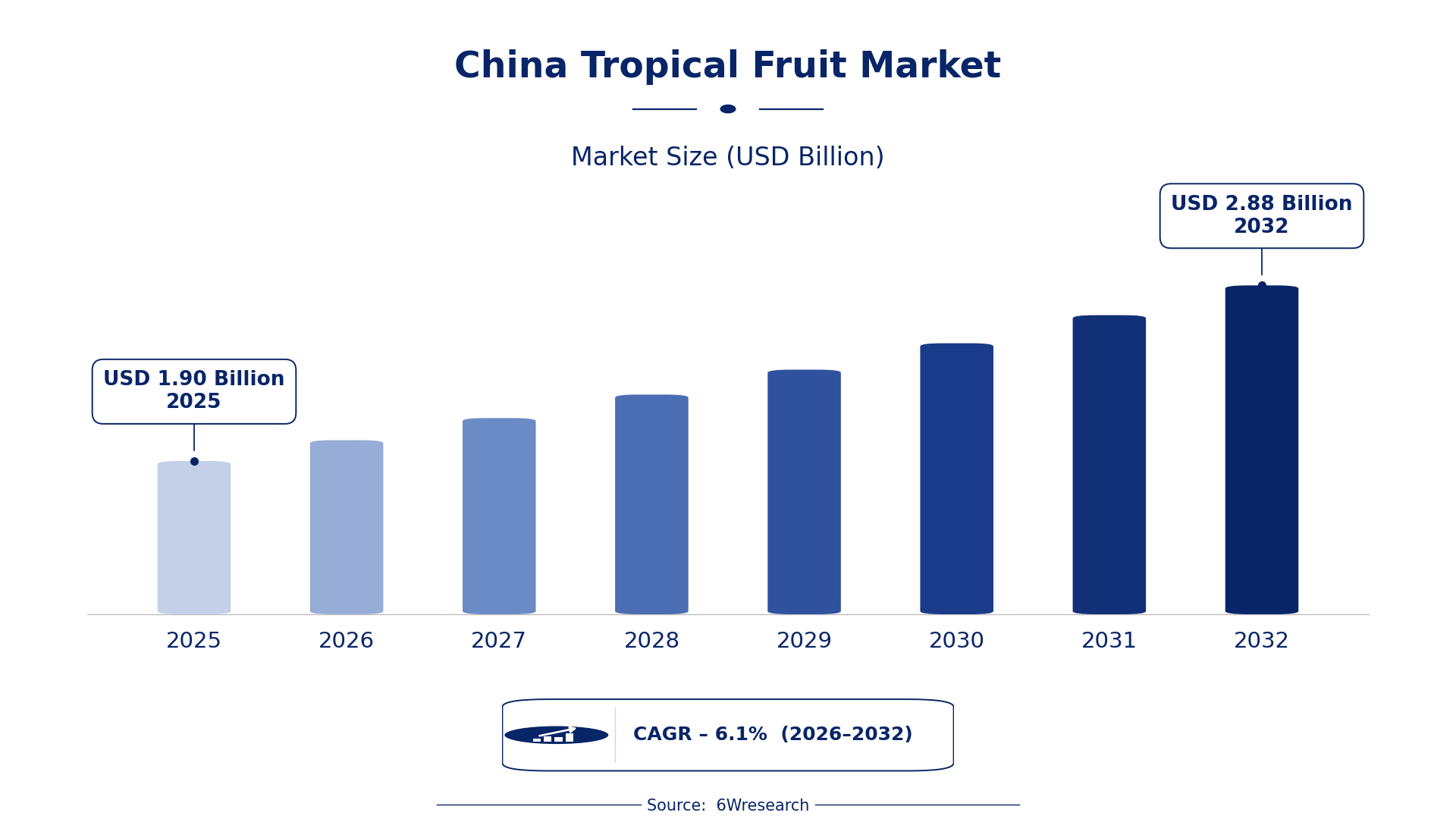
According to 6Wresearch internal database and industry insights, the China Tropical Fruit Market was valued at USD 1.90 billion in 2025 and is projected to reach USD 2.88 billion by 2032, growing at a CAGR of approximately 6.1% during 2026–2032.
China Tropical Fruit Market Highlights
| Report Metric | Details |
| Report Name | China Tropical Fruit Market |
| Market Size 2025 | USD 1.90 billion |
| Market Size 2032 | USD 2.88 billion |
| Absolute Growth 2025–2032 | USD 0.98 billion |
| CAGR 2026–2032 | 6.1% |
| Peak Annual Growth | 8.4% in 2030 |
| Forecast Period | 2026–2032 |
| Historical Data | 2022–2025 |
| Base Year | 2025 |
| Leading Fruit Type, 2025 | Mango (41% share) |
| Leading Processing Type, 2025 | Fresh / Pulp (52% share) |
| Leading Packaging Type, 2025 | Canned/Juice Pack (37% share) |
| Leading End User, 2025 | Juice Manufacturers (41% share) |
| Fastest-Growing Fruit Type | Papaya (8.2% CAGR) |
| Fastest-Growing Processing Type | Fresh / Dried (8.8% CAGR) |
| Fastest-Growing Packaging Type | Frozen Pouches (7.8% CAGR) |
| Fastest-Growing End User | Foodservice Industry (8.9% CAGR) |
| Growing Sector | Foodservice Industry |
| Key End Users | Juice Manufacturers, Retail Supermarkets, Foodservice Industry, Export Traders |
China Tropical Fruit Market Year-wise Growth Rate and Key Drivers (2022–2032)
This graph illustrates the annual growth rates of the market from 2022 to 2032, highlighting a steady upward trajectory and projected market expansion over the forecast period.
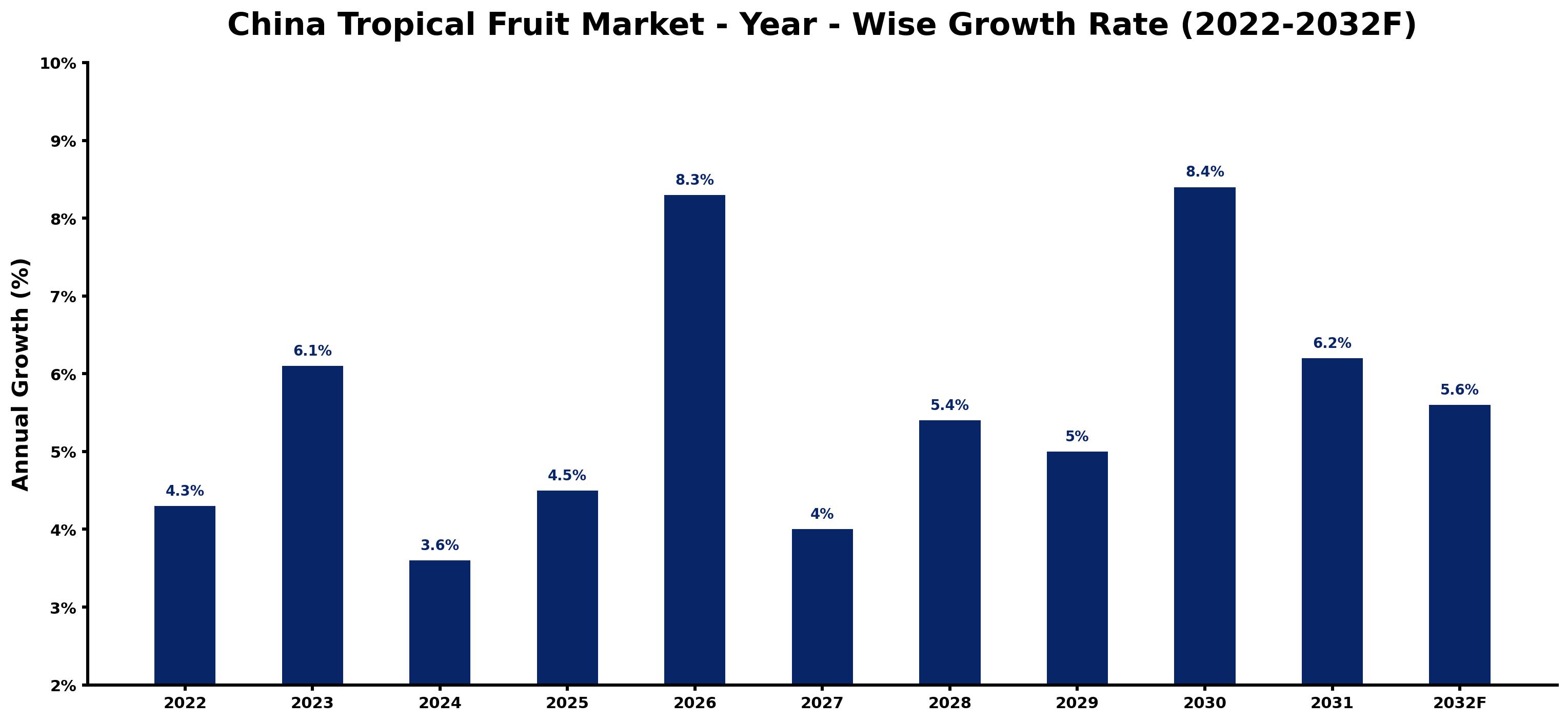
Below, each year's estimated growth is shown next to the factor that most influenced it.
| Year | Estimated Annual Growth (%) | Market Rationale |
| 2022 | 4.3 | The market experienced steady growth due to increasing domestic consumption of tropical fruits. |
| 2023 | 6.1 | Sales accelerated as urban supermarkets reported a 20% rise in tropical fruit sales over two years. |
| 2024 | 3.6 | Growth slowed as production faced challenges from adverse weather conditions affecting crop yields. |
| 2025 | 4.5 | Demand increased with the implementation of the 'Tropical Fruit Development Plan' to improve production capabilities. |
| 2026 | 8.3 | The market is expected to surge as exports grow, supported by rising demand from Southeast Asia. |
| 2027 | 4.0 | A slowdown is projected due to heightened competition among local producers in the tropical fruit sector. |
| 2028 | 5.4 | Growth is expected to resume as the foodservice industry expands its use of tropical fruits in various dishes. |
| 2029 | 5.0 | The market is projected to see a slowdown as retail prices adjust to align with production costs. |
| 2030 | 8.4 | A peak in growth is anticipated as consumer interest in organic tropical fruits surges. |
| 2031 | 6.2 | Growth is expected to slow as the market stabilises following rapid expansion in previous years. |
| 2032 | 5.6 | The market will continue to grow, driven by sustained consumer interest in tropical fruit products. |
Note: Market size estimations and growth projections presented in this report are based on 6Wresearch's proprietary forecasting methodology, utilizing the latest available industry data, government publications, and primary research inputs.
China Tropical Fruit Market Synopsis
The China Tropical Fruit Market encompasses a variety of fruits such as mangoes, pineapples, and papayas, cultivated primarily for fresh consumption and juice production. Tropical fruits are harvested in warm climates, with local production exceeding 30 million tons in 2022. The 'Tropical Fruit Development Plan' launched in 2023 aims to improve production and export capabilities, further supporting market expansion.
Market Dynamics Impact Analysis (2026–2032)
| Factor | Type | Impact | Primary Segment Affected |
| Increasing domestic consumption of tropical fruits among urban populations | Driver | High | Fresh / Pulp |
| Rising exports to Southeast Asia driven by improved quality standards | Driver | High | Canned/Juice Pack |
| Growing demand for organic tropical fruits in urban markets | Opportunity | High | Fresh / Dried |
| Expansion of the foodservice industry incorporating tropical fruits into menus | Opportunity | High | Foodservice Industry |
| Weather-related challenges affecting crop yields and quality | Restraint | Medium | Mango |
| Intense competition among local producers leading to price pressures | Restraint | Medium | Pineapple |
| Logistical challenges in transporting tropical fruits to remote areas | Challenge | Medium | Banana (Tropical) |
| Regulatory compliance costs associated with quality standards | Challenge | Medium | Papaya |
Evaluation of Drivers in China Tropical Fruit Market (2026–2032)
The main growth drivers and the segments they affect most are set out below.
| Drivers | Primary Segment Affected | Why It Matters (Evidence) |
| Rising domestic consumption of tropical fruits in urban areas | Fresh / Pulp | Retail supermarkets in urban areas reported a 20% increase in tropical fruit sales over two years. |
| Growing exports to Southeast Asia due to improved quality | Canned/Juice Pack | China exported approximately 1.5 million tons of tropical fruits in 2022. |
| Increasing popularity of organic tropical fruits among consumers | Fresh / Dried | The government allocated funds in 2023 to support organic tropical fruit farming, enhancing production capabilities. |
| Expansion of the foodservice industry incorporating tropical fruits | Foodservice Industry | The foodservice sector is increasingly using tropical fruits in various dishes, driving demand further. |
| Support from the 'Tropical Fruit Development Plan' to improve production | Juice Manufacturers | The plan aims to improve production and export capabilities, boosting demand for tropical fruits. |
Market growth for Tropical Fruit in China is underpinned by rising domestic consumption, expanding exports, and increasing popularity of organic options. In 2022, over 30 million tons of tropical fruits were produced, with notable contributions from mangoes and pineapples. Urban supermarkets reported a 20% increase in tropical fruit sales, reflecting changing consumer preferences. The foodservice industry is increasingly incorporating tropical fruits into menus, driving demand further.
Evaluation of Restraints in China Tropical Fruit Market
The key brakes on demand, and where they bite hardest, are shown below.
| Market Restraint | Primary Segment Affected | Why It Matters (Evidence) |
| Weather-related challenges impacting crop yields and quality | Mango | Inconsistent weather patterns have led to reduced yields, affecting supply and pricing. |
| Intense competition among local producers leading to price pressures | Pineapple | Increased competition has resulted in lower profit margins for producers. |
| Logistical challenges in transporting tropical fruits to remote areas | Banana (Tropical) | Transportation difficulties can delay deliveries, impacting freshness and sales. |
| Regulatory compliance costs associated with quality standards | Papaya | Producers face increased costs to meet the National Standard for Fresh Fruits, affecting profitability. |
| Limited access to advanced agricultural technology for small farmers | Fresh / Dried | Small-scale farmers struggle to invest in technology that could improve productivity. |
China Tropical Fruit Market Challenges
Buyers in the China tropical fruit market still have to solve a few problems, starting with outdated harvesting technology. Many producers use traditional methods, resulting in a 15% reduction in yield quality and efficiency, which directly impacts buyers by limiting the availability of high-quality products. Regulatory challenges stem from the National Standard for Fresh Fruits, which imposes strict quality controls that can delay shipments, affecting buyers who depend on timely deliveries. Rising production costs are another concern, with expenses increasing by 10% due to labour and input prices, forcing buyers to pay higher prices for tropical fruits. Fluctuating consumer preferences also pose a challenge, as producers must quickly adapt to market trends, risking unsold inventory for retailers.
Trends in the China Tropical Fruit Market
Several trends are reshaping the China Tropical Fruit Market; the most important are set out below.
- Shift towards Organic Tropical Fruits: Urban consumers are increasingly opting for organic tropical fruits, with sales witnessing a notable rise. In 2023, government funds were allocated to support organic farming initiatives, reflecting this trend.
- Growing Popularity of Tropical Fruits in Foodservice: The foodservice industry is incorporating more tropical fruits into menus, with a reported 15% increase in usage. This shift is particularly evident in urban areas, where demand for tropical fruit dishes is on the rise.
- Increase in Exports to Southeast Asia: China's tropical fruit exports to Southeast Asia reached approximately 1.5 million tons in 2022. This growth results from improved quality standards and heightened regional demand.
- Expansion of Retail Supermarkets Offering Tropical Fruits: Retail supermarkets in urban areas have broadened their tropical fruit offerings, leading to a 20% increase in sales over the past two years. This trend underscores changing consumer preferences.
Investment Opportunities in the China Tropical Fruit Market
Some of the investment opportunities in the China Tropical Fruit Market are mentioned below.
- Investment in Organic Tropical Fruit Farming: With the government's support for organic farming, there is an opportunity to invest in organic tropical fruit production. The market for organic fruits is growing rapidly, particularly in urban areas, with a projected increase in demand.
- Supply of Frozen Tropical Fruit Products: The demand for frozen tropical fruit products is increasing, particularly in the foodservice industry. Investing in production facilities for frozen pouches can meet this growing need, with urban foodservice outlets expanding their menus.
- Partnerships with Local Farmers for Fresh Produce: Establishing partnerships with local farmers can improve supply chains for fresh tropical fruits. This approach can help meet the rising demand in urban supermarkets, where fresh produce is increasingly sought after.
- Development of Canned Tropical Fruit Products: The canned tropical fruit segment is growing, presenting opportunities for investment in processing facilities. Urban supermarkets are increasingly stocking canned products to meet consumer demand, with sales rising annually.
Government Initiatives in the China Tropical Fruit Market
The 'National Tropical Fruit Industry Development Plan' approved in 2022 aims to boost tropical fruit exports by 15% by 2025. Additionally, the 'Tropical Fruit Quality Improvement Program' launched in 2021 focuses on enhancing production techniques and standards. These measures ensure that producers comply with quality regulations, promoting better market access and competitiveness. In 2023, the government allocated funds to support organic tropical fruit farming, improving production capabilities for growers. The 'Green Food Standard' (GB/T 19630) regulates tropical fruit production, ensuring adherence to quality standards and enhancing marketability.
In 2023, the Ministry of Agriculture and Rural Affairs initiated a subsidy program for farmers adopting sustainable practices in tropical fruit cultivation. This program promotes the development of environmentally friendly farming techniques, boosting productivity. The Agricultural Technology Promotion Center oversees these initiatives, ensuring compliance with national standards. The government has allocated substantial funding to enhance research and development in tropical fruit varieties, benefiting producers and increasing competitiveness.
Future Insight of the China Tropical Fruit Market
The China tropical fruit market will undergo notable changes by 2032, primarily driven by advancements in organic farming practices. The government's 'Tropical Fruit Development Plan' will improve production capabilities, enabling suppliers to meet the growing demand for organic products. By 2025, consumption is projected to reach 40 million tons, indicating a robust market for retailers. The annual 'Hainan International Tropical Fruit Expo' will encourage innovation and collaboration, providing opportunities for producers to showcase new products and trends, ultimately benefiting buyers in this evolving market.
Market Segmentation Analysis
Each segment group is reviewed below, with the leader by share and the fastest grower by CAGR.
By Fruit Type – Mango Dominated, Papaya Expected to Grow Fastest
According to Vasudha, AM at 6Wresearch, the largest fruit type category in 2025 was Mango, with a 41% share of total revenue. Mango holds the largest share in China's tropical fruit market due to its widespread use in fresh consumption and juice production. In 2022, mangoes were a major contributor to the over 30 million tons of tropical fruits produced, particularly in Hainan province, which has an ideal climate for cultivation. Papaya is set to record the highest CAGR in this split, 8.2% over 2026–2032. Papaya is experiencing the fastest growth as it gains popularity for fresh consumption and smoothies, appealing to health-conscious consumers. The increasing trend towards healthier eating habits is driving rapid expansion in this segment of the market. Suppliers should focus on enhancing mango production while also addressing the rising demand for papaya to meet changing consumer preferences.
By Processing Type – Fresh / Pulp Dominated, Fresh / Dried Expected to Grow Fastest
Fresh / Pulp accounted for a 52% market share by processing type in 2025. Fresh / Pulp dominates the market share as it is extensively used in juice and smoothie production, catering to the rising demand for fresh beverages. This processing type aligns well with consumer preferences for nutritious options. Fresh / Dried is projected to grow fastest, at a CAGR of 8.8% during 2026–2032. Fresh / Dried is the fastest-growing segment, driven by the popularity of dried fruits as convenient snacks. This trend is further supported by changing consumer lifestyles that favour on-the-go food options. Producers should invest in fresh and dried processing capabilities to capitalise on the increasing demand for healthy snack alternatives.
By Packaging Type – Canned/Juice Pack Dominated, Frozen Pouches Expected to Grow Fastest
In 2025, Canned/Juice Pack led the packaging type split with a 37% share. Canned/Juice Pack leads the market share due to its common use for extending shelf life, making it a preferred choice for both manufacturers and consumers. This packaging type is essential for the distribution of tropical fruit juices across various channels. Over 2026–2032, Frozen Pouches are expected to post the fastest growth, at a CAGR of 7.8%. Frozen Pouches are gaining traction as they offer convenience for foodservice operations, allowing for easy preparation of tropical fruit dishes. The growing foodservice industry is a key driver of this packaging type's rapid growth. Manufacturers should consider expanding their packaging options to include frozen pouches to meet the needs of the evolving foodservice sector.
By End User – Juice Manufacturers Dominated, Foodservice Industry Expected to Grow Fastest
Juice Manufacturers took a 41% share of end user in 2025, more than any other category. Juice Manufacturers command the largest market share as they are the primary consumers of tropical fruits for juice production. The growing demand for fresh juices in urban centres is a significant factor contributing to this segment's prominence in the market. The quickest growth will come from Foodservice Industry, forecast to expand at a CAGR of 8.9% between 2026 and 2032. The Foodservice Industry is the fastest-growing segment, utilising tropical fruits in a variety of dishes to cater to diverse consumer tastes. This growth is propelled by the rising popularity of health-focused dining experiences among consumers. Suppliers should build strong relationships with juice manufacturers while also targeting the foodservice industry to leverage its rapid growth.
Key Attractiveness of the Report
- 10 Years of Market Numbers
- Historical Data Starting from 2022 to 2025
- Base Year 2025
- Forecast Data until 2032
- Key Performance Indicators Impacting the Market
- Major Upcoming Developments and Projects
Key Highlights of the Report:
- China Tropical Fruit Market Outlook
- Market Size of China Tropical Fruit Market, 2025
- Forecast of China Tropical Fruit Market, 2032
- Historical Data and Forecast of China Tropical Fruit Revenues & Volume for the Period 2022 - 2032F
- China Tropical Fruit Market Trend Evolution
- China Tropical Fruit Market Drivers and Challenges
- China Tropical Fruit Price Trends
- China Tropical Fruit Porter's Five Forces
- China Tropical Fruit Industry Life Cycle
- Historical Data and Forecast of China Tropical Fruit Market Revenues & Volume By Fruit Type for the Period 2022 - 2032F
- Historical Data and Forecast of China Tropical Fruit Market Revenues & Volume By Mango for the Period 2022 - 2032F
- Historical Data and Forecast of China Tropical Fruit Market Revenues & Volume By Pineapple for the Period 2022 - 2032F
- Historical Data and Forecast of China Tropical Fruit Market Revenues & Volume By Papaya for the Period 2022 - 2032F
- Historical Data and Forecast of China Tropical Fruit Market Revenues & Volume By Banana (Tropical) for the Period 2022 - 2032F
- Historical Data and Forecast of China Tropical Fruit Market Revenues & Volume By Processing Type for the Period 2022 - 2032F
- Historical Data and Forecast of China Tropical Fruit Market Revenues & Volume By Fresh / Pulp for the Period 2022 - 2032F
- Historical Data and Forecast of China Tropical Fruit Market Revenues & Volume By Fresh / Dried for the Period 2022 - 2032F
- Historical Data and Forecast of China Tropical Fruit Market Revenues & Volume By Cut / Frozen for the Period 2022 - 2032F
- Historical Data and Forecast of China Tropical Fruit Market Revenues & Volume By Whole / Pureed for the Period 2022 - 2032F
- Historical Data and Forecast of China Tropical Fruit Market Revenues & Volume By Packaging Type for the Period 2022 - 2032F
- Historical Data and Forecast of China Tropical Fruit Market Revenues & Volume By Canned/Juice Pack for the Period 2022 - 2032F
- Historical Data and Forecast of China Tropical Fruit Market Revenues & Volume By Vacuum Sealed for the Period 2022 - 2032F
- Historical Data and Forecast of China Tropical Fruit Market Revenues & Volume By Frozen Pouches for the Period 2022 - 2032F
- Historical Data and Forecast of China Tropical Fruit Market Revenues & Volume By Shrink Wrap / Export Box for the Period 2022 - 2032F
- Historical Data and Forecast of China Tropical Fruit Market Revenues & Volume By End User for the Period 2022 - 2032F
- Historical Data and Forecast of China Tropical Fruit Market Revenues & Volume By Juice Manufacturers for the Period 2022 - 2032F
- Historical Data and Forecast of China Tropical Fruit Market Revenues & Volume By Retail Supermarkets for the Period 2022 - 2032F
- Historical Data and Forecast of China Tropical Fruit Market Revenues & Volume By Foodservice Industry for the Period 2022 - 2032F
- Historical Data and Forecast of China Tropical Fruit Market Revenues & Volume By Export Traders for the Period 2022 - 2032F
- China Tropical Fruit Import Export Trade Statistics
- Market Opportunity Assessment By Fruit Type
- Market Opportunity Assessment By Processing Type
- Market Opportunity Assessment By Packaging Type
- Market Opportunity Assessment By End User
- China Tropical Fruit Top Companies Market Share
- China Tropical Fruit Competitive Benchmarking By Technical and Operational Parameters
- China Tropical Fruit Company Profiles
- China Tropical Fruit Key Strategic Recommendations
Market Covered
This report examines the market across the segments below.
By Fruit Type
- Mango
- Pineapple
- Papaya
- Banana (Tropical)
By Processing Type
- Fresh / Pulp
- Fresh / Dried
- Cut / Frozen
- Whole / Pureed
By Packaging Type
- Canned/Juice Pack
- Vacuum Sealed
- Frozen Pouches
- Shrink Wrap / Export Box
By End User
- Juice Manufacturers
- Retail Supermarkets
- Foodservice Industry
- Export Traders































