India TSV Technology Market Size & Growth Rate
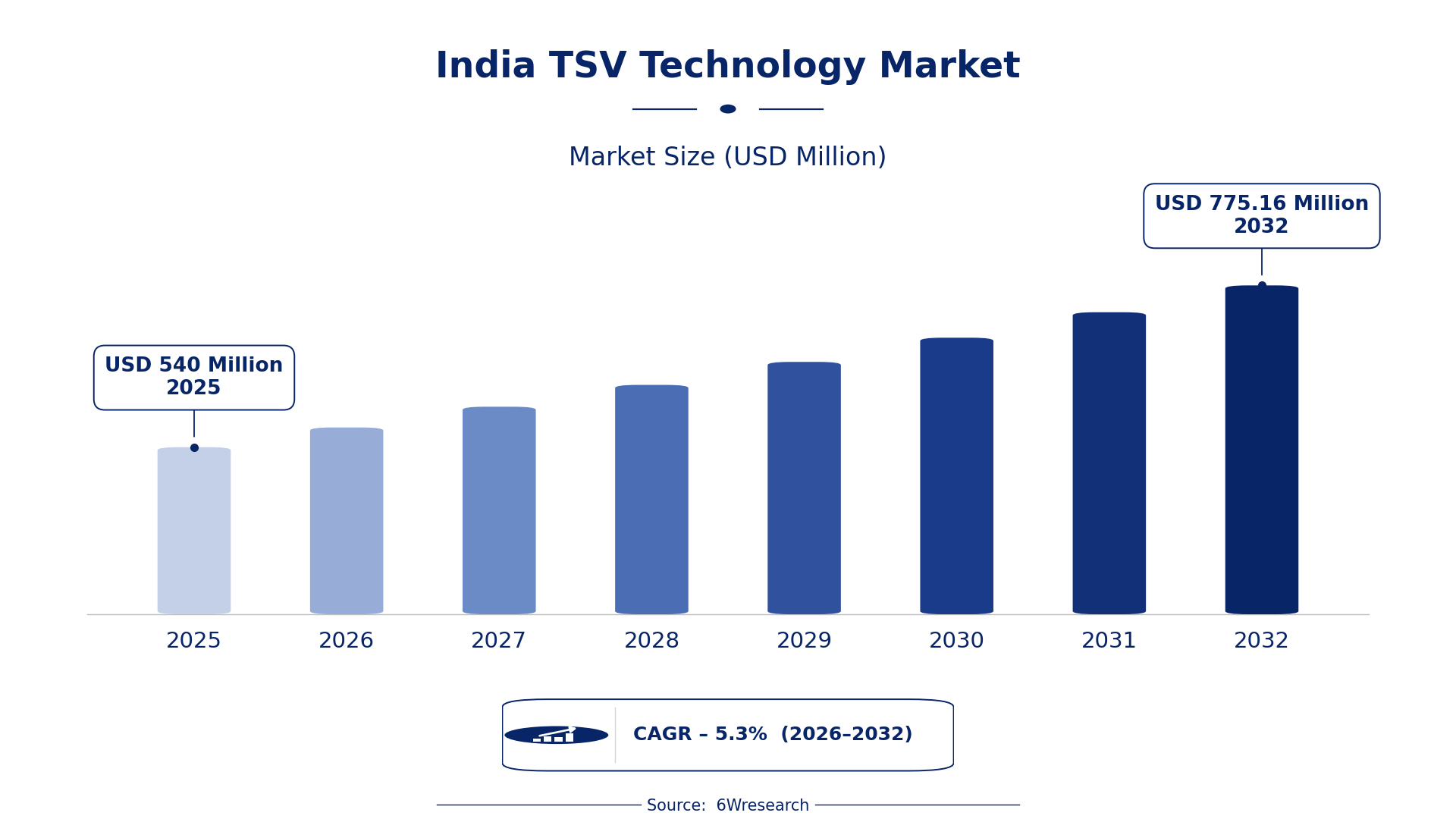
According to 6Wresearch internal database and industry insights, the India TSV Technology Market was valued at USD 540.0 million in 2025 and is projected to reach USD 775.16 million by 2032, growing at a CAGR of approximately 5.3% during 2026–2032.
India TSV Technology Market Highlights
| Report Metric | Details |
| Report Name | India TSV Technology Market |
| Market Size 2025 | USD 540.0 million |
| Market Size 2032 | USD 775.16 million |
| Absolute Growth 2025–2032 | USD 235.16 million |
| CAGR 2026–2032 | 5.3% |
| Peak Annual Growth | 6.5% in 2027 |
| Forecast Period | 2026–2032 |
| Historical Data | 2022–2025 |
| Base Year | 2025 |
| Leading TSV Type, 2025 | Via-First (45% share) |
| Leading Integration Level, 2025 | 3D IC Packaging (45% share) |
| Leading Use Case, 2025 | Memory Chips (50% share) |
| Leading End User, 2025 | Chip Manufacturers (52% share) |
| Fastest-Growing TSV Type | High Aspect Ratio TSV (7.5% CAGR) |
| Fastest-Growing Integration Level | Heterogeneous Integration (7.5% CAGR) |
| Fastest-Growing Use Case | AI Accelerators (6.7% CAGR) |
| Fastest-Growing End User | Electronics OEMs (7.9% CAGR) |
| Growing Sector | semiconductors |
| Key End Users | Chip Manufacturers, Electronics OEMs, Semiconductor Foundries, IC Designers |
India TSV Technology Market Year-wise Growth Rate and Key Drivers (2022–2032)
This graph illustrates the annual growth rates of the market from 2022 to 2032, highlighting a steady upward trajectory and projected market expansion over the forecast period.
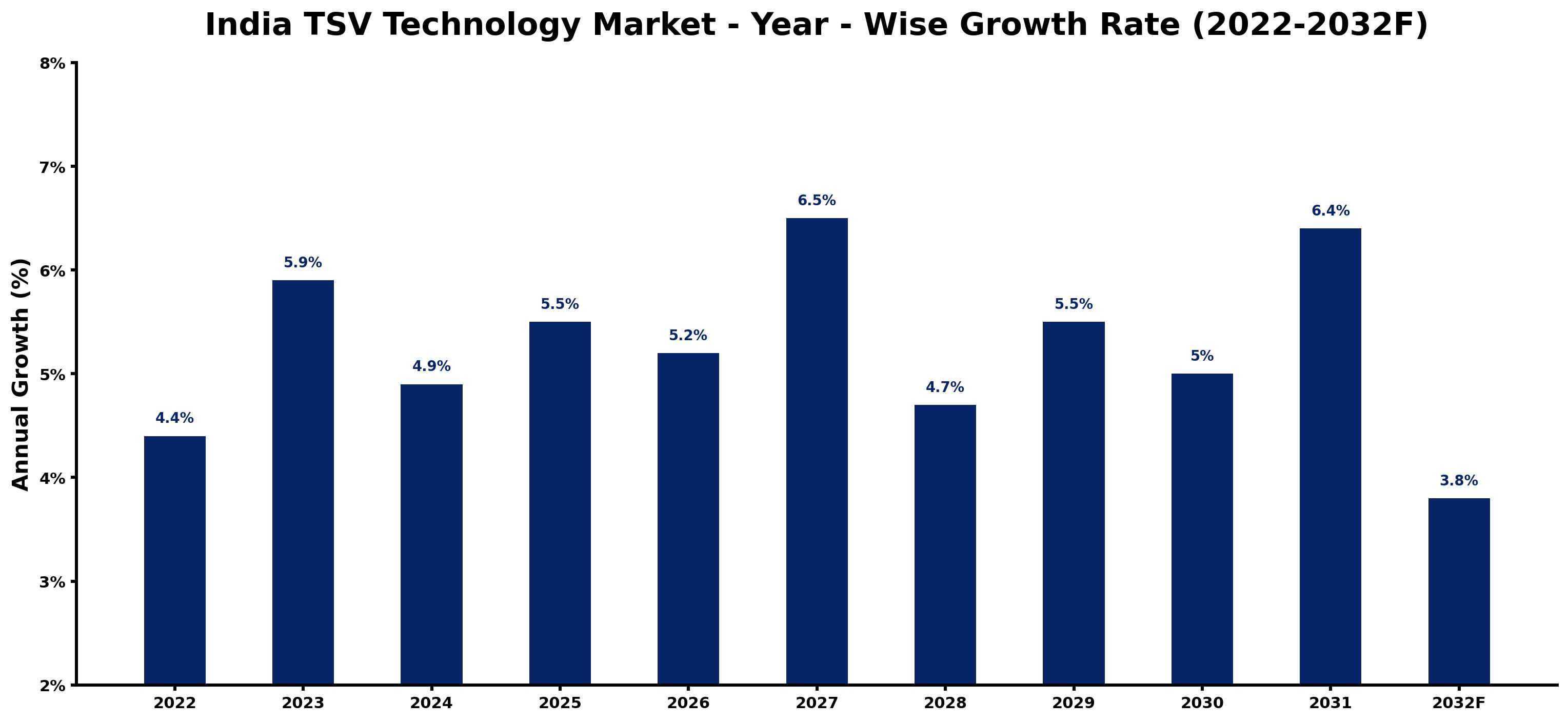
Year by year, the estimates below pair each growth rate with the development that shaped it.
| Year | Estimated Annual Growth (%) | Market Rationale |
| 2022 | 4.4 | The market showed steady growth as domestic demand for semiconductor technology increased. |
| 2023 | 5.9 | Growth accelerated due to the launch of the Semiconductor Mission, boosting local production. |
| 2024 | 4.9 | Growth slowed as manufacturers adjusted to new production capacities and the impact of the Semiconductor Mission became clear. |
| 2025 | 5.5 | A resurgence in demand for mobile processors drove faster growth in the market, particularly among chip manufacturers. |
| 2026 | 5.2 | Growth is expected to slow as the market faces challenges in scaling production capabilities. |
| 2027 | 6.5 | A peak in demand for high-performance computing applications is projected to spur significant growth in the market. |
| 2028 | 4.7 | Growth is anticipated to slow as the market stabilises after the previous year's peak performance. |
| 2029 | 5.5 | Increased exports of electronics products are expected to drive a faster growth rate in the market. |
| 2030 | 5.0 | Growth is projected to slow as manufacturers face supply chain constraints and rising costs. |
| 2031 | 6.4 | Demand is expected to surge again as new technologies in AI processing gain traction. |
| 2032 | 3.8 | Growth is projected to slow as the market matures and faces increased competition from global players. |
Note: Market size estimations and growth projections presented in this report are based on 6Wresearch's proprietary forecasting methodology, utilizing the latest available industry data, government publications, and primary research inputs.
India TSV Technology Market Synopsis
TSV Technology in India refers to a semiconductor technology that enables vertical interconnections in integrated circuits. It is produced through etching and filling vias in silicon wafers, improving performance and density. The India TSV Technology Market is growing due to rising domestic demand from chip manufacturers, particularly in memory chips and mobile processors. The Semiconductor Mission, launched in 2021, aims to boost local manufacturing and attract investment.
Market Dynamics Impact Analysis (2026–2032)
| Factor | Type | Impact | Primary Segment Affected |
| Rising demand for memory chips driven by the increase in mobile subscribers | Driver | High | Memory Chips |
| The Semiconductor Mission encourages investment in local manufacturing capabilities | Driver | High | Chip Manufacturers |
| The gap in local semiconductor production creates opportunities for investment | Opportunity | High | Electronics OEMs |
| The need for advanced packaging solutions in high-performance computing applications | Opportunity | Medium | 3D IC Packaging |
| Challenges in scaling production to meet rising demand for mobile processors | Restraint | High | Mobile Processors |
| Supply chain disruptions affecting the availability of raw materials | Restraint | Medium | Semiconductor Foundries |
| The need for skilled workforce remains a challenge for manufacturers | Challenge | High | Chip Manufacturers |
| High initial investment costs deter new entrants into the market | Challenge | Medium | Electronics OEMs |
Evaluation of Drivers in India TSV Technology Market (2026–2032)
Below mentioned are some major drivers and their influence on market dynamics.
| Drivers | Primary Segment Affected | Why It Matters (Evidence) |
| Increased demand for mobile processors due to 1.3 billion mobile subscribers | Mobile Processors | This demand drives manufacturers to invest in TSV technology for improved performance, resulting in higher production volumes. |
| The Semiconductor Mission's $10 billion budget supports local production | Chip Manufacturers | This initiative motivates manufacturers to adopt TSV technology in their products, strengthening their competitive edge. |
| Growing need for AI accelerators in high-performance computing | AI Accelerators | This trend encourages chip manufacturers to integrate TSV technology for better efficiency, increasing their market share. |
| Rising electronics exports, reaching $10 billion in 2021-2022 | Electronics OEMs | Increased exports drive demand for advanced semiconductor technologies, including TSV, boosting production efforts. |
| The 'Make in India' initiative boosts local semiconductor production | Semiconductor Foundries | This initiative promotes investment in TSV technology to improve manufacturing capabilities, supporting domestic supply. |
Growth in the TSV Technology market in India comes from rising demand for mobile processors, driven by the country's large mobile subscriber base. Increased demand for AI accelerators in high-performance computing applications prompts chip manufacturers to integrate TSV for improved efficiency. Rising electronics exports stimulate demand for advanced semiconductor technologies, further boosting production efforts. The focus on local manufacturing capabilities is expected to strengthen the market position of domestic producers.
Evaluation of Restraints in India TSV Technology Market
The following restraints limit how fast demand can grow.
| Market Restraint | Primary Segment Affected | Why It Matters (Evidence) |
| Challenges in scaling production to meet demand for mobile processors | Mobile Processors | Manufacturers struggle to increase output, causing potential supply shortages that can affect delivery timelines. |
| Supply chain disruptions affecting raw material availability | Semiconductor Foundries | These disruptions can delay production schedules and increase costs, impacting overall profitability. |
| Limited skilled workforce for advanced semiconductor manufacturing | Chip Manufacturers | A shortage of trained professionals hampers production efficiency and innovation, reducing competitiveness. |
| High initial investment costs for new entrants in the market | Electronics OEMs | These costs deter potential competitors from entering the TSV technology space, limiting market growth. |
| Regulatory hurdles in establishing new manufacturing facilities | 3D IC Packaging | Complex regulations can slow down the establishment of new production lines, delaying market entry. |
India TSV Technology Market Challenges
The India TSV Technology market still has to solve a few problems, starting with regulatory hurdles that slow down approvals for new manufacturing plants. This complexity exists due to evolving standards and can delay project timelines for suppliers by up to six months. Cost pressures impact the market as rising raw material prices can increase production costs by 15%, affecting margins for producers. Competition is intensifying as international players seek to enter the market, which can squeeze local manufacturers, forcing them to lower prices and potentially reduce quality. Continuous technological advancements in TSV methods require ongoing investment, straining budgets for smaller firms.
Trends in the India TSV Technology Market
Buyers and suppliers in the India TSV Technology Market are adjusting to the following trends.
- Shift in Semiconductor Manufacturing to Karnataka: Karnataka is becoming a semiconductor manufacturing hub, attracting significant investment to support local production. The state aims to contribute to India's goal of achieving $400 billion in electronics manufacturing by 2025.
- Growing Demand for AI Accelerators: The demand for AI accelerators is projected to grow at a rate of 6.7%. This trend drives chip manufacturers to adopt TSV technology for improved performance and efficiency.
- Electronics OEMs Prioritising Local Sourcing: Electronics OEMs are increasingly focusing on local sourcing of semiconductor components. This shift is expected to strengthen supply chain resilience and reduce dependency on imports, benefiting local manufacturers.
- Emergence of Advanced Packaging Solutions: The rise of heterogeneous integration is transforming packaging solutions in semiconductor manufacturing. This trend is essential for meeting the demands of high-performance computing applications.
Investment Opportunities in the India TSV Technology Market
The following opportunities in the India TSV Technology Market pair current demand with a clear way in.
- $300 billion Electronics Manufacturing Target by 2026: With India's electronics manufacturing sector expected to grow to $300 billion by 2026, there is an opportunity for investment in semiconductor production facilities to meet the increasing demand.
- Electronics OEMs Seeking Advanced Packaging Solutions: Electronics OEMs are looking for advanced packaging solutions to improve product performance. Investing in 3D IC packaging can effectively meet this demand for innovation.
- Karnataka's Semiconductor Manufacturing Hub: Karnataka's emergence as a semiconductor manufacturing hub presents opportunities for partnerships with local firms to improve production capabilities and foster innovation.
- Entry through Joint Ventures in Semiconductor Sector: Establishing joint ventures with local manufacturers can facilitate entry into the Indian semiconductor market, utilising local expertise and resources to navigate regulatory landscapes.
Government Initiatives in the India TSV Technology Market
The 'Semiconductor Mission', initiated by the Ministry of Electronics and Information Technology in 2021, aims to promote semiconductor manufacturing in India with a budget of $10 billion. This initiative supports the development of local production capabilities and encourages investments in advanced technologies, including TSV. By bolstering domestic manufacturing, it aims to create job opportunities and strengthen India's position in the global semiconductor market.
The 'Production Linked Incentive Scheme', introduced in 2021, incentivises semiconductor and display manufacturing in India. This scheme encourages chip manufacturers to invest in local production, offering financial benefits for achieving specified production targets. The Electronics Sector Skills Council plays a vital role in training the workforce, ensuring that buyers have access to skilled professionals. These measures collectively support the growth of the semiconductor industry, enabling buyers to source locally produced components more efficiently.
Future Insight of the India TSV Technology Market
The India TSV Technology market is expected to develop significantly by 2032, driven by several key factors. The government's 'Semiconductor Mission' will bolster domestic manufacturing capabilities, enhancing production efficiency. The 'Production Linked Incentive' scheme is set to attract substantial investments, boosting sector growth. Karnataka's role as a semiconductor hub will support innovation and development in TSV technology. By 2025, India's electronics exports are projected to reach $10 billion, creating new opportunities for both buyers and suppliers.
Market Segmentation Analysis
The report offers a comprehensive study of the following market segments and their leading categories in the market.
By TSV Type – Via-First Dominated, High Aspect Ratio TSV Expected to Grow Fastest
According to Vasudha, AM at 6Wresearch, Via-First took a 45% share of tsv type in 2025, more than any other category. The Via-First segment commands the largest share as it is directly used for connecting layers in 3D integrated circuits, which are vital for contemporary semiconductor applications. This technology is predominantly utilised by manufacturers in Karnataka, a prominent semiconductor production hub. High Aspect Ratio TSV is projected to grow fastest, at a CAGR of 7.5% during 2026–2032. High Aspect Ratio TSV is experiencing rapid growth due to its necessity for high-density vertical connections in advanced semiconductor applications. The increasing focus on compact designs in the industry will further propel this segment's growth. Suppliers should focus on enhancing their High Aspect Ratio TSV offerings to leverage this growing demand.
By Integration Level – 3D IC Packaging Dominated, Heterogeneous Integration Expected to Grow Fastest
3D IC Packaging accounted for a 45% market share by integration level in 2025. 3D IC Packaging leads the market share as it is vital for advanced packaging solutions, enabling better performance and efficiency in semiconductor devices. This technology is widely adopted by chip manufacturers across India, particularly in Karnataka, where semiconductor innovation thrives. The quickest growth will come from Heterogeneous Integration, forecast to expand at a CAGR of 7.5% between 2026 and 2032. Heterogeneous Integration is the fastest-growing segment, propelled by the need to combine different technologies into a single package for improved functionality. As the industry shifts towards more complex designs, this integration method will see substantial growth in demand. Buyers should consider investing in Heterogeneous Integration capabilities to remain competitive in the semiconductor market.
By Use Case – Memory Chips Dominated, AI Accelerators Expected to Grow Fastest
Memory Chips held a 50% share of the India TSV Technology Market by use case in 2025. Memory Chips hold the largest market share as they are extensively utilised in DRAM and NAND flash technologies, which are critical for a wide range of electronic devices. The robust demand for memory solutions in India's expanding electronics sector reinforces this segment's dominance. Over 2026–2032, AI Accelerators are expected to post the fastest growth, at a CAGR of 6.7%. AI Accelerators are the fastest-growing use case, propelled by the rising need for specialised processing units in various applications. As the market for advanced processing continues to grow, the demand for these accelerators will increase significantly. Suppliers should prioritise the development of AI Accelerator technologies to address the increasing market needs.
By End User – Chip Manufacturers Dominated, Electronics OEMs Expected to Grow Fastest
In 2025, Chip Manufacturers led the end user split with a 52% share. Chip Manufacturers account for the largest share as they are the primary users of TSV technology, integral to their production processes. The concentration of semiconductor manufacturing in regions like Karnataka further solidifies this segment's leading position. Electronics OEMs are set to record the highest CAGR in this split, 7.9% over 2026–2032. Electronics OEMs are the fastest-growing end user segment, as they increasingly incorporate TSV technology to improve their product designs. With the expansion of the electronics market, this segment's growth is expected to accelerate. Suppliers must engage with Electronics OEMs to ensure their offerings align with the market's evolving requirements.
Key Attractiveness of the Report
- 10 Years of Market Numbers
- Historical Data Starting from 2022 to 2025
- Base Year 2025
- Forecast Data until 2032
- Key Performance Indicators Impacting the Market
- Major Upcoming Developments and Projects
Key Highlights of the Report:
- India TSV Technology Market Outlook
- Market Size of India TSV Technology Market, 2025
- Forecast of India TSV Technology Market, 2032
- Historical Data and Forecast of India TSV Technology Revenues & Volume for the Period 2022 - 2032F
- India TSV Technology Market Trend Evolution
- India TSV Technology Market Drivers and Challenges
- India TSV Technology Price Trends
- India TSV Technology Porter's Five Forces
- India TSV Technology Industry Life Cycle
- Historical Data and Forecast of India TSV Technology Market Revenues & Volume By TSV Type for the Period 2022 - 2032F
- Historical Data and Forecast of India TSV Technology Market Revenues & Volume By Via-First for the Period 2022 - 2032F
- Historical Data and Forecast of India TSV Technology Market Revenues & Volume By Via-Middle for the Period 2022 - 2032F
- Historical Data and Forecast of India TSV Technology Market Revenues & Volume By Via-Last for the Period 2022 - 2032F
- Historical Data and Forecast of India TSV Technology Market Revenues & Volume By High Aspect Ratio TSV for the Period 2022 - 2032F
- Historical Data and Forecast of India TSV Technology Market Revenues & Volume By Integration Level for the Period 2022 - 2032F
- Historical Data and Forecast of India TSV Technology Market Revenues & Volume By 3D IC Packaging for the Period 2022 - 2032F
- Historical Data and Forecast of India TSV Technology Market Revenues & Volume By Heterogeneous Integration for the Period 2022 - 2032F
- Historical Data and Forecast of India TSV Technology Market Revenues & Volume By Logic + Memory Stacking for the Period 2022 - 2032F
- Historical Data and Forecast of India TSV Technology Market Revenues & Volume By Advanced Interconnect for the Period 2022 - 2032F
- Historical Data and Forecast of India TSV Technology Market Revenues & Volume By Use Case for the Period 2022 - 2032F
- Historical Data and Forecast of India TSV Technology Market Revenues & Volume By Memory Chips for the Period 2022 - 2032F
- Historical Data and Forecast of India TSV Technology Market Revenues & Volume By Mobile Processors for the Period 2022 - 2032F
- Historical Data and Forecast of India TSV Technology Market Revenues & Volume By High-Performance Computing for the Period 2022 - 2032F
- Historical Data and Forecast of India TSV Technology Market Revenues & Volume By AI Accelerators for the Period 2022 - 2032F
- Historical Data and Forecast of India TSV Technology Market Revenues & Volume By End User for the Period 2022 - 2032F
- Historical Data and Forecast of India TSV Technology Market Revenues & Volume By Chip Manufacturers for the Period 2022 - 2032F
- Historical Data and Forecast of India TSV Technology Market Revenues & Volume By Electronics OEMs for the Period 2022 - 2032F
- Historical Data and Forecast of India TSV Technology Market Revenues & Volume By Semiconductor Foundries for the Period 2022 - 2032F
- Historical Data and Forecast of India TSV Technology Market Revenues & Volume By IC Designers for the Period 2022 - 2032F
- India TSV Technology Import Export Trade Statistics
- Market Opportunity Assessment By TSV Type
- Market Opportunity Assessment By Integration Level
- Market Opportunity Assessment By Use Case
- Market Opportunity Assessment By End User
- India TSV Technology Top Companies Market Share
- India TSV Technology Competitive Benchmarking By Technical and Operational Parameters
- India TSV Technology Company Profiles
- India TSV Technology Key Strategic Recommendations
Market Covered
Segments analysed in this report are listed below.
By TSV Type
- Via-First
- Via-Middle
- Via-Last
- High Aspect Ratio TSV
By Integration Level
- 3D IC Packaging
- Heterogeneous Integration
- Logic + Memory Stacking
- Advanced Interconnect
By Use Case
- Memory Chips
- Mobile Processors
- High-Performance Computing
- AI Accelerators
By End User
- Chip Manufacturers
- Electronics OEMs
- Semiconductor Foundries
- IC Designers































