India Turbine Blade Cooling Market Size & Growth Rate
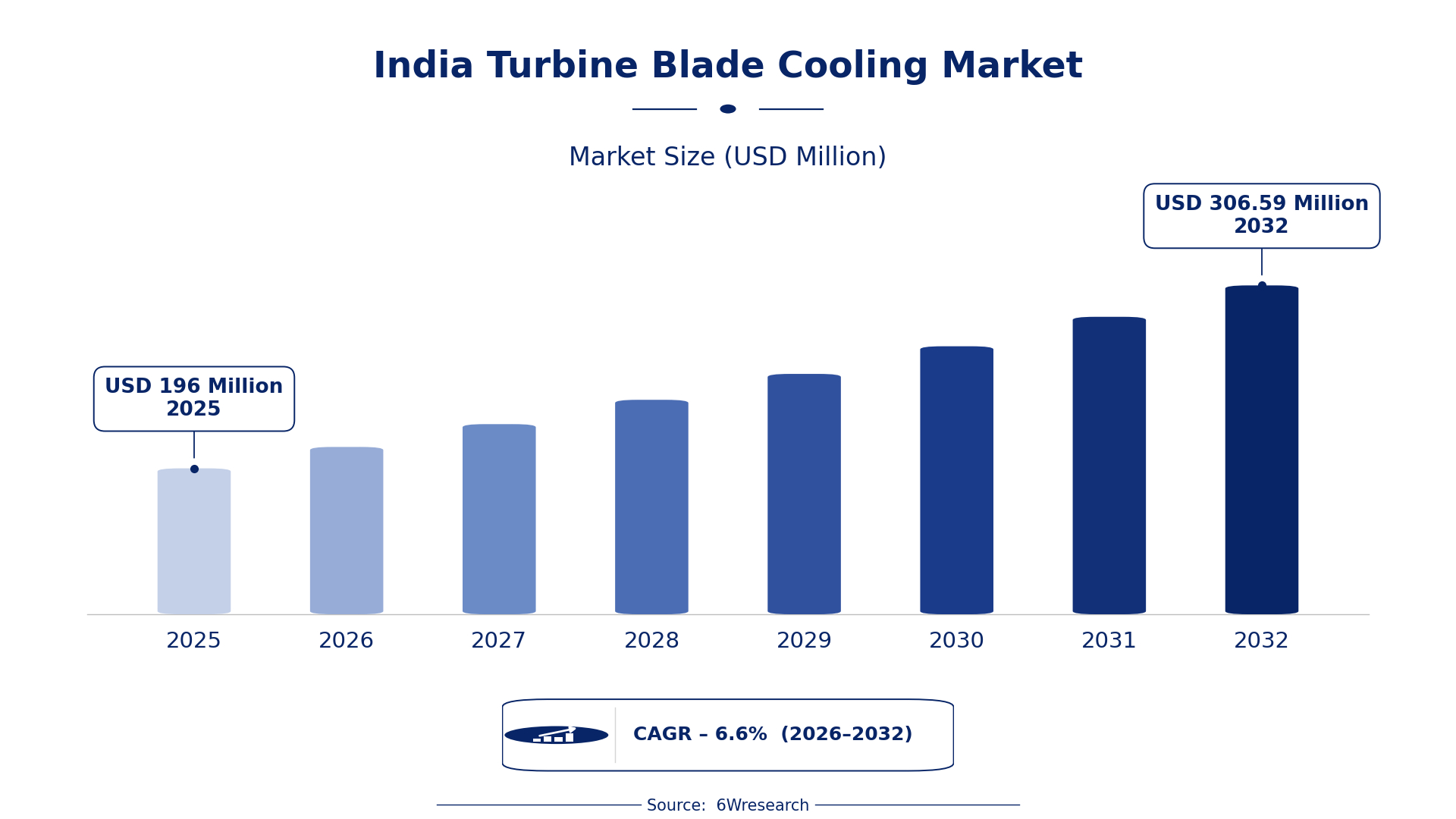
According to 6Wresearch internal database and industry insights, the India Turbine Blade Cooling Market was valued at USD 196.0 million in 2025 and is projected to reach USD 306.59 million by 2032, growing at a CAGR of approximately 6.6% during 2026–2032.
India Turbine Blade Cooling Market Highlights
| Report Metric | Details |
| Report Name | India Turbine Blade Cooling Market |
| Market Size 2025 | USD 196.0 million |
| Market Size 2032 | USD 306.59 million |
| Absolute Growth 2025–2032 | USD 110.59 million |
| CAGR 2026–2032 | 6.6% |
| Peak Annual Growth | 9.1% in 2028 |
| Forecast Period | 2026–2032 |
| Historical Data | 2022–2025 |
| Base Year | 2025 |
| Leading Cooling Method, 2025 | Film Cooling (36% share) |
| Leading Blade Material, 2025 | Superalloys (46% share) |
| Leading Engine Type, 2025 | Jet Engines (39% share) |
| Leading End User, 2025 | Aircraft OEMs (46% share) |
| Fastest-Growing Cooling Method | Transpiration Cooling (8.8% CAGR) |
| Fastest-Growing Blade Material | Porous Metal Blades (7.8% CAGR) |
| Fastest-Growing Engine Type | Turbofan Engines (8.1% CAGR) |
| Fastest-Growing End User | Military Contractors (8.6% CAGR) |
| Growing Sector | Military Contractors |
| Key End Users | Aircraft OEMs, Military Contractors, Turbine Manufacturers, Power Gen Companies |
India Turbine Blade Cooling Market Year-wise Growth Rate and Key Drivers (2022–2032)
This graph illustrates the annual growth rates of the market from 2022 to 2032, highlighting a steady upward trajectory and projected market expansion over the forecast period.
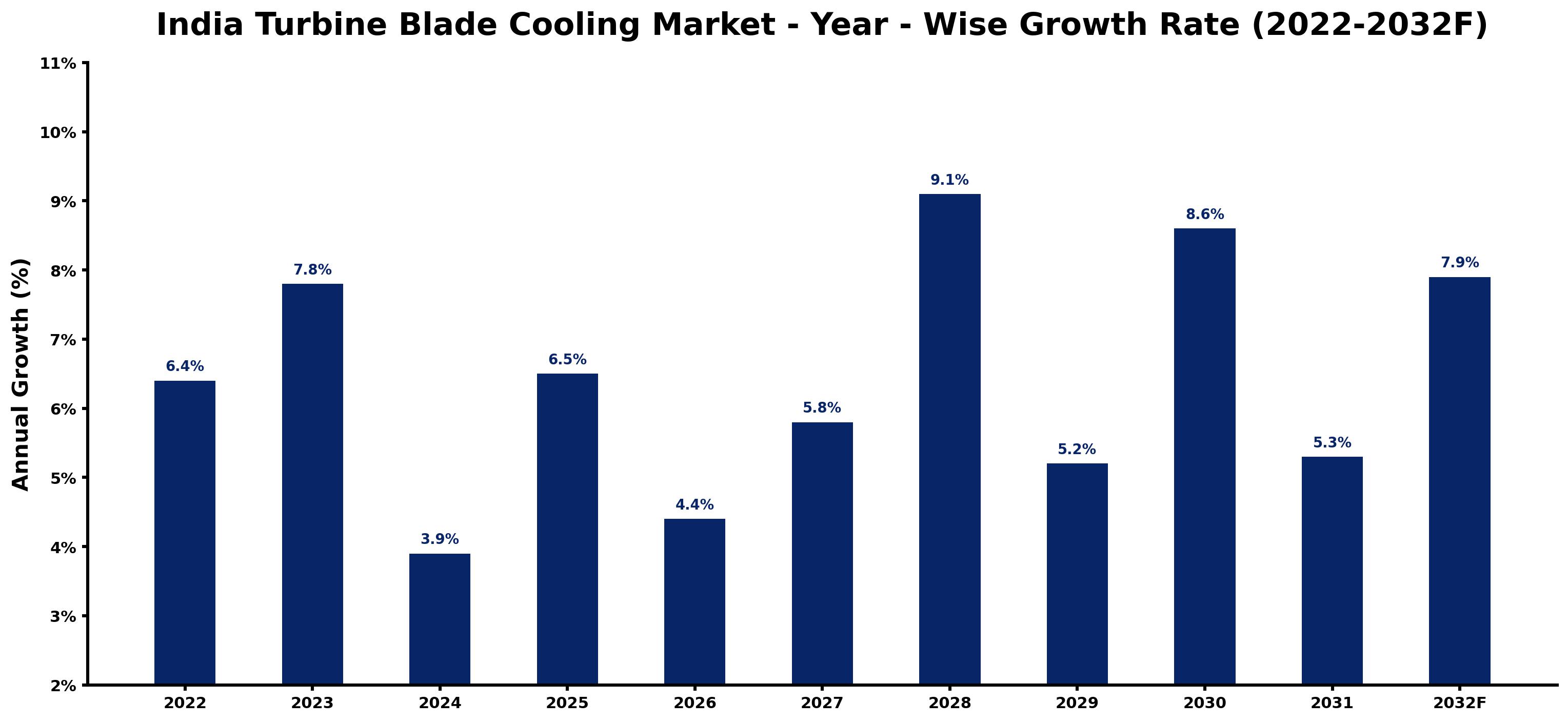
Each row of the following table gives one year's estimated growth and the event or demand shift that explains it.
| Year | Estimated Annual Growth (%) | Market Rationale |
| 2022 | 6.4 | The market experienced steady demand from the aerospace sector and power generation companies. |
| 2023 | 7.8 | Increased aircraft acquisitions and regional connectivity initiatives boosted growth significantly. |
| 2024 | 3.9 | Growth slowed as manufacturers adjusted to new standards and production capacities. |
| 2025 | 6.5 | Demand rose again due to ongoing expansions in the aerospace and energy sectors. |
| 2026 | 4.4 | The market saw a slowdown as companies faced challenges in material sourcing and approvals. |
| 2027 | 5.8 | Growth accelerated with rising investments in advanced turbine technologies and local production. |
| 2028 | 9.1 | A peak in growth occurred as new aircraft and gas turbine projects were initiated. |
| 2029 | 5.2 | The market experienced a slowdown as manufacturers adjusted to changing demand patterns. |
| 2030 | 8.6 | Growth surged again, driven by the need for efficient gas turbines in power generation. |
| 2031 | 5.3 | Demand slowed as the market stabilised amid increased competition and production capacity. |
| 2032 | 7.9 | Growth picked up again due to ongoing investments in turbine technologies and local manufacturing. |
Note: Market size estimations and growth projections presented in this report are based on 6Wresearch's proprietary forecasting methodology, utilizing the latest available industry data, government publications, and primary research inputs.
India Turbine Blade Cooling Market Synopsis
Turbine Blade Cooling in India involves techniques to regulate temperatures in turbine blades, ensuring optimal performance and durability. Methods such as film cooling and transpiration cooling play a crucial role in both aerospace and power generation sectors. The Turbine Blade Cooling Market is growing due to increasing demand from domestic manufacturers and power generation firms. With an anticipated requirement for over 1,000 new aircraft by 2030, the aerospace industry is a major contributor. Furthermore, India's power generation capacity reached 400 GW in 2022, further driving the need for effective cooling solutions.
Market Dynamics Impact Analysis (2026–2032)
| Factor | Type | Impact | Primary Segment Affected |
| Increasing demand for efficient cooling methods in aerospace applications | Driver | High | Film Cooling |
| Expansion of gas turbine usage in power generation | Driver | High | Gas Turbines |
| Growing need for advanced turbine technologies in military applications | Opportunity | High | Military Contractors |
| Rising investments in local manufacturing capabilities | Opportunity | Medium | Aircraft OEMs |
| High costs associated with imported superalloys | Restraint | High | Superalloys |
| Supply chain disruptions affecting material availability | Restraint | Medium | Turbine Manufacturers |
| Intense competition from international manufacturers | Challenge | High | Film Cooling |
| Technological advancements in cooling methods lagging behind global standards | Challenge | Medium | Film Cooling |
Evaluation of Drivers in India Turbine Blade Cooling Market (2026–2032)
The factors lifting demand, and the evidence behind each, are summarised below.
| Drivers | Primary Segment Affected | Why It Matters (Evidence) |
| Rising aircraft acquisitions in India | Jet Engines | This demand is driven by the projected need for over 1,000 new aircraft by 2030. |
| Expansion of power generation capacity | Gas Turbines | The Indian power generation capacity reached 400 GW in 2022, increasing the need for gas turbines. |
| Investment in indigenous manufacturing | Superalloys | The 'Make in India' initiative aims to boost local production of turbine components. |
| Increased focus on advanced cooling technologies | Transpiration Cooling | Research initiatives by the Indian Institute of Technology are developing advanced cooling techniques. |
| Growing military budget allocations | Military Contractors | India's military budget for 2023 includes funding for advanced turbine technologies. |
Growth across the Turbine Blade Cooling market in India is anchored in rising aircraft acquisitions, expanding power generation capacity, and increased investment in local manufacturing. The projected demand for over 1,000 new aircraft by 2030 is driving manufacturers to seek advanced cooling solutions. In 2022, India's power generation capacity reached 400 GW, boosting the need for efficient gas turbines. Investment in indigenous manufacturing is increasing as local production capabilities expand, leading to more purchases of superalloys and advanced cooling technologies. These factors create a strong demand for turbine blade cooling solutions in the country.
Evaluation of Restraints in India Turbine Blade Cooling Market
The key brakes on demand, and where they bite hardest, are shown below.
| Market Restraint | Primary Segment Affected | Why It Matters (Evidence) |
| High costs due to reliance on imported materials | Superalloys | Production expenses can inflate by up to 15% due to imported superalloys. |
| Supply chain disruptions | Turbine Manufacturers | Material sourcing delays can lead to production setbacks of several months. |
| Intense competition from international manufacturers | Film Cooling | Local suppliers struggle to maintain pricing and market share. |
| Technological advancements lagging behind global standards | Film Cooling | Delays in product development timelines hinder local manufacturers' competitiveness. |
| Regulatory hurdles in material approvals | Superalloys | Compliance with standards can prolong the approval process for new materials. |
India Turbine Blade Cooling Market Challenges
Turbine blade cooling in India faces several challenges that hinder market growth for buyers. High costs arise from the dependence on imported superalloys, which can increase production expenses by 15% for turbine manufacturers. Intense competition from international suppliers pressures local producers to lower prices, squeezing margins and affecting profitability. Technological advancements in cooling methods are not keeping pace with global developments, resulting in delays of up to six months for product launches, which impacts buyers seeking timely solutions. Supply chain disruptions, particularly in material sourcing, can lead to production delays of several months, affecting delivery timelines for power generation companies.
Trends in the India Turbine Blade Cooling Market
The trends below show where the India Turbine Blade Cooling Market is heading.
- Shift towards Advanced Cooling Techniques: The market is experiencing a shift towards advanced cooling techniques, particularly transpiration cooling. Research initiatives by the Indian Institute of Technology are refining these methods, resulting in improved turbine efficiency.
- Increase in Domestic Aircraft Production: Domestic aircraft production is on the rise, driven by the anticipated demand for over 1,000 new aircraft by 2030. This trend is encouraging manufacturers to invest in advanced cooling solutions.
- Growing Focus on Energy Efficiency: The emphasis on energy efficiency is increasing within the power generation sector. The Ministry of Power's initiatives aim to improve the efficiency of gas turbines, heightening demand for effective cooling solutions.
- Expansion of Military Aircraft Programs: Military aircraft programs are expanding, with increased funding in the 2023 military budget. This growth is expected to boost demand for advanced turbine technologies and cooling solutions.
Investment Opportunities in the India Turbine Blade Cooling Market
Below are the investment opportunities with the strongest case in the India Turbine Blade Cooling Market.
- Partnerships for Local Manufacturing: Local partnerships can enhance manufacturing capabilities, with a projected market size of USD 196.0 million by 2025. Collaborating with regional turbine manufacturers can facilitate entry into the market.
- Investment in Research and Development: Investment in R&D for cooling technologies is critical, with the Indian Institute of Technology leading initiatives. This presents opportunities for collaboration and innovation in turbine cooling solutions.
- Focus on Aerospace Sector: The aerospace sector is a key area for investment, driven by the demand for new aircraft. Engaging with aircraft OEMs can provide significant opportunities for turbine cooling suppliers.
- Development of Indigenous Technologies: The push for indigenous technologies presents opportunities for local manufacturers. The National Aerospace Policy 2021 aims to boost domestic production, creating a favourable environment for investment.
Government Initiatives in the India Turbine Blade Cooling Market
The National Aerospace Policy 2021 aims to boost domestic manufacturing of aircraft and turbine components, targeting a $70 billion market by 2030. This policy promotes local production of turbine blade materials and cooling technologies, reducing dependence on imports. The Ministry of Power's 'National Electricity Policy' stresses the importance of efficient gas turbines and associated technologies as part of its 2021 update. This policy aids manufacturers in improving their production capabilities and satisfying domestic demand.
The Defense Acquisition Procedure 2020 includes measures for indigenization of turbine technologies to lessen reliance on imports and strengthen local manufacturing. The 'Make in India' initiative was reinforced in 2021 to promote domestic production of aerospace and defense components, including turbine blades. The National Institute of Technology has received government funding to develop advanced turbine cooling technologies under the 'Research and Development Scheme' launched in 2022. These initiatives provide financial support and resources for local manufacturers to innovate and enhance their product offerings.
Future Insight of the India Turbine Blade Cooling Market
The turbine blade cooling market in India is set for transformation by 2032 due to several key factors. The Indian power generation capacity is projected to reach 600 GW, driving the need for efficient cooling solutions. The National Aerospace and Defense Policy will promote indigenous manufacturing, enhancing local capabilities and reducing reliance on imports. Research initiatives at the Indian Institute of Technology will lead to breakthroughs in advanced cooling techniques, improving performance and durability for turbine blades. These developments will create opportunities for buyers to access more reliable and cost-effective cooling solutions.
Market Segmentation Analysis
Each segment group is reviewed below, with the leader by share and the fastest grower by CAGR.
By Cooling Method – Film Cooling Dominated, Transpiration Cooling Expected to Grow Fastest
According to Vasudha, AM at 6Wresearch, Film Cooling accounted for a 36% market share by cooling method in 2025. Film cooling commands the largest share in the India turbine blade cooling market as it is vital for maintaining optimal temperatures in high-performance engines. This method is particularly critical in aerospace applications, where effective thermal management directly influences engine efficiency and longevity. Transpiration Cooling is set to record the highest CAGR in this split, 8.8% over 2026–2032. Transpiration cooling is experiencing rapid growth as it is increasingly utilised in advanced cooling systems that provide enhanced thermal management capabilities. The rising demand for this method is associated with the industry's focus on improving efficiency in modern turbine designs. Suppliers should focus on developing advanced cooling techniques to meet the growing demands of the aerospace sector.
By Blade Material – Superalloys Dominated, Porous Metal Blades Expected to Grow Fastest
The largest blade material category in 2025 was Superalloys, with a 46% share of total revenue. Superalloys hold a dominant market share as they are the primary material for high-temperature turbine blades, ensuring durability and performance under extreme conditions. Their extensive application in both aerospace and power generation sectors solidifies their leading position in the market. The quickest growth will come from Porous Metal Blades, forecast to expand at a CAGR of 7.8% between 2026 and 2032. Porous metal blades are witnessing the fastest growth due to their unique design that improves cooling efficiency in specialised applications. As the industry seeks to enhance turbine performance, this material is becoming increasingly relevant. Buyers should consider advanced materials to improve turbine efficiency and performance in their operations.
By Engine Type – Jet Engines Dominated, Turbofan Engines Expected to Grow Fastest
Jet Engines held a 39% share of the India Turbine Blade Cooling Market by engine type in 2025. Jet engines represent the largest share in the turbine blade cooling market, serving as the main application area for these cooling technologies within commercial aviation. The growth of the aerospace sector in India significantly drives the demand for effective jet engine cooling solutions. Over 2026–2032, Turbofan Engines are expected to post the fastest growth, at a CAGR of 8.1%. Turbofan engines are rapidly expanding due to their prominent use in commercial aviation, where efficiency and performance are paramount. The anticipated increase in new aircraft acquisitions will further boost the demand for advanced cooling technologies. Suppliers must align their product offerings with the evolving requirements of the commercial aviation sector to capture market opportunities.
By End User – Aircraft OEMs Dominated, Military Contractors Expected to Grow Fastest
With a 46% revenue share in 2025, Aircraft OEMs was the largest end user category. Aircraft OEMs hold the largest market share as they are the primary customers for turbine blade cooling solutions, driven by the demand for new aircraft and upgrades. Their focus on performance and efficiency in engine design fuels the need for effective cooling methods. Military Contractors are projected to grow fastest, at a CAGR of 8.6% during 2026–2032. Military contractors are experiencing the fastest growth in demand for advanced turbine technologies, driven by increased military budgets and a focus on indigenous manufacturing. This segment's need for high-performance solutions is expanding rapidly. Suppliers should target military contractors to capitalise on the growing demand for advanced turbine technologies in the defence sector.
Key Attractiveness of the Report
- 10 Years of Market Numbers
- Historical Data Starting from 2022 to 2025
- Base Year 2025
- Forecast Data until 2032
- Key Performance Indicators Impacting the Market
- Major Upcoming Developments and Projects
Key Highlights of the Report:
- India Turbine Blade Cooling Market Outlook
- Market Size of India Turbine Blade Cooling Market, 2025
- Forecast of India Turbine Blade Cooling Market, 2032
- Historical Data and Forecast of India Turbine Blade Cooling Revenues & Volume for the Period 2022 - 2032F
- India Turbine Blade Cooling Market Trend Evolution
- India Turbine Blade Cooling Market Drivers and Challenges
- India Turbine Blade Cooling Price Trends
- India Turbine Blade Cooling Porter's Five Forces
- India Turbine Blade Cooling Industry Life Cycle
- Historical Data and Forecast of India Turbine Blade Cooling Market Revenues & Volume By Cooling Method for the Period 2022 - 2032F
- Historical Data and Forecast of India Turbine Blade Cooling Market Revenues & Volume By Film Cooling for the Period 2022 - 2032F
- Historical Data and Forecast of India Turbine Blade Cooling Market Revenues & Volume By Transpiration Cooling for the Period 2022 - 2032F
- Historical Data and Forecast of India Turbine Blade Cooling Market Revenues & Volume By Convection Cooling for the Period 2022 - 2032F
- Historical Data and Forecast of India Turbine Blade Cooling Market Revenues & Volume By Impingement Cooling for the Period 2022 - 2032F
- Historical Data and Forecast of India Turbine Blade Cooling Market Revenues & Volume By Blade Material for the Period 2022 - 2032F
- Historical Data and Forecast of India Turbine Blade Cooling Market Revenues & Volume By Superalloys for the Period 2022 - 2032F
- Historical Data and Forecast of India Turbine Blade Cooling Market Revenues & Volume By Porous Metal Blades for the Period 2022 - 2032F
- Historical Data and Forecast of India Turbine Blade Cooling Market Revenues & Volume By Directionally Solidified for the Period 2022 - 2032F
- Historical Data and Forecast of India Turbine Blade Cooling Market Revenues & Volume By Single Crystal Blades for the Period 2022 - 2032F
- Historical Data and Forecast of India Turbine Blade Cooling Market Revenues & Volume By Engine Type for the Period 2022 - 2032F
- Historical Data and Forecast of India Turbine Blade Cooling Market Revenues & Volume By Jet Engines for the Period 2022 - 2032F
- Historical Data and Forecast of India Turbine Blade Cooling Market Revenues & Volume By Turbofan Engines for the Period 2022 - 2032F
- Historical Data and Forecast of India Turbine Blade Cooling Market Revenues & Volume By Gas Turbines for the Period 2022 - 2032F
- Historical Data and Forecast of India Turbine Blade Cooling Market Revenues & Volume By Industrial Turbines for the Period 2022 - 2032F
- Historical Data and Forecast of India Turbine Blade Cooling Market Revenues & Volume By End User for the Period 2022 - 2032F
- Historical Data and Forecast of India Turbine Blade Cooling Market Revenues & Volume By Aircraft OEMs for the Period 2022 - 2032F
- Historical Data and Forecast of India Turbine Blade Cooling Market Revenues & Volume By Military Contractors for the Period 2022 - 2032F
- Historical Data and Forecast of India Turbine Blade Cooling Market Revenues & Volume By Turbine Manufacturers for the Period 2022 - 2032F
- Historical Data and Forecast of India Turbine Blade Cooling Market Revenues & Volume By Power Gen Companies for the Period 2022 - 2032F
- India Turbine Blade Cooling Import Export Trade Statistics
- Market Opportunity Assessment By Cooling Method
- Market Opportunity Assessment By Blade Material
- Market Opportunity Assessment By Engine Type
- Market Opportunity Assessment By End User
- India Turbine Blade Cooling Top Companies Market Share
- India Turbine Blade Cooling Competitive Benchmarking By Technical and Operational Parameters
- India Turbine Blade Cooling Company Profiles
- India Turbine Blade Cooling Key Strategic Recommendations
Market Covered
The report offers an extensive study of the following market segments.
By Cooling Method
- Film Cooling
- Transpiration Cooling
- Convection Cooling
- Impingement Cooling
By Blade Material
- Superalloys
- Porous Metal Blades
- Directionally Solidified
- Single Crystal Blades
By Engine Type
- Jet Engines
- Turbofan Engines
- Gas Turbines
- Industrial Turbines
By End User
- Aircraft OEMs
- Military Contractors
- Turbine Manufacturers
- Power Gen Companies































