China Turbine Blade Cooling Market Size & Growth Rate
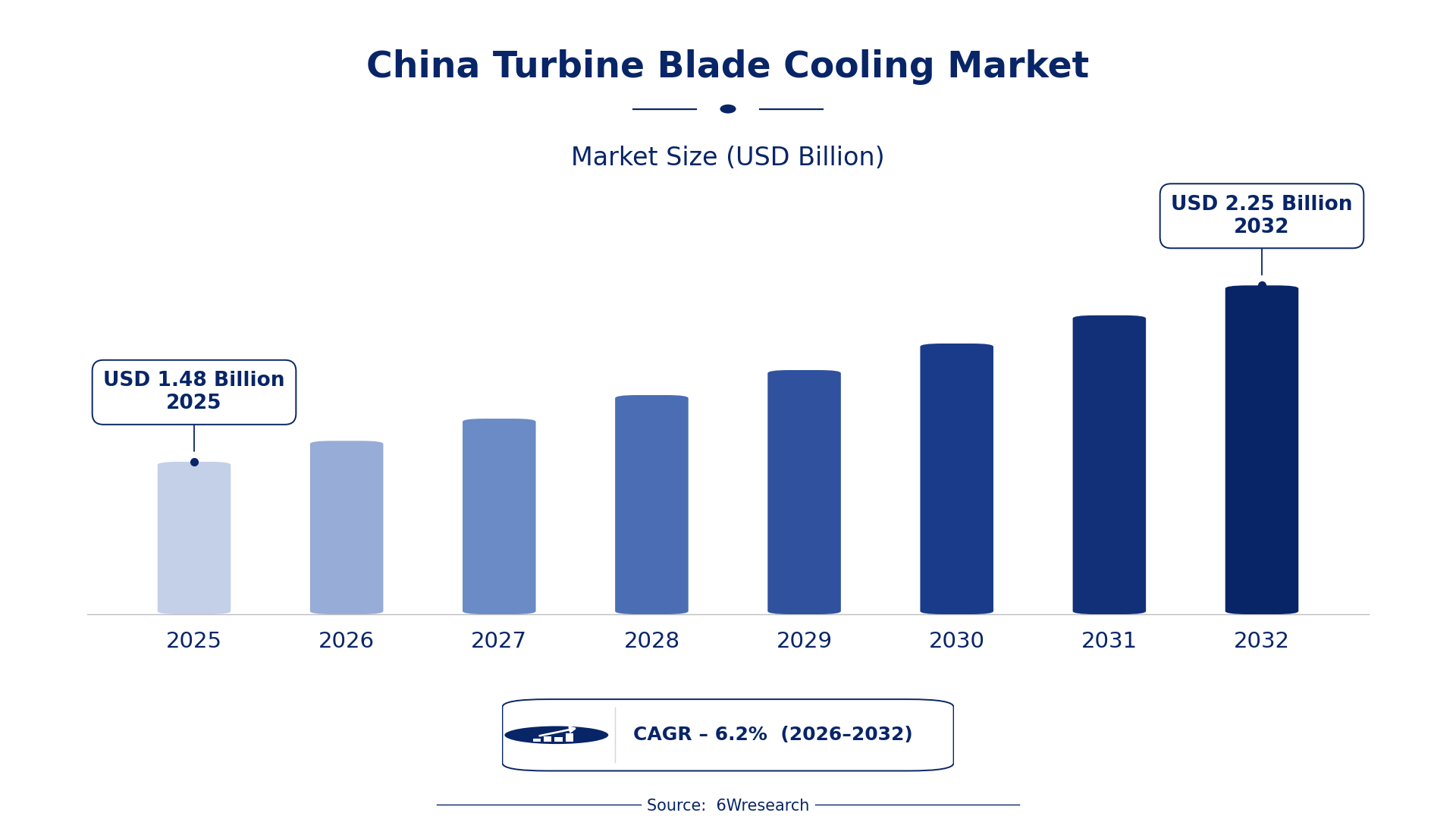
According to 6Wresearch internal database and industry insights, the China Turbine Blade Cooling Market was valued at USD 1.48 billion in 2025 and is projected to reach USD 2.25 billion by 2032, growing at a CAGR of approximately 6.2% during 2026–2032.
China Turbine Blade Cooling Market Highlights
| Report Metric | Details |
| Report Name | China Turbine Blade Cooling Market |
| Market Size 2025 | USD 1.48 billion |
| Market Size 2032 | USD 2.25 billion |
| Absolute Growth 2025–2032 | USD 0.77 billion |
| CAGR 2026–2032 | 6.2% |
| Peak Annual Growth | 8.6% in 2026 |
| Forecast Period | 2026–2032 |
| Historical Data | 2022–2025 |
| Base Year | 2025 |
| Leading Cooling Method, 2025 | Film Cooling (41% share) |
| Leading Blade Material, 2025 | Superalloys (45% share) |
| Leading Engine Type, 2025 | Jet Engines (38% share) |
| Leading End User, 2025 | Aircraft OEMs (53% share) |
| Fastest-Growing Cooling Method | Transpiration Cooling (7.8% CAGR) |
| Fastest-Growing Blade Material | Single Crystal Blades (8.3% CAGR) |
| Fastest-Growing Engine Type | Gas Turbines (8.2% CAGR) |
| Fastest-Growing End User | Turbine Manufacturers (7.3% CAGR) |
| Growing Sector | Aerospace |
| Key End Users | Aircraft OEMs, Military Contractors, Turbine Manufacturers, Power Gen Companies |
China Turbine Blade Cooling Market Year-wise Growth Rate and Key Drivers (2022–2032)
This graph illustrates the annual growth rates of the market from 2022 to 2032, highlighting a steady upward trajectory and projected market expansion over the forecast period.
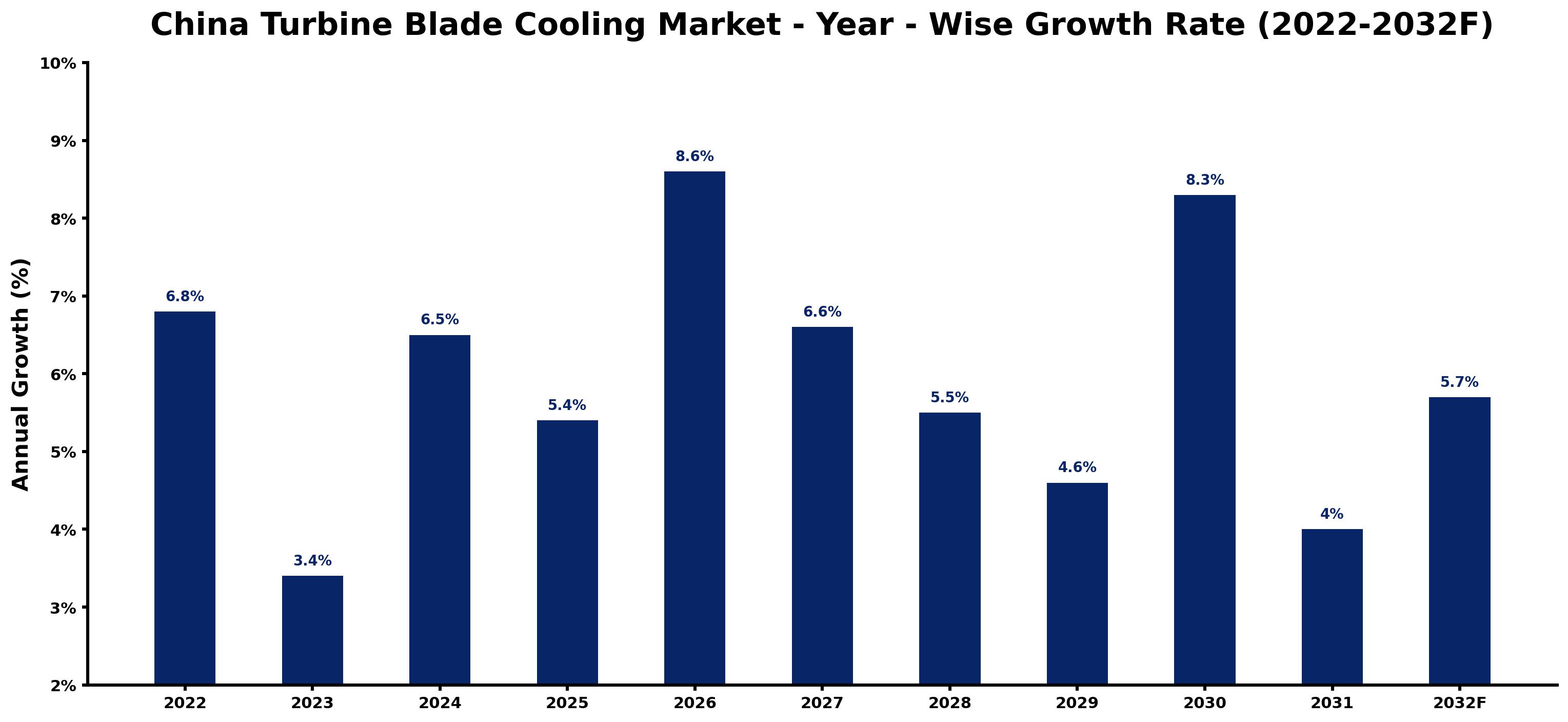
The following table presents the estimated annual growth rate for each year together with the principal factor influencing market performance.
| Year | Estimated Annual Growth (%) | Market Rationale |
| 2022 | 6.8 | The market experienced strong demand due to the Aerospace Industry Development Plan launched in 2021. |
| 2023 | 3.4 | Growth slowed as manufacturers adjusted to supply chain challenges and the updated National Standard for Turbine Blade Materials. |
| 2024 | 6.5 | Increased production capacity in the aerospace sector drove a faster growth rate, particularly in jet engines. |
| 2025 | 5.4 | The market saw a slowdown as demand stabilised after rapid growth in military aircraft production. |
| 2026 | 8.6 | A surge in aerospace manufacturing and military projects boosted demand as military aircraft production expanded. |
| 2027 | 6.6 | Growth slowed as the market adjusted to the peak demand of the previous year, focusing on efficiency. |
| 2028 | 5.5 | Demand remained steady as manufacturers improved compliance with the updated cooling technologies standard. |
| 2029 | 4.6 | The market experienced a slowdown as production levels normalised after rapid growth in gas turbines. |
| 2030 | 8.3 | Growth accelerated again due to increased military aircraft production requirements and government investments. |
| 2031 | 4.0 | A slowdown occurred as the market adjusted to the previous year's high growth in aerospace applications. |
| 2032 | 5.7 | Demand is expected to rise as new aerospace projects and military contracts are initiated. |
Note: Market size estimations and growth projections presented in this report are based on 6Wresearch's proprietary forecasting methodology, utilizing the latest available industry data, government publications, and primary research inputs.
China Turbine Blade Cooling Market Synopsis
Turbine Blade Cooling in China includes methods to control heat in turbine blades, primarily utilising film and transpiration cooling techniques. These methods are crucial for ensuring performance and durability in turbine blades constructed from advanced materials like superalloys. The China Turbine Blade Cooling Market is growing due to strong demand from the aerospace sector and military applications. With an estimated 7% annual rise in aircraft manufacturing, the market is poised for expansion. Progress in turbine technologies and increased production capacity are further driving demand.
Market Dynamics Impact Analysis (2026–2032)
| Factor | Type | Impact | Primary Segment Affected |
| Rising demand for jet engines in the aerospace sector | Driver | High | Jet Engines |
| Increased military aircraft production requiring advanced cooling technologies | Driver | High | Jet Engines |
| Growing investment in aerospace development programs | Opportunity | High | Aircraft OEMs |
| Expansion of gas turbine production capabilities | Opportunity | Medium | Gas Turbines |
| High costs associated with advanced cooling technology development | Restraint | High | Turbine Manufacturers |
| Regulatory compliance requirements for new cooling methods | Restraint | Medium | Film Cooling |
| Limited availability of skilled workforce in advanced materials | Challenge | High | Turbine Manufacturers |
| Competition from alternative cooling technologies | Challenge | Medium | Film Cooling |
Evaluation of Drivers in China Turbine Blade Cooling Market (2026–2032)
Below mentioned are some major drivers and their influence on market dynamics.
| Drivers | Primary Segment Affected | Why It Matters (Evidence) |
| Increased production of jet engines | Jet Engines | The aerospace sector's growth, with a projected 7% annual increase, drives demand for cooling technologies in jet engines. |
| Military aircraft production expansion | Jet Engines | Projected military aircraft production requires advanced cooling technologies, leading to higher demand for turbine blade cooling. |
| Investment in aerospace development programs | Aircraft OEMs | Government investment of $1 billion in aerospace development stimulates demand for advanced cooling solutions among manufacturers. |
| Growth in gas turbine production | Gas Turbines | China's gas turbine production reached approximately 180 units in 2022, increasing the demand for effective cooling technologies. |
| Technological advancements in turbine materials | Film Cooling | The update of the National Standard for Turbine Blade Materials in 2022 encourages the adoption of new cooling methods. |
The aerospace sector is expected to grow at 7% annually, boosting demand for cooling technologies. In 2022, gas turbine production reached around 180 units, underscoring the need for effective cooling solutions. The update of the National Standard for Turbine Blade Materials in 2022 encourages the adoption of advanced cooling techniques. These developments are prompting increased purchasing activity among turbine manufacturers and aerospace firms.
Evaluation of Restraints in China Turbine Blade Cooling Market
Below mentioned are some major restraints and their influence on market dynamics.
| Market Restraint | Primary Segment Affected | Why It Matters (Evidence) |
| High development costs for advanced cooling technologies | Turbine Manufacturers | The investment required for developing advanced cooling solutions limits market entry for new producers. |
| Regulatory compliance for new cooling methods | Film Cooling | Producers must navigate complex regulations, which can delay product development and market entry for manufacturers. |
| Limited availability of skilled workforce | Turbine Manufacturers | A shortage of skilled professionals in advanced materials affects production capabilities and innovation for turbine manufacturers. |
| Competition from alternative cooling technologies | Film Cooling | Emerging cooling technologies may divert investment and interest away from traditional cooling methods, impacting market share. |
| Supply chain disruptions impacting material availability | Film Cooling | Ongoing global supply chain issues can hinder the timely procurement of essential materials for cooling technologies. |
China Turbine Blade Cooling Market Challenges
The China Turbine Blade Cooling market still has to solve a few problems, starting with regulatory compliance. The National Aeronautics and Space Administration of China enforces strict standards for turbine blade materials and cooling methods, which can delay production timelines for manufacturers by up to six months. Next, high production costs present a challenge; superalloys, used in 85% of turbine blades, are expensive, raising overall manufacturing expenses for producers by approximately 20%. Rapid technological advancements in cooling methods can outpace current capabilities, forcing buyers to invest in frequent upgrades, which can lead to additional costs of around $500,000 per project. Finally, the demand for cooling solutions from the installed base of over 1,500 gas turbines pressures buyers to secure reliable supply chains amid rising costs, complicating procurement processes.
Trends in the China Turbine Blade Cooling Market
Buyers and suppliers in the China Turbine Blade Cooling Market are adjusting to the following trends.
- Shift in Cooling Methods for Aerospace Applications: Aircraft OEMs are increasingly adopting transpiration cooling methods to improve turbine efficiency. In 2023, this shift is driven by the need for better thermal management, with a projected 7% growth in aircraft manufacturing.
- Transition to Advanced Materials in Turbine Blades: The National Standard for Turbine Blade Materials updated in 2022 encourages the use of superalloys and single crystal blades. This shift is essential for meeting the demands of high-performance applications, with superalloys used in 85% of turbine blades.
- Growth in Military Aircraft Production: China's military aircraft production is expected to require advanced cooling technologies for next-generation engines. This trend began in 2022, with an anticipated increase in military spending driving demand for improved turbine cooling solutions.
- Expansion of Gas Turbine Production Facilities: Gas turbine production facilities in China are expanding to meet the growing energy demands. In 2022, the installed base of gas turbines exceeded 1,500 units, necessitating enhanced cooling technologies.
Investment Opportunities in the China Turbine Blade Cooling Market
Some of the investment opportunities in the China Turbine Blade Cooling Market are mentioned below.
- Partnerships with Local Manufacturers: Now is the time to invest in partnerships with local turbine manufacturers to strengthen cooling technology capabilities. The growing aerospace sector, with a projected 7% annual increase, offers opportunities for collaboration.
- Investment in Aerospace Development Programs: Investing in aerospace development programs can yield high returns, especially with the government's $1 billion commitment. Aircraft OEMs are key players in this sector, driving demand for advanced cooling solutions.
- Supply of Advanced Cooling Technologies: There is a pressing need for advanced cooling technologies in military applications, particularly for next-generation engines. Collaborating with military contractors can facilitate entry into this lucrative market.
- Focus on Gas Turbine Cooling Solutions: With the expansion of gas turbine production facilities, there is a timely opportunity to supply innovative cooling solutions. Targeting power generation companies can lead to fruitful partnerships.
Government Initiatives in the China Turbine Blade Cooling Market
The 'Aerospace Industry Development Plan' launched by the Ministry of Industry and Information Technology in 2021 aims to improve turbine technology by 2025. This plan focuses on enhancing production capabilities and fostering innovation in cooling technologies. The 'National Standard for Turbine Blade Materials' was updated in 2022 to include new cooling methods, regulated by the Standardization Administration of China, ensuring manufacturers adhere to the latest standards for material performance and cooling efficiency. In 2023, the 'Energy Development Strategy Action Plan' was approved by the State Council, focusing on improving gas turbine efficiency and cooling methods, enhancing performance in the energy sector. The 'High-Temperature Materials Research Program' initiated by the Ministry of Science and Technology in 2020 funds research projects aimed at developing innovative cooling solutions for high-performance applications.
In 2023, the Ministry of Industry and Information Technology launched a program to enhance turbine efficiency standards, which will support manufacturers in adopting advanced cooling technologies. This initiative aims to improve the overall performance of turbine systems and is expected to benefit turbine manufacturers and aerospace companies significantly.
Future Insight of the China Turbine Blade Cooling Market
The China Turbine Blade Cooling market is set to evolve significantly by 2032, driven by advancements in cooling technologies and government investments. The aerospace sector's projected 7% annual growth in aircraft manufacturing will create a need for improved cooling solutions to meet performance standards. The Ministry of Industry and Information Technology's new program aimed at enhancing turbine efficiency will encourage suppliers to innovate and adopt advanced materials. With military aircraft production on the rise, the demand for advanced cooling technologies will likely surge, opening new opportunities for both buyers and suppliers.
Market Segmentation Analysis
The report offers a comprehensive study of the following market segments and their leading categories in the market.
By Cooling Method – Film Cooling Dominated, Transpiration Cooling Expected to Grow Fastest
According to Vasudha, AM at 6Wresearch, Film Cooling held a 41% share of the China Turbine Blade Cooling Market by cooling method in 2025. Film cooling holds the largest share in the China turbine blade cooling market due to its extensive application in jet engines, where effective thermal management is crucial. This method is particularly favoured for its ability to shield blades from extreme temperatures, ensuring optimal performance in aerospace applications. Transpiration Cooling is set to record the highest CAGR in this split, 7.8% over 2026–2032. Transpiration cooling is experiencing rapid growth because it significantly enhances cooling efficiency in high-performance turbine applications. The rising demand for advanced cooling solutions in next-generation military aircraft engines is a key driver of this segment's expansion. Suppliers should focus on developing advanced cooling technologies to meet the increasing demands of the aerospace industry.
By Blade Material – Superalloys Dominated, Single Crystal Blades Expected to Grow Fastest
Superalloys accounted for a 45% market share by blade material in 2025. Superalloys dominate the market share for turbine blade materials, accounting for 85% of high-performance blades in China due to their exceptional strength and resistance to high temperatures. This material is vital for maintaining the durability and efficiency of turbine blades in demanding environments. Single Crystal Blades are projected to grow fastest, at a CAGR of 8.3% during 2026–2032. Single crystal blades are growing rapidly as they are essential for advanced turbine designs that require superior performance under extreme thermal conditions. The increasing complexity of turbine designs in aerospace applications is propelling this segment's growth. Buyers should consider procuring advanced materials like single crystal blades to enhance turbine performance and longevity.
By Engine Type – Jet Engines Dominated, Gas Turbines Expected to Grow Fastest
The largest engine type category in 2025 was Jet Engines, with a 38% share of total revenue. Jet engines represent the largest share of the engine type segment, primarily due to their significant application in the aerospace sector where turbine blade cooling technologies are essential. The ongoing expansion in aircraft manufacturing directly drives the demand for effective cooling solutions in these engines. Over 2026–2032, Gas Turbines are expected to post the fastest growth, at a CAGR of 8.2%. Gas turbines are the fastest-growing segment, largely because they are critical for power generation within the energy sector. The existing installed base of over 1,500 gas turbines in China is contributing to this rapid growth. Suppliers must adapt their product offerings to meet the rising demand for cooling technologies in gas turbines.
By End User – Aircraft OEMs Dominated, Turbine Manufacturers Expected to Grow Fastest
Aircraft OEMs took a 53% share of end user in 2025, more than any other category. Aircraft OEMs hold the largest market share as they are the primary end users of turbine blade cooling technologies, which are crucial for ensuring optimal aircraft performance. The robust growth in aircraft manufacturing in China further solidifies their leading position in the market. The quickest growth will come from Turbine Manufacturers, forecast to expand at a CAGR of 7.3% between 2026 and 2032. Turbine manufacturers are experiencing the fastest growth as they play a vital role in producing turbine blades and cooling systems, driven by the expanding aerospace and energy sectors. Their need for advanced cooling solutions is becoming increasingly urgent. Suppliers should tailor their strategies to address the specific needs of turbine manufacturers as they scale up their production capabilities.
Key Attractiveness of the Report
- 10 Years of Market Numbers
- Historical Data Starting from 2022 to 2025
- Base Year 2025
- Forecast Data until 2032
- Key Performance Indicators Impacting the Market
- Major Upcoming Developments and Projects
Key Highlights of the Report:
- China Turbine Blade Cooling Market Outlook
- Market Size of China Turbine Blade Cooling Market, 2025
- Forecast of China Turbine Blade Cooling Market, 2032
- Historical Data and Forecast of China Turbine Blade Cooling Revenues & Volume for the Period 2022 - 2032F
- China Turbine Blade Cooling Market Trend Evolution
- China Turbine Blade Cooling Market Drivers and Challenges
- China Turbine Blade Cooling Price Trends
- China Turbine Blade Cooling Porter's Five Forces
- China Turbine Blade Cooling Industry Life Cycle
- Historical Data and Forecast of China Turbine Blade Cooling Market Revenues & Volume By Cooling Method for the Period 2022 - 2032F
- Historical Data and Forecast of China Turbine Blade Cooling Market Revenues & Volume By Film Cooling for the Period 2022 - 2032F
- Historical Data and Forecast of China Turbine Blade Cooling Market Revenues & Volume By Transpiration Cooling for the Period 2022 - 2032F
- Historical Data and Forecast of China Turbine Blade Cooling Market Revenues & Volume By Convection Cooling for the Period 2022 - 2032F
- Historical Data and Forecast of China Turbine Blade Cooling Market Revenues & Volume By Impingement Cooling for the Period 2022 - 2032F
- Historical Data and Forecast of China Turbine Blade Cooling Market Revenues & Volume By Blade Material for the Period 2022 - 2032F
- Historical Data and Forecast of China Turbine Blade Cooling Market Revenues & Volume By Superalloys for the Period 2022 - 2032F
- Historical Data and Forecast of China Turbine Blade Cooling Market Revenues & Volume By Porous Metal Blades for the Period 2022 - 2032F
- Historical Data and Forecast of China Turbine Blade Cooling Market Revenues & Volume By Directionally Solidified for the Period 2022 - 2032F
- Historical Data and Forecast of China Turbine Blade Cooling Market Revenues & Volume By Single Crystal Blades for the Period 2022 - 2032F
- Historical Data and Forecast of China Turbine Blade Cooling Market Revenues & Volume By Engine Type for the Period 2022 - 2032F
- Historical Data and Forecast of China Turbine Blade Cooling Market Revenues & Volume By Jet Engines for the Period 2022 - 2032F
- Historical Data and Forecast of China Turbine Blade Cooling Market Revenues & Volume By Turbofan Engines for the Period 2022 - 2032F
- Historical Data and Forecast of China Turbine Blade Cooling Market Revenues & Volume By Gas Turbines for the Period 2022 - 2032F
- Historical Data and Forecast of China Turbine Blade Cooling Market Revenues & Volume By Industrial Turbines for the Period 2022 - 2032F
- Historical Data and Forecast of China Turbine Blade Cooling Market Revenues & Volume By End User for the Period 2022 - 2032F
- Historical Data and Forecast of China Turbine Blade Cooling Market Revenues & Volume By Aircraft OEMs for the Period 2022 - 2032F
- Historical Data and Forecast of China Turbine Blade Cooling Market Revenues & Volume By Military Contractors for the Period 2022 - 2032F
- Historical Data and Forecast of China Turbine Blade Cooling Market Revenues & Volume By Turbine Manufacturers for the Period 2022 - 2032F
- Historical Data and Forecast of China Turbine Blade Cooling Market Revenues & Volume By Power Gen Companies for the Period 2022 - 2032F
- China Turbine Blade Cooling Import Export Trade Statistics
- Market Opportunity Assessment By Cooling Method
- Market Opportunity Assessment By Blade Material
- Market Opportunity Assessment By Engine Type
- Market Opportunity Assessment By End User
- China Turbine Blade Cooling Top Companies Market Share
- China Turbine Blade Cooling Competitive Benchmarking By Technical and Operational Parameters
- China Turbine Blade Cooling Company Profiles
- China Turbine Blade Cooling Key Strategic Recommendations
Market Covered
Segments analysed in this report are listed below.
By Cooling Method
- Film Cooling
- Transpiration Cooling
- Convection Cooling
- Impingement Cooling
By Blade Material
- Superalloys
- Porous Metal Blades
- Directionally Solidified
- Single Crystal Blades
By Engine Type
- Jet Engines
- Turbofan Engines
- Gas Turbines
- Industrial Turbines
By End User
- Aircraft OEMs
- Military Contractors
- Turbine Manufacturers
- Power Gen Companies































