India Turbine Electronic Ignition Market Size & Growth Rate
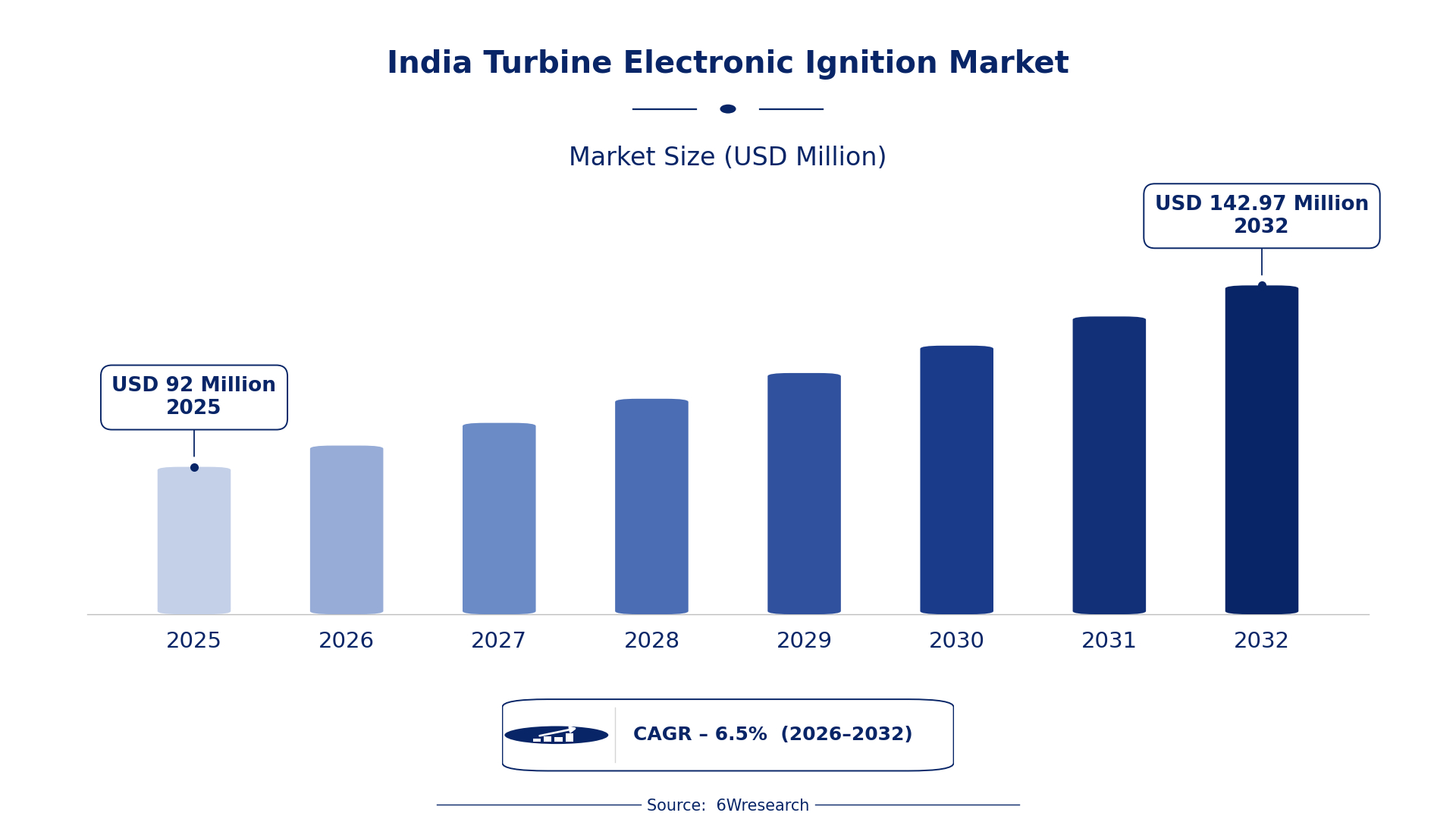
According to 6Wresearch internal database and industry insights, the India Turbine Electronic Ignition Market was valued at USD 92.0 million in 2025 and is projected to reach USD 142.97 million by 2032, growing at a CAGR of approximately 6.5% during 2026–2032.
India Turbine Electronic Ignition Market Highlights
| Report Metric | Details |
| Report Name | India Turbine Electronic Ignition Market |
| Market Size 2025 | USD 92.0 million |
| Market Size 2032 | USD 142.97 million |
| Absolute Growth 2025–2032 | USD 50.97 million |
| CAGR 2026–2032 | 6.5% |
| Peak Annual Growth | 9.4% in 2032 |
| Forecast Period | 2026–2032 |
| Historical Data | 2022–2025 |
| Base Year | 2025 |
| Leading Ignition Type, 2025 | Capacitor Discharge (42% share) |
| Leading Energy Source, 2025 | Electrical Spark (41% share) |
| Leading Turbine Class, 2025 | Jet Engines (41% share) |
| Leading End User, 2025 | Aircraft OEMs (46% share) |
| Fastest-Growing Ignition Type | Solid-State Ignition (8.8% CAGR) |
| Fastest-Growing Energy Source | Microcontroller-Based (7.6% CAGR) |
| Fastest-Growing Turbine Class | Gas Turbines (8.6% CAGR) |
| Fastest-Growing End User | Aerospace Suppliers (7.9% CAGR) |
| Growing Sector | Aerospace Suppliers |
| Key End Users | Aircraft OEMs, Aerospace Suppliers, Turbine Builders, Defense Organizations |
India Turbine Electronic Ignition Market Year-wise Growth Rate and Key Drivers (2022–2032)
This graph illustrates the annual growth rates of the market from 2022 to 2032, highlighting a steady upward trajectory and projected market expansion over the forecast period.
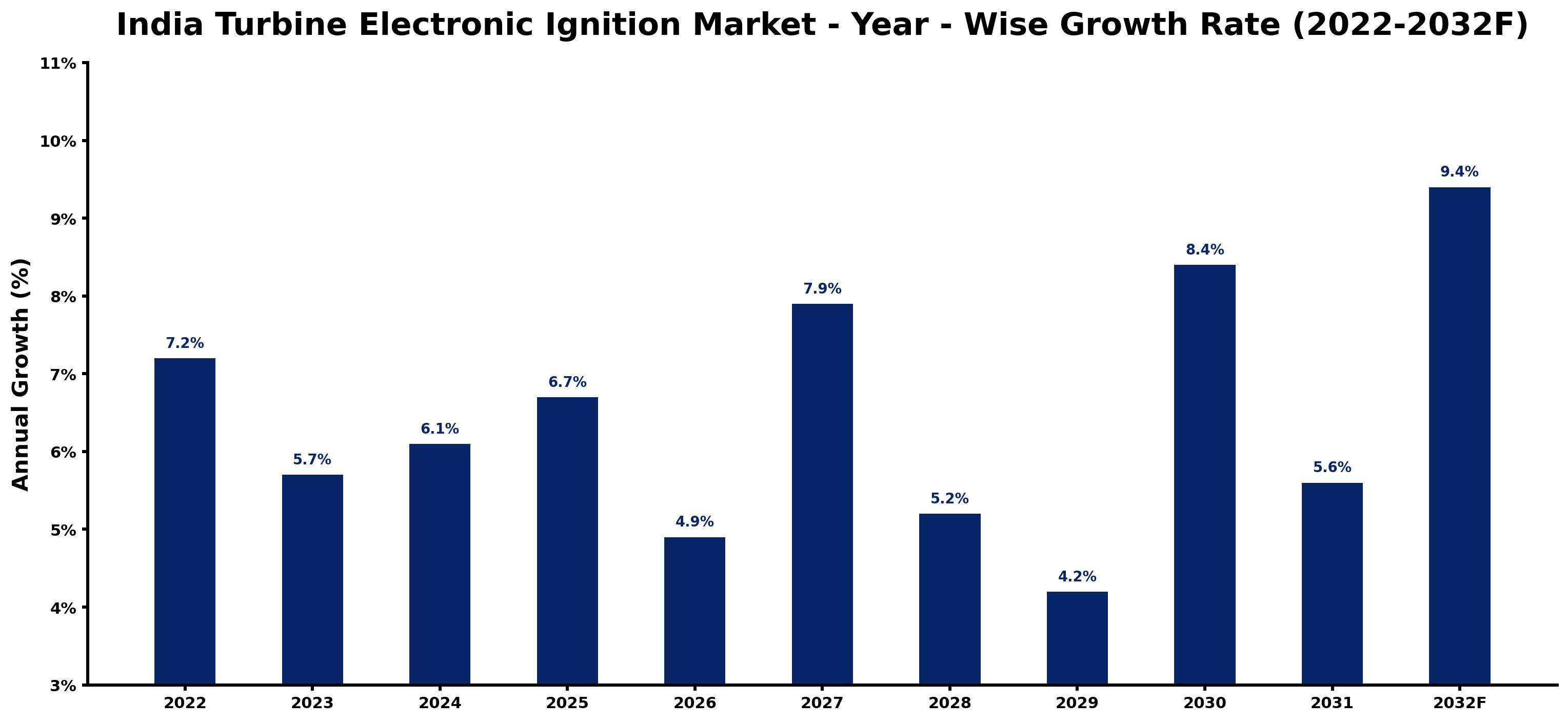
Annual growth estimates for each year appear below with the principal reason behind them, explaining the shifts that set the pace of the market.
| Year | Estimated Annual Growth (%) | Market Rationale |
| 2022 | 7.2 | The market showed strong performance due to increased defense spending and demand for advanced aviation technologies. |
| 2023 | 5.7 | Growth slowed as the market adjusted to previous high levels of investment and demand. |
| 2024 | 6.1 | A slight recovery occurred as domestic aircraft manufacturers ramped up production. |
| 2025 | 6.7 | Demand increased further as the government pushed for local manufacturing initiatives. |
| 2026 | 4.9 | Growth is expected to slow again as the market faces challenges in supply chain and production capacity. |
| 2027 | 7.9 | A rebound in growth is projected as military modernization efforts intensify. |
| 2028 | 5.2 | Growth is expected to decelerate due to increased competition among suppliers. |
| 2029 | 4.2 | A further slowdown is anticipated as the market adjusts to new technological standards. |
| 2030 | 8.4 | Growth is projected to accelerate again with renewed investments in military aviation capabilities. |
| 2031 | 5.6 | The market will experience a slowdown as demand stabilises after previous peaks. |
| 2032 | 9.4 | A peak in growth is expected as military spending reaches new heights. |
Note: Market size estimations and growth projections presented in this report are based on 6Wresearch's proprietary forecasting methodology, utilizing the latest available industry data, government publications, and primary research inputs.
India Turbine Electronic Ignition Market Synopsis
The India Turbine Electronic Ignition Market encompasses advanced systems designed to ignite fuel in turbine engines, primarily used in aviation and military applications. These systems are essential for ensuring reliable ignition in jet engines and helicopters. The market is expanding due to increased defense spending, particularly with the government aiming to raise it to 2.5% of GDP by 2025. The 'Make in India' initiative is boosting local manufacturing, creating further demand from domestic aircraft manufacturers and defense organizations. Key regions like Maharashtra and Karnataka are contributing significantly to this growth.
Market Dynamics Impact Analysis (2026–2032)
| Factor | Type | Impact | Primary Segment Affected |
| Increased defense spending to 2.5% of GDP by 2025 | Driver | High | Military Aircraft |
| Growing demand from domestic aircraft manufacturers | Driver | High | Aircraft OEMs |
| Rising need for advanced ignition systems in military aviation | Opportunity | High | Military Aircraft |
| Expansion of aerospace manufacturing hubs in Maharashtra and Karnataka | Opportunity | Medium | Aerospace Suppliers |
| Challenges in supply chain management affecting production timelines | Restraint | High | Turbine Builders |
| High costs associated with advanced technology integration | Restraint | Medium | Aerospace Suppliers |
| Limited availability of skilled workforce in aerospace engineering | Challenge | High | Aerospace Suppliers |
| Technological advancements requiring continuous investment | Challenge | Medium | Turbine Builders |
Evaluation of Drivers in India Turbine Electronic Ignition Market (2026–2032)
Key forces behind demand, with the segment each one moves most, are listed below.
| Drivers | Primary Segment Affected | Why It Matters (Evidence) |
| Increased defense spending | Military Aircraft | The government aims to raise defense spending to 2.5% of GDP by 2025, boosting demand for military aircraft and related technologies. |
| Rising air travel demand | Aircraft OEMs | India's population exceeds 1.4 billion, leading to increased demand for air travel and necessitating advanced ignition systems for domestic aircraft manufacturers. |
| Local manufacturing initiatives | Turbine Builders | The 'Make in India' initiative promotes domestic production, enhancing supply chain resilience and increasing orders for ignition systems. |
| Modernization of military aviation | Defense Organizations | The government approved a $1.5 billion budget for military aviation modernization, driving procurement of advanced ignition technologies. |
| Concentration of aerospace activities | Aerospace Suppliers | Key regions like Maharashtra and Karnataka strengthen the local supply chain, resulting in higher demand for ignition systems. |
Growth in the Turbine Electronic Ignition market in India comes from increased defense spending, rising air travel demand, and local manufacturing initiatives. The government aims to raise defense spending to 2.5% of GDP by 2025, which will boost demand for military aircraft and related technologies. With a population exceeding 1.4 billion, air travel demand is surging, prompting domestic aircraft manufacturers to seek advanced ignition systems. Local production initiatives stimulate manufacturing, while a significant budget for military aviation modernization drives procurement of advanced technologies. The concentration of aerospace activities in key regions strengthens the local supply chain, increasing orders for ignition systems across the sector.
Evaluation of Restraints in India Turbine Electronic Ignition Market
Below mentioned are some major restraints and their influence on market dynamics.
| Market Restraint | Primary Segment Affected | Why It Matters (Evidence) |
| Supply chain disruptions affecting production timelines | Turbine Builders | Delays in component delivery can hinder the timely production of ignition systems, impacting overall market growth. |
| High costs of advanced technology integration | Aerospace Suppliers | The financial burden of adopting new technologies can limit investment in ignition systems, accounting for over 20% of total engine expenses. |
| Limited skilled workforce in aerospace engineering | Aerospace Suppliers | A shortage of qualified engineers can slow down production and innovation in ignition technologies, affecting market competitiveness. |
| Regulatory compliance costs for aerospace components | Turbine Builders | Meeting stringent quality standards increases operational costs for manufacturers of ignition systems, affecting profit margins. |
| Competition from international suppliers | Military Aircraft | Foreign manufacturers may offer lower prices, making it challenging for local producers to compete effectively in the market. |
India Turbine Electronic Ignition Market Challenges
The India Turbine Electronic Ignition market still has to solve a few problems, and the first is supply chain reliability. Many producers depend on imported components, which can delay production timelines for local manufacturers, impacting their ability to meet demand. Buyers face challenges due to the stringent quality standards set by the Bureau of Indian Standards, which can prolong the procurement process for ignition systems. The high cost of advanced ignition technology, often comprising over 20% of total engine expenses, pressures buyers to seek more economical alternatives. Rapid technological advancements require producers to invest heavily in R&D, diverting funds from other critical areas.
Trends in the India Turbine Electronic Ignition Market
Below mentioned are some of the trends shaping the India Turbine Electronic Ignition Market growth.
- Shift towards Advanced Ignition Technologies: India is increasingly adopting advanced ignition technologies to enhance military aviation capabilities. The 'Atmanirbhar Bharat' initiative supports this transition, with a projected increase in local production by 20% by 2025.
- Transition from Traditional to Solid-State Ignition Systems: Since 2020, there has been a notable shift towards solid-state ignition systems, driven by their reliability. The market for solid-state systems is projected to grow at a CAGR of 8.8% through 2032.
- Emergence of Microcontroller-Based Ignition Systems: Microcontroller-based ignition systems are gaining traction, offering improved control and monitoring. This segment is projected to grow at a CAGR of 7.6% as demand for precision increases.
- Focus on Redundant Ignition Systems for Safety: The emphasis on safety in aviation has led to a rise in redundant ignition systems. The market for these systems is expected to expand significantly as safety regulations tighten.
Investment Opportunities in the India Turbine Electronic Ignition Market
Investors looking at the India Turbine Electronic Ignition Market should consider the following areas.
- Aerospace Suppliers seeking advanced systems: With a projected market size of USD 142.97 million by 2032, aerospace suppliers are looking for advanced ignition solutions. Partnering with local manufacturers in Maharashtra can facilitate market entry.
- Military Aircraft manufacturers expanding capabilities: The Indian Air Force operates over 1,500 aircraft, creating a demand for advanced ignition systems. Suppliers can enter this market by aligning with the 'Make in India' initiative.
- Growing market for Gas Turbines: The gas turbine segment is poised for growth, driven by increased power generation needs. Suppliers can target this segment by establishing partnerships with turbine builders.
- Investment in Defense Organizations: As defence spending rises, organisations will seek reliable ignition systems for military applications. Suppliers can capitalise by obtaining necessary certifications to meet quality standards.
Government Initiatives in the India Turbine Electronic Ignition Market
The 'Make in India' initiative, launched in 2014, aims to promote local manufacturing capabilities in defence and aerospace sectors. This policy encourages domestic production of ignition systems, reducing reliance on imports. The 'Aerospace and Defence Sector Policy' introduced in 2021 aims to boost indigenous production and streamline procurement processes for defence products. This policy supports local manufacturers in meeting the growing demand for advanced ignition technologies. The National Policy on Electronics 2019 also aims to increase domestic production of electronic components, including those used in ignition systems.
The Ministry of Defence oversees various initiatives to promote research and development in aerospace technologies, further supporting the growth of the turbine electronic ignition market. The Bureau of Indian Standards (BIS) sets quality standards for aerospace components, including ignition systems, which manufacturers must comply with to ensure market access. The Directorate General of Civil Aviation (DGCA) ensures that ignition systems meet stringent quality requirements. Additionally, the Defence Acquisition Procedure 2020 has been updated to streamline procurement processes for indigenous defence products, facilitating market entry for local manufacturers.
Future Insight of the India Turbine Electronic Ignition Market
Several forward-looking factors should support the India Turbine Electronic Ignition market over the coming years. The government's commitment to increase defence spending to 2.5% of GDP by 2025 is expected to boost demand for military aircraft, enhancing the need for reliable ignition systems. The 'Make in India' initiative promotes local manufacturing, which will strengthen supply chain resilience. The National Aerospace Policy aims for a $26 billion aerospace market by 2025, encouraging innovation in ignition technologies. The Indian Space Research Organisation's focus on advanced aerospace technologies will further drive growth in the ignition system sector.
Market Segmentation Analysis
The analysis below covers each segmentation, its leading category in 2025 and its fastest-growing category through 2032.
By Ignition Type – Capacitor Discharge Dominated, Solid-State Ignition Expected to Grow Fastest
According to Vasudha, AM at 6Wresearch, in 2025, Capacitor Discharge led the ignition type split with a 42% share. Capacitor Discharge holds the largest share due to its essential role in initiating combustion in turbine engines, particularly for military and commercial aviation. Its widespread adoption by domestic aircraft manufacturers ensures reliable performance in jet engines, making it a preferred choice. Solid-State Ignition is projected to grow fastest, at a CAGR of 8.8% during 2026–2032. Solid-State Ignition is experiencing rapid growth as it provides reliable ignition under various conditions, catering to the increasing demand for advanced ignition systems in modern aircraft. The industry's focus on enhancing efficiency and safety standards will further drive this segment's expansion. Suppliers should focus on developing Solid-State Ignition systems to meet the rising demands of the aviation market.
By Energy Source – Electrical Spark Dominated, Microcontroller-Based Expected to Grow Fastest
The largest energy source category in 2025 was Electrical Spark, with a 41% share of total revenue. Electrical Spark leads the market share as it is the fundamental ignition method for turbine engines, crucial for ensuring reliable operation. Its established presence in the aerospace sector makes it the preferred choice among manufacturers for ignition solutions. Over 2026–2032, Microcontroller-Based is expected to post the fastest growth, at a CAGR of 7.6%. Microcontroller-Based ignition systems are witnessing significant growth due to their advanced control and monitoring capabilities, aligning with the industry's shift towards automation and efficiency. This trend is evident in the increasing adoption of these systems by aerospace suppliers. Buyers should invest in Microcontroller-Based systems to enhance operational efficiency and reliability in ignition.
By Turbine Class – Jet Engines Dominated, Gas Turbines Expected to Grow Fastest
Jet Engines held a 41% share of the India Turbine Electronic Ignition Market by turbine class in 2025. Jet Engines represent the largest share of the market as they are the primary application area for turbine electronic ignition systems, particularly in commercial aviation. The extensive fleet operated by the Indian Air Force further solidifies this segment's dominance. Gas Turbines are set to record the highest CAGR in this split, 8.6% over 2026–2032. Gas Turbines are the fastest-growing segment, driven by their increasing use in power generation and industrial applications. The rising demand for energy efficiency and sustainable solutions is propelling this growth. Suppliers should consider diversifying their product lines to include Gas Turbines to capture emerging opportunities in the energy sector.
By End User – Aircraft OEMs Dominated, Aerospace Suppliers Expected to Grow Fastest
Aircraft OEMs accounted for a 46% market share by end user in 2025. Aircraft OEMs dominate the market share as they are the primary users of turbine electronic ignition systems, directly influencing the market through their production requirements. The growing number of operational aircraft in India significantly strengthens this segment's position. The quickest growth will come from Aerospace Suppliers, forecast to expand at a CAGR of 7.9% between 2026 and 2032. Aerospace Suppliers are experiencing the fastest growth as they provide essential components and systems for turbine ignition, responding to the increasing demands from Aircraft OEMs. This trend is expected to continue as the aerospace sector expands. Suppliers should enhance collaborations with Aerospace Suppliers to improve their market presence and address the needs of Aircraft OEMs.
Key Attractiveness of the Report
- 10 Years of Market Numbers
- Historical Data Starting from 2022 to 2025
- Base Year 2025
- Forecast Data until 2032
- Key Performance Indicators Impacting the Market
- Major Upcoming Developments and Projects
Key Highlights of the Report:
- India Turbine Electronic Ignition Market Outlook
- Market Size of India Turbine Electronic Ignition Market, 2025
- Forecast of India Turbine Electronic Ignition Market, 2032
- Historical Data and Forecast of India Turbine Electronic Ignition Revenues & Volume for the Period 2022 - 2032F
- India Turbine Electronic Ignition Market Trend Evolution
- India Turbine Electronic Ignition Market Drivers and Challenges
- India Turbine Electronic Ignition Price Trends
- India Turbine Electronic Ignition Porter's Five Forces
- India Turbine Electronic Ignition Industry Life Cycle
- Historical Data and Forecast of India Turbine Electronic Ignition Market Revenues & Volume By Ignition Type for the Period 2022 - 2032F
- Historical Data and Forecast of India Turbine Electronic Ignition Market Revenues & Volume By Capacitor Discharge for the Period 2022 - 2032F
- Historical Data and Forecast of India Turbine Electronic Ignition Market Revenues & Volume By Solid-State Ignition for the Period 2022 - 2032F
- Historical Data and Forecast of India Turbine Electronic Ignition Market Revenues & Volume By High-Energy Ignition for the Period 2022 - 2032F
- Historical Data and Forecast of India Turbine Electronic Ignition Market Revenues & Volume By Redundant Ignition for the Period 2022 - 2032F
- Historical Data and Forecast of India Turbine Electronic Ignition Market Revenues & Volume By Energy Source for the Period 2022 - 2032F
- Historical Data and Forecast of India Turbine Electronic Ignition Market Revenues & Volume By Electrical Spark for the Period 2022 - 2032F
- Historical Data and Forecast of India Turbine Electronic Ignition Market Revenues & Volume By Microcontroller-Based for the Period 2022 - 2032F
- Historical Data and Forecast of India Turbine Electronic Ignition Market Revenues & Volume By Dual Spark Systems for the Period 2022 - 2032F
- Historical Data and Forecast of India Turbine Electronic Ignition Market Revenues & Volume By Backup Systems for the Period 2022 - 2032F
- Historical Data and Forecast of India Turbine Electronic Ignition Market Revenues & Volume By Turbine Class for the Period 2022 - 2032F
- Historical Data and Forecast of India Turbine Electronic Ignition Market Revenues & Volume By Jet Engines for the Period 2022 - 2032F
- Historical Data and Forecast of India Turbine Electronic Ignition Market Revenues & Volume By Helicopter Engines for the Period 2022 - 2032F
- Historical Data and Forecast of India Turbine Electronic Ignition Market Revenues & Volume By Gas Turbines for the Period 2022 - 2032F
- Historical Data and Forecast of India Turbine Electronic Ignition Market Revenues & Volume By Military Aircraft for the Period 2022 - 2032F
- Historical Data and Forecast of India Turbine Electronic Ignition Market Revenues & Volume By End User for the Period 2022 - 2032F
- Historical Data and Forecast of India Turbine Electronic Ignition Market Revenues & Volume By Aircraft OEMs for the Period 2022 - 2032F
- Historical Data and Forecast of India Turbine Electronic Ignition Market Revenues & Volume By Aerospace Suppliers for the Period 2022 - 2032F
- Historical Data and Forecast of India Turbine Electronic Ignition Market Revenues & Volume By Turbine Builders for the Period 2022 - 2032F
- Historical Data and Forecast of India Turbine Electronic Ignition Market Revenues & Volume By Defense Organizations for the Period 2022 - 2032F
- India Turbine Electronic Ignition Import Export Trade Statistics
- Market Opportunity Assessment By Ignition Type
- Market Opportunity Assessment By Energy Source
- Market Opportunity Assessment By Turbine Class
- Market Opportunity Assessment By End User
- India Turbine Electronic Ignition Top Companies Market Share
- India Turbine Electronic Ignition Competitive Benchmarking By Technical and Operational Parameters
- India Turbine Electronic Ignition Company Profiles
- India Turbine Electronic Ignition Key Strategic Recommendations
Market Covered
The report offers an extensive study of the following market segments.
By Ignition Type
- Capacitor Discharge
- Solid-State Ignition
- High-Energy Ignition
- Redundant Ignition
By Energy Source
- Electrical Spark
- Microcontroller-Based
- Dual Spark Systems
- Backup Systems
By Turbine Class
- Jet Engines
- Helicopter Engines
- Gas Turbines
- Military Aircraft
By End User
- Aircraft OEMs
- Aerospace Suppliers
- Turbine Builders
- Defense Organizations































