China Turbine Electronic Ignition Market Size & Growth Rate
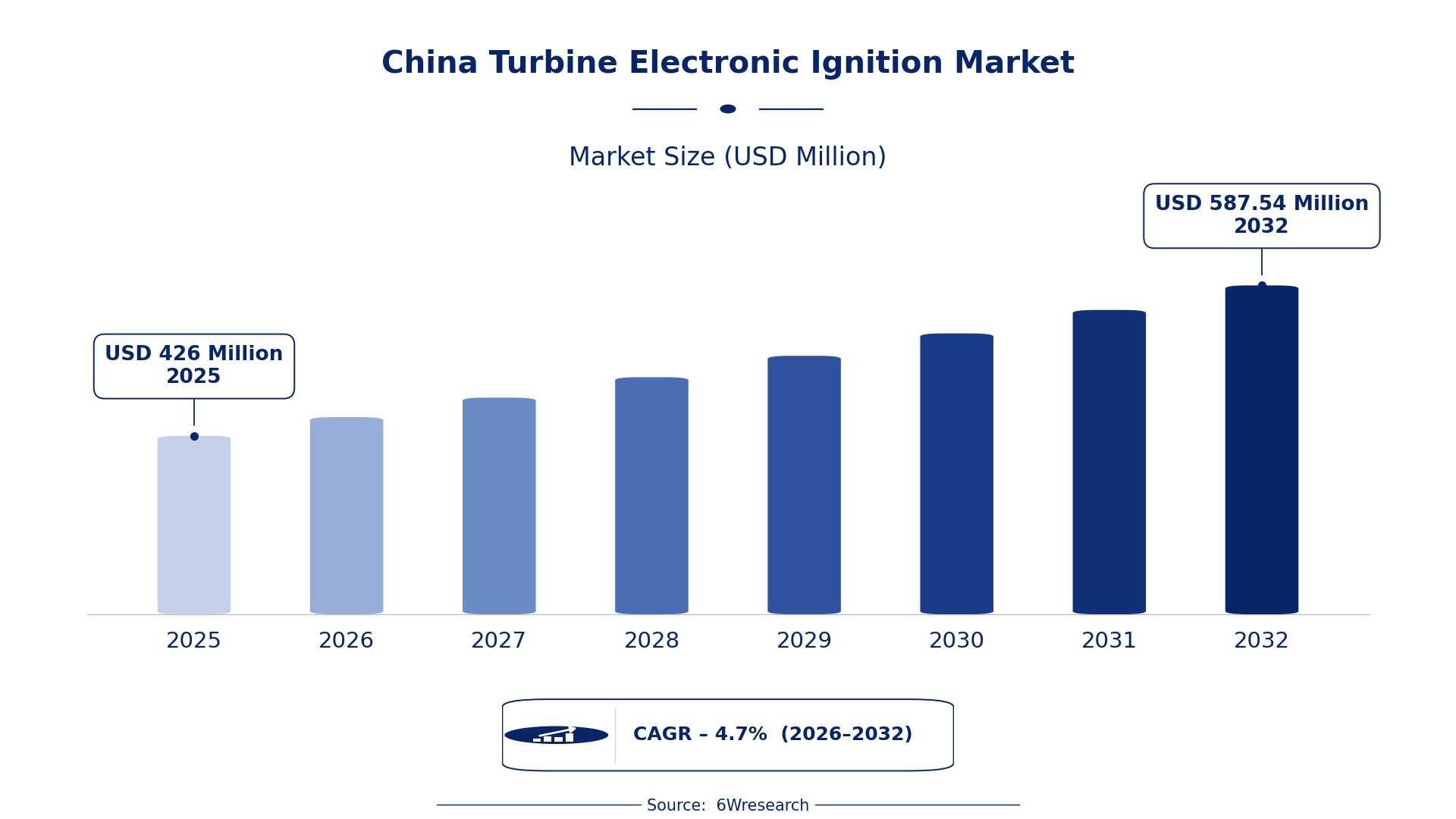
According to 6Wresearch internal database and industry insights, the China Turbine Electronic Ignition Market was valued at USD 426.0 million in 2025 and is projected to reach USD 587.54 million by 2032, growing at a CAGR of approximately 4.7% during 2026–2032.
China Turbine Electronic Ignition Market Highlights
| Report Metric | Details |
| Report Name | China Turbine Electronic Ignition Market |
| Market Size 2025 | USD 426.0 million |
| Market Size 2032 | USD 587.54 million |
| Absolute Growth 2025–2032 | USD 161.54 million |
| CAGR 2026–2032 | 4.7% |
| Peak Annual Growth | 7.0% in 2027 |
| Forecast Period | 2026–2032 |
| Historical Data | 2022–2025 |
| Base Year | 2025 |
| Leading Ignition Type, 2025 | Capacitor Discharge (49% share) |
| Leading Energy Source, 2025 | Electrical Spark (50% share) |
| Leading Turbine Class, 2025 | Jet Engines (38% share) |
| Leading End User, 2025 | Aircraft OEMs (40% share) |
| Fastest-Growing Ignition Type | Solid-State Ignition (6.5% CAGR) |
| Fastest-Growing Energy Source | Microcontroller-Based (6.8% CAGR) |
| Fastest-Growing Turbine Class | Helicopter Engines (6.8% CAGR) |
| Fastest-Growing End User | Aerospace Suppliers (6.5% CAGR) |
| Growing Sector | Aerospace Suppliers |
| Key End Users | Aircraft OEMs, Aerospace Suppliers, Turbine Builders, Defense Organizations |
China Turbine Electronic Ignition Market Year-wise Growth Rate and Key Drivers (2022–2032)
This graph illustrates the annual growth rates of the market from 2022 to 2032, highlighting a steady upward trajectory and projected market expansion over the forecast period.
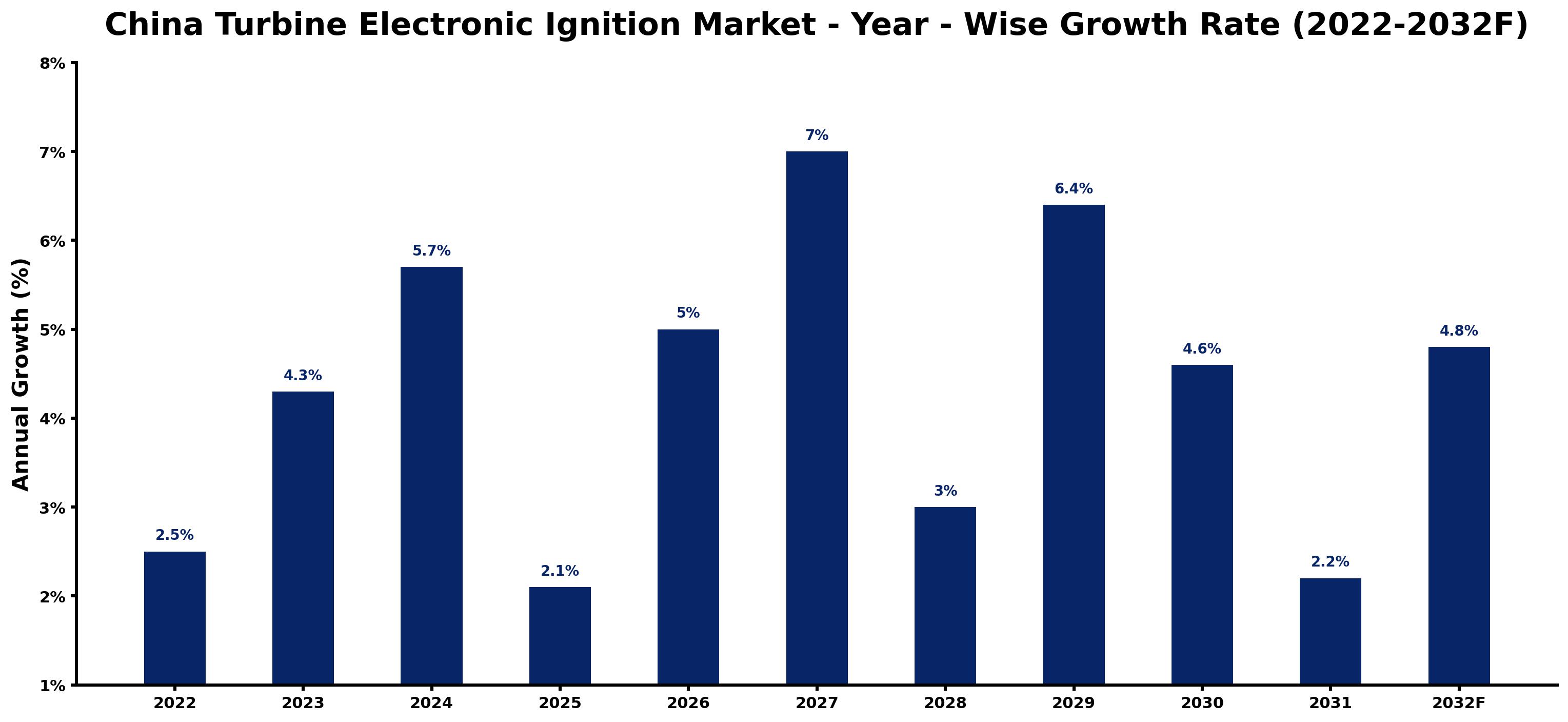
Below, each year's estimated growth is shown next to the factor that most influenced it.
| Year | Estimated Annual Growth (%) | Market Rationale |
| 2022 | 2.5 | The market showed steady growth due to ongoing production in the aerospace sector. |
| 2023 | 4.3 | Increased aircraft production contributed to faster growth compared to the previous year. |
| 2024 | 5.7 | Demand surged as the aerospace industry continued to expand, leading to higher ignition system needs. |
| 2025 | 2.1 | Growth slowed as the market adjusted to production capacity and demand fluctuations. |
| 2026 | 5.0 | Investment in advanced aviation technologies spurred a rebound in growth rates. |
| 2027 | 7.0 | A peak in growth was driven by heightened military spending and aircraft production. |
| 2028 | 3.0 | Growth slowed as the market stabilised following rapid expansion in previous years. |
| 2029 | 6.4 | Demand accelerated again as the aviation sector continued to recover and expand. |
| 2030 | 4.6 | Growth decelerated slightly as the market approached saturation in key segments. |
| 2031 | 2.2 | The market experienced a slowdown as growth rates normalised after peak years. |
| 2032 | 4.8 | A resurgence in demand is expected as new aircraft models enter production. |
Note: Market size estimations and growth projections presented in this report are based on 6Wresearch's proprietary forecasting methodology, utilizing the latest available industry data, government publications, and primary research inputs.
China Turbine Electronic Ignition Market Synopsis
Turbine Electronic Ignition in China involves sophisticated technologies designed to ignite fuel in turbine engines, primarily for aviation applications. These systems rely on high-performance electronic components to ensure precise ignition timing. The China Turbine Electronic Ignition Market is expanding due to heightened aircraft production and military expenditure. The aerospace industry is expected to reach a value of $1 trillion by 2035, which will drive the demand for ignition systems. Domestic manufacturers and defence organisations are major buyers, further stimulating market activity.
Market Dynamics Impact Analysis (2026–2032)
| Factor | Type | Impact | Primary Segment Affected |
| Increased aircraft production and military spending drive demand for ignition systems. | Driver | High | Jet Engines |
| Investment in advanced aviation technologies enhances ignition system capabilities. | Driver | High | Electrical Spark |
| The growing fleet of commercial aircraft presents a significant supply opportunity. | Opportunity | High | Aircraft OEMs |
| The shift towards high-performance ignition systems opens new market avenues. | Opportunity | High | Solid-State Ignition |
| Regulatory compliance and certification requirements can delay market entry. | Restraint | Medium | Aerospace Suppliers |
| Limited access to advanced technologies may hinder production capabilities. | Restraint | Medium | Turbine Builders |
| The Turbine Electronic Ignition Market in China faces challenges from stringent regulations. | Challenge | High | Military Aircraft |
| High development costs can limit investment in new technologies. | Challenge | High | Gas Turbines |
Evaluation of Drivers in China Turbine Electronic Ignition Market (2026–2032)
The table below links each growth driver to the segment it affects and the evidence for it.
| Drivers | Primary Segment Affected | Why It Matters (Evidence) |
| Increased aircraft production | Jet Engines | In 2022, China produced approximately 300 commercial aircraft, boosting demand for ignition systems. |
| Investment in aviation technology | Electrical Spark | Support from the Ministry of Industry and Information Technology promotes aviation technology development, improving ignition system capabilities. |
| Growing military budget | Military Aircraft | China's defense budget for 2023 is approximately $224 billion, increasing military aircraft production. |
| Expansion of aerospace hubs | Aerospace Suppliers | The Shanghai region is a hub for aerospace manufacturing, driving demand for ignition systems. |
| Rising fleet of commercial aircraft | Aircraft OEMs | China has a growing fleet of over 3,000 commercial aircraft, increasing the need for ignition systems. |
Market growth in China for Turbine Electronic Ignition hinges on increased aircraft production, investment in aviation technology, and a growing military budget. In 2022, around 300 commercial aircraft were produced, which boosted the demand for ignition systems. The defence budget for 2023 is approximately $224 billion, anticipated to enhance military aircraft production. The Shanghai region acts as a manufacturing hub, propelling the demand for ignition systems. The expanding fleet of over 3,000 commercial aircraft is also creating a substantial need for ignition technologies.
Evaluation of Restraints in China Turbine Electronic Ignition Market
The table below lists the restraints and the evidence behind each.
| Market Restraint | Primary Segment Affected | Why It Matters (Evidence) |
| Stringent regulatory compliance | Aerospace Suppliers | ISO 9001 certification is commonly required for aerospace suppliers, adding to operational costs. |
| Limited access to advanced technologies | Turbine Builders | Producers face challenges in acquiring advanced technologies, impacting production efficiency. |
| High development costs | Gas Turbines | Investment in new ignition technologies can be prohibitively expensive, limiting market participation. |
| Market entry delays due to certification | Military Aircraft | Compliance with safety standards can prolong the time to market for new systems. |
| Dependency on domestic suppliers | Jet Engines | A leading supplier on local suppliers can create bottlenecks in the supply chain, affecting production timelines. |
China Turbine Electronic Ignition Market Challenges
Buyers in the China Turbine Electronic Ignition market encounter a skills shortage, as the rapid expansion of the aerospace sector has outstripped the training of qualified technicians. This shortage results in production delays for manufacturers, complicating efforts to meet the rising demand for ignition systems. Cost pressures are considerable, with the price of high-performance electronic components rising due to global supply chain disruptions, increasing production costs by about 15% for producers. Moreover, buyers face challenges with outdated technology, as many existing ignition systems fail to meet current safety standards, leading to compliance costs that can exceed $1 million per aircraft.
Trends in the China Turbine Electronic Ignition Market
The trends below show where the China Turbine Electronic Ignition Market is heading.
- Shift Towards Advanced Ignition Systems: Aircraft OEMs are increasingly adopting advanced ignition systems to improve performance and reliability. In 2022, China produced approximately 300 commercial aircraft, driving this trend.
- Increased Military Investment in Aviation: The Chinese government is prioritising military aircraft production, with a defense budget of approximately $224 billion in 2023. This focus is driving greater demand for ignition systems.
- Growth in Aerospace Manufacturing Hubs: The Shanghai region is emerging as a key aerospace manufacturing hub, contributing to increased production capabilities. The region supports over 200 airports, further driving demand for ignition systems.
- Adoption of High-Efficiency Technologies: The shift towards microcontroller-based ignition systems is gaining traction, with a projected growth rate of 6.8% from 2026 to 2032. This change reflects the industry's focus on efficiency.
Investment Opportunities in the China Turbine Electronic Ignition Market
Below are the investment opportunities with the strongest case in the China Turbine Electronic Ignition Market.
- $1 trillion aerospace market by 2035: China's aerospace industry is projected to reach a value of $1 trillion by 2035, creating opportunities for suppliers of ignition systems to tap into this expanding market.
- Growing demand from Aircraft OEMs: With a rising fleet of over 3,000 commercial aircraft, there is considerable demand for ignition systems. Suppliers can enter this market by collaborating with local manufacturers.
- Investment in advanced ignition technologies: There is a notable gap in high-performance ignition systems, with a projected growth rate of 6.5% for Solid-State Ignition. Suppliers can concentrate on developing these technologies to satisfy demand.
- Expansion of aerospace hubs in Shanghai: The Shanghai region is a central area for aerospace manufacturing, offering opportunities for suppliers to form partnerships and provide advanced ignition systems.
Government Initiatives in the China Turbine Electronic Ignition Market
The 'Made in China 2025' initiative, launched in 2015, aims to boost advanced manufacturing, including aviation technologies. This initiative encourages investment in high-tech industries, improving the capabilities of ignition system producers and suppliers. The initiative sets a target for domestic production to reach 70% by 2025, promoting local development and innovation in the aerospace sector.
The Civil Aviation Administration of China (CAAC) oversees the approval of aircraft safety standards and performance regulations. The agency ensures that ignition systems meet safety requirements, impacting how producers develop and certify their products. Additionally, the National Development and Reform Commission supports funding for high-tech industries, including aerospace, facilitating investment in advanced ignition technologies. This funding is vital for manufacturers looking to innovate and improve their offerings.
Future Insight of the China Turbine Electronic Ignition Market
The China Turbine Electronic Ignition market will experience substantial changes by 2032, driven by advancements in aerospace manufacturing technologies. The 'Made in China 2025' initiative will improve production capabilities, enabling suppliers to innovate and lower costs. With China's aerospace industry projected to reach a value of $1 trillion by 2035, the demand for ignition systems will rise significantly, particularly as the fleet of commercial aircraft continues to expand. The Ministry of Industry and Information Technology's support for aviation technologies will further promote the development of more efficient ignition systems.
Market Segmentation Analysis
Each segment group is reviewed below, with the leader by share and the fastest grower by CAGR.
By Ignition Type – Capacitor Discharge Dominated, Solid-State Ignition Expected to Grow Fastest
According to Vasudha, AM at 6Wresearch, Capacitor Discharge held a 49% share of the China Turbine Electronic Ignition Market by ignition type in 2025. Capacitor Discharge holds the largest share in the China Turbine Electronic Ignition Market due to its essential role in ensuring reliable ignition for turbine engines. This technology is widely used in various aircraft types, including those produced by domestic manufacturers. Over 2026–2032, Solid-State Ignition is expected to post the fastest growth, at a CAGR of 6.5%. Solid-State Ignition is experiencing rapid growth as it offers improved durability and efficiency, making it a preferred choice among manufacturers seeking enhanced performance. The increase in commercial aircraft production, which reached approximately 300 units in 2022, further fuels this trend. Suppliers should prioritise advancements in Solid-State Ignition technologies to capture the expanding market opportunities.
By Energy Source – Electrical Spark Dominated, Microcontroller-Based Expected to Grow Fastest
Electrical Spark accounted for a 50% market share by energy source in 2025. Electrical Spark dominates the market share as it is the fundamental ignition method for turbine engines, ensuring reliable performance in aviation applications. Its widespread adoption among aircraft manufacturers solidifies its position as the leading choice. The quickest growth will come from Microcontroller-Based, forecast to expand at a CAGR of 6.8% between 2026 and 2032. Microcontroller-Based systems are rapidly gaining traction due to their ability to provide precise control and efficiency, which are vital for modern turbine engines. The focus on advanced manufacturing, underscored by the 'Made in China 2025' initiative, supports this growth. Buyers should consider integrating Microcontroller-Based systems to improve ignition efficiency and overall aircraft performance.
By Turbine Class – Jet Engines Dominated, Helicopter Engines Expected to Grow Fastest
The largest turbine class category in 2025 was Jet Engines, with a 38% share of total revenue. Jet Engines represent the largest share in the market as they are the primary application for turbine ignition systems, crucial for both commercial and military aviation. The notable production of over 300 commercial aircraft in 2022 highlights the importance of this segment. Helicopter Engines are set to record the highest CAGR in this split, 6.8% over 2026–2032. Helicopter Engines are witnessing the fastest growth, driven by their essential role in rotorcraft operations and the rising demand for versatile aviation solutions. The expansion of the aerospace sector in China supports this upward trend. Suppliers focusing on the Helicopter Engines segment should prepare for increased demand as the aviation market continues to expand.
By End User – Aircraft OEMs Dominated, Aerospace Suppliers Expected to Grow Fastest
In 2025, Aircraft OEMs led the end user split with a 40% share. Aircraft OEMs command the largest market share as they are the main customers for turbine ignition technology, directly influencing demand through their production activities. Their ongoing projects in the aerospace sector generate significant sales for ignition system suppliers. Aerospace Suppliers are projected to grow fastest, at a CAGR of 6.5% during 2026–2032. Aerospace Suppliers are experiencing rapid growth as they provide critical components and systems for aircraft manufacturers, responding to the rising production rates in the industry. Support from the National Development and Reform Commission strengthens their market position. Suppliers should enhance partnerships with Aerospace Suppliers to take advantage of the growing demand for ignition systems.
Key Attractiveness of the Report
- 10 Years of Market Numbers
- Historical Data Starting from 2022 to 2025
- Base Year 2025
- Forecast Data until 2032
- Key Performance Indicators Impacting the Market
- Major Upcoming Developments and Projects
Key Highlights of the Report:
- China Turbine Electronic Ignition Market Outlook
- Market Size of China Turbine Electronic Ignition Market, 2025
- Forecast of China Turbine Electronic Ignition Market, 2032
- Historical Data and Forecast of China Turbine Electronic Ignition Revenues & Volume for the Period 2022 - 2032F
- China Turbine Electronic Ignition Market Trend Evolution
- China Turbine Electronic Ignition Market Drivers and Challenges
- China Turbine Electronic Ignition Price Trends
- China Turbine Electronic Ignition Porter's Five Forces
- China Turbine Electronic Ignition Industry Life Cycle
- Historical Data and Forecast of China Turbine Electronic Ignition Market Revenues & Volume By Ignition Type for the Period 2022 - 2032F
- Historical Data and Forecast of China Turbine Electronic Ignition Market Revenues & Volume By Capacitor Discharge for the Period 2022 - 2032F
- Historical Data and Forecast of China Turbine Electronic Ignition Market Revenues & Volume By Solid-State Ignition for the Period 2022 - 2032F
- Historical Data and Forecast of China Turbine Electronic Ignition Market Revenues & Volume By High-Energy Ignition for the Period 2022 - 2032F
- Historical Data and Forecast of China Turbine Electronic Ignition Market Revenues & Volume By Redundant Ignition for the Period 2022 - 2032F
- Historical Data and Forecast of China Turbine Electronic Ignition Market Revenues & Volume By Energy Source for the Period 2022 - 2032F
- Historical Data and Forecast of China Turbine Electronic Ignition Market Revenues & Volume By Electrical Spark for the Period 2022 - 2032F
- Historical Data and Forecast of China Turbine Electronic Ignition Market Revenues & Volume By Microcontroller-Based for the Period 2022 - 2032F
- Historical Data and Forecast of China Turbine Electronic Ignition Market Revenues & Volume By Dual Spark Systems for the Period 2022 - 2032F
- Historical Data and Forecast of China Turbine Electronic Ignition Market Revenues & Volume By Backup Systems for the Period 2022 - 2032F
- Historical Data and Forecast of China Turbine Electronic Ignition Market Revenues & Volume By Turbine Class for the Period 2022 - 2032F
- Historical Data and Forecast of China Turbine Electronic Ignition Market Revenues & Volume By Jet Engines for the Period 2022 - 2032F
- Historical Data and Forecast of China Turbine Electronic Ignition Market Revenues & Volume By Helicopter Engines for the Period 2022 - 2032F
- Historical Data and Forecast of China Turbine Electronic Ignition Market Revenues & Volume By Gas Turbines for the Period 2022 - 2032F
- Historical Data and Forecast of China Turbine Electronic Ignition Market Revenues & Volume By Military Aircraft for the Period 2022 - 2032F
- Historical Data and Forecast of China Turbine Electronic Ignition Market Revenues & Volume By End User for the Period 2022 - 2032F
- Historical Data and Forecast of China Turbine Electronic Ignition Market Revenues & Volume By Aircraft OEMs for the Period 2022 - 2032F
- Historical Data and Forecast of China Turbine Electronic Ignition Market Revenues & Volume By Aerospace Suppliers for the Period 2022 - 2032F
- Historical Data and Forecast of China Turbine Electronic Ignition Market Revenues & Volume By Turbine Builders for the Period 2022 - 2032F
- Historical Data and Forecast of China Turbine Electronic Ignition Market Revenues & Volume By Defense Organizations for the Period 2022 - 2032F
- China Turbine Electronic Ignition Import Export Trade Statistics
- Market Opportunity Assessment By Ignition Type
- Market Opportunity Assessment By Energy Source
- Market Opportunity Assessment By Turbine Class
- Market Opportunity Assessment By End User
- China Turbine Electronic Ignition Top Companies Market Share
- China Turbine Electronic Ignition Competitive Benchmarking By Technical and Operational Parameters
- China Turbine Electronic Ignition Company Profiles
- China Turbine Electronic Ignition Key Strategic Recommendations
Market Covered
Segments analysed in this report are listed below.
By Ignition Type
- Capacitor Discharge
- Solid-State Ignition
- High-Energy Ignition
- Redundant Ignition
By Energy Source
- Electrical Spark
- Microcontroller-Based
- Dual Spark Systems
- Backup Systems
By Turbine Class
- Jet Engines
- Helicopter Engines
- Gas Turbines
- Military Aircraft
By End User
- Aircraft OEMs
- Aerospace Suppliers
- Turbine Builders
- Defense Organizations































