India Turbine Engine Heat Exchanger Market Size & Growth Rate
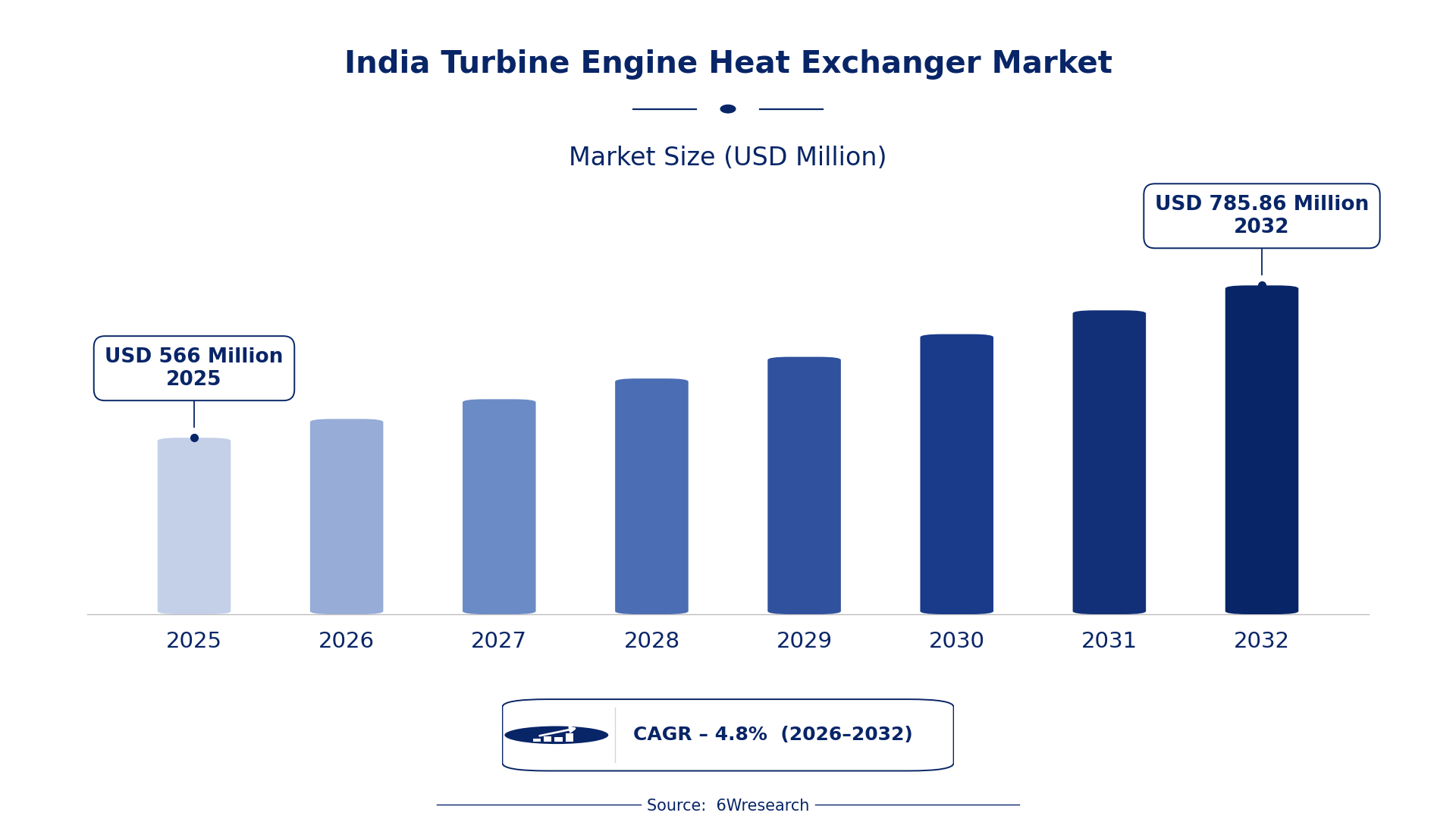
According to 6Wresearch internal database and industry insights, the India Turbine Engine Heat Exchanger Market was valued at USD 566.0 million in 2025 and is projected to reach USD 785.86 million by 2032, growing at a CAGR of approximately 4.8% during 2026–2032.
India Turbine Engine Heat Exchanger Market Highlights
| Report Metric | Details |
| Report Name | India Turbine Engine Heat Exchanger Market |
| Market Size 2025 | USD 566.0 million |
| Market Size 2032 | USD 785.86 million |
| Absolute Growth 2025–2032 | USD 219.86 million |
| CAGR 2026–2032 | 4.8% |
| Peak Annual Growth | 7.3% in 2026 |
| Forecast Period | 2026–2032 |
| Historical Data | 2022–2025 |
| Base Year | 2025 |
| Leading Heat Exchanger Type, 2025 | Air-to-Air Heat Exchanger (47% share) |
| Leading Cooling Medium, 2025 | Bleed Air Cooling (49% share) |
| Leading Application Area, 2025 | Cabin Air Systems (42% share) |
| Leading End User, 2025 | Aircraft OEMs (39% share) |
| Fastest-Growing Heat Exchanger Type | Air-to-Oil Cooler (7.5% CAGR) |
| Fastest-Growing Cooling Medium | Engine Oil Cooling (7.3% CAGR) |
| Fastest-Growing Application Area | Turbofan Engines (6.0% CAGR) |
| Fastest-Growing End User | Engine Suppliers (6.7% CAGR) |
| Growing Sector | Aerospace |
| Key End Users | Aircraft OEMs, Engine Suppliers, Aerospace Integrators, UAV Builders |
India Turbine Engine Heat Exchanger Market Year-wise Growth Rate and Key Drivers (2022–2032)
This graph illustrates the annual growth rates of the market from 2022 to 2032, highlighting a steady upward trajectory and projected market expansion over the forecast period.
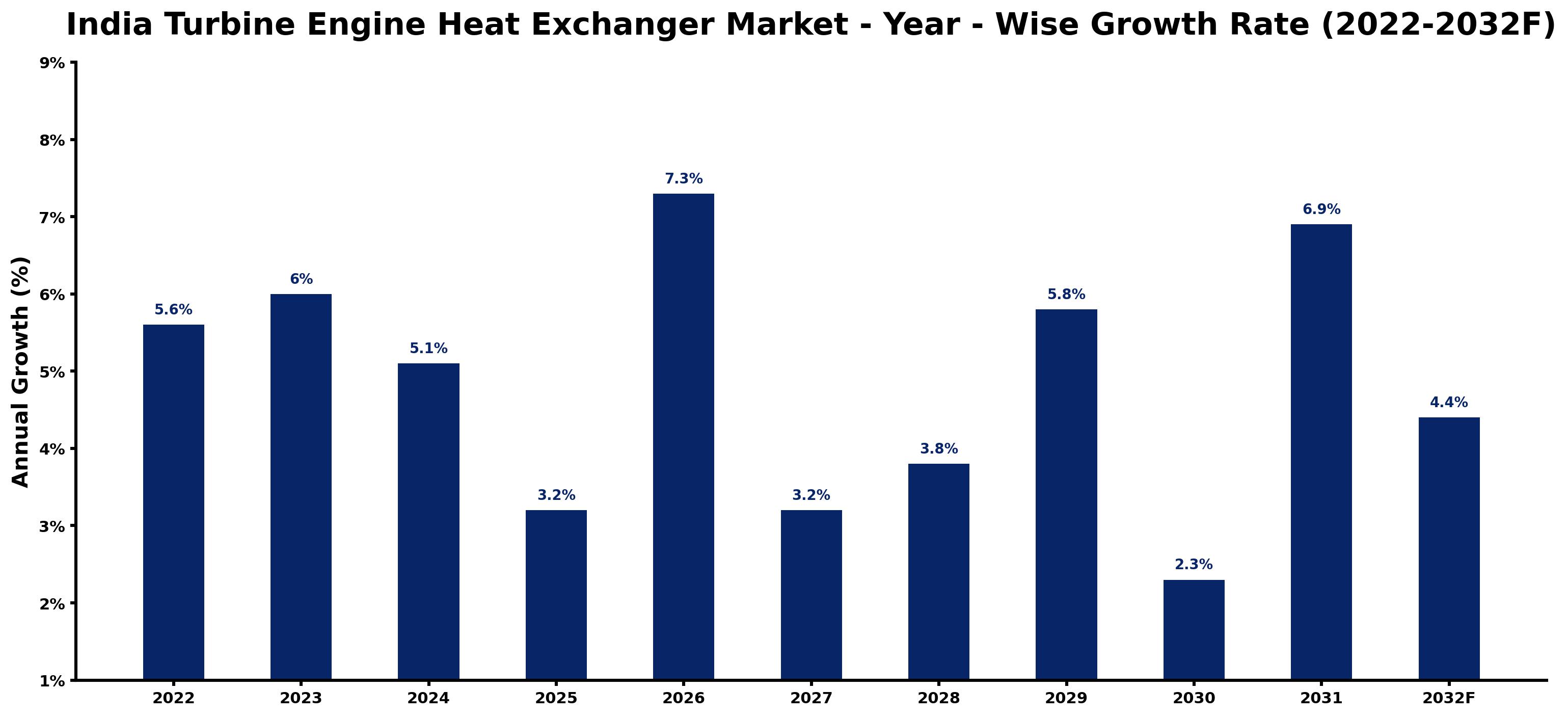
Each row of the following table gives one year's estimated growth and the event or demand shift that explains it.
| Year | Estimated Annual Growth (%) | Market Rationale |
| 2022 | 5.6 | The aerospace sector showed solid activity, with a focus on military aircraft production. |
| 2023 | 6.0 | Demand increased as the Indian Air Force initiated fleet upgrades, boosting component requirements. |
| 2024 | 5.1 | Growth slowed as manufacturers adjusted to supply chain challenges in the aerospace sector. |
| 2025 | 3.2 | Demand continued to slow due to limited new contracts in military aviation and market saturation. |
| 2026 | 7.3 | The market is expected to rebound with increased investments in domestic aerospace manufacturing initiatives. |
| 2027 | 3.2 | Growth is projected to slow again as production stabilises following the previous year's surge in demand. |
| 2028 | 3.8 | Demand is expected to rise as the adoption of advanced heat exchangers gains traction in military applications. |
| 2029 | 5.8 | The market will see a resurgence driven by new contracts for UAVs and military aircraft. |
| 2030 | 2.3 | Growth is projected to slow as manufacturers face challenges in meeting quality standards and certifications. |
| 2031 | 6.9 | Demand is expected to increase as the government announces new initiatives to support aerospace production. |
| 2032 | 4.4 | Growth is projected to slow as the market matures, with established players dominating. |
Note: Market size estimations and growth projections presented in this report are based on 6Wresearch's proprietary forecasting methodology, utilizing the latest available industry data, government publications, and primary research inputs.
India Turbine Engine Heat Exchanger Market Synopsis
Turbine Engine Heat Exchanger Market in India encompasses critical components designed to manage heat in turbine engines. These exchangers are essential for cooling engine oil and bleed air in aircraft systems. The market is growing due to a burgeoning aerospace sector, particularly in military and UAV applications. The Defence Research and Development Organisation is actively developing advanced heat exchangers, while the 'Make in India' initiative boosts domestic production. Demand is driven by increasing military aircraft production and technological advancements, with over 1,000 military aircraft produced in 2022.
Market Dynamics Impact Analysis (2026–2032)
| Factor | Type | Impact | Primary Segment Affected |
| Rising military aircraft production drives demand for turbine engine heat exchangers due to increased need for cooling solutions. | Driver | High | Air-to-Air Heat Exchanger |
| Technological advancements in UAVs enhance the need for efficient heat management in turbine engines. | Driver | High | Bleed Air Cooling |
| Growing demand for UAVs presents opportunities for suppliers to develop specialised heat exchangers. | Opportunity | High | UAVs and Small Aircraft |
| The increasing focus on local production opens avenues for investment in manufacturing facilities. | Opportunity | High | Aircraft OEMs |
| Dependence on imported materials leads to supply chain disruptions, affecting production timelines. | Restraint | High | Engine Oil Cooling |
| Regulatory compliance costs can burden smaller manufacturers, limiting their market participation. | Restraint | Medium | Compact Plate Coolers |
| Intense competition forces suppliers to lower prices, impacting profit margins and sustainability. | Challenge | High | Turbofan Engines |
| Technological lag in implementing quality standards restricts market access for local firms. | Challenge | Medium | Military Aircraft |
Evaluation of Drivers in India Turbine Engine Heat Exchanger Market (2026–2032)
The main growth drivers and the segments they affect most are set out below.
| Drivers | Primary Segment Affected | Why It Matters (Evidence) |
| Increased military aircraft production leads to higher demand for heat exchangers. | Air-to-Air Heat Exchanger | India produced over 1,000 military aircraft in 2022, necessitating more cooling solutions. |
| The 'Make in India' initiative promotes local manufacturing of aerospace components. | Engine Oil Cooling | The Indian government allocated ₹1,000 crores for aerospace technology development in 2023. |
| Growing UAV market drives demand for advanced cooling solutions in new aircraft designs. | UAVs and Small Aircraft | The Indian Air Force's plans for UAV integration increase the need for heat exchangers. |
| Technological advancements in heat exchanger design improve performance and reliability. | Cabin Air Systems | Standards such as AS9100 are being adopted for quality assurance in manufacturing. |
| The expansion of aerospace hubs like Bengaluru fosters a competitive manufacturing environment. | Turbofan Engines | Bengaluru hosts numerous suppliers, enhancing the local supply chain for aerospace components. |
Market growth for Turbine Engine Heat Exchanger in India is underpinned by rising military aircraft production, increasing UAV integration and technological advancements. The Indian Air Force's fleet upgrades have driven demand for cooling solutions, with over 1,000 military aircraft produced in 2022. The allocation of ₹1,000 crores for aerospace technology development supports local manufacturing capabilities. The adoption of standards such as AS9100 ensures quality assurance, stimulating demand further. The expansion of aerospace hubs creates a competitive environment for manufacturers, leading to increased production of advanced heat exchangers.
Evaluation of Restraints in India Turbine Engine Heat Exchanger Market
The following restraints limit how fast demand can grow.
| Market Restraint | Primary Segment Affected | Why It Matters (Evidence) |
| Strict quality assurance standards limit the number of local manufacturers. | Air-to-Oil Cooler | Only a few manufacturers can meet the AS9100 certification requirements, restricting competition. |
| Supply chain disruptions can delay production schedules and increase costs. | Liquid-to-Air | Manufacturers face challenges sourcing materials due to global supply chain issues. |
| Limited investment in R&D may hinder innovation in heat exchanger technology. | Bleed Air Cooling | Without R&D funding, advancements in heat exchanger efficiency may stall. |
| High production costs can deter new entrants into the market. | Compact Plate Coolers | Manufacturers face challenges in scaling production while maintaining profitability. |
| Regulatory compliance can complicate the manufacturing process for heat exchangers. | High-Speed Jet Engines | Navigating complex regulations can delay product launches and increase costs. |
India Turbine Engine Heat Exchanger Market Challenges
The India Turbine Engine Heat Exchanger Market faces fierce competition, with over 1,000 military aircraft produced in 2022 compelling suppliers to lower prices, thereby squeezing profit margins. Supply chain disruptions stem from reliance on imported materials, causing production delays of up to six months for manufacturers and limiting their ability to satisfy buyer demand. Technological advancements are hindered as local firms struggle to implement standards like AS9100, restricting quality assurance and market access for buyers. Regulatory changes may impose compliance costs of ₹100 crores on smaller manufacturers, threatening their competitiveness in the market.
Trends in the India Turbine Engine Heat Exchanger Market
Four trends stand out in the India Turbine Engine Heat Exchanger Market.
- Shift Towards Advanced Materials in Heat Exchangers: In 2023, manufacturers began adopting advanced materials to boost heat exchanger efficiency. This shift responds to the demand for superior performance in military applications, resulting in a greater need for effective designs.
- Transition from Traditional to Modern Cooling Solutions: The market is evolving from traditional cooling methods to modern solutions, particularly in UAVs. This transition is clear as the Indian Air Force integrates new technologies into their fleet.
- Emergence of UAV Technology: Interest in UAV technology has surged since 2022, with substantial investments in development. This trend is reshaping the demand for turbine engine heat exchangers in India.
- Growing Importance of Quality Standards: The adoption of quality standards like AS9100 has increased since 2021, ensuring improved manufacturing practices. This trend is crucial for suppliers aiming to compete in the aerospace market.
Investment Opportunities in the India Turbine Engine Heat Exchanger Market
Some of the investment opportunities in the India Turbine Engine Heat Exchanger Market are mentioned below.
- Investment in Aerospace Manufacturing Hubs: Bengaluru is emerging as a key aerospace manufacturing hub, with ₹1,000 crores allocated for technology development. This investment opens doors for suppliers to form partnerships and expand their market presence.
- Growing Demand for UAVs: The rising focus on UAV technology offers a chance for manufacturers. With over 1,000 military aircraft produced in 2022, suppliers can meet the increasing need for advanced heat exchangers.
- Expansion of Military Aircraft Production: The Indian Air Force's fleet upgrade plans generate demand for turbine engine heat exchangers. This creates opportunities for manufacturers to supply critical components as production scales up.
- Technological Advancements in Heat Exchangers: The rise in the adoption of advanced materials in heat exchangers is driven by the need for greater efficiency. Manufacturers can invest in R&D to create products that align with evolving industry standards.
Government Initiatives in the India Turbine Engine Heat Exchanger Market
The Aerospace and Defence Manufacturing Policy, updated in 2021, encourages local production of aerospace components. This policy aims to ensure that manufacturers meet the increasing demand for turbine engine heat exchangers. The Defence Research and Development Organisation (DRDO) is actively involved in developing advanced heat exchangers, supporting the aerospace sector's growth. The government has also implemented the 'Make in India' initiative, which focuses on boosting domestic manufacturing capabilities and reducing reliance on imports. This initiative is expected to create a conducive environment for local manufacturers to thrive, with a target of increasing local production by 25% by 2025.
In 2023, the Indian government allocated ₹1,000 crores for aerospace and defence technology development. The Ministry of Defence oversees this funding, which supports various projects aimed at enhancing local manufacturing and innovation in the aerospace sector. This financial backing is essential for developing advanced heat exchangers and other components, ensuring that the industry remains competitive and responsive to market demands.
Future Insight of the India Turbine Engine Heat Exchanger Market
The India Turbine Engine Heat Exchanger Market will experience notable changes by 2032, driven by the Ministry of Defence's 'Make in India' initiative focused on enhancing local production capabilities. The Defence Research and Development Organisation's emphasis on developing advanced heat exchanger technologies will broaden options for suppliers. Bengaluru's rising status as an aerospace manufacturing hub will attract further investments, encouraging innovation and collaboration. With the Indian government allocating ₹1,000 crores for aerospace and defence technology development, buyers will benefit from improved product quality and greater availability.
Market Segmentation Analysis
The analysis below covers each segmentation, its leading category in 2025 and its fastest-growing category through 2032.
By Heat Exchanger Type – Air-to-Air Heat Exchanger Dominated, Air-to-Oil Cooler Expected to Grow Fastest
According to Vasudha, AM at 6Wresearch, in 2025, Air-to-Air Heat Exchanger led the heat exchanger type split with a 47% share. Air-to-Air Heat Exchangers are pivotal in cooling systems for aircraft, particularly in military applications where performance is critical. Their widespread implementation in Bengaluru's aerospace sector, which produced over 1,000 military aircraft in 2022, reinforces their leading market share. Air-to-Oil Cooler is projected to grow fastest, at a CAGR of 7.5% during 2026–2032. The Air-to-Oil Cooler segment is experiencing rapid growth due to the increasing need for effective regulation of engine oil temperatures. With the Indian Air Force's ongoing fleet upgrades, the demand for efficient cooling solutions is becoming increasingly important. Suppliers should focus on enhancing their Air-to-Oil Cooler offerings to capitalise on the growing opportunities in the aerospace market.
By Cooling Medium – Bleed Air Cooling Dominated, Engine Oil Cooling Expected to Grow Fastest
The largest cooling medium category in 2025 was Bleed Air Cooling, with a 49% share of total revenue. Bleed Air Cooling maintains the largest market share as it is vital for managing engine temperatures across various aircraft systems. Its critical role in ensuring optimal performance makes it a preferred choice among aerospace manufacturers. Over 2026–2032, Engine Oil Cooling is expected to post the fastest growth, at a CAGR of 7.3%. Engine Oil Cooling is the fastest-growing segment, spurred by the rising demand for enhanced engine performance and reliability. As the aerospace industry expands, the need for effective oil cooling solutions is expected to rise significantly. Buyers should prioritise suppliers who specialise in Engine Oil Cooling to ensure optimal engine performance and longevity.
By Application Area – Cabin Air Systems Dominated, Turbofan Engines Expected to Grow Fastest
With a 42% revenue share in 2025, Cabin Air Systems was the largest application area category. Cabin Air Systems lead the market due to their importance in ensuring passenger comfort during flights. Their widespread implementation across commercial airlines solidifies their market share in the aerospace sector. The quickest growth will come from Turbofan Engines, forecast to expand at a CAGR of 6.0% between 2026 and 2032. Turbofan Engines are the fastest-growing application area, largely due to their extensive use in commercial aviation. The increasing number of new aircraft deliveries is driving demand for advanced cooling solutions in this segment. Suppliers must innovate to meet the rising demand for cooling solutions in Turbofan Engines to stay competitive.
By End User – Aircraft OEMs Dominated, Engine Suppliers Expected to Grow Fastest
Aircraft OEMs took a 39% share of end user in 2025, more than any other category. Aircraft OEMs dominate the market share as they are central to the manufacturing of aircraft and their components. Their established relationships with suppliers and substantial production volumes solidify their leading position in the market. Engine Suppliers are set to record the highest CAGR in this split, 6.7% over 2026–2032. Engine Suppliers are witnessing the fastest growth, driven by the increasing demand for essential components in the expanding aerospace sector. As military and commercial aircraft production ramps up, the need for reliable engine suppliers will continue to grow. Suppliers should strengthen partnerships with Engine Suppliers to leverage the expanding opportunities in the aerospace market.
Key Attractiveness of the Report
- 10 Years of Market Numbers
- Historical Data Starting from 2022 to 2025
- Base Year 2025
- Forecast Data until 2032
- Key Performance Indicators Impacting the Market
- Major Upcoming Developments and Projects
Key Highlights of the Report:
- India Turbine Engine Heat Exchanger Market Outlook
- Market Size of India Turbine Engine Heat Exchanger Market, 2025
- Forecast of India Turbine Engine Heat Exchanger Market, 2032
- Historical Data and Forecast of India Turbine Engine Heat Exchanger Revenues & Volume for the Period 2022 - 2032F
- India Turbine Engine Heat Exchanger Market Trend Evolution
- India Turbine Engine Heat Exchanger Market Drivers and Challenges
- India Turbine Engine Heat Exchanger Price Trends
- India Turbine Engine Heat Exchanger Porter's Five Forces
- India Turbine Engine Heat Exchanger Industry Life Cycle
- Historical Data and Forecast of India Turbine Engine Heat Exchanger Market Revenues & Volume By Heat Exchanger Type for the Period 2022 - 2032F
- Historical Data and Forecast of India Turbine Engine Heat Exchanger Market Revenues & Volume By Air-to-Air Heat Exchanger for the Period 2022 - 2032F
- Historical Data and Forecast of India Turbine Engine Heat Exchanger Market Revenues & Volume By Air-to-Oil Cooler for the Period 2022 - 2032F
- Historical Data and Forecast of India Turbine Engine Heat Exchanger Market Revenues & Volume By Liquid-to-Air for the Period 2022 - 2032F
- Historical Data and Forecast of India Turbine Engine Heat Exchanger Market Revenues & Volume By Compact Plate Coolers for the Period 2022 - 2032F
- Historical Data and Forecast of India Turbine Engine Heat Exchanger Market Revenues & Volume By Cooling Medium for the Period 2022 - 2032F
- Historical Data and Forecast of India Turbine Engine Heat Exchanger Market Revenues & Volume By Bleed Air Cooling for the Period 2022 - 2032F
- Historical Data and Forecast of India Turbine Engine Heat Exchanger Market Revenues & Volume By Engine Oil Cooling for the Period 2022 - 2032F
- Historical Data and Forecast of India Turbine Engine Heat Exchanger Market Revenues & Volume By High-Speed Jet Engines for the Period 2022 - 2032F
- Historical Data and Forecast of India Turbine Engine Heat Exchanger Market Revenues & Volume By Space-Limited Modules for the Period 2022 - 2032F
- Historical Data and Forecast of India Turbine Engine Heat Exchanger Market Revenues & Volume By Application Area for the Period 2022 - 2032F
- Historical Data and Forecast of India Turbine Engine Heat Exchanger Market Revenues & Volume By Cabin Air Systems for the Period 2022 - 2032F
- Historical Data and Forecast of India Turbine Engine Heat Exchanger Market Revenues & Volume By Turbofan Engines for the Period 2022 - 2032F
- Historical Data and Forecast of India Turbine Engine Heat Exchanger Market Revenues & Volume By Military Aircraft for the Period 2022 - 2032F
- Historical Data and Forecast of India Turbine Engine Heat Exchanger Market Revenues & Volume By UAVs and Small Aircraft for the Period 2022 - 2032F
- Historical Data and Forecast of India Turbine Engine Heat Exchanger Market Revenues & Volume By End User for the Period 2022 - 2032F
- Historical Data and Forecast of India Turbine Engine Heat Exchanger Market Revenues & Volume By Aircraft OEMs for the Period 2022 - 2032F
- Historical Data and Forecast of India Turbine Engine Heat Exchanger Market Revenues & Volume By Engine Suppliers for the Period 2022 - 2032F
- Historical Data and Forecast of India Turbine Engine Heat Exchanger Market Revenues & Volume By Aerospace Integrators for the Period 2022 - 2032F
- Historical Data and Forecast of India Turbine Engine Heat Exchanger Market Revenues & Volume By UAV Builders for the Period 2022 - 2032F
- India Turbine Engine Heat Exchanger Import Export Trade Statistics
- Market Opportunity Assessment By Heat Exchanger Type
- Market Opportunity Assessment By Cooling Medium
- Market Opportunity Assessment By Application Area
- Market Opportunity Assessment By End User
- India Turbine Engine Heat Exchanger Top Companies Market Share
- India Turbine Engine Heat Exchanger Competitive Benchmarking By Technical and Operational Parameters
- India Turbine Engine Heat Exchanger Company Profiles
- India Turbine Engine Heat Exchanger Key Strategic Recommendations
Market Covered
Segments analysed in this report are listed below.
By Heat Exchanger Type
- Air-to-Air Heat Exchanger
- Air-to-Oil Cooler
- Liquid-to-Air
- Compact Plate Coolers
By Cooling Medium
- Bleed Air Cooling
- Engine Oil Cooling
- High-Speed Jet Engines
- Space-Limited Modules
By Application Area
- Cabin Air Systems
- Turbofan Engines
- Military Aircraft
- UAVs and Small Aircraft
By End User
- Aircraft OEMs
- Engine Suppliers
- Aerospace Integrators
- UAV Builders































