China Turbine Engine Heat Exchanger Market Size & Growth Rate
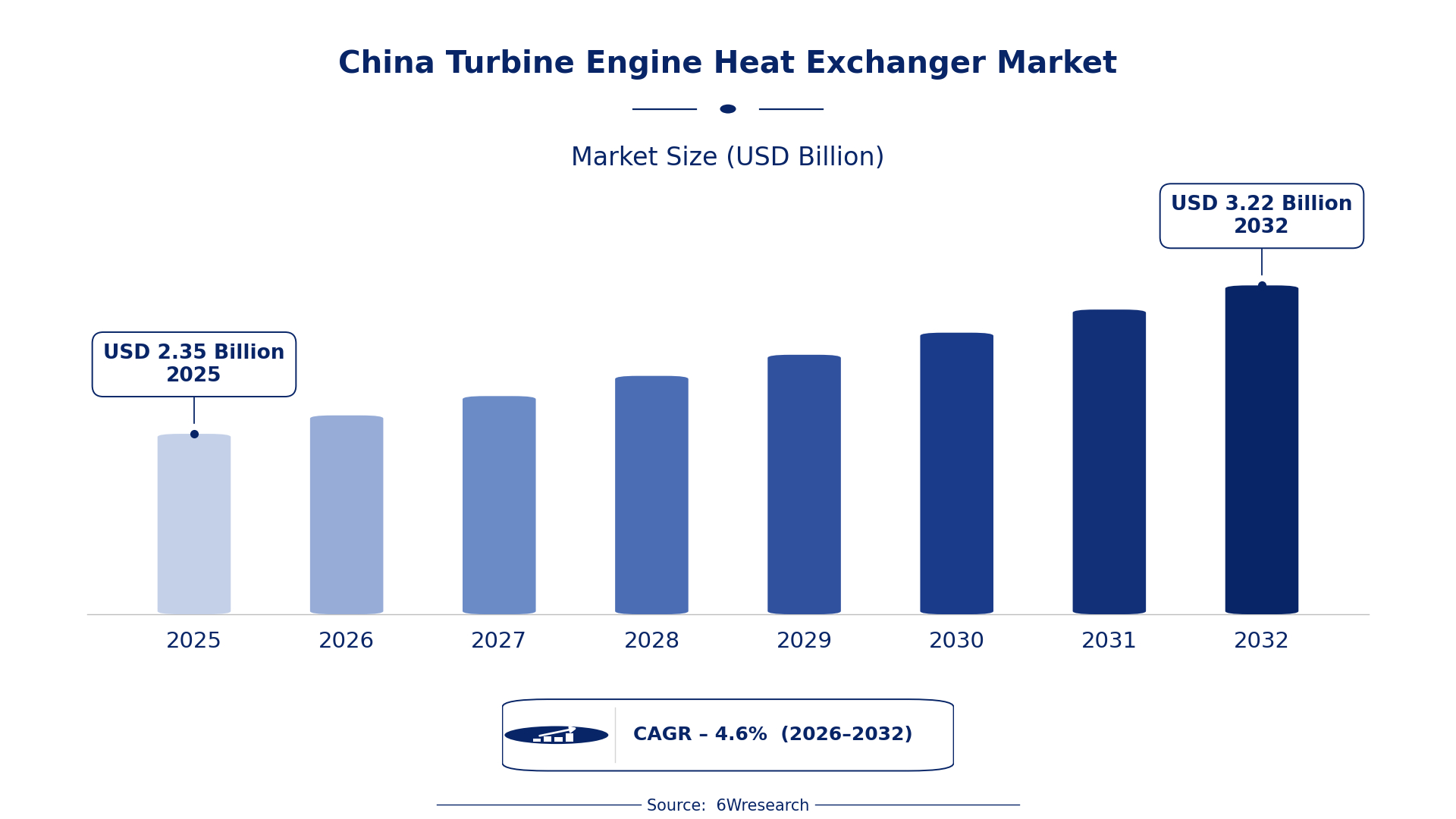
According to 6Wresearch internal database and industry insights, the China Turbine Engine Heat Exchanger Market was valued at USD 2.35 billion in 2025 and is projected to reach USD 3.22 billion by 2032, growing at a CAGR of approximately 4.6% during 2026–2032.
China Turbine Engine Heat Exchanger Market Highlights
| Report Metric | Details |
| Report Name | China Turbine Engine Heat Exchanger Market |
| Market Size 2025 | USD 2.35 billion |
| Market Size 2032 | USD 3.22 billion |
| Absolute Growth 2025–2032 | USD 0.87 billion |
| CAGR 2026–2032 | 4.6% |
| Peak Annual Growth | 6.2% in 2026 |
| Forecast Period | 2026–2032 |
| Historical Data | 2022–2025 |
| Base Year | 2025 |
| Leading Heat Exchanger Type, 2025 | Air-to-Air Heat Exchanger (50% share) |
| Leading Cooling Medium, 2025 | Bleed Air Cooling (37% share) |
| Leading Application Area, 2025 | Cabin Air Systems (42% share) |
| Leading End User, 2025 | Aircraft OEMs (49% share) |
| Fastest-Growing Heat Exchanger Type | Air-to-Oil Cooler (6.0% CAGR) |
| Fastest-Growing Cooling Medium | Engine Oil Cooling (5.7% CAGR) |
| Fastest-Growing Application Area | Turbofan Engines (6.7% CAGR) |
| Fastest-Growing End User | Engine Suppliers (7.4% CAGR) |
| Growing Sector | Turbofan Engines |
| Key End Users | Cabin Air Systems, Turbofan Engines, Military Aircraft, UAVs and Small Aircraft |
China Turbine Engine Heat Exchanger Market Year-wise Growth Rate and Key Drivers (2022–2032)
This graph illustrates the annual growth rates of the market from 2022 to 2032, highlighting a steady upward trajectory and projected market expansion over the forecast period.
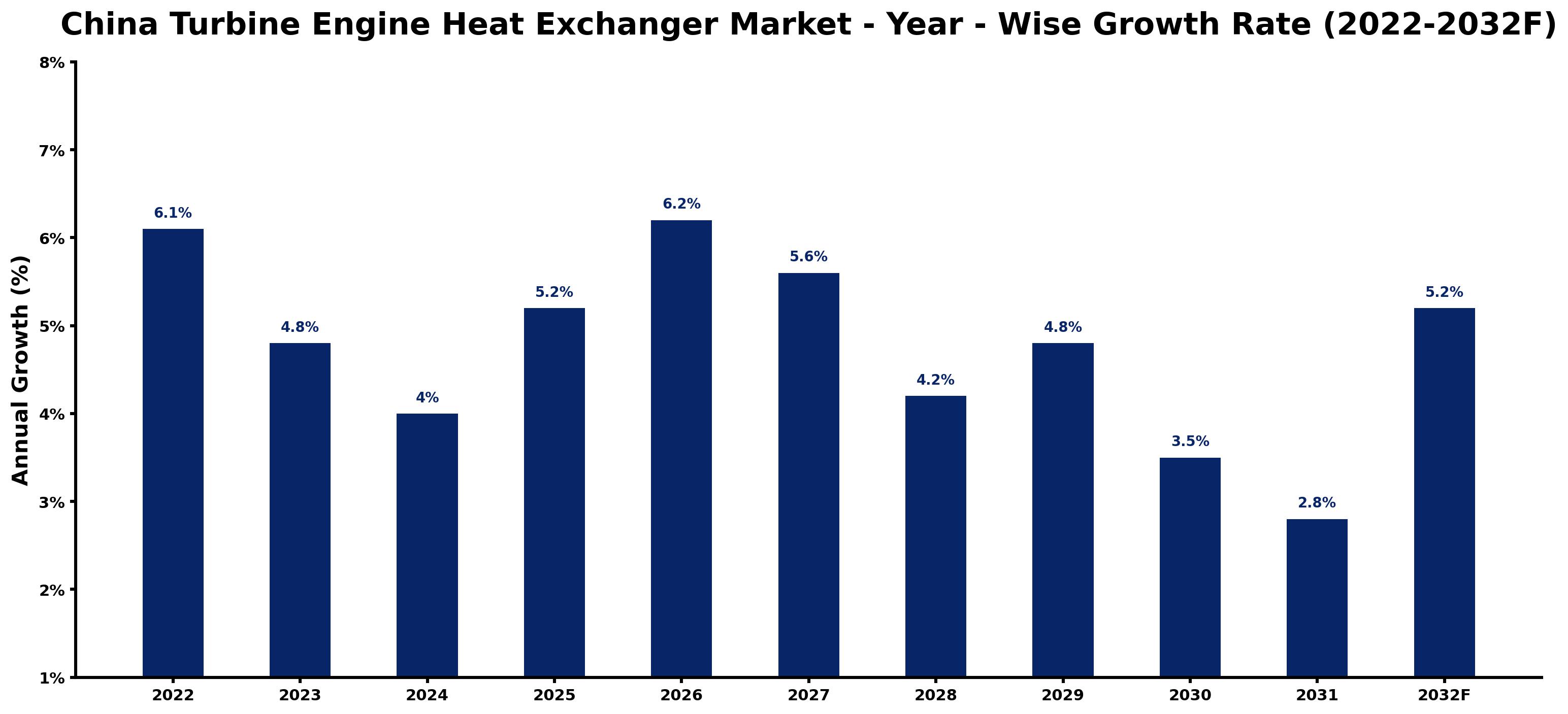
The following table presents the estimated annual growth rate for each year together with the principal factor influencing market performance.
| Year | Estimated Annual Growth (%) | Market Rationale |
| 2022 | 6.1 | The market experienced strong demand from domestic aircraft manufacturers and military applications. |
| 2023 | 4.8 | Growth slowed due to adjustments in production schedules and supply chain constraints. |
| 2024 | 4.0 | Demand continued to grow, albeit at a slower pace, influenced by ongoing military aircraft production. |
| 2025 | 5.2 | Growth accelerated as the government pushed for a 20% increase in domestic aircraft production by 2025. |
| 2026 | 6.2 | The market peaked with investments in advanced aerospace technologies and heat exchanger innovation. |
| 2027 | 5.6 | Growth slowed as manufacturers faced challenges in meeting rising quality standards. |
| 2028 | 4.2 | Demand continued to grow, driven by increased production of UAVs and military aircraft. |
| 2029 | 4.8 | A resurgence in demand occurred as the military aircraft sector expanded further. |
| 2030 | 3.5 | Growth slowed due to market saturation in certain aerospace segments. |
| 2031 | 2.8 | The market continued to grow, albeit at a reduced rate, influenced by evolving industry standards. |
| 2032 | 5.2 | Demand surged as manufacturers adapted to new technologies and increased production capabilities. |
Note: Market size estimations and growth projections presented in this report are based on 6Wresearch's proprietary forecasting methodology, utilizing the latest available industry data, government publications, and primary research inputs.
China Turbine Engine Heat Exchanger Market Synopsis
The Turbine Engine Heat Exchanger Market in China centres on essential components that transfer heat between fluids in aircraft engines. These exchangers utilise advanced materials to endure extreme conditions, primarily for cooling engine oil and bleed air. The market is expanding due to increasing demand from domestic aircraft manufacturers and military applications. The Chinese government aims to boost domestic aircraft production by 20% by 2025, prompting further investments in aerospace technologies. The demand for UAVs is expected to rise at 25% annually until 2025, propelling market growth.
Market Dynamics Impact Analysis (2026–2032)
| Factor | Type | Impact | Primary Segment Affected |
| Growing domestic aircraft production | Driver | High | Aircraft OEMs |
| Increased military aircraft production | Driver | High | Military Aircraft |
| Expansion of UAV market | Opportunity | High | UAVs and Small Aircraft |
| Investment in aerospace technology | Opportunity | High | Aerospace Integrators |
| Challenges in quality control | Restraint | Medium | Engine Suppliers |
| Supply chain disruptions | Restraint | Medium | Aerospace Integrators |
| Limited skilled workforce in aerospace | Challenge | High | Aircraft OEMs |
| High production costs for advanced materials | Challenge | Medium | Engine Suppliers |
Evaluation of Drivers in China Turbine Engine Heat Exchanger Market (2026–2032)
Below mentioned are some major drivers and their influence on market dynamics.
| Drivers | Primary Segment Affected | Why It Matters (Evidence) |
| Increased domestic aircraft production | Aircraft OEMs | This drives demand for heat exchangers as manufacturers ramp up output to meet a government target of 20% increase by 2025. |
| Rising military aircraft production | Military Aircraft | The focus on military capabilities leads to a higher demand for advanced heat exchangers, with production expected to rise by 15% annually. |
| Growth in UAV adoption | UAVs and Small Aircraft | The increasing number of UAVs necessitates efficient thermal management solutions, projected to grow at 25% annually until 2025. |
| Investments in aerospace technology development | Aerospace Integrators | Funding for advanced heat exchanger designs improves production capabilities and quality, with 100 billion RMB invested since 2020. |
| Expansion of commercial aviation | Cabin Air Systems | The growing fleet of commercial aircraft increases the need for effective heat exchange solutions, driven by rising passenger numbers. |
Growth across the Turbine Engine Heat Exchanger market in China is anchored in rising domestic aircraft production, military aircraft demand, and UAV adoption. The commitment to increase domestic aircraft production by 20% by 2025 will drive demand for heat exchangers. Military aircraft production is expected to increase significantly, creating a need for advanced heat exchangers. The UAV market is expanding, with a notable growth rate until 2025, generating demand for efficient thermal management solutions. Investments in aerospace technology development have reached 100 billion RMB since 2020, improving production capabilities and quality standards.
Evaluation of Restraints in China Turbine Engine Heat Exchanger Market
The table below lists the restraints and the evidence behind each.
| Market Restraint | Primary Segment Affected | Why It Matters (Evidence) |
| Supply chain disruptions | Aerospace Integrators | Challenges in sourcing advanced materials delay production timelines, affecting delivery for manufacturers. |
| Skills shortages | Engine Suppliers | A lack of trained engineers in heat exchanger technology hinders innovation and efficiency. |
| Regulatory compliance issues | Aircraft OEMs | Adherence to ISO 9001 standards can slow down manufacturing processes, impacting timely delivery. |
| Market saturation | Cabin Air Systems | Certain aerospace segments face saturation, limiting growth opportunities for manufacturers. |
| Fluctuating demand | Military Aircraft | Inconsistent demand patterns create pressure on suppliers to meet urgent needs. |
China Turbine Engine Heat Exchanger Market Challenges
The China Turbine Engine Heat Exchanger market encounters a substantial supply challenge, as local manufacturers struggle to obtain advanced materials required for production. This limitation stems from underdeveloped domestic capabilities, causing production delays of up to six months for aerospace buyers. A shortage of skilled engineers in heat exchanger technology further complicates the situation, hindering innovation and operational efficiency for suppliers. Buyers face inconsistent demand, particularly with military aircraft production expected to increase by 15% annually, placing pressure on suppliers to adapt swiftly. Compliance with ISO 9001 standards can slow manufacturing processes, potentially delaying delivery timelines for aerospace buyers.
Trends in the China Turbine Engine Heat Exchanger Market
Below mentioned are some of the trends shaping the China Turbine Engine Heat Exchanger Market growth.
- Rise in UAV Adoption: The UAV market in China is projected to grow at a rate of 25% annually until 2025, reflecting increasing military and commercial applications. This trend is supported by the government's target to double the number of UAVs in service by 2025.
- Focus on Advanced Heat Exchanger Technology: The National Aerospace Industry Development Plan emphasises innovation in heat exchanger technology, promoting advancements in design and efficiency. This initiative aligns with the government's investment of 100 billion RMB in aerospace technology development since 2020.
- Expansion of Military Aircraft Production: China's military aircraft production is expected to increase by 15% annually through 2025, reflecting the government's commitment to enhancing national defence capabilities. This growth will drive demand for advanced heat exchangers in military applications.
- Growth in Commercial Aviation: The total number of registered aircraft in China reached over 3000 in 2022, indicating a strong demand for commercial aviation. This growth necessitates effective heat exchange solutions in cabin air systems.
Investment Opportunities in the China Turbine Engine Heat Exchanger Market
The following opportunities in the China Turbine Engine Heat Exchanger Market pair current demand with a clear way in.
- Investment in Advanced Manufacturing: With the Chinese government investing 100 billion RMB in aerospace technology development, there is an opportunity for suppliers to improve manufacturing capabilities. Aircraft OEMs are seeking local partners to meet rising production demands.
- Expansion in UAV Market: The projected 25% annual growth in UAV demand until 2025 presents an opportunity for suppliers to create specialised heat exchangers. Collaborating with UAV builders can facilitate entry into this expanding market.
- Focus on Military Applications: The anticipated 15% annual growth in military aircraft production generates a demand for advanced heat exchangers. Suppliers can target military aircraft manufacturers to provide tailored solutions.
- Enhancements in Cabin Air Systems: The increase in the number of commercial aircraft requires effective heat exchange solutions for cabin air systems. Suppliers can invest in innovative technologies to meet the growing needs of aircraft OEMs.
Government Initiatives in the China Turbine Engine Heat Exchanger Market
The National Aerospace Industry Development Plan (2021) aims to improve domestic production capabilities for aerospace components, including heat exchangers, with a focus on innovation and sustainability. This plan encourages manufacturers to adopt advanced technologies and enhance product quality, ensuring compliance with international standards. The government has set ambitious targets for increasing domestic aircraft production by 20% by 2025, which will drive demand for heat exchangers.
The Aerospace Component Quality Improvement Program, launched by the Ministry of Industry and Information Technology in 2022, focuses on enhancing standards and quality control in aerospace manufacturing. This program provides funding and resources to support manufacturers in meeting stringent quality requirements, ensuring that heat exchangers comply with safety and performance standards. The Civil Aviation Administration of China also plays a significant role in regulating and approving aircraft components, including heat exchangers, to ensure safety and reliability in aviation.
Future Insight of the China Turbine Engine Heat Exchanger Market
The China Turbine Engine Heat Exchanger market will undergo notable changes by 2032, as domestic aircraft production is set to increase by 20% by 2025. Government investments in aerospace technology development will improve manufacturing capabilities and drive innovation. The National Aerospace Industry Development Plan will concentrate on advancements in heat exchanger technology, ensuring enhanced performance and efficiency. With the anticipated growth in UAV demand projected at 25% annually until 2025, suppliers will find new opportunities to expand their product offerings and adapt to market needs.
Market Segmentation Analysis
Each segment group is reviewed below, with the leader by share and the fastest grower by CAGR.
By Heat Exchanger Type – Air-to-Air Heat Exchanger Dominated, Air-to-Oil Cooler Expected to Grow Fastest
According to Vasudha, AM at 6Wresearch, Air-to-Air Heat Exchanger accounted for a 50% market share by heat exchanger type in 2025. The Air-to-Air Heat Exchanger holds the largest market share due to its critical function in cooling cabin air systems, essential for maintaining passenger comfort in aircraft. With over 3000 registered aircraft in China, its importance in the aerospace sector remains significant. Over 2026–2032, Air-to-Oil Cooler is expected to post the fastest growth, at a CAGR of 6.0%. The Air-to-Oil Cooler is experiencing rapid growth as it is vital for cooling engine oil in turbine engines, particularly with the expansion of the aerospace industry. The projected 15% annual increase in military aircraft production through 2025 will further drive demand for this heat exchanger type. Suppliers should enhance their air-to-oil cooler offerings to capitalise on the growing military and commercial aircraft markets.
By Cooling Medium – Bleed Air Cooling Dominated, Engine Oil Cooling Expected to Grow Fastest
With a 37% revenue share in 2025, Bleed Air Cooling was the largest cooling medium category. Bleed Air Cooling leads the market because it is crucial for maintaining cabin temperature, ensuring a comfortable environment for passengers in aircraft. This widespread application across the growing fleet of over 3000 registered aircraft in China reinforces its dominant position. Engine Oil Cooling is projected to grow fastest, at a CAGR of 5.7% during 2026–2032. Engine Oil Cooling is the fastest-growing segment as it is essential for ensuring engine oil remains within operational temperature limits, especially with the increase in military aircraft production. The anticipated growth in military aircraft will significantly boost this segment. Buyers should prioritise suppliers that specialise in engine oil cooling solutions to meet the increasing demands of modern aircraft.
By Application Area – Cabin Air Systems Dominated, Turbofan Engines Expected to Grow Fastest
The largest application area category in 2025 was Cabin Air Systems, with a 42% share of total revenue. Cabin Air Systems dominate the market as they are vital for passenger comfort in commercial aviation, making them a primary focus for aircraft manufacturers. The increasing number of registered aircraft in China amplifies the demand for effective cabin air solutions. Turbofan Engines are set to record the highest CAGR in this split, 6.7% over 2026–2032. Turbofan Engines are the fastest-growing application area, widely utilised in modern commercial aircraft, as the industry shifts towards more efficient propulsion systems. The growth in military aircraft production will further accelerate the demand for heat exchangers in this category. Suppliers should align their product development with the needs of turbofan engine applications to capture emerging opportunities in the aerospace sector.
By End User – Aircraft OEMs Dominated, Engine Suppliers Expected to Grow Fastest
Aircraft OEMs took a 49% share of end user in 2025, more than any other category. Aircraft OEMs represent the largest share of the market as they are the primary users of heat exchangers in aircraft manufacturing, driven by increasing domestic production targets. Their significant role in the supply chain ensures a steady demand for heat exchangers. The quickest growth will come from Engine Suppliers, forecast to expand at a CAGR of 7.4% between 2026 and 2032. Engine Suppliers are the fastest-growing end user segment as they provide heat exchangers as part of engine assembly, which is increasingly crucial with ramped-up production. The focus on military aircraft production will further enhance their growth trajectory. Suppliers should strengthen relationships with engine suppliers to secure contracts and ensure their products meet the evolving requirements of engine assembly.
Key Attractiveness of the Report
- 10 Years of Market Numbers
- Historical Data Starting from 2022 to 2025
- Base Year 2025
- Forecast Data until 2032
- Key Performance Indicators Impacting the Market
- Major Upcoming Developments and Projects
Key Highlights of the Report:
- China Turbine Engine Heat Exchanger Market Outlook
- Market Size of China Turbine Engine Heat Exchanger Market, 2025
- Forecast of China Turbine Engine Heat Exchanger Market, 2032
- Historical Data and Forecast of China Turbine Engine Heat Exchanger Revenues & Volume for the Period 2022 - 2032F
- China Turbine Engine Heat Exchanger Market Trend Evolution
- China Turbine Engine Heat Exchanger Market Drivers and Challenges
- China Turbine Engine Heat Exchanger Price Trends
- China Turbine Engine Heat Exchanger Porter's Five Forces
- China Turbine Engine Heat Exchanger Industry Life Cycle
- Historical Data and Forecast of China Turbine Engine Heat Exchanger Market Revenues & Volume By Heat Exchanger Type for the Period 2022 - 2032F
- Historical Data and Forecast of China Turbine Engine Heat Exchanger Market Revenues & Volume By Air-to-Air Heat Exchanger for the Period 2022 - 2032F
- Historical Data and Forecast of China Turbine Engine Heat Exchanger Market Revenues & Volume By Air-to-Oil Cooler for the Period 2022 - 2032F
- Historical Data and Forecast of China Turbine Engine Heat Exchanger Market Revenues & Volume By Liquid-to-Air for the Period 2022 - 2032F
- Historical Data and Forecast of China Turbine Engine Heat Exchanger Market Revenues & Volume By Compact Plate Coolers for the Period 2022 - 2032F
- Historical Data and Forecast of China Turbine Engine Heat Exchanger Market Revenues & Volume By Cooling Medium for the Period 2022 - 2032F
- Historical Data and Forecast of China Turbine Engine Heat Exchanger Market Revenues & Volume By Bleed Air Cooling for the Period 2022 - 2032F
- Historical Data and Forecast of China Turbine Engine Heat Exchanger Market Revenues & Volume By Engine Oil Cooling for the Period 2022 - 2032F
- Historical Data and Forecast of China Turbine Engine Heat Exchanger Market Revenues & Volume By High-Speed Jet Engines for the Period 2022 - 2032F
- Historical Data and Forecast of China Turbine Engine Heat Exchanger Market Revenues & Volume By Space-Limited Modules for the Period 2022 - 2032F
- Historical Data and Forecast of China Turbine Engine Heat Exchanger Market Revenues & Volume By Application Area for the Period 2022 - 2032F
- Historical Data and Forecast of China Turbine Engine Heat Exchanger Market Revenues & Volume By Cabin Air Systems for the Period 2022 - 2032F
- Historical Data and Forecast of China Turbine Engine Heat Exchanger Market Revenues & Volume By Turbofan Engines for the Period 2022 - 2032F
- Historical Data and Forecast of China Turbine Engine Heat Exchanger Market Revenues & Volume By Military Aircraft for the Period 2022 - 2032F
- Historical Data and Forecast of China Turbine Engine Heat Exchanger Market Revenues & Volume By UAVs and Small Aircraft for the Period 2022 - 2032F
- Historical Data and Forecast of China Turbine Engine Heat Exchanger Market Revenues & Volume By End User for the Period 2022 - 2032F
- Historical Data and Forecast of China Turbine Engine Heat Exchanger Market Revenues & Volume By Aircraft OEMs for the Period 2022 - 2032F
- Historical Data and Forecast of China Turbine Engine Heat Exchanger Market Revenues & Volume By Engine Suppliers for the Period 2022 - 2032F
- Historical Data and Forecast of China Turbine Engine Heat Exchanger Market Revenues & Volume By Aerospace Integrators for the Period 2022 - 2032F
- Historical Data and Forecast of China Turbine Engine Heat Exchanger Market Revenues & Volume By UAV Builders for the Period 2022 - 2032F
- China Turbine Engine Heat Exchanger Import Export Trade Statistics
- Market Opportunity Assessment By Heat Exchanger Type
- Market Opportunity Assessment By Cooling Medium
- Market Opportunity Assessment By Application Area
- Market Opportunity Assessment By End User
- China Turbine Engine Heat Exchanger Top Companies Market Share
- China Turbine Engine Heat Exchanger Competitive Benchmarking By Technical and Operational Parameters
- China Turbine Engine Heat Exchanger Company Profiles
- China Turbine Engine Heat Exchanger Key Strategic Recommendations
Market Covered
This report examines the market across the segments below.
By Heat Exchanger Type
- Air-to-Air Heat Exchanger
- Air-to-Oil Cooler
- Liquid-to-Air
- Compact Plate Coolers
By Cooling Medium
- Bleed Air Cooling
- Engine Oil Cooling
- High-Speed Jet Engines
- Space-Limited Modules
By Application Area
- Cabin Air Systems
- Turbofan Engines
- Military Aircraft
- UAVs and Small Aircraft
By End User
- Aircraft OEMs
- Engine Suppliers
- Aerospace Integrators
- UAV Builders































