India UAV Operating Systems Market Size & Growth Rate
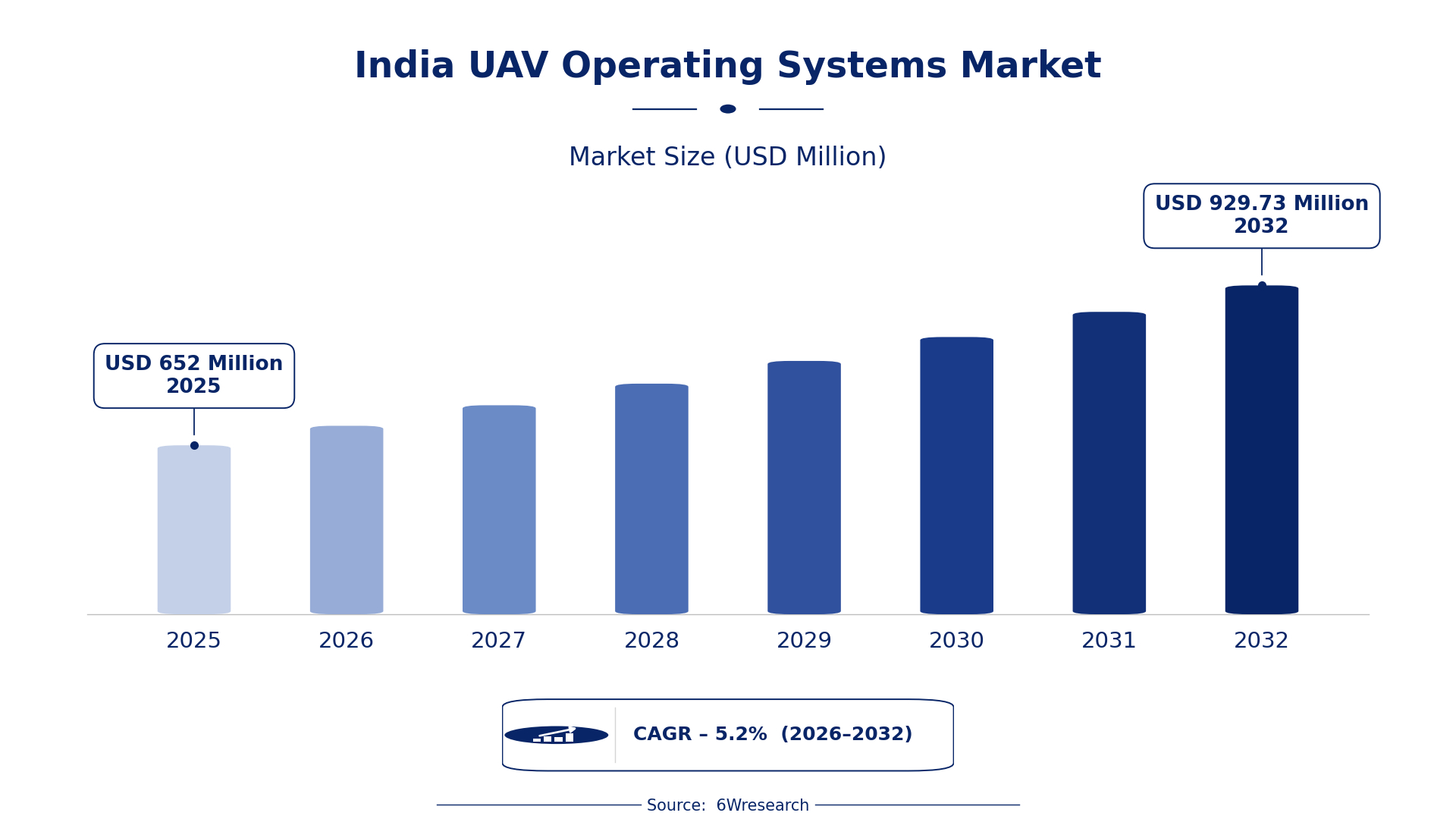
According to 6Wresearch internal database and industry insights, the India UAV Operating Systems Market was valued at USD 652.0 million in 2025 and is projected to reach USD 929.73 million by 2032, growing at a CAGR of approximately 5.2% during 2026–2032.
India UAV Operating Systems Market Highlights
| Report Metric | Details |
| Report Name | India UAV Operating Systems Market |
| Market Size 2025 | USD 652.0 million |
| Market Size 2032 | USD 929.73 million |
| Absolute Growth 2025–2032 | USD 277.73 million |
| CAGR 2026–2032 | 5.2% |
| Peak Annual Growth | 7.7% in 2031 |
| Forecast Period | 2026–2032 |
| Historical Data | 2022–2025 |
| Base Year | 2025 |
| Leading OS Type, 2025 | RTOS (Real-Time OS) (51% share) |
| Leading Architecture, 2025 | Microcontroller-Based (45% share) |
| Leading UAV Class, 2025 | Military UAVs (39% share) |
| Leading End User, 2025 | Defense OEMs (50% share) |
| Fastest-Growing OS Type | Linux-Based UAV OS (6.8% CAGR) |
| Fastest-Growing Architecture | Open Source (7.6% CAGR) |
| Fastest-Growing UAV Class | Micro/Nano UAVs (7.1% CAGR) |
| Fastest-Growing End User | Aerospace Integrators (7.3% CAGR) |
| Growing Sector | Defense and Aerospace |
| Key End Users | Defense OEMs, Embedded System Designers, Avionics Developers, Aerospace Integrators |
India UAV Operating Systems Market Year-wise Growth Rate and Key Drivers (2022–2032)
This graph illustrates the annual growth rates of the market from 2022 to 2032, highlighting a steady upward trajectory and projected market expansion over the forecast period.
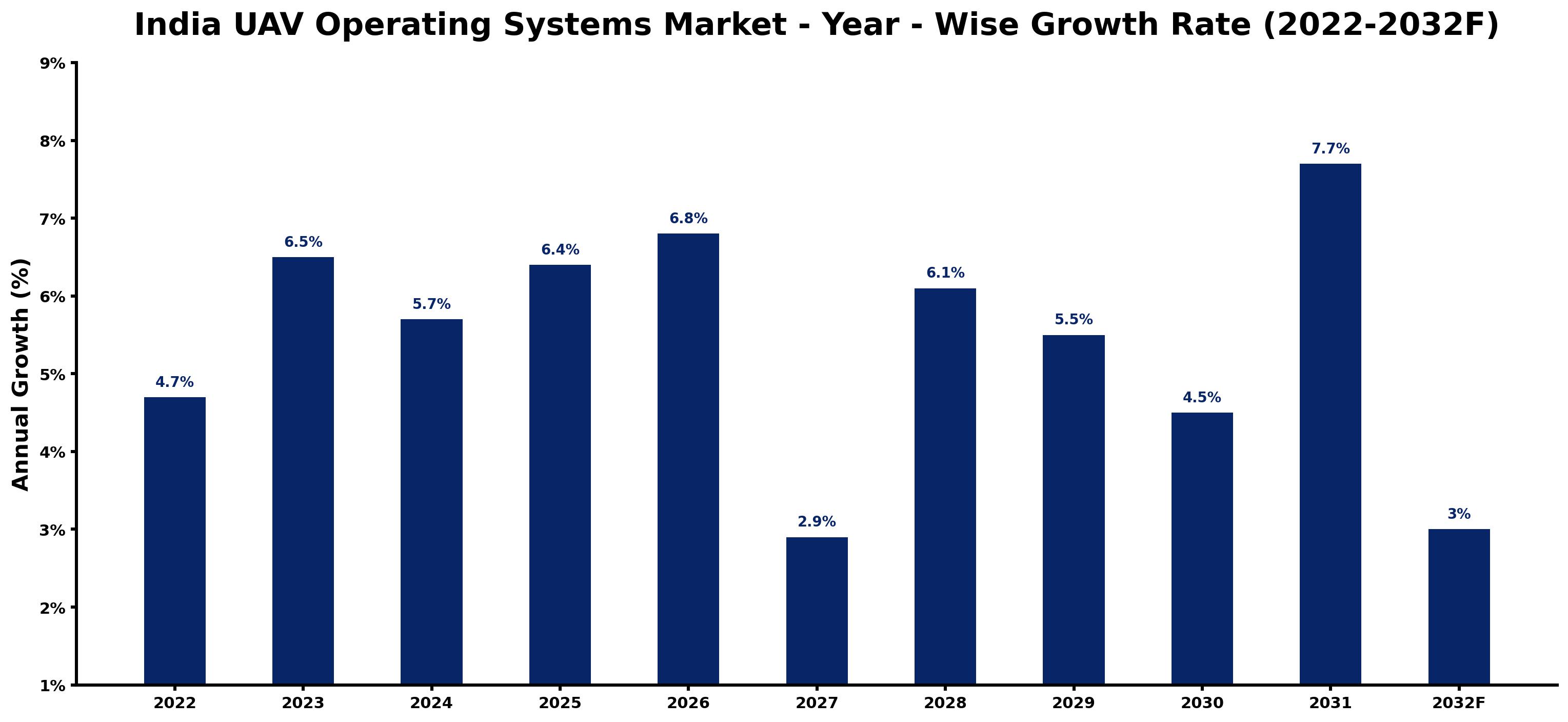
Year by year, the estimates below pair each growth rate with the development that shaped it.
| Year | Estimated Annual Growth (%) | Market Rationale |
| 2022 | 4.7 | The market experienced steady growth, driven by increased domestic UAV demand. |
| 2023 | 6.5 | Growth accelerated due to heightened defense spending and the Atmanirbhar Bharat initiative. |
| 2024 | 5.7 | The market saw a slowdown as investments stabilised after previous peaks. |
| 2025 | 6.4 | Demand increased as the Indian Air Force expanded its UAV capabilities. |
| 2026 | 6.8 | Growth continued, supported by new defense contracts and technology advancements. |
| 2027 | 2.9 | A slowdown occurred as market conditions adjusted after peak growth in 2026. |
| 2028 | 6.1 | Demand rebounded with renewed investments in UAV technology and systems. |
| 2029 | 5.5 | The market slowed again as competition intensified among manufacturers. |
| 2030 | 4.5 | A further slowdown was noted as the market adjusted to new standards. |
| 2031 | 7.7 | Growth peaked with increased investments in advanced UAV systems. |
| 2032 | 3.0 | The market is expected to slow as it matures and stabilises. |
Note: Market size estimations and growth projections presented in this report are based on 6Wresearch's proprietary forecasting methodology, utilizing the latest available industry data, government publications, and primary research inputs.
India UAV Operating Systems Market Synopsis
UAV Operating Systems in India serve as the software platforms that control unmanned aerial vehicles, crucial for navigation, data processing, and mission management. This market is primarily driven by the defense and aerospace sectors, with strong contributions from local development initiatives. The Atmanirbhar Bharat initiative encourages domestic production, while the Drone Rules 2021 promote innovation and regulation. As a result, the India UAV Operating Systems Market is poised for substantial growth, reflecting its robust potential.
Market Dynamics Impact Analysis (2026–2032)
| Factor | Type | Impact | Primary Segment Affected |
| Increased defense spending on UAV technologies | Driver | High | Military UAVs |
| Growing demand for surveillance and reconnaissance capabilities | Driver | High | Micro/Nano UAVs |
| Investment in indigenous UAV manufacturing | Opportunity | High | Defense OEMs |
| Emerging applications in civilian sectors | Opportunity | Medium | Aerospace Integrators |
| Limited availability of skilled workforce | Restraint | High | Embedded System Designers |
| High development costs for advanced systems | Restraint | Medium | Avionics Developers |
| Regulatory hurdles in UAV operations | Challenge | High | RTOS (Real-Time OS) |
| Technological challenges in system integration | Challenge | Medium | Mission-Critical OS |
Evaluation of Drivers in India UAV Operating Systems Market (2026–2032)
The main growth drivers and the segments they affect most are set out below.
| Drivers | Primary Segment Affected | Why It Matters (Evidence) |
| Increased defense budget allocations for UAV technology | Military UAVs | The Indian defense budget for 2023-2024 includes allocations of ₹100 billion for UAV technology advancements, driving demand from military sectors. |
| Growing interest in surveillance applications | Micro/Nano UAVs | The Indian Air Force's investment of ₹500 crores in advanced UAV systems for surveillance drives demand for Micro/Nano UAV operating systems. |
| Support from the Atmanirbhar Bharat initiative | Defense OEMs | The initiative aims for a 50% increase in domestic UAV production by 2025, boosting demand for operating systems. |
| Rising investments from private sector | Aerospace Integrators | Increased private investments of ₹300 crores in UAV technologies are expanding the market for operating systems. |
| Development of new UAV standards by BIS | RTOS (Real-Time OS) | The Bureau of Indian Standards is developing standards for UAV operations, improving safety and reliability. |
The Indian defense budget for 2023-2024 allocates ₹100 billion for UAV technology advancements, stimulating demand from military sectors. The Indian Air Force's investment of ₹500 crores in advanced UAV systems for surveillance drives demand for Micro/Nano UAV operating systems. Additionally, rising investments from private sector players in UAV technologies are expanding the market for operating systems, while the Bureau of Indian Standards is developing standards that improve safety and reliability across all UAV classes.
Evaluation of Restraints in India UAV Operating Systems Market
Below mentioned are some major restraints and their influence on market dynamics.
| Market Restraint | Primary Segment Affected | Why It Matters (Evidence) |
| Limited availability of skilled workforce | Embedded System Designers | The shortage of skilled professionals in UAV technology hinders development and increases costs for manufacturers. |
| High development costs for advanced systems | Avionics Developers | The investment required for advanced UAV systems can deter smaller companies from entering the market. |
| Regulatory hurdles in UAV operations | RTOS (Real-Time OS) | Complex regulations can delay the deployment of UAV systems, affecting operational timelines for buyers. |
| Technological challenges in system integration | Mission-Critical OS | Integrating various UAV components remains a challenge, impacting the reliability of mission-critical operations. |
| Limited market awareness among potential buyers | Aerospace Integrators | Many potential buyers lack knowledge of UAV capabilities, limiting market growth opportunities. |
India UAV Operating Systems Market Challenges
The India UAV Operating Systems market still has to solve a few problems, and the first is intense competition. With over 100 registered UAV manufacturers, price wars can reduce profit margins for producers, making it challenging to allocate funds for research and development. Regulatory hurdles follow, as the Drone Rules 2021 impose strict compliance requirements that can delay product launches for manufacturers and limit options for buyers. Supply chain disruptions also pose challenges; reliance on imported components can lead to production delays, impacting buyers' access to advanced UAV systems. Skills shortages in software development restrict producers' capacity to innovate, resulting in potential stagnation in technology advancement for the market.
Trends in the India UAV Operating Systems Market
Buyers and suppliers in the India UAV Operating Systems Market are adjusting to the following trends.
- Shift from Proprietary to Open Source Operating Systems: The UAV Operating Systems market is experiencing a shift towards open-source platforms, reflecting the flexibility they offer. The growing adoption of Linux-based UAV OS is projected to grow at a CAGR of 6.8%, indicating this trend.
- Increased Focus on Military UAV Applications: Military UAVs are becoming increasingly crucial for defense operations, holding a market share of 39%. The Indian Air Force's ongoing investments in these systems highlight their importance in national security.
- Emergence of Micro/Nano UAVs for Civilian Use: Micro/Nano UAVs are gaining traction for civilian applications, with a projected growth rate of 7.1%. This trend is driven by their versatility in surveillance and reconnaissance missions.
- Growing Demand for Mission-Critical Operating Systems: There is a rising demand for mission-critical operating systems that are essential for safety in defense operations. The focus on reliability is leading to increased investments in this segment.
Investment Opportunities in the India UAV Operating Systems Market
The following opportunities in the India UAV Operating Systems Market pair current demand with a clear way in.
- Gap in Indigenous UAV Manufacturing: With a target of 50% increase in domestic production by 2025, there is an opportunity for investment in local UAV manufacturing. Defense OEMs are actively seeking partners to enhance production capabilities.
- Rising Demand for Surveillance Applications: Now is an opportune time to supply UAV operating systems tailored for surveillance, as the Indian Air Force expands its UAV capabilities. This presents a chance for Aerospace Integrators to collaborate with local manufacturers.
- Investment in Advanced UAV Technologies: The UAV market is expected to grow significantly, with increased investments anticipated. Embedded System Designers are encouraged to innovate and develop UAV operating systems to meet this demand.
- Expansion of UAV Regulations and Standards: The implementation of the Drone Rules 2021 creates opportunities for compliance and certification services. Companies can engage with the Bureau of Indian Standards to align their products with new regulations.
Government Initiatives in the India UAV Operating Systems Market
The 'Drone Rules 2021' introduced by the Ministry of Civil Aviation simplifies UAV operations, promoting innovation and ensuring safety in the sector. This measure encourages local manufacturers to invest in UAV technologies, improving domestic capabilities. Additionally, the 'Make in India' initiative, launched in 2021, aims to boost indigenous UAV manufacturing, targeting a 50% increase in production by 2025. These frameworks create a conducive environment for UAV operating systems development and deployment.
The Indian government established the 'Drone Promotion Council' in 2023 to facilitate collaboration among UAV industry stakeholders. This council aims to streamline processes and improve communication between manufacturers and regulators. The Defence Research and Development Organisation (DRDO) received a budget of ₹1,000 crores for UAV development projects under the Aatmanirbhar Bharat initiative, which supports various research and development efforts. Such funding enables manufacturers to advance their UAV operating systems and technologies.
Future Insight of the India UAV Operating Systems Market
The UAV Operating Systems market in India is set to experience significant transformations by 2032, largely due to the Atmanirbhar Bharat initiative, which encourages local development. Increased investments in UAV technologies from both public and private sectors will stimulate innovation and improve system capabilities. The establishment of standards by the Bureau of Indian Standards will enhance safety protocols, building buyer confidence. The National Drone Policy will streamline UAV usage across various sectors, opening new avenues for suppliers and expanding the overall market.
Market Segmentation Analysis
Each segment group is reviewed below, with the leader by share and the fastest grower by CAGR.
By OS Type – RTOS (Real-Time OS) Dominated, Linux-Based UAV OS Expected to Grow Fastest
According to Vasudha, AM at 6Wresearch, in 2025, RTOS (Real-Time OS) led the os type split with a 51% share. RTOS holds the largest share in the India UAV Operating Systems Market due to its critical role in time-sensitive operations. For instance, the Indian Air Force relies on RTOS for advanced surveillance missions, ensuring timely data processing and response. Linux-Based UAV OS is set to record the highest CAGR in this split, 6.8% over 2026–2032. Linux-Based UAV OS is experiencing rapid growth as it offers flexibility and is widely adopted for educational and prototyping purposes. The increasing number of UAV manufacturers in India, exceeding 100, is driving demand for adaptable operating systems like Linux. Suppliers should focus on developing RTOS solutions while also considering the rising interest in Linux-based systems to capture diverse market needs.
By Architecture – Microcontroller-Based Dominated, Open Source Expected to Grow Fastest
Microcontroller-Based accounted for a 45% market share by architecture in 2025. Microcontroller-Based architecture commands the largest share in the India UAV Operating Systems Market because it is essential for controlling UAV hardware. Its widespread utilisation in various UAV types, particularly within defence applications, highlights its pivotal role in the industry. Open Source is projected to grow fastest, at a CAGR of 7.6% during 2026–2032. Open Source architecture is experiencing rapid growth as it supports educational initiatives and prototyping, allowing developers to create cost-effective solutions. The push for indigenous UAV development under the Atmanirbhar Bharat initiative is expected to further propel this segment's expansion. Suppliers should prioritise the development of Open Source solutions to meet the needs of budget-conscious buyers and encourage greater customisation in UAV systems.
By UAV Class – Military UAVs Dominated, Micro/Nano UAVs Expected to Grow Fastest
Military UAVs took a 39% share of uav class in 2025, more than any other category. Military UAVs lead the market as they represent the primary application area for UAV operating systems, particularly in defence operations. The Indian Ministry of Defence's focus on indigenous UAV development underpins this segment's dominance. The quickest growth will come from Micro/Nano UAVs, forecast to expand at a CAGR of 7.1% between 2026 and 2032. Micro/Nano UAVs are the fastest-growing class, primarily due to their increasing use in surveillance and reconnaissance missions across various sectors. The rising demand for compact UAVs in urban environments is propelling this segment's growth. Suppliers should consider expanding their offerings to include Micro/Nano UAV solutions to meet the growing demand in surveillance applications.
By End User – Defense OEMs Dominated, Aerospace Integrators Expected to Grow Fastest
Defense OEMs held a 50% share of the India UAV Operating Systems Market by end user in 2025. Defense OEMs constitute the largest end-user group for UAV operating systems, largely due to their high demand for military applications. The substantial allocations in the defence budget for UAV technology advancements reinforce their leading position in the market. Over 2026–2032, Aerospace Integrators are expected to post the fastest growth, at a CAGR of 7.3%. Aerospace Integrators are the fastest-growing segment, driven by their crucial role in system integration for UAVs. The implementation of the National Drone Policy is anticipated to boost their importance and demand within the UAV market. Suppliers should aim to collaborate with Aerospace Integrators to ensure their products align with integration needs and comply with new regulatory frameworks.
Key Attractiveness of the Report
- 10 Years of Market Numbers
- Historical Data Starting from 2022 to 2025
- Base Year 2025
- Forecast Data until 2032
- Key Performance Indicators Impacting the Market
- Major Upcoming Developments and Projects
Key Highlights of the Report:
- India UAV Operating Systems Market Outlook
- Market Size of India UAV Operating Systems Market, 2025
- Forecast of India UAV Operating Systems Market, 2032
- Historical Data and Forecast of India UAV Operating Systems Revenues & Volume for the Period 2022 - 2032F
- India UAV Operating Systems Market Trend Evolution
- India UAV Operating Systems Market Drivers and Challenges
- India UAV Operating Systems Price Trends
- India UAV Operating Systems Porter's Five Forces
- India UAV Operating Systems Industry Life Cycle
- Historical Data and Forecast of India UAV Operating Systems Market Revenues & Volume By OS Type for the Period 2022 - 2032F
- Historical Data and Forecast of India UAV Operating Systems Market Revenues & Volume By RTOS (Real-Time OS) for the Period 2022 - 2032F
- Historical Data and Forecast of India UAV Operating Systems Market Revenues & Volume By Linux-Based UAV OS for the Period 2022 - 2032F
- Historical Data and Forecast of India UAV Operating Systems Market Revenues & Volume By Proprietary OS for the Period 2022 - 2032F
- Historical Data and Forecast of India UAV Operating Systems Market Revenues & Volume By Mission-Critical OS for the Period 2022 - 2032F
- Historical Data and Forecast of India UAV Operating Systems Market Revenues & Volume By Architecture for the Period 2022 - 2032F
- Historical Data and Forecast of India UAV Operating Systems Market Revenues & Volume By Microcontroller-Based for the Period 2022 - 2032F
- Historical Data and Forecast of India UAV Operating Systems Market Revenues & Volume By Open Source for the Period 2022 - 2032F
- Historical Data and Forecast of India UAV Operating Systems Market Revenues & Volume By Custom Kernel for the Period 2022 - 2032F
- Historical Data and Forecast of India UAV Operating Systems Market Revenues & Volume By Secure Architecture for the Period 2022 - 2032F
- Historical Data and Forecast of India UAV Operating Systems Market Revenues & Volume By UAV Class for the Period 2022 - 2032F
- Historical Data and Forecast of India UAV Operating Systems Market Revenues & Volume By Micro/Nano UAVs for the Period 2022 - 2032F
- Historical Data and Forecast of India UAV Operating Systems Market Revenues & Volume By Large Tactical UAVs for the Period 2022 - 2032F
- Historical Data and Forecast of India UAV Operating Systems Market Revenues & Volume By Military UAVs for the Period 2022 - 2032F
- Historical Data and Forecast of India UAV Operating Systems Market Revenues & Volume By HALE/MALE UAVs for the Period 2022 - 2032F
- Historical Data and Forecast of India UAV Operating Systems Market Revenues & Volume By End User for the Period 2022 - 2032F
- Historical Data and Forecast of India UAV Operating Systems Market Revenues & Volume By Embedded System Designers for the Period 2022 - 2032F
- Historical Data and Forecast of India UAV Operating Systems Market Revenues & Volume By Avionics Developers for the Period 2022 - 2032F
- Historical Data and Forecast of India UAV Operating Systems Market Revenues & Volume By Defense OEMs for the Period 2022 - 2032F
- Historical Data and Forecast of India UAV Operating Systems Market Revenues & Volume By Aerospace Integrators for the Period 2022 - 2032F
- India UAV Operating Systems Import Export Trade Statistics
- Market Opportunity Assessment By OS Type
- Market Opportunity Assessment By Architecture
- Market Opportunity Assessment By UAV Class
- Market Opportunity Assessment By End User
- India UAV Operating Systems Top Companies Market Share
- India UAV Operating Systems Competitive Benchmarking By Technical and Operational Parameters
- India UAV Operating Systems Company Profiles
- India UAV Operating Systems Key Strategic Recommendations
Market Covered
The report offers an extensive study of the following market segments.
By OS Type
- RTOS (Real-Time OS)
- Linux-Based UAV OS
- Proprietary OS
- Mission-Critical OS
By Architecture
- Microcontroller-Based
- Open Source
- Custom Kernel
- Secure Architecture
By UAV Class
- Micro/Nano UAVs
- Large Tactical UAVs
- Military UAVs
- HALE/MALE UAVs
By End User
- Embedded System Designers
- Avionics Developers
- Defense OEMs
- Aerospace Integrators































