China UAV Operating Systems Market Size & Growth Rate
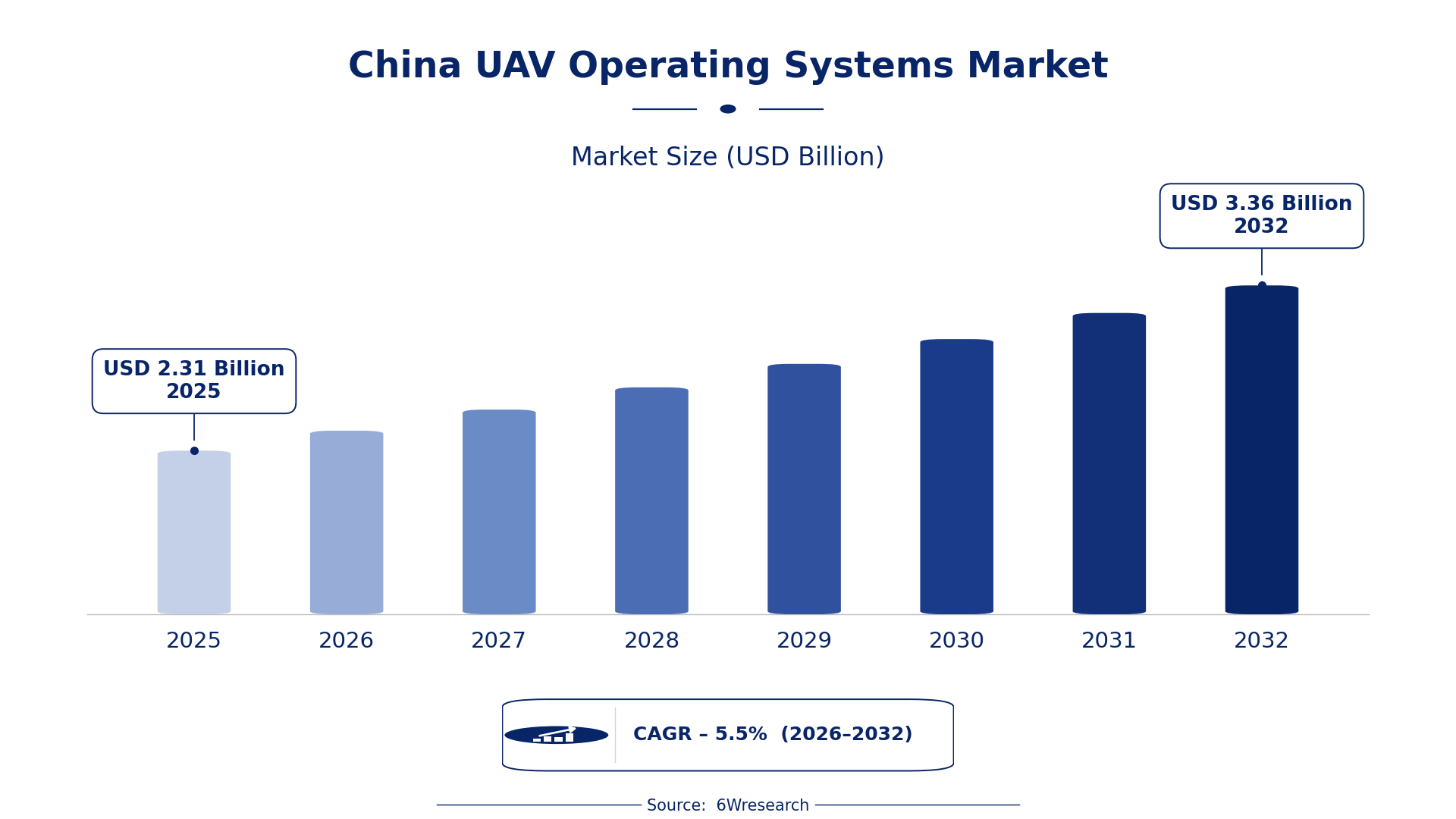
According to 6Wresearch internal database and industry insights, the China UAV Operating Systems Market was valued at USD 2.31 billion in 2025 and is projected to reach USD 3.36 billion by 2032, growing at a CAGR of approximately 5.5% during 2026–2032.
China UAV Operating Systems Market Highlights
| Report Metric | Details |
| Report Name | China UAV Operating Systems Market |
| Market Size 2025 | USD 2.31 billion |
| Market Size 2032 | USD 3.36 billion |
| Absolute Growth 2025–2032 | USD 1.05 billion |
| CAGR 2026–2032 | 5.5% |
| Peak Annual Growth | 7.8% in 2028 |
| Forecast Period | 2026–2032 |
| Historical Data | 2022–2025 |
| Base Year | 2025 |
| Leading OS Type, 2025 | RTOS (Real-Time OS) (43% share) |
| Leading Architecture, 2025 | Microcontroller-Based (49% share) |
| Leading UAV Class, 2025 | Military UAVs (43% share) |
| Leading End User, 2025 | Defense OEMs (52% share) |
| Fastest-Growing OS Type | Linux-Based UAV OS (8.2% CAGR) |
| Fastest-Growing Architecture | Open Source (7.5% CAGR) |
| Fastest-Growing UAV Class | Micro/Nano UAVs (7.4% CAGR) |
| Fastest-Growing End User | Avionics Developers (6.5% CAGR) |
| Growing Sector | Defense and Agriculture |
| Key End Users | Defense OEMs, Embedded System Designers, Avionics Developers, Aerospace Integrators |
China UAV Operating Systems Market Year-wise Growth Rate and Key Drivers (2022–2032)
This graph illustrates the annual growth rates of the market from 2022 to 2032, highlighting a steady upward trajectory and projected market expansion over the forecast period.
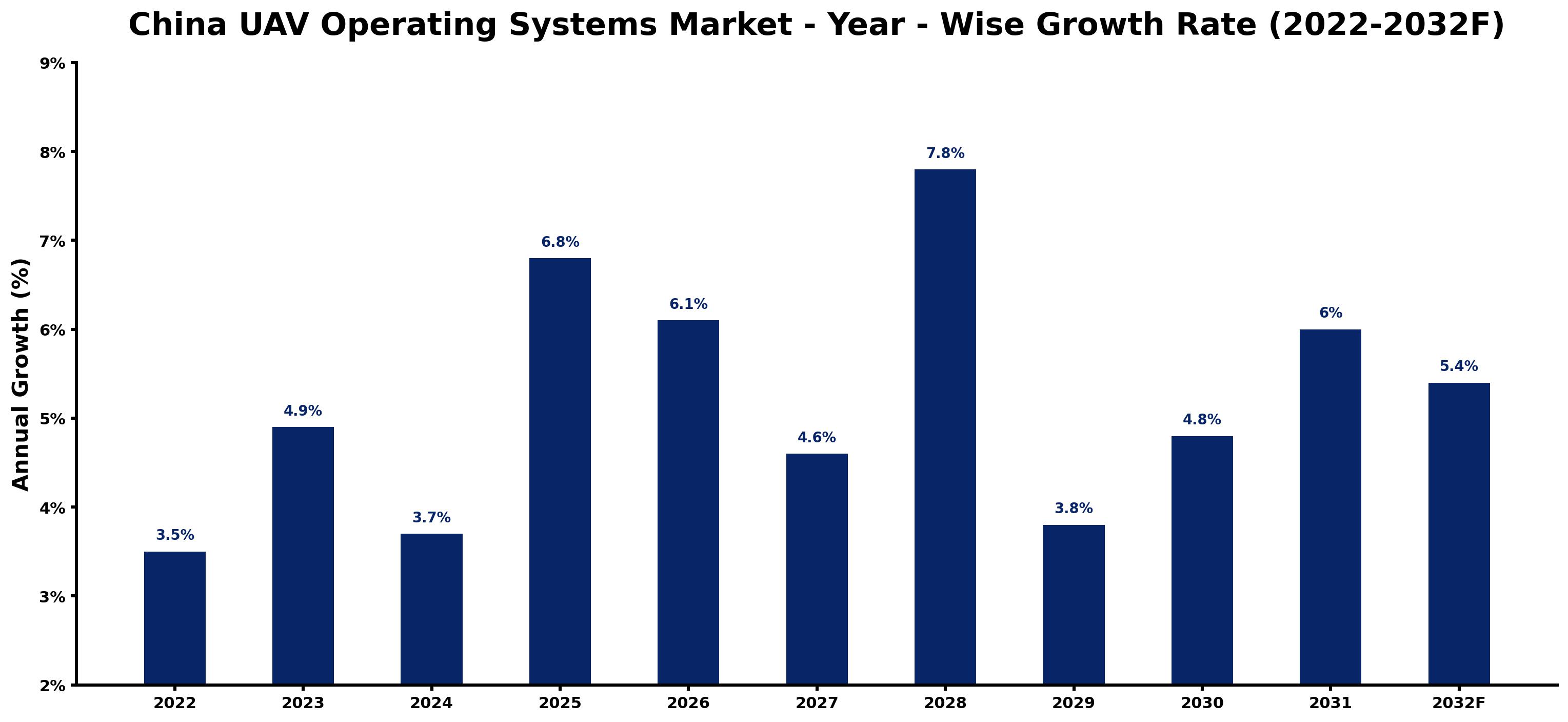
The table below sets out the estimated growth rate for each year and the main factor behind it.
| Year | Estimated Annual Growth (%) | Market Rationale |
| 2022 | 3.5 | The market showed steady activity with increasing interest in UAV applications. |
| 2023 | 4.9 | Demand accelerated due to heightened agricultural UAV usage and technology advancements from the 14th Five-Year Plan. |
| 2024 | 3.7 | Growth slowed slightly as manufacturers adjusted to the CAAC's regulatory changes in UAV operations. |
| 2025 | 6.8 | A surge in military UAV projects drove substantial growth in the market, supported by the National Defense Authorization Act. |
| 2026 | 6.1 | The market is expected to experience a slowdown as competition intensifies among local manufacturers. |
| 2027 | 4.6 | Demand will continue to decelerate amid evolving regulatory frameworks and the CAAC's guidelines. |
| 2028 | 7.8 | A resurgence in military spending will lead to a significant increase in UAV system orders. |
| 2029 | 3.8 | Growth is projected to slow again as the market stabilises after the previous peak in demand. |
| 2030 | 4.8 | An uptick in urban surveillance applications will stimulate renewed interest in UAV systems. |
| 2031 | 6.0 | Increased investments in UAV technology will contribute to a rise in market activity. |
| 2032 | 5.4 | Growth is expected to decelerate as the market reaches a more mature stage with established players. |
Note: Market size estimations and growth projections presented in this report are based on 6Wresearch's proprietary forecasting methodology, utilizing the latest available industry data, government publications, and primary research inputs.
China UAV Operating Systems Market Synopsis
UAV Operating Systems in China encompass specialized software platforms designed for unmanned aerial vehicle control and operation. These systems ensure real-time processing and reliability, primarily used in military and civilian applications such as flight control and navigation. The China UAV Operating Systems Market is expanding, driven by significant demand from defense sectors and domestic manufacturers. Over 60% of UAVs in China are utilized for agricultural purposes, highlighting the diverse applications fueling market growth. The government's substantial investment in UAV research and development further supports this upward trend.
Market Dynamics Impact Analysis (2026–2032)
| Factor | Type | Impact | Primary Segment Affected |
| Increasing military expenditure on UAV technologies | Driver | High | Military UAVs |
| Growing agricultural UAV applications | Driver | High | Micro/Nano UAVs |
| Investment in UAV technology development | Opportunity | High | RTOS (Real-Time OS) |
| Expansion of UAV manufacturing capabilities | Opportunity | Medium | Microcontroller-Based |
| Regulatory compliance costs for UAV operations | Restraint | High | Linux-Based UAV OS |
| Limited integration of UAVs in civilian airspace | Restraint | Medium | Proprietary OS |
| High initial investment costs for advanced UAV systems | Challenge | High | Mission-Critical OS |
| Supply chain disruptions affecting component availability | Challenge | Medium | Open Source |
Evaluation of Drivers in China UAV Operating Systems Market (2026–2032)
Key forces behind demand, with the segment each one moves most, are listed below.
| Drivers | Primary Segment Affected | Why It Matters (Evidence) |
| Increased military expenditure on UAVs | Military UAVs | This investment leads to higher procurement of UAV systems, with the National Defense Authorization Act mandating expanded UAV use in military operations. |
| Rising agricultural applications of UAVs | Micro/Nano UAVs | The growing interest in precision agriculture drives farmers to adopt UAVs, with over 60% of UAVs now used for agricultural purposes. |
| Government support for UAV technology | RTOS (Real-Time OS) | The 14th Five-Year Plan aims for a 30% increase in UAV production efficiency, boosting demand for advanced operating systems. |
| Technological advancements in UAV systems | Linux-Based UAV OS | Flexibility and open-source advantages attract developers, leading to increased adoption among manufacturers. |
| Growing demand from defense OEMs | Defense OEMs | A large share of UAV production is driven by defense OEMs, which account for 52% of the end-user market. |
Over 60% of UAVs are now used for agricultural purposes, driving farmers to adopt UAVs for precision agriculture. The 14th Five-Year Plan aims for a 30% increase in UAV production efficiency, further stimulating demand for advanced operating systems. Technological advancements are attracting developers, enhancing market growth.
Evaluation of Restraints in China UAV Operating Systems Market
The table below lists the restraints and the evidence behind each.
| Market Restraint | Primary Segment Affected | Why It Matters (Evidence) |
| High compliance costs for UAV operations | Linux-Based UAV OS | Manufacturers must invest in compliance with the CAAC's UAV Management Regulations, increasing operational costs. |
| Challenges in integrating UAVs into civilian airspace | Proprietary OS | Regulatory barriers limit the operational scope of proprietary systems, affecting market penetration. |
| Dependence on high-quality components | Mission-Critical OS | Supply chain disruptions can delay production timelines, impacting delivery schedules for critical systems. |
| Limited market awareness of UAV benefits | Open Source | The lack of understanding among potential users restricts the adoption of open-source UAV systems. |
| Regulatory hurdles for UAV manufacturers | RTOS (Real-Time OS) | Compliance with safety standards can slow down the development and deployment of new systems. |
China UAV Operating Systems Market Challenges
A lack of qualified software engineers in the UAV Operating Systems market delays product development, as many manufacturers struggle to find talent, resulting in project timelines extending by up to six months. Intense competition among over 300 UAV manufacturers drives prices down, which often leads to reduced investment in research and development, ultimately delivering lower quality products for buyers. Buyers face rising operational costs due to regulatory compliance, as the Civil Aviation Administration of China mandates ISO 9001 certification, increasing expenses by approximately 15% for UAV operators. Regulatory challenges also hinder innovation, with stringent CAAC safety regulations causing product approval delays that can last up to a year for new suppliers.
Trends in the China UAV Operating Systems Market
The trends below show where the China UAV Operating Systems Market is heading.
- Shift towards Agricultural UAV Applications: The Ministry of Agriculture has actively promoted UAV use in farming, resulting in over 60% of UAVs being deployed for agricultural tasks. This trend enhances efficiency in crop monitoring and management.
- Increased Military Investment in UAVs: The National Defense Authorization Act has sparked a surge in military UAV projects, targeting 50% operational readiness by 2025. This investment is reshaping the defence UAV sector.
- Expansion of UAV Manufacturing Hubs: Shenzhen has emerged as a pivotal hub for UAV technology and manufacturing, hosting over 300 registered UAV manufacturers. This concentration stimulates innovation and competitive pricing in the market.
- Growing Demand for Urban Surveillance UAVs: China aims to bolster UAV surveillance capabilities in urban areas by 2025, indicating a shift towards security applications. This initiative is likely to increase the demand for UAV systems.
Investment Opportunities in the China UAV Operating Systems Market
Several openings in the China UAV Operating Systems Market merit attention from investors.
- Investment in RTOS Development: With the government's 10 billion CNY investment in UAV R&D, there exists an opportunity for developing advanced RTOS solutions. Defence OEMs are key buyers, and partnerships with local firms can facilitate market entry.
- Supply of Microcontroller-Based Systems: The market gap for efficient microcontroller-based UAV systems is clear, with demand expected to rise. Embedded system designers are seeking dependable partners to address this need.
- Expansion into Open Source UAV Solutions: The growing interest in customisable UAV systems presents an opportunity for suppliers of open-source solutions. Collaborating with avionics developers can broaden market reach.
- Development of Proprietary UAV Operating Systems: The demand for unique features in UAV systems opens avenues for proprietary OS development. Engaging with defence OEMs can yield tailored solutions that meet specific operational requirements.
Government Initiatives in the China UAV Operating Systems Market
The Civil Aviation Administration of China (CAAC) established UAV Management Regulations in 2020, outlining operational guidelines to ensure safety and compliance in UAV flights. These regulations compel manufacturers to adhere to strict safety standards, influencing production processes and operational capabilities. The Ministry of Industry and Information Technology (MIIT) supports UAV technology development through the 14th Five-Year Plan, targeting a 30% increase in UAV production efficiency by 2025, which encourages investment in advanced operating systems.
The National Key Research and Development Program, with a budget of 5 billion CNY, backs UAV innovation projects, administered by the Ministry of Science and Technology. This funding allows manufacturers to pursue advanced research and development, promoting progress in UAV technology. Additionally, the Ministry of Defense's UAV Development Strategy focuses on enhancing military UAV capabilities, aiming for 50% operational readiness by 2025, which drives demand for sophisticated UAV operating systems.
Future Insight of the China UAV Operating Systems Market
Several forward-looking factors are set to support the UAV Operating Systems market in China in the coming years. The Ministry of Industry and Information Technology's support through the 14th Five-Year Plan will enable technological advancements for manufacturers. By 2025, the UAV population is projected to exceed 1 million units, generating substantial demand for sophisticated operating systems. Improved urban surveillance capabilities will create new application areas, while significant government investment in UAV research and development will stimulate growth and innovation in the sector.
Market Segmentation Analysis
The analysis below covers each segmentation, its leading category in 2025 and its fastest-growing category through 2032.
By OS Type – RTOS (Real-Time OS) Dominated, Linux-Based UAV OS Expected to Grow Fastest
According to Vasudha, AM at 6Wresearch, in 2025, RTOS (Real-Time OS) led the os type split with a 43% share. RTOS holds the largest share in the China UAV Operating Systems Market due to its critical role in ensuring immediate response during UAV operations, especially in military contexts. The substantial government investment in UAV technology development further solidifies its widespread use among manufacturers. The quickest growth will come from Linux-Based UAV OS, forecast to expand at a CAGR of 8.2% between 2026 and 2032. The Linux-Based UAV OS segment is experiencing rapid growth, driven by its flexibility and open-source nature, which attract developers looking for customisable solutions. This trend is evident as more companies shift towards Linux-based systems to optimise their UAV operations. Suppliers should focus on advancing RTOS capabilities while also embracing the growing demand for Linux-based solutions to meet diverse customer needs.
By Architecture – Microcontroller-Based Dominated, Open Source Expected to Grow Fastest
Microcontroller-Based took a 49% share of architecture in 2025, more than any other category. Microcontroller-Based architecture dominates the market as it is commonly used in smaller UAVs, providing efficient processing capabilities for various applications. This architecture is particularly favoured by manufacturers focusing on cost-effective and compact UAV designs. Open Source is projected to grow fastest, at a CAGR of 7.5% during 2026–2032. Open Source architecture is the fastest-growing segment, driven by the demand for customization and community-driven development, allowing developers to tailor systems to specific needs. This trend is likely to continue as more users seek adaptable solutions for their UAV operations. Manufacturers should invest in open-source solutions to attract a broader customer base while maintaining strong offerings in microcontroller-based systems.
By UAV Class – Military UAVs Dominated, Micro/Nano UAVs Expected to Grow Fastest
Military UAVs accounted for a 43% market share by uav class in 2025. Military UAVs account for the largest share in the market, primarily due to substantial demand from defense sectors that require advanced surveillance and operational capabilities. This segment benefits from government investments and mandates for increased UAV usage in military operations. Over 2026–2032, Micro/Nano UAVs are expected to post the fastest growth, at a CAGR of 7.4%. Micro/Nano UAVs are the fastest-growing class, driven by rising interest in personal and commercial applications, including agriculture and surveillance. This growth reflects a shift towards smaller, more versatile UAVs that can be deployed in various environments. Suppliers should consider diversifying their offerings to include micro/nano UAV solutions while continuing to support military UAV developments.
By End User – Defense OEMs Dominated, Avionics Developers Expected to Grow Fastest
Defense OEMs held a 52% share of the China UAV Operating Systems Market by end user in 2025. Defense OEMs dominate the market share as they are the principal users in military UAV production, necessitating sophisticated operating systems to comply with stringent regulations. Their strong position is bolstered by ongoing government contracts and military modernisation efforts that fuel demand for advanced UAV technologies. Avionics Developers are set to record the highest CAGR in this split, 6.5% over 2026–2032. Avionics Developers represent the fastest-growing end user segment, driven by the rising demand for advanced flight control systems in military and civilian UAV applications. This growth underscores the increasing importance of enhancing UAV capabilities through improved avionics technology for operational success. Suppliers should build robust partnerships with avionics developers to leverage the rising demand for advanced flight control systems in the UAV market.
Key Attractiveness of the Report
- 10 Years of Market Numbers
- Historical Data Starting from 2022 to 2025
- Base Year 2025
- Forecast Data until 2032
- Key Performance Indicators Impacting the Market
- Major Upcoming Developments and Projects
Key Highlights of the Report:
- China UAV Operating Systems Market Outlook
- Market Size of China UAV Operating Systems Market, 2025
- Forecast of China UAV Operating Systems Market, 2032
- Historical Data and Forecast of China UAV Operating Systems Revenues & Volume for the Period 2022 - 2032F
- China UAV Operating Systems Market Trend Evolution
- China UAV Operating Systems Market Drivers and Challenges
- China UAV Operating Systems Price Trends
- China UAV Operating Systems Porter's Five Forces
- China UAV Operating Systems Industry Life Cycle
- Historical Data and Forecast of China UAV Operating Systems Market Revenues & Volume By OS Type for the Period 2022 - 2032F
- Historical Data and Forecast of China UAV Operating Systems Market Revenues & Volume By RTOS (Real-Time OS) for the Period 2022 - 2032F
- Historical Data and Forecast of China UAV Operating Systems Market Revenues & Volume By Linux-Based UAV OS for the Period 2022 - 2032F
- Historical Data and Forecast of China UAV Operating Systems Market Revenues & Volume By Proprietary OS for the Period 2022 - 2032F
- Historical Data and Forecast of China UAV Operating Systems Market Revenues & Volume By Mission-Critical OS for the Period 2022 - 2032F
- Historical Data and Forecast of China UAV Operating Systems Market Revenues & Volume By Architecture for the Period 2022 - 2032F
- Historical Data and Forecast of China UAV Operating Systems Market Revenues & Volume By Microcontroller-Based for the Period 2022 - 2032F
- Historical Data and Forecast of China UAV Operating Systems Market Revenues & Volume By Open Source for the Period 2022 - 2032F
- Historical Data and Forecast of China UAV Operating Systems Market Revenues & Volume By Custom Kernel for the Period 2022 - 2032F
- Historical Data and Forecast of China UAV Operating Systems Market Revenues & Volume By Secure Architecture for the Period 2022 - 2032F
- Historical Data and Forecast of China UAV Operating Systems Market Revenues & Volume By UAV Class for the Period 2022 - 2032F
- Historical Data and Forecast of China UAV Operating Systems Market Revenues & Volume By Micro/Nano UAVs for the Period 2022 - 2032F
- Historical Data and Forecast of China UAV Operating Systems Market Revenues & Volume By Large Tactical UAVs for the Period 2022 - 2032F
- Historical Data and Forecast of China UAV Operating Systems Market Revenues & Volume By Military UAVs for the Period 2022 - 2032F
- Historical Data and Forecast of China UAV Operating Systems Market Revenues & Volume By HALE/MALE UAVs for the Period 2022 - 2032F
- Historical Data and Forecast of China UAV Operating Systems Market Revenues & Volume By End User for the Period 2022 - 2032F
- Historical Data and Forecast of China UAV Operating Systems Market Revenues & Volume By Embedded System Designers for the Period 2022 - 2032F
- Historical Data and Forecast of China UAV Operating Systems Market Revenues & Volume By Avionics Developers for the Period 2022 - 2032F
- Historical Data and Forecast of China UAV Operating Systems Market Revenues & Volume By Defense OEMs for the Period 2022 - 2032F
- Historical Data and Forecast of China UAV Operating Systems Market Revenues & Volume By Aerospace Integrators for the Period 2022 - 2032F
- China UAV Operating Systems Import Export Trade Statistics
- Market Opportunity Assessment By OS Type
- Market Opportunity Assessment By Architecture
- Market Opportunity Assessment By UAV Class
- Market Opportunity Assessment By End User
- China UAV Operating Systems Top Companies Market Share
- China UAV Operating Systems Competitive Benchmarking By Technical and Operational Parameters
- China UAV Operating Systems Company Profiles
- China UAV Operating Systems Key Strategic Recommendations
Market Covered
Segments analysed in this report are listed below.
By OS Type
- RTOS (Real-Time OS)
- Linux-Based UAV OS
- Proprietary OS
- Mission-Critical OS
By Architecture
- Microcontroller-Based
- Open Source
- Custom Kernel
- Secure Architecture
By UAV Class
- Micro/Nano UAVs
- Large Tactical UAVs
- Military UAVs
- HALE/MALE UAVs
By End User
- Embedded System Designers
- Avionics Developers
- Defense OEMs
- Aerospace Integrators































