India Ultra-Lightweight Materials Market Size & Growth Rate
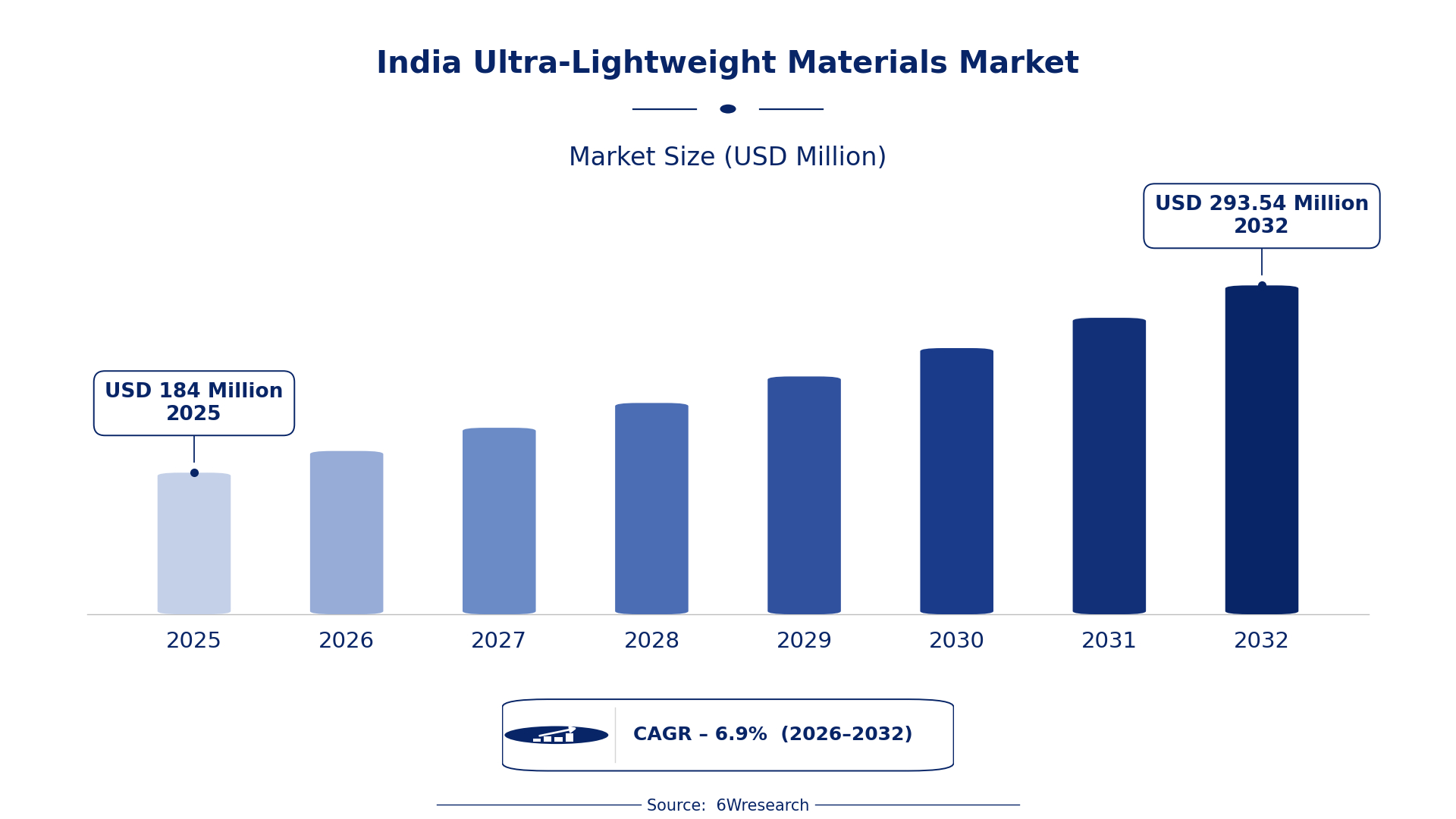
According to 6Wresearch internal database and industry insights, the India Ultra-Lightweight Materials Market was valued at USD 184.0 million in 2025 and is projected to reach USD 293.54 million by 2032, growing at a CAGR of approximately 6.9% during 2026–2032.
India Ultra-Lightweight Materials Market Highlights
| Report Metric | Details |
| Report Name | India Ultra-Lightweight Materials Market |
| Market Size 2025 | USD 184.0 million |
| Market Size 2032 | USD 293.54 million |
| Absolute Growth 2025–2032 | USD 109.54 million |
| CAGR 2026–2032 | 6.9% |
| Peak Annual Growth | 9.2% in 2026 |
| Forecast Period | 2026–2032 |
| Historical Data | 2022–2025 |
| Base Year | 2025 |
| Leading Material Type, 2025 | Carbon Fiber (36% share) |
| Leading Application Sector, 2025 | Aerospace (42% share) |
| Leading Form Type, 2025 | Composite Sheets (46% share) |
| Leading End User, 2025 | Aircraft OEMs (42% share) |
| Fastest-Growing Material Type | Magnesium Alloys (9.3% CAGR) |
| Fastest-Growing Application Sector | Automotive (8.5% CAGR) |
| Fastest-Growing Form Type | Structural Frames (9.0% CAGR) |
| Fastest-Growing End User | Car Manufacturers (9.2% CAGR) |
| Growing Sector | Aerospace |
| Key End Users | Aircraft OEMs, Car Manufacturers, Device Assemblers |
India Ultra-Lightweight Materials Market Year-wise Growth Rate and Key Drivers (2022–2032)
This graph illustrates the annual growth rates of the market from 2022 to 2032, highlighting a steady upward trajectory and projected market expansion over the forecast period.
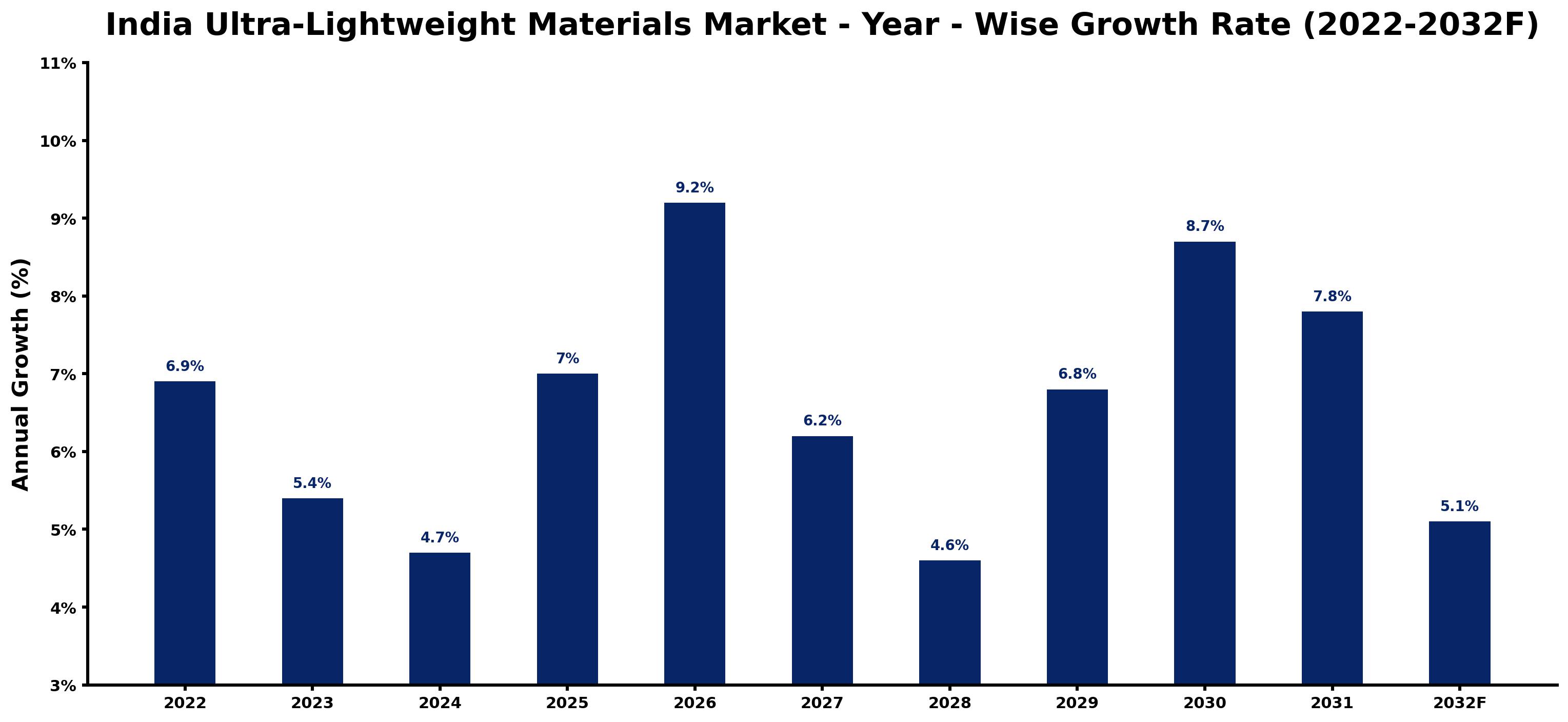
Year by year, the estimates below pair each growth rate with the development that shaped it.
| Year | Estimated Annual Growth (%) | Market Rationale |
| 2022 | 6.9 | The market experienced steady demand due to ongoing aerospace projects and increased vehicle production. |
| 2023 | 5.4 | Growth slowed as the automotive sector faced supply chain disruptions affecting lightweight components. |
| 2024 | 4.7 | Demand continued to slow as manufacturers adjusted to fluctuating material costs and availability. |
| 2025 | 7.0 | A resurgence in vehicle production, driven by the Automotive Mission Plan, boosted demand for lightweight materials. |
| 2026 | 9.2 | Investment in advanced manufacturing technologies is projected to drive demand for ultra-lightweight materials in aerospace. |
| 2027 | 6.2 | Growth is anticipated to slow as the market adjusts to new BIS standards for lightweight materials. |
| 2028 | 4.6 | A further slowdown is expected as manufacturers focus on cost-efficiency amid rising raw material prices. |
| 2029 | 6.8 | Demand will increase again as automotive manufacturers aim to meet the 20% weight reduction target. |
| 2030 | 8.7 | Growth is expected to accelerate as the aerospace sector ramps up production, requiring more lightweight components. |
| 2031 | 7.8 | A slowdown is anticipated as supply chain challenges persist, impacting timely material availability. |
| 2032 | 5.1 | The market will continue to grow, albeit at a slower pace, as new regulations influence material standards. |
Note: Market size estimations and growth projections presented in this report are based on 6Wresearch's proprietary forecasting methodology, utilizing the latest available industry data, government publications, and primary research inputs.
India Ultra-Lightweight Materials Market Synopsis
Ultra-Lightweight Materials in India include advanced composites designed for high strength-to-weight ratios, primarily utilised in aerospace, automotive, and consumer electronics. These materials are crafted through techniques such as weaving and moulding. The India Ultra-Lightweight Materials Market is growing due to substantial investments in domestic manufacturing and a rise in vehicle production, with the automotive sector producing 22.7 million vehicles in 2021. Initiatives like the National Aerospace Policy 2021 further stimulate the demand for lightweight materials, enhancing the country's manufacturing capabilities.
Market Dynamics Impact Analysis (2026–2032)
| Factor | Type | Impact | Primary Segment Affected |
| Increased investment in aerospace manufacturing | Driver | High | Aerospace |
| Growing automotive production requirements | Driver | High | Automotive |
| Rising demand for lightweight materials in defense applications | Opportunity | Medium | Aerospace |
| Expanding consumer electronics sector requiring lightweight components | Opportunity | Medium | Consumer Electronics |
| High costs of advanced materials limiting adoption | Restraint | High | Automotive |
| Supply chain disruptions affecting material availability | Restraint | Medium | Aerospace |
| Regulatory delays in material approvals slowing market entry | Challenge | High | Consumer Electronics |
| Competition from alternative materials impacting market share | Challenge | Medium | Automotive |
Evaluation of Drivers in India Ultra-Lightweight Materials Market (2026–2032)
The main growth drivers and the segments they affect most are set out below.
| Drivers | Primary Segment Affected | Why It Matters (Evidence) |
| Investment in advanced manufacturing technologies | Aerospace | This investment increases production capabilities, driving demand for ultra-lightweight materials as manufacturers seek to improve efficiency. |
| Growing automotive production | Automotive | In 2021, the automotive industry produced 22.7 million vehicles, driving demand for lightweight components to enhance fuel efficiency. |
| Government initiatives promoting lightweight materials | Aerospace | The National Aerospace Policy 2021 aims to boost domestic manufacturing capabilities, increasing the need for lightweight materials. |
| Rising fuel efficiency standards in automotive | Automotive | The automotive lightweighting initiative under the Automotive Mission Plan 2026 targets a 20% weight reduction, increasing demand for lightweight components. |
| Increasing use of lightweight materials in electronics | Consumer Electronics | The National Policy on Electronics 2019 emphasises lightweight materials, driving demand for thermoplastics in mobile device assemblies. |
Growth in the Ultra-Lightweight Materials market in India comes from increased investment in advanced manufacturing technologies, which boosts production capabilities. The automotive sector produced 22.7 million vehicles in 2021, driving demand for lightweight components to enhance fuel efficiency. Additionally, the growing use of thermoplastics in mobile device assemblies highlights the expanding applications of ultra-lightweight materials in the electronics sector.
Evaluation of Restraints in India Ultra-Lightweight Materials Market
The table below lists the restraints and the evidence behind each.
| Market Restraint | Primary Segment Affected | Why It Matters (Evidence) |
| High costs of advanced materials | Automotive | The high costs associated with carbon fiber and magnesium alloys limit their widespread adoption in vehicle manufacturing. |
| Supply chain disruptions affecting material availability | Aerospace | Ongoing supply chain issues have delayed the procurement of lightweight materials, hindering production schedules. |
| Regulatory delays in material approvals | Consumer Electronics | The lengthy approval processes for new lightweight materials can slow down product development timelines. |
| Competition from alternative materials | Automotive | The rise of alternative materials like high-strength steel can impact the market share of ultra-lightweight materials. |
| Limited awareness among manufacturers about lightweight benefits | Aerospace | Some manufacturers are still unaware of the advantages of using ultra-lightweight materials, affecting adoption rates. |
India Ultra-Lightweight Materials Market Challenges
The India Ultra-Lightweight Materials Market struggles with high production costs, as raw materials and manufacturing processes can inflate component prices for automotive and aerospace manufacturers by up to 30%. A shortage of skilled workers in advanced composite technologies limits producers' ability to meet rising demand, leading to project delays and increased operational expenses. Technological constraints in local manufacturing hinder the adoption of advanced lightweight materials, resulting in product development setbacks for suppliers. Global logistics issues cause supply chain disruptions, forcing buyers to extend lead times and potentially miss critical market opportunities.
Trends in the India Ultra-Lightweight Materials Market
Below mentioned are some of the trends shaping the India Ultra-Lightweight Materials Market growth.
- Shift towards Lightweight Materials in Automotive: Car manufacturers in India are increasingly adopting lightweight materials to comply with fuel efficiency standards. The automotive lightweighting initiative aims for a 20% weight reduction by 2026, which will enhance vehicle performance.
- Expansion of Aerospace Manufacturing Capabilities: The National Aerospace Policy 2021 is driving growth in the aerospace sector, targeting $70 billion by 2030. This policy encourages the use of ultra-lightweight materials in aircraft production, which is projected to improve efficiency.
- Growing Use of Thermoplastics in Consumer Electronics: Thermoplastics are becoming essential in mobile device assemblies due to their lightweight and durable properties. This trend is supported by the National Policy on Electronics 2019, which aims to boost competitiveness in the electronics sector.
- Increased Focus on Magnesium Alloys: The automotive sector is exploring magnesium alloys for lightweight structures, driven by the Ministry of Commerce and Industry's initiatives. This shift is expected to improve vehicle performance and efficiency.
Investment Opportunities in the India Ultra-Lightweight Materials Market
Below are the investment opportunities with the strongest case in the India Ultra-Lightweight Materials Market.
- Joint Ventures to Promote Lightweight Materials: The Indian government allocated $1 billion for aerospace and defence manufacturing in 2023, creating opportunities for joint ventures in lightweight materials production. This funding aims to strengthen domestic capabilities.
- Supply of Advanced Composites for Aerospace: With the aerospace sector targeting $70 billion by 2030, there is a significant opportunity to supply advanced composites. Collaborating with aircraft OEMs can facilitate market entry and enhance production capabilities.
- Investment in Lightweight Steel for Automotive: The Lightweight Steel Association of India promotes the use of lightweight steel. This presents an opportunity to invest in steel production for automotive applications, which can improve vehicle efficiency.
- Approval Pathways for New Materials: The Make in India initiative encourages the domestic production of ultra-lightweight materials. Engaging with local partners can streamline the approval process and improve market access.
Government Initiatives in the India Ultra-Lightweight Materials Market
The National Aerospace Policy 2021, introduced by the Ministry of Civil Aviation, aims to boost domestic aerospace manufacturing capabilities, including lightweight materials. This policy promotes advanced materials in aircraft production, supporting manufacturers in adopting lightweight solutions to ensure competitiveness in the global market. The initiative targets a $70 billion aerospace sector by 2030, enhancing the overall industry.
The Lightweight Materials for Automotive Applications program, initiated by the Ministry of Heavy Industries in 2021, promotes the adoption of lightweight technologies in vehicle production. This program funds research and development projects, encouraging manufacturers to explore advanced materials. The Bureau of Indian Standards (BIS) established standards for lightweight materials in construction in 2022, ensuring quality and safety in building applications. This regulatory framework aids producers in meeting compliance requirements.
Future Insight of the India Ultra-Lightweight Materials Market
The India Ultra-Lightweight Materials Market will evolve significantly by 2032, primarily due to the National Aerospace Policy 2021, which aims to strengthen domestic production capabilities. The automotive lightweighting initiative is set to achieve a 20% reduction in vehicle weight, improving fuel efficiency and overall performance. A $1 billion investment in aerospace and defence manufacturing will accelerate the development of advanced lightweight technologies. As the Bureau of Indian Standards implements stricter regulations, suppliers will need to adjust their products to meet compliance and maintain competitiveness.
Market Segmentation Analysis
Each segment group is reviewed below, with the leader by share and the fastest grower by CAGR.
By Material Type – Carbon Fiber Dominated, Magnesium Alloys Expected to Grow Fastest
According to Bhawna Singh, Assistant Manager at 6Wresearch, Carbon Fiber held a 36% share of the India Ultra-Lightweight Materials Market by material type in 2025. Carbon fiber holds the largest share in the India Ultra-Lightweight Materials Market due to its extensive application in both aerospace and automotive sectors, where reducing weight is crucial for performance. For instance, the Indian aerospace industry relies heavily on carbon fiber composites to enhance fuel efficiency and overall aircraft functionality. Over 2026–2032, Magnesium Alloys are expected to post the fastest growth, at a CAGR of 9.3%. The magnesium alloys segment is experiencing rapid growth as automotive manufacturers increasingly adopt these materials to construct lightweight structures, which aligns with the Automotive Mission Plan 2026's objective of achieving a 20% reduction in vehicle weight. This trend indicates a significant shift towards more efficient materials in the automotive sector. Suppliers should focus on developing magnesium alloys to meet the rising demand from automotive manufacturers aiming for improved fuel efficiency.
By Application Sector – Aerospace Dominated, Automotive Expected to Grow Fastest
In 2025, Aerospace led the application sector split with a 42% share. The aerospace sector commands the largest share of the market as it is critical for manufacturing aircraft and their components, which require ultra-lightweight materials for optimal performance. The National Aerospace Policy 2021 further reinforces this demand by promoting domestic manufacturing capabilities in aerospace materials. The quickest growth will come from Automotive, forecast to expand at a CAGR of 8.5% between 2026 and 2032. The automotive sector is the fastest-growing application for ultra-lightweight materials, driven by the need for improved fuel efficiency and compliance with stringent regulations. The automotive lightweighting initiative aims for a 30% reduction in vehicle weight by 2030, propelling the adoption of advanced materials. This growth in the automotive sector presents opportunities for suppliers to innovate and provide lightweight solutions that meet industry standards.
By Form Type – Composite Sheets Dominated, Structural Frames Expected to Grow Fastest
Composite Sheets accounted for a 46% market share by form type in 2025. Composite sheets dominate the market due to their versatility and structural integrity, making them suitable for various applications across industries. Their widespread use in both aerospace and automotive sectors underscores their importance in the lightweight materials market. Structural Frames are projected to grow fastest, at a CAGR of 9.0% during 2026–2032. Structural frames are the fastest-growing form type as they are integral in building lightweight structures, particularly in the construction and automotive sectors. This growth is driven by the increasing focus on efficiency and sustainability in manufacturing processes. Suppliers should invest in developing structural frames to capitalise on the growing demand for lightweight construction solutions.
By End User – Aircraft OEMs Dominated, Car Manufacturers Expected to Grow Fastest
Aircraft OEMs took a 42% share of end user in 2025, more than any other category. Aircraft OEMs represent the largest share of the end-user market for ultra-lightweight materials as they are the primary consumers in aircraft manufacturing. Their reliance on advanced materials for enhancing performance and safety drives substantial demand within this segment. Car Manufacturers are set to record the highest CAGR in this split, 9.2% over 2026–2032. Car manufacturers are the fastest-growing end users of ultra-lightweight materials, motivated by the need to boost vehicle performance while complying with environmental standards. The push for better fuel efficiency is accelerating the integration of lightweight materials in vehicle production. This trend indicates that suppliers must align their offerings with the automotive industry's focus on lightweight materials to effectively capture market share.
Key Attractiveness of the Report
- 10 Years of Market Numbers
- Historical Data Starting from 2022 to 2025
- Base Year 2025
- Forecast Data until 2032
- Key Performance Indicators Impacting the Market
- Major Upcoming Developments and Projects
Key Highlights of the Report:
- India Ultra-Lightweight Materials Market Outlook
- Market Size of India Ultra-Lightweight Materials Market, 2025
- Forecast of India Ultra-Lightweight Materials Market, 2032
- Historical Data and Forecast of India Ultra-Lightweight Materials Revenues & Volume for the Period 2022 - 2032F
- India Ultra-Lightweight Materials Market Trend Evolution
- India Ultra-Lightweight Materials Market Drivers and Challenges
- India Ultra-Lightweight Materials Price Trends
- India Ultra-Lightweight Materials Porter's Five Forces
- India Ultra-Lightweight Materials Industry Life Cycle
- Historical Data and Forecast of India Ultra-Lightweight Materials Market Revenues & Volume By Material Type for the Period 2022 - 2032F
- Historical Data and Forecast of India Ultra-Lightweight Materials Market Revenues & Volume By Carbon Fiber for the Period 2022 - 2032F
- Historical Data and Forecast of India Ultra-Lightweight Materials Market Revenues & Volume By Magnesium Alloys for the Period 2022 - 2032F
- Historical Data and Forecast of India Ultra-Lightweight Materials Market Revenues & Volume By Thermoplastics for the Period 2022 - 2032F
- Historical Data and Forecast of India Ultra-Lightweight Materials Market Revenues & Volume By Lightweight Steel for the Period 2022 - 2032F
- Historical Data and Forecast of India Ultra-Lightweight Materials Market Revenues & Volume By Application Sector for the Period 2022 - 2032F
- Historical Data and Forecast of India Ultra-Lightweight Materials Market Revenues & Volume By Aerospace for the Period 2022 - 2032F
- Historical Data and Forecast of India Ultra-Lightweight Materials Market Revenues & Volume By Automotive for the Period 2022 - 2032F
- Historical Data and Forecast of India Ultra-Lightweight Materials Market Revenues & Volume By Consumer Electronics for the Period 2022 - 2032F
- Historical Data and Forecast of India Ultra-Lightweight Materials Market Revenues & Volume By Rail / Marine for the Period 2022 - 2032F
- Historical Data and Forecast of India Ultra-Lightweight Materials Market Revenues & Volume By Form Type for the Period 2022 - 2032F
- Historical Data and Forecast of India Ultra-Lightweight Materials Market Revenues & Volume By Composite Sheets for the Period 2022 - 2032F
- Historical Data and Forecast of India Ultra-Lightweight Materials Market Revenues & Volume By Structural Frames for the Period 2022 - 2032F
- Historical Data and Forecast of India Ultra-Lightweight Materials Market Revenues & Volume By Molded Components for the Period 2022 - 2032F
- Historical Data and Forecast of India Ultra-Lightweight Materials Market Revenues & Volume By Plates / Beams for the Period 2022 - 2032F
- Historical Data and Forecast of India Ultra-Lightweight Materials Market Revenues & Volume By End User for the Period 2022 - 2032F
- Historical Data and Forecast of India Ultra-Lightweight Materials Market Revenues & Volume By Aircraft OEMs for the Period 2022 - 2032F
- Historical Data and Forecast of India Ultra-Lightweight Materials Market Revenues & Volume By Car Manufacturers for the Period 2022 - 2032F
- Historical Data and Forecast of India Ultra-Lightweight Materials Market Revenues & Volume By Device Assemblers for the Period 2022 - 2032F
- Historical Data and Forecast of India Ultra-Lightweight Materials Market Revenues & Volume By Industrial Builders for the Period 2022 - 2032F
- India Ultra-Lightweight Materials Import Export Trade Statistics
- Market Opportunity Assessment By Material Type
- Market Opportunity Assessment By Application Sector
- Market Opportunity Assessment By Form Type
- Market Opportunity Assessment By End User
- India Ultra-Lightweight Materials Top Companies Market Share
- India Ultra-Lightweight Materials Competitive Benchmarking By Technical and Operational Parameters
- India Ultra-Lightweight Materials Company Profiles
- India Ultra-Lightweight Materials Key Strategic Recommendations
Market Covered
This report examines the market across the segments below.
By Material Type
- Carbon Fiber
- Magnesium Alloys
- Thermoplastics
- Lightweight Steel
By Application Sector
- Aerospace
- Automotive
- Consumer Electronics
- Rail / Marine
By Form Type
- Composite Sheets
- Structural Frames
- Molded Components
- Plates / Beams
By End User
- Aircraft OEMs
- Car Manufacturers
- Device Assemblers
- Industrial Builders































