China Ultra-Lightweight Materials Market Size & Growth Rate
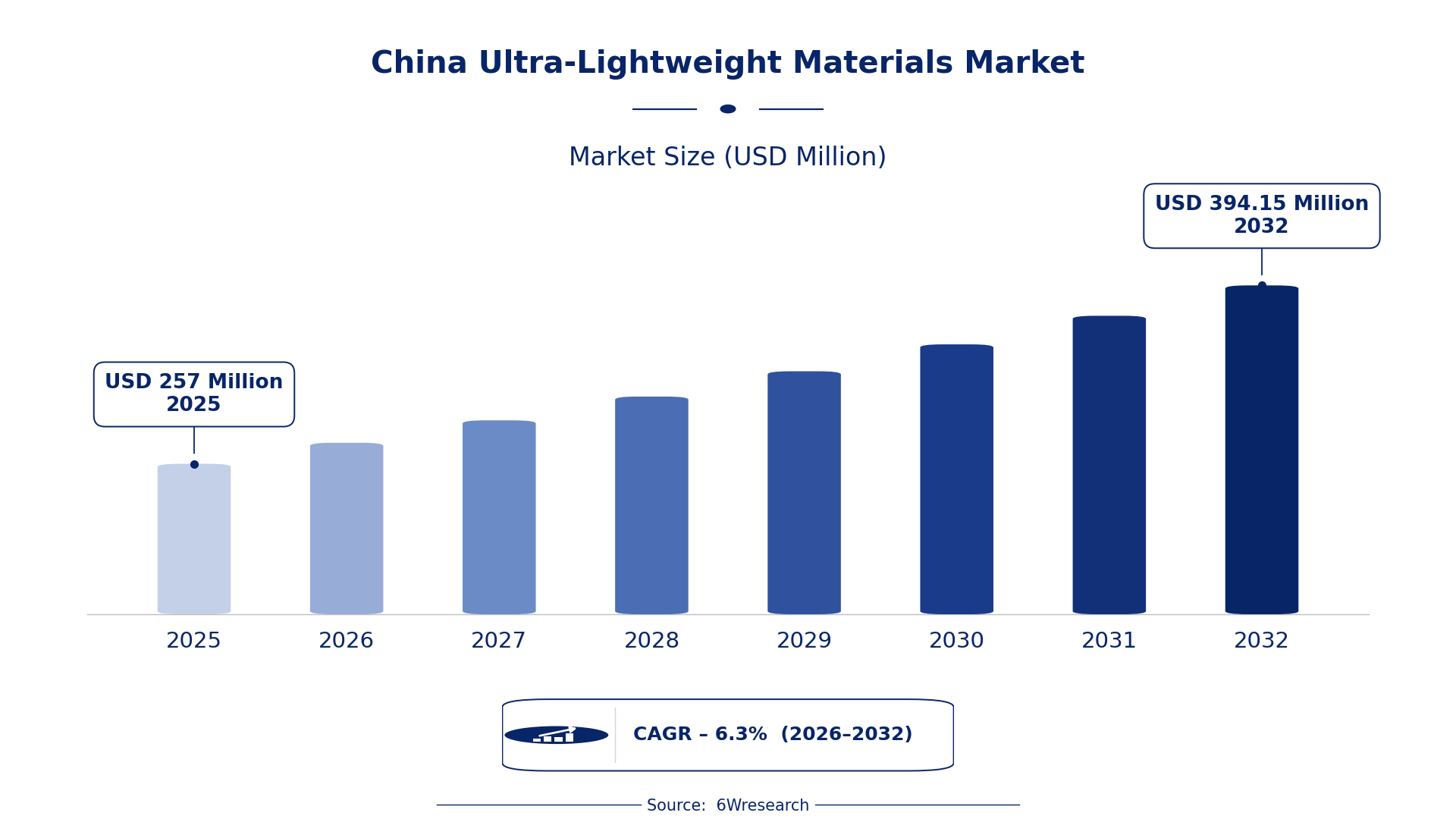
According to 6Wresearch internal database and industry insights, the China Ultra-Lightweight Materials Market was valued at USD 257.0 million in 2025 and is projected to reach USD 394.15 million by 2032, growing at a CAGR of approximately 6.3% during 2026–2032.
China Ultra-Lightweight Materials Market Highlights
| Report Metric | Details |
| Report Name | China Ultra-Lightweight Materials Market |
| Market Size 2025 | USD 257.0 million |
| Market Size 2032 | USD 394.15 million |
| Absolute Growth 2025–2032 | USD 137.15 million |
| CAGR 2026–2032 | 6.3% |
| Peak Annual Growth | 8.8% in 2029 |
| Forecast Period | 2026–2032 |
| Historical Data | 2022–2025 |
| Base Year | 2025 |
| Leading Material Type, 2025 | Carbon Fiber (39% share) |
| Leading Application Sector, 2025 | Aerospace (51% share) |
| Leading Form Type, 2025 | Composite Sheets (46% share) |
| Leading End User, 2025 | Aircraft OEMs (45% share) |
| Fastest-Growing Material Type | Magnesium Alloys (8.6% CAGR) |
| Fastest-Growing Application Sector | Automotive (8.9% CAGR) |
| Fastest-Growing Form Type | Structural Frames (8.7% CAGR) |
| Fastest-Growing End User | Car Manufacturers (7.7% CAGR) |
| Growing Sector | Aerospace |
| Key End Users | Aircraft OEMs, Car Manufacturers, Device Assemblers |
China Ultra-Lightweight Materials Market Year-wise Growth Rate and Key Drivers (2022–2032)
This graph illustrates the annual growth rates of the market from 2022 to 2032, highlighting a steady upward trajectory and projected market expansion over the forecast period.
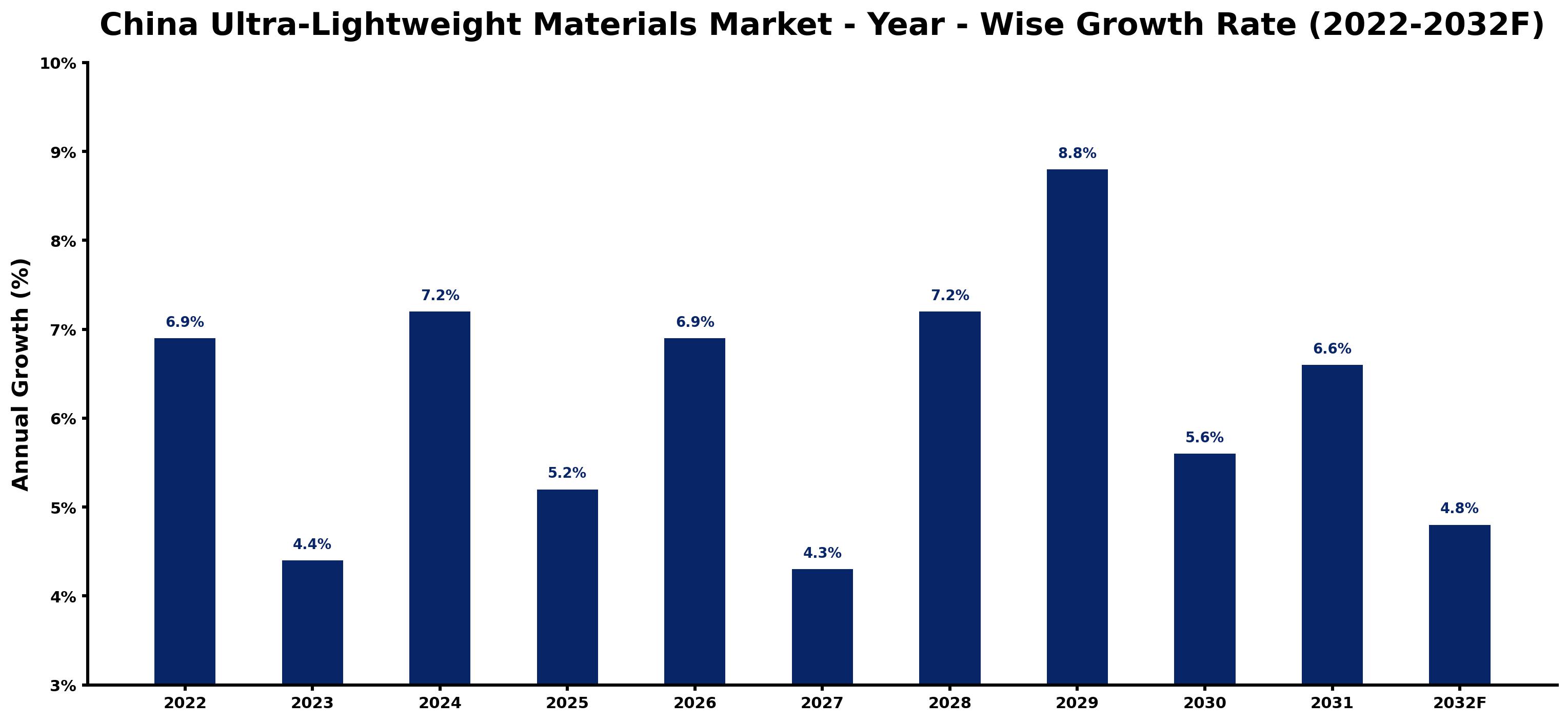
Annual growth estimates for each year appear below with the principal reason behind them, explaining the shifts that set the pace of the market.
| Year | Estimated Annual Growth (%) | Market Rationale |
| 2022 | 6.9 | The market experienced steady growth due to strong demand from the aerospace sector. |
| 2023 | 4.4 | Growth slowed as the automotive sector adjusted to the 'National Standard GB/T 33563-2017' for lightweight materials. |
| 2024 | 7.2 | Increased production capacity in the aerospace industry drove faster growth. |
| 2025 | 5.2 | Growth slowed again as demand stabilised following previous peaks in the automotive sector. |
| 2026 | 6.9 | Rising consumption of lightweight materials in automotive applications accelerated growth. |
| 2027 | 4.3 | Market growth slowed as manufacturers faced supply chain challenges in sourcing materials. |
| 2028 | 7.2 | Demand surged as aerospace projects ramped up production capabilities in the Beijing-Tianjin-Hebei region. |
| 2029 | 8.8 | The peak growth rate was achieved due to heightened investments in lightweight technologies. |
| 2030 | 5.6 | Growth slowed as the market began to normalise after rapid expansion in the automotive sector. |
| 2031 | 6.6 | Increased adoption of lightweight materials in automotive applications spurred growth. |
| 2032 | 4.8 | Growth slowed as the market reached a more stable phase. |
Note: Market size estimations and growth projections presented in this report are based on 6Wresearch's proprietary forecasting methodology, utilizing the latest available industry data, government publications, and primary research inputs.
China Ultra-Lightweight Materials Market Synopsis
The China Ultra-Lightweight Materials Market covers advanced composites designed to reduce weight while maintaining strength. These materials are primarily used in aerospace components, automotive parts, and consumer electronics. The market is expanding due to strong demand from the aerospace and automotive sectors, driven by initiatives like the 'Made in China 2025' programme. With China's aerospace industry projected to grow at a CAGR of 5.5% from 2023 to 2030, demand for ultra-lightweight materials is set to rise. The automotive sector is also expected to consume over 500,000 tons of lightweight materials by 2025, further contributing to market growth.
Market Dynamics Impact Analysis (2026–2032)
| Factor | Type | Impact | Primary Segment Affected |
| Strong demand from the aerospace sector due to ongoing projects and innovations. | Driver | High | Aerospace |
| Increasing automotive lightweighting initiatives to improve fuel efficiency. | Driver | High | Automotive |
| Rising investments in lightweight materials production technologies. | Opportunity | High | Composite Sheets |
| Growing consumer electronics market requiring lightweight components. | Opportunity | Medium | Thermoplastics |
| High production costs limiting accessibility for smaller manufacturers. | Restraint | High | Carbon Fiber |
| Regulatory compliance requirements increasing operational complexity. | Restraint | Medium | Magnesium Alloys |
| Supply chain disruptions affecting material availability and pricing. | Challenge | High | Lightweight Steel |
| Technological advancements outpacing current production capabilities. | Challenge | Medium | Structural Frames |
Evaluation of Drivers in China Ultra-Lightweight Materials Market (2026–2032)
Below mentioned are some major drivers and their influence on market dynamics.
| Drivers | Primary Segment Affected | Why It Matters (Evidence) |
| Growing demand from aerospace manufacturers for lightweight components. | Aerospace | The aerospace industry in China is expected to grow at a CAGR of 5.5% from 2023 to 2030, leading to increased purchases of ultra-lightweight materials. |
| Automotive lightweighting initiatives to enhance fuel efficiency. | Automotive | The automotive sector in China is projected to consume over 500,000 tons of lightweight materials by 2025, prompting manufacturers to increase their orders. |
| Investment in advanced lightweight material technologies. | Composite Sheets | China's investment in aerospace technology reached $15 billion in 2023, focusing on innovations in lightweight materials. |
| Consumer electronics market growth driving demand. | Thermoplastics | China's consumer electronics market is expected to reach 1.5 billion units by 2025, increasing the need for lightweight materials. |
| Support from government initiatives promoting lightweight materials. | Magnesium Alloys | The 'Made in China 2025' initiative launched in 2023 aims to enhance lightweight material production, boosting demand. |
The Ultra-Lightweight Materials market in China is growing on the back of rising end-use demand from the aerospace and automotive sectors, alongside a responsive supply chain. The aerospace industry is expanding, leading to increased purchases of ultra-lightweight materials, particularly from Aircraft OEMs. Investment in aerospace technology reached $15 billion in 2023, focusing on innovations that improve production capabilities. The automotive sector will consume over 500,000 tons of lightweight materials by 2025, prompting manufacturers to increase their orders. China's consumer electronics market is projected to reach 1.5 billion units by 2025, driving further demand for lightweight materials as manufacturers adapt to consumer preferences.
Evaluation of Restraints in China Ultra-Lightweight Materials Market
Below mentioned are some major restraints and their influence on market dynamics.
| Market Restraint | Primary Segment Affected | Why It Matters (Evidence) |
| High production costs limiting small manufacturers' market entry. | Carbon Fiber | China produced 1.2 million tons of carbon fiber in 2022, but high costs restrict smaller players from accessing this market. |
| Regulatory compliance increasing operational complexity for manufacturers. | Magnesium Alloys | The National Standard GB/T 33563-2017 governs testing, adding complexity for manufacturers in the magnesium alloys segment. |
| Supply chain disruptions affecting material availability. | Lightweight Steel | Recent supply chain issues hinder the construction sector's demand for lightweight steel, impacting availability. |
| Technological advancements requiring substantial investment. | Structural Frames | Manufacturers must invest heavily in new technologies to keep pace with innovations in lightweight material production. |
| Limited awareness of lightweight materials among potential users. | Thermoplastics | Despite growth in consumer electronics, many manufacturers remain unaware of the benefits of lightweight materials. |
China Ultra-Lightweight Materials Market Challenges
In China, the ultra-lightweight materials market encounters notable supply chain disruptions due to dependence on specific raw materials, which can delay production timelines for manufacturers and extend lead times by up to three months. A shortage of skilled workers in advanced composite technologies restricts producers' capacity to meet rising demand, potentially limiting output by 15%. Increasing raw material costs, influenced by global market fluctuations, have raised expenses for buyers, leading to price hikes of around 20% over the past year. Intense competition among local manufacturers has ignited price wars, squeezing profit margins for suppliers and forcing them to compromise on quality to maintain market share.
Trends in the China Ultra-Lightweight Materials Market
Buyers and suppliers in the China Ultra-Lightweight Materials Market are adjusting to the following trends.
- Launch of 'Made in China 2025' Initiative: In 2023, the 'Made in China 2025' initiative aims to boost lightweight material production across industries with a budget of $200 million, significantly increasing the development and adoption of ultra-lightweight materials.
- Shift towards Advanced Lightweight Technologies: China is increasingly adopting advanced lightweight technologies to improve production efficiency. The National Key R&D Program, initiated in 2020, supports innovative projects focusing on aerospace applications, enhancing the competitive edge of local manufacturers.
- Growth of Consumer Electronics Market: China's consumer electronics market is projected to reach 1.5 billion units by 2025, driving demand for lightweight materials. This shift is prompting manufacturers to incorporate ultra-lightweight materials into their products to meet consumer preferences.
- Expansion of Aerospace Manufacturing Hubs: The Beijing-Tianjin-Hebei region is becoming a key area for aerospace manufacturing, utilising ultra-lightweight materials extensively. This trend is expected to increase the demand for these materials as the aerospace sector continues to expand.
Investment Opportunities in the China Ultra-Lightweight Materials Market
Several openings in the China Ultra-Lightweight Materials Market merit attention from investors.
- Timing of Increased Investment: With China's investment in aerospace technology reaching $15 billion in 2023, there is a prime opportunity to supply ultra-lightweight materials to this expanding sector, particularly in the Beijing-Tianjin-Hebei region.
- Entry through Joint Ventures: Forming joint ventures with local manufacturers can facilitate entry into the Chinese market for lightweight materials, especially in the Guangdong province, a major manufacturing hub.
- Focus on Aerospace Components: The aerospace sector is growing rapidly, creating opportunities for suppliers of ultra-lightweight materials. Targeting Aircraft OEMs can lead to substantial contracts as demand escalates.
- Supply of Thermoplastics for Electronics: The burgeoning consumer electronics market presents an opportunity to supply thermoplastics, particularly in Zhejiang province, where advancements in lightweight materials are being prioritised.
Government Initiatives in the China Ultra-Lightweight Materials Market
In 2023, the Ministry of Industry and Information Technology launched the 'Advanced Manufacturing 2035' plan with a budget of $200 million to improve production efficiency and sustainability in the lightweight materials sector. This initiative supports manufacturers by providing funding for research and development projects. Additionally, the National Development and Reform Commission approved the 'Lightweight Materials Development Strategy' in 2022, targeting a 30% increase in production efficiency by 2025, further bolstering the industry.
The 'Lightweight Materials Innovation Fund' established in 2022 encourages private sector investment in advanced materials research and development. This fund supports projects that focus on innovative lightweight materials, offering financial assistance to manufacturers. The Ministry of Science and Technology is involved in the 'National Key R&D Program', which funds innovative lightweight material projects, particularly in aerospace applications, enhancing the capabilities of local producers.
Future Insight of the China Ultra-Lightweight Materials Market
By 2032, buyers and suppliers in the ultra-lightweight materials market will benefit from improved production capabilities due to the 'Made in China 2025' initiative and a $100 million budget allocated for research in lightweight materials. The Guangdong province is set to enhance manufacturing efficiency, leading to more streamlined supply chains. The implementation of ISO 9001:2015 standards will elevate product quality across the industry. As the automotive sector is projected to consume over 500,000 tons of lightweight materials by 2025, demand will continue to surge, driving innovation and growth.
Market Segmentation Analysis
The report offers a comprehensive study of the following market segments and their leading categories in the market.
By Material Type – Carbon Fiber Dominated, Magnesium Alloys Expected to Grow Fastest
According to Bhawna Singh, Assistant Manager at 6Wresearch, Carbon Fiber held a 39% share of the China Ultra-Lightweight Materials Market by material type in 2025. Carbon fiber leads China's ultra-lightweight materials market due to its indispensable role in high-performance applications such as aerospace and automotive. With 1.2 million tons produced in 2022, it remains the preferred choice for manufacturers aiming for superior strength-to-weight ratios. Magnesium Alloys are projected to grow fastest, at a CAGR of 8.6% during 2026–2032. Magnesium alloys are experiencing rapid adoption, particularly in the automotive sector, where they are favoured for their weight reduction capabilities and improved fuel efficiency. The automotive industry's anticipated consumption of over 500,000 tons of lightweight materials by 2025 highlights this accelerating trend. Suppliers should focus on developing magnesium alloys to align with the growing demand in the automotive sector.
By Application Sector – Aerospace Dominated, Automotive Expected to Grow Fastest
Aerospace took a 51% share of application sector in 2025, more than any other category. The aerospace sector commands the largest share of the ultra-lightweight materials market in China, primarily due to its critical role in aircraft manufacturing and components. The Beijing-Tianjin-Hebei region significantly contributes to this demand with its robust aerospace infrastructure. Over 2026–2032, Automotive is expected to post the fastest growth, at a CAGR of 8.9%. The automotive sector is the fastest-growing application for ultra-lightweight materials, driven by an increasing emphasis on vehicle lightweighting and performance enhancement. A notable 10% increase in lightweight material usage in vehicles in 2023 exemplifies this rapid growth. Buyers in the automotive sector should establish strategic collaborations with lightweight material suppliers to enhance vehicle efficiency.
By Form Type – Composite Sheets Dominated, Structural Frames Expected to Grow Fastest
In 2025, Composite Sheets led the form type split with a 46% share. Composite sheets dominate the market share for ultra-lightweight materials, as they are widely used across various applications for their lightweight properties. Their versatility makes them a preferred choice for many manufacturers in the aerospace and automotive sectors. The quickest growth will come from Structural Frames, forecast to expand at a CAGR of 8.7% between 2026 and 2032. Structural frames are the fastest-growing form type, particularly important in automotive and aerospace for maintaining structural integrity while reducing weight. This growth is driven by the increasing demand for efficient and durable components in these industries. Suppliers should invest in developing advanced structural frame solutions to meet the rising demand from manufacturers.
By End User – Aircraft OEMs Dominated, Car Manufacturers Expected to Grow Fastest
With a 45% revenue share in 2025, Aircraft OEMs was the largest end user category. Aircraft OEMs represent the largest share of the ultra-lightweight materials market in China, as they are major consumers for aircraft production. Their reliance on these materials for high-performance aircraft underscores the significance of this segment. Car Manufacturers are set to record the highest CAGR in this split, 7.7% over 2026–2032. Car manufacturers are the fastest-growing end users of ultra-lightweight materials, extensively utilising them to achieve vehicle lightweighting and improve overall performance. This trend showcases the automotive industry's dedication to enhancing fuel efficiency and reducing emissions. Suppliers should tailor their offerings to meet the specific needs of car manufacturers to capitalise on this expanding market.
Key Attractiveness of the Report
- 10 Years of Market Numbers
- Historical Data Starting from 2022 to 2025
- Base Year 2025
- Forecast Data until 2032
- Key Performance Indicators Impacting the Market
- Major Upcoming Developments and Projects
Key Highlights of the Report:
- China Ultra-Lightweight Materials Market Outlook
- Market Size of China Ultra-Lightweight Materials Market, 2025
- Forecast of China Ultra-Lightweight Materials Market, 2032
- Historical Data and Forecast of China Ultra-Lightweight Materials Revenues & Volume for the Period 2022 - 2032F
- China Ultra-Lightweight Materials Market Trend Evolution
- China Ultra-Lightweight Materials Market Drivers and Challenges
- China Ultra-Lightweight Materials Price Trends
- China Ultra-Lightweight Materials Porter's Five Forces
- China Ultra-Lightweight Materials Industry Life Cycle
- Historical Data and Forecast of China Ultra-Lightweight Materials Market Revenues & Volume By Material Type for the Period 2022 - 2032F
- Historical Data and Forecast of China Ultra-Lightweight Materials Market Revenues & Volume By Carbon Fiber for the Period 2022 - 2032F
- Historical Data and Forecast of China Ultra-Lightweight Materials Market Revenues & Volume By Magnesium Alloys for the Period 2022 - 2032F
- Historical Data and Forecast of China Ultra-Lightweight Materials Market Revenues & Volume By Thermoplastics for the Period 2022 - 2032F
- Historical Data and Forecast of China Ultra-Lightweight Materials Market Revenues & Volume By Lightweight Steel for the Period 2022 - 2032F
- Historical Data and Forecast of China Ultra-Lightweight Materials Market Revenues & Volume By Application Sector for the Period 2022 - 2032F
- Historical Data and Forecast of China Ultra-Lightweight Materials Market Revenues & Volume By Aerospace for the Period 2022 - 2032F
- Historical Data and Forecast of China Ultra-Lightweight Materials Market Revenues & Volume By Automotive for the Period 2022 - 2032F
- Historical Data and Forecast of China Ultra-Lightweight Materials Market Revenues & Volume By Consumer Electronics for the Period 2022 - 2032F
- Historical Data and Forecast of China Ultra-Lightweight Materials Market Revenues & Volume By Rail / Marine for the Period 2022 - 2032F
- Historical Data and Forecast of China Ultra-Lightweight Materials Market Revenues & Volume By Form Type for the Period 2022 - 2032F
- Historical Data and Forecast of China Ultra-Lightweight Materials Market Revenues & Volume By Composite Sheets for the Period 2022 - 2032F
- Historical Data and Forecast of China Ultra-Lightweight Materials Market Revenues & Volume By Structural Frames for the Period 2022 - 2032F
- Historical Data and Forecast of China Ultra-Lightweight Materials Market Revenues & Volume By Molded Components for the Period 2022 - 2032F
- Historical Data and Forecast of China Ultra-Lightweight Materials Market Revenues & Volume By Plates / Beams for the Period 2022 - 2032F
- Historical Data and Forecast of China Ultra-Lightweight Materials Market Revenues & Volume By End User for the Period 2022 - 2032F
- Historical Data and Forecast of China Ultra-Lightweight Materials Market Revenues & Volume By Aircraft OEMs for the Period 2022 - 2032F
- Historical Data and Forecast of China Ultra-Lightweight Materials Market Revenues & Volume By Car Manufacturers for the Period 2022 - 2032F
- Historical Data and Forecast of China Ultra-Lightweight Materials Market Revenues & Volume By Device Assemblers for the Period 2022 - 2032F
- Historical Data and Forecast of China Ultra-Lightweight Materials Market Revenues & Volume By Industrial Builders for the Period 2022 - 2032F
- China Ultra-Lightweight Materials Import Export Trade Statistics
- Market Opportunity Assessment By Material Type
- Market Opportunity Assessment By Application Sector
- Market Opportunity Assessment By Form Type
- Market Opportunity Assessment By End User
- China Ultra-Lightweight Materials Top Companies Market Share
- China Ultra-Lightweight Materials Competitive Benchmarking By Technical and Operational Parameters
- China Ultra-Lightweight Materials Company Profiles
- China Ultra-Lightweight Materials Key Strategic Recommendations
Market Covered
The report offers an extensive study of the following market segments.
By Material Type
- Carbon Fiber
- Magnesium Alloys
- Thermoplastics
- Lightweight Steel
By Application Sector
- Aerospace
- Automotive
- Consumer Electronics
- Rail / Marine
By Form Type
- Composite Sheets
- Structural Frames
- Molded Components
- Plates / Beams
By End User
- Aircraft OEMs
- Car Manufacturers
- Device Assemblers
- Industrial Builders































