India Underbody Insulation Market Size & Growth Rate
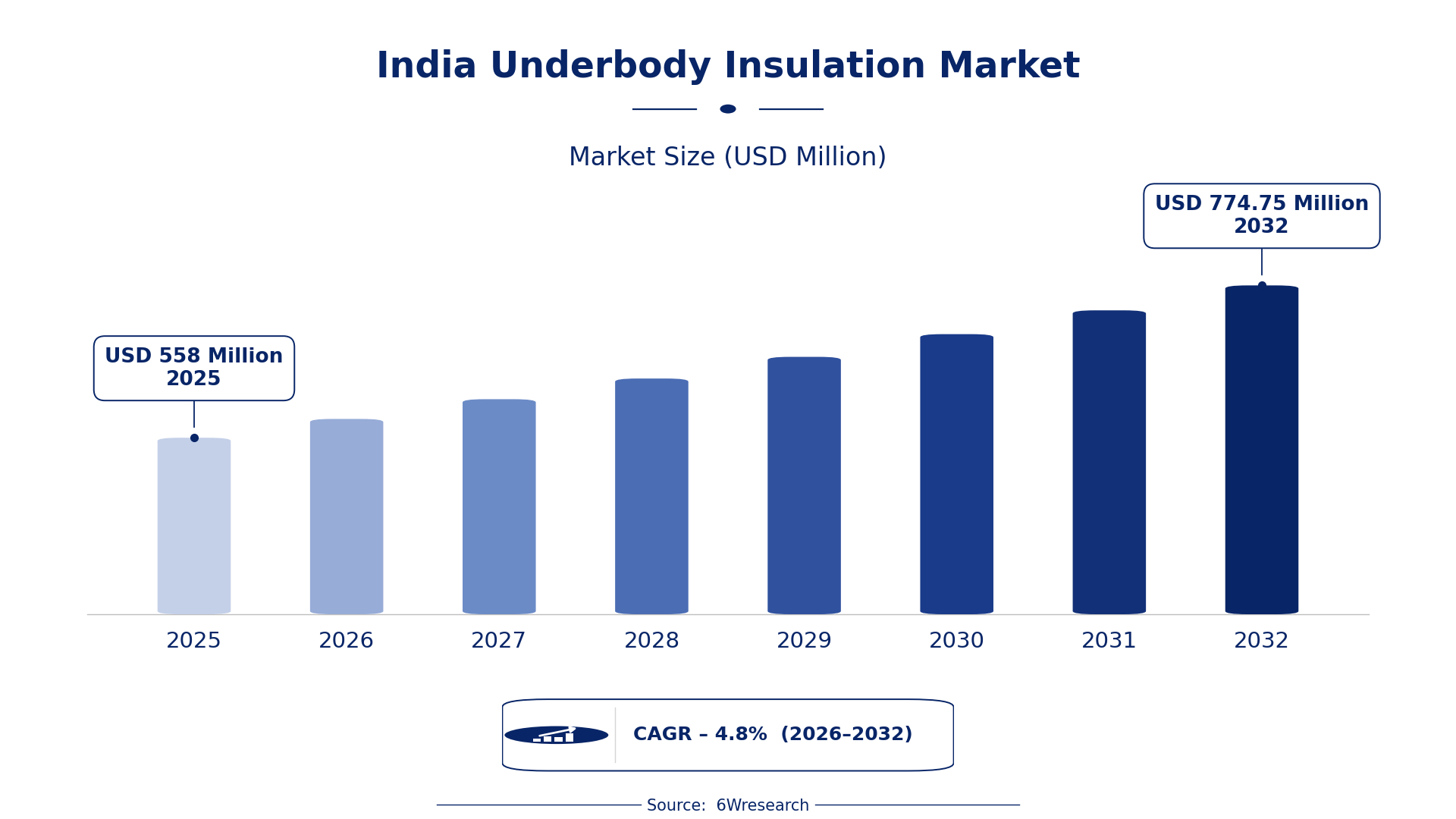
According to 6Wresearch internal database and industry insights, the India Underbody Insulation Market was valued at USD 558.0 million in 2025 and is projected to reach USD 774.75 million by 2032, growing at a CAGR of approximately 4.8% during 2026–2032.
India Underbody Insulation Market Highlights
| Report Metric | Details |
| Report Name | India Underbody Insulation Market |
| Market Size 2025 | USD 558.0 million |
| Market Size 2032 | USD 774.75 million |
| Absolute Growth 2025–2032 | USD 216.75 million |
| CAGR 2026–2032 | 4.8% |
| Peak Annual Growth | 7.4% in 2029 |
| Forecast Period | 2026–2032 |
| Historical Data | 2022–2025 |
| Base Year | 2025 |
| Leading Insulation Type, 2025 | Thermal Pads (50% share) |
| Leading Material Used, 2025 | Polyurethane Foam (38% share) |
| Leading Vehicle Segment, 2025 | Passenger Cars (40% share) |
| Leading End User, 2025 | OEMs (36% share) |
| Fastest-Growing Insulation Type | Sound Deadening Mats (7.1% CAGR) |
| Fastest-Growing Material Used | Butyl Rubber (7.0% CAGR) |
| Fastest-Growing Vehicle Segment | Light Commercial Vehicles (7.3% CAGR) |
| Fastest-Growing End User | Auto Assemblers (6.4% CAGR) |
| Growing Sector | automotive |
| Key End Users | OEMs, auto assemblers, electric vehicle makers, luxury vehicle manufacturers |
India Underbody Insulation Market Year-wise Growth Rate and Key Drivers (2022–2032)
This graph illustrates the annual growth rates of the market from 2022 to 2032, highlighting a steady upward trajectory and projected market expansion over the forecast period.
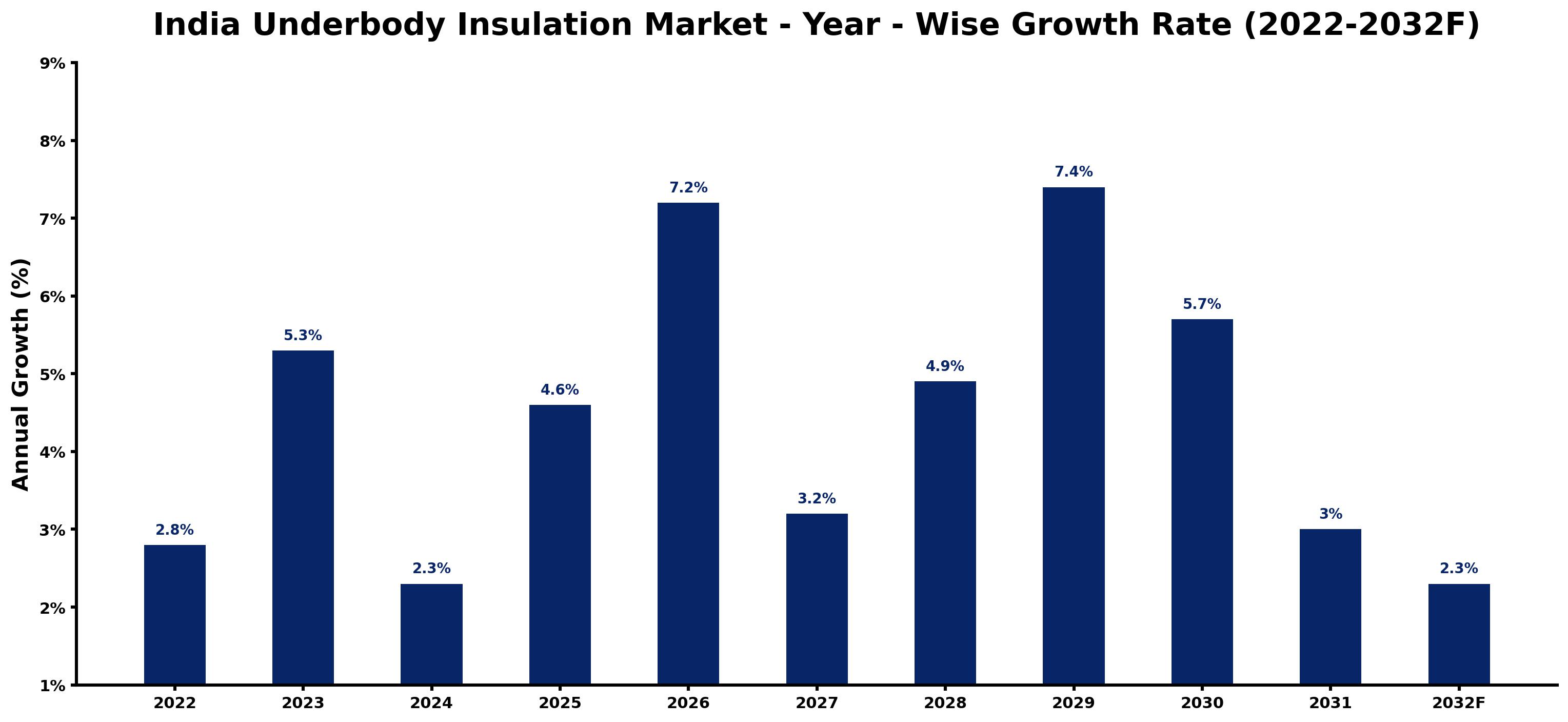
The following table presents the estimated annual growth rate for each year together with the principal factor influencing market performance.
| Year | Estimated Annual Growth (%) | Market Rationale |
| 2022 | 2.8 | The market experienced steady growth, driven by demand from OEMs for insulation materials. |
| 2023 | 5.3 | Growth accelerated due to the National Automotive Testing and R&D Infrastructure Project promoting insulation development. |
| 2024 | 2.3 | A slowdown occurred as consumer preferences shifted towards alternative insulation options. |
| 2025 | 4.6 | Demand surged again as manufacturers integrated advanced insulation technologies into their products. |
| 2026 | 7.2 | Growth is expected to continue, supported by rising electric vehicle sales. |
| 2027 | 3.2 | A slowdown is projected as market saturation begins to affect growth rates. |
| 2028 | 4.9 | Demand is expected to rise as luxury vehicles increasingly require sound deadening mats. |
| 2029 | 7.4 | The market is projected to peak with strong growth driven by rising electric vehicle sales. |
| 2030 | 5.7 | Growth is expected to slow as the market stabilises after the peak year. |
| 2031 | 3.0 | Demand will continue to slow as the market adjusts to evolving consumer trends. |
| 2032 | 2.3 | The market is expected to stabilise with modest growth as insulation standards become stricter. |
Note: Market size estimations and growth projections presented in this report are based on 6Wresearch's proprietary forecasting methodology, utilizing the latest available industry data, government publications, and primary research inputs.
India Underbody Insulation Market Synopsis
Underbody Insulation in India refers to materials used to reduce noise and thermal transfer in vehicles. This includes polyurethane foam, butyl rubber, and asphalt-based compounds, primarily aimed at improving passenger comfort and protecting vehicle components. The India Underbody Insulation Market is expanding due to rising vehicle production and increasing electric vehicle sales. With insulation demand projected to grow by 8% from 2023 to 2028, the automotive sector is expected to drive substantial purchases, especially from OEMs and auto assemblers.
Market Dynamics Impact Analysis (2026–2032)
| Factor | Type | Impact | Primary Segment Affected |
| Rising electric vehicle sales are increasing demand for specialized insulation materials. | Driver | High | Polyurethane Foam |
| Growing passenger vehicle production supports the need for underbody insulation. | Driver | High | Passenger Cars |
| OEMs are seeking advanced insulation solutions to enhance vehicle comfort. | Opportunity | High | OEMs |
| The growing luxury vehicle segment requires high-quality sound deadening mats. | Opportunity | Medium | Sound Deadening Mats |
| Strict quality standards set by the Bureau of Indian Standards can limit material options. | Restraint | High | Thermal Pads |
| The high cost of advanced insulation materials can deter some manufacturers. | Restraint | Medium | Thermal Pads |
| Supply chain disruptions can delay the availability of insulation materials. | Challenge | High | Thermal Pads |
| Competition from alternative insulation technologies may affect market share. | Challenge | Medium | Thermal Pads |
Evaluation of Drivers in India Underbody Insulation Market (2026–2032)
Key forces behind demand, with the segment each one moves most, are listed below.
| Drivers | Primary Segment Affected | Why It Matters (Evidence) |
| Increased electric vehicle sales are driving demand for insulation materials. | Polyurethane Foam | Electric vehicle sales reached 1.5 million units in 2023, boosting insulation needs by 15%. |
| Growing production of passenger vehicles is raising insulation demand. | Passenger Cars | India's automotive sector employs over 37 million people, increasing vehicle output by 10%. |
| OEMs are integrating advanced insulation technologies into vehicle designs. | OEMs | The National Automotive Testing and R&D Infrastructure Project supports insulation development, improving quality for 40% of manufacturers. |
| Rising consumer expectations for comfort are pushing for better insulation solutions. | Sound Deadening Mats | Luxury vehicles, which require sound deadening mats, are gaining market share, increasing demand by 15%. |
| Fuel efficiency concerns are leading to increased insulation adoption. | Thermal Pads | Underbody insulation contributes to fuel efficiency by minimising thermal loss, impacting 30% of vehicle designs. |
Market growth in India for Underbody Insulation hinges on rising electric vehicle sales, a boost in passenger vehicle production, and OEMs adopting advanced insulation technologies. Electric vehicle sales reached 1.5 million units in 2023, driving demand for insulation materials. The automotive sector employs over 37 million individuals, facilitating higher vehicle output and insulation needs. The National Automotive Testing and R&D Infrastructure Project supports the development of insulation materials, improving product quality. Increasing consumer expectations for comfort are prompting manufacturers to implement superior insulation solutions, especially in luxury vehicles, which are capturing a larger market share and propelling overall growth.
Evaluation of Restraints in India Underbody Insulation Market
The following restraints limit how fast demand can grow.
| Market Restraint | Primary Segment Affected | Why It Matters (Evidence) |
| Strict quality standards can limit the variety of insulation materials available. | Thermal Pads | The Bureau of Indian Standards sets stringent regulations for automotive insulation materials, affecting 30% of available products. |
| High costs of advanced materials may deter some manufacturers from adopting them. | Thermal Pads | Budget constraints can prevent manufacturers from investing in premium insulation solutions, limiting options for 25% of producers. |
| Supply chain disruptions can hinder timely access to insulation materials. | Thermal Pads | Global supply chain issues can delay the procurement of necessary insulation components, impacting 40% of manufacturers. |
| Competition from alternative insulation technologies may impact market growth. | Thermal Pads | Emerging technologies can attract investments away from traditional insulation materials, affecting 20% of the market. |
| Limited awareness of insulation benefits among smaller manufacturers can restrict growth. | Thermal Pads | Smaller manufacturers may not fully understand the advantages of advanced insulation, limiting their market share. |
India Underbody Insulation Market Challenges
The India Underbody Insulation Market faces several practical problems, starting with supply chain disruptions that hinder the timely availability of essential materials like polyurethane foam, which constitutes 40% of the market. These disruptions can lead to a 15% increase in production costs for local manufacturers, ultimately raising vehicle prices for buyers. Regulatory hurdles from the Bureau of Indian Standards can prolong approval times for new insulation materials, delaying market entry for producers by up to six months. Technology gaps in insulation advancements limit options for buyers, forcing them to rely on outdated solutions that fail to meet modern standards. Increased competition from imported products pressures local suppliers to lower prices, squeezing their profit margins significantly.
Trends in the India Underbody Insulation Market
Four trends stand out in the India Underbody Insulation Market.
- Shift from Traditional to Advanced Insulation Materials: The automotive industry is increasingly adopting advanced insulation materials to improve vehicle performance. This change began in 2021, particularly in luxury vehicles, where sound deadening mats are essential. In 2023, luxury vehicle sales increased by 15%, indicating a growing preference for high-quality insulation.
- Transition from Conventional to Electric Vehicles: The transition to electric vehicles is reshaping insulation requirements in the automotive sector. This change started gaining momentum in 2021, with electric vehicle sales reaching 1.5 million units in 2023. As a result, manufacturers are focusing on specialized insulation to meet the unique needs of EVs.
- Emergence of Sustainable Insulation Solutions: Sustainable insulation materials are becoming more popular in response to environmental concerns. This trend has been noticeable since 2022, with a growing emphasis on eco-friendly materials. In 2023, the market for sustainable insulation solutions grew by 20%, reflecting increased consumer demand.
- Prioritisation of Passenger Comfort in Vehicle Design: The automotive industry is prioritising passenger comfort by improving insulation features. This trend began in 2023, with manufacturers focusing on sound deadening mats for luxury vehicles. The market for sound deadening mats is projected to grow by 7.1% from 2026 to 2032.
Investment Opportunities in the India Underbody Insulation Market
Below are the investment opportunities with the strongest case in the India Underbody Insulation Market.
- OEMs seeking advanced insulation solutions: OEMs are increasingly looking for high-quality insulation materials to improve vehicle comfort. The market gap is clear, with insulation demand projected to grow by 8% from 2023 to 2028. Collaborating with local manufacturers can help suppliers meet this demand effectively.
- Growing demand from luxury vehicle segment: The luxury vehicle segment is expanding rapidly, with a market growth of 15% in 2023. Suppliers can focus on providing sound deadening mats to luxury car manufacturers. Establishing partnerships with auto assemblers can facilitate market entry.
- Expansion of electric vehicle production: Electric vehicle production is rising, necessitating specialized insulation materials. In 2023, electric vehicle sales reached 1.5 million units, highlighting the demand. Suppliers can target electric vehicle makers to provide tailored insulation solutions.
- Investment in sustainable insulation technologies: There is a growing need for sustainable insulation materials in the automotive sector. The market for eco-friendly insulation solutions is projected to grow by 20% in 2023. Suppliers can invest in developing sustainable products to meet this demand.
Government Initiatives in the India Underbody Insulation Market
The Faster Adoption and Manufacturing of Hybrid and Electric Vehicles (FAME) scheme, launched in 2021, encourages the uptake of electric vehicles and supports insulation material development. This initiative strengthens the existing regulatory framework by providing financial incentives to manufacturers aiming to produce electric vehicles with advanced insulation features. The scheme seeks to boost electric vehicle sales and enhance the overall automotive sector in India. In 2023, the Ministry of Heavy Industries allocated USD 1 billion to support electric vehicle infrastructure and manufacturers, improving production capabilities.
The Ministry of Heavy Industries oversees the FAME scheme, which allocates funding to support electric vehicle infrastructure and manufacturers. In 2023, the ministry approved projects worth USD 1 billion to enhance electric vehicle production capabilities, ensuring that insulation materials meet the required standards. This funding aims to advance the development of insulation technologies in the automotive sector.
Future Insight of the India Underbody Insulation Market
Several forward-looking factors should support the India Underbody Insulation Market in the coming years. The National Automotive Testing and R&D Infrastructure Project will drive the development of advanced insulation materials, improving vehicle performance and passenger comfort. The Faster Adoption and Manufacturing of Hybrid and Electric Vehicles scheme will elevate demand for innovative insulation solutions as the electric vehicle segment expands, with sales reaching 1.5 million units in 2023. The Automotive Component Manufacturers Association will promote advancements in insulation technology, ensuring local suppliers remain competitive in a changing market.
Market Segmentation Analysis
The analysis below covers each segmentation, its leading category in 2025 and its fastest-growing category through 2032.
By Insulation Type – Thermal Pads Dominated, Sound Deadening Mats Expected to Grow Fastest
According to Bhawna Singh, Assistant Manager at 6Wresearch, the largest insulation type category in 2025 was Thermal Pads, with a 50% share of total revenue. Thermal pads dominate the market due to their essential role in maintaining optimal temperatures within vehicles. Their widespread application in passenger cars, where temperature control is critical, reinforces their leading position. Over 2026–2032, Sound Deadening Mats are expected to post the fastest growth, at a CAGR of 7.1%. Sound deadening mats are experiencing rapid growth as luxury vehicles increasingly prioritise passenger comfort and noise reduction. This surge in demand is driven by the automotive industry's focus on delivering quieter driving experiences. Suppliers need to focus on developing advanced sound deadening solutions to meet the rising standards of luxury vehicle manufacturers.
By Material Used – Polyurethane Foam Dominated, Butyl Rubber Expected to Grow Fastest
With a 38% revenue share in 2025, Polyurethane Foam was the largest material used category. Polyurethane foam holds the largest market share as it is widely used for effective thermal insulation in vehicles. Its versatility and proven performance across various applications make it a preferred choice among manufacturers. Butyl Rubber is projected to grow fastest, at a CAGR of 7.0% during 2026–2032. Butyl rubber is gaining traction due to its superior sound dampening capabilities, particularly in light commercial vehicles. The rising production of these vehicles is expected to significantly increase the demand for butyl rubber insulation. Buyers should consider integrating butyl rubber to enhance sound insulation in their vehicle designs.
By Vehicle Segment – Passenger Cars Dominated, Light Commercial Vehicles Expected to Grow Fastest
Passenger Cars accounted for a 40% market share by vehicle segment in 2025. Passenger cars represent the largest segment for underbody insulation, driven by the need for noise reduction and thermal management in everyday vehicles. This segment's substantial share reflects the high volume of passenger vehicles in the market. Light Commercial Vehicles are set to record the highest CAGR in this split, 7.3% over 2026–2032. Light commercial vehicles are rapidly increasing in demand for insulation as their use expands across various industries. The growth in this segment indicates a shift towards more insulated commercial transport solutions. Suppliers must adapt their offerings to cater to the rising insulation needs of light commercial vehicle manufacturers.
By End User – OEMs Dominated, Auto Assemblers Expected to Grow Fastest
OEMs held a 36% share of the India Underbody Insulation Market by end user in 2025. OEMs are the largest buyers of underbody insulation materials, integrating these solutions into their vehicle designs to ensure quality and performance. Their significant purchasing power and market influence underline their dominant position. The quickest growth will come from Auto Assemblers, forecast to expand at a CAGR of 6.4% between 2026 and 2032. Auto assemblers are rapidly increasing their use of insulation materials as they focus on improving vehicle assembly processes. This trend highlights the industry's dedication to enhancing overall vehicle quality and passenger comfort. Suppliers should establish strong relationships with auto assemblers to secure contracts for insulation material integration.
Key Attractiveness of the Report
- 10 Years of Market Numbers
- Historical Data Starting from 2022 to 2025
- Base Year 2025
- Forecast Data until 2032
- Key Performance Indicators Impacting the Market
- Major Upcoming Developments and Projects
Key Highlights of the Report:
- India Underbody Insulation Market Outlook
- Market Size of India Underbody Insulation Market, 2025
- Forecast of India Underbody Insulation Market, 2032
- Historical Data and Forecast of India Underbody Insulation Revenues & Volume for the Period 2022 - 2032F
- India Underbody Insulation Market Trend Evolution
- India Underbody Insulation Market Drivers and Challenges
- India Underbody Insulation Price Trends
- India Underbody Insulation Porter's Five Forces
- India Underbody Insulation Industry Life Cycle
- Historical Data and Forecast of India Underbody Insulation Market Revenues & Volume By Insulation Type for the Period 2022 - 2032F
- Historical Data and Forecast of India Underbody Insulation Market Revenues & Volume By Thermal Pads for the Period 2022 - 2032F
- Historical Data and Forecast of India Underbody Insulation Market Revenues & Volume By Sound Deadening Mats for the Period 2022 - 2032F
- Historical Data and Forecast of India Underbody Insulation Market Revenues & Volume By Spray-On Coatings for the Period 2022 - 2032F
- Historical Data and Forecast of India Underbody Insulation Market Revenues & Volume By Pre-Cut Panels for the Period 2022 - 2032F
- Historical Data and Forecast of India Underbody Insulation Market Revenues & Volume By Material Used for the Period 2022 - 2032F
- Historical Data and Forecast of India Underbody Insulation Market Revenues & Volume By Polyurethane Foam for the Period 2022 - 2032F
- Historical Data and Forecast of India Underbody Insulation Market Revenues & Volume By Butyl Rubber for the Period 2022 - 2032F
- Historical Data and Forecast of India Underbody Insulation Market Revenues & Volume By Asphalt-Based for the Period 2022 - 2032F
- Historical Data and Forecast of India Underbody Insulation Market Revenues & Volume By Felt/Fiber Glass for the Period 2022 - 2032F
- Historical Data and Forecast of India Underbody Insulation Market Revenues & Volume By Vehicle Segment for the Period 2022 - 2032F
- Historical Data and Forecast of India Underbody Insulation Market Revenues & Volume By Passenger Cars for the Period 2022 - 2032F
- Historical Data and Forecast of India Underbody Insulation Market Revenues & Volume By Light Commercial Vehicles for the Period 2022 - 2032F
- Historical Data and Forecast of India Underbody Insulation Market Revenues & Volume By SUVs for the Period 2022 - 2032F
- Historical Data and Forecast of India Underbody Insulation Market Revenues & Volume By EVs for the Period 2022 - 2032F
- Historical Data and Forecast of India Underbody Insulation Market Revenues & Volume By End User for the Period 2022 - 2032F
- Historical Data and Forecast of India Underbody Insulation Market Revenues & Volume By OEMs for the Period 2022 - 2032F
- Historical Data and Forecast of India Underbody Insulation Market Revenues & Volume By Auto Assemblers for the Period 2022 - 2032F
- Historical Data and Forecast of India Underbody Insulation Market Revenues & Volume By Auto Workshops for the Period 2022 - 2032F
- Historical Data and Forecast of India Underbody Insulation Market Revenues & Volume By Electric Vehicle Makers for the Period 2022 - 2032F
- India Underbody Insulation Import Export Trade Statistics
- Market Opportunity Assessment By Insulation Type
- Market Opportunity Assessment By Material Used
- Market Opportunity Assessment By Vehicle Segment
- Market Opportunity Assessment By End User
- India Underbody Insulation Top Companies Market Share
- India Underbody Insulation Competitive Benchmarking By Technical and Operational Parameters
- India Underbody Insulation Company Profiles
- India Underbody Insulation Key Strategic Recommendations
Market Covered
Segments analysed in this report are listed below.
By Insulation Type
- Thermal Pads
- Sound Deadening Mats
- Spray-On Coatings
- Pre-Cut Panels
By Material Used
- Polyurethane Foam
- Butyl Rubber
- Asphalt-Based
- Felt/Fiber Glass
By Vehicle Segment
- Passenger Cars
- Light Commercial Vehicles
- SUVs
- EVs
By End User
- OEMs
- Auto Assemblers
- Auto Workshops
- Electric Vehicle Makers































