India Urban Agriculture Market Size & Growth Rate
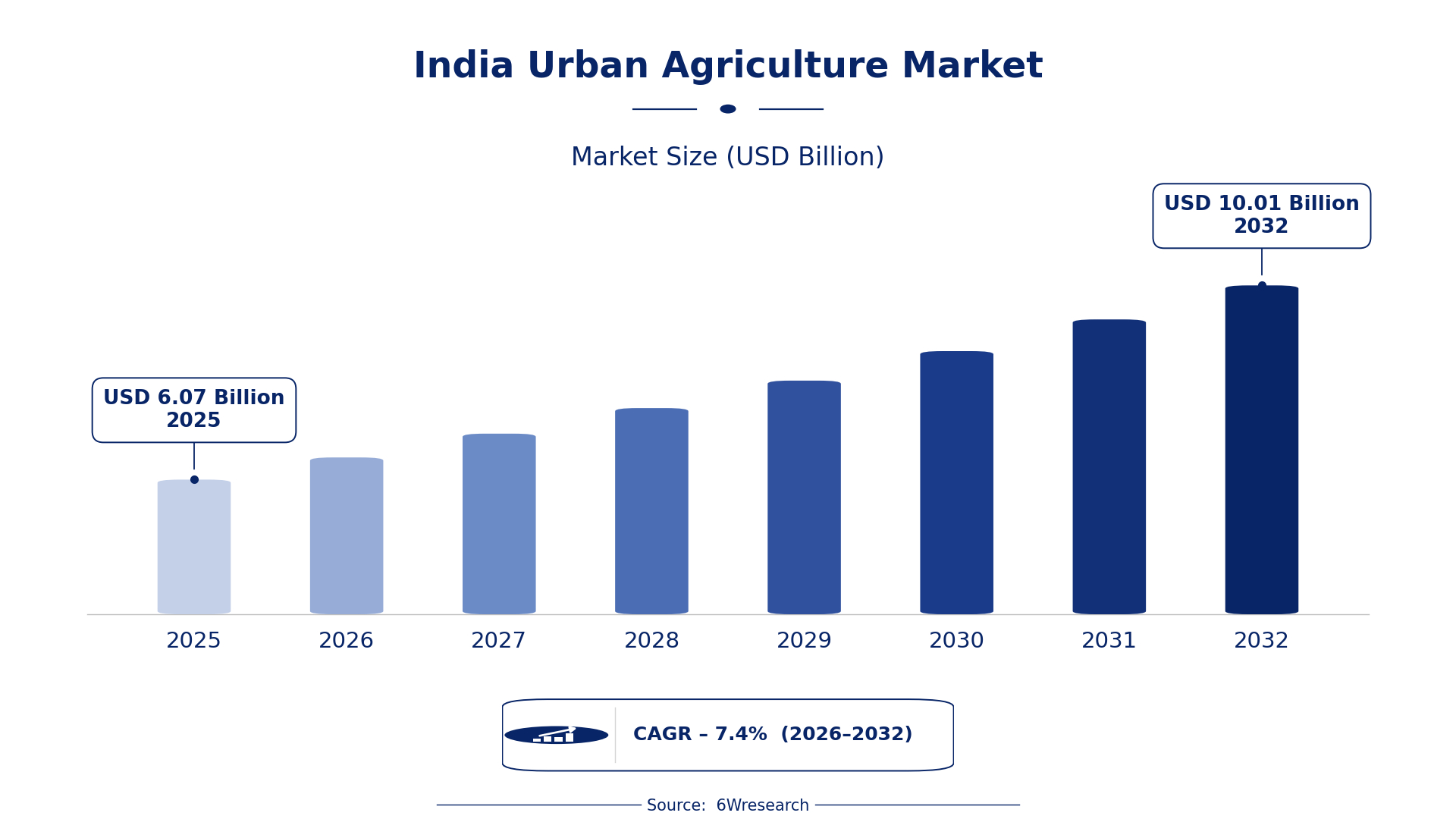
According to 6Wresearch internal database and industry insights, the India Urban Agriculture Market was valued at USD 6.07 billion in 2025 and is projected to reach USD 10.01 billion by 2032, growing at a CAGR of approximately 7.4% during 2026–2032.
India Urban Agriculture Market Highlights
| Report Metric | Details |
| Report Name | India Urban Agriculture Market |
| Market Size 2025 | USD 6.07 billion |
| Market Size 2032 | USD 10.01 billion |
| Absolute Growth 2025–2032 | USD 3.94 billion |
| CAGR 2026–2032 | 7.4% |
| Peak Annual Growth | 9.4% in 2030 |
| Forecast Period | 2026–2032 |
| Historical Data | 2022–2025 |
| Base Year | 2025 |
| Leading Farming Type, 2025 | Indoor Vertical Farms (46% share) |
| Leading Growing Technique, 2025 | Hydroponics (55% share) |
| Leading Output Category, 2025 | Leafy Greens (34% share) |
| Leading End User, 2025 | Urban Farmers (46% share) |
| Fastest-Growing Growing Technique | IoT-Controlled (9.9% CAGR) |
| Fastest-Growing Output Category | Herbs & Microgreens (8.8% CAGR) |
| Fastest-Growing End User | Restaurants (9.6% CAGR) |
| Growing Sector | Urban Agriculture |
| Key End Users | Urban Farmers, Restaurants, NGOs & Cooperatives, Retailers |
India Urban Agriculture Market Year-wise Growth Rate and Key Drivers (2022–2032)
This graph illustrates the annual growth rates of the market from 2022 to 2032, highlighting a steady upward trajectory and projected market expansion over the forecast period.
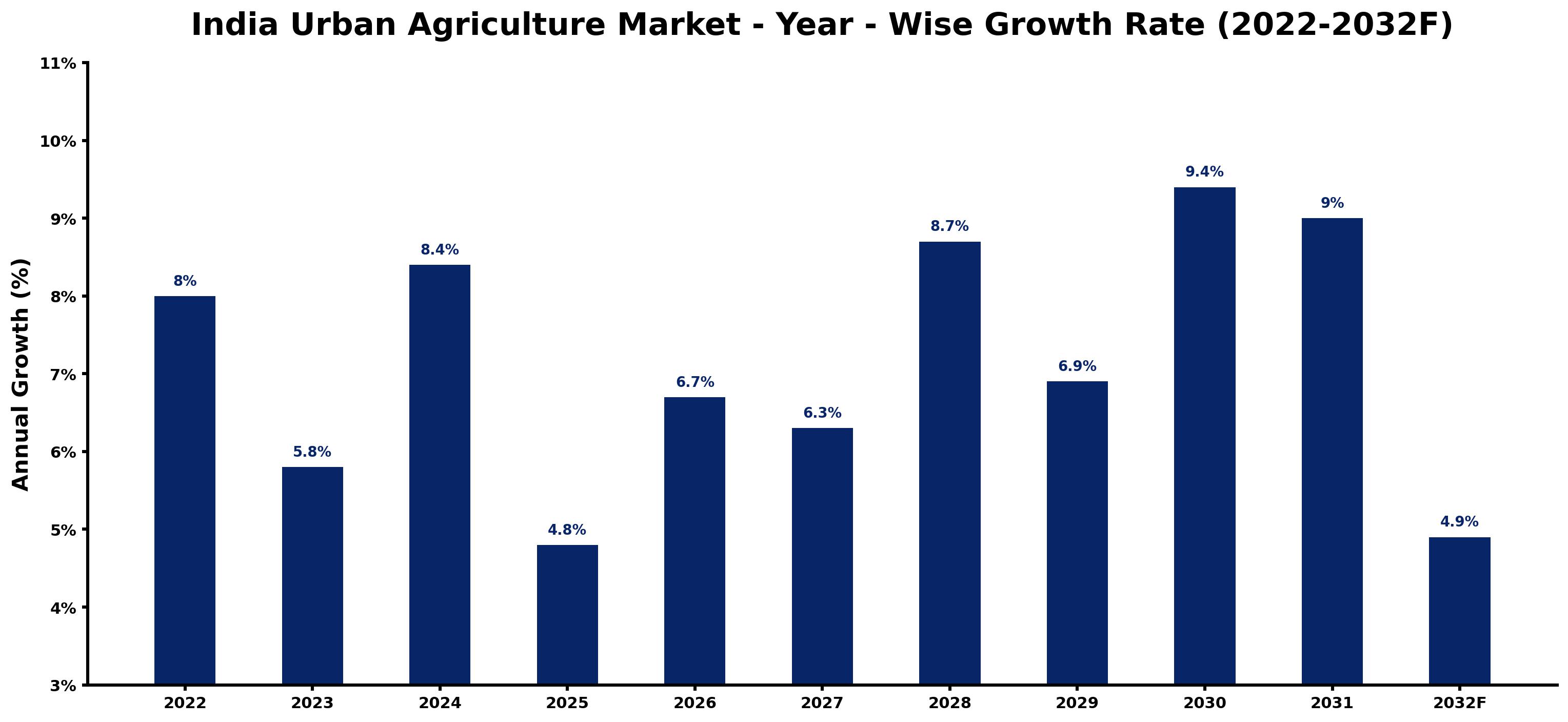
Year by year, the estimates below pair each growth rate with the development that shaped it.
| Year | Estimated Annual Growth (%) | Market Rationale |
| 2022 | 8.0 | The market experienced steady growth due to the Urban Farming Initiative promoting urban food production. |
| 2023 | 5.8 | Urban farmers faced challenges in accessing hydroponics technology and resources, slowing growth. |
| 2024 | 8.4 | Demand surged with the rise of community gardens, supported by local NGOs and urban farming initiatives. |
| 2025 | 4.8 | Changing consumer preferences affected urban farming strategies, leading to slower growth. |
| 2026 | 6.7 | Investment in hydroponics technology is expected to spur growth as urban farmers adopt new methods. |
| 2027 | 6.3 | Urban farmers encounter supply chain disruptions and resource limitations, slowing growth. |
| 2028 | 8.7 | Increased interest in sustainable practices and local food sourcing is expected to boost the market. |
| 2029 | 6.9 | Urban farmers face challenges in effectively scaling operations, leading to slower growth. |
| 2030 | 9.4 | Peak growth will be driven by the Urban Farming Initiative, which promotes urban food production. |
| 2031 | 9.0 | Market dynamics stabilise amidst evolving consumer habits, resulting in slower growth. |
| 2032 | 4.9 | Urban agriculture is projected to grow steadily as it becomes integral to city planning. |
Note: Market size estimations and growth projections presented in this report are based on 6Wresearch's proprietary forecasting methodology, utilizing the latest available industry data, government publications, and primary research inputs.
India Urban Agriculture Market Synopsis
Urban Agriculture in India involves cultivating food within urban areas using techniques like rooftop farming and hydroponics. This approach provides fresh produce and improves food security while promoting sustainability. The India Urban Agriculture Market is expanding due to rising urban populations and initiatives like the Urban Farming Initiative launched in 2021. Increased investment in technology and growing interest from urban farmers further drive demand.
Market Dynamics Impact Analysis (2026–2032)
| Factor | Type | Impact | Primary Segment Affected |
| Investment in hydroponics technology is increasing demand for efficient urban farming methods. | Driver | High | Hydroponics |
| The rise of community gardens fosters local engagement and food production. | Driver | High | Community Gardens |
| Urban farmers are seeking efficient growing techniques to maximise yields in limited spaces. | Opportunity | High | Indoor Vertical Farms |
| The growing interest in organic produce opens avenues for new market entrants. | Opportunity | Medium | Organic Soil-Based |
| Limited access to funding hampers the growth of urban agriculture initiatives. | Restraint | High | Urban Farmers |
| Supply chain disruptions impact the availability of essential farming inputs. | Restraint | Medium | Hydroponics |
| High operational costs can deter new entrants into urban agriculture. | Challenge | High | Indoor Vertical Farms |
| Regulatory hurdles slow down the approval processes for urban farming projects. | Challenge | Medium | Community Gardens |
Evaluation of Drivers in India Urban Agriculture Market (2026–2032)
The main growth drivers and the segments they affect most are set out below.
| Drivers | Primary Segment Affected | Why It Matters (Evidence) |
| Increased investment in hydroponics technology drives production efficiency. | Hydroponics | Numerous startups focusing on hydroponics are driving demand for urban farming solutions. |
| The popularity of community gardens encourages local food production and engagement. | Community Gardens | Community gardens have increased by 30% since 2020, reflecting growing urban interest. |
| Urban farmers are adopting vertical farming to maximise limited urban space. | Indoor Vertical Farms | Indoor vertical farms are projected to hold a 46% market share by 2025. |
| The demand for fresh, organic produce is rising among urban consumers. | Organic Soil-Based | Over 60% of urban farmers report using organic methods, aligning with health trends. |
| Government initiatives provide financial support to urban farmers. | Urban Farmers | The 'Pradhan Mantri Kisan Samman Nidhi' scheme supports urban farmers financially. |
Market growth for Urban Agriculture in India is underpinned by increased investment in hydroponics technology and rising demand for fresh produce among urban consumers. Numerous startups focusing on hydroponics are driving demand for urban farming solutions, with the hydroponics segment projected to hold a 55% market share by 2025. The popularity of community gardens encourages local food production and engagement, with a notable increase in such gardens since 2020. Urban farmers are adopting vertical farming to maximise limited urban space, with indoor vertical farms expected to play a crucial role in the market.
Evaluation of Restraints in India Urban Agriculture Market
The main factors holding the market back are set out below.
| Market Restraint | Primary Segment Affected | Why It Matters (Evidence) |
| Limited access to funding hampers the growth of urban agriculture initiatives. | Urban Farmers | Many urban farmers struggle to secure financing for their projects, affecting scalability. |
| Supply chain disruptions impact the availability of essential farming inputs. | Hydroponics | Urban farmers face challenges in sourcing materials, delaying production timelines. |
| High operational costs can deter new entrants into urban agriculture. | Indoor Vertical Farms | The initial investment for setting up vertical farms can be prohibitively expensive. |
| Regulatory hurdles slow down the approval processes for urban farming projects. | Community Gardens | Complex approval processes can delay the establishment of community gardens. |
| Market competition may limit profitability for small urban farmers. | Organic Soil-Based | Increasing competition among local producers can drive prices down. |
India Urban Agriculture Market Challenges
Urban agriculture in India faces significant technological hurdles, as many farmers rely on outdated methods, leading to crop yield delays and reduced productivity. Regulatory challenges also create obstacles, with local zoning laws often taking up to six months for approval, hindering the establishment of new farms. High initial costs for vertical farming systems pose a barrier, making it difficult for small-scale suppliers to enter the market. Intense competition from traditional agriculture persists, as rural producers benefit from lower operational costs, forcing urban farmers to struggle with pricing and market access.
Trends in the India Urban Agriculture Market
The trends below show where the India Urban Agriculture Market is heading.
- Start of Urban Farming Initiatives: The Urban Farming Initiative launched in 2021 has boosted urban food production, with over 1.3 billion people benefiting from increased food security.
- Rising Popularity of Community Gardens: Community gardens have surged in urban areas, with a 30% increase since 2020, promoting local engagement and food sustainability.
- Shift Towards Hydroponics: Hydroponics is gaining traction, with numerous startups focusing on this technique, leading to a projected market share of 55% by 2025.
- Increased Adoption of Organic Methods: Over 60% of urban farmers report using organic methods, reflecting a growing consumer preference for healthy, sustainable produce.
Investment Opportunities in the India Urban Agriculture Market
Some of the investment opportunities in the India Urban Agriculture Market are mentioned below.
- Urban Areas as Growth Hubs: The Urban Farming Initiative offers subsidies and training, creating a timely opportunity for new entrants to partner with local organisations.
- Growing Demand from Restaurants: Restaurants are increasingly sourcing fresh produce from urban farms, with a projected 9.6% growth rate for this buyer group, making it a target for suppliers.
- Investment in Technology Adoption: The rise of IoT-controlled farming techniques presents an opportunity for technology providers to enter the urban agriculture market, meeting the demand for efficiency.
- Support for Local Cooperatives: Local cooperatives are seeking partnerships to develop urban agriculture, with a growing need for sustainable practices.
Government Initiatives in the India Urban Agriculture Market
The 'Urban Farming Initiative' by the Ministry of Agriculture, launched in 2021, aims to improve urban food production through subsidies and training programs for urban farmers. This initiative builds on previous efforts under the 'National Horticulture Mission', which has been supporting local production since 2020. By providing financial assistance and resources, these measures significantly impact urban agriculture practices, encouraging more farmers to engage in sustainable methods. The initiative also aligns with the goals of the 'Smart Cities Mission', integrating urban agriculture into city planning to promote green spaces and food security.
In 2022, the 'Smart Cities Mission' allocated USD 500 million for integrating urban agriculture into city planning, promoting green spaces and food security. The Ministry of Agriculture oversees this initiative, ensuring that urban agriculture is prioritised in urban development projects. Additionally, the 'Soil Health Card Scheme', updated in 2021, supports urban farmers in assessing soil health for improved crop yield, increasing the overall productivity of urban agriculture.
Future Insight of the India Urban Agriculture Market
By 2032, buyers and suppliers in the India urban agriculture market can expect substantial changes driven by initiatives like the Urban Farming Initiative and the Smart Cities Mission. The adoption of ISO 22000 standards will enhance food safety, attracting health-conscious consumers. Vertical farming technology will gain momentum, bolstered by state incentives that improve production efficiency. An increase in community gardens will foster local engagement, with participation among urban residents projected to rise significantly, strengthening community ties and food sustainability.
Market Segmentation Analysis
The report offers a comprehensive study of the following market segments and their leading categories in the market.
By Farming Type – Indoor Vertical Farms Dominated and Is Expected to Record the Fastest Growth
According to Bhawna Singh, Assistant Manager at 6Wresearch, Indoor Vertical Farms held a 46% share of the India Urban Agriculture Market by farming type in 2025. Indoor vertical farms dominate the market due to their ability to maximise yield in limited spaces, catering to urban areas with high population density. For instance, cities like Mumbai and Delhi have seen a surge in these farms, effectively utilising rooftops and other confined spaces. Its lead should widen, with a projected CAGR of 8.6% during 2026–2032, the highest in this split. The growth of indoor vertical farms will continue to accelerate as urban areas increasingly adopt advanced technologies for efficient farming. This trend is supported by government initiatives like the 'Smart Cities Mission', which promotes sustainable urban agriculture practices. Suppliers should focus on providing advanced technology solutions to meet the increasing demand for indoor vertical farming.
By Growing Technique – Hydroponics Dominated, IoT-Controlled Expected to Grow Fastest
The largest growing technique category in 2025 was Hydroponics, with a 55% share of total revenue. Hydroponics holds the largest market share because it provides an efficient method for growing plants without soil, making it ideal for urban settings. This technique is widely adopted by startups aiming to meet the fresh produce demand in densely populated areas like Mumbai and Delhi. IoT-Controlled is projected to grow fastest, at a CAGR of 9.9% during 2026–2032. The IoT-controlled growing technique is rapidly gaining traction, enhancing farming efficiency through technology that allows farmers to monitor and manage their crops remotely. This approach resonates with tech-savvy urban farmers who are eager to optimise their operations and yield. Suppliers should consider integrating IoT solutions to improve the efficiency and productivity of hydroponic systems.
By Output Category – Leafy Greens Dominated, Herbs & Microgreens Expected to Grow Fastest
Leafy Greens accounted for a 34% market share by output category in 2025. Leafy greens dominate the output category due to their high demand in urban diets, particularly among health-conscious consumers seeking fresh produce. This trend is especially evident in urban areas where residents prioritise nutritional benefits in their food choices. Herbs & Microgreens are set to record the highest CAGR in this split, 8.8% over 2026–2032. Herbs and microgreens are witnessing the fastest growth, driven by their popularity in culinary uses and health markets, appealing to both restaurants and home cooks. The rising interest in gourmet cooking and health-conscious eating significantly fuels this demand. Suppliers should focus on expanding their offerings of herbs and microgreens to capture the growing market segment.
By End User – Urban Farmers Dominated, Restaurants Expected to Grow Fastest
In 2025, Urban Farmers led the end user split with a 46% share. Urban farmers represent the largest segment as they are the primary users of urban agriculture techniques, actively engaging in practices that enhance food security in cities. Their involvement is crucial for the sustainability of urban agriculture initiatives across various regions. The quickest growth will come from Restaurants, forecast to expand at a CAGR of 9.6% between 2026 and 2032. Restaurants are the fastest-growing end-user segment, driven by their increasing need for fresh, locally sourced ingredients to elevate their culinary offerings. The trend towards farm-to-table dining significantly propels this growth, reflecting changing consumer preferences. Suppliers should establish partnerships with restaurants to ensure a steady demand for fresh produce from urban farms.
Key Attractiveness of the Report
- 10 Years of Market Numbers
- Historical Data Starting from 2022 to 2025
- Base Year 2025
- Forecast Data until 2032
- Key Performance Indicators Impacting the Market
- Major Upcoming Developments and Projects
Key Highlights of the Report:
- India Urban Agriculture Market Outlook
- Market Size of India Urban Agriculture Market, 2025
- Forecast of India Urban Agriculture Market, 2032
- Historical Data and Forecast of India Urban Agriculture Revenues & Volume for the Period 2022 - 2032F
- India Urban Agriculture Market Trend Evolution
- India Urban Agriculture Market Drivers and Challenges
- India Urban Agriculture Price Trends
- India Urban Agriculture Porter's Five Forces
- India Urban Agriculture Industry Life Cycle
- Historical Data and Forecast of India Urban Agriculture Market Revenues & Volume By Farming Type for the Period 2022 - 2032F
- Historical Data and Forecast of India Urban Agriculture Market Revenues & Volume By Rooftop Farms for the Period 2022 - 2032F
- Historical Data and Forecast of India Urban Agriculture Market Revenues & Volume By Indoor Vertical Farms for the Period 2022 - 2032F
- Historical Data and Forecast of India Urban Agriculture Market Revenues & Volume By Community Gardens for the Period 2022 - 2032F
- Historical Data and Forecast of India Urban Agriculture Market Revenues & Volume By Greenhouses for the Period 2022 - 2032F
- Historical Data and Forecast of India Urban Agriculture Market Revenues & Volume By Growing Technique for the Period 2022 - 2032F
- Historical Data and Forecast of India Urban Agriculture Market Revenues & Volume By Hydroponics for the Period 2022 - 2032F
- Historical Data and Forecast of India Urban Agriculture Market Revenues & Volume By Aeroponics for the Period 2022 - 2032F
- Historical Data and Forecast of India Urban Agriculture Market Revenues & Volume By Organic Soil-Based for the Period 2022 - 2032F
- Historical Data and Forecast of India Urban Agriculture Market Revenues & Volume By IoT-Controlled for the Period 2022 - 2032F
- Historical Data and Forecast of India Urban Agriculture Market Revenues & Volume By Output Category for the Period 2022 - 2032F
- Historical Data and Forecast of India Urban Agriculture Market Revenues & Volume By Leafy Greens for the Period 2022 - 2032F
- Historical Data and Forecast of India Urban Agriculture Market Revenues & Volume By Herbs & Microgreens for the Period 2022 - 2032F
- Historical Data and Forecast of India Urban Agriculture Market Revenues & Volume By Vegetables for the Period 2022 - 2032F
- Historical Data and Forecast of India Urban Agriculture Market Revenues & Volume By Fruits & Flowers for the Period 2022 - 2032F
- Historical Data and Forecast of India Urban Agriculture Market Revenues & Volume By End User for the Period 2022 - 2032F
- Historical Data and Forecast of India Urban Agriculture Market Revenues & Volume By Urban Farmers for the Period 2022 - 2032F
- Historical Data and Forecast of India Urban Agriculture Market Revenues & Volume By Restaurants for the Period 2022 - 2032F
- Historical Data and Forecast of India Urban Agriculture Market Revenues & Volume By NGOs & Cooperatives for the Period 2022 - 2032F
- Historical Data and Forecast of India Urban Agriculture Market Revenues & Volume By Retailers for the Period 2022 - 2032F
- India Urban Agriculture Import Export Trade Statistics
- Market Opportunity Assessment By Farming Type
- Market Opportunity Assessment By Growing Technique
- Market Opportunity Assessment By Output Category
- Market Opportunity Assessment By End User
- India Urban Agriculture Top Companies Market Share
- India Urban Agriculture Competitive Benchmarking By Technical and Operational Parameters
- India Urban Agriculture Company Profiles
- India Urban Agriculture Key Strategic Recommendations
Market Covered
The report offers an extensive study of the following market segments.
By Farming Type
- Rooftop Farms
- Indoor Vertical Farms
- Community Gardens
- Greenhouses
By Growing Technique
- Hydroponics
- Aeroponics
- Organic Soil-Based
- IoT-Controlled
By Output Category
- Leafy Greens
- Herbs & Microgreens
- Vegetables
- Fruits & Flowers
By End User
- Urban Farmers
- Restaurants
- NGOs & Cooperatives
- Retailers































