China Urban Agriculture Market Size & Growth Rate
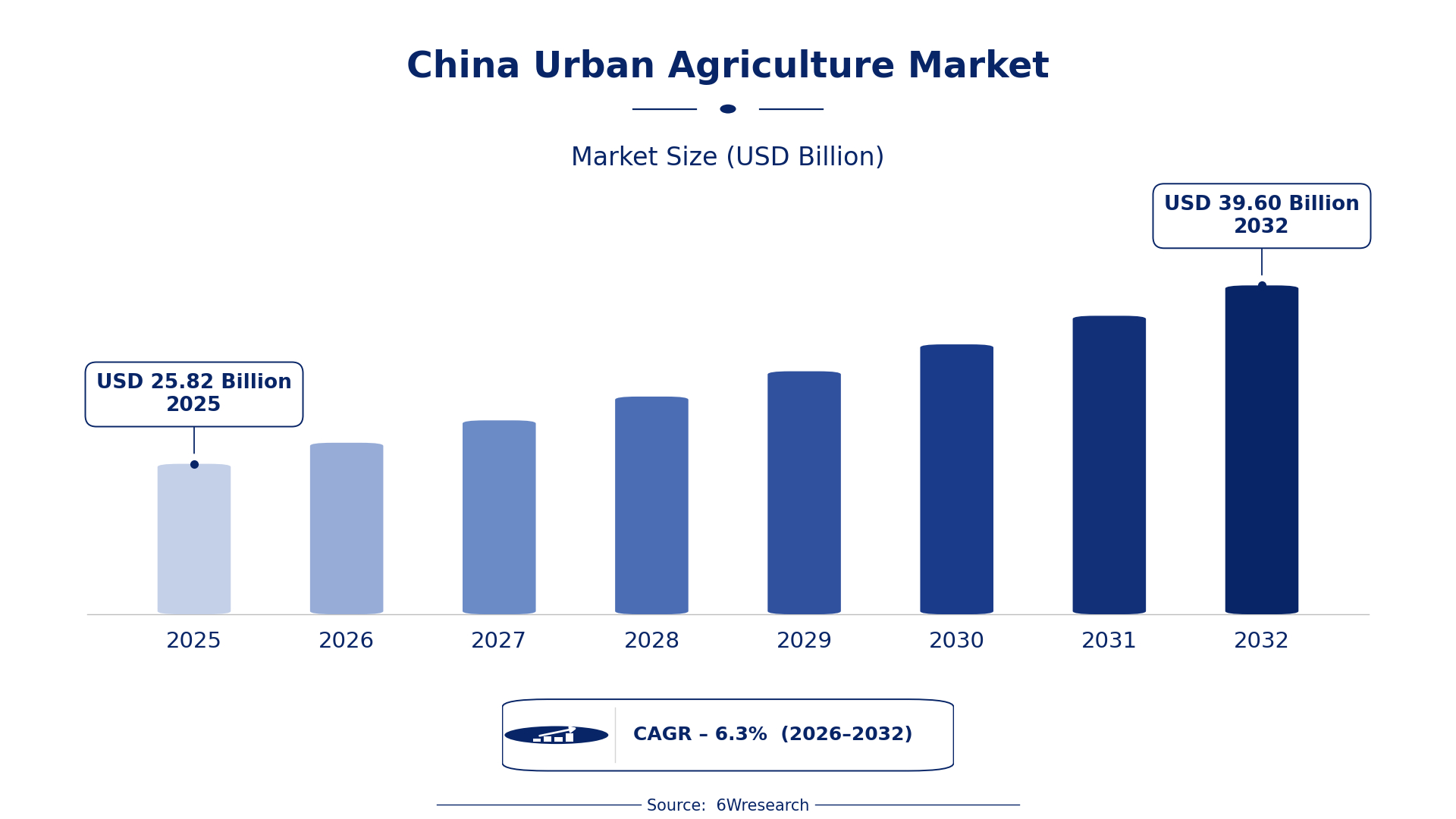
According to 6Wresearch internal database and industry insights, the China Urban Agriculture Market was valued at USD 25.82 billion in 2025 and is projected to reach USD 39.60 billion by 2032, growing at a CAGR of approximately 6.3% during 2026–2032.
China Urban Agriculture Market Highlights
| Report Metric | Details |
| Report Name | China Urban Agriculture Market |
| Market Size 2025 | USD 25.82 billion |
| Market Size 2032 | USD 39.60 billion |
| Absolute Growth 2025–2032 | USD 13.78 billion |
| CAGR 2026–2032 | 6.3% |
| Peak Annual Growth | 8.7% in 2029 |
| Forecast Period | 2026–2032 |
| Historical Data | 2022–2025 |
| Base Year | 2025 |
| Leading Farming Type, 2025 | Indoor Vertical Farms (51% share) |
| Leading Growing Technique, 2025 | Hydroponics (43% share) |
| Leading Output Category, 2025 | Leafy Greens (41% share) |
| Leading End User, 2025 | Urban Farmers (42% share) |
| Fastest-Growing Growing Technique | IoT-Controlled (8.5% CAGR) |
| Fastest-Growing Output Category | Vegetables (8.2% CAGR) |
| Fastest-Growing End User | Restaurants (7.9% CAGR) |
| Growing Sector | Urban Farmers |
| Key End Users | Urban Farmers, Restaurants, Retailers |
China Urban Agriculture Market Year-wise Growth Rate and Key Drivers (2022–2032)
This graph illustrates the annual growth rates of the market from 2022 to 2032, highlighting a steady upward trajectory and projected market expansion over the forecast period.
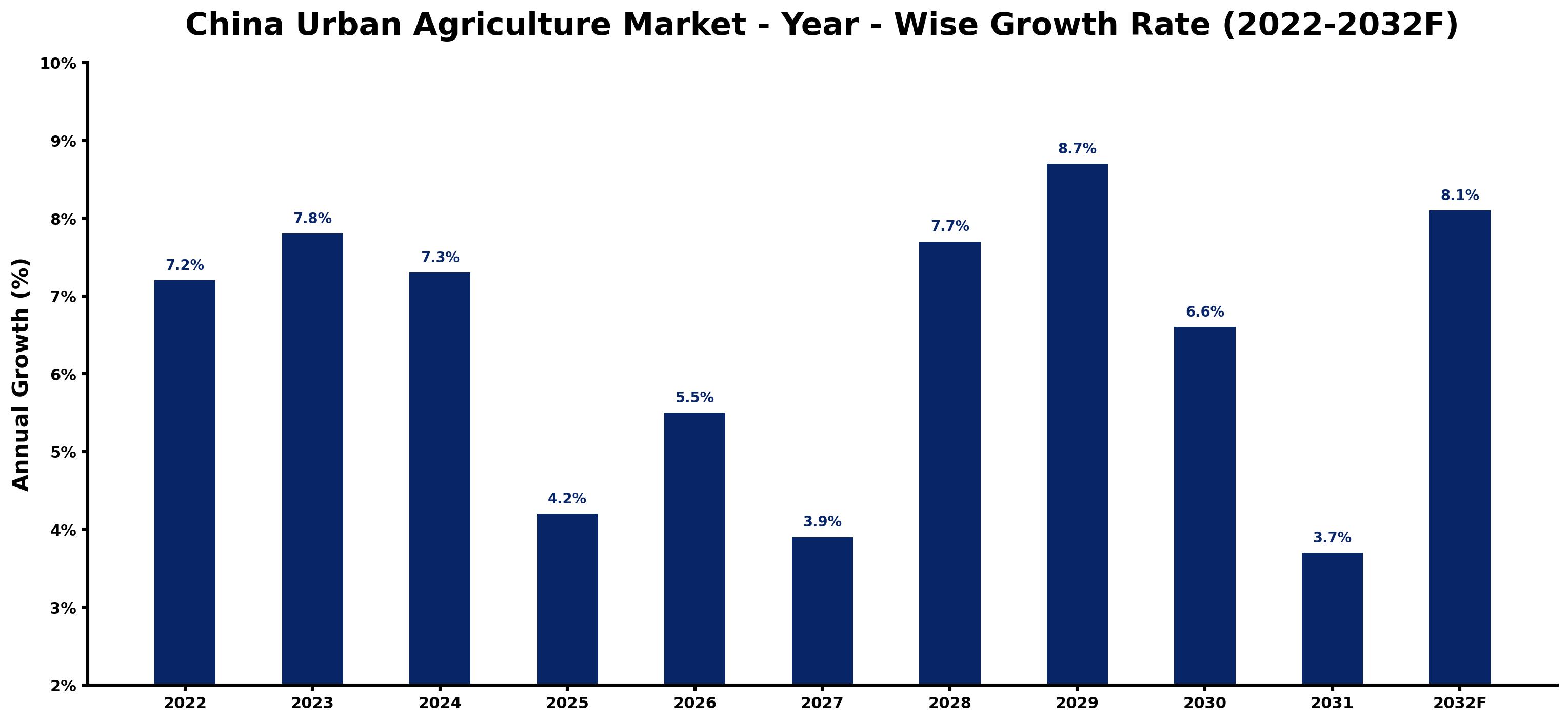
The following table presents the estimated annual growth rate for each year together with the principal factor influencing market performance.
| Year | Estimated Annual Growth (%) | Market Rationale |
| 2022 | 7.2 | Urban agriculture contributed significantly to fresh produce consumption in major cities. |
| 2023 | 7.8 | Shanghai's rooftop farms expanded, boosting local food production and consumption. |
| 2024 | 7.3 | Growth slowed as urban farming initiatives faced space limitations in cities. |
| 2025 | 4.2 | Urban farming projects continued, but growth rates began to normalise. |
| 2026 | 5.5 | Investment in hydroponics systems increased, driving demand for local produce. |
| 2027 | 3.9 | Growth moderated as urban farmers adjusted to changing market conditions. |
| 2028 | 7.7 | Demand for vertical farming surged, leading to increased food production efficiency. |
| 2029 | 8.7 | Urban agriculture saw its peak growth as government initiatives gained traction. |
| 2030 | 6.6 | Growth slowed as market adjustments occurred following rapid expansion. |
| 2031 | 3.7 | Urban agriculture maintained growth, but at a more sustainable rate. |
| 2032 | 8.1 | The market is expected to grow as sustainable practices become more prevalent. |
Note: Market size estimations and growth projections presented in this report are based on 6Wresearch's proprietary forecasting methodology, utilizing the latest available industry data, government publications, and primary research inputs.
China Urban Agriculture Market Synopsis
Urban Agriculture in China involves growing food in urban settings, utilising innovative methods like rooftop farms and vertical farming. These practices focus on local food production and reducing food miles. The China Urban Agriculture Market is thriving due to rising urban populations and increasing demand for fresh produce. Government initiatives, such as the Urban Agriculture Development Program, are promoting sustainable practices and enhancing food security. By 2025, urban agriculture is projected to contribute significantly to local food supplies, supporting community engagement and environmental sustainability.
Market Dynamics Impact Analysis (2026–2032)
| Factor | Type | Impact | Primary Segment Affected |
| Increasing urban population driving demand for local food sources. | Driver | High | Urban Farmers |
| Rising adoption of hydroponics systems enhancing food production efficiency. | Driver | High | Hydroponics |
| Investment in community gardens to improve food security in urban areas. | Opportunity | Medium | Community Gardens |
| Growing interest in vertical farming techniques to maximise space in cities. | Opportunity | Medium | Indoor Vertical Farms |
| Limited space for traditional farming methods in urban environments. | Restraint | High | Rooftop Farms |
| Challenges in maintaining consistent yields across urban farms. | Restraint | Medium | Indoor Vertical Farms |
| High initial investment costs for advanced farming technologies. | Challenge | High | Hydroponics |
| Regulatory hurdles for urban farming initiatives affecting expansion. | Challenge | Medium | Community Gardens |
Evaluation of Drivers in China Urban Agriculture Market (2026–2032)
The factors lifting demand, and the evidence behind each, are summarised below.
| Drivers | Primary Segment Affected | Why It Matters (Evidence) |
| Urban population growth increases demand for locally sourced food. | Urban Farmers | China's urban population reached 64% in 2022, prompting urban farmers to expand production. |
| Hydroponics systems enhance efficiency and yield in urban settings. | Hydroponics | With over 1,000 installations reported, hydroponics is increasingly adopted in urban areas. |
| Government initiatives support sustainable urban farming practices. | Community Gardens | The Urban Agriculture Development Program launched in 2023 aims to enhance food security. |
| Vertical farming maximises food production per square meter. | Indoor Vertical Farms | Vertical farms can produce up to 30 times more food than traditional methods. |
| IoT technology improves monitoring and management of urban farms. | IoT-Controlled | IoT-controlled farms are projected to increase efficiency by 25% by 2025. |
The Urban Agriculture market in China is expanding as urban population growth, investment in advanced farming technologies, and rising demand for local produce drive development. In 2022, the urban population reached 64%, prompting urban farmers to increase production. Hydroponics systems are increasingly adopted, improving efficiency. Vertical farms can produce up to 30 times more food per square meter than traditional methods, further boosting local food supplies.
Evaluation of Restraints in China Urban Agriculture Market
Below mentioned are some major restraints and their influence on market dynamics.
| Market Restraint | Primary Segment Affected | Why It Matters (Evidence) |
| Limited space for traditional farming methods in urban environments. | Rooftop Farms | Urban areas often lack sufficient space for conventional farming, limiting production potential. |
| Challenges in maintaining consistent yields across urban farms. | Indoor Vertical Farms | Urban farms may struggle with yield consistency due to varying environmental factors. |
| High initial investment costs for advanced farming technologies. | Hydroponics | The cost of setting up hydroponics systems can be a barrier for new urban farmers. |
| Regulatory hurdles for urban farming initiatives affecting expansion. | Community Gardens | Complex regulations can hinder the establishment and growth of community gardens. |
| Market saturation in certain urban areas limiting growth potential. | Indoor Vertical Farms | As more vertical farms emerge, competition increases, affecting profitability. |
China Urban Agriculture Market Challenges
The China Urban Agriculture Market still has to solve a few problems, and the first is regulatory compliance. The National Standard for Urban Agriculture, established in 2021, imposes strict guidelines that can delay project approvals for producers, costing them potential revenue. Supply chain disruptions also pose a challenge, as urban farmers often rely on specific suppliers for hydroponics systems, leading to increased costs and delays in production. Buyers face rising prices due to competition for local produce, which can inflate costs by up to 20% in major cities. Competition among urban farms intensifies, with over 1,000 hydroponics installations creating a saturated market that pressures profit margins for producers.
Trends in the China Urban Agriculture Market
Buyers and suppliers in the China Urban Agriculture Market are adjusting to the following trends.
- Shift towards Hydroponics in Urban Farming: Urban farmers are increasingly adopting hydroponics systems, with over 1,000 installations reported in cities. This shift improves food production efficiency, allowing for soil-less cultivation and better resource management.
- Growth of Community Gardens: Community gardens in Guangzhou serve over 5,000 residents, promoting local food production and engagement. This trend supports food security and strengthens community ties among urban populations.
- Expansion of Vertical Farming: Vertical farming is gaining traction in urban areas, with facilities producing up to 30 times more food per square meter than traditional methods. This trend is reshaping urban food landscapes and addressing space constraints.
- Government Support for Urban Agriculture: The Urban Agriculture Development Program, launched in 2023, allocates 500 million yuan to improve food security in cities. This initiative encourages sustainable practices and boosts local food production.
Investment Opportunities in the China Urban Agriculture Market
Below are the investment opportunities with the strongest case in the China Urban Agriculture Market.
- Invest in Hydroponics Systems: With over 1,000 installations, there is an opportunity to supply hydroponics systems in urban areas. Urban farmers are increasingly seeking efficient solutions to improve production.
- Develop Community Gardens: Community gardens are gaining popularity, especially in cities like Guangzhou. Investing in these initiatives can improve food security for over 5,000 residents, fostering local engagement.
- Support Vertical Farming Technologies: Vertical farming is set to grow rapidly, with a focus on maximising space efficiency. Suppliers can enter this market by partnering with urban farmers and providing innovative technologies.
- Enter the IoT-Controlled Farming Sector: IoT-controlled farms are expected to increase efficiency by 25% by 2025. Collaborating with local partners can facilitate entry into this growing segment.
Government Initiatives in the China Urban Agriculture Market
The Urban Agriculture Development Program, initiated by the Ministry of Agriculture in 2023, aims to improve food security in cities. With a budget of 500 million yuan, this initiative supports urban farming projects and sustainable practices. The National Standard for Urban Agriculture, established in 2021, promotes best practices in urban farming, ensuring quality and safety in food production. These measures encourage urban farmers to adopt modern techniques and improve local food supplies.
The Ministry of Agriculture oversees the approval and funding of urban agriculture projects under the Urban Agriculture Development Program. This agency also supports the implementation of the National Standard for Urban Agriculture, which sets guidelines for urban farming practices. Additionally, the Ministry of Housing and Urban-Rural Development promotes the Green Roof Initiative, integrating urban agriculture into city planning to increase green spaces and food production.
Future Insight of the China Urban Agriculture Market
The China Urban Agriculture Market is set for transformation by 2032, driven by several key initiatives. The Urban Agriculture Development Program, launched in 2023, will provide vital resources for sustainable practices, improving food security for city residents. By 2025, farms using advanced technology are expected to boost operational efficiency significantly, enabling producers to maximise their outputs. Vertical farms, which can yield up to 30 times more food per square meter than traditional methods, will be essential in catering to the increasing needs of urban populations.
Market Segmentation Analysis
The analysis below covers each segmentation, its leading category in 2025 and its fastest-growing category through 2032.
By Farming Type – Indoor Vertical Farms Dominated and Is Expected to Record the Fastest Growth
According to Bhawna Singh, Assistant Manager at 6Wresearch, in 2025, Indoor Vertical Farms led the farming type split with a 51% share. Indoor vertical farms hold the largest market share as they maximise space efficiency and yields in urban areas. For instance, these farms can produce up to 30 times more food per square metre than traditional farming methods, making them particularly advantageous in densely populated cities. The same category are also set to grow fastest, at a CAGR of 7.6% during 2026–2032. The growth of indoor vertical farms will continue to accelerate, reinforcing their market lead due to rising urbanisation and the increasing demand for local food sources. With China's urban population reaching 64% in 2022, the need for efficient food production methods will intensify further, allowing this segment to expand its share. Suppliers should focus on enhancing technologies for indoor vertical farms to meet the growing demand.
By Growing Technique – Hydroponics Dominated, IoT-Controlled Expected to Grow Fastest
Hydroponics accounted for a 43% market share by growing technique in 2025. Hydroponics commands the largest market share as it enables soil-less cultivation with efficient water use, making it well-suited for urban environments. This technique has gained traction, with over 1,000 installations reported in urban areas, reflecting its widespread acceptance among urban farmers. Over 2026–2032, IoT-Controlled is expected to post the fastest growth, at a CAGR of 8.5%. While hydroponics leads in market share, IoT-controlled systems are rapidly gaining popularity as they enhance monitoring and management of urban farms. The projected 25% increase in efficiency by 2025 indicates a strong growth trajectory for IoT in urban agriculture, further boosting the segment's appeal. Buyers should consider investing in IoT-controlled systems to optimise their urban farming operations.
By Output Category – Leafy Greens Dominated, Vegetables Expected to Grow Fastest
The largest output category category in 2025 was Leafy Greens, with a 41% share of total revenue. Leafy greens represent the largest market share due to their high demand for fresh produce in urban areas. The significance of leafy greens is underscored by urban agriculture contributing to 15% of fresh produce consumed in major cities in China in 2022, showcasing their popularity among consumers. The quickest growth will come from Vegetables, forecast to expand at a CAGR of 8.2% between 2026 and 2032. Vegetables are the fastest-growing category, essential for local food supply in cities and indicative of the increasing focus on food security. As urban farming initiatives expand, the demand for a diverse range of vegetables is expected to surge significantly, further driving growth in this segment. Suppliers should diversify their offerings to include a wider range of vegetables to cater to urban consumers.
By End User – Urban Farmers Dominated, Restaurants Expected to Grow Fastest
Urban Farmers held a 42% share of the China Urban Agriculture Market by end user in 2025. Urban farmers are the key players in the urban agriculture movement, holding the largest market share as they directly contribute to local food production. Their initiatives are crucial for addressing food security in urban settings, supported by various government programs and community efforts. Restaurants are projected to grow fastest, at a CAGR of 7.9% during 2026–2032. Restaurants are the fastest-growing end user, increasingly sourcing fresh ingredients from local farms to meet consumer demand for quality and sustainability. This trend is likely to persist as urban agriculture gains traction and visibility in the market, further expanding the segment's share. Suppliers should build partnerships with restaurants to enhance distribution channels for fresh produce.
Key Attractiveness of the Report
- 10 Years of Market Numbers
- Historical Data Starting from 2022 to 2025
- Base Year 2025
- Forecast Data until 2032
- Key Performance Indicators Impacting the Market
- Major Upcoming Developments and Projects
Key Highlights of the Report:
- China Urban Agriculture Market Outlook
- Market Size of China Urban Agriculture Market, 2025
- Forecast of China Urban Agriculture Market, 2032
- Historical Data and Forecast of China Urban Agriculture Revenues & Volume for the Period 2022 - 2032F
- China Urban Agriculture Market Trend Evolution
- China Urban Agriculture Market Drivers and Challenges
- China Urban Agriculture Price Trends
- China Urban Agriculture Porter's Five Forces
- China Urban Agriculture Industry Life Cycle
- Historical Data and Forecast of China Urban Agriculture Market Revenues & Volume By Farming Type for the Period 2022 - 2032F
- Historical Data and Forecast of China Urban Agriculture Market Revenues & Volume By Rooftop Farms for the Period 2022 - 2032F
- Historical Data and Forecast of China Urban Agriculture Market Revenues & Volume By Indoor Vertical Farms for the Period 2022 - 2032F
- Historical Data and Forecast of China Urban Agriculture Market Revenues & Volume By Community Gardens for the Period 2022 - 2032F
- Historical Data and Forecast of China Urban Agriculture Market Revenues & Volume By Greenhouses for the Period 2022 - 2032F
- Historical Data and Forecast of China Urban Agriculture Market Revenues & Volume By Growing Technique for the Period 2022 - 2032F
- Historical Data and Forecast of China Urban Agriculture Market Revenues & Volume By Hydroponics for the Period 2022 - 2032F
- Historical Data and Forecast of China Urban Agriculture Market Revenues & Volume By Aeroponics for the Period 2022 - 2032F
- Historical Data and Forecast of China Urban Agriculture Market Revenues & Volume By Organic Soil-Based for the Period 2022 - 2032F
- Historical Data and Forecast of China Urban Agriculture Market Revenues & Volume By IoT-Controlled for the Period 2022 - 2032F
- Historical Data and Forecast of China Urban Agriculture Market Revenues & Volume By Output Category for the Period 2022 - 2032F
- Historical Data and Forecast of China Urban Agriculture Market Revenues & Volume By Leafy Greens for the Period 2022 - 2032F
- Historical Data and Forecast of China Urban Agriculture Market Revenues & Volume By Herbs & Microgreens for the Period 2022 - 2032F
- Historical Data and Forecast of China Urban Agriculture Market Revenues & Volume By Vegetables for the Period 2022 - 2032F
- Historical Data and Forecast of China Urban Agriculture Market Revenues & Volume By Fruits & Flowers for the Period 2022 - 2032F
- Historical Data and Forecast of China Urban Agriculture Market Revenues & Volume By End User for the Period 2022 - 2032F
- Historical Data and Forecast of China Urban Agriculture Market Revenues & Volume By Urban Farmers for the Period 2022 - 2032F
- Historical Data and Forecast of China Urban Agriculture Market Revenues & Volume By Restaurants for the Period 2022 - 2032F
- Historical Data and Forecast of China Urban Agriculture Market Revenues & Volume By NGOs & Cooperatives for the Period 2022 - 2032F
- Historical Data and Forecast of China Urban Agriculture Market Revenues & Volume By Retailers for the Period 2022 - 2032F
- China Urban Agriculture Import Export Trade Statistics
- Market Opportunity Assessment By Farming Type
- Market Opportunity Assessment By Growing Technique
- Market Opportunity Assessment By Output Category
- Market Opportunity Assessment By End User
- China Urban Agriculture Top Companies Market Share
- China Urban Agriculture Competitive Benchmarking By Technical and Operational Parameters
- China Urban Agriculture Company Profiles
- China Urban Agriculture Key Strategic Recommendations
Market Covered
This report examines the market across the segments below.
By Farming Type
- Rooftop Farms
- Indoor Vertical Farms
- Community Gardens
- Greenhouses
By Growing Technique
- Hydroponics
- Aeroponics
- Organic Soil-Based
- IoT-Controlled
By Output Category
- Leafy Greens
- Herbs & Microgreens
- Vegetables
- Fruits & Flowers
By End User
- Urban Farmers
- Restaurants
- NGOs & Cooperatives
- Retailers































