India Urban EV Charging Market Size & Growth Rate
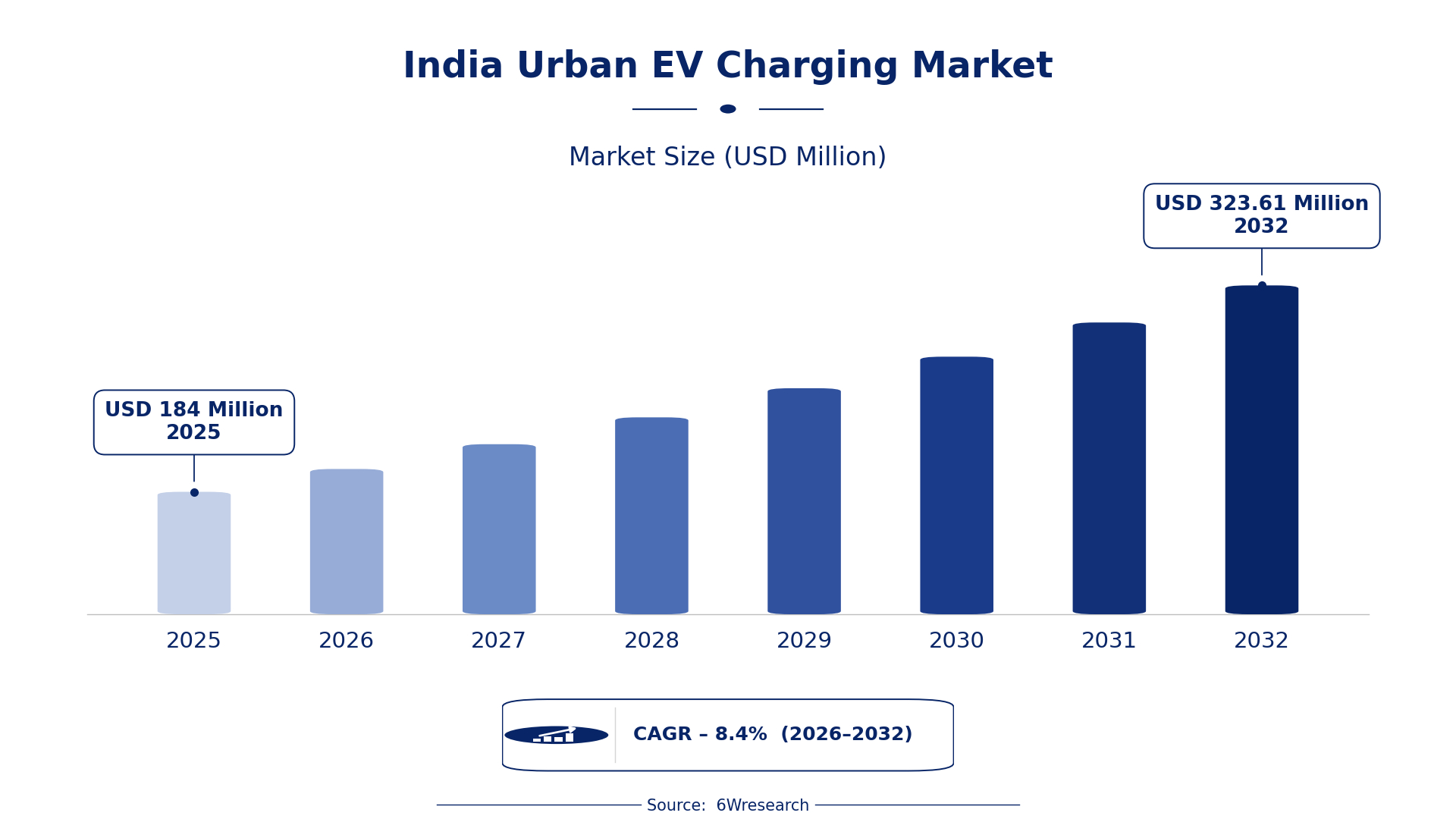
According to 6Wresearch internal database and industry insights, the India Urban EV Charging Market was valued at USD 184.0 million in 2025 and is projected to reach USD 323.61 million by 2032, growing at a CAGR of approximately 8.4% during 2026–2032.
India Urban EV Charging Market Highlights
| Report Metric | Details |
| Report Name | India Urban EV Charging Market |
| Market Size 2025 | USD 184.0 million |
| Market Size 2032 | USD 323.61 million |
| Absolute Growth 2025–2032 | USD 139.61 million |
| CAGR 2026–2032 | 8.4% |
| Peak Annual Growth | 10.6% in 2030 |
| Forecast Period | 2026–2032 |
| Historical Data | 2022–2025 |
| Base Year | 2025 |
| Leading Charging Type, 2025 | Fast Chargers (47% share) |
| Leading Installation Type, 2025 | Public Charging Hub (38% share) |
| Leading Vehicle Segment, 2025 | Passenger EVs (51% share) |
| Leading End User, 2025 | EV Drivers (49% share) |
| Fastest-Growing Charging Type | Smart Chargers (9.6% CAGR) |
| Fastest-Growing Installation Type | Residential Installations (10.9% CAGR) |
| Fastest-Growing Vehicle Segment | Two- & Three-Wheelers (10.3% CAGR) |
| Fastest-Growing End User | Delivery Aggregators (10.2% CAGR) |
| Growing Sector | Delivery Aggregators |
| Key End Users | EV Drivers, Municipalities, Delivery Aggregators, Apartment Owners |
India Urban EV Charging Market Year-wise Growth Rate and Key Drivers (2022–2032)
This graph illustrates the annual growth rates of the market from 2022 to 2032, highlighting a steady upward trajectory and projected market expansion over the forecast period.
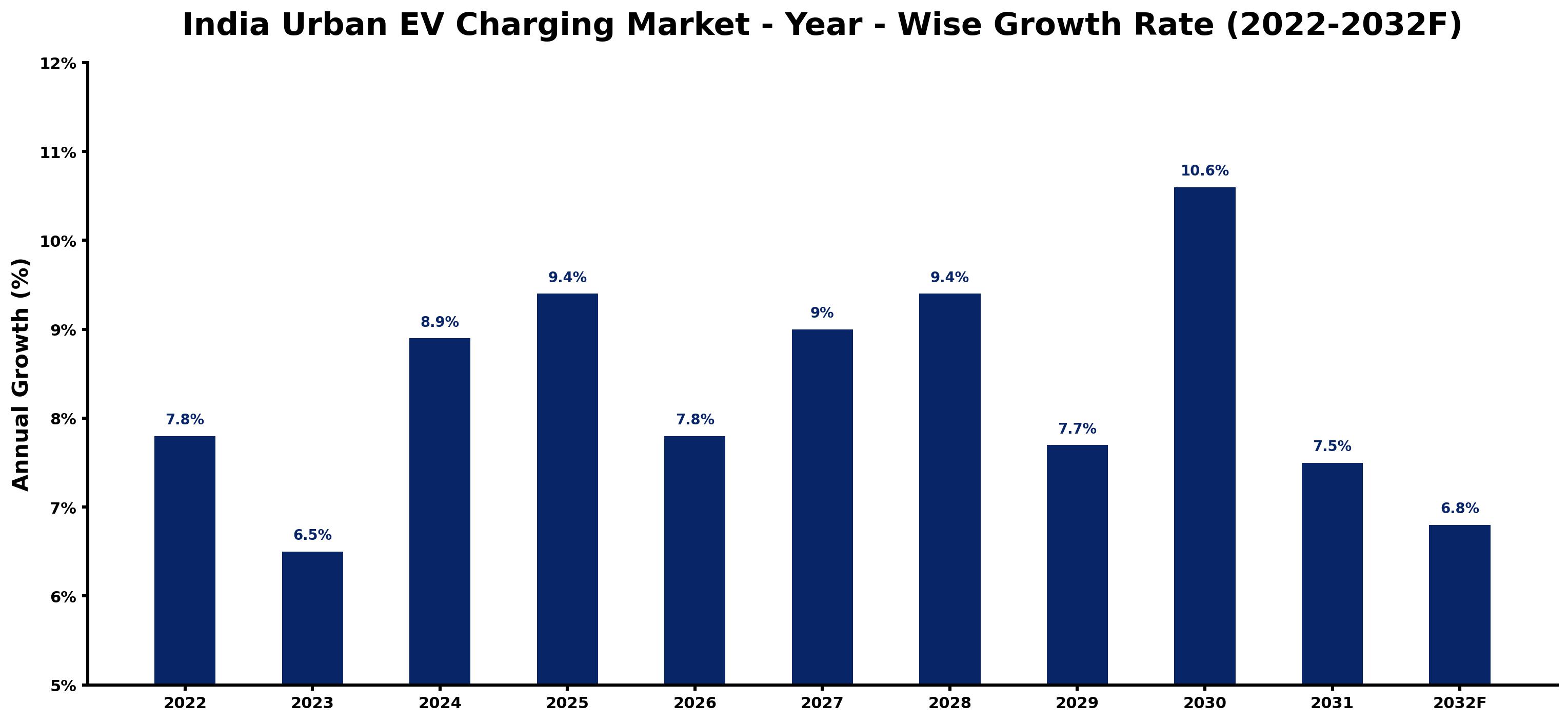
Annual growth estimates for each year appear below with the principal reason behind them, explaining the shifts that set the pace of the market.
| Year | Estimated Annual Growth (%) | Market Rationale |
| 2022 | 7.8 | The market experienced steady growth due to increasing urban EV adoption driven by the National Electric Mobility Mission Plan. |
| 2023 | 6.5 | Growth slowed as infrastructure development faced delays in major cities, particularly in Delhi and Maharashtra. |
| 2024 | 8.9 | Investment in charging stations accelerated, boosting market activity as municipalities expanded their initiatives. |
| 2025 | 9.4 | The market peaked as public charging hubs expanded across urban areas, enhancing accessibility for EV drivers. |
| 2026 | 7.8 | Growth slowed again as competition among charging providers intensified, affecting market dynamics. |
| 2027 | 9.0 | Demand increased with the rise of electric delivery vehicles in urban fleets, particularly among delivery aggregators. |
| 2028 | 9.4 | The market experienced a resurgence with new smart charging installations driven by the Smart Cities Mission. |
| 2029 | 7.7 | Growth slowed as the market began to stabilise after rapid expansion and increased infrastructure. |
| 2030 | 10.6 | The market peaked again with a surge in EV sales and charging infrastructure, supported by government initiatives. |
| 2031 | 7.5 | Growth slowed as saturation in some urban areas began to occur, impacting new installations. |
| 2032 | 6.8 | The market continues to grow but at a more moderate pace, with ongoing demand from urban EV drivers. |
Note: Market size estimations and growth projections presented in this report are based on 6Wresearch's proprietary forecasting methodology, utilizing the latest available industry data, government publications, and primary research inputs.
India Urban EV Charging Market Synopsis
Urban EV Charging in India involves the installation of infrastructure to support electric vehicles through charging stations. This sector is essential for providing energy to electric vehicles in urban areas, facilitating cleaner transportation, and reducing emissions. The India Urban EV Charging Market is growing due to rising demand from urban EV drivers, municipalities, and delivery services. With over 1,000 public charging stations installed as of 2023, the market is expected to expand further as initiatives like the FAME India Scheme promote electric vehicle adoption.
Market Dynamics Impact Analysis (2026–2032)
| Factor | Type | Impact | Primary Segment Affected |
| Growing urban EV adoption driven by government initiatives | Driver | High | Public Charging Hub |
| Increased investment in smart charging solutions | Driver | High | Smart Chargers |
| Need for accessible charging solutions in urban areas | Opportunity | High | Residential Installations |
| Rising demand for electric two-wheelers in urban centres | Opportunity | High | Two- & Three-Wheelers |
| Limited charging infrastructure in rural areas | Restraint | Medium | Public Charging Hub |
| High installation costs for charging stations | Restraint | Medium | Smart Chargers |
| Urban EV Charging in India faces challenges from infrastructure development delays | Challenge | High | Public Charging Hub |
| Competition among charging providers leads to market fragmentation | Challenge | Medium | Smart Chargers |
Evaluation of Drivers in India Urban EV Charging Market (2026–2032)
The factors lifting demand, and the evidence behind each, are summarised below.
| Drivers | Primary Segment Affected | Why It Matters (Evidence) |
| Government initiatives like the FAME India Scheme promote EV adoption | Public Charging Hub | With a budget of ₹10,000 crore, this scheme incentivises the installation of charging infrastructure. |
| Rising urbanisation increases demand for efficient charging solutions | Smart Chargers | As cities expand, the need for smart charging technology to manage energy efficiently becomes critical. |
| Investment in public charging stations is accelerating | Public Charging Hub | Over 1,000 public EV charging stations have been installed across major cities, improving accessibility. |
| Growing electric vehicle registrations spur infrastructure development | Residential Installations | With approximately 1.5 million registered EVs, homeowners are increasingly seeking convenient charging solutions. |
| Municipalities are actively developing charging infrastructure | Public Charging Hub | Cities like Delhi and Maharashtra are leading in EV adoption and charging station deployment. |
Expansion of the Urban EV Charging market in India is driven by substantial investment in infrastructure, rising urbanisation, and a surge in electric vehicle registrations. The Smart Cities Mission supports the installation of smart charging stations, leading to a notable increase in urban charging options. Approximately 1.5 million registered electric vehicles create a pressing need for accessible charging solutions, prompting municipalities to invest in infrastructure development. This combined investment and demand from urban EV drivers and delivery aggregators are reshaping the market, propelling further growth in the sector.
Evaluation of Restraints in India Urban EV Charging Market
The table below lists the restraints and the evidence behind each.
| Market Restraint | Primary Segment Affected | Why It Matters (Evidence) |
| Limited availability of charging infrastructure in rural areas | Public Charging Hub | Only major urban centres have sufficient charging stations, leaving rural areas underserved, impacting EV adoption. |
| High installation costs hinder rapid deployment of charging stations | Smart Chargers | The financial burden of setting up charging infrastructure can deter potential investors from entering the market. |
| Regulatory challenges slow down infrastructure development | Public Charging Hub | Bureaucratic hurdles can delay the approval process for new charging installations, affecting timelines. |
| Market fragmentation complicates user access to charging stations | Smart Chargers | Multiple providers lead to inconsistent charging standards and user experiences, making it difficult for consumers. |
| Consumer awareness about EV benefits remains low | Residential Installations | Limited knowledge about electric vehicles and charging options affects adoption rates among potential buyers. |
India Urban EV Charging Market Challenges
The India Urban EV Charging market struggles with inadequate charging infrastructure, as only over 1,000 public EV charging stations exist across major cities. This limitation hinders buyers' ability to adopt electric vehicles, as they need convenient charging options to transition effectively. Regulatory challenges arise from the Bureau of Indian Standards' 2022 guidelines, which can slow down infrastructure rollout for suppliers due to compliance costs. Skills shortages in the workforce impede the installation of charging stations, delaying projects for producers. Supply chain disruptions further affect the availability of essential electrical components, causing setbacks for municipalities in expanding their charging networks.
Trends in the India Urban EV Charging Market
The trends below show where the India Urban EV Charging Market is heading.
- Shift towards Smart Charging Solutions: The Smart Cities Mission promotes smart charging stations across urban areas, improving energy management. With a projected growth rate of 9.6% for smart chargers, this trend is essential for efficient urban mobility.
- Increased Focus on Public Charging Hubs: As of 2023, public charging hubs account for 38% of installations, driven by urban EV adoption. This shift supports the growing need for accessible charging solutions in cities, improving user convenience.
- Rise of Electric Two-Wheelers: Electric two-wheelers represent over 70% of total EV sales in India as of 2023. This trend highlights the demand for accessible charging solutions tailored to urban commuters, facilitating cleaner transport.
- Expansion of Charging Infrastructure in Residential Areas: In 2023, the Ministry of Road Transport and Highways issued guidelines for residential charging stations. This initiative aims to ensure accessibility for EV owners, reflecting a growing trend in urban areas.
Investment Opportunities in the India Urban EV Charging Market
Some of the investment opportunities in the India Urban EV Charging Market are mentioned below.
- Investment in Public Charging Infrastructure: With a notable gap in rural areas, municipalities are seeking partners to expand charging networks. The demand for accessible EV charging solutions is high, creating opportunities for investment in infrastructure.
- Development of Smart Charging Solutions: The increasing urban EV adoption generates a demand for smart charging technology. Companies can invest in developing these solutions to serve urban fleets and delivery aggregators, improving efficiency.
- Expansion of Residential Charging Solutions: As electric vehicle ownership rises, the need for home charging solutions becomes clear. Apartment owners are seeking efficient installations to accommodate their EVs, creating a market opportunity.
- Growth in Delivery Aggregators' Charging Needs: With a projected increase in electric delivery vehicles, the demand for efficient charging solutions is substantial. Investing in charging infrastructure for delivery services presents a promising opportunity.
Government Initiatives in the India Urban EV Charging Market
The regulatory framework for Urban EV Charging in India is shaped by several key measures. The FAME II scheme, launched in 2021, allocated ₹10,000 crore to promote electric mobility through subsidies for charging infrastructure. The National Electric Mobility Mission Plan (NEMMP), updated in 2020, aims to boost EV adoption and charging solutions across the country. Additionally, the Bureau of Energy Efficiency introduced the Energy Conservation Building Code for EV charging infrastructure in 2022, promoting energy-efficient designs in new buildings.
Municipalities are utilising the Smart Cities Mission to fund urban EV charging projects, aiming to enhance infrastructure in 100 cities by 2025. The Ministry of Heavy Industries oversees the implementation of these initiatives, ensuring that urban areas receive adequate support for charging infrastructure development. This collaboration between government agencies and local authorities is crucial for meeting the growing demand from EV drivers.
Future Insight of the India Urban EV Charging Market
The India Urban EV Charging market will transform by 2032, driven by initiatives like the National Electric Mobility Mission Plan, which targets 6-7 million EV sales by 2025. The Smart Cities Mission will improve urban charging infrastructure, promoting cleaner transportation. As the government continues to support local manufacturing through the Atmanirbhar Bharat initiative, suppliers will need to adapt to emerging technologies and standards. With electric two-wheelers representing over 70% of total EV sales, the demand for tailored charging solutions will increase, requiring innovation from producers.
Market Segmentation Analysis
Each segment group is reviewed below, with the leader by share and the fastest grower by CAGR.
By Charging Type – Fast Chargers Dominated, Smart Chargers Expected to Grow Fastest
According to Bhawna Singh, Assistant Manager at 6Wresearch, in 2025, Fast Chargers led the charging type split with a 47% share. Fast Chargers hold the largest market share in the India Urban EV Charging Market due to their essential role in urban mobility, providing quick recharging options for electric vehicles. Their extensive presence across major cities supports the increasing number of electric vehicles, making them crucial for urban infrastructure. The quickest growth will come from Smart Chargers, forecast to expand at a CAGR of 9.6% between 2026 and 2032. Smart Chargers are growing rapidly as they facilitate efficient energy management and enhance user convenience, appealing to the rising population of EV owners. This trend towards smart technology in charging solutions is likely to further boost demand, ensuring Fast Chargers maintain their leading position. Suppliers should prioritise the development of smart charging technologies to cater to the evolving needs of urban EV drivers.
By Installation Type – Public Charging Hub Dominated, Residential Installations Expected to Grow Fastest
Public Charging Hub accounted for a 38% market share by installation type in 2025. Public Charging Hubs dominate the market share, being vital for urban infrastructure as they allow multiple electric vehicles to charge simultaneously in high-demand areas. Their strategic locations in cities are essential for supporting the growing adoption of electric vehicles, making them indispensable for urban mobility. Over 2026–2032, Residential Installations are expected to post the fastest growth, at a CAGR of 10.9%. Residential Installations are experiencing the fastest growth, driven by the increasing preference for home charging solutions among electric vehicle owners. As more consumers invest in EVs, the demand for convenient residential charging options is expected to rise significantly, reinforcing the importance of Public Charging Hubs. Buyers should consider investing in residential charging solutions to improve their EV ownership experience.
By Vehicle Segment – Passenger EVs Dominated, Two- & Three-Wheelers Expected to Grow Fastest
The largest vehicle segment category in 2025 was Passenger EVs, with a 51% share of total revenue. Passenger EVs represent the largest segment in the India Urban EV Charging Market, significantly driving the demand for charging infrastructure. With around 1.5 million registered electric vehicles, this segment is critical for supporting urban charging needs and reflects the shift towards cleaner transportation. Two- & Three-Wheelers are projected to grow fastest, at a CAGR of 10.3% during 2026–2032. Two- & Three-Wheelers are witnessing the fastest growth, representing a major segment of the EV market in India that requires accessible charging solutions. The rising adoption of electric two-wheelers is expected to accelerate this growth, further solidifying the dominance of Passenger EVs in the market. Suppliers should focus on developing charging solutions specifically designed for two- and three-wheeler vehicles to capture this expanding market.
By End User – EV Drivers Dominated, Delivery Aggregators Expected to Grow Fastest
EV Drivers took a 49% share of end user in 2025, more than any other category. EV Drivers are the primary end-users of urban EV charging infrastructure, holding the largest market share as they depend on these facilities for their daily commuting needs. Their increasing numbers, driven by the rise in electric vehicle registrations, highlight the necessity of robust charging networks in urban areas. Delivery Aggregators are set to record the highest CAGR in this split, 10.2% over 2026–2032. Delivery Aggregators are the fastest-growing end-user segment, as they require efficient charging solutions for their electric delivery vehicles to maintain operational efficiency. The surge in e-commerce and delivery services is driving this demand, emphasising the need for tailored solutions for EV Drivers. Suppliers should concentrate on creating customised charging solutions for delivery aggregators to capitalise on this growing segment.
Key Attractiveness of the Report
- 10 Years of Market Numbers
- Historical Data Starting from 2022 to 2025
- Base Year 2025
- Forecast Data until 2032
- Key Performance Indicators Impacting the Market
- Major Upcoming Developments and Projects
Key Highlights of the Report:
- India Urban EV Charging Market Outlook
- Market Size of India Urban EV Charging Market, 2025
- Forecast of India Urban EV Charging Market, 2032
- Historical Data and Forecast of India Urban EV Charging Revenues & Volume for the Period 2022 - 2032F
- India Urban EV Charging Market Trend Evolution
- India Urban EV Charging Market Drivers and Challenges
- India Urban EV Charging Price Trends
- India Urban EV Charging Porter's Five Forces
- India Urban EV Charging Industry Life Cycle
- Historical Data and Forecast of India Urban EV Charging Market Revenues & Volume By Charging Type for the Period 2022 - 2032F
- Historical Data and Forecast of India Urban EV Charging Market Revenues & Volume By Fast Chargers for the Period 2022 - 2032F
- Historical Data and Forecast of India Urban EV Charging Market Revenues & Volume By Smart Chargers for the Period 2022 - 2032F
- Historical Data and Forecast of India Urban EV Charging Market Revenues & Volume By Wireless Chargers for the Period 2022 - 2032F
- Historical Data and Forecast of India Urban EV Charging Market Revenues & Volume By Battery Swapping for the Period 2022 - 2032F
- Historical Data and Forecast of India Urban EV Charging Market Revenues & Volume By Installation Type for the Period 2022 - 2032F
- Historical Data and Forecast of India Urban EV Charging Market Revenues & Volume By Public Charging Hub for the Period 2022 - 2032F
- Historical Data and Forecast of India Urban EV Charging Market Revenues & Volume By Residential Installations for the Period 2022 - 2032F
- Historical Data and Forecast of India Urban EV Charging Market Revenues & Volume By Road-Embedded for the Period 2022 - 2032F
- Historical Data and Forecast of India Urban EV Charging Market Revenues & Volume By Modular Units for the Period 2022 - 2032F
- Historical Data and Forecast of India Urban EV Charging Market Revenues & Volume By Vehicle Segment for the Period 2022 - 2032F
- Historical Data and Forecast of India Urban EV Charging Market Revenues & Volume By Passenger EVs for the Period 2022 - 2032F
- Historical Data and Forecast of India Urban EV Charging Market Revenues & Volume By Light Electric Vehicles for the Period 2022 - 2032F
- Historical Data and Forecast of India Urban EV Charging Market Revenues & Volume By Urban Fleets for the Period 2022 - 2032F
- Historical Data and Forecast of India Urban EV Charging Market Revenues & Volume By Two- & Three-Wheelers for the Period 2022 - 2032F
- Historical Data and Forecast of India Urban EV Charging Market Revenues & Volume By End User for the Period 2022 - 2032F
- Historical Data and Forecast of India Urban EV Charging Market Revenues & Volume By EV Drivers for the Period 2022 - 2032F
- Historical Data and Forecast of India Urban EV Charging Market Revenues & Volume By Apartment Owners for the Period 2022 - 2032F
- Historical Data and Forecast of India Urban EV Charging Market Revenues & Volume By Municipalities for the Period 2022 - 2032F
- Historical Data and Forecast of India Urban EV Charging Market Revenues & Volume By Delivery Aggregators for the Period 2022 - 2032F
- India Urban EV Charging Import Export Trade Statistics
- Market Opportunity Assessment By Charging Type
- Market Opportunity Assessment By Installation Type
- Market Opportunity Assessment By Vehicle Segment
- Market Opportunity Assessment By End User
- India Urban EV Charging Top Companies Market Share
- India Urban EV Charging Competitive Benchmarking By Technical and Operational Parameters
- India Urban EV Charging Company Profiles
- India Urban EV Charging Key Strategic Recommendations
Market Covered
The report offers an extensive study of the following market segments.
By Charging Type
- Fast Chargers
- Smart Chargers
- Wireless Chargers
- Battery Swapping
By Installation Type
- Public Charging Hub
- Residential Installations
- Road-Embedded
- Modular Units
By Vehicle Segment
- Passenger EVs
- Light Electric Vehicles
- Urban Fleets
- Two- & Three-Wheelers
By End User
- EV Drivers
- Apartment Owners
- Municipalities
- Delivery Aggregators































