China Urban EV Charging Market Size & Growth Rate
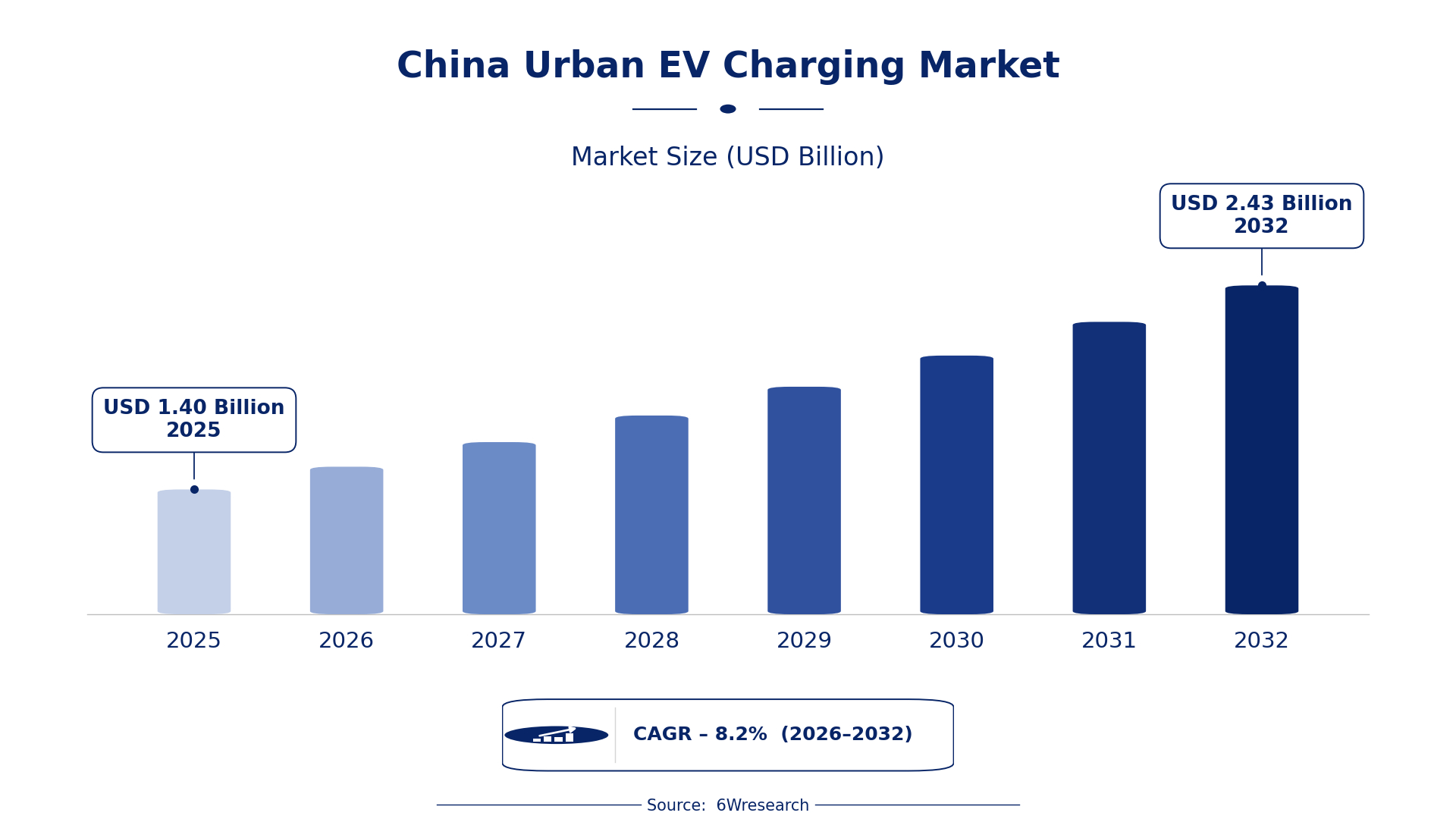
According to 6Wresearch internal database and industry insights, the China Urban EV Charging Market was valued at USD 1.40 billion in 2025 and is projected to reach USD 2.43 billion by 2032, growing at a CAGR of approximately 8.2% during 2026–2032.
China Urban EV Charging Market Highlights
| Report Metric | Details |
| Report Name | China Urban EV Charging Market |
| Market Size 2025 | USD 1.40 billion |
| Market Size 2032 | USD 2.43 billion |
| Absolute Growth 2025–2032 | USD 1.03 billion |
| CAGR 2026–2032 | 8.2% |
| Peak Annual Growth | 10.2% in 2031 |
| Forecast Period | 2026–2032 |
| Historical Data | 2022–2025 |
| Base Year | 2025 |
| Leading Charging Type, 2025 | Fast Chargers (48% share) |
| Leading Installation Type, 2025 | Public Charging Hub (46% share) |
| Leading Vehicle Segment, 2025 | Passenger EVs (37% share) |
| Leading End User, 2025 | EV Drivers (39% share) |
| Fastest-Growing Charging Type | Smart Chargers (10.8% CAGR) |
| Fastest-Growing Installation Type | Residential Installations (10.5% CAGR) |
| Fastest-Growing Vehicle Segment | Light Electric Vehicles (9.6% CAGR) |
| Fastest-Growing End User | Apartment Owners (9.4% CAGR) |
| Growing Sector | Electric Vehicle Infrastructure |
| Key End Users | EV Drivers, Apartment Owners, Municipalities, Urban Fleets |
China Urban EV Charging Market Year-wise Growth Rate and Key Drivers (2022–2032)
This graph illustrates the annual growth rates of the market from 2022 to 2032, highlighting a steady upward trajectory and projected market expansion over the forecast period.
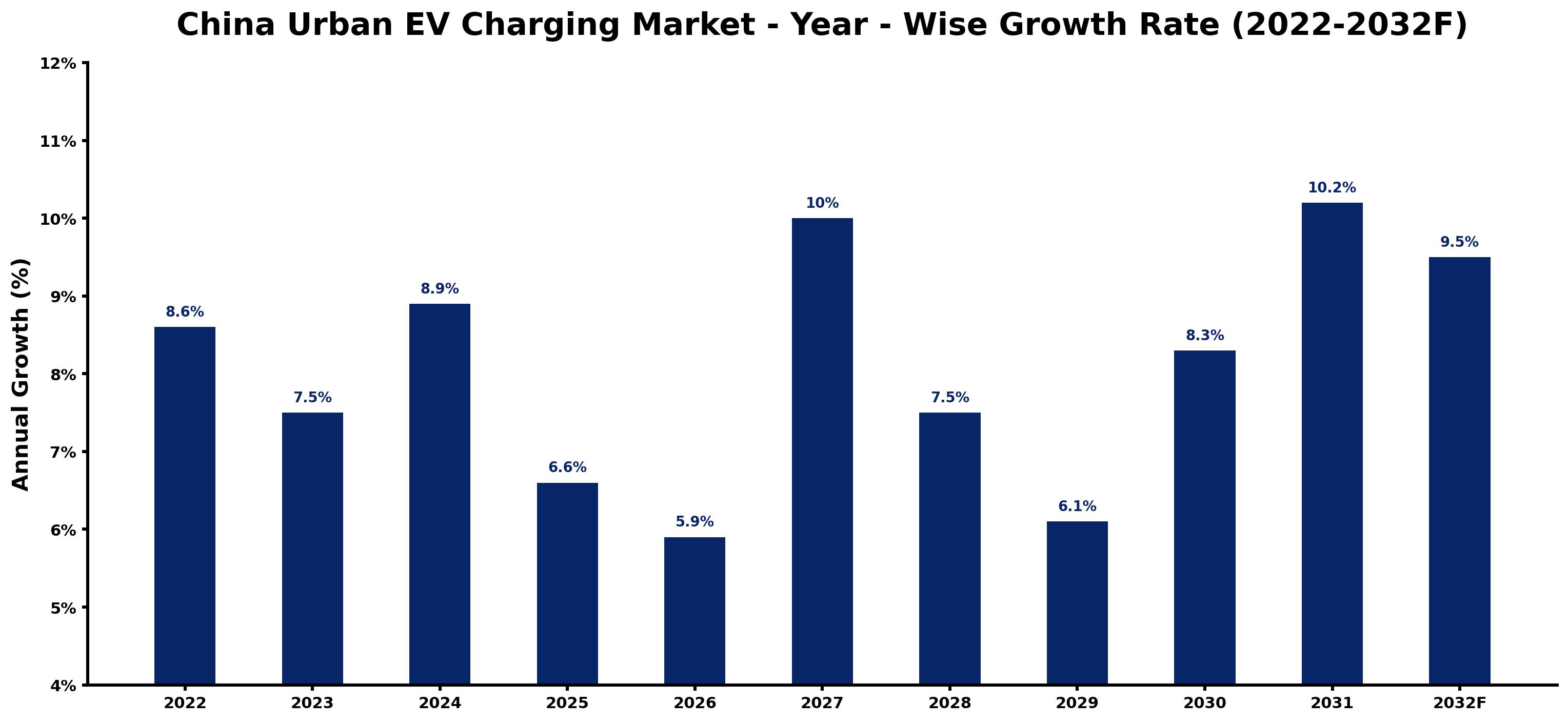
Each row of the following table gives one year's estimated growth and the event or demand shift that explains it.
| Year | Estimated Annual Growth (%) | Market Rationale |
| 2022 | 8.6 | Urban EV Charging demand was strong due to rising electric vehicle sales and infrastructure development. |
| 2023 | 7.5 | Demand slowed as the 'Green Transport Development Action Plan' began to influence infrastructure expansion. |
| 2024 | 8.9 | Demand accelerated with the implementation of the 'Electric Vehicle Promotion and Application Action Plan' promoting electric mobility. |
| 2025 | 6.6 | A slowdown occurred as the market adjusted following rapid growth in previous years. |
| 2026 | 5.9 | Growth is expected to slow as the market matures and competition intensifies. |
| 2027 | 10.0 | Demand is projected to surge with urban fleet electrification initiatives driving infrastructure needs. |
| 2028 | 7.5 | Growth is anticipated to slow as market saturation begins to take effect. |
| 2029 | 6.1 | Demand growth is expected to decline as infrastructure expansion faces logistical challenges. |
| 2030 | 8.3 | Demand will increase again due to rising electric vehicle adoption and supportive policies. |
| 2031 | 10.2 | A peak in growth is projected as urban charging infrastructure expands significantly. |
| 2032 | 9.5 | Growth is expected to slow as the market stabilises after rapid expansion. |
Note: Market size estimations and growth projections presented in this report are based on 6Wresearch's proprietary forecasting methodology, utilizing the latest available industry data, government publications, and primary research inputs.
China Urban EV Charging Market Synopsis
The China Urban EV Charging Market encompasses the infrastructure and technology that supports electric vehicle charging in urban areas, including public charging hubs and smart charging systems. With over 1 million public charging points in 2023, the demand for charging solutions is set to rise as electric vehicle adoption increases. The market is expanding, driven by a growing urban population of 1.4 billion and government initiatives targeting 20% electric vehicle sales by 2025. This combination of factors is creating opportunities for infrastructure development and investment.
Market Dynamics Impact Analysis (2026–2032)
| Factor | Type | Impact | Primary Segment Affected |
| Growing urban population driving demand for EV infrastructure | Driver | High | Public Charging Hub |
| Investment in smart charging technology to improve efficiency | Driver | High | Smart Chargers |
| Increasing need for residential charging solutions | Opportunity | High | Residential Installations |
| Expansion of urban fleet electrification initiatives | Opportunity | High | Urban Fleets |
| Limited charging infrastructure in rural areas | Restraint | High | Public Charging Hub |
| High installation costs for residential charging solutions | Restraint | Medium | Residential Installations |
| Urban EV Charging market faces challenges in infrastructure expansion | Challenge | High | Public Charging Hub |
| Competition among charging service providers is intensifying | Challenge | Medium | Smart Chargers |
Evaluation of Drivers in China Urban EV Charging Market (2026–2032)
Below mentioned are some major drivers and their influence on market dynamics.
| Drivers | Primary Segment Affected | Why It Matters (Evidence) |
| Increasing investment in public charging infrastructure | Public Charging Hub | This investment leads to the installation of over 4.8 million charging points by 2025, improving accessibility for EV drivers. |
| Rising demand for fast chargers due to urban fleet electrification | Fast Chargers | Urban fleets require quick turnaround times, driving the need for 48% of the charging market to be fast chargers. |
| Government initiatives promoting electric vehicle adoption | Smart Chargers | The 'Smart Charging Infrastructure Standard' encourages the installation of smart chargers that improve energy management. |
| Growing number of electric vehicles on the road | Passenger EVs | With 2 million electric vehicles produced in 2023, the demand for charging infrastructure and solutions increases. |
| Subsidies for residential charging installations | Residential Installations | Subsidies make it more affordable for apartment owners to install charging solutions, increasing adoption. |
Growth across the Urban EV Charging market in China is anchored in substantial investments in public charging infrastructure, crucial for accessibility. In 2023, the production of 2 million electric vehicles drove the demand for efficient charging solutions. Urban fleet electrification is pushing the need for fast chargers, as these fleets require quick turnaround times. With over 50% of EV owners in urban areas utilising public charging stations, the demand for reliable infrastructure continues to rise.
Evaluation of Restraints in China Urban EV Charging Market
The main factors holding the market back are set out below.
| Market Restraint | Primary Segment Affected | Why It Matters (Evidence) |
| Limited public charging infrastructure in less populated areas | Public Charging Hub | This lack of infrastructure restricts access for EV drivers in rural regions. |
| High costs associated with residential charging installations | Residential Installations | These costs deter apartment owners from investing in home charging solutions. |
| Slow adoption of wireless charging technology | Wireless Chargers | Limited maturity of the technology restricts its widespread acceptance. |
| Regulatory hurdles for new installations | Public Charging Hub | Complex regulations can delay the deployment of new charging stations. |
| Competition among service providers leading to price wars | Smart Chargers | Intense competition can reduce profitability for charging service providers. |
China Urban EV Charging Market Challenges
In the China Urban EV Charging market, fierce competition among infrastructure providers results in aggressive pricing, which can erode profit margins for producers and limit their capacity to improve service quality. A shortage of skilled technicians hampers installation and maintenance efforts, causing delays for distributors and frustrating buyers who need reliable access to charging facilities. Rapid technological changes pose challenges for suppliers, as they must continually upgrade their systems to comply with new standards, leading to increased costs and potential obsolescence. Supply chain disruptions can also postpone the delivery of crucial components, hindering the expansion of charging networks for urban buyers.
Trends in the China Urban EV Charging Market
Below mentioned are some of the trends shaping the China Urban EV Charging Market growth.
- Shift towards Smart Charging Solutions: EV Drivers are increasingly adopting smart charging solutions, as seen in the rise of smart chargers across urban areas. In 2023, smart chargers accounted for 30% of new installations, improving energy management.
- Expansion of Public Charging Hubs in Urban Areas: Shanghai has seen a rapid increase in public charging stations, with over 200 installed by 2023. This expansion supports the growing urban population's demand for electric vehicle infrastructure.
- Increase in Residential Charging Installations: As of 2023, Beijing's subsidy program for residential EV charging installations has led to a notable rise in home charging solutions. This trend addresses the convenience needs of apartment owners.
- Growth of Fast Charging Infrastructure: The demand for fast chargers is increasing, driven by urban fleet electrification initiatives. In 2023, fast chargers represented 48% of the charging market, reflecting this shift.
Investment Opportunities in the China Urban EV Charging Market
Several openings in the China Urban EV Charging Market merit attention from investors.
- Timing for Investment in Smart Charging Solutions: With the market projected to grow, now is the time to invest in smart charging solutions. The National Intelligent Charging Infrastructure Development Plan aims to install 4.8 million charging points by 2025.
- Supply of Fast Charging Solutions: The increasing need for fast chargers creates an opportunity for suppliers to meet urban fleet demands. Urban fleets require quick turnaround times, making fast chargers essential.
- Residential Charging Solutions for Apartment Owners: With over 50% of EV owners in urban areas using public charging stations, there is a gap in residential charging solutions. Suppliers can partner with municipalities to develop shared charging systems.
- Investment in Public Charging Infrastructure: The government aims to install 4.8 million charging points by 2025, presenting an opportunity for infrastructure providers. Collaborating with local authorities can facilitate entry into this growing market.
Government Initiatives in the China Urban EV Charging Market
The 'Green Transport Development Action Plan' by the State Council, 2022, targets the installation of 4.8 million charging points by 2025. This plan enables municipalities to receive funding for developing public charging infrastructure, ensuring that urban EV drivers have access to necessary solutions. Additionally, the 'Smart Charging Infrastructure Standard' established by the National Standards of China in 2022 promotes interoperability and safety for charging systems, benefiting both producers and users.
Municipalities are utilising the 'Electric Vehicle Charging Infrastructure Construction Plan' initiated by the Ministry of Industry and Information Technology in 2022 to improve public charging accessibility. This plan supports funding for new installations, ensuring that urban EV drivers can access charging solutions conveniently. The implementation of the 'Urban Electric Vehicle Charging Infrastructure Development Guidelines' by the Ministry of Transport in 2022 further standardises charging solutions across cities, promoting uniformity and efficiency.
Future Insight of the China Urban EV Charging Market
The China Urban EV Charging market is poised for transformative developments by 2032, with the government targeting 20% of new vehicle sales to be electric by 2025. Enhanced public investment in charging infrastructure will significantly improve accessibility, particularly in urban centres like Shanghai and Beijing. The 'Smart Charging Infrastructure Standard' will optimise operations and elevate user experience. By 2032, the number of public charging points is projected to exceed 2 million, effectively meeting the rising demand for electric vehicles and bolstering urban fleet electrification initiatives.
Market Segmentation Analysis
The analysis below covers each segmentation, its leading category in 2025 and its fastest-growing category through 2032.
By Charging Type – Fast Chargers Dominated, Smart Chargers Expected to Grow Fastest
According to Bhawna Singh, Assistant Manager at 6Wresearch, in 2025, Fast Chargers led the charging type split with a 48% share. Fast chargers lead the market due to their essential role in enabling quick vehicle turnaround in urban settings, supported by the extensive network of over 1 million public charging points across China. Their importance is underscored by the government's push for electric vehicle adoption, aiming for 20% of new vehicle sales to be electric by 2025. Smart Chargers are projected to grow fastest, at a CAGR of 10.8% during 2026–2032. Smart chargers are experiencing rapid growth as they provide efficient energy management and user convenience, particularly with urban fleet electrification initiatives gaining momentum. The government's initiatives to enhance charging networks by 2025 will likely further propel this segment's expansion. Suppliers must focus on developing smart charging solutions to align with the increasing demand and enhance user satisfaction.
By Installation Type – Public Charging Hub Dominated, Residential Installations Expected to Grow Fastest
With a 46% revenue share in 2025, Public Charging Hub was the largest installation type category. Public charging hubs capture the largest market share due to their vital role in accommodating the needs of China's vast urban population of 1.4 billion. Cities like Shanghai, boasting over 200 public charging stations, highlight the necessity of these hubs for widespread electric vehicle access. Over 2026–2032, Residential Installations are expected to post the fastest growth, at a CAGR of 10.5%. Residential installations are rapidly increasing as they address the growing demand for convenient home charging solutions, particularly with subsidy programmes in cities like Beijing promoting their adoption. This trend is expected to persist as more urban residents shift towards electric vehicles. Buyers should consider investing in residential charging solutions to improve convenience and accessibility for electric vehicle owners.
By Vehicle Segment – Passenger EVs Dominated, Light Electric Vehicles Expected to Grow Fastest
Passenger EVs accounted for a 37% market share by vehicle segment in 2025. Passenger EVs hold the largest share as they are the primary vehicle type using charging infrastructure, driven by government initiatives promoting electric mobility. The substantial production of 2 million electric vehicles in 2023 underscores the importance of this segment. The quickest growth will come from Light Electric Vehicles, forecast to expand at a CAGR of 9.6% between 2026 and 2032. Light electric vehicles are growing rapidly, spurred by urbanisation and the need for efficient transport solutions. While still less prevalent than passenger EVs, their increasing adoption indicates a shift in consumer preferences. Suppliers must adapt their offerings to cater to the rising demand for light electric vehicles alongside traditional passenger EVs.
By End User – EV Drivers Dominated, Apartment Owners Expected to Grow Fastest
EV Drivers took a 39% share of end user in 2025, more than any other category. EV drivers represent the main user group for charging services, with over 50% of urban EV owners relying on public charging stations. This substantial user base drives the need for extensive charging infrastructure across urban areas. Apartment Owners are set to record the highest CAGR in this split, 9.4% over 2026–2032. Apartment owners are increasingly seeking shared charging solutions in residential areas, reflecting the growing demand for convenient charging options. This trend is likely to accelerate as urban populations continue to rise. Suppliers should focus on developing solutions that cater specifically to the needs of apartment owners to tap into this emerging market.
Key Attractiveness of the Report
- 10 Years of Market Numbers
- Historical Data Starting from 2022 to 2025
- Base Year 2025
- Forecast Data until 2032
- Key Performance Indicators Impacting the Market
- Major Upcoming Developments and Projects
Key Highlights of the Report:
- China Urban EV Charging Market Outlook
- Market Size of China Urban EV Charging Market, 2025
- Forecast of China Urban EV Charging Market, 2032
- Historical Data and Forecast of China Urban EV Charging Revenues & Volume for the Period 2022 - 2032F
- China Urban EV Charging Market Trend Evolution
- China Urban EV Charging Market Drivers and Challenges
- China Urban EV Charging Price Trends
- China Urban EV Charging Porter's Five Forces
- China Urban EV Charging Industry Life Cycle
- Historical Data and Forecast of China Urban EV Charging Market Revenues & Volume By Charging Type for the Period 2022 - 2032F
- Historical Data and Forecast of China Urban EV Charging Market Revenues & Volume By Fast Chargers for the Period 2022 - 2032F
- Historical Data and Forecast of China Urban EV Charging Market Revenues & Volume By Smart Chargers for the Period 2022 - 2032F
- Historical Data and Forecast of China Urban EV Charging Market Revenues & Volume By Wireless Chargers for the Period 2022 - 2032F
- Historical Data and Forecast of China Urban EV Charging Market Revenues & Volume By Battery Swapping for the Period 2022 - 2032F
- Historical Data and Forecast of China Urban EV Charging Market Revenues & Volume By Installation Type for the Period 2022 - 2032F
- Historical Data and Forecast of China Urban EV Charging Market Revenues & Volume By Public Charging Hub for the Period 2022 - 2032F
- Historical Data and Forecast of China Urban EV Charging Market Revenues & Volume By Residential Installations for the Period 2022 - 2032F
- Historical Data and Forecast of China Urban EV Charging Market Revenues & Volume By Road-Embedded for the Period 2022 - 2032F
- Historical Data and Forecast of China Urban EV Charging Market Revenues & Volume By Modular Units for the Period 2022 - 2032F
- Historical Data and Forecast of China Urban EV Charging Market Revenues & Volume By Vehicle Segment for the Period 2022 - 2032F
- Historical Data and Forecast of China Urban EV Charging Market Revenues & Volume By Passenger EVs for the Period 2022 - 2032F
- Historical Data and Forecast of China Urban EV Charging Market Revenues & Volume By Light Electric Vehicles for the Period 2022 - 2032F
- Historical Data and Forecast of China Urban EV Charging Market Revenues & Volume By Urban Fleets for the Period 2022 - 2032F
- Historical Data and Forecast of China Urban EV Charging Market Revenues & Volume By Two- & Three-Wheelers for the Period 2022 - 2032F
- Historical Data and Forecast of China Urban EV Charging Market Revenues & Volume By End User for the Period 2022 - 2032F
- Historical Data and Forecast of China Urban EV Charging Market Revenues & Volume By EV Drivers for the Period 2022 - 2032F
- Historical Data and Forecast of China Urban EV Charging Market Revenues & Volume By Apartment Owners for the Period 2022 - 2032F
- Historical Data and Forecast of China Urban EV Charging Market Revenues & Volume By Municipalities for the Period 2022 - 2032F
- Historical Data and Forecast of China Urban EV Charging Market Revenues & Volume By Delivery Aggregators for the Period 2022 - 2032F
- China Urban EV Charging Import Export Trade Statistics
- Market Opportunity Assessment By Charging Type
- Market Opportunity Assessment By Installation Type
- Market Opportunity Assessment By Vehicle Segment
- Market Opportunity Assessment By End User
- China Urban EV Charging Top Companies Market Share
- China Urban EV Charging Competitive Benchmarking By Technical and Operational Parameters
- China Urban EV Charging Company Profiles
- China Urban EV Charging Key Strategic Recommendations
Market Covered
This report examines the market across the segments below.
By Charging Type
- Fast Chargers
- Smart Chargers
- Wireless Chargers
- Battery Swapping
By Installation Type
- Public Charging Hub
- Residential Installations
- Road-Embedded
- Modular Units
By Vehicle Segment
- Passenger EVs
- Light Electric Vehicles
- Urban Fleets
- Two- & Three-Wheelers
By End User
- EV Drivers
- Apartment Owners
- Municipalities
- Delivery Aggregators































