India Urban Infrastructure Automation Market Size & Growth Rate
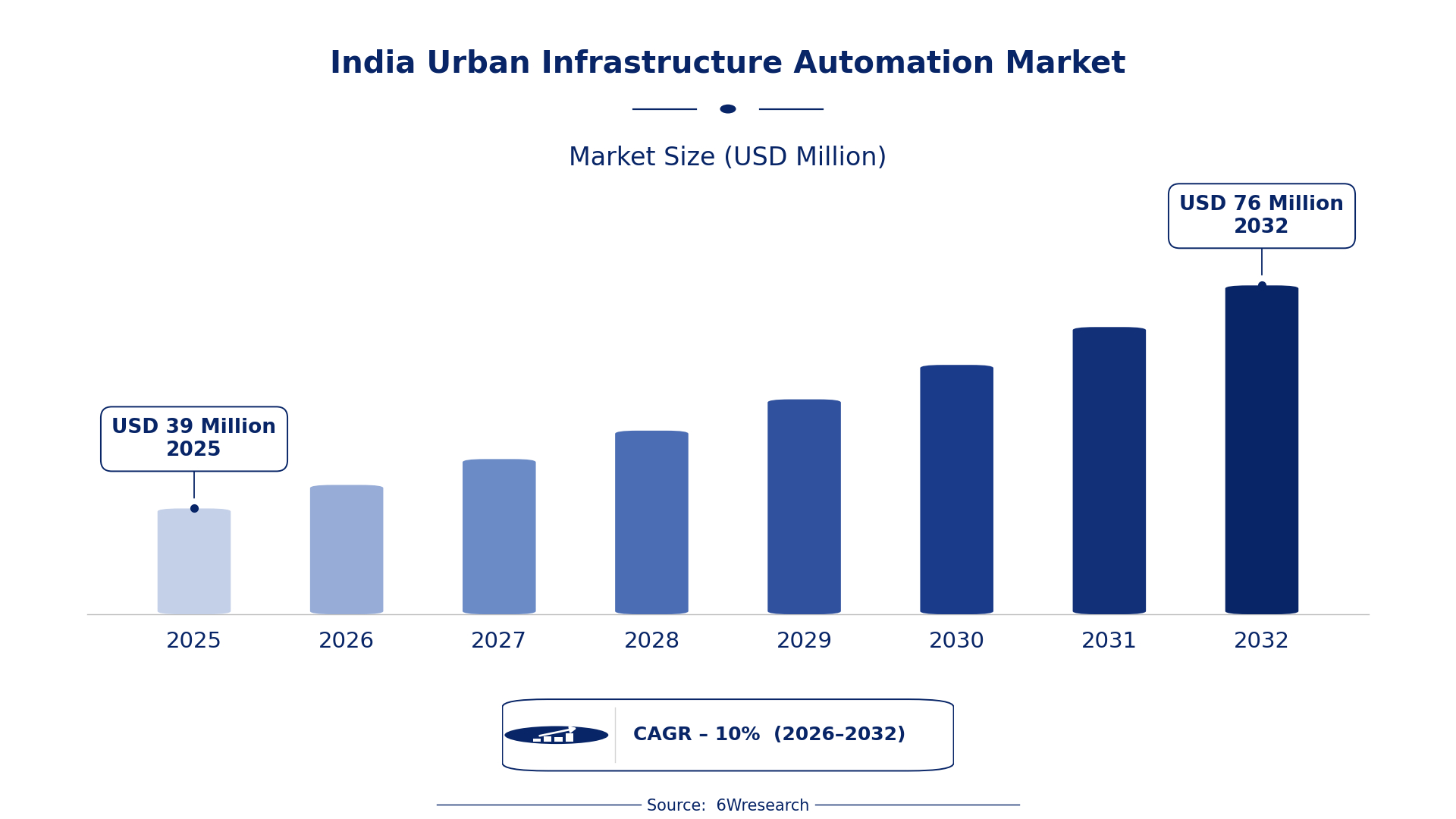
According to 6Wresearch internal database and industry insights, the India Urban Infrastructure Automation Market was valued at USD 39.0 million in 2025 and is projected to reach USD 76 million by 2032, growing at a CAGR of approximately 10% during 2026–2032.
India Urban Infrastructure Automation Market Highlights
| Report Metric | Details |
| Report Name | India Urban Infrastructure Automation Market |
| Market Size 2025 | USD 39.0 million |
| Market Size 2032 | USD 76 million |
| Absolute Growth 2025–2032 | USD 37 million |
| CAGR 2026–2032 | 10% |
| Peak Annual Growth | 12.1% in 2027 |
| Forecast Period | 2026–2032 |
| Historical Data | 2022–2025 |
| Base Year | 2025 |
| Leading Automation Type, 2025 | Traffic Management (40% share) |
| Leading Infrastructure Segment, 2025 | Smart Roads (38% share) |
| Leading Technology Used, 2025 | AI + IoT (37% share) |
| Leading End User, 2025 | City Governments (45% share) |
| Fastest-Growing Automation Type | Energy Automation (11.2% CAGR) |
| Fastest-Growing Technology Used | SCADA Systems (12.0% CAGR) |
| Fastest-Growing End User | Urban Developers (11.3% CAGR) |
| Growing Sector | Urban Infrastructure |
| Key End Users | City Governments, Utility Providers, Urban Developers, Municipal Corporations |
India Urban Infrastructure Automation Market Year-wise Growth Rate and Key Drivers (2022–2032)
This graph illustrates the annual growth rates of the market from 2022 to 2032, highlighting a steady upward trajectory and projected market expansion over the forecast period.
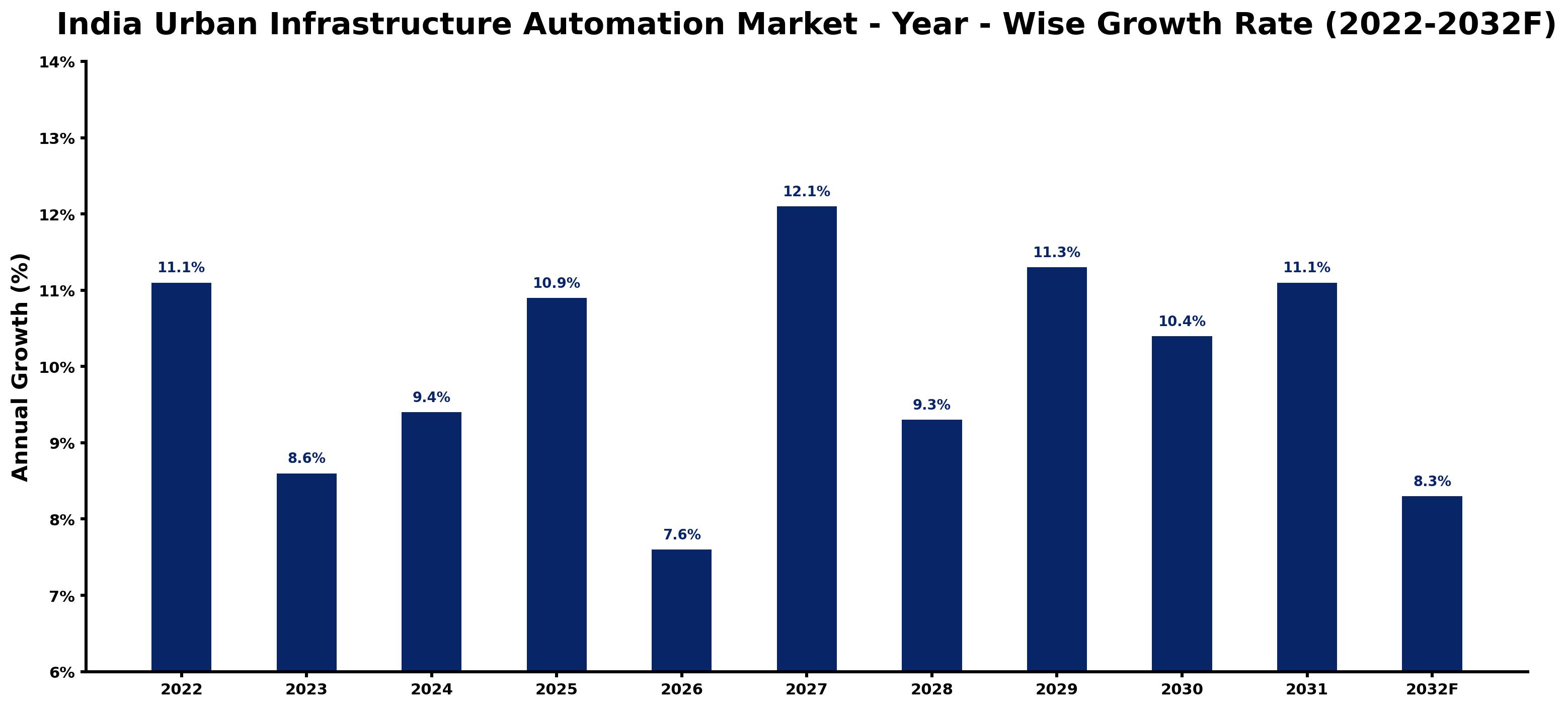
Year by year, the estimates below pair each growth rate with the development that shaped it.
| Year | Estimated Annual Growth (%) | Market Rationale |
| 2022 | 11.1 | The market exhibited strong demand from city governments focusing on infrastructure improvements. |
| 2023 | 8.6 | Growth slowed due to adjustments in project timelines and resource allocation. |
| 2024 | 9.4 | Increased investments in smart city projects accelerated market expansion. |
| 2025 | 10.9 | Demand rose as cities implemented more automation technologies for efficiency. |
| 2026 | 7.6 | A slowdown occurred as some projects faced regulatory hurdles and delays. |
| 2027 | 12.1 | The market peaked due to heightened investments in smart infrastructure initiatives. |
| 2028 | 9.3 | Growth slowed as cities reassessed their automation strategies and budgets. |
| 2029 | 11.3 | Demand surged as urban developers adopted more automation solutions. |
| 2030 | 10.4 | The market experienced slower growth as some projects reached completion. |
| 2031 | 11.1 | Increased focus on sustainability drove demand for automation technologies. |
| 2032 | 8.3 | The Smart Cities Mission 2.0 will drive demand as cities implement advanced automation solutions. |
Note: Market size estimations and growth projections presented in this report are based on 6Wresearch's proprietary forecasting methodology, utilizing the latest available industry data, government publications, and primary research inputs.
India Urban Infrastructure Automation Market Synopsis
The India Urban Infrastructure Automation Market involves integrating advanced technologies to improve urban services. This includes systems like AI, IoT, and SCADA for traffic management, energy distribution, and waste management. The market is expanding due to India's urban population, projected to reach 600 million by 2031, and initiatives like the Smart Cities Mission, which aims to develop 100 smart cities across the country. City governments and utility providers are key buyers, driving the adoption of automation technologies to improve efficiency and sustainability.
Market Dynamics Impact Analysis (2026–2032)
| Factor | Type | Impact | Primary Segment Affected |
| Increasing urban population driving demand for efficient infrastructure management | Driver | High | Traffic Management |
| Investment in smart city initiatives enhancing urban infrastructure | Driver | High | Energy Automation |
| Growing need for modern waste management solutions in urban areas | Opportunity | Medium | Waste Automation |
| Rising demand for building automation systems in new developments | Opportunity | Medium | Building Automation |
| Challenges in project financing and budget allocation for automation | Restraint | High | Smart Roads |
| Regulatory hurdles delaying the implementation of automation technologies | Restraint | Medium | Power Grids |
| Limited skilled workforce to manage advanced automation systems | Challenge | High | Public Structures |
| Competition among suppliers leading to price pressures | Challenge | Medium | Underground Bins |
Evaluation of Drivers in India Urban Infrastructure Automation Market (2026–2032)
The factors lifting demand, and the evidence behind each, are summarised below.
| Drivers | Primary Segment Affected | Why It Matters (Evidence) |
| Integration of AI and IoT technologies for real-time monitoring | Energy Automation | This integration allows utility providers to optimise energy distribution, resulting in increased purchases of automation systems. |
| Government initiatives promoting smart city projects | Traffic Management | The Smart Cities Mission encourages city governments to invest in advanced traffic management solutions, boosting demand for automation technologies. |
| Growing urban population necessitating efficient waste management | Waste Automation | With urban populations rising, municipal corporations are investing in automated waste management systems to improve operational efficiency. |
| Increased focus on energy efficiency in commercial buildings | Building Automation | City governments are implementing building automation technologies to improve energy efficiency and occupant comfort. |
| Development of standards for smart city infrastructure | Smart Roads | The Bureau of Indian Standards' guidelines support the adoption of smart road technologies by urban developers. |
Market growth in India for Urban Infrastructure Automation rests on substantial investments in smart city projects, increased demand for efficient energy distribution, and the integration of advanced technologies. As India's urban population reaches 600 million by 2031, utility providers are increasingly adopting automation technologies to meet rising service demands. Cities like Bengaluru and Pune are leading in implementing smart traffic management systems, resulting in improved urban mobility. The focus on energy efficiency is prompting city governments to adopt building automation technologies, further boosting market demand.
Evaluation of Restraints in India Urban Infrastructure Automation Market
Below mentioned are some major restraints and their influence on market dynamics.
| Market Restraint | Primary Segment Affected | Why It Matters (Evidence) |
| Budget constraints limiting investment in automation technologies | Smart Roads | City governments face financial limitations, restricting their ability to implement advanced automation solutions. |
| Regulatory challenges hindering project approvals | Power Grids | Complex regulations can delay the deployment of modern power distribution systems, impacting market growth. |
| Shortage of skilled professionals to manage automation systems | Public Structures | The lack of trained personnel affects the effective implementation and maintenance of urban automation technologies. |
| High initial costs associated with automation technologies | Waste Automation | Municipal corporations may hesitate to invest in advanced waste management systems due to upfront expenses. |
| Competition leading to price wars among suppliers | Underground Bins | Intense competition can drive down prices, affecting profit margins for suppliers in the market. |
India Urban Infrastructure Automation Market Challenges
Buyers and suppliers in the India Urban Infrastructure Automation market encounter intense competition, as numerous firms compete for a limited number of contracts, resulting in price reductions that can erode profit margins by 15%. Supply chain disruptions lead to delays in project execution, with sourcing components often extending timelines by up to six months for urban developers. A shortage of skilled workers in automation technologies complicates implementation, with only 30% of the workforce adequately trained, causing project delays for utility providers. Rapid technological advancements outpace existing infrastructure capabilities, leading to inefficiencies in service delivery for city governments.
Trends in the India Urban Infrastructure Automation Market
Below mentioned are some of the trends shaping the India Urban Infrastructure Automation Market growth.
- Launch of Smart Cities Mission 2.0: In 2023, the Ministry of Urban Affairs introduced Smart Cities Mission 2.0, which includes a budget of ₹10,000 crore over five years. This initiative is set to drive investments in automation technologies across various cities.
- Shift towards AI and IoT integration: Cities are increasingly adopting AI and IoT technologies to improve urban management. For instance, Bengaluru has implemented smart traffic systems, leading to a 20% reduction in congestion during peak hours.
- Growth of SCADA Systems in Urban Infrastructure: The adoption of SCADA systems is rising as cities modernise their infrastructure. The National Smart Grid Mission aims to enhance power distribution networks, with a target of 50% automation by 2025.
- Increased focus on sustainable waste management: Municipal corporations are prioritising smart waste management solutions to improve efficiency. In 2023, a government programme incentivised the adoption of smart waste systems, aiming for a 30% reduction in operational costs.
Investment Opportunities in the India Urban Infrastructure Automation Market
Some of the investment opportunities in the India Urban Infrastructure Automation Market are mentioned below.
- Partnerships with local governments: Now is the time to invest in smart city technologies, as city governments seek partners for automation projects. Collaborating with municipal corporations can lead to substantial contracts in urban infrastructure.
- Supply of energy automation solutions: With the rising need for efficient energy distribution, suppliers should focus on AI and IoT technologies. Urban developers are increasingly seeking these solutions to optimise energy consumption.
- Development of smart traffic management systems: City governments are looking for innovative traffic management solutions to reduce congestion. Investing in advanced AI-driven systems can meet this growing demand effectively.
- Expansion into building automation markets: As urban developments increase, there is a significant opportunity to supply building automation technologies. The focus on energy efficiency in new constructions presents a timely investment opportunity.
Government Initiatives in the India Urban Infrastructure Automation Market
In 2023, the Ministry of Urban Affairs launched the Smart Cities Mission 2.0, which aims to enhance urban infrastructure automation with a budget of ₹10,000 crore over five years. This initiative builds on the previous Smart Cities Mission, which focused on developing 100 smart cities across India. The updated mission prioritises the integration of automation technologies to improve urban services, ensuring that city governments have the resources to implement these advancements. Additionally, the National Smart Grid Mission, initiated in 2020, continues to modernise power distribution networks, further supporting urban infrastructure automation. These measures collectively enhance the operational efficiency of urban services, benefiting both producers and buyers in the market.
In 2022, the Ministry of Housing and Urban Affairs allocated ₹1,000 crore for smart city projects, promoting automation technologies in urban developments. The National Institute of Urban Affairs plays a vital role in conducting research and providing guidelines for urban automation technologies. Furthermore, the Bureau of Indian Standards oversees the establishment of standards for smart city infrastructure automation, ensuring compliance and quality in implementation. These agencies are crucial for approving projects and funding initiatives that drive the adoption of automation in urban infrastructure, ultimately benefiting city governments and utility providers.
Future Insight of the India Urban Infrastructure Automation Market
The India Urban Infrastructure Automation market will undergo substantial changes by 2032, driven by government initiatives and the integration of advanced technologies. The Smart Cities Mission will expand to develop 100 smart cities, significantly enhancing urban infrastructure and services. A ₹1,000 crore investment in smart city projects will boost automation adoption, particularly in waste management and energy distribution. The National Smart Grid Mission will modernise power distribution, improving energy management processes and service reliability for urban developers and utility providers.
Market Segmentation Analysis
The analysis below covers each segmentation, its leading category in 2025 and its fastest-growing category through 2032.
By Automation Type – Traffic Management Dominated, Energy Automation Expected to Grow Fastest
According to Bhawna Singh, Assistant Manager at 6Wresearch, Traffic Management took a 40% share of automation type in 2025, more than any other category. Traffic management holds the largest share in India’s urban infrastructure automation market due to its critical role in alleviating congestion in densely populated areas. For instance, cities like Bengaluru and Pune are actively implementing advanced traffic management systems to improve urban mobility and efficiency. Energy Automation is projected to grow fastest, at a CAGR of 11.2% during 2026–2032. Energy automation is experiencing rapid growth as urban centres strive to optimise energy distribution amidst increasing demand. The government's allocation of ₹1,000 crore for smart city projects highlights the urgency for adopting energy automation technologies. Suppliers should focus on developing tailored solutions for traffic management and energy automation to meet the rising demand from city governments.
By Infrastructure Segment – Smart Roads Dominated and Is Expected to Record the Fastest Growth
With a 38% revenue share in 2025, Smart Roads was the largest infrastructure segment category. Smart roads dominate the market share as they are essential for implementing advanced traffic management systems and enhancing road safety. The Smart Cities Mission prioritises smart road initiatives to improve urban mobility and infrastructure efficiency. Its lead should widen, with a projected CAGR of 12.1% during 2026–2032, the highest in this split. Smart roads are also the fastest-growing segment, driven by the pressing need for integrated traffic management solutions in urban settings. The ongoing push for smart city initiatives ensures sustained investment and development in smart roads. This trend indicates that suppliers should concentrate on innovations in smart road technologies to align with urban development goals.
By Technology Used – AI + IoT Dominated, SCADA Systems Expected to Grow Fastest
AI + IoT accounted for a 37% market share by technology used in 2025. AI combined with IoT technologies leads the market share as they provide crucial capabilities for smart city solutions through data-driven insights. Their integration into urban infrastructure is essential for real-time monitoring and effective management of urban services. Over 2026–2032, SCADA Systems are expected to post the fastest growth, at a CAGR of 12.0%. SCADA systems represent the fastest-growing technology segment, vital for monitoring and controlling urban infrastructure operations. The increasing complexity of urban systems drives the demand for SCADA to ensure effective management and operational efficiency. Vendors should consider enhancing SCADA offerings to capitalise on the growing need for comprehensive urban infrastructure management solutions.
By End User – City Governments Dominated, Urban Developers Expected to Grow Fastest
The largest end user category in 2025 was City Governments, with a 45% share of total revenue. City governments account for the largest share of the market as they are the primary users implementing automation to enhance urban management. Their commitment to improving living standards fuels the demand for advanced infrastructure solutions. Urban Developers are set to record the highest CAGR in this split, 11.3% over 2026–2032. Urban developers are the fastest-growing end user group, significantly integrating automation into new developments to address contemporary urban challenges. This trend is expected to accelerate as urbanisation continues to expand. Suppliers should target urban developers with innovative automation solutions to take advantage of this expanding market segment.
Key Attractiveness of the Report
- 10 Years of Market Numbers
- Historical Data Starting from 2022 to 2025
- Base Year 2025
- Forecast Data until 2032
- Key Performance Indicators Impacting the Market
- Major Upcoming Developments and Projects
Key Highlights of the Report:
- India Urban Infrastructure Automation Market Outlook
- Market Size of India Urban Infrastructure Automation Market, 2025
- Forecast of India Urban Infrastructure Automation Market, 2032
- Historical Data and Forecast of India Urban Infrastructure Automation Revenues & Volume for the Period 2022 - 2032F
- India Urban Infrastructure Automation Market Trend Evolution
- India Urban Infrastructure Automation Market Drivers and Challenges
- India Urban Infrastructure Automation Price Trends
- India Urban Infrastructure Automation Porter's Five Forces
- India Urban Infrastructure Automation Industry Life Cycle
- Historical Data and Forecast of India Urban Infrastructure Automation Market Revenues & Volume By Automation Type for the Period 2022 - 2032F
- Historical Data and Forecast of India Urban Infrastructure Automation Market Revenues & Volume By Traffic Management for the Period 2022 - 2032F
- Historical Data and Forecast of India Urban Infrastructure Automation Market Revenues & Volume By Energy Automation for the Period 2022 - 2032F
- Historical Data and Forecast of India Urban Infrastructure Automation Market Revenues & Volume By Building Automation for the Period 2022 - 2032F
- Historical Data and Forecast of India Urban Infrastructure Automation Market Revenues & Volume By Waste Automation for the Period 2022 - 2032F
- Historical Data and Forecast of India Urban Infrastructure Automation Market Revenues & Volume By Infrastructure Segment for the Period 2022 - 2032F
- Historical Data and Forecast of India Urban Infrastructure Automation Market Revenues & Volume By Smart Roads for the Period 2022 - 2032F
- Historical Data and Forecast of India Urban Infrastructure Automation Market Revenues & Volume By Power Grids for the Period 2022 - 2032F
- Historical Data and Forecast of India Urban Infrastructure Automation Market Revenues & Volume By Public Structures for the Period 2022 - 2032F
- Historical Data and Forecast of India Urban Infrastructure Automation Market Revenues & Volume By Underground Bins for the Period 2022 - 2032F
- Historical Data and Forecast of India Urban Infrastructure Automation Market Revenues & Volume By Technology Used for the Period 2022 - 2032F
- Historical Data and Forecast of India Urban Infrastructure Automation Market Revenues & Volume By AI + IoT for the Period 2022 - 2032F
- Historical Data and Forecast of India Urban Infrastructure Automation Market Revenues & Volume By SCADA Systems for the Period 2022 - 2032F
- Historical Data and Forecast of India Urban Infrastructure Automation Market Revenues & Volume By BMS for the Period 2022 - 2032F
- Historical Data and Forecast of India Urban Infrastructure Automation Market Revenues & Volume By Sensor-Based Systems for the Period 2022 - 2032F
- Historical Data and Forecast of India Urban Infrastructure Automation Market Revenues & Volume By End User for the Period 2022 - 2032F
- Historical Data and Forecast of India Urban Infrastructure Automation Market Revenues & Volume By City Governments for the Period 2022 - 2032F
- Historical Data and Forecast of India Urban Infrastructure Automation Market Revenues & Volume By Utility Providers for the Period 2022 - 2032F
- Historical Data and Forecast of India Urban Infrastructure Automation Market Revenues & Volume By Urban Developers for the Period 2022 - 2032F
- Historical Data and Forecast of India Urban Infrastructure Automation Market Revenues & Volume By Municipal Corporations for the Period 2022 - 2032F
- India Urban Infrastructure Automation Import Export Trade Statistics
- Market Opportunity Assessment By Automation Type
- Market Opportunity Assessment By Infrastructure Segment
- Market Opportunity Assessment By Technology Used
- Market Opportunity Assessment By End User
- India Urban Infrastructure Automation Top Companies Market Share
- India Urban Infrastructure Automation Competitive Benchmarking By Technical and Operational Parameters
- India Urban Infrastructure Automation Company Profiles
- India Urban Infrastructure Automation Key Strategic Recommendations
Market Covered
Segments analysed in this report are listed below.
By Automation Type
- Traffic Management
- Energy Automation
- Building Automation
- Waste Automation
By Infrastructure Segment
- Smart Roads
- Power Grids
- Public Structures
- Underground Bins
By Technology Used
- AI + IoT
- SCADA Systems
- BMS
- Sensor-Based Systems
By End User
- City Governments
- Utility Providers
- Urban Developers
- Municipal Corporations































