China Urban Infrastructure Automation Market Size & Growth Rate
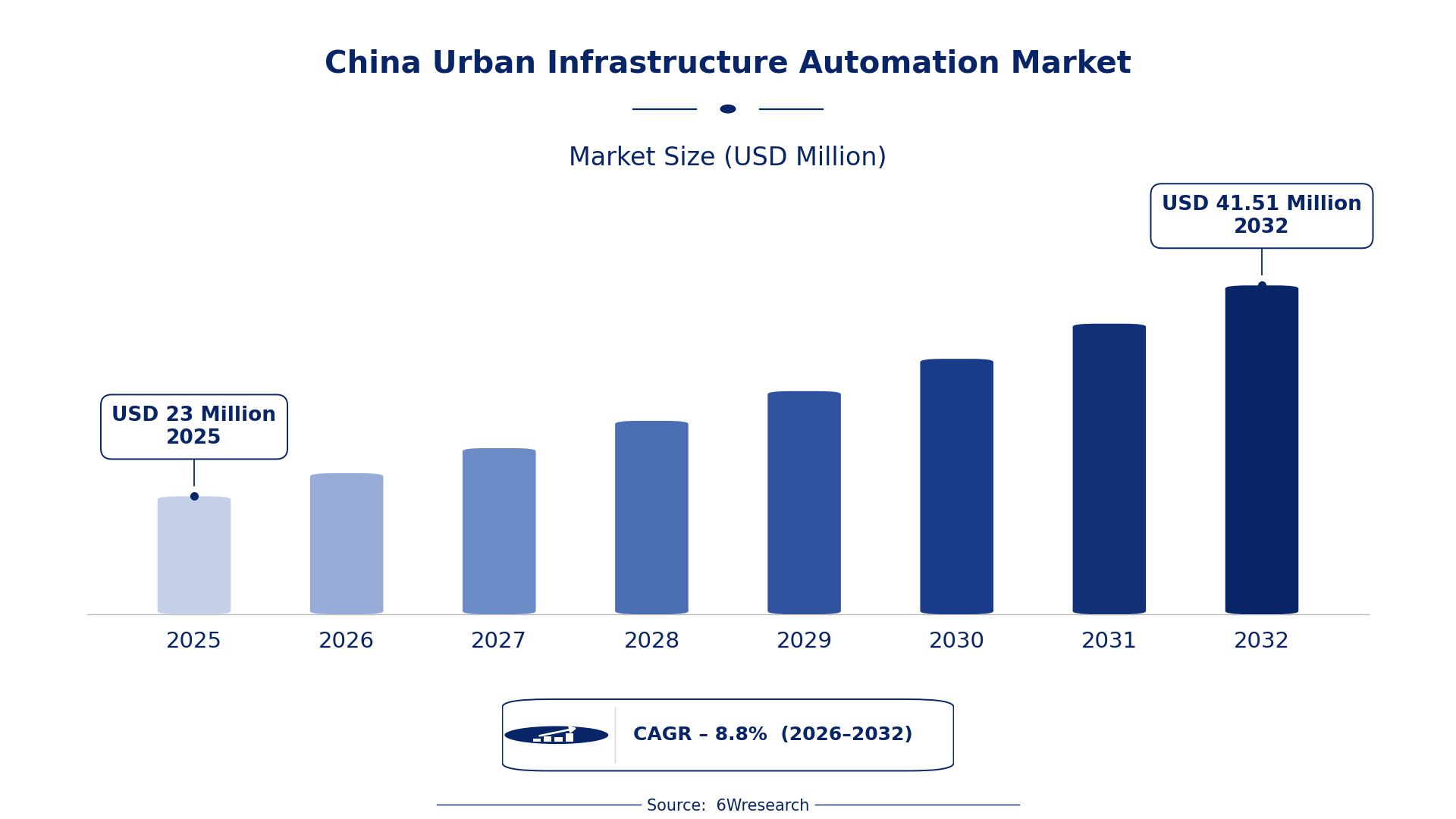
According to 6Wresearch internal database and industry insights, the China Urban Infrastructure Automation Market was valued at USD 23.0 million in 2025 and is projected to reach USD 41.51 million by 2032, growing at a CAGR of approximately 8.8% during 2026–2032.
China Urban Infrastructure Automation Market Highlights
| Report Metric | Details |
| Report Name | China Urban Infrastructure Automation Market |
| Market Size 2025 | USD 23.0 million |
| Market Size 2032 | USD 41.51 million |
| Absolute Growth 2025–2032 | USD 18.51 million |
| CAGR 2026–2032 | 8.8% |
| Peak Annual Growth | 11.0% in 2027 |
| Forecast Period | 2026–2032 |
| Historical Data | 2022–2025 |
| Base Year | 2025 |
| Leading Automation Type, 2025 | Traffic Management (42% share) |
| Leading Infrastructure Segment, 2025 | Smart Roads (49% share) |
| Leading Technology Used, 2025 | AI + IoT (37% share) |
| Leading End User, 2025 | City Governments (45% share) |
| Fastest-Growing Automation Type | Energy Automation (10.7% CAGR) |
| Fastest-Growing Technology Used | SCADA Systems (11.2% CAGR) |
| Fastest-Growing End User | Municipal Corporations (10.4% CAGR) |
| Growing Sector | Traffic Management |
| Key End Users | City Governments, Municipal Corporations, Utility Providers |
China Urban Infrastructure Automation Market Year-wise Growth Rate and Key Drivers (2022–2032)
This graph illustrates the annual growth rates of the market from 2022 to 2032, highlighting a steady upward trajectory and projected market expansion over the forecast period.
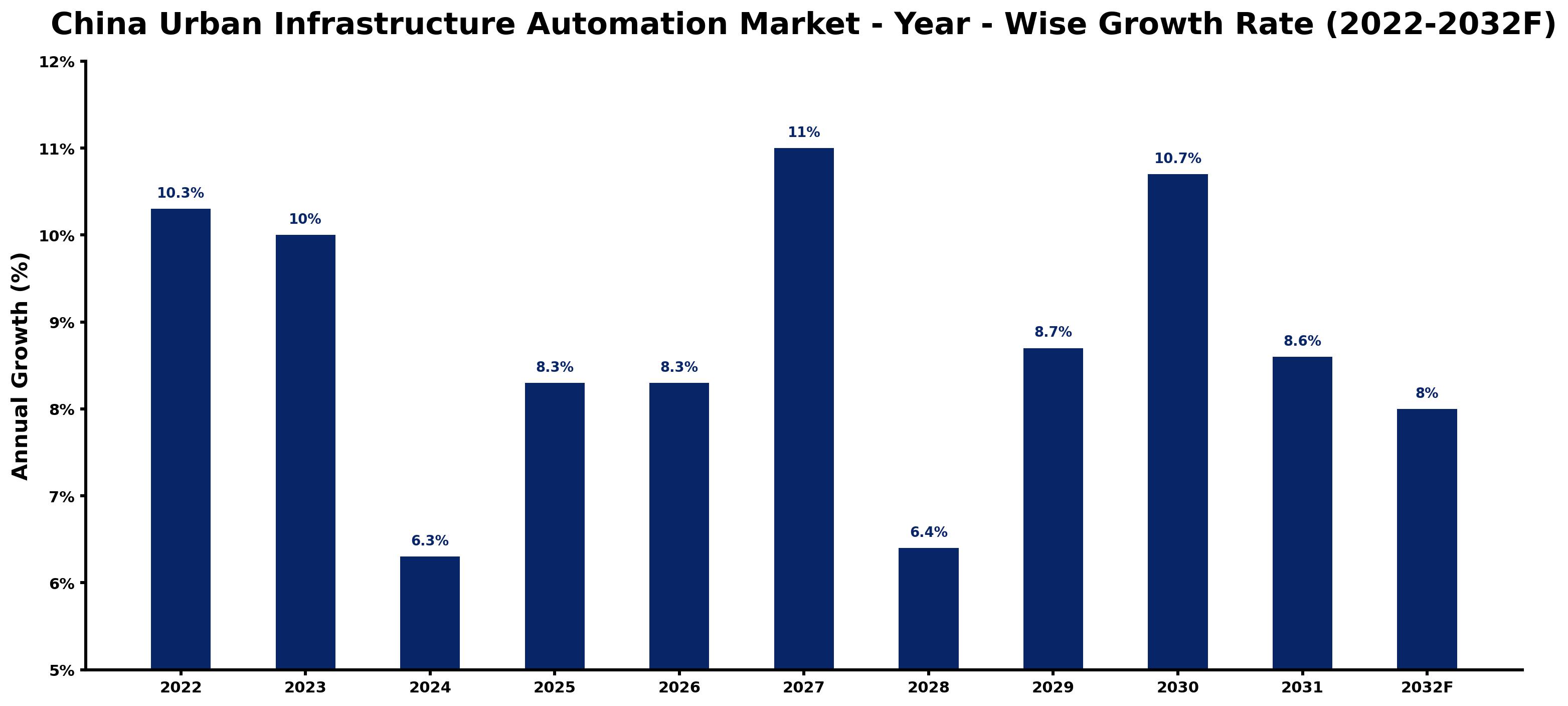
The following table presents the estimated annual growth rate for each year together with the principal factor influencing market performance.
| Year | Estimated Annual Growth (%) | Market Rationale |
| 2022 | 10.3 | The market experienced strong demand due to urbanisation and investment in smart city projects. |
| 2023 | 10.0 | Demand remained robust as cities focused on implementing smart technologies for urban management. |
| 2024 | 6.3 | The market continued to grow, driven by the completion of several major automation projects. |
| 2025 | 8.3 | Investment in traffic management automation projects accelerated, boosting market performance. |
| 2026 | 8.3 | Growth is expected to slow again as the market adjusts to previous high levels of investment. |
| 2027 | 11.0 | A surge in demand for automation technologies is projected to drive growth to its peak this year. |
| 2028 | 6.4 | The market will see a slowdown as the focus shifts to optimising existing systems and technologies. |
| 2029 | 8.7 | A renewed interest in energy automation technologies is expected to lead to increased investments and growth. |
| 2030 | 10.7 | Demand is projected to rise again as cities continue to adopt advanced automation solutions for infrastructure. |
| 2031 | 8.6 | Growth is expected to slow as the market stabilises after several years of rapid expansion. |
| 2032 | 8.0 | The market is projected to maintain steady growth as urban infrastructure needs evolve. |
Note: Market size estimations and growth projections presented in this report are based on 6Wresearch's proprietary forecasting methodology, utilizing the latest available industry data, government publications, and primary research inputs.
China Urban Infrastructure Automation Market Synopsis
Urban Infrastructure Automation in China focuses on integrating advanced technologies to enhance the management of urban services. This encompasses areas such as traffic management, energy distribution, and waste management using AI and IoT solutions. The China Urban Infrastructure Automation Market is expanding, with the urban population reaching 1.4 billion in 2023. Major investments, including Beijing's 10 billion RMB in traffic automation, are propelling demand for smart city technologies, especially among city governments and municipal corporations. As urbanisation progresses, the requirement for efficient infrastructure solutions is becoming increasingly urgent.
Market Dynamics Impact Analysis (2026–2032)
| Factor | Type | Impact | Primary Segment Affected |
| Investment in smart city projects drives demand for automation technologies. | Driver | High | Traffic Management |
| The need for efficient energy distribution systems creates opportunities for automation. | Driver | High | Energy Automation |
| Growing urban populations require enhanced infrastructure solutions. | Opportunity | High | Building Automation |
| The shift towards sustainable urban practices opens new markets for automation. | Opportunity | Medium | Waste Automation |
| High initial costs of automation technologies can deter adoption. | Restraint | High | Traffic Management |
| Limited skilled workforce for implementing advanced technologies hampers growth. | Restraint | Medium | Energy Automation |
| Regulatory challenges can delay project approvals and implementations. | Challenge | High | Building Automation |
| Rapid technological changes require continuous investment and adaptation. | Challenge | Medium | Waste Automation |
Evaluation of Drivers in China Urban Infrastructure Automation Market (2026–2032)
The main growth drivers and the segments they affect most are set out below.
| Drivers | Primary Segment Affected | Why It Matters (Evidence) |
| Investment in smart city projects | Traffic Management | Beijing's 10 billion RMB investment in traffic management automation in 2022 boosts demand. |
| Need for efficient energy distribution | Energy Automation | The '13th Five-Year Plan' emphasises smart grids, driving investments in energy automation. |
| Urban population growth | Building Automation | China's urban population reached 1.4 billion in 2023, increasing demand for building automation. |
| Focus on sustainability | Waste Automation | The 'Green Urban Infrastructure Plan' promotes sustainable practices, increasing automation in waste management. |
| Technological advancements in AI and IoT | Traffic Management | 70% of major cities adopted AI and IoT technologies for urban management in 2023. |
Growth in the Urban Infrastructure Automation market in China is driven by heightened investment in smart city projects, urban population growth, and the demand for effective energy distribution. In 2022, Beijing allocated 10 billion RMB for traffic management automation, boosting demand. The urban population reached 1.4 billion in 2023, creating a strong need for building automation solutions. The 'Green Urban Infrastructure Plan' promotes sustainable practices, further stimulating waste automation projects. Additionally, 70% of major cities adopted AI and IoT technologies for urban management in 2023, leading to increased purchases of automation systems.
Evaluation of Restraints in China Urban Infrastructure Automation Market
The key brakes on demand, and where they bite hardest, are shown below.
| Market Restraint | Primary Segment Affected | Why It Matters (Evidence) |
| High initial costs of automation technologies | Traffic Management | The upfront investment required for smart traffic systems can deter city governments from adopting them. |
| Limited skilled workforce for advanced technology implementation | Energy Automation | A shortage of qualified professionals hinders the effective deployment of energy automation solutions. |
| Regulatory challenges delaying project approvals | Building Automation | Complex approval processes can slow down the implementation of building automation technologies. |
| Rapid technological changes requiring continuous investment | Waste Automation | Frequent updates in technology necessitate ongoing investments, straining municipal budgets. |
| Integration issues with existing infrastructure | Traffic Management | Legacy systems can complicate the integration of new automation technologies, delaying projects. |
China Urban Infrastructure Automation Market Challenges
The China Urban Infrastructure Automation market still has to solve a few problems, and the first is supply chain disruptions. These disruptions can delay project timelines for producers, increasing costs by up to 20% and risking penalties for late delivery. Regulatory hurdles also pose challenges, as compliance with building automation standards can slow down implementation for buyers, costing them valuable time and resources. Complex technology integration makes it difficult for producers to deliver cohesive solutions, frustrating buyers and potentially causing project overruns. A shortage of skilled workers in the sector hampers growth, forcing producers to invest more in training, which inflates project budgets by approximately 15%.
Trends in the China Urban Infrastructure Automation Market
Buyers and suppliers in the China Urban Infrastructure Automation Market are adjusting to the following trends.
- Shift from Manual to Automated Traffic Management: In 2023, Shanghai reported a 30% reduction in traffic congestion due to smart traffic systems. This shift towards automation is reshaping urban mobility strategies, encouraging cities to invest in similar technologies.
- Transition to Smart Energy Grids: The '13th Five-Year Plan' has led to a focus on smart grid technologies, with substantial investments in energy automation. This transition is crucial for managing urban energy demands more efficiently.
- Emergence of AI and IoT in Urban Management: As of 2023, 70% of major cities in China have adopted AI and IoT technologies for urban management. This trend is improving operational efficiency and service delivery across urban infrastructures.
- City Governments Prioritising Building Automation: City governments are increasingly adopting building automation technologies, with over 50% of new public buildings equipped with management systems as of 2023. This prioritisation stems from the need for energy efficiency.
Investment Opportunities in the China Urban Infrastructure Automation Market
The following opportunities in the China Urban Infrastructure Automation Market pair current demand with a clear way in.
- City Governments Seeking Automation Solutions: City governments are increasingly investing in urban infrastructure automation, focusing on traffic management and energy systems. The 10 billion RMB investment in Beijing underscores the demand for these technologies.
- Partnerships for Technology Deployment: Local partnerships are vital for implementing automation solutions effectively. Collaborating with technology providers can enhance project success rates in urban areas.
- Growing Demand for Energy Efficiency: With over 50% of new public buildings equipped with automation systems, there is a substantial opportunity for suppliers to meet this demand. This trend is driven by the push for energy efficiency standards.
- Funding Available for Waste Management Automation: The Urban Waste Management Automation Initiative, funded with 5 billion RMB in 2023, offers an opportunity for companies to develop and supply innovative waste management solutions.
Government Initiatives in the China Urban Infrastructure Automation Market
The 'Smart City Development Strategy' by the National Development and Reform Commission, launched in 2021, aims to integrate technology into urban planning and management. This strategy encourages cities to adopt automation technologies, improving overall urban infrastructure efficiency. The 'National Standard for Intelligent Traffic Systems', approved in 2020, sets guidelines for traffic management improvements, ensuring cities implement effective solutions. Additionally, the 'Green Urban Infrastructure Plan', launched in 2021, supports sustainable practices in urban development, promoting automation in energy and waste management.
City governments benefit from the subsidy program initiated by the Ministry of Housing and Urban-Rural Development in 2022, which supports building automation technologies. This program aims to improve energy efficiency in public buildings, facilitating the adoption of advanced systems. The Urban Waste Management Automation Initiative, introduced in 2023, enhances waste collection efficiency and encourages municipalities to invest in automation solutions. These measures support the transition towards smarter urban infrastructure.
Future Insight of the China Urban Infrastructure Automation Market
The China Urban Infrastructure Automation market is poised for transformative changes by 2032, driven by the expansion of smart city initiatives. Urban automation technologies will gain traction as the government invests heavily in infrastructure, with funding projected to exceed 15 billion RMB by the end of the decade. Collaboration between public and private sectors will spur innovation, enabling the development of more integrated solutions. The rise of energy-efficient building standards will encourage buyers to adopt automation technologies, improving urban management and sustainability.
Market Segmentation Analysis
Each segment group is reviewed below, with the leader by share and the fastest grower by CAGR.
By Automation Type – Traffic Management Dominated, Energy Automation Expected to Grow Fastest
According to Bhawna Singh, Assistant Manager at 6Wresearch, Traffic Management took a 42% share of automation type in 2025, more than any other category. Traffic management holds the largest share in China's urban infrastructure automation market due to its vital role in optimising traffic flow and reducing congestion. Beijing's 10 billion RMB investment in traffic management automation projects illustrates the strong demand for these solutions. The quickest growth will come from Energy Automation, forecast to expand at a CAGR of 10.7% between 2026 and 2032. Energy automation is experiencing rapid growth as cities increasingly focus on efficient energy consumption and distribution. The Ministry of Housing and Urban-Rural Development's promotion of energy efficiency standards since 2020 is driving this demand. Suppliers should develop integrated solutions that address both traffic and energy management to meet the rising urban demand.
By Infrastructure Segment – Smart Roads Dominated and Is Expected to Record the Fastest Growth
In 2025, Smart Roads led the infrastructure segment split with a 49% share. Smart roads dominate the market share by effectively integrating technology into transportation infrastructure, significantly improving traffic management capabilities. The ongoing urbanisation in cities like Shanghai highlights the critical need for smart roads to facilitate efficient urban mobility. The same category are also set to grow fastest, at a CAGR of 10.1% during 2026–2032. Smart roads are also the fastest-growing segment, driven by increasing investments in smart city initiatives and the urgent need for enhanced traffic management solutions. The expansion of the National Smart City Pilot Program has accelerated the adoption of smart road technologies across various regions. This trend indicates that suppliers should prioritise the development of smart road technologies to capture the growing demand from city planners.
By Technology Used – AI + IoT Dominated, SCADA Systems Expected to Grow Fastest
The largest technology used category in 2025 was AI + IoT, with a 37% share of total revenue. AI and IoT technologies lead the market share due to their foundational role in enabling smart infrastructure solutions across various urban applications. Their widespread adoption in over 70% of major cities in China highlights their importance in urban management. SCADA Systems are set to record the highest CAGR in this split, 11.2% over 2026–2032. SCADA systems are the fastest-growing technology segment, as they provide real-time monitoring and control essential for managing complex infrastructure systems. The increasing complexity of urban services necessitates the deployment of SCADA systems for effective management. This means that technology providers should invest in developing advanced SCADA solutions to meet the rising demand from urban infrastructure projects.
By End User – City Governments Dominated, Municipal Corporations Expected to Grow Fastest
City Governments accounted for a 45% market share by end user in 2025. City governments represent the largest share of the market as they are the primary users of urban infrastructure automation solutions that enhance public service management. Their active involvement in smart city initiatives significantly drives the demand for these technologies. Municipal Corporations are projected to grow fastest, at a CAGR of 10.4% during 2026–2032. Municipal corporations are the fastest-growing end-user segment, as they are responsible for implementing and managing urban infrastructure automation solutions. The focus on improving urban services is prompting municipal corporations to adopt these technologies more rapidly. This suggests that suppliers should tailor their offerings to meet the specific needs of municipal corporations for effective automation implementation.
Key Attractiveness of the Report
- 10 Years of Market Numbers
- Historical Data Starting from 2022 to 2025
- Base Year 2025
- Forecast Data until 2032
- Key Performance Indicators Impacting the Market
- Major Upcoming Developments and Projects
Key Highlights of the Report:
- China Urban Infrastructure Automation Market Outlook
- Market Size of China Urban Infrastructure Automation Market, 2025
- Forecast of China Urban Infrastructure Automation Market, 2032
- Historical Data and Forecast of China Urban Infrastructure Automation Revenues & Volume for the Period 2022 - 2032F
- China Urban Infrastructure Automation Market Trend Evolution
- China Urban Infrastructure Automation Market Drivers and Challenges
- China Urban Infrastructure Automation Price Trends
- China Urban Infrastructure Automation Porter's Five Forces
- China Urban Infrastructure Automation Industry Life Cycle
- Historical Data and Forecast of China Urban Infrastructure Automation Market Revenues & Volume By Automation Type for the Period 2022 - 2032F
- Historical Data and Forecast of China Urban Infrastructure Automation Market Revenues & Volume By Traffic Management for the Period 2022 - 2032F
- Historical Data and Forecast of China Urban Infrastructure Automation Market Revenues & Volume By Energy Automation for the Period 2022 - 2032F
- Historical Data and Forecast of China Urban Infrastructure Automation Market Revenues & Volume By Building Automation for the Period 2022 - 2032F
- Historical Data and Forecast of China Urban Infrastructure Automation Market Revenues & Volume By Waste Automation for the Period 2022 - 2032F
- Historical Data and Forecast of China Urban Infrastructure Automation Market Revenues & Volume By Infrastructure Segment for the Period 2022 - 2032F
- Historical Data and Forecast of China Urban Infrastructure Automation Market Revenues & Volume By Smart Roads for the Period 2022 - 2032F
- Historical Data and Forecast of China Urban Infrastructure Automation Market Revenues & Volume By Power Grids for the Period 2022 - 2032F
- Historical Data and Forecast of China Urban Infrastructure Automation Market Revenues & Volume By Public Structures for the Period 2022 - 2032F
- Historical Data and Forecast of China Urban Infrastructure Automation Market Revenues & Volume By Underground Bins for the Period 2022 - 2032F
- Historical Data and Forecast of China Urban Infrastructure Automation Market Revenues & Volume By Technology Used for the Period 2022 - 2032F
- Historical Data and Forecast of China Urban Infrastructure Automation Market Revenues & Volume By AI + IoT for the Period 2022 - 2032F
- Historical Data and Forecast of China Urban Infrastructure Automation Market Revenues & Volume By SCADA Systems for the Period 2022 - 2032F
- Historical Data and Forecast of China Urban Infrastructure Automation Market Revenues & Volume By BMS for the Period 2022 - 2032F
- Historical Data and Forecast of China Urban Infrastructure Automation Market Revenues & Volume By Sensor-Based Systems for the Period 2022 - 2032F
- Historical Data and Forecast of China Urban Infrastructure Automation Market Revenues & Volume By End User for the Period 2022 - 2032F
- Historical Data and Forecast of China Urban Infrastructure Automation Market Revenues & Volume By City Governments for the Period 2022 - 2032F
- Historical Data and Forecast of China Urban Infrastructure Automation Market Revenues & Volume By Utility Providers for the Period 2022 - 2032F
- Historical Data and Forecast of China Urban Infrastructure Automation Market Revenues & Volume By Urban Developers for the Period 2022 - 2032F
- Historical Data and Forecast of China Urban Infrastructure Automation Market Revenues & Volume By Municipal Corporations for the Period 2022 - 2032F
- China Urban Infrastructure Automation Import Export Trade Statistics
- Market Opportunity Assessment By Automation Type
- Market Opportunity Assessment By Infrastructure Segment
- Market Opportunity Assessment By Technology Used
- Market Opportunity Assessment By End User
- China Urban Infrastructure Automation Top Companies Market Share
- China Urban Infrastructure Automation Competitive Benchmarking By Technical and Operational Parameters
- China Urban Infrastructure Automation Company Profiles
- China Urban Infrastructure Automation Key Strategic Recommendations
Market Covered
This report examines the market across the segments below.
By Automation Type
- Traffic Management
- Energy Automation
- Building Automation
- Waste Automation
By Infrastructure Segment
- Smart Roads
- Power Grids
- Public Structures
- Underground Bins
By Technology Used
- AI + IoT
- SCADA Systems
- BMS
- Sensor-Based Systems
By End User
- City Governments
- Utility Providers
- Urban Developers
- Municipal Corporations































