India Urban Logistics Market Size & Growth Rate
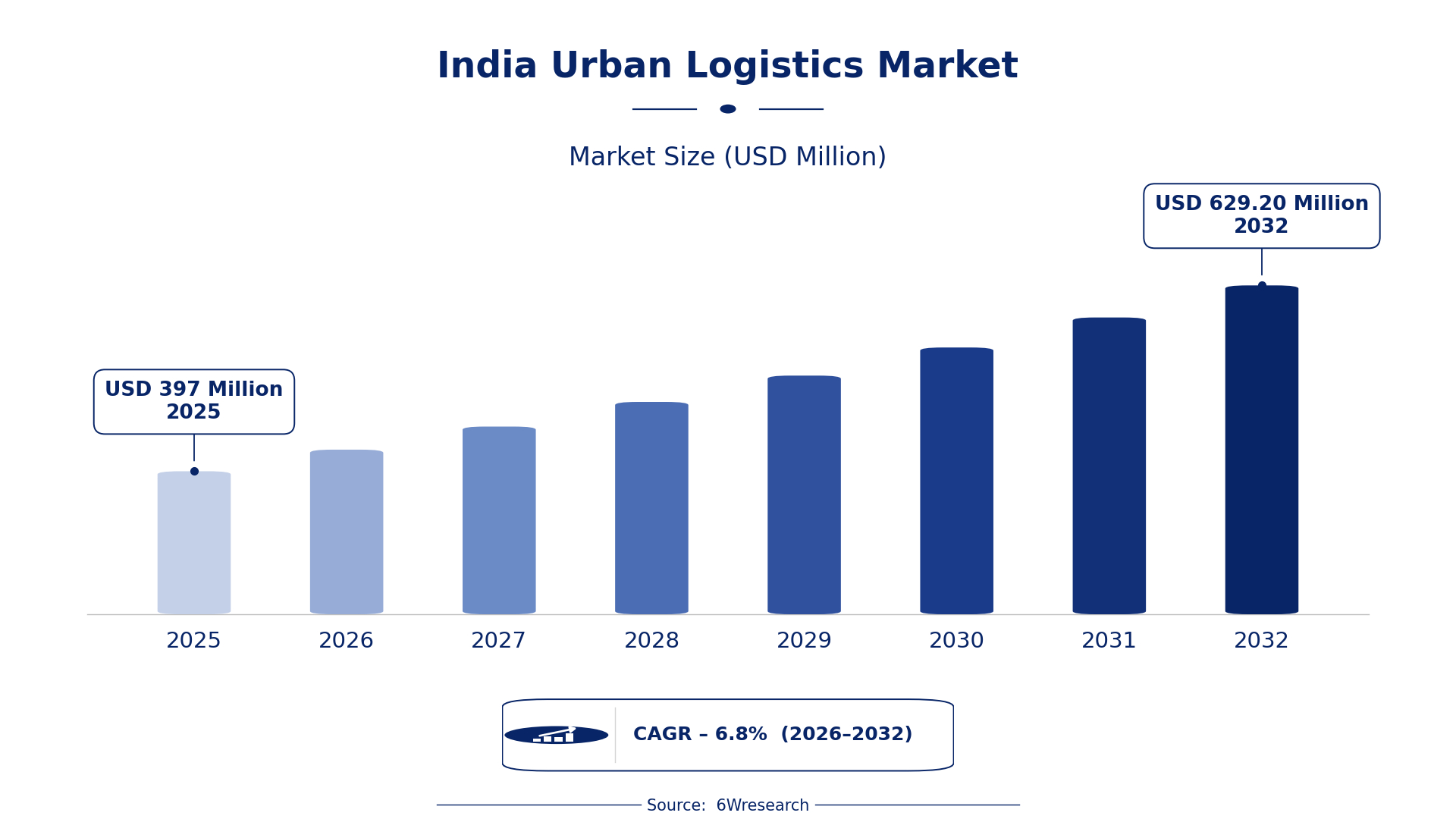
According to 6Wresearch internal database and industry insights, the India Urban Logistics Market was valued at USD 397.0 million in 2025 and is projected to reach USD 629.20 million by 2032, growing at a CAGR of approximately 6.8% during 2026–2032.
India Urban Logistics Market Highlights
| Report Metric | Details |
| Report Name | India Urban Logistics Market |
| Market Size 2025 | USD 397.0 million |
| Market Size 2032 | USD 629.20 million |
| Absolute Growth 2025–2032 | USD 232.20 million |
| CAGR 2026–2032 | 6.8% |
| Peak Annual Growth | 8.6% in 2028 |
| Forecast Period | 2026–2032 |
| Historical Data | 2022–2025 |
| Base Year | 2025 |
| Leading Logistics Type, 2025 | Last-Mile Delivery (43% share) |
| Leading Delivery Timeframe, 2025 | Same-Day (45% share) |
| Leading Technology Used, 2025 | Route Optimization AI (52% share) |
| Leading End User, 2025 | eCommerce Companies (38% share) |
| Fastest-Growing Logistics Type | Micro-fulfillment (9.5% CAGR) |
| Fastest-Growing Technology Used | IoT Tracking (8.3% CAGR) |
| Fastest-Growing End User | Grocery Retailers (8.6% CAGR) |
| Growing Sector | eCommerce |
| Key End Users | eCommerce Companies, Grocery Retailers, Logistics Aggregators, D2C Brands |
India Urban Logistics Market Year-wise Growth Rate and Key Drivers (2022–2032)
This graph illustrates the annual growth rates of the market from 2022 to 2032, highlighting a steady upward trajectory and projected market expansion over the forecast period.
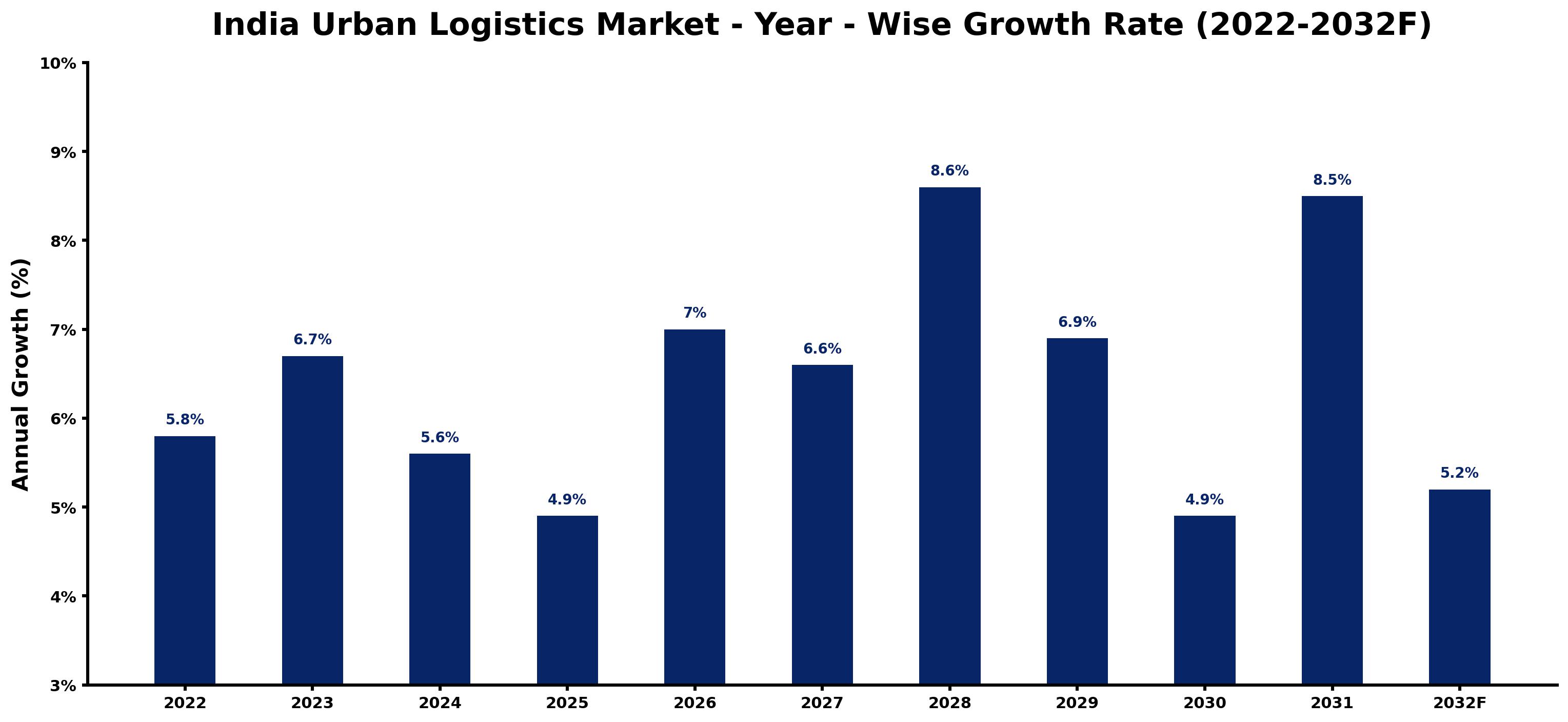
Annual growth estimates for each year appear below with the principal reason behind them, explaining the shifts that set the pace of the market.
| Year | Estimated Annual Growth (%) | Market Rationale |
| 2022 | 5.8 | The market experienced steady growth, driven by increasing urbanisation and eCommerce demand. |
| 2023 | 6.7 | Growth accelerated due to the expanding last-mile delivery services in urban areas. |
| 2024 | 5.6 | A slight slowdown occurred as the market adjusted following rapid growth. |
| 2025 | 4.9 | The market continued to grow, supported by ongoing investments in urban logistics infrastructure. |
| 2026 | 7.0 | Growth is expected to rebound as technology adoption in logistics gains traction across sectors. |
| 2027 | 6.6 | A slowdown in growth is projected as the market stabilises after rapid advancements. |
| 2028 | 8.6 | The market is expected to peak with heightened demand for same-day delivery services from consumers. |
| 2029 | 6.9 | Growth is projected to slow again as the market adjusts to new operational efficiencies. |
| 2030 | 4.9 | A further slowdown is anticipated as logistics firms focus on optimising costs. |
| 2031 | 8.5 | Growth is expected to accelerate again due to rising demand from grocery retailers for efficient logistics. |
| 2032 | 5.2 | The market is projected to experience a slowdown as it matures, focusing on sustainable practices. |
Note: Market size estimations and growth projections presented in this report are based on 6Wresearch's proprietary forecasting methodology, utilizing the latest available industry data, government publications, and primary research inputs.
India Urban Logistics Market Synopsis
Urban Logistics in India encompasses the systems that facilitate the movement of goods within cities. This includes technologies like route optimization and automation, which are crucial for eCommerce and grocery delivery. The India Urban Logistics Market is experiencing rapid growth, propelled by the increasing urban population projected to reach 600 million by 2031 and the rising demand for efficient logistics solutions. The National Logistics Policy, introduced in 2022, aims to improve logistics efficiency, further driving this demand.
Market Dynamics Impact Analysis (2026–2032)
| Factor | Type | Impact | Primary Segment Affected |
| Growing eCommerce sector driving demand for efficient delivery solutions | Driver | High | Last-Mile Delivery |
| Increasing urban population necessitating improved logistics infrastructure | Driver | High | Urban Warehousing |
| Investment in smart city initiatives enhancing urban logistics capabilities | Opportunity | High | Urban Warehousing |
| Rising demand for same-day delivery services from consumers | Opportunity | High | Same-Day |
| High logistics costs impacting competitiveness for producers | Restraint | High | Last-Mile Delivery |
| Skill gaps in the workforce affecting operational efficiency | Restraint | Medium | Last-Mile Delivery |
| Infrastructure challenges delaying logistics operations | Challenge | High | Last-Mile Delivery |
| Regulatory complexities hindering logistics operations | Challenge | Medium | Last-Mile Delivery |
Evaluation of Drivers in India Urban Logistics Market (2026–2032)
The factors lifting demand, and the evidence behind each, are summarised below.
| Drivers | Primary Segment Affected | Why It Matters (Evidence) |
| Expansion of last-mile delivery services | Last-Mile Delivery | Over 30% of urban logistics is driven by last-mile delivery services, increasing consumer access to goods and enhancing service offerings. |
| Adoption of route optimization technologies | Route Optimization AI | Route optimization technologies are being adopted by over 60% of logistics firms, improving delivery efficiency and reducing operational costs. |
| Increased urban warehousing demand | Urban Warehousing | Urban warehousing demand is surging in metropolitan areas, with a growth rate of 9.5%, facilitating quicker deliveries and better inventory management. |
| Growth of eCommerce companies | eCommerce Companies | The eCommerce sector in India is projected to grow to $200 billion by 2026, boosting logistics demand significantly across urban areas. |
| Integration of IoT tracking in logistics | IoT Tracking | IoT tracking is being integrated into 70% of logistics operations, improving shipment visibility and operational efficiency across the supply chain. |
Market growth for Urban Logistics in India is underpinned by the expansion of last-mile delivery services, the adoption of route optimization technologies, and increasing urban warehousing demand. Over 30% of urban logistics is driven by last-mile delivery services, which increases consumer access to goods. Demand for urban warehousing is surging in metropolitan areas, facilitating quicker deliveries. The eCommerce sector is expected to grow significantly, which will boost logistics demand. Additionally, IoT tracking is integrated into 70% of logistics operations, improving visibility and efficiency across the supply chain.
Evaluation of Restraints in India Urban Logistics Market
The key brakes on demand, and where they bite hardest, are shown below.
| Market Restraint | Primary Segment Affected | Why It Matters (Evidence) |
| High logistics costs impacting competitiveness | Last-Mile Delivery | Logistics costs in India are currently high, accounting for approximately 13% of GDP, which affects the overall competitiveness of producers. |
| Skill gaps in the workforce | Last-Mile Delivery | The Logistics Sector Skill Council aims to train 1 million individuals by 2025 to address workforce skill gaps in the logistics sector. |
| Infrastructure challenges delaying operations | Last-Mile Delivery | Urban infrastructure is often inadequate, causing delays in logistics operations and impacting service quality, particularly in cities like Mumbai and Delhi. |
| Regulatory complexities hindering operations | Last-Mile Delivery | Complex regulations can slow down logistics processes, affecting timely deliveries and operational efficiency for logistics providers. |
| Limited adoption of automation technologies | Robotics | Despite the potential for efficiency, robotics in warehousing is currently adopted by only 20% of logistics firms, limiting operational improvements. |
India Urban Logistics Market Challenges
Buyers in the India Urban Logistics Market still face significant technology issues, as over 40% of logistics firms do not utilise advanced route optimization systems, leading to delivery costs that can exceed 15% of total expenses. Suppliers encounter regulatory hurdles; although the National Logistics Policy aims to improve efficiency, it has not simplified compliance processes, delaying service deployment for logistics providers by up to six months. Heightened competition from over 1,000 startups forces established suppliers to reduce prices, which may compromise service quality. Supply chain disruptions persist; urban warehousing demand is increasing, yet insufficient infrastructure in cities like Mumbai and Delhi can delay deliveries by 20%.
Trends in the India Urban Logistics Market
The trends below show where the India Urban Logistics Market is heading.
- Shift towards Same-Day Delivery Services: In India, the demand for same-day delivery services has surged, particularly among eCommerce companies. This trend is reflected in the 45% share of same-day deliveries in 2025, showcasing consumer preferences for quick service.
- Emergence of IoT Tracking in Logistics: The integration of IoT tracking technologies in logistics operations has become increasingly common in India. With 70% of logistics operations adopting this technology, it enhances visibility and efficiency in supply chains.
- Growth of Urban Warehousing Solutions: Urban warehousing is gaining traction in metropolitan areas like Mumbai and Delhi, driven by the need for efficient storage solutions. This is highlighted by the increasing demand for urban warehousing, which supports faster deliveries.
- Expansion of Smart City Initiatives: Smart city initiatives are improving urban infrastructure to support logistics in India. The government's investment in these initiatives is expected to enhance connectivity and efficiency in urban logistics operations.
Investment Opportunities in the India Urban Logistics Market
Several openings in the India Urban Logistics Market merit attention from investors.
- eCommerce Companies seeking efficient logistics: eCommerce companies in India are increasingly looking for efficient logistics solutions to meet growing demand. With the eCommerce sector expected to grow to $200 billion by 2026, there is a notable opportunity for logistics providers to enhance their services.
- Urban Warehousing Solutions needed: Urban warehousing solutions are in high demand as cities expand. With urban warehousing demand increasing by 9.5%, logistics firms can invest in facilities in metropolitan areas to meet this need.
- Last-Mile Delivery Services expansion: Last-mile delivery services are essential for meeting consumer expectations. With over 30% of urban logistics driven by last-mile services, logistics providers can enhance their offerings to capture this growing market.
- Investment in Route Optimization Technologies: There is a pressing need for logistics firms to invest in route optimization technologies. With over 60% of firms adopting these technologies, this presents a lucrative opportunity for suppliers.
Government Initiatives in the India Urban Logistics Market
The National Logistics Policy, launched by the Ministry of Commerce and Industry in 2022, aims to reduce logistics costs to 8% of GDP by 2025. This policy enhances competitiveness for producers by streamlining logistics processes and improving efficiency across the sector. The government is also focused on creating a single-window clearance system for logistics, which simplifies regulatory compliance for logistics providers and buyers alike.
The Ministry of Commerce and Industry oversees the implementation of the National Logistics Policy, ensuring that logistics firms comply with the new standards. Additionally, the Logistics Sector Skill Council, established in 2020, aims to enhance workforce skills in logistics, targeting to train 1 million individuals by 2025. This initiative supports the industry's growth by providing a skilled workforce to meet the increasing demand for logistics services.
Future Insight of the India Urban Logistics Market
The India Urban Logistics Market will undergo transformative changes by 2032, driven by the eCommerce sector's growth to $200 billion. The integration of digital logistics solutions will streamline operations, benefiting both buyers and suppliers. Government initiatives, such as the Smart Cities Mission, will improve urban infrastructure, facilitating smoother logistics processes. The National Industrial Corridor Development Programme will enhance connectivity and service delivery across urban areas, meeting the rising demand driven by an urban population projected to reach 600 million by 2031.
Market Segmentation Analysis
The report offers a comprehensive study of the following market segments and their leading categories in the market.
By Logistics Type – Last-Mile Delivery Dominated, Micro-fulfillment Expected to Grow Fastest
According to Bhawna Singh, Assistant Manager at 6Wresearch, Last-Mile Delivery held a 43% share of the India Urban Logistics Market by logistics type in 2025. Last-mile delivery holds the largest share in India due to its critical role in transporting goods directly to consumers' doorsteps. This segment's prominence is evident as over 30% of urban logistics relies on last-mile services, showcasing its essential nature in the logistics ecosystem. Micro-fulfillment is set to record the highest CAGR in this split, 9.5% over 2026–2032. Micro-fulfillment is experiencing rapid growth as urban areas implement systems for swift order processing, driven by the increasing number of logistics startups focusing on urban delivery solutions. This trend indicates a shift towards more efficient delivery methods in densely populated regions. Suppliers should focus on enhancing last-mile delivery capabilities to align with the growing demands of the eCommerce sector.
By Delivery Timeframe – Same-Day Dominated and Is Expected to Record the Fastest Growth
With a 45% revenue share in 2025, Same-Day was the largest delivery timeframe category. Same-day delivery commands the largest market share as it effectively meets the rising consumer demand for quick deliveries in urban settings. The increasing urban population, projected to reach 600 million by 2031, further fuels this need. Same-Day is also forecast to expand faster than any other category, at a CAGR of 9.2% over 2026–2032. Same-day delivery is also the fastest-growing timeframe, as consumers increasingly expect immediate service. This trend is reinforced by the government's push for logistics efficiency through initiatives like the National Logistics Policy. Suppliers must prioritise same-day delivery capabilities to stay competitive in the urban logistics market.
By Technology Used – Route Optimization AI Dominated, IoT Tracking Expected to Grow Fastest
The largest technology used category in 2025 was Route Optimization AI, with a 52% share of total revenue. Route optimization leads the market share as it significantly improves delivery efficiency and reduces operational costs for logistics companies. The fact that over 60% of logistics firms are adopting route optimization underscores its vital importance in streamlining service delivery. IoT Tracking is projected to grow fastest, at a CAGR of 8.3% during 2026–2032. IoT tracking is rapidly gaining traction, enhancing visibility and tracking of shipments, which is essential for modern logistics operations. Its integration into 70% of logistics processes demonstrates its increasing relevance and necessity in the market. Investing in advanced technologies like IoT tracking is essential for suppliers aiming to improve service quality and operational efficiency.
By End User – eCommerce Companies Dominated, Grocery Retailers Expected to Grow Fastest
In 2025, eCommerce Companies led the end user split with a 38% share. eCommerce companies dominate the urban logistics market as they are the primary users of logistics services for their delivery operations. The expected growth of the eCommerce sector to $200 billion by 2026 directly fuels the demand for effective logistics solutions. The quickest growth will come from Grocery Retailers, forecast to expand at a CAGR of 8.6% between 2026 and 2032. Grocery retailers are the fastest-growing end-user segment, driven by their reliance on efficient delivery systems to meet consumer demands. The surge in online grocery shopping significantly accelerates this segment's growth trajectory. Suppliers should tailor their logistics services to meet the specific needs of grocery retailers to capitalise on this expanding market.
Key Attractiveness of the Report
- 10 Years of Market Numbers
- Historical Data Starting from 2022 to 2025
- Base Year 2025
- Forecast Data until 2032
- Key Performance Indicators Impacting the Market
- Major Upcoming Developments and Projects
Key Highlights of the Report:
- India Urban Logistics Market Outlook
- Market Size of India Urban Logistics Market, 2025
- Forecast of India Urban Logistics Market, 2032
- Historical Data and Forecast of India Urban Logistics Revenues & Volume for the Period 2022 - 2032F
- India Urban Logistics Market Trend Evolution
- India Urban Logistics Market Drivers and Challenges
- India Urban Logistics Price Trends
- India Urban Logistics Porter's Five Forces
- India Urban Logistics Industry Life Cycle
- Historical Data and Forecast of India Urban Logistics Market Revenues & Volume By Logistics Type for the Period 2022 - 2032F
- Historical Data and Forecast of India Urban Logistics Market Revenues & Volume By Last-Mile Delivery for the Period 2022 - 2032F
- Historical Data and Forecast of India Urban Logistics Market Revenues & Volume By Micro-fulfillment for the Period 2022 - 2032F
- Historical Data and Forecast of India Urban Logistics Market Revenues & Volume By Consolidated Shipping for the Period 2022 - 2032F
- Historical Data and Forecast of India Urban Logistics Market Revenues & Volume By Urban Warehousing for the Period 2022 - 2032F
- Historical Data and Forecast of India Urban Logistics Market Revenues & Volume By Delivery Timeframe for the Period 2022 - 2032F
- Historical Data and Forecast of India Urban Logistics Market Revenues & Volume By Same-Day for the Period 2022 - 2032F
- Historical Data and Forecast of India Urban Logistics Market Revenues & Volume By <24 Hours for the Period 2022 - 2032F
- Historical Data and Forecast of India Urban Logistics Market Revenues & Volume By Scheduled for the Period 2022 - 2032F
- Historical Data and Forecast of India Urban Logistics Market Revenues & Volume By Instant Access for the Period 2022 - 2032F
- Historical Data and Forecast of India Urban Logistics Market Revenues & Volume By Technology Used for the Period 2022 - 2032F
- Historical Data and Forecast of India Urban Logistics Market Revenues & Volume By Route Optimization AI for the Period 2022 - 2032F
- Historical Data and Forecast of India Urban Logistics Market Revenues & Volume By Robotics for the Period 2022 - 2032F
- Historical Data and Forecast of India Urban Logistics Market Revenues & Volume By IoT Tracking for the Period 2022 - 2032F
- Historical Data and Forecast of India Urban Logistics Market Revenues & Volume By Inventory Automation for the Period 2022 - 2032F
- Historical Data and Forecast of India Urban Logistics Market Revenues & Volume By End User for the Period 2022 - 2032F
- Historical Data and Forecast of India Urban Logistics Market Revenues & Volume By eCommerce Companies for the Period 2022 - 2032F
- Historical Data and Forecast of India Urban Logistics Market Revenues & Volume By Grocery Retailers for the Period 2022 - 2032F
- Historical Data and Forecast of India Urban Logistics Market Revenues & Volume By Logistics Aggregators for the Period 2022 - 2032F
- Historical Data and Forecast of India Urban Logistics Market Revenues & Volume By D2C Brands for the Period 2022 - 2032F
- India Urban Logistics Import Export Trade Statistics
- Market Opportunity Assessment By Logistics Type
- Market Opportunity Assessment By Delivery Timeframe
- Market Opportunity Assessment By Technology Used
- Market Opportunity Assessment By End User
- India Urban Logistics Top Companies Market Share
- India Urban Logistics Competitive Benchmarking By Technical and Operational Parameters
- India Urban Logistics Company Profiles
- India Urban Logistics Key Strategic Recommendations
Market Covered
The report offers an extensive study of the following market segments.
By Logistics Type
- Last-Mile Delivery
- Micro-fulfillment
- Consolidated Shipping
- Urban Warehousing
By Delivery Timeframe
- Same-Day
- <24 Hours
- Scheduled
- Instant Access
By Technology Used
- Route Optimization AI
- Robotics
- IoT Tracking
- Inventory Automation
By End User
- eCommerce Companies
- Grocery Retailers
- Logistics Aggregators
- D2C Brands































