China Urban Logistics Market Size & Growth Rate
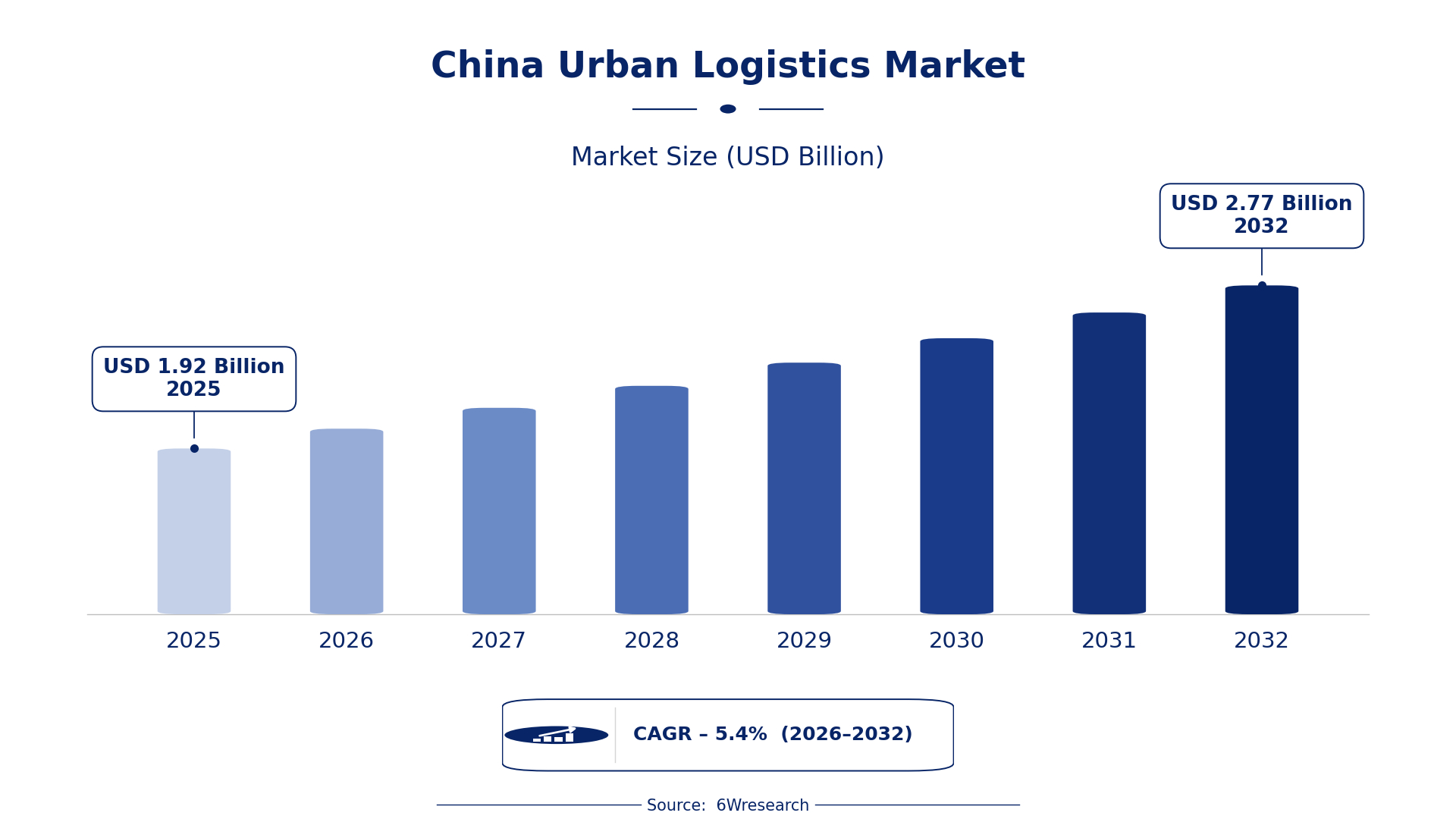
According to 6Wresearch internal database and industry insights, the China Urban Logistics Market was valued at USD 1.92 billion in 2025 and is projected to reach USD 2.77 billion by 2032, growing at a CAGR of approximately 5.4% during 2026–2032.
China Urban Logistics Market Highlights
| Report Metric | Details |
| Report Name | China Urban Logistics Market |
| Market Size 2025 | USD 1.92 billion |
| Market Size 2032 | USD 2.77 billion |
| Absolute Growth 2025–2032 | USD 0.85 billion |
| CAGR 2026–2032 | 5.4% |
| Peak Annual Growth | 6.8% in 2026 |
| Forecast Period | 2026–2032 |
| Historical Data | 2022–2025 |
| Base Year | 2025 |
| Leading Logistics Type, 2025 | Last-Mile Delivery (43% share) |
| Leading Delivery Timeframe, 2025 | Same-Day (39% share) |
| Leading Technology Used, 2025 | Route Optimization AI (39% share) |
| Leading End User, 2025 | eCommerce Companies (46% share) |
| Fastest-Growing Logistics Type | Micro-fulfillment (7.2% CAGR) |
| Fastest-Growing Technology Used | IoT Tracking (8.1% CAGR) |
| Fastest-Growing End User | Grocery Retailers (7.7% CAGR) |
| Growing Sector | eCommerce |
| Key End Users | eCommerce Companies, Grocery Retailers, Logistics Aggregators, D2C Brands |
China Urban Logistics Market Year-wise Growth Rate and Key Drivers (2022–2032)
This graph illustrates the annual growth rates of the market from 2022 to 2032, highlighting a steady upward trajectory and projected market expansion over the forecast period.
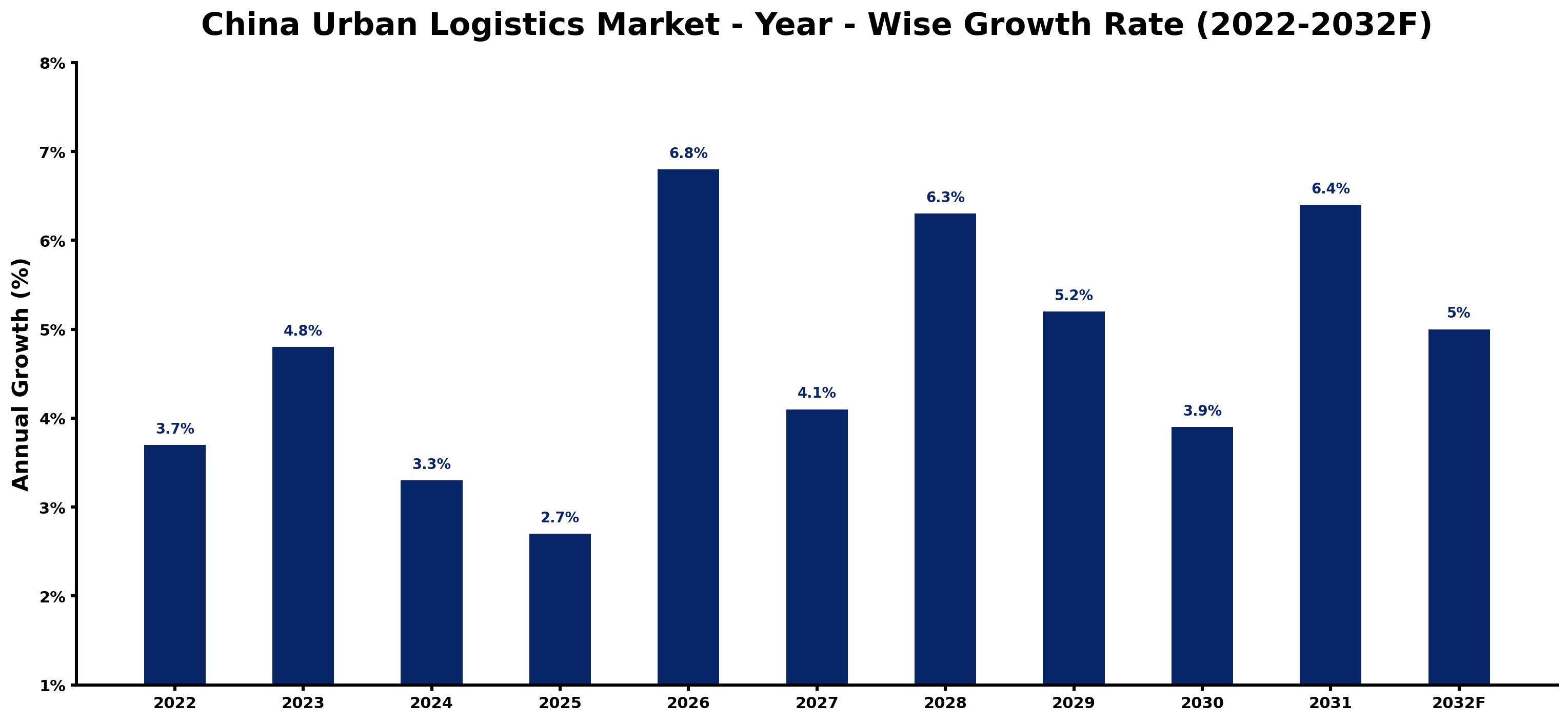
The table below sets out the estimated growth rate for each year and the main factor behind it.
| Year | Estimated Annual Growth (%) | Market Rationale |
| 2022 | 3.7 | Urban logistics demand increased due to a surge in eCommerce activities. |
| 2023 | 4.8 | Faster growth was driven by heightened consumer expectations for delivery speed. |
| 2024 | 3.3 | Growth slowed as firms adjusted to operational challenges and demand fluctuations. |
| 2025 | 2.7 | A further slowdown occurred as logistics firms faced capacity constraints. |
| 2026 | 6.8 | A surge in demand for same-day delivery services is expected to spur rapid growth. |
| 2027 | 4.1 | Demand is projected to grow as logistics firms adapt to rising operational costs. |
| 2028 | 6.3 | Technological advancements in logistics operations are anticipated to drive demand. |
| 2029 | 5.2 | The market is expected to experience a slowdown as firms focus on efficiency improvements. |
| 2030 | 3.9 | Growth is projected to slow as logistics companies face challenges in scaling operations. |
| 2031 | 6.4 | A faster growth rate is expected due to heightened demand from eCommerce and grocery sectors. |
| 2032 | 5.0 | Growth is projected to slow again as the market stabilises amid evolving consumer preferences. |
Note: Market size estimations and growth projections presented in this report are based on 6Wresearch's proprietary forecasting methodology, utilizing the latest available industry data, government publications, and primary research inputs.
China Urban Logistics Market Synopsis
Urban Logistics in China refers to the systems and processes for moving goods within urban areas. It encompasses technologies such as route optimization AI and IoT tracking, facilitating efficient last-mile delivery and urban warehousing. The China Urban Logistics Market is thriving, driven by rising domestic demand from eCommerce companies and grocery retailers. Investments in technology and infrastructure are improving operational efficiency, with urban logistics demand increasing by 25% in 2022. The growing urban population, reaching 1 billion in 2023, further fuels this market's expansion.
Market Dynamics Impact Analysis (2026–2032)
| Factor | Type | Impact | Primary Segment Affected |
| Rising eCommerce activities drive demand for efficient last-mile delivery solutions. | Driver | High | Last-Mile Delivery |
| Technological advancements in logistics operations create opportunities for improved service delivery. | Driver | High | Route Optimization AI |
| The increasing establishment of micro-fulfillment centers presents investment opportunities for logistics providers. | Opportunity | High | Micro-fulfillment |
| Growing urban populations create a demand for enhanced logistics services in tier-1 cities. | Opportunity | High | Urban Warehousing |
| Capacity constraints limit logistics firms' ability to meet rising consumer demands. | Restraint | High | Last-Mile Delivery |
| Operational costs are rising due to increased competition among logistics providers. | Restraint | Medium | Urban Warehousing |
| The Urban Logistics market in China faces practical problems including capacity constraints. | Challenge | High | Last-Mile Delivery |
| Competition among logistics firms is intensifying, affecting pricing and service quality. | Challenge | Medium | Micro-fulfillment |
Evaluation of Drivers in China Urban Logistics Market (2026–2032)
The factors lifting demand, and the evidence behind each, are summarised below.
| Drivers | Primary Segment Affected | Why It Matters (Evidence) |
| Increased eCommerce activities are driving demand for last-mile delivery services. | Last-Mile Delivery | In 2022, urban logistics demand increased by 25% due to rising eCommerce activities. |
| Adoption of route optimization technologies improves delivery efficiency. | Route Optimization AI | Seventy percent of logistics firms are adopting route optimization technologies to reduce operational costs. |
| Expansion of urban warehousing solutions supports rapid distribution. | Urban Warehousing | Urban warehousing space in cities like Shanghai expanded by 15% in the last year. |
| Same-day delivery services have become a standard offering for eCommerce companies. | Same-Day | Over 60% of eCommerce companies in China now offer same-day delivery services. |
| Micro-fulfillment centers are increasingly being established to meet consumer demands. | Micro-fulfillment | Over 200 micro-fulfillment centers are currently operational in tier-1 cities. |
The Urban Logistics market in China is expanding as rising investment in infrastructure, technological advancements, and increasing end-use demand drive growth. In 2022, urban logistics demand surged by 25%, largely due to increased online shopping. The adoption of route optimization technologies by 70% of logistics firms improves delivery efficiency, prompting more purchases from eCommerce companies. Urban warehousing solutions are expanding, with a 15% increase in space in tier-1 cities, facilitating quicker distribution. Over 60% of eCommerce companies now offer same-day delivery services, further boosting demand.
Evaluation of Restraints in China Urban Logistics Market
The main factors holding the market back are set out below.
| Market Restraint | Primary Segment Affected | Why It Matters (Evidence) |
| Capacity constraints limit the ability of logistics firms to meet rising consumer demands. | Last-Mile Delivery | Increased demand for last-mile delivery services has led to operational bottlenecks for many firms. |
| Rising operational costs due to competition impact profitability for logistics providers. | Urban Warehousing | Competition among logistics firms is driving up costs, affecting service pricing. |
| Complex regulatory requirements can hinder operational efficiency in urban logistics. | Micro-fulfillment | Logistics firms must navigate various regulations that can slow down service implementation. |
| Limited access to advanced technologies can restrict service quality improvements. | Route Optimization AI | Not all logistics firms can afford the latest technologies, affecting their competitiveness. |
| Market saturation in major cities may limit growth potential for new entrants. | Last-Mile Delivery | High competition in urban areas makes it challenging for new logistics providers to gain market share. |
China Urban Logistics Market Challenges
The China Urban Logistics Market encounters various practical issues, including regulatory challenges that complicate operations for providers. Local regulations can delay project approvals, forcing companies to allocate additional resources and extend delivery timelines. Distributors face rising logistics costs, which have climbed by 15% due to fuel price increases, affecting profit margins. Buyers contend with fierce competition among eCommerce platforms, leading to price reductions and pressure to accept lower service levels. Furthermore, the rapid growth of urban warehousing has resulted in congestion, potentially causing delivery delays of up to 30% for consumers.
Trends in the China Urban Logistics Market
Below mentioned are some of the trends shaping the China Urban Logistics Market growth.
- eCommerce Companies Adopting Same-Day Delivery: eCommerce companies are increasingly adopting same-day delivery to meet consumer expectations. In 2023, over 60% of these companies offer this service, reflecting a shift towards faster delivery options.
- Urban Warehousing Expanding in Tier-1 Cities: The establishment of urban warehousing is on the rise, with over 200 micro-fulfillment centers operational in tier-1 cities. This trend supports rapid order fulfillment and improves delivery speed.
- Rise of Route Optimization Technologies: Route optimization AI is becoming essential for logistics firms, with 70% adoption among providers. This technology is vital for improving delivery efficiency and reducing costs.
- Government Initiatives Supporting Green Logistics: The 'Green Logistics Action Plan' approved in 2023 aims to reduce emissions in urban delivery systems by 30% by 2030. This initiative encourages logistics firms to adopt more sustainable practices.
Investment Opportunities in the China Urban Logistics Market
The following opportunities in the China Urban Logistics Market pair current demand with a clear way in.
- Investment in Micro-Fulfillment Centers: With over 200 micro-fulfillment centers currently operational, there is a strong opportunity for investment in this sector. The demand for rapid order fulfilment in tier-1 cities creates a market for new entrants.
- Supply of Route Optimization Technologies: As 70% of logistics firms implement route optimization technologies, there is a supply gap for advanced solutions. Collaborating with tech startups can improve service offerings in urban logistics.
- Collaborations for Last-Mile Delivery Solutions: The increasing demand for last-mile delivery solutions presents opportunities for partnerships with logistics aggregators. These collaborations can enhance service efficiency and customer satisfaction.
- Expansion of Urban Warehousing Facilities: The urban warehousing sector is growing, with a 15% increase in space in cities like Shanghai. Investing in new facilities can meet the rising demand for efficient logistics solutions.
Government Initiatives in the China Urban Logistics Market
The 'National Standard for Urban Logistics', issued in 2021, regulates service quality and operational standards within the sector. This law ensures that logistics providers adhere to specific criteria, enhancing overall service reliability. The 'Urban Logistics Development Plan' launched by the National Development and Reform Commission in 2021 aims to improve infrastructure and efficiency by 2025, providing a framework for future growth. The 'Smart Logistics Initiative' of 2022 promotes the use of AI and IoT technologies, funding projects that enhance logistics operations and efficiency.
In 2023, the Ministry of Transport reported a 20% increase in urban delivery efficiency attributed to the 'Smart Logistics Initiative' of 2022. This initiative supports the adoption of AI and IoT technologies, funding projects that improve logistics operations. The 'Green Logistics Action Plan', approved in 2023, aims to reduce emissions in urban delivery systems by 30% by 2030, promoting sustainable practices among logistics providers. The Ministry of Industry and Information Technology initiated the 'Logistics Technology Innovation Program' in 2022, providing funding for tech startups in urban logistics.
Future Insight of the China Urban Logistics Market
By 2032, participants in the China Urban Logistics Market can expect significant advancements driven by technology and government initiatives. The Urban Logistics Development Plan will improve infrastructure, leading to streamlined operations. A projected 20% increase in urban delivery efficiency will enhance service capabilities, while the growth of micro-fulfillment centers will bolster last-mile delivery. The widespread adoption of IoT tracking devices will improve shipment visibility, ensuring timely deliveries. These changes will elevate service standards and reduce operational costs for all stakeholders.
Market Segmentation Analysis
Each segment group is reviewed below, with the leader by share and the fastest grower by CAGR.
By Logistics Type – Last-Mile Delivery Dominated, Micro-fulfillment Expected to Grow Fastest
According to Bhawna Singh, Assistant Manager at 6Wresearch, in 2025, Last-Mile Delivery led the logistics type split with a 43% share. Last-mile delivery holds the largest market share as it is crucial for ensuring timely delivery of goods in urban settings. This segment is particularly important in densely populated cities where consumer satisfaction hinges on efficient delivery services. Micro-fulfillment is projected to grow fastest, at a CAGR of 7.2% during 2026–2032. Micro-fulfillment is experiencing rapid growth as it caters to the increasing demand for quick order fulfilment close to consumers, thereby enhancing delivery efficiency. The establishment of over 200 micro-fulfillment centres in tier-1 cities underscores the momentum of this trend. Suppliers should focus on enhancing last-mile delivery and micro-fulfillment capabilities to leverage the growth opportunities in the market.
By Delivery Timeframe – Same-Day Dominated and Is Expected to Record the Fastest Growth
Same-Day took a 39% share of delivery timeframe in 2025, more than any other category. Same-day delivery leads the market as it aligns perfectly with consumer expectations for immediate service, making it a top choice for eCommerce businesses. The fact that over 60% of eCommerce companies now offer this service underscores its widespread acceptance. The same category is also set to grow fastest, at a CAGR of 6.9% during 2026–2032. Same-day delivery is experiencing rapid growth, fuelled by increasing consumer demand for quick fulfilment in online shopping. This trend is likely to continue as more businesses adopt same-day options to remain competitive. Buyers will enjoy improved delivery alternatives, while suppliers must adapt to the rising demand for same-day services.
By Technology Used – Route Optimization AI Dominated, IoT Tracking Expected to Grow Fastest
Route Optimization AI held a 39% share of the China Urban Logistics Market by technology used in 2025. Route optimization technology commands the largest market share due to its vital role in improving delivery efficiency and lowering operational costs within logistics. Its widespread adoption by 70% of logistics firms in urban areas highlights its significance in the sector. The quickest growth will come from IoT Tracking, forecast to expand at a CAGR of 8.1% between 2026 and 2032. IoT tracking is rapidly advancing as it offers essential real-time visibility of shipments and inventory management, which logistics operators increasingly seek. The integration of IoT devices is transforming logistics operations and driving efficiency. Suppliers should prioritise the development of advanced tracking technologies to secure a competitive advantage in the urban logistics market.
By End User – eCommerce Companies Dominated, Grocery Retailers Expected to Grow Fastest
eCommerce Companies accounted for a 46% market share by end user in 2025. eCommerce companies represent the largest share of the urban logistics market, primarily utilising these services for last-mile delivery to meet consumer expectations. The 25% surge in demand for urban logistics due to eCommerce activities in 2022 highlights their substantial influence. Grocery Retailers are set to record the highest CAGR in this split, 7.7% over 2026–2032. Grocery retailers are the fastest-growing segment, increasingly depending on urban logistics for the timely delivery of perishable goods. This trend is propelled by the growing urban population, which necessitates efficient grocery distribution solutions. Suppliers should customise their offerings to meet the specific needs of eCommerce and grocery sectors, as these are pivotal in driving the urban logistics market.
Key Attractiveness of the Report
- 10 Years of Market Numbers
- Historical Data Starting from 2022 to 2025
- Base Year 2025
- Forecast Data until 2032
- Key Performance Indicators Impacting the Market
- Major Upcoming Developments and Projects
Key Highlights of the Report:
- China Urban Logistics Market Outlook
- Market Size of China Urban Logistics Market, 2025
- Forecast of China Urban Logistics Market, 2032
- Historical Data and Forecast of China Urban Logistics Revenues & Volume for the Period 2022 - 2032F
- China Urban Logistics Market Trend Evolution
- China Urban Logistics Market Drivers and Challenges
- China Urban Logistics Price Trends
- China Urban Logistics Porter's Five Forces
- China Urban Logistics Industry Life Cycle
- Historical Data and Forecast of China Urban Logistics Market Revenues & Volume By Logistics Type for the Period 2022 - 2032F
- Historical Data and Forecast of China Urban Logistics Market Revenues & Volume By Last-Mile Delivery for the Period 2022 - 2032F
- Historical Data and Forecast of China Urban Logistics Market Revenues & Volume By Micro-fulfillment for the Period 2022 - 2032F
- Historical Data and Forecast of China Urban Logistics Market Revenues & Volume By Consolidated Shipping for the Period 2022 - 2032F
- Historical Data and Forecast of China Urban Logistics Market Revenues & Volume By Urban Warehousing for the Period 2022 - 2032F
- Historical Data and Forecast of China Urban Logistics Market Revenues & Volume By Delivery Timeframe for the Period 2022 - 2032F
- Historical Data and Forecast of China Urban Logistics Market Revenues & Volume By Same-Day for the Period 2022 - 2032F
- Historical Data and Forecast of China Urban Logistics Market Revenues & Volume By <24 Hours for the Period 2022 - 2032F
- Historical Data and Forecast of China Urban Logistics Market Revenues & Volume By Scheduled for the Period 2022 - 2032F
- Historical Data and Forecast of China Urban Logistics Market Revenues & Volume By Instant Access for the Period 2022 - 2032F
- Historical Data and Forecast of China Urban Logistics Market Revenues & Volume By Technology Used for the Period 2022 - 2032F
- Historical Data and Forecast of China Urban Logistics Market Revenues & Volume By Route Optimization AI for the Period 2022 - 2032F
- Historical Data and Forecast of China Urban Logistics Market Revenues & Volume By Robotics for the Period 2022 - 2032F
- Historical Data and Forecast of China Urban Logistics Market Revenues & Volume By IoT Tracking for the Period 2022 - 2032F
- Historical Data and Forecast of China Urban Logistics Market Revenues & Volume By Inventory Automation for the Period 2022 - 2032F
- Historical Data and Forecast of China Urban Logistics Market Revenues & Volume By End User for the Period 2022 - 2032F
- Historical Data and Forecast of China Urban Logistics Market Revenues & Volume By eCommerce Companies for the Period 2022 - 2032F
- Historical Data and Forecast of China Urban Logistics Market Revenues & Volume By Grocery Retailers for the Period 2022 - 2032F
- Historical Data and Forecast of China Urban Logistics Market Revenues & Volume By Logistics Aggregators for the Period 2022 - 2032F
- Historical Data and Forecast of China Urban Logistics Market Revenues & Volume By D2C Brands for the Period 2022 - 2032F
- China Urban Logistics Import Export Trade Statistics
- Market Opportunity Assessment By Logistics Type
- Market Opportunity Assessment By Delivery Timeframe
- Market Opportunity Assessment By Technology Used
- Market Opportunity Assessment By End User
- China Urban Logistics Top Companies Market Share
- China Urban Logistics Competitive Benchmarking By Technical and Operational Parameters
- China Urban Logistics Company Profiles
- China Urban Logistics Key Strategic Recommendations
Market Covered
The report offers an extensive study of the following market segments.
By Logistics Type
- Last-Mile Delivery
- Micro-fulfillment
- Consolidated Shipping
- Urban Warehousing
By Delivery Timeframe
- Same-Day
- <24 Hours
- Scheduled
- Instant Access
By Technology Used
- Route Optimization AI
- Robotics
- IoT Tracking
- Inventory Automation
By End User
- eCommerce Companies
- Grocery Retailers
- Logistics Aggregators
- D2C Brands































