India Urban Mobility Battery Market Size & Growth Rate
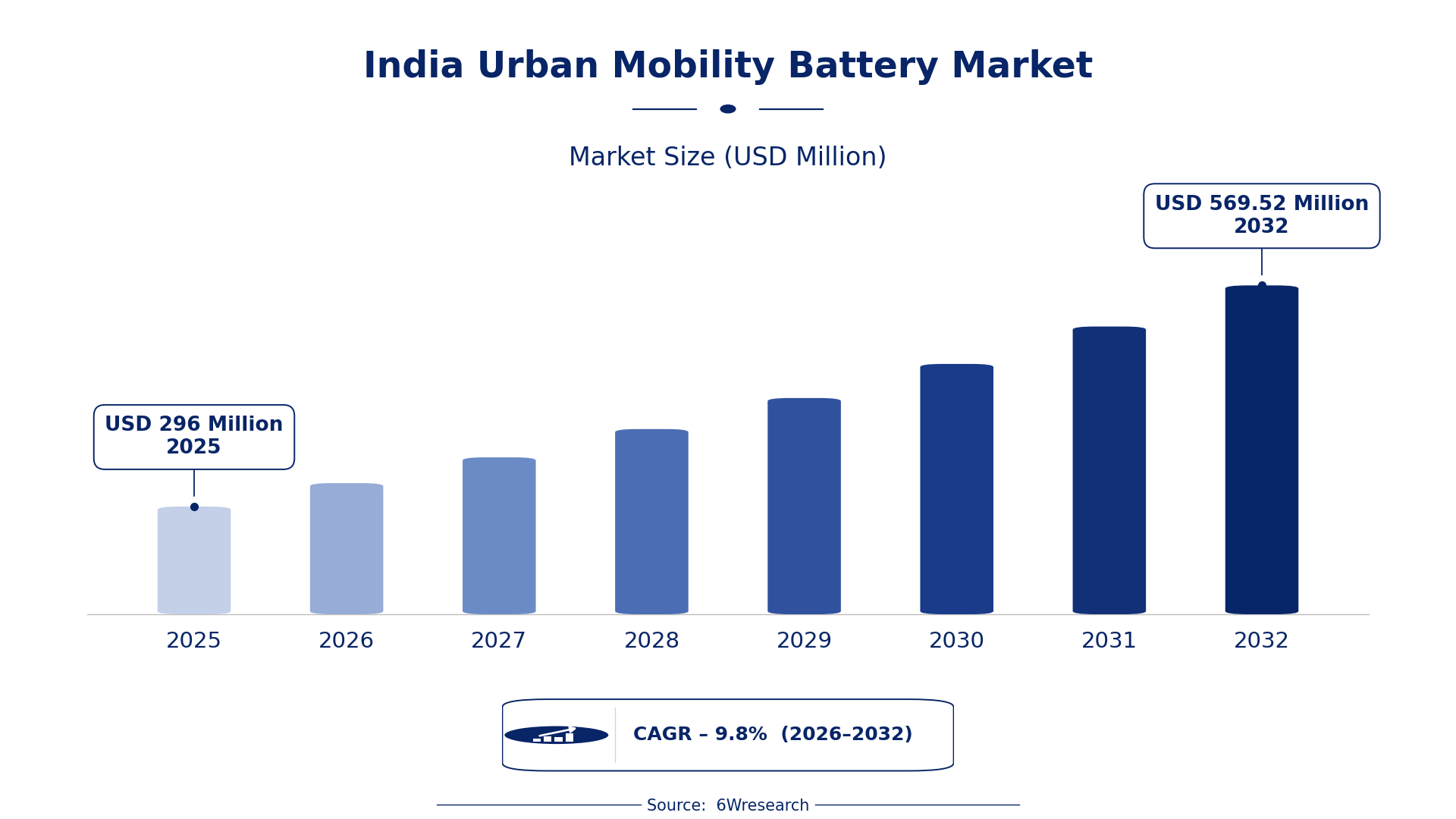
According to 6Wresearch internal database and industry insights, the India Urban Mobility Battery Market was valued at USD 296.0 million in 2025 and is projected to reach USD 569.52 million by 2032, growing at a CAGR of approximately 9.8% during 2026–2032.
India Urban Mobility Battery Market Highlights
| Report Metric | Details |
| Report Name | India Urban Mobility Battery Market |
| Market Size 2025 | USD 296.0 million |
| Market Size 2032 | USD 569.52 million |
| Absolute Growth 2025–2032 | USD 273.52 million |
| CAGR 2026–2032 | 9.8% |
| Peak Annual Growth | 12.3% in 2029 |
| Forecast Period | 2026–2032 |
| Historical Data | 2022–2025 |
| Base Year | 2025 |
| Leading Battery Type, 2025 | Lithium-Ion Batteries (36% share) |
| Leading Application Vehicle, 2025 | e-Bikes (36% share) |
| Leading Chemistry, 2025 | NMC/NCA (51% share) |
| Leading End User, 2025 | Mobility OEMs (39% share) |
| Fastest-Growing Battery Type | Solid-State Batteries (12.5% CAGR) |
| Fastest-Growing Application Vehicle | e-Scooters (12.1% CAGR) |
| Fastest-Growing Chemistry | LFP (11.4% CAGR) |
| Fastest-Growing End User | Battery Startups (11.2% CAGR) |
| Growing Sector | electric two-wheeler market |
| Key End Users | Mobility OEMs, Battery Startups, Fleet Operators, Charging Infrastructure Firms |
India Urban Mobility Battery Market Year-wise Growth Rate and Key Drivers (2022–2032)
This graph illustrates the annual growth rates of the market from 2022 to 2032, highlighting a steady upward trajectory and projected market expansion over the forecast period.
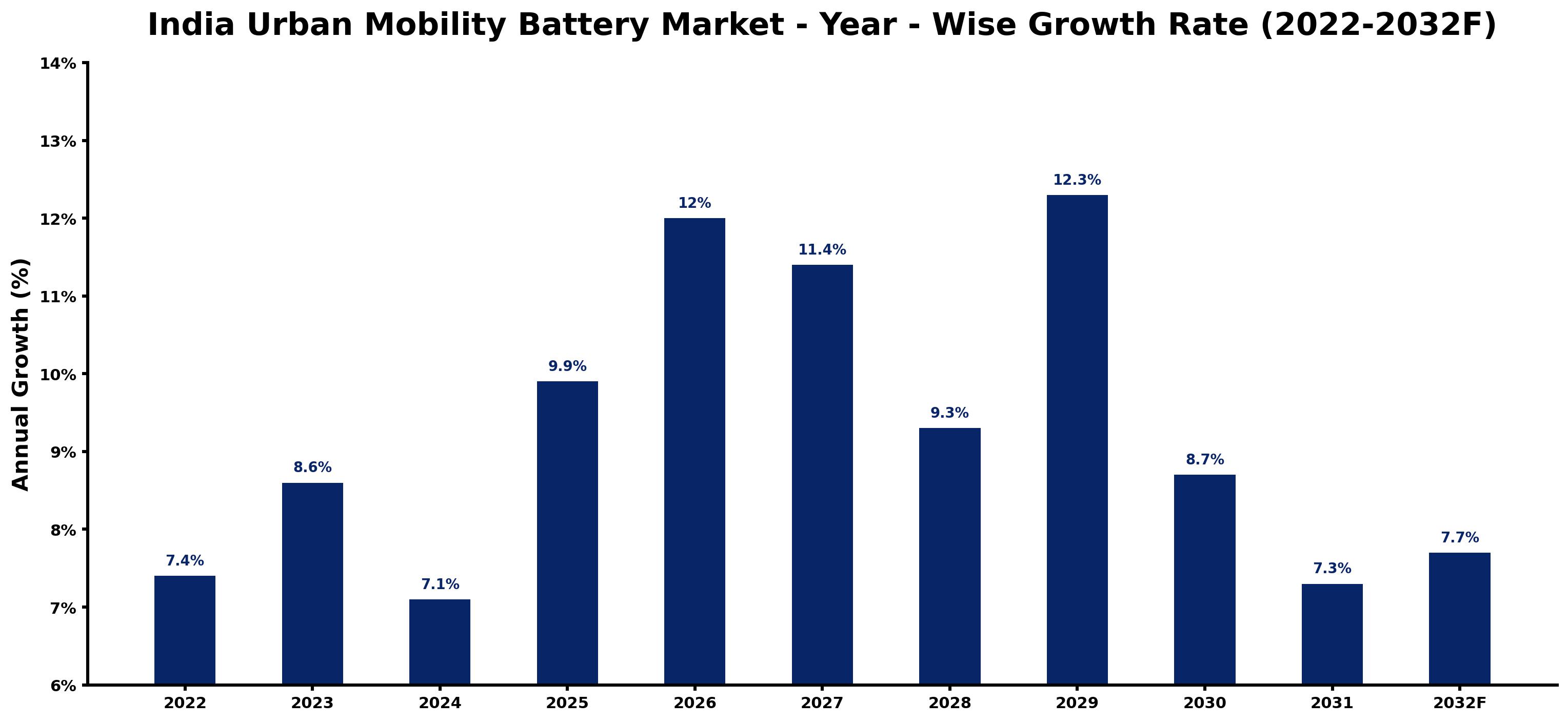
The table below sets out the estimated growth rate for each year and the main factor behind it.
| Year | Estimated Annual Growth (%) | Market Rationale |
| 2022 | 7.4 | The market experienced steady growth due to increasing electric vehicle adoption. |
| 2023 | 8.6 | Demand surged as India's electric vehicle population reached 1.5 million units. |
| 2024 | 7.1 | Growth slowed slightly as the market adjusted to infrastructure developments. |
| 2025 | 9.9 | The market rebounded with faster growth driven by new investments in electric mobility. |
| 2026 | 12.0 | Demand accelerated with the government targeting 30% electric vehicle penetration by 2030. |
| 2027 | 11.4 | Growth rate decreased as the market stabilised after rapid expansion. |
| 2028 | 9.3 | The market continued to grow, albeit at a slower pace, reflecting maturing demand. |
| 2029 | 12.3 | A peak growth rate was achieved as urban mobility solutions gained traction. |
| 2030 | 8.7 | Growth slowed again as the market faced challenges in scaling infrastructure. |
| 2031 | 7.3 | The market maintained growth, supported by ongoing investments in battery technology. |
| 2032 | 7.7 | Demand is expected to rise as battery manufacturing capacity expands significantly. |
Note: Market size estimations and growth projections presented in this report are based on 6Wresearch's proprietary forecasting methodology, utilizing the latest available industry data, government publications, and primary research inputs.
India Urban Mobility Battery Market Synopsis
Urban Mobility Battery Market in India includes lithium-ion batteries used in electric vehicles, especially e-bikes and e-scooters. These batteries are produced through advanced assembly processes and play a crucial role in urban transportation. The market is set for robust growth, driven by an electric vehicle population of 1.5 million units in 2023 and government initiatives such as the FAME II scheme, which allocates ₹10,000 crore to promote electric vehicle adoption.
Market Dynamics Impact Analysis (2026–2032)
| Factor | Type | Impact | Primary Segment Affected |
| Growing electric vehicle adoption and investments in charging infrastructure | Driver | High | e-Bikes |
| Increasing demand for energy-efficient transport solutions | Driver | High | e-Scooters |
| Rising opportunities in battery technology innovation | Opportunity | High | Battery Startups |
| Emerging demand for swappable battery packs in urban areas | Opportunity | Medium | Swappable Battery Packs |
| Challenges in scaling battery manufacturing capacity | Restraint | High | Lithium-Ion Batteries |
| Regulatory hurdles affecting new entrants in the market | Restraint | Medium | Mobility OEMs |
| Supply chain disruptions impacting battery availability | Challenge | High | Compact EVs |
| High initial costs of electric vehicles compared to traditional options | Challenge | Medium | Two-Wheeler EVs |
Evaluation of Drivers in India Urban Mobility Battery Market (2026–2032)
The factors lifting demand, and the evidence behind each, are summarised below.
| Drivers | Primary Segment Affected | Why It Matters (Evidence) |
| Government initiatives promoting electric vehicle adoption | e-Bikes | The FAME II scheme supports electric vehicle adoption with a budget of ₹10,000 crore, encouraging more consumers to purchase e-bikes. |
| Rising urban population and demand for eco-friendly transport | e-Scooters | India's urban areas are experiencing a shift towards sustainable mobility, driving more buyers to invest in e-scooters for daily commutes. |
| Technological advancements in battery efficiency and performance | Lithium-Ion Batteries | The anticipated battery manufacturing capacity of 100 GWh by 2025 increases the availability of efficient batteries for electric vehicles, boosting demand. |
| Growing interest in electric delivery fleets for urban logistics | Delivery Fleets | The rise of e-commerce in India is driving demand for electric delivery vehicles, prompting fleet operators to invest in urban mobility batteries. |
| Supportive policies for local battery manufacturing | Battery Startups | The Production Linked Incentive Scheme encourages innovation and local production, increasing demand for advanced battery solutions among startups. |
Expansion of the Urban Mobility Battery market in India is backed by increasing electric vehicle adoption, urbanisation, and advancements in battery technology. The electric vehicle population reached 1.5 million units in 2023, boosting demand for urban mobility batteries. The anticipated battery manufacturing capacity of 100 GWh by 2025 will increase supply, enabling more fleet operators to invest in electric delivery solutions. Growing interest in sustainable transport options is prompting mobility OEMs to innovate and expand their offerings in this evolving market.
Evaluation of Restraints in India Urban Mobility Battery Market
The key brakes on demand, and where they bite hardest, are shown below.
| Market Restraint | Primary Segment Affected | Why It Matters (Evidence) |
| Limited battery manufacturing capacity leading to supply shortages | Lithium-Ion Batteries | India's battery manufacturing capacity is projected to reach 100 GWh by 2025, but current limitations may affect supply. |
| Regulatory complexities hindering new market entrants | Mobility OEMs | New companies face challenges navigating regulatory requirements, which can delay product launches and market entry. |
| High initial costs of electric vehicles compared to traditional vehicles | Two-Wheeler EVs | The price difference can deter potential buyers, slowing down the adoption of electric mobility solutions. |
| Supply chain disruptions impacting battery availability | Compact EVs | Global supply chain issues have led to delays in battery procurement, affecting production timelines and availability for manufacturers. |
| Consumer hesitation regarding electric vehicle performance and range | e-Scooters | Concerns about battery life and charging infrastructure can limit consumer adoption and hinder market growth. |
India Urban Mobility Battery Market Challenges
The India Urban Mobility Battery Market faces intense competition among producers, which compresses profit margins for manufacturers. This rivalry stems from the rapid increase in electric vehicle adoption, with 1.5 million units registered in 2023, prompting suppliers to reduce prices to attract buyers. Technological hurdles also impede growth; many manufacturers find it challenging to implement advanced battery management systems, leading to delays in product availability for consumers seeking reliable solutions. Additionally, rising raw material costs, particularly for lithium, are escalating production expenses, ultimately raising prices for end users.
Trends in the India Urban Mobility Battery Market
Buyers and suppliers in the India Urban Mobility Battery Market are adjusting to the following trends.
- Shift Towards e-Scooters in Urban Areas: Cities across India are increasingly adopting e-scooters as a primary mode of transport, with a growth rate of 12.1% from 2026 to 2032. This trend is particularly visible in urban centres like Bengaluru, where e-scooter usage is rapidly expanding.
- Rise of Swappable Battery Solutions: The introduction of swappable battery packs is gaining traction, particularly in urban areas where convenience is paramount. This segment is expected to see substantial growth, improving user experience and accessibility.
- Focus on Sustainable Battery Technologies: India is witnessing a shift towards sustainable battery solutions, with initiatives promoting LFP chemistry, which is expected to grow at 11.4% from 2026 to 2032. This focus aligns with the government's sustainability goals and consumer preferences for eco-friendly options.
- Expansion of Charging Infrastructure: The National Institute of Solar Energy is promoting solar-powered charging stations, supporting the growing electric vehicle market. With a target of 5 million electric vehicles by 2025, this initiative is vital for improving charging accessibility.
Investment Opportunities in the India Urban Mobility Battery Market
Investors looking at the India Urban Mobility Battery Market should consider the following areas.
- Partnerships for Battery Manufacturing: Now is an opportune time for joint ventures in battery manufacturing, with the government aiming for 30% electric vehicle penetration by 2030. Collaborating with local firms can facilitate market entry and compliance with regulations.
- Investment in Charging Infrastructure Development: With India's electric vehicle population reaching 1.5 million, there is a pressing need for charging infrastructure. Investing in charging stations can cater to the growing demand from urban mobility users, ensuring accessibility and convenience.
- Focus on Battery Recycling Initiatives: As the market expands, battery recycling presents a valuable opportunity. The increasing number of electric vehicles will generate demand for sustainable disposal solutions, benefiting firms that specialise in recycling and environmental management.
- Development of Advanced Battery Technologies: The anticipated growth in battery manufacturing capacity creates a window for innovation in advanced battery technologies. Engaging with battery startups can lead to solutions that meet market needs and improve performance.
Government Initiatives in the India Urban Mobility Battery Market
The Faster Adoption and Manufacturing of Hybrid and Electric Vehicles (FAME II) scheme, implemented by the Ministry of Heavy Industries in 2021, promotes electric vehicle adoption with a budget of ₹10,000 crore. This initiative has boosted the market for urban mobility batteries by providing incentives for consumers and manufacturers alike. Additionally, the National Electric Mobility Mission Plan (NEMMP) 2020, launched by NITI Aayog, focuses on enhancing electric vehicle manufacturing and infrastructure, aiming for 5 million electric vehicles by 2025, further driving demand for batteries.
The Ministry of Heavy Industries oversees the implementation of various electric mobility initiatives, including the Production Linked Incentive Scheme for Advanced Chemistry Cell Battery Storage, which aims to boost domestic battery production. This scheme encourages local manufacturing, ensuring a steady supply of batteries for the growing electric vehicle market. Furthermore, the Electric Vehicle Policy 2021 of Maharashtra promotes local manufacturing and infrastructure development, targeting 1 million electric vehicles by 2025, which will enhance the overall market for urban mobility batteries.
Future Insight of the India Urban Mobility Battery Market
The India Urban Mobility Battery Market will undergo notable changes by 2032, driven by supportive government initiatives and advancements in technology. The National Electric Mobility Mission Plan aims for 5 million electric vehicles by 2025, creating substantial demand for batteries. The Production Linked Incentive Scheme is expected to significantly increase battery manufacturing capacity, reaching 100 GWh, which will enhance supply for producers. Furthermore, the promotion of solar-powered charging stations will contribute to a greener urban transport ecosystem, benefiting both suppliers and consumers.
Market Segmentation Analysis
The report offers a comprehensive study of the following market segments and their leading categories in the market.
By Battery Type – Lithium-Ion Batteries Dominated, Solid-State Batteries Expected to Grow Fastest
According to Bhawna Singh, Assistant Manager at 6Wresearch, the largest battery type category in 2025 was Lithium-Ion Batteries, with a 36% share of total revenue. Lithium-ion batteries hold the largest share in the India Urban Mobility Battery Market as they are essential for powering electric vehicles, which are increasingly crucial for urban transport. Their dominance is underscored by the government's target of achieving 30% electric vehicle penetration by 2030, driving demand. Solid-State Batteries are set to record the highest CAGR in this split, 12.5% over 2026–2032. Solid-state batteries are poised for rapid growth due to advancements in technology that improve their safety and efficiency, appealing to manufacturers focused on high-performance solutions. The increase in research and development funding, supported by government initiatives, is likely to hasten their commercial availability. Suppliers must focus on enhancing lithium-ion battery technologies while also investing in solid-state developments to meet future market needs.
By Application Vehicle – e-Bikes Dominated, e-Scooters Expected to Grow Fastest
e-Bikes took a 36% share of application vehicle in 2025, more than any other category. e-Bikes dominate the market share as they are a popular choice for urban commuters seeking efficient and eco-friendly transport solutions. Their growing adoption is further supported by government initiatives promoting electric mobility, including the FAME II scheme. The quickest growth will come from e-Scooters, forecast to expand at a CAGR of 12.1% between 2026 and 2032. e-Scooters are experiencing the fastest growth due to their convenience and affordability, making them an attractive option for urban users. The surge in demand for e-scooters aligns with the increasing urbanisation and the need for sustainable transport alternatives. Suppliers must prioritise the development of e-bike and e-scooter battery solutions to capture the expanding urban mobility market.
By Chemistry – NMC/NCA Dominated, LFP Expected to Grow Fastest
With a 51% revenue share in 2025, NMC/NCA was the largest chemistry category. NMC/NCA chemistry leads the market share as it is widely used in high-performance batteries, essential for electric vehicles that require efficient energy storage. This chemistry is favoured by mobility OEMs for its superior energy density and longevity. LFP is projected to grow fastest, at a CAGR of 11.4% during 2026–2032. LFP chemistry is set to grow rapidly due to its cost-effectiveness and safety features, making it a preferred choice for manufacturers aiming to reduce production costs. The increasing focus on affordable electric vehicles is driving this trend. Suppliers should consider diversifying their offerings to include LFP batteries to cater to cost-sensitive segments of the market.
By End User – Mobility OEMs Dominated, Battery Startups Expected to Grow Fastest
Mobility OEMs held a 39% share of the India Urban Mobility Battery Market by end user in 2025. Mobility OEMs lead the market as they are the primary manufacturers of electric vehicles, significantly driving the demand for urban mobility batteries. Their pivotal role is reinforced by NITI Aayog's goal of deploying 5 million electric vehicles by 2025, ensuring sustained growth in this segment. Over 2026–2032, Battery Startups are expected to post the fastest growth, at a CAGR of 11.2%. Battery startups are rapidly growing by providing innovative solutions that align with the evolving battery technology landscape. Their agility in responding to market trends positions them for considerable expansion in the urban mobility battery sector. Suppliers should engage with both mobility OEMs and battery startups to leverage emerging opportunities in the urban mobility battery market.
Key Attractiveness of the Report
- 10 Years of Market Numbers
- Historical Data Starting from 2022 to 2025
- Base Year 2025
- Forecast Data until 2032
- Key Performance Indicators Impacting the Market
- Major Upcoming Developments and Projects
Key Highlights of the Report:
- India Urban Mobility Battery Market Outlook
- Market Size of India Urban Mobility Battery Market, 2025
- Forecast of India Urban Mobility Battery Market, 2032
- Historical Data and Forecast of India Urban Mobility Battery Revenues & Volume for the Period 2022 - 2032F
- India Urban Mobility Battery Market Trend Evolution
- India Urban Mobility Battery Market Drivers and Challenges
- India Urban Mobility Battery Price Trends
- India Urban Mobility Battery Porter's Five Forces
- India Urban Mobility Battery Industry Life Cycle
- Historical Data and Forecast of India Urban Mobility Battery Market Revenues & Volume By Battery Type for the Period 2022 - 2032F
- Historical Data and Forecast of India Urban Mobility Battery Market Revenues & Volume By Lithium-Ion Batteries for the Period 2022 - 2032F
- Historical Data and Forecast of India Urban Mobility Battery Market Revenues & Volume By Solid-State Batteries for the Period 2022 - 2032F
- Historical Data and Forecast of India Urban Mobility Battery Market Revenues & Volume By Swappable Battery Packs for the Period 2022 - 2032F
- Historical Data and Forecast of India Urban Mobility Battery Market Revenues & Volume By Fast-Charging Units for the Period 2022 - 2032F
- Historical Data and Forecast of India Urban Mobility Battery Market Revenues & Volume By Application Vehicle for the Period 2022 - 2032F
- Historical Data and Forecast of India Urban Mobility Battery Market Revenues & Volume By e-Bikes, e-Scooters for the Period 2022 - 2032F
- Historical Data and Forecast of India Urban Mobility Battery Market Revenues & Volume By Compact EVs for the Period 2022 - 2032F
- Historical Data and Forecast of India Urban Mobility Battery Market Revenues & Volume By Delivery Fleets for the Period 2022 - 2032F
- Historical Data and Forecast of India Urban Mobility Battery Market Revenues & Volume By Two-Wheeler EVs for the Period 2022 - 2032F
- Historical Data and Forecast of India Urban Mobility Battery Market Revenues & Volume By Chemistry for the Period 2022 - 2032F
- Historical Data and Forecast of India Urban Mobility Battery Market Revenues & Volume By NMC/NCA for the Period 2022 - 2032F
- Historical Data and Forecast of India Urban Mobility Battery Market Revenues & Volume By Solid Electrolyte for the Period 2022 - 2032F
- Historical Data and Forecast of India Urban Mobility Battery Market Revenues & Volume By LFP for the Period 2022 - 2032F
- Historical Data and Forecast of India Urban Mobility Battery Market Revenues & Volume By Advanced Lithium for the Period 2022 - 2032F
- Historical Data and Forecast of India Urban Mobility Battery Market Revenues & Volume By End User for the Period 2022 - 2032F
- Historical Data and Forecast of India Urban Mobility Battery Market Revenues & Volume By Mobility OEMs for the Period 2022 - 2032F
- Historical Data and Forecast of India Urban Mobility Battery Market Revenues & Volume By Battery Startups for the Period 2022 - 2032F
- Historical Data and Forecast of India Urban Mobility Battery Market Revenues & Volume By Fleet Operators for the Period 2022 - 2032F
- Historical Data and Forecast of India Urban Mobility Battery Market Revenues & Volume By Charging Infrastructure Firms for the Period 2022 - 2032F
- India Urban Mobility Battery Import Export Trade Statistics
- Market Opportunity Assessment By Battery Type
- Market Opportunity Assessment By Application Vehicle
- Market Opportunity Assessment By Chemistry
- Market Opportunity Assessment By End User
- India Urban Mobility Battery Top Companies Market Share
- India Urban Mobility Battery Competitive Benchmarking By Technical and Operational Parameters
- India Urban Mobility Battery Company Profiles
- India Urban Mobility Battery Key Strategic Recommendations
Market Covered
Segments analysed in this report are listed below.
By Battery Type
- Lithium-Ion Batteries
- Solid-State Batteries
- Swappable Battery Packs
- Fast-Charging Units
By Application Vehicle
- e-Bikes
- e-Scooters
- Compact EVs
- Delivery Fleets
- Two-Wheeler EVs
By Chemistry
- NMC/NCA
- Solid Electrolyte
- LFP
- Advanced Lithium
By End User
- Mobility OEMs
- Battery Startups
- Fleet Operators
- Charging Infrastructure Firms































