China Urban Mobility Battery Market Size & Growth Rate
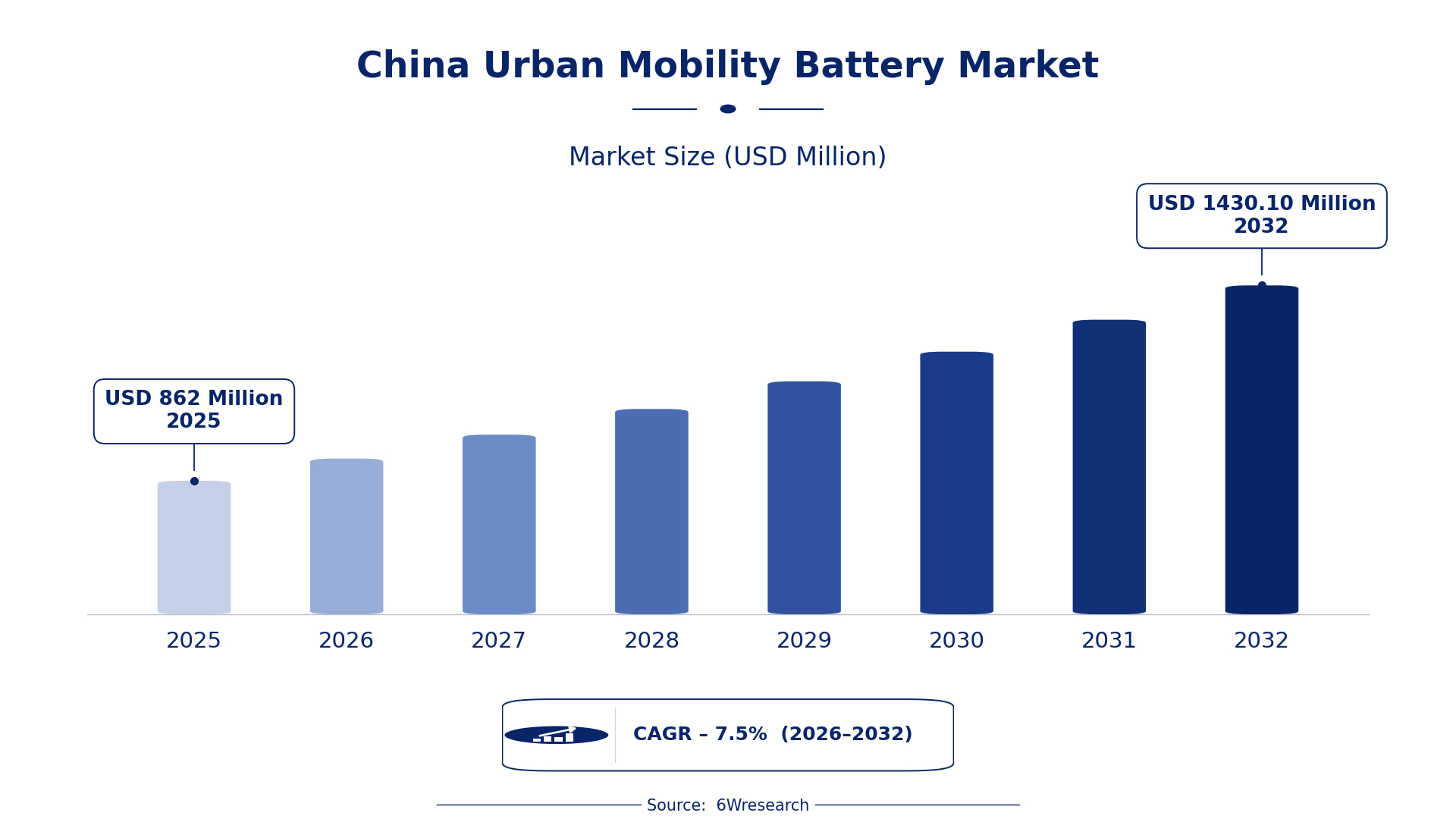
According to 6Wresearch internal database and industry insights, the China Urban Mobility Battery Market was valued at USD 862.0 million in 2025 and is projected to reach USD 1,430.10 million by 2032, growing at a CAGR of approximately 7.5% during 2026–2032.
China Urban Mobility Battery Market Highlights
| Report Metric | Details |
| Report Name | China Urban Mobility Battery Market |
| Market Size 2025 | USD 862.0 million |
| Market Size 2032 | USD 1,430.10 million |
| Absolute Growth 2025–2032 | USD 568.10 million |
| CAGR 2026–2032 | 7.5% |
| Peak Annual Growth | 10.1% in 2032 |
| Forecast Period | 2026–2032 |
| Historical Data | 2022–2025 |
| Base Year | 2025 |
| Leading Battery Type, 2025 | Lithium-Ion Batteries (38% share) |
| Leading Application Vehicle, 2025 | e-Bikes (47% share) |
| Leading Chemistry, 2025 | NMC/NCA (42% share) |
| Leading End User, 2025 | Mobility OEMs (42% share) |
| Fastest-Growing Battery Type | Solid-State Batteries (8.7% CAGR) |
| Fastest-Growing Application Vehicle | Delivery Fleets (8.9% CAGR) |
| Fastest-Growing Chemistry | LFP (9.5% CAGR) |
| Fastest-Growing End User | Battery Startups (9.1% CAGR) |
| Growing Sector | Electric Two-Wheelers |
| Key End Users | Mobility OEMs, Battery Startups, Fleet Operators, Charging Infrastructure Firms |
China Urban Mobility Battery Market Year-wise Growth Rate and Key Drivers (2022–2032)
This graph illustrates the annual growth rates of the market from 2022 to 2032, highlighting a steady upward trajectory and projected market expansion over the forecast period.
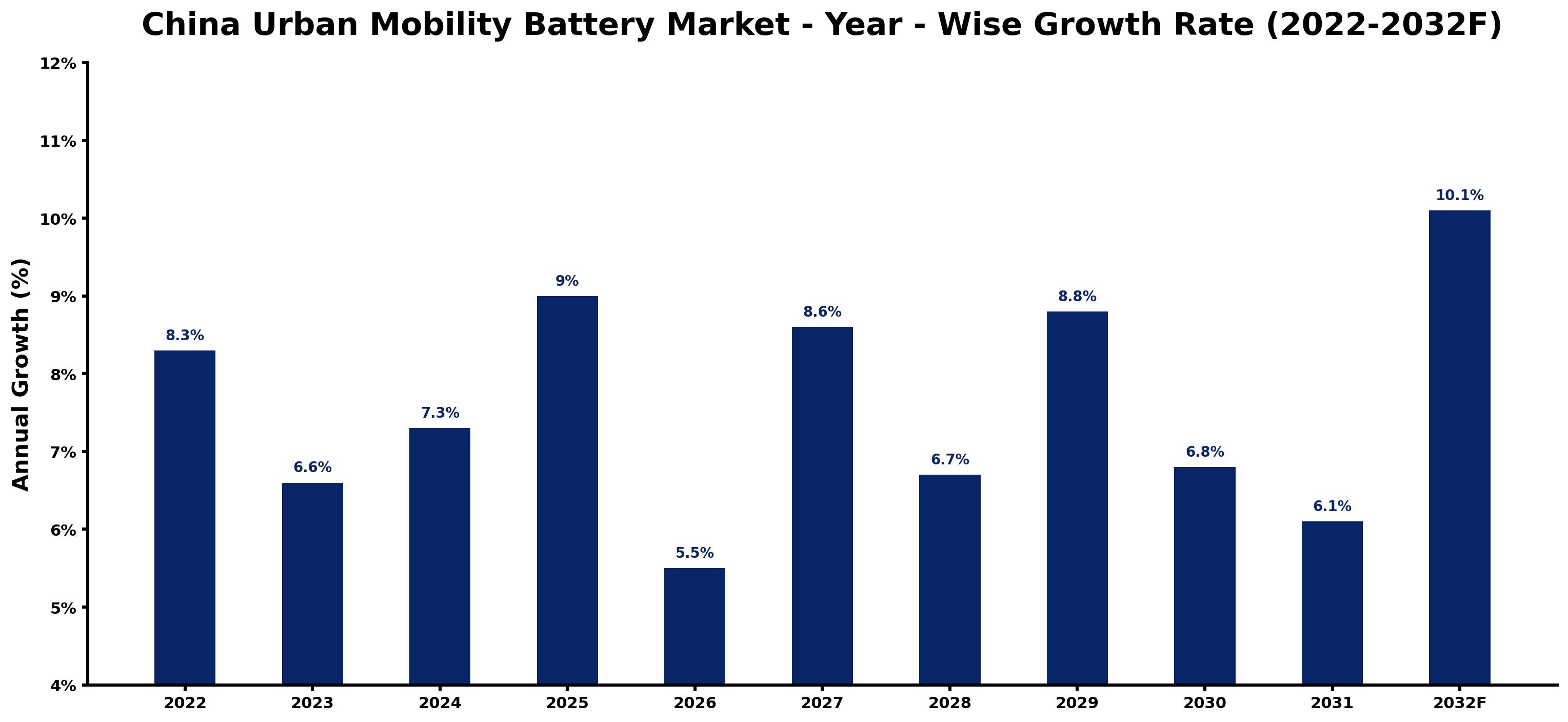
Below, each year's estimated growth is shown next to the factor that most influenced it.
| Year | Estimated Annual Growth (%) | Market Rationale |
| 2022 | 8.3 | The market experienced steady growth due to increasing urbanisation and electric vehicle adoption. |
| 2023 | 6.6 | Growth slowed as the market adjusted to the new electric vehicle charging standard implemented in Beijing. |
| 2024 | 7.3 | Demand surged with the introduction of new electric mobility initiatives and subsidies for two-wheelers. |
| 2025 | 9.0 | The market peaked with investments in electric two-wheelers and delivery fleets driven by government support. |
| 2026 | 5.5 | Growth is expected to slow as production capacity struggles to meet rising demand. |
| 2027 | 8.6 | Demand is projected to increase with the rising popularity of electric delivery fleets in urban areas. |
| 2028 | 6.7 | Growth is expected to slow as the market matures and competition among manufacturers intensifies. |
| 2029 | 8.8 | Demand is projected to rise as battery recycling initiatives gain traction and improve sustainability. |
| 2030 | 6.8 | Growth is expected to slow as the market stabilises after rapid expansion in previous years. |
| 2031 | 6.1 | Demand is projected to decelerate as the market adjusts to new regulatory frameworks. |
| 2032 | 10.1 | The market is expected to peak with advancements in battery technology and infrastructure improvements. |
Note: Market size estimations and growth projections presented in this report are based on 6Wresearch's proprietary forecasting methodology, utilizing the latest available industry data, government publications, and primary research inputs.
China Urban Mobility Battery Market Synopsis
The China Urban Mobility Battery Market includes lithium-ion batteries designed specifically for electric vehicles, such as e-bikes and e-scooters. These batteries are manufactured using advanced electrochemical processes, playing a crucial role in powering sustainable urban transport solutions. The market is expanding due to rising urbanisation, government incentives, and the development of electric vehicle infrastructure. By 2025, the Chinese government aims for 20% of all vehicles to be electric, prompting further investments in this sector. With over 10 million e-scooter users in Shanghai, demand is rapidly increasing.
Market Dynamics Impact Analysis (2026–2032)
| Factor | Type | Impact | Primary Segment Affected |
| Growing urbanisation and demand for sustainable transport solutions | Driver | High | e-Bikes |
| Government subsidies for electric two-wheelers | Driver | High | e-Scooters |
| Expansion of charging infrastructure in urban areas | Opportunity | High | Charging Infrastructure Firms |
| Emerging battery recycling market driven by government initiatives | Opportunity | Medium | Lithium-Ion Batteries |
| Production capacity constraints for lithium-ion batteries | Restraint | High | Lithium-Ion Batteries |
| Regulatory compliance costs for battery safety standards | Restraint | Medium | NMC/NCA |
| Limited consumer awareness of electric mobility benefits | Challenge | High | Mobility OEMs |
| Intense competition among battery manufacturers | Challenge | Medium | Battery Startups |
Evaluation of Drivers in China Urban Mobility Battery Market (2026–2032)
The table below links each growth driver to the segment it affects and the evidence for it.
| Drivers | Primary Segment Affected | Why It Matters (Evidence) |
| Rising urbanisation leading to increased demand for electric mobility solutions | e-Bikes | The average range for e-bikes is approximately 50-70 km per charge, attracting urban commuters. |
| Government subsidies encouraging adoption of electric two-wheelers | e-Scooters | In 2022, a subsidy program targeted a 30% increase in electric two-wheeler adoption. |
| Expansion of charging infrastructure in major cities | Charging Infrastructure Firms | As of 2023, China has over 1,000 charging stations, facilitating electric vehicle use. |
| Growth in delivery fleets using electric vehicles | Delivery Fleets | The market for electric delivery fleets is expanding at a rate of 15% annually. |
| Advancements in battery technology improving performance | Lithium-Ion Batteries | The annual production capacity of lithium-ion batteries in China exceeds 200 GWh. |
The average range for e-bikes is approximately 50-70 km per charge, attracting urban commuters seeking efficient transport. As of 2023, China has over 1,000 charging stations, facilitating the use of electric vehicles. The market for electric delivery fleets is expanding at a rate of 15% annually, driving further investments in battery solutions.
Evaluation of Restraints in China Urban Mobility Battery Market
The following restraints limit how fast demand can grow.
| Market Restraint | Primary Segment Affected | Why It Matters (Evidence) |
| Production capacity constraints for lithium-ion batteries | Lithium-Ion Batteries | The annual production capacity of lithium-ion batteries is over 200 GWh, but demand is outpacing supply. |
| Regulatory compliance costs for battery safety standards | NMC/NCA | The Chinese National Standard GB/T 31467.3 regulates battery safety, increasing costs for manufacturers. |
| Limited consumer awareness of electric mobility benefits | Mobility OEMs | Despite the installed base of electric vehicles surpassing 10 million, many consumers remain uninformed. |
| Intense competition among battery manufacturers | Battery Startups | The rapid growth in the battery market has led to fierce competition, impacting profit margins. |
| Challenges in battery recycling processes | Lithium-Ion Batteries | Stricter regulations on battery recycling implemented in 2020 have increased operational costs for recyclers. |
China Urban Mobility Battery Market Challenges
The China Urban Mobility Battery market encounters regulatory challenges that complicate compliance with the new electric vehicle charging standard introduced in Beijing in 2023, hindering infrastructure deployment for suppliers. Supply chain disruptions stem from rising demand for NMC battery types, resulting in longer lead times for producers struggling to secure necessary materials. Technological uncertainties arise as the expected launch of solid-state batteries by 2025 may not materialise, leaving buyers uncertain about safer alternatives. Cost issues persist since lithium-ion batteries in e-bikes typically last only 3-5 years, requiring consumers to frequently replace batteries and affecting their budgets for urban mobility solutions.
Trends in the China Urban Mobility Battery Market
Below mentioned are some of the trends shaping the China Urban Mobility Battery Market growth.
- Growth in e-Bike Adoption: In 2022, the total number of e-scooter users in Shanghai reached 10 million, showcasing the rising popularity of electric mobility. This trend indicates a shift towards sustainable transport solutions in urban areas.
- Advancements in Charging Infrastructure: The 'Electric Mobility Promotion Strategy' introduced in 2023 aims to improve charging infrastructure nationwide, with over 1,000 stations established. This development supports the growing electric vehicle market in China.
- Emergence of Battery Recycling Initiatives: The battery recycling market is expected to grow significantly, driven by government initiatives aimed at environmental protection. This shift is essential for sustainable battery management in urban mobility.
- Transition to Solid-State Batteries: Solid-state batteries are expected to enter the market by 2025, improving safety and performance. This technological advancement will attract more consumers to electric mobility solutions.
Investment Opportunities in the China Urban Mobility Battery Market
Below are the investment opportunities with the strongest case in the China Urban Mobility Battery Market.
- Partnerships with Charging Infrastructure Firms: With over 1,000 charging stations established, collaborating with charging infrastructure firms presents an opportunity for battery manufacturers to expand their market presence and improve accessibility.
- Investment in Battery Recycling Facilities: The growing battery recycling market, supported by government initiatives, offers an opportunity for investment in recycling facilities to meet increasing demand for sustainable practices.
- Supply of LFP Batteries for Budget-Friendly EVs: LFP batteries are favoured for their cost-effectiveness, making them ideal for budget-friendly electric vehicles. This trend presents an opportunity for manufacturers to target cost-sensitive consumers.
- Joint Ventures with Mobility OEMs: As Mobility OEMs capture a 42% share in 2025, forming joint ventures with these manufacturers can improve market access and product development.
Government Initiatives in the China Urban Mobility Battery Market
The Ministry of Ecology and Environment enforced stricter regulations on battery recycling in 2020, promoting environmental protection and ensuring sustainable practices in production. In 2021, the Ministry of Industry and Information Technology introduced the 'New Energy Vehicle Industry Development Plan', aiming for 20% electric vehicle penetration by 2025, which will stimulate demand for urban mobility batteries. The National Development and Reform Commission approved a subsidy programme for electric two-wheelers in 2022, targeting a 30% increase in adoption, benefiting both manufacturers and consumers.
The State Council launched the 'Electric Mobility Promotion Strategy' in 2023 to improve charging infrastructure nationwide. This initiative is designed to support the growing electric vehicle market, ensuring that manufacturers can meet the rising demand for urban mobility solutions. The Ministry of Transport's 'Green Transport Initiative' advocates for electric delivery fleets, emphasising sustainability and efficiency in urban logistics. These measures provide financial support and regulatory frameworks that encourage the growth of the urban mobility battery market.
Future Insight of the China Urban Mobility Battery Market
The China Urban Mobility Battery market will evolve significantly by 2032, driven by key developments. The government's target of 20% electric vehicle adoption by 2025 will increase demand for urban mobility batteries. The 'Electric Mobility Development Plan' aims to improve production processes and encourage innovations in battery technology. The battery recycling sector is set to expand, propelled by government initiatives promoting eco-friendly practices. With an annual production capacity exceeding 200 GWh, the industry is positioned for robust growth.
Market Segmentation Analysis
The report offers a comprehensive study of the following market segments and their leading categories in the market.
By Battery Type – Lithium-Ion Batteries Dominated, Solid-State Batteries Expected to Grow Fastest
According to Bhawna Singh, Assistant Manager at 6Wresearch, Lithium-Ion Batteries took a 38% share of battery type in 2025, more than any other category. Lithium-Ion Batteries command the largest market share due to their extensive use in electric vehicles, offering reliable energy storage solutions. Their annual production capacity in China, exceeding 200 GWh, highlights the robust supply chain supporting urban mobility needs. Solid-State Batteries are set to record the highest CAGR in this split, 8.7% over 2026–2032. Solid-State Batteries are expected to experience rapid growth as they are anticipated to enter the market by 2025, promising enhanced safety and performance. This upcoming shift is likely to attract significant investment, further accelerating their adoption in urban mobility applications. Suppliers should focus on advancing solid-state technology to maintain a competitive edge as the market progresses.
By Application Vehicle – e-Bikes Dominated, Delivery Fleets Expected to Grow Fastest
e-Bikes accounted for a 47% market share by application vehicle in 2025. e-Bikes dominate the market share as they are a popular mode of transport in urban areas, with the total number of e-scooter users in Shanghai reaching 10 million. This widespread adoption underscores the demand for efficient urban mobility solutions. The quickest growth will come from Delivery Fleets, forecast to expand at a CAGR of 8.9% between 2026 and 2032. Delivery Fleets are experiencing the fastest growth, with a remarkable annual growth rate of 15% as businesses increasingly adopt electric vehicles for last-mile delivery solutions. This trend reflects a shift towards sustainable logistics practices. Buyers in the delivery sector should consider integrating electric vehicles to capitalise on this growing trend.
By Chemistry – NMC/NCA Dominated, LFP Expected to Grow Fastest
With a 42% revenue share in 2025, NMC/NCA was the largest chemistry category. NMC/NCA batteries dominate the market share because they are widely used in high-performance electric vehicles that demand superior energy density. Their established reputation among manufacturers reinforces their status as the preferred chemistry for urban mobility solutions. LFP is projected to grow fastest, at a CAGR of 9.5% during 2026–2032. LFP batteries are witnessing notable growth as they gain popularity for their safety and longevity, especially among budget-conscious consumers. The cost-effectiveness of this chemistry is driving its adoption across various segments of the electric vehicle market. Suppliers must invest in LFP technology to meet the increasing demand for safe and affordable battery options.
By End User – Mobility OEMs Dominated, Battery Startups Expected to Grow Fastest
The largest end user category in 2025 was Mobility OEMs, with a 42% share of total revenue. Mobility OEMs capture the largest market share as they are the primary manufacturers of electric vehicles, significantly influencing the demand for urban mobility batteries. Their established relationships with suppliers ensure a steady flow of battery orders to support ongoing production. Over 2026–2032, Battery Startups are expected to post the fastest growth, at a CAGR of 9.1%. Battery Startups are rapidly gaining momentum as they introduce innovative battery technologies, drawing substantial investment and interest from larger manufacturers. Their agility allows them to swiftly adapt to changing market demands and technological advancements. Investors should explore opportunities in battery startups to capitalise on the potential of emerging technologies within the battery market.
Key Attractiveness of the Report
- 10 Years of Market Numbers
- Historical Data Starting from 2022 to 2025
- Base Year 2025
- Forecast Data until 2032
- Key Performance Indicators Impacting the Market
- Major Upcoming Developments and Projects
Key Highlights of the Report:
- China Urban Mobility Battery Market Outlook
- Market Size of China Urban Mobility Battery Market, 2025
- Forecast of China Urban Mobility Battery Market, 2032
- Historical Data and Forecast of China Urban Mobility Battery Revenues & Volume for the Period 2022 - 2032F
- China Urban Mobility Battery Market Trend Evolution
- China Urban Mobility Battery Market Drivers and Challenges
- China Urban Mobility Battery Price Trends
- China Urban Mobility Battery Porter's Five Forces
- China Urban Mobility Battery Industry Life Cycle
- Historical Data and Forecast of China Urban Mobility Battery Market Revenues & Volume By Battery Type for the Period 2022 - 2032F
- Historical Data and Forecast of China Urban Mobility Battery Market Revenues & Volume By Lithium-Ion Batteries for the Period 2022 - 2032F
- Historical Data and Forecast of China Urban Mobility Battery Market Revenues & Volume By Solid-State Batteries for the Period 2022 - 2032F
- Historical Data and Forecast of China Urban Mobility Battery Market Revenues & Volume By Swappable Battery Packs for the Period 2022 - 2032F
- Historical Data and Forecast of China Urban Mobility Battery Market Revenues & Volume By Fast-Charging Units for the Period 2022 - 2032F
- Historical Data and Forecast of China Urban Mobility Battery Market Revenues & Volume By Application Vehicle for the Period 2022 - 2032F
- Historical Data and Forecast of China Urban Mobility Battery Market Revenues & Volume By e-Bikes, e-Scooters for the Period 2022 - 2032F
- Historical Data and Forecast of China Urban Mobility Battery Market Revenues & Volume By Compact EVs for the Period 2022 - 2032F
- Historical Data and Forecast of China Urban Mobility Battery Market Revenues & Volume By Delivery Fleets for the Period 2022 - 2032F
- Historical Data and Forecast of China Urban Mobility Battery Market Revenues & Volume By Two-Wheeler EVs for the Period 2022 - 2032F
- Historical Data and Forecast of China Urban Mobility Battery Market Revenues & Volume By Chemistry for the Period 2022 - 2032F
- Historical Data and Forecast of China Urban Mobility Battery Market Revenues & Volume By NMC/NCA for the Period 2022 - 2032F
- Historical Data and Forecast of China Urban Mobility Battery Market Revenues & Volume By Solid Electrolyte for the Period 2022 - 2032F
- Historical Data and Forecast of China Urban Mobility Battery Market Revenues & Volume By LFP for the Period 2022 - 2032F
- Historical Data and Forecast of China Urban Mobility Battery Market Revenues & Volume By Advanced Lithium for the Period 2022 - 2032F
- Historical Data and Forecast of China Urban Mobility Battery Market Revenues & Volume By End User for the Period 2022 - 2032F
- Historical Data and Forecast of China Urban Mobility Battery Market Revenues & Volume By Mobility OEMs for the Period 2022 - 2032F
- Historical Data and Forecast of China Urban Mobility Battery Market Revenues & Volume By Battery Startups for the Period 2022 - 2032F
- Historical Data and Forecast of China Urban Mobility Battery Market Revenues & Volume By Fleet Operators for the Period 2022 - 2032F
- Historical Data and Forecast of China Urban Mobility Battery Market Revenues & Volume By Charging Infrastructure Firms for the Period 2022 - 2032F
- China Urban Mobility Battery Import Export Trade Statistics
- Market Opportunity Assessment By Battery Type
- Market Opportunity Assessment By Application Vehicle
- Market Opportunity Assessment By Chemistry
- Market Opportunity Assessment By End User
- China Urban Mobility Battery Top Companies Market Share
- China Urban Mobility Battery Competitive Benchmarking By Technical and Operational Parameters
- China Urban Mobility Battery Company Profiles
- China Urban Mobility Battery Key Strategic Recommendations
Market Covered
The report offers an extensive study of the following market segments.
By Battery Type
- Lithium-Ion Batteries
- Solid-State Batteries
- Swappable Battery Packs
- Fast-Charging Units
By Application Vehicle
- e-Bikes
- e-Scooters
- Compact EVs
- Delivery Fleets
- Two-Wheeler EVs
By Chemistry
- NMC/NCA
- Solid Electrolyte
- LFP
- Advanced Lithium
By End User
- Mobility OEMs
- Battery Startups
- Fleet Operators
- Charging Infrastructure Firms































