India Urban Mobility Market Size & Growth Rate
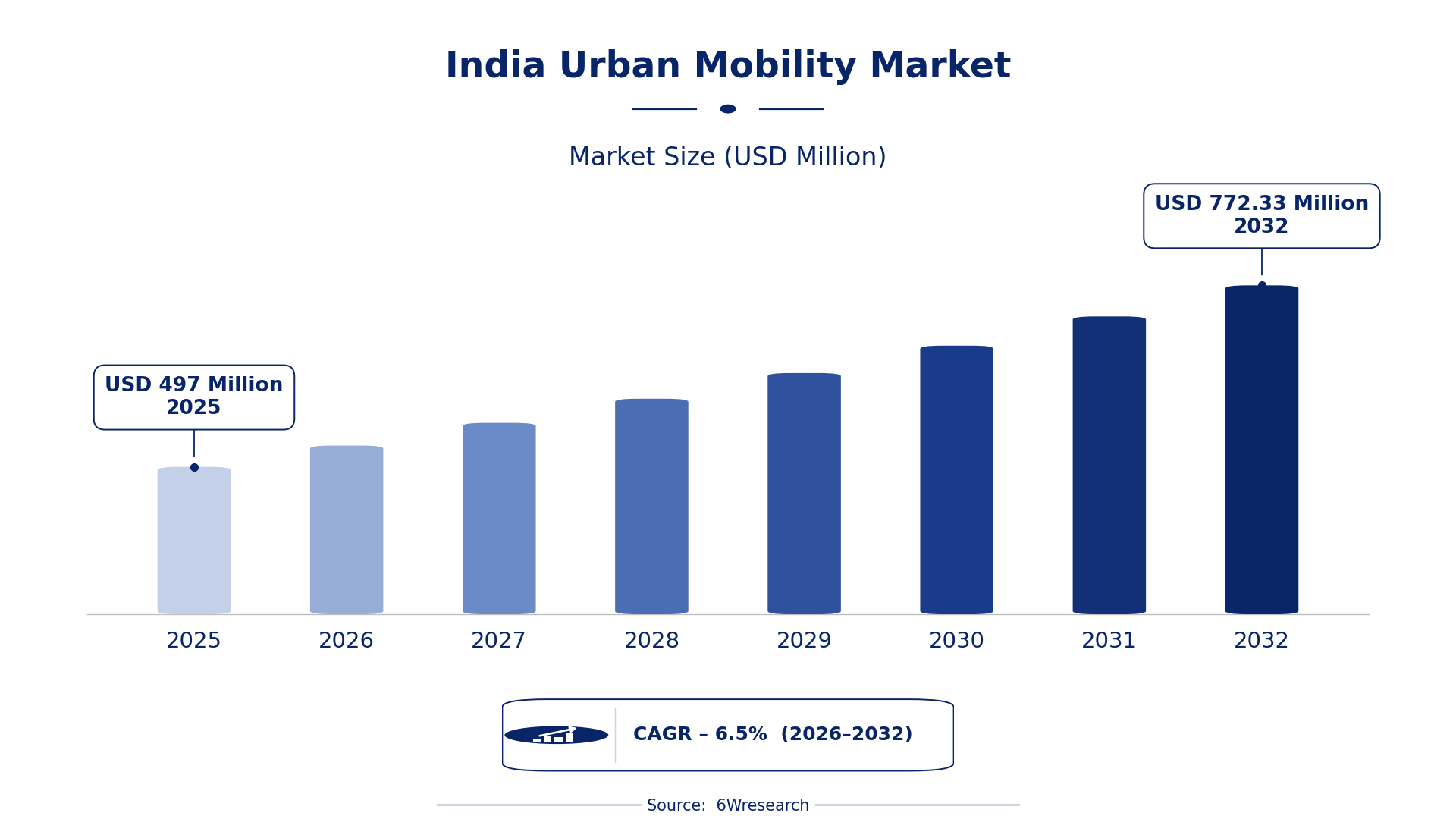
According to 6Wresearch internal database and industry insights, the India Urban Mobility Market was valued at USD 497.0 million in 2025 and is projected to reach USD 772.33 million by 2032, growing at a CAGR of approximately 6.5% during 2026–2032.
India Urban Mobility Market Highlights
| Report Metric | Details |
| Report Name | India Urban Mobility Market |
| Market Size 2025 | USD 497.0 million |
| Market Size 2032 | USD 772.33 million |
| Absolute Growth 2025–2032 | USD 275.33 million |
| CAGR 2026–2032 | 6.5% |
| Peak Annual Growth | 8.3% in 2031 |
| Forecast Period | 2026–2032 |
| Historical Data | 2022–2025 |
| Base Year | 2025 |
| Leading Mode of Transport, 2025 | Public Transit (50% share) |
| Leading Vehicle Type, 2025 | Buses (42% share) |
| Leading Energy Source, 2025 | Electric (40% share) |
| Leading End User, 2025 | Urban Commuters (41% share) |
| Fastest-Growing Mode of Transport | Shared Mobility (8.0% CAGR) |
| Fastest-Growing Vehicle Type | e-Scooters (9.2% CAGR) |
| Fastest-Growing End User | Students (9.0% CAGR) |
| Growing Sector | Public Transit |
| Key End Users | Urban Commuters, Municipal Transport, Working Professionals, Students |
India Urban Mobility Market Year-wise Growth Rate and Key Drivers (2022–2032)
This graph illustrates the annual growth rates of the market from 2022 to 2032, highlighting a steady upward trajectory and projected market expansion over the forecast period.
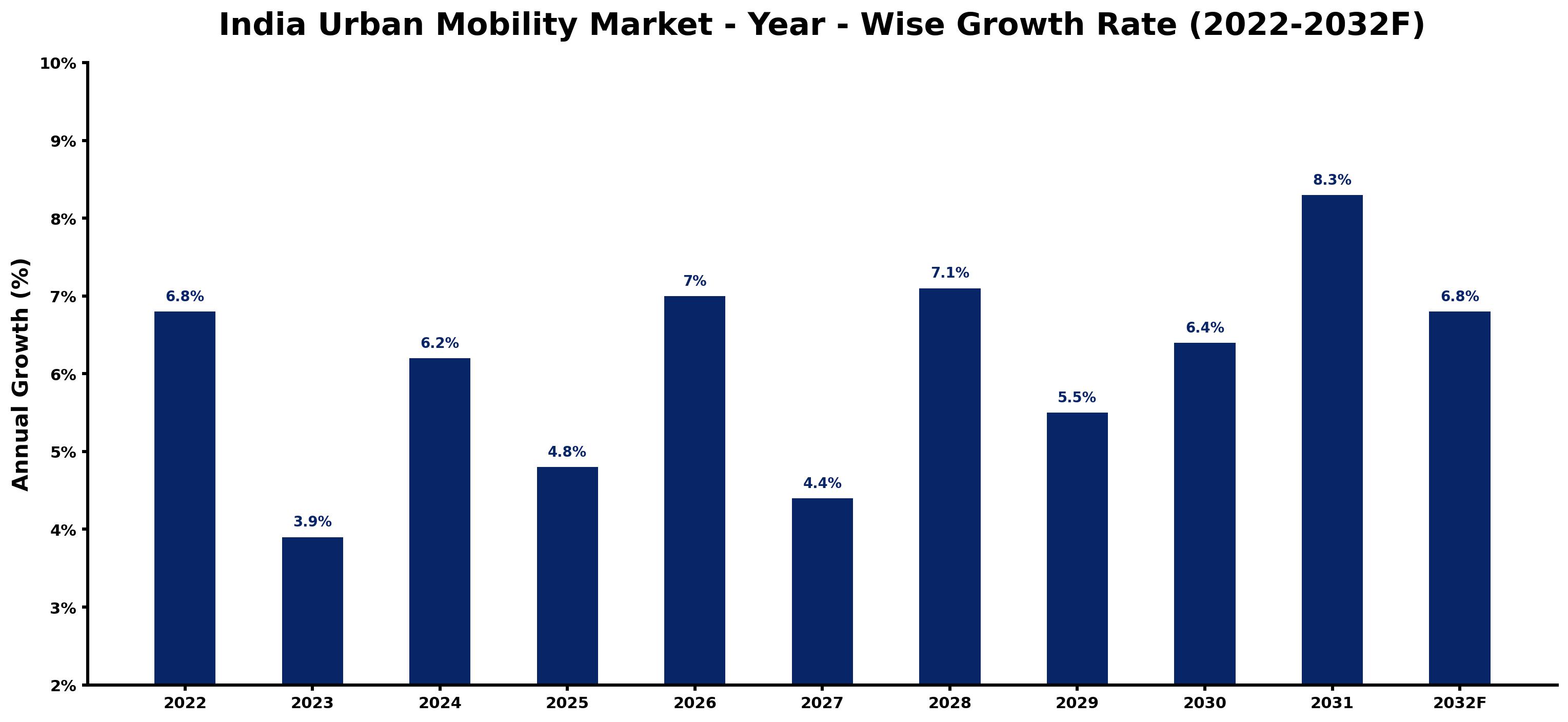
Each row of the following table gives one year's estimated growth and the event or demand shift that explains it.
| Year | Estimated Annual Growth (%) | Market Rationale |
| 2022 | 6.8 | The market experienced strong demand due to urban population growth and increased public transit usage. |
| 2023 | 3.9 | Growth slowed as the market adjusted to changing commuting patterns and fluctuating fuel prices. |
| 2024 | 6.2 | A resurgence in public transit investments spurred faster growth as cities expanded their services. |
| 2025 | 4.8 | Demand moderated as shared mobility options became more mainstream, impacting traditional transport modes. |
| 2026 | 7.0 | Investment in electric vehicle infrastructure is expected to boost growth as the government promotes sustainable transport. |
| 2027 | 4.4 | Growth is projected to slow as local authorities face regulatory challenges in implementing new mobility solutions. |
| 2028 | 7.1 | A renewed focus on electric buses and e-scooters is expected to lead to faster growth in urban mobility. |
| 2029 | 5.5 | Growth will moderate as urban commuters adjust to new transport options and preferences shift. |
| 2030 | 6.4 | Increased government incentives for electric vehicles will drive demand higher again. |
| 2031 | 8.3 | The market peaks as urban population growth and electric vehicle adoption reach critical mass. |
| 2032 | 6.8 | Growth slows slightly as the market stabilises after reaching a peak in electric vehicle penetration. |
Note: Market size estimations and growth projections presented in this report are based on 6Wresearch's proprietary forecasting methodology, utilizing the latest available industry data, government publications, and primary research inputs.
India Urban Mobility Market Synopsis
Urban Mobility in India includes various transport modes aimed at improving commuting efficiency in cities. This encompasses shared mobility solutions, public transit systems, and personal vehicles, primarily powered by electric technologies. The India Urban Mobility Market is expanding due to a growing urban population and government initiatives that promote sustainable transport. With India's urban population expected to reach 600 million by 2031, the demand for efficient transport solutions is increasing. Substantial investments in infrastructure and incentives for electric vehicles are further propelling this growth.
Market Dynamics Impact Analysis (2026–2032)
| Factor | Type | Impact | Primary Segment Affected |
| Increasing urban population driving demand for efficient transport solutions. | Driver | High | Public Transit |
| Government incentives for electric vehicles boosting adoption rates. | Driver | High | Electric |
| Growing preference for shared mobility options among urban commuters. | Opportunity | Medium | Shared Mobility |
| Expansion of electric bus fleets in cities creating new market opportunities. | Opportunity | Medium | Buses |
| Infrastructure challenges in developing electric vehicle charging stations. | Restraint | High | Electric |
| High initial costs of electric vehicles limiting widespread adoption. | Restraint | Medium | Electric |
| The Urban Mobility market in India faces a few practical problems, including infrastructure limitations. | Challenge | High | Public Transit |
| Regulatory hurdles in implementing new mobility solutions can delay market growth. | Challenge | Medium | Shared Mobility |
Evaluation of Drivers in India Urban Mobility Market (2026–2032)
Below mentioned are some major drivers and their influence on market dynamics.
| Drivers | Primary Segment Affected | Why It Matters (Evidence) |
| Urban population growth driving demand for public transport services. | Public Transit | India's urban population is expected to reach 600 million by 2031, increasing the need for efficient transport. |
| Government incentives for electric vehicles encouraging adoption. | Electric | The Indian government allocated ₹10,000 crores for electric vehicle incentives in 2021, boosting purchases. |
| Rise in shared mobility services providing flexible transport options. | Shared Mobility | Shared mobility services have grown by 30% in urban areas in the last year, attracting more users. |
| Investment in electric bus infrastructure enhancing public transport. | Buses | As of 2023, there are 250 operational electric buses in Bengaluru, improving urban transit options. |
| Increased focus on sustainable transport solutions by local authorities. | Electric | The National Electric Mobility Mission Plan launched in 2020 supports the transition to electric vehicles. |
The Urban Mobility market in India is growing on the back of increased investment in infrastructure, rising urban population, and government incentives for electric vehicles. India's urban population is projected to reach 600 million by 2031, driving demand for efficient transport solutions. The Indian government allocated ₹10,000 crores for electric vehicle incentives in 2021, encouraging adoption of electric mobility. Shared mobility services have expanded by 30% in urban areas last year, attracting users seeking flexible transport options. As of 2023, there are over 1 million registered e-scooters in India, supporting the shift towards sustainable transport initiatives.
Evaluation of Restraints in India Urban Mobility Market
The table below lists the restraints and the evidence behind each.
| Market Restraint | Primary Segment Affected | Why It Matters (Evidence) |
| Infrastructure limitations in developing electric vehicle charging stations. | Electric | The average cost of electric vehicles remains higher than traditional vehicles, deterring buyers. |
| High initial costs of electric vehicles limiting widespread adoption. | Electric | The average cost of electric vehicles remains higher than traditional vehicles, deterring buyers. |
| Limited public awareness of new mobility solutions affecting adoption rates. | Shared Mobility | Many urban commuters are still unfamiliar with shared mobility services, slowing their uptake. |
| Regulatory hurdles in implementing new mobility solutions can delay market growth. | Public Transit | Local authorities face challenges in aligning regulations with innovative transport solutions. |
| Competition from traditional transport modes impacting market share of new solutions. | Shared Mobility | Public transport accounts for 45% of urban commuting in major cities, limiting shared mobility growth. |
India Urban Mobility Market Challenges
The India Urban Mobility Market encounters several practical issues, beginning with technology gaps. Many cities lack adequate electric vehicle charging infrastructure, which hinders adoption for buyers interested in greener transport options. Supply chain challenges restrict the availability of electric buses, with only 250 currently operational in Bengaluru, limiting public transport growth and affecting commuter convenience. Competition among shared mobility services has intensified, leading to price wars that threaten profit margins for providers. A skills shortage remains, as training for emerging technologies is insufficient, delaying the rollout of effective urban mobility solutions until 2032.
Trends in the India Urban Mobility Market
Four trends stand out in the India Urban Mobility Market.
- Shift from Personal Vehicles to Shared Mobility: Urban commuters are increasingly choosing shared mobility solutions, with shared services growing by 30% in urban areas last year. This shift reflects changing preferences towards more sustainable transport options.
- Transition to Electric Buses in Public Transit: The introduction of electric buses is transforming public transport in cities like Bengaluru, with 250 operational electric buses as of 2023. This trend supports the government's push for sustainable urban mobility.
- Emergence of E-Scooters as a Preferred Transport Mode: E-scooters are becoming a popular choice for short-distance travel, with over 1 million registered e-scooters in India as of 2023. This trend highlights the growing demand for flexible and eco-friendly transport options.
- Prioritisation of Sustainable Transport Initiatives: The National Electric Mobility Mission Plan launched in 2020 is driving investments in electric vehicles and infrastructure. This initiative aims for 30% electric vehicle penetration by 2030, shaping future mobility.
Investment Opportunities in the India Urban Mobility Market
Some of the investment opportunities in the India Urban Mobility Market are mentioned below.
- Electric Vehicle Charging Infrastructure: With the Indian government aiming for 30% electric vehicle penetration by 2030, there is a gap in charging infrastructure. Investing in charging stations in urban areas can meet the rising demand for electric vehicles.
- Shared Mobility Services Expansion: The recent 30% growth in shared mobility services indicates a strong market opportunity. Targeting urban commuters through app-based services can attract new users seeking convenient transport options.
- Electric Bus Fleet Development: The operational electric buses in Bengaluru highlight a growing opportunity in public transit. Investing in electric bus manufacturing can cater to the increasing demand from municipal transport authorities.
- E-Scooter Market Growth: With over 1 million registered e-scooters, the e-scooter market is expanding rapidly. Suppliers can enter this market by partnering with local manufacturers to meet rising consumer demand.
Government Initiatives in the India Urban Mobility Market
The National Electric Mobility Mission Plan 2020 aims to promote electric vehicles with a budget of ₹10,000 crores for subsidies and incentives. This initiative is designed to facilitate the adoption of electric mobility solutions across the country, impacting producers and buyers alike. The Smart Cities Mission, initiated in 2020, focuses on improving urban mobility infrastructure and funding projects that enhance public transport systems. This programme enables cities to adapt to increasing urbanisation and invest in sustainable transport solutions.
The Ministry of Housing and Urban Affairs oversees the Smart Cities Mission, approving funding for urban mobility projects. The Ministry of Heavy Industries administers the FAME II scheme, which provides incentives for electric and hybrid vehicles, boosting adoption and supporting local manufacturers.
Future Insight of the India Urban Mobility Market
By 2032, transformative changes are anticipated in the India Urban Mobility Market, driven by government initiatives and evolving technologies. The National Electric Mobility Mission Plan targets 30% electric vehicle penetration by 2030, which will elevate the number of registered e-scooters significantly. The Smart Cities Mission will upgrade urban infrastructure, while revised EV charging standards will facilitate wider electric vehicle adoption. These advancements will enhance commuting efficiency for urban commuters and foster a more sustainable transport ecosystem.
Market Segmentation Analysis
Each segment group is reviewed below, with the leader by share and the fastest grower by CAGR.
By Mode of Transport – Public Transit Dominated, Shared Mobility Expected to Grow Fastest
According to Bhawna Singh, Assistant Manager at 6Wresearch, with a 50% revenue share in 2025, Public Transit was the largest mode of transport category. Public transit commands the largest share in India's urban mobility market because it is vital for transporting millions daily, particularly in densely populated cities like Mumbai, where bus ridership averages around 4 million passengers. This mode effectively addresses the commuting needs of urban populations, making it essential for mass transportation. The quickest growth will come from Shared Mobility, forecast to expand at a CAGR of 8.0% between 2026 and 2032. Shared mobility is rapidly expanding, with a notable 30% growth in urban areas over the past year, driven by the increasing demand for flexible transport options among city residents. This trend suggests a shift in commuter preferences towards adaptable transport solutions, which will likely enhance public transit's existing lead. Suppliers should enhance public transit offerings while investing in shared mobility solutions to meet the changing demands of urban commuters.
By Vehicle Type – Buses Dominated, e-Scooters Expected to Grow Fastest
Buses accounted for a 42% market share by vehicle type in 2025. Buses lead the vehicle type segment due to their crucial role in public transit systems, providing mass transportation solutions in cities where they serve as a backbone for urban mobility. Their widespread operational presence, especially in major urban centres, reinforces their dominant position in the market. Over 2026–2032, e-Scooters are expected to post the fastest growth, at a CAGR of 9.2%. e-Scooters are experiencing rapid growth as they gain popularity for short-distance travel in urban environments, appealing to commuters looking for convenience and efficiency. This trend is expected to continue as urban areas expand and the demand for quick transport options increases. Manufacturers should focus on developing e-scooters alongside traditional bus services to cater to the diverse needs of urban commuters.
By Energy Source – Electric Dominated and Is Expected to Record the Fastest Growth
Electric took a 40% share of energy source in 2025, more than any other category. Electric energy sources lead the market as they power a substantial portion of urban mobility solutions, aligning with government initiatives promoting sustainable transport. The push for electric vehicles is further supported by the National Electric Mobility Mission Plan launched in 2020, which aims for 30% electric vehicle penetration by 2030. Electric is also forecast to expand faster than any other category, at a CAGR of 9.1% over 2026–2032. Electric energy sources are also the fastest-growing segment, as increasing awareness and government incentives drive the adoption of electric vehicles across urban mobility solutions. This dual role as both leader and fastest indicates a strong momentum that will likely continue to expand. Suppliers must invest in electric technologies to remain competitive and align with the government's sustainability goals.
By End User – Urban Commuters Dominated, Students Expected to Grow Fastest
In 2025, Urban Commuters led the end user split with a 41% share. Urban commuters account for the largest share of end users in the market, relying heavily on urban mobility services for their daily transportation needs. With over 70% of students in urban areas using public transport, this demographic plays a significant role in shaping the demand for efficient commuting solutions. Students are set to record the highest CAGR in this split, 9.0% over 2026–2032. Students represent the fastest-growing segment among end users, primarily utilising urban mobility solutions for commuting to educational institutions. Their increasing presence in urban areas and preference for public transport indicate a shift in commuting patterns that will continue to develop. Providers should tailor their services to better meet the needs of students, ensuring accessibility and convenience in urban mobility options.
Key Attractiveness of the Report
- 10 Years of Market Numbers
- Historical Data Starting from 2022 to 2025
- Base Year 2025
- Forecast Data until 2032
- Key Performance Indicators Impacting the Market
- Major Upcoming Developments and Projects
Key Highlights of the Report:
- India Urban Mobility Market Outlook
- Market Size of India Urban Mobility Market, 2025
- Forecast of India Urban Mobility Market, 2032
- Historical Data and Forecast of India Urban Mobility Revenues & Volume for the Period 2022 - 2032F
- India Urban Mobility Market Trend Evolution
- India Urban Mobility Market Drivers and Challenges
- India Urban Mobility Price Trends
- India Urban Mobility Porter's Five Forces
- India Urban Mobility Industry Life Cycle
- Historical Data and Forecast of India Urban Mobility Market Revenues & Volume By Mode of Transport for the Period 2022 - 2032F
- Historical Data and Forecast of India Urban Mobility Market Revenues & Volume By Shared Mobility for the Period 2022 - 2032F
- Historical Data and Forecast of India Urban Mobility Market Revenues & Volume By Public Transit for the Period 2022 - 2032F
- Historical Data and Forecast of India Urban Mobility Market Revenues & Volume By Ride-Hailing for the Period 2022 - 2032F
- Historical Data and Forecast of India Urban Mobility Market Revenues & Volume By Personal Mobility for the Period 2022 - 2032F
- Historical Data and Forecast of India Urban Mobility Market Revenues & Volume By Vehicle Type for the Period 2022 - 2032F
- Historical Data and Forecast of India Urban Mobility Market Revenues & Volume By e-Scooters, e-Bikes for the Period 2022 - 2032F
- Historical Data and Forecast of India Urban Mobility Market Revenues & Volume By Buses, Metro for the Period 2022 - 2032F
- Historical Data and Forecast of India Urban Mobility Market Revenues & Volume By Cars, Vans for the Period 2022 - 2032F
- Historical Data and Forecast of India Urban Mobility Market Revenues & Volume By Hoverboards, Foldable EVs for the Period 2022 - 2032F
- Historical Data and Forecast of India Urban Mobility Market Revenues & Volume By Energy Source for the Period 2022 - 2032F
- Historical Data and Forecast of India Urban Mobility Market Revenues & Volume By Electric for the Period 2022 - 2032F
- Historical Data and Forecast of India Urban Mobility Market Revenues & Volume By Hybrid/Fuel Cell for the Period 2022 - 2032F
- Historical Data and Forecast of India Urban Mobility Market Revenues & Volume By Electric/Diesel for the Period 2022 - 2032F
- Historical Data and Forecast of India Urban Mobility Market Revenues & Volume By Rechargeable Battery for the Period 2022 - 2032F
- Historical Data and Forecast of India Urban Mobility Market Revenues & Volume By End User for the Period 2022 - 2032F
- Historical Data and Forecast of India Urban Mobility Market Revenues & Volume By Urban Commuters for the Period 2022 - 2032F
- Historical Data and Forecast of India Urban Mobility Market Revenues & Volume By Municipal Transport for the Period 2022 - 2032F
- Historical Data and Forecast of India Urban Mobility Market Revenues & Volume By Working Professionals for the Period 2022 - 2032F
- Historical Data and Forecast of India Urban Mobility Market Revenues & Volume By Students for the Period 2022 - 2032F
- India Urban Mobility Import Export Trade Statistics
- Market Opportunity Assessment By Mode of Transport
- Market Opportunity Assessment By Vehicle Type
- Market Opportunity Assessment By Energy Source
- Market Opportunity Assessment By End User
- India Urban Mobility Top Companies Market Share
- India Urban Mobility Competitive Benchmarking By Technical and Operational Parameters
- India Urban Mobility Company Profiles
- India Urban Mobility Key Strategic Recommendations
Market Covered
The report offers an extensive study of the following market segments.
By Mode of Transport
- Shared Mobility
- Public Transit
- Ride-Hailing
- Personal Mobility
By Vehicle Type
- e-Scooters
- e-Bikes
- Buses
- Metro
- Cars
- Vans
- Hoverboards
- Foldable EVs
By Energy Source
- Electric
- Hybrid/Fuel Cell
- Electric/Diesel
- Rechargeable Battery
By End User
- Urban Commuters
- Municipal Transport
- Working Professionals
- Students































