China Urban Mobility Market Size & Growth Rate
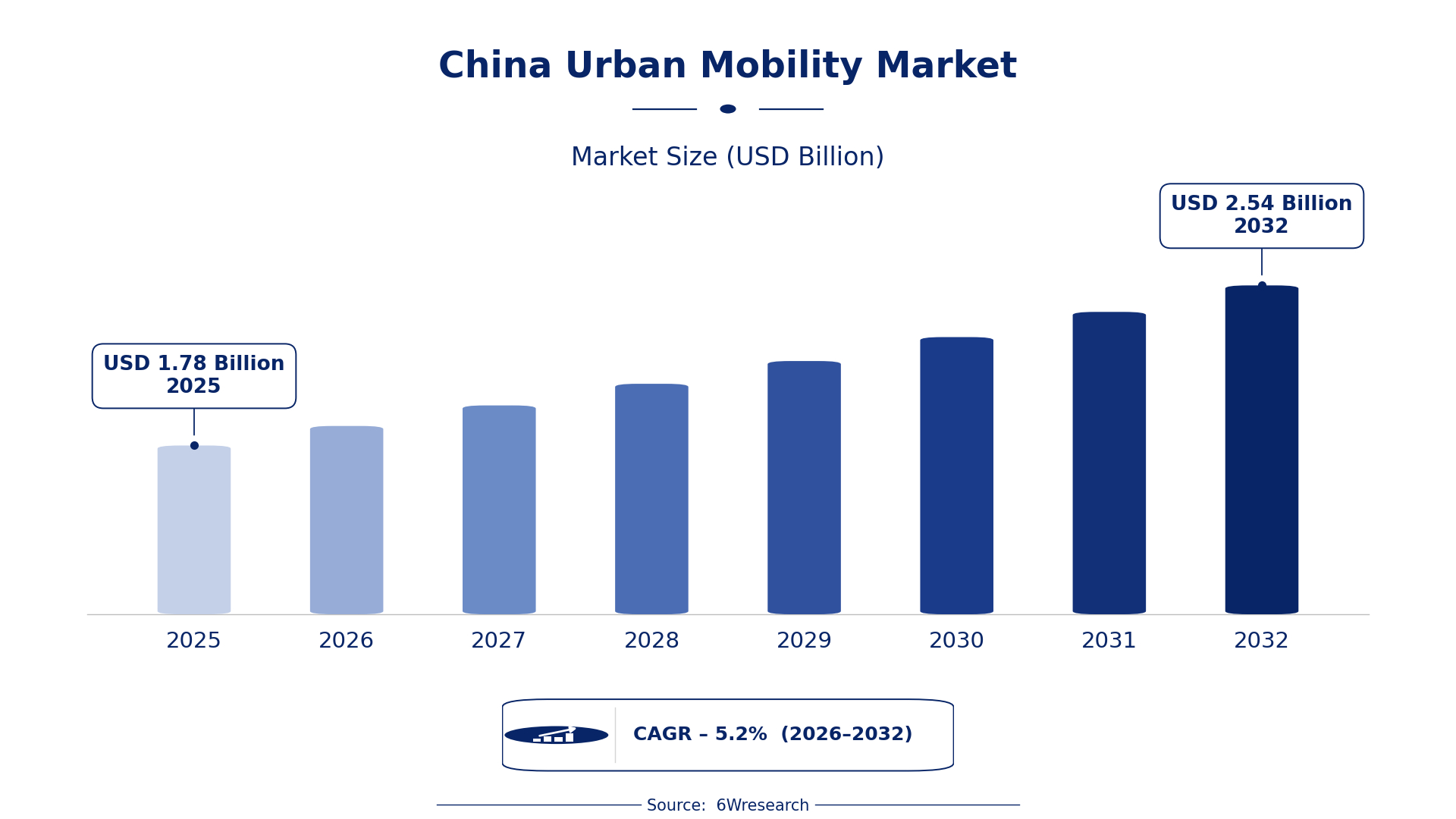
According to 6Wresearch internal database and industry insights, the China Urban Mobility Market was valued at USD 1.78 billion in 2025 and is projected to reach USD 2.54 billion by 2032, growing at a CAGR of approximately 5.2% during 2026–2032.
China Urban Mobility Market Highlights
| Report Metric | Details |
| Report Name | China Urban Mobility Market |
| Market Size 2025 | USD 1.78 billion |
| Market Size 2032 | USD 2.54 billion |
| Absolute Growth 2025–2032 | USD 0.76 billion |
| CAGR 2026–2032 | 5.2% |
| Peak Annual Growth | 7.6% in 2032 |
| Forecast Period | 2026–2032 |
| Historical Data | 2022–2025 |
| Base Year | 2025 |
| Leading Mode of Transport, 2025 | Shared Mobility (48% share) |
| Leading Vehicle Type, 2025 | e-Scooters (32% share) |
| Leading Energy Source, 2025 | Electric (51% share) |
| Leading End User, 2025 | Urban Commuters (43% share) |
| Fastest-Growing Mode of Transport | Public Transit (6.6% CAGR) |
| Fastest-Growing Vehicle Type | e-Bikes (6.3% CAGR) |
| Fastest-Growing Energy Source | Hybrid/Fuel Cell (7.5% CAGR) |
| Fastest-Growing End User | Municipal Transport (6.7% CAGR) |
| Growing Sector | Electric Mobility |
| Key End Users | Urban Commuters, Municipal Transport, Working Professionals, Students |
China Urban Mobility Market Year-wise Growth Rate and Key Drivers (2022–2032)
This graph illustrates the annual growth rates of the market from 2022 to 2032, highlighting a steady upward trajectory and projected market expansion over the forecast period.
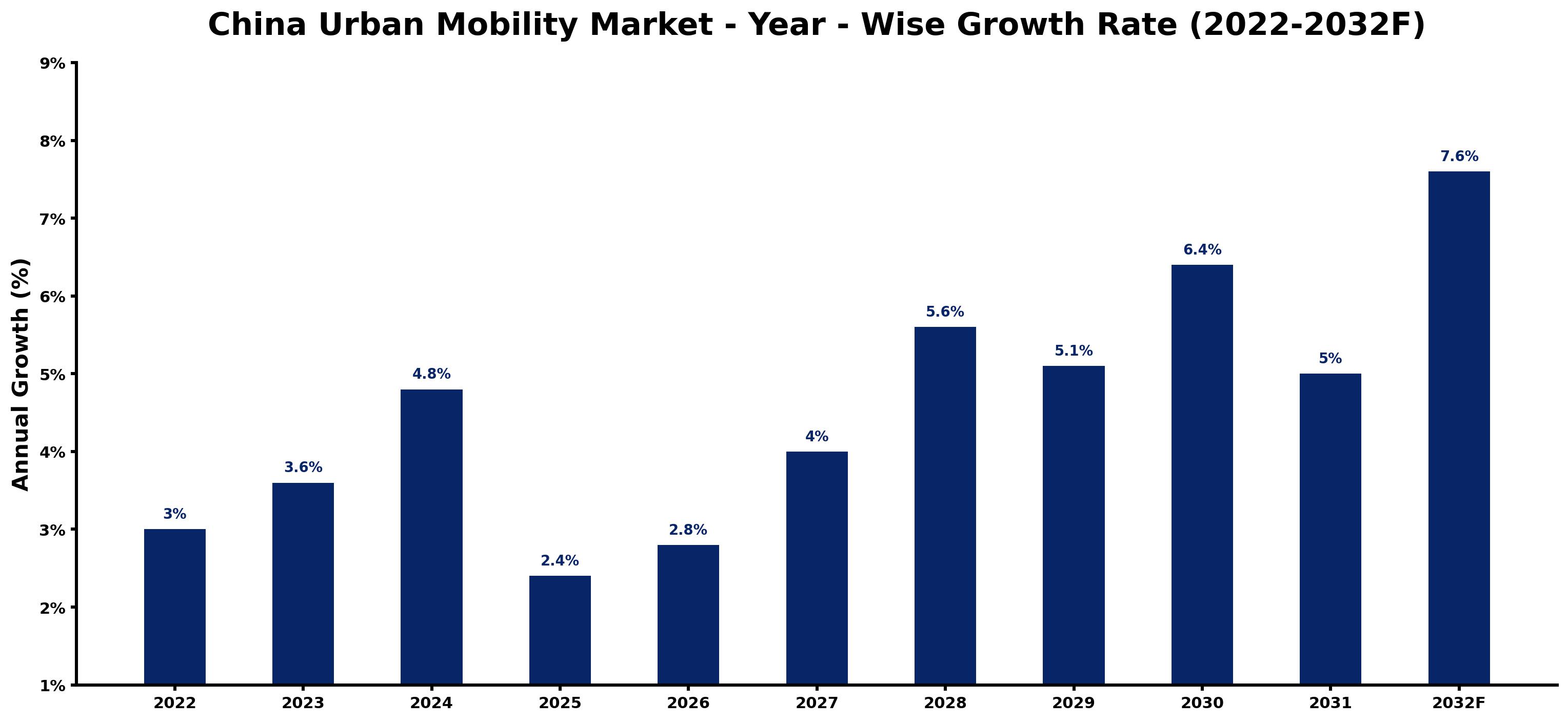
Year by year, the estimates below pair each growth rate with the development that shaped it.
| Year | Estimated Annual Growth (%) | Market Rationale |
| 2022 | 3.0 | Urban commuters exceeded 400 million, driving demand for efficient transport solutions. |
| 2023 | 3.6 | Shared mobility services increased by 30% since 2020, boosting urban commuting options. |
| 2024 | 4.8 | The average daily ridership of public transit surpassed 100 million in major cities, increasing demand. |
| 2025 | 2.4 | Growth slowed as urban infrastructure investments faced delays in some regions. |
| 2026 | 2.8 | The introduction of 500 new electric buses in Shanghai is expected to stimulate public transport usage. |
| 2027 | 4.0 | Rising investments in smart city initiatives will benefit the urban mobility sector. |
| 2028 | 5.6 | The National Standard for Electric Bicycles improved safety, encouraging more users. |
| 2029 | 5.1 | Public transport usage remains strong, supported by government initiatives and subsidies. |
| 2030 | 6.4 | The government aims for 50% public transport usage by 2035, driving further investments. |
| 2031 | 5.0 | The Electric Vehicle Industry Development Plan targets 25% of vehicles to be electric by 2025, supporting market growth. |
| 2032 | 7.6 | Peak annual growth is driven by increasing urban commuter demand for sustainable solutions. |
Note: Market size estimations and growth projections presented in this report are based on 6Wresearch's proprietary forecasting methodology, utilizing the latest available industry data, government publications, and primary research inputs.
China Urban Mobility Market Synopsis
Urban Mobility in China includes various modes of transportation designed to enhance city commuting efficiency. It covers shared mobility solutions, public transit systems, and personal vehicles. The China Urban Mobility Market is expanding due to investments in smart city infrastructure and a growing demand from urban commuters. In 2022, urban commuters surpassed 400 million, underscoring the necessity for effective transport solutions. Government initiatives like the Urban Mobility Development Plan are driving this growth by improving public transport systems and encouraging the use of electric vehicles.
Market Dynamics Impact Analysis (2026–2032)
| Factor | Type | Impact | Primary Segment Affected |
| Technological advancements in electric vehicles drive demand for sustainable transport solutions. | Driver | High | Electric |
| The growing popularity of shared mobility services enhances urban commuting options. | Driver | High | Shared Mobility |
| Investment in electric bus fleets presents opportunities for cleaner public transport solutions. | Opportunity | High | Public Transit |
| The push for eco-friendly commuting options opens avenues for e-bike suppliers. | Opportunity | Medium | e-Bikes |
| Infrastructure delays can hinder the timely rollout of new urban mobility solutions. | Restraint | High | Public Transit |
| Safety concerns regarding electric mobility vehicles may limit user adoption rates. | Restraint | Medium | e-Scooters |
| The Urban Mobility Market in China faces challenges related to infrastructure development. | Challenge | High | Public Transit |
| Competition among various modes of transport can lead to market fragmentation. | Challenge | Medium | Shared Mobility |
Evaluation of Drivers in China Urban Mobility Market (2026–2032)
The main growth drivers and the segments they affect most are set out below.
| Drivers | Primary Segment Affected | Why It Matters (Evidence) |
| Technological advancements in electric vehicles are enhancing urban transport efficiency. | Electric | The Electric Vehicle Industry Development Plan aims for 25% of vehicles to be electric by 2025, increasing demand for electric mobility solutions. |
| The rise of shared mobility services is transforming urban commuting. | Shared Mobility | Shared mobility services have seen a 30% increase in usage since 2020, attracting urban commuters seeking convenience. |
| Investment in public transport infrastructure is vital for urban mobility. | Public Transit | The Beijing Metro operates over 700 kilometers of track, facilitating mass transportation for over 100 million daily riders. |
| Increasing urban population drives demand for efficient transport solutions. | Urban Commuters | In 2022, urban commuters in China exceeded 400 million, necessitating improved urban mobility options. |
| Government initiatives promote electric vehicle adoption and infrastructure. | e-Bikes | The Hangzhou city government promotes e-bikes as part of its green transport initiative, encouraging eco-friendly commuting. |
In 2022, urban commuters exceeded 400 million, creating a strong need for efficient transport solutions. The Electric Vehicle Industry Development Plan aims for 25% of vehicles to be electric by 2025, increasing options for buyers. Shared mobility services have seen a 30% increase in usage since 2020, attracting urban residents seeking convenience. Investment in public transport infrastructure is vital, as the Beijing Metro operates extensive track, facilitating mass transportation for millions of daily riders.
Evaluation of Restraints in China Urban Mobility Market
Below mentioned are some major restraints and their influence on market dynamics.
| Market Restraint | Primary Segment Affected | Why It Matters (Evidence) |
| Infrastructure delays can hinder the timely rollout of new urban mobility solutions. | Public Transit | The Guangdong province has invested 5 billion RMB in urban mobility infrastructure, but delays have slowed implementation. |
| Safety concerns regarding electric mobility vehicles may limit user adoption rates. | e-Scooters | The National Standard for Electric Bicycles was updated in 2021 to improve safety regulations, affecting user confidence. |
| Regulatory hurdles can slow down the introduction of new mobility solutions. | e-Bikes | The revised National Standard for Electric Bicycles in 2021 requires compliance checks that can delay market entry. |
| Limited public awareness of new mobility options can restrict user adoption. | Public Transit | Despite improvements, the average daily ridership of public transit in major cities was over 100 million, indicating potential growth. |
| Intense competition among various modes of transport can lead to market fragmentation. | Shared Mobility | Ride-hailing services accounted for 15% of urban transport in 2022, complicating market dynamics. |
China Urban Mobility Market Challenges
The China Urban Mobility market encounters several practical issues, starting with insufficient public transport infrastructure. Over 400 million urban commuters face overcrowded systems, causing delays in their daily travel and impacting productivity. Fierce competition among shared mobility services has triggered price wars, squeezing margins for providers and leading to reduced service quality for users. Regulatory hurdles also impede market growth; recent updates to the National Standard for Electric Bicycles have introduced stricter safety requirements, raising operational costs for manufacturers. Rapid technological advancements can outstrip existing regulations, leaving consumers uncertain about compliance and safety in new mobility solutions.
Trends in the China Urban Mobility Market
Several trends are reshaping the China Urban Mobility Market; the most important are set out below.
- Shift Towards Electric Buses: Municipal transport authorities are increasingly adopting electric buses to promote sustainability. In 2023, Shanghai introduced 500 new electric buses to its fleet, reflecting a growing commitment to cleaner public transport.
- Rising Popularity of E-Bikes: Urban commuters are increasingly opting for e-bikes as a convenient transport solution. The Hangzhou city government promotes e-bikes as part of its green transport initiative, with notable uptake in urban areas.
- Growth of Shared Mobility Services: Shared mobility services are becoming a preferred choice for urban commuting. Since 2020, usage has increased by 30%, driven by urban residents seeking convenience and flexibility.
- Expansion of Public Transit Systems: Public transit systems are expanding to meet rising urban demand. The average daily ridership of public transit in major cities was over 100 million, improving connectivity for millions of daily riders.
Investment Opportunities in the China Urban Mobility Market
The following opportunities in the China Urban Mobility Market pair current demand with a clear way in.
- Investment in Electric Bus Infrastructure: Municipalities are investing in electric bus fleets to modernise public transport. In 2023, Shanghai introduced 500 new electric buses, creating opportunities for infrastructure suppliers.
- Emerging E-Bike Market: With the demand for eco-friendly commuting options rising, suppliers can invest in e-bike production. The Hangzhou city government promotes e-bikes, making it a key market for manufacturers.
- Expansion of Shared Mobility Services: The increasing urban population presents a gap for shared mobility services. Urban commuters exceeding 400 million in 2022 highlight the need for more flexible transport solutions.
- Development of Smart City Infrastructure: Investment in smart city initiatives is essential for urban mobility. Collaborating with local governments on infrastructure projects can facilitate market entry and growth.
Government Initiatives in the China Urban Mobility Market
In 2021, the Ministry of Transport launched the 'Urban Mobility Development Plan' to enhance urban transport efficiency and sustainability. This initiative aims to improve public transport systems and promote electric vehicles, thereby supporting urban mobility. By focusing on infrastructure development, it encourages municipalities to adopt cleaner transport options, ultimately benefiting urban commuters and the environment.
In 2022, the National Development and Reform Commission approved a subsidy program for electric buses, encouraging cleaner public transport solutions. This initiative, backed by the Ministry of Transport, aims to increase the number of electric buses in urban fleets. By providing financial incentives, it supports municipalities in transitioning to more sustainable transport options, thereby improving urban mobility.
Future Insight of the China Urban Mobility Market
The China Urban Mobility market is set for considerable changes by 2032, driven by several key initiatives. The Urban Mobility Development Plan aims to increase public transport usage to 50% by 2035, promoting sustainable commuting options. The introduction of 500 new electric buses in Shanghai reflects a commitment to electrification across urban transport. By 2032, the government expects 2 million registered e-scooters to enhance last-mile connectivity, encouraging cleaner alternatives for buyers. These initiatives will create a more integrated and efficient urban transport system in the coming years.
Market Segmentation Analysis
The analysis below covers each segmentation, its leading category in 2025 and its fastest-growing category through 2032.
By Mode of Transport – Shared Mobility Dominated, Public Transit Expected to Grow Fastest
According to Bhawna Singh, Assistant Manager at 6Wresearch, with a 48% revenue share in 2025, Shared Mobility was the largest mode of transport category. Shared mobility holds the largest market share as it caters to urban residents who prioritise convenience and flexibility in their commuting choices. The notable increase in usage of services such as bike-sharing and e-scooter rentals reflects a significant shift towards these shared solutions in urban environments. Public Transit is set to record the highest CAGR in this split, 6.6% over 2026–2032. Public transit is experiencing rapid growth, driven by government initiatives like the 'Urban Mobility Development Plan' which focuses on enhancing transport efficiency. With an average daily ridership of over 100 million in major cities, the segment shows strong potential for further expansion. Suppliers should focus on integrating shared mobility solutions with public transport to effectively meet the needs of the growing urban commuter base.
By Vehicle Type – e-Scooters Dominated, e-Bikes Expected to Grow Fastest
e-Scooters took a 32% share of vehicle type in 2025, more than any other category. e-Scooters dominate the market share as they are highly favoured for short-distance travel, appealing to urban residents seeking quick and efficient transport. Their registered user base of over 2 million in urban areas underscores their popularity and utility. Over 2026–2032, e-Bikes are expected to post the fastest growth, at a CAGR of 6.3%. e-Bikes are the fastest-growing segment, driven by increasing awareness of eco-friendly commuting options and municipal support for green transport initiatives. The push for sustainable mobility solutions is expected to accelerate their adoption in the coming years. Manufacturers should prioritise the development of e-bikes to meet the rising demand for sustainable urban transport.
By Energy Source – Electric Dominated, Hybrid/Fuel Cell Expected to Grow Fastest
In 2025, Electric led the energy source split with a 51% share. Electric energy sources dominate the market as they are the preferred choice for new urban mobility solutions, aligning with the target of having 25% of vehicles be electric by 2025. This commitment to electric vehicles illustrates a strong focus on sustainability in urban transport initiatives. The quickest growth will come from Hybrid/Fuel Cell, forecast to expand at a CAGR of 7.5% between 2026 and 2032. Hybrid and fuel cell technologies are gaining momentum, particularly as urban areas invest in cleaner alternatives to conventional fuels. The promotion of hybrid vehicles by the National Energy Administration reflects an increasing acceptance of varied energy sources in urban mobility. Suppliers should explore diversifying their product lines to include hybrid options, catering to the changing energy preferences in the market.
By End User – Urban Commuters Dominated, Municipal Transport Expected to Grow Fastest
Urban Commuters held a 43% share of the China Urban Mobility Market by end user in 2025. Urban commuters represent the largest user group for urban mobility services, motivated by the need for efficient transport solutions in densely populated areas. Their substantial numbers underscore the importance of tailoring services to effectively address the demands of this demographic. Municipal Transport is projected to grow fastest, at a CAGR of 6.7% during 2026–2032. Municipal transport is witnessing rapid growth as government efforts enhance public transport systems to better serve urban populations. The objective to increase public transport usage to 50% by 2035 highlights the critical focus on developing this segment. Service providers must collaborate with municipal transport authorities to develop integrated solutions that effectively meet the needs of urban commuters.
Key Attractiveness of the Report
- 10 Years of Market Numbers
- Historical Data Starting from 2022 to 2025
- Base Year 2025
- Forecast Data until 2032
- Key Performance Indicators Impacting the Market
- Major Upcoming Developments and Projects
Key Highlights of the Report:
- China Urban Mobility Market Outlook
- Market Size of China Urban Mobility Market, 2025
- Forecast of China Urban Mobility Market, 2032
- Historical Data and Forecast of China Urban Mobility Revenues & Volume for the Period 2022 - 2032F
- China Urban Mobility Market Trend Evolution
- China Urban Mobility Market Drivers and Challenges
- China Urban Mobility Price Trends
- China Urban Mobility Porter's Five Forces
- China Urban Mobility Industry Life Cycle
- Historical Data and Forecast of China Urban Mobility Market Revenues & Volume By Mode of Transport for the Period 2022 - 2032F
- Historical Data and Forecast of China Urban Mobility Market Revenues & Volume By Shared Mobility for the Period 2022 - 2032F
- Historical Data and Forecast of China Urban Mobility Market Revenues & Volume By Public Transit for the Period 2022 - 2032F
- Historical Data and Forecast of China Urban Mobility Market Revenues & Volume By Ride-Hailing for the Period 2022 - 2032F
- Historical Data and Forecast of China Urban Mobility Market Revenues & Volume By Personal Mobility for the Period 2022 - 2032F
- Historical Data and Forecast of China Urban Mobility Market Revenues & Volume By Vehicle Type for the Period 2022 - 2032F
- Historical Data and Forecast of China Urban Mobility Market Revenues & Volume By e-Scooters, e-Bikes for the Period 2022 - 2032F
- Historical Data and Forecast of China Urban Mobility Market Revenues & Volume By Buses, Metro for the Period 2022 - 2032F
- Historical Data and Forecast of China Urban Mobility Market Revenues & Volume By Cars, Vans for the Period 2022 - 2032F
- Historical Data and Forecast of China Urban Mobility Market Revenues & Volume By Hoverboards, Foldable EVs for the Period 2022 - 2032F
- Historical Data and Forecast of China Urban Mobility Market Revenues & Volume By Energy Source for the Period 2022 - 2032F
- Historical Data and Forecast of China Urban Mobility Market Revenues & Volume By Electric for the Period 2022 - 2032F
- Historical Data and Forecast of China Urban Mobility Market Revenues & Volume By Hybrid/Fuel Cell for the Period 2022 - 2032F
- Historical Data and Forecast of China Urban Mobility Market Revenues & Volume By Electric/Diesel for the Period 2022 - 2032F
- Historical Data and Forecast of China Urban Mobility Market Revenues & Volume By Rechargeable Battery for the Period 2022 - 2032F
- Historical Data and Forecast of China Urban Mobility Market Revenues & Volume By End User for the Period 2022 - 2032F
- Historical Data and Forecast of China Urban Mobility Market Revenues & Volume By Urban Commuters for the Period 2022 - 2032F
- Historical Data and Forecast of China Urban Mobility Market Revenues & Volume By Municipal Transport for the Period 2022 - 2032F
- Historical Data and Forecast of China Urban Mobility Market Revenues & Volume By Working Professionals for the Period 2022 - 2032F
- Historical Data and Forecast of China Urban Mobility Market Revenues & Volume By Students for the Period 2022 - 2032F
- China Urban Mobility Import Export Trade Statistics
- Market Opportunity Assessment By Mode of Transport
- Market Opportunity Assessment By Vehicle Type
- Market Opportunity Assessment By Energy Source
- Market Opportunity Assessment By End User
- China Urban Mobility Top Companies Market Share
- China Urban Mobility Competitive Benchmarking By Technical and Operational Parameters
- China Urban Mobility Company Profiles
- China Urban Mobility Key Strategic Recommendations
Market Covered
This report examines the market across the segments below.
By Mode of Transport
- Shared Mobility
- Public Transit
- Ride-Hailing
- Personal Mobility
By Vehicle Type
- e-Scooters
- e-Bikes
- Buses
- Metro
- Cars
- Vans
- Hoverboards
- Foldable EVs
By Energy Source
- Electric
- Hybrid/Fuel Cell
- Electric/Diesel
- Rechargeable Battery
By End User
- Urban Commuters
- Municipal Transport
- Working Professionals
- Students































