India Urban Sanitation Automation Market Size & Growth Rate
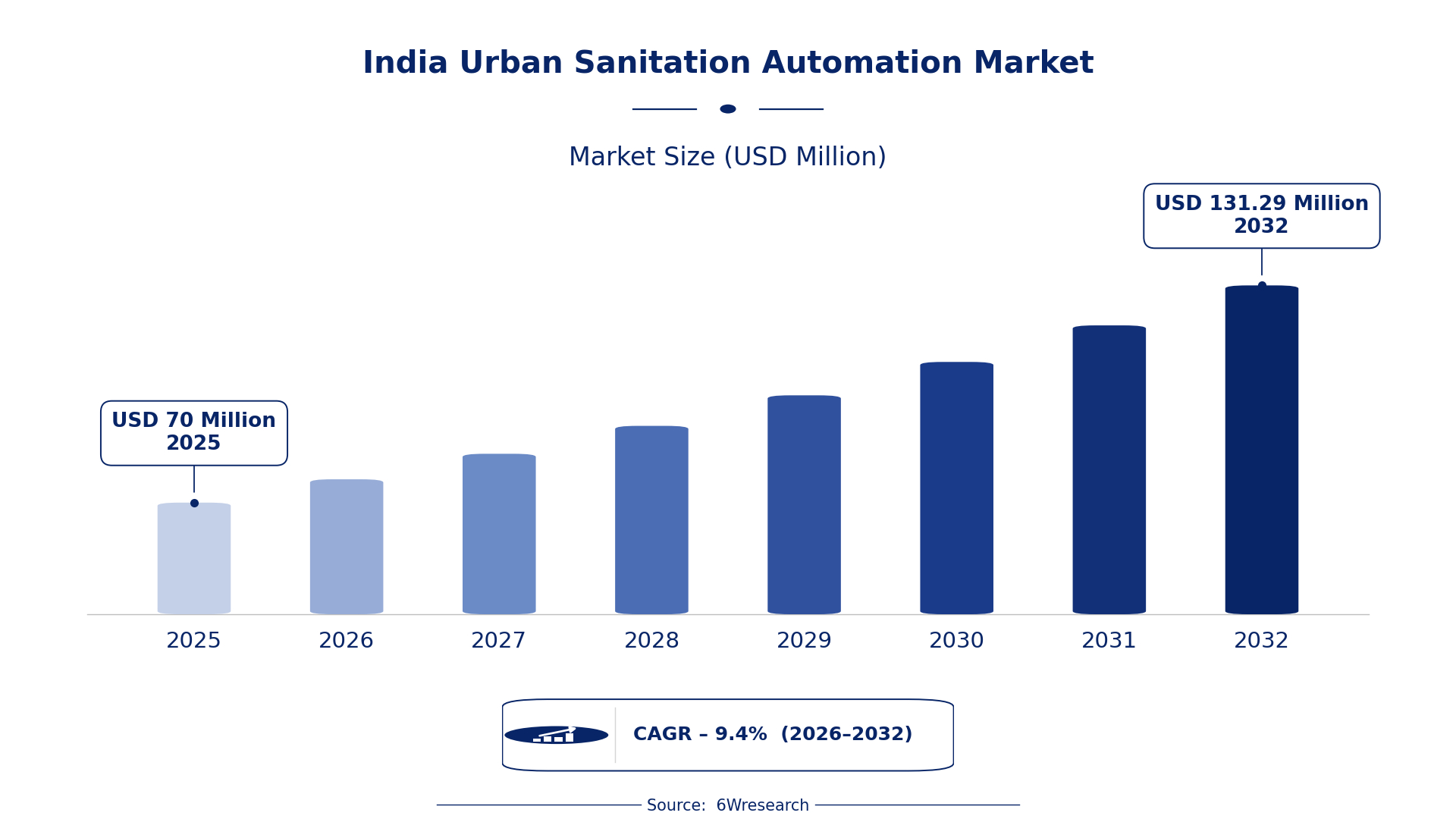
According to 6Wresearch internal database and industry insights, the India Urban Sanitation Automation Market was valued at USD 70.0 million in 2025 and is projected to reach USD 131.29 million by 2032, growing at a CAGR of approximately 9.4% during 2026–2032.
India Urban Sanitation Automation Market Highlights
| Report Metric | Details |
| Report Name | India Urban Sanitation Automation Market |
| Market Size 2025 | USD 70.0 million |
| Market Size 2032 | USD 131.29 million |
| Absolute Growth 2025–2032 | USD 61.29 million |
| CAGR 2026–2032 | 9.4% |
| Peak Annual Growth | 11.1% in 2029 |
| Forecast Period | 2026–2032 |
| Historical Data | 2022–2025 |
| Base Year | 2025 |
| Leading Sanitation Type, 2025 | Smart Waste Disposal (36% share) |
| Leading Technology Used, 2025 | IoT-Enabled Bins (39% share) |
| Leading Automation Level, 2025 | Full Automation (38% share) |
| Leading End User, 2025 | Municipal Bodies (41% share) |
| Fastest-Growing Sanitation Type | Robotic Sewer Cleaning (10.7% CAGR) |
| Fastest-Growing Automation Level | Semi-Autonomous (10.5% CAGR) |
| Fastest-Growing End User | City Corporations (12.1% CAGR) |
| Growing Sector | Municipal sanitation |
| Key End Users | Municipal Bodies, City Corporations, Public Health Departments, Urban Planners |
India Urban Sanitation Automation Market Year-wise Growth Rate and Key Drivers (2022–2032)
This graph illustrates the annual growth rates of the market from 2022 to 2032, highlighting a steady upward trajectory and projected market expansion over the forecast period.
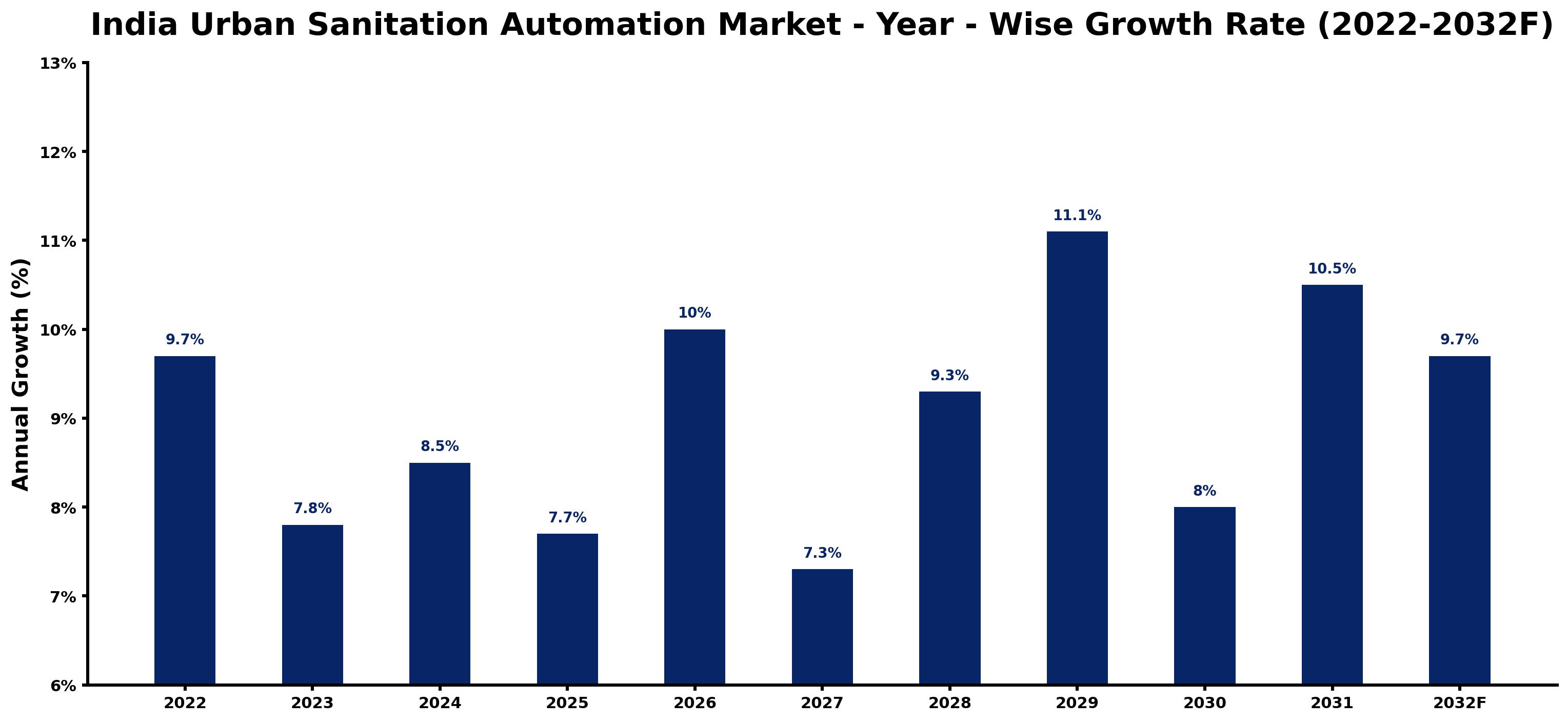
Each row of the following table gives one year's estimated growth and the event or demand shift that explains it.
| Year | Estimated Annual Growth (%) | Market Rationale |
| 2022 | 9.7 | The market experienced strong growth due to increased urbanisation and sanitation needs driven by the National Urban Sanitation Policy. |
| 2023 | 7.8 | Growth slowed as municipal bodies adjusted to new sanitation technologies and budgets following the Smart Cities Mission. |
| 2024 | 8.5 | Demand accelerated with more cities adopting smart waste disposal solutions supported by the Swachh Bharat Mission. |
| 2025 | 7.7 | Growth decelerated as some municipalities faced funding constraints for projects outlined in the Atal Mission for Rejuvenation and Urban Transformation. |
| 2026 | 10.0 | The market is expected to rebound with investments in urban sanitation automation driven by government funding. |
| 2027 | 7.3 | Growth is projected to slow as competition among suppliers intensifies in major cities. |
| 2028 | 9.3 | Demand is expected to increase as AI monitoring systems are integrated into sanitation practices in urban areas. |
| 2029 | 11.1 | The market is projected to peak as cities expand their automation initiatives significantly under the Smart Cities Mission. |
| 2030 | 8.0 | Growth is expected to slow as urban planners focus on integrating multiple technologies into sanitation systems. |
| 2031 | 10.5 | Demand will rise as public health departments prioritise automated sanitation solutions in response to urban challenges. |
| 2032 | 9.7 | Growth is projected to decelerate as the market reaches a more mature stage, with ongoing support from the National Urban Sanitation Policy. |
Note: Market size estimations and growth projections presented in this report are based on 6Wresearch's proprietary forecasting methodology, utilizing the latest available industry data, government publications, and primary research inputs.
India Urban Sanitation Automation Market Synopsis
Urban Sanitation Automation in India involves the integration of technology to manage urban waste and sanitation systems. This includes smart waste disposal, robotic sewer cleaning, and AI monitoring systems designed to improve public health. The India Urban Sanitation Automation Market is expanding due to the urban population exceeding 460 million and the Smart Cities Mission, which aims to develop 100 smart cities. These initiatives drive demand for advanced sanitation solutions, resulting in substantial investments in the sector.
Market Dynamics Impact Analysis (2026–2032)
| Factor | Type | Impact | Primary Segment Affected |
| Rising urban population drives demand for efficient waste management solutions. | Driver | High | Smart Waste Disposal |
| Integration of AI monitoring systems enhances operational efficiency in sanitation. | Driver | High | AI Monitoring Systems |
| Investment in smart sanitation technologies is increasing across major cities. | Opportunity | High | Robotic Sewer Cleaning |
| Municipal bodies are seeking partnerships to implement advanced sanitation solutions. | Opportunity | Medium | Public Toilet Systems |
| Funding constraints limit the pace of technology adoption in some municipalities. | Restraint | High | AI Monitoring Systems |
| Competition among suppliers may lead to price wars, affecting profitability. | Restraint | Medium | Smart Waste Disposal |
| Urban Sanitation Automation in India faces challenges in technology integration. | Challenge | High | Robotic Sewer Cleaning |
| Regulatory compliance can delay project approvals and implementations. | Challenge | Medium | Public Toilet Systems |
Evaluation of Drivers in India Urban Sanitation Automation Market (2026–2032)
Key forces behind demand, with the segment each one moves most, are listed below.
| Drivers | Primary Segment Affected | Why It Matters (Evidence) |
| Increasing urban population necessitates efficient waste management solutions. | Smart Waste Disposal | With over 460 million people in urban areas, demand for smart waste disposal systems is surging. |
| AI monitoring systems improve sanitation management efficiency. | AI Monitoring Systems | Integration of AI in municipal departments allows for real-time monitoring and response capabilities. |
| Government initiatives like the Smart Cities Mission promote sanitation automation. | Robotic Sewer Cleaning | The initiative encourages cities to adopt robotic cleaning technologies for better hygiene. |
| Public health concerns drive demand for automated sanitation solutions. | Public Toilet Systems | Municipal bodies are increasingly adopting automated solutions to improve public health standards. |
| Funding from urban development projects supports sanitation technology investments. | Smart Waste Disposal | The Indian government allocated ₹1,000 crore for urban sanitation projects in 2023. |
The urban population exceeds 460 million, creating a pressing need for efficient waste management solutions. The Smart Cities Mission promotes the adoption of robotic sewer cleaning technologies, encouraging cities to improve hygiene standards. Municipal bodies are prioritising automated sanitation solutions to improve hygiene across urban areas, reflecting a shift towards modern waste management practices.
Evaluation of Restraints in India Urban Sanitation Automation Market
Below mentioned are some major restraints and their influence on market dynamics.
| Market Restraint | Primary Segment Affected | Why It Matters (Evidence) |
| Funding constraints limit the pace of technology adoption in municipalities. | AI Monitoring Systems | Some municipalities face budgetary issues that delay the implementation of advanced sanitation technologies. |
| Competition among suppliers may lead to price wars, affecting profitability. | Smart Waste Disposal | Intense competition in major cities can drive down prices, impacting supplier margins. |
| Regulatory compliance can delay project approvals and implementations. | Public Toilet Systems | Bureaucratic hurdles in obtaining necessary approvals can slow down deployment of new systems. |
| Limited awareness of advanced technologies among municipal staff hampers adoption. | Robotic Sewer Cleaning | Some municipal bodies lack the expertise to implement and maintain robotic cleaning systems. |
| Infrastructure limitations in older cities restrict the deployment of new technologies. | AI Monitoring Systems | Aging urban infrastructure complicates the integration of modern sanitation solutions. |
India Urban Sanitation Automation Market Challenges
The India Urban Sanitation Automation Market faces critical supply chain challenges, particularly in sourcing advanced technologies, which delays project implementation for municipal bodies. High integration costs for new sanitation technologies force city corporations to allocate up to 30% more of their budgets, restricting their ability to adopt these solutions. Local governments encounter project delays due to regulatory hurdles, extending timelines by an average of six months and affecting service delivery. Rapid technological advancements create difficulties for municipalities to keep pace, risking the obsolescence of solutions within just a few years, leading to wasted investments for buyers.
Trends in the India Urban Sanitation Automation Market
The trends below show where the India Urban Sanitation Automation Market is heading.
- Shift towards Smart Waste Disposal Solutions: In 2023, municipalities focused on efficiency, leading to a surge in the adoption of smart waste disposal solutions. The Smart Cities Mission has driven this change, resulting in a 36% market share for smart waste disposal.
- Emergence of AI Monitoring Systems in Sanitation: Since 2022, AI monitoring systems have been increasingly integrated into municipal sanitation departments. This trend improves operational efficiency, with a growing number of cities adopting these technologies for better hygiene management.
- Robotic Sewer Cleaning Gaining Traction: Robotic sewer cleaning systems have been tested in major metropolitan areas since 2023. This shift towards automation aims to reduce human intervention and improve sanitation efficiency across urban regions.
- Public Toilet Systems Becoming Automated: Public toilet systems are increasingly adopting automation technologies. This trend is evident in cities like Delhi, where automated solutions are being implemented to improve public health.
Investment Opportunities in the India Urban Sanitation Automation Market
Below are the investment opportunities with the strongest case in the India Urban Sanitation Automation Market.
- Investment in Smart Waste Disposal Technologies: With the urban population exceeding 460 million, there is a notable gap in efficient waste management solutions. Municipal bodies are seeking partnerships to implement smart waste disposal technologies, creating opportunities for suppliers.
- Entry into Robotic Sewer Cleaning Market: The growing demand for robotic sewer cleaning systems presents an opportunity for new entrants. Collaborating with municipal bodies can facilitate market entry and technology adoption.
- Expansion of AI Monitoring Systems: The integration of AI monitoring systems is becoming essential for urban sanitation. Suppliers can target municipal bodies looking to improve their sanitation management capabilities.
- Development of Automated Public Toilet Systems: The increasing focus on public health creates a demand for automated public toilet systems. Collaborating with city corporations can help suppliers tap into this growing market.
Government Initiatives in the India Urban Sanitation Automation Market
The National Urban Sanitation Policy, updated in 2021, emphasises the adoption of smart sanitation solutions to improve urban hygiene standards. This policy sets guidelines for municipalities to follow, facilitating the integration of advanced sanitation technologies. The Smart Cities Mission continues to promote urban sanitation automation, encouraging cities to adopt innovative solutions. In 2023, the Indian government allocated ₹1,000 crore for urban sanitation projects, supporting infrastructure improvements and technology integration. These measures aim to elevate public health and hygiene standards across urban areas.
Municipal bodies utilise the Atal Mission for Rejuvenation and Urban Transformation (AMRUT) to fund urban sanitation automation projects. This scheme provides financial support for infrastructure improvements, enabling cities to implement advanced sanitation technologies. The Swachh Survekshan 2022 cleanliness survey encourages cities to adopt innovative sanitation solutions, fostering competition among municipalities to improve hygiene standards. The Bureau of Indian Standards also plays a role in setting guidelines for sanitation technology integration, ensuring compliance with national standards.
Future Insight of the India Urban Sanitation Automation Market
The India Urban Sanitation Automation Market is set to evolve by 2032, propelled by the Smart Cities Mission and a robust government emphasis on urban sanitation initiatives. The integration of advanced waste management technologies will improve operational efficiency for municipal bodies. With ₹1,000 crore allocated for urban sanitation projects in 2023, this funding will support the development of smart sanitation solutions. As urban planners increasingly incorporate these technologies in city designs, public health outcomes are expected to improve, positively impacting communities across major urban centres.
Market Segmentation Analysis
The analysis below covers each segmentation, its leading category in 2025 and its fastest-growing category through 2032.
By Sanitation Type – Smart Waste Disposal Dominated, Robotic Sewer Cleaning Expected to Grow Fastest
According to Bhawna Singh, Assistant Manager at 6Wresearch, Smart Waste Disposal accounted for a 36% market share by sanitation type in 2025. Smart waste disposal captures the largest market share in India's urban sanitation automation sector due to its critical role in managing urban waste effectively. Municipal bodies in key regions like Delhi and Mumbai are increasingly adopting these solutions to tackle the challenges of their growing populations. Robotic Sewer Cleaning is projected to grow fastest, at a CAGR of 10.7% during 2026–2032. Robotic sewer cleaning is experiencing rapid growth as municipalities seek to reduce human involvement in hazardous sewer environments. The Indian government's allocation of ₹1,000 crore for urban sanitation projects in 2023 is expected to significantly boost investments in these technologies. This trend indicates that suppliers should focus on advancing smart waste disposal technologies to meet the rising demand.
By Technology Used – IoT-Enabled Bins Dominated and Is Expected to Record the Fastest Growth
IoT-Enabled Bins took a 39% share of technology used in 2025, more than any other category. IoT-enabled bins lead the market share as they are vital for efficient waste management, providing essential data for operational effectiveness. Their incorporation into urban sanitation frameworks aligns seamlessly with the objectives of initiatives like the Smart Cities Mission. IoT-Enabled Bins are also forecast to expand faster than any other category, at a CAGR of 12.1% over 2026–2032. The growth of IoT-enabled bins is fuelled by their ability to improve waste management and lower operational costs for city corporations. As urban areas continue to grow, the demand for these smart solutions is likely to surge, reinforcing their market position. Suppliers should focus on advancing IoT-enabled technologies to take advantage of the expanding urban sanitation automation market.
By Automation Level – Full Automation Dominated, Semi-Autonomous Expected to Grow Fastest
Full Automation held a 38% share of the India Urban Sanitation Automation Market by automation level in 2025. Full automation commands the largest market share as it represents the highest level of integration in sanitation management, ensuring seamless operations without human intervention. This appeal is particularly strong among municipal bodies aiming to improve efficiency in waste management processes. Over 2026–2032, Semi-Autonomous is expected to post the fastest growth, at a CAGR of 10.5%. Semi-autonomous systems are witnessing swift growth as they offer a balance between automation and human oversight, making them attractive to city corporations looking to enhance their sanitation operations. As municipalities increasingly adopt these systems, the market for full automation will benefit from heightened investments. This suggests that suppliers should invest in both fully automated and semi-autonomous solutions to cater to diverse client needs.
By End User – Municipal Bodies Dominated, City Corporations Expected to Grow Fastest
With a 41% revenue share in 2025, Municipal Bodies was the largest end user category. Municipal bodies command the largest share in the urban sanitation automation market as they are the primary buyers of these technologies for city-wide sanitation improvements. Their ongoing projects, particularly in major cities, drive substantial demand for automation solutions. The quickest growth will come from City Corporations, forecast to expand at a CAGR of 12.1% between 2026 and 2032. City corporations are rapidly adopting urban sanitation automation technologies to address specific local challenges, leading to their status as the fastest-growing end user segment. As urbanisation accelerates, their demand for efficient sanitation solutions will likely increase further. This highlights the need for suppliers to tailor their offerings to meet the specific requirements of city corporations.
Key Attractiveness of the Report
- 10 Years of Market Numbers
- Historical Data Starting from 2022 to 2025
- Base Year 2025
- Forecast Data until 2032
- Key Performance Indicators Impacting the Market
- Major Upcoming Developments and Projects
Key Highlights of the Report:
- India Urban Sanitation Automation Market Outlook
- Market Size of India Urban Sanitation Automation Market, 2025
- Forecast of India Urban Sanitation Automation Market, 2032
- Historical Data and Forecast of India Urban Sanitation Automation Revenues & Volume for the Period 2022 - 2032F
- India Urban Sanitation Automation Market Trend Evolution
- India Urban Sanitation Automation Market Drivers and Challenges
- India Urban Sanitation Automation Price Trends
- India Urban Sanitation Automation Porter's Five Forces
- India Urban Sanitation Automation Industry Life Cycle
- Historical Data and Forecast of India Urban Sanitation Automation Market Revenues & Volume By Sanitation Type for the Period 2022 - 2032F
- Historical Data and Forecast of India Urban Sanitation Automation Market Revenues & Volume By Smart Waste Disposal for the Period 2022 - 2032F
- Historical Data and Forecast of India Urban Sanitation Automation Market Revenues & Volume By Robotic Sewer Cleaning for the Period 2022 - 2032F
- Historical Data and Forecast of India Urban Sanitation Automation Market Revenues & Volume By AI Monitoring Systems for the Period 2022 - 2032F
- Historical Data and Forecast of India Urban Sanitation Automation Market Revenues & Volume By Public Toilet Systems for the Period 2022 - 2032F
- Historical Data and Forecast of India Urban Sanitation Automation Market Revenues & Volume By Technology Used for the Period 2022 - 2032F
- Historical Data and Forecast of India Urban Sanitation Automation Market Revenues & Volume By IoT-Enabled Bins for the Period 2022 - 2032F
- Historical Data and Forecast of India Urban Sanitation Automation Market Revenues & Volume By Vision + Robotics for the Period 2022 - 2032F
- Historical Data and Forecast of India Urban Sanitation Automation Market Revenues & Volume By Air Quality + Garbage Sensors for the Period 2022 - 2032F
- Historical Data and Forecast of India Urban Sanitation Automation Market Revenues & Volume By Auto Flush/Touchless Ops for the Period 2022 - 2032F
- Historical Data and Forecast of India Urban Sanitation Automation Market Revenues & Volume By Automation Level for the Period 2022 - 2032F
- Historical Data and Forecast of India Urban Sanitation Automation Market Revenues & Volume By Full Automation for the Period 2022 - 2032F
- Historical Data and Forecast of India Urban Sanitation Automation Market Revenues & Volume By Semi-Autonomous for the Period 2022 - 2032F
- Historical Data and Forecast of India Urban Sanitation Automation Market Revenues & Volume By Real-Time for the Period 2022 - 2032F
- Historical Data and Forecast of India Urban Sanitation Automation Market Revenues & Volume By Smart Interface for the Period 2022 - 2032F
- Historical Data and Forecast of India Urban Sanitation Automation Market Revenues & Volume By End User for the Period 2022 - 2032F
- Historical Data and Forecast of India Urban Sanitation Automation Market Revenues & Volume By Municipal Bodies for the Period 2022 - 2032F
- Historical Data and Forecast of India Urban Sanitation Automation Market Revenues & Volume By City Corporations for the Period 2022 - 2032F
- Historical Data and Forecast of India Urban Sanitation Automation Market Revenues & Volume By Public Health Dept. for the Period 2022 - 2032F
- Historical Data and Forecast of India Urban Sanitation Automation Market Revenues & Volume By Urban Planners for the Period 2022 - 2032F
- India Urban Sanitation Automation Import Export Trade Statistics
- Market Opportunity Assessment By Sanitation Type
- Market Opportunity Assessment By Technology Used
- Market Opportunity Assessment By Automation Level
- Market Opportunity Assessment By End User
- India Urban Sanitation Automation Top Companies Market Share
- India Urban Sanitation Automation Competitive Benchmarking By Technical and Operational Parameters
- India Urban Sanitation Automation Company Profiles
- India Urban Sanitation Automation Key Strategic Recommendations
Market Covered
The report offers an extensive study of the following market segments.
By Sanitation Type
- Smart Waste Disposal
- Robotic Sewer Cleaning
- AI Monitoring Systems
- Public Toilet Systems
By Technology Used
- IoT-Enabled Bins
- Vision + Robotics
- Air Quality + Garbage Sensors
- Auto Flush/Touchless Ops
By Automation Level
- Full Automation
- Semi-Autonomous
- Real-Time
- Smart Interface
By End User
- Municipal Bodies
- City Corporations
- Public Health Dept.
- Urban Planners































