China Urban Sanitation Automation Market Size & Growth Rate
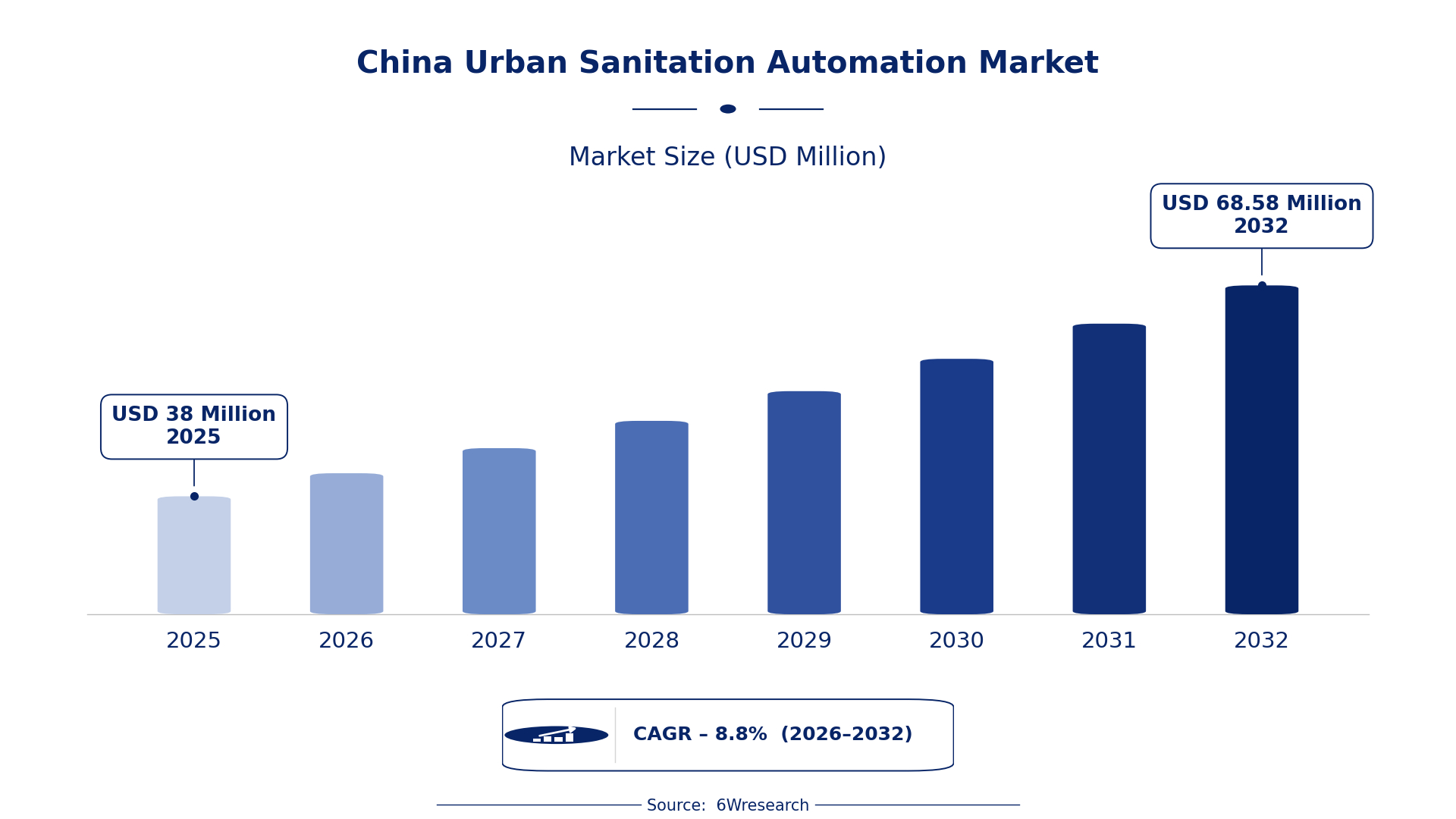
According to 6Wresearch internal database and industry insights, the China Urban Sanitation Automation Market was valued at USD 38.0 million in 2025 and is projected to reach USD 68.58 million by 2032, growing at a CAGR of approximately 8.8% during 2026–2032.
China Urban Sanitation Automation Market Highlights
| Report Metric | Details |
| Report Name | China Urban Sanitation Automation Market |
| Market Size 2025 | USD 38.0 million |
| Market Size 2032 | USD 68.58 million |
| Absolute Growth 2025–2032 | USD 30.58 million |
| CAGR 2026–2032 | 8.8% |
| Peak Annual Growth | 11.0% in 2031 |
| Forecast Period | 2026–2032 |
| Historical Data | 2022–2025 |
| Base Year | 2025 |
| Leading Sanitation Type, 2025 | Smart Waste Disposal (39% share) |
| Leading Technology Used, 2025 | IoT-Enabled Bins (52% share) |
| Leading Automation Level, 2025 | Full Automation (38% share) |
| Leading End User, 2025 | Municipal Bodies (48% share) |
| Fastest-Growing Sanitation Type | AI Monitoring Systems (11.3% CAGR) |
| Fastest-Growing Automation Level | Real-Time (11.1% CAGR) |
| Fastest-Growing End User | Public Health Dept. (11.0% CAGR) |
| Growing Sector | Municipal sanitation services |
| Key End Users | Municipal bodies, city corporations, public health departments, urban planners |
China Urban Sanitation Automation Market Year-wise Growth Rate and Key Drivers (2022–2032)
This graph illustrates the annual growth rates of the market from 2022 to 2032, highlighting a steady upward trajectory and projected market expansion over the forecast period.
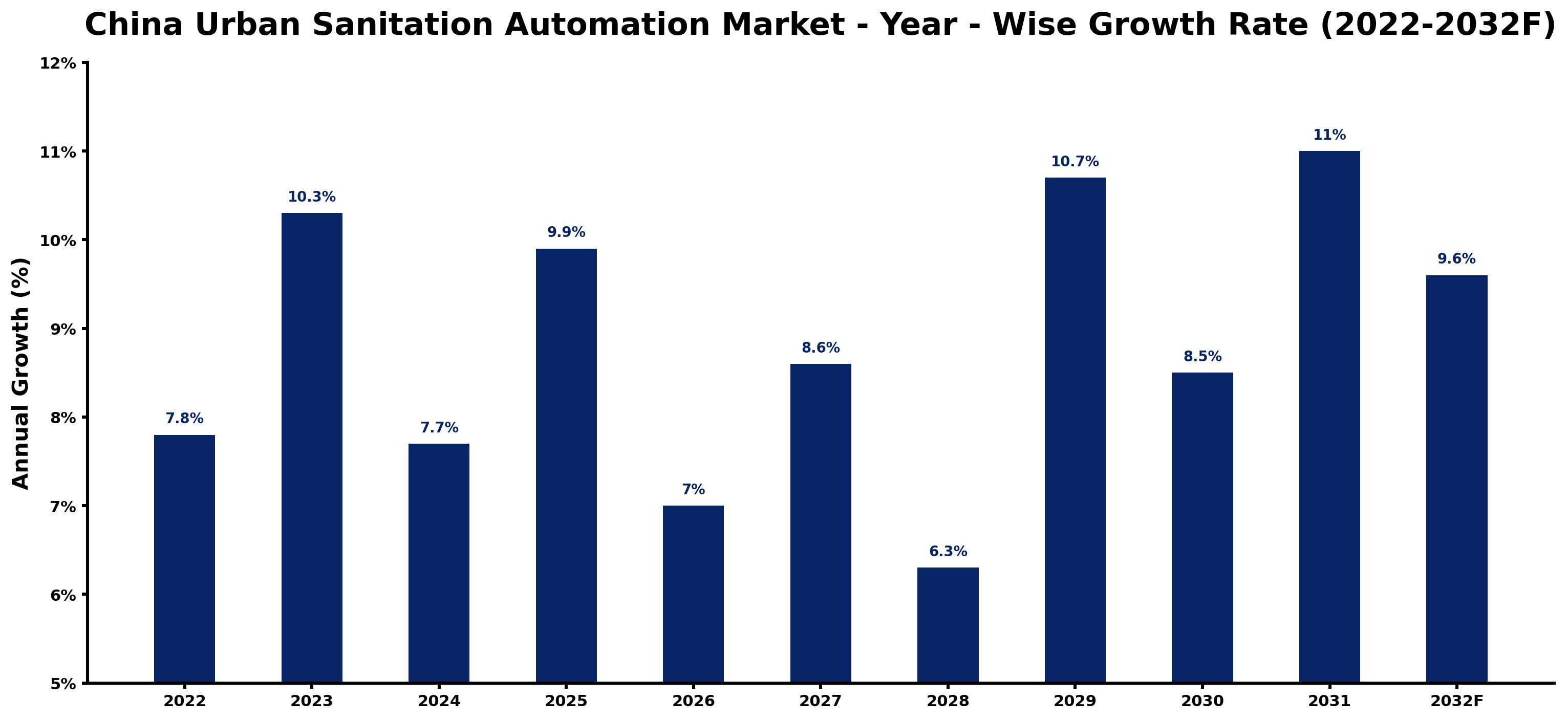
Below, each year's estimated growth is shown next to the factor that most influenced it.
| Year | Estimated Annual Growth (%) | Market Rationale |
| 2022 | 7.8 | Urban sanitation automation demand was influenced by a growing urban population. |
| 2023 | 10.3 | The implementation of the Urban Sanitation Automation Program accelerated market growth. |
| 2024 | 7.7 | Demand growth slowed as the Urban Sanitation Automation Program matured. |
| 2025 | 9.9 | Municipal bodies increased investments in smart waste disposal technologies under the Smart City Initiative. |
| 2026 | 7.0 | The market is expected to slow as adoption rates stabilise following initial growth. |
| 2027 | 8.6 | Public health departments will begin integrating automated systems into sanitation practices under the Public Hygiene Enhancement Program. |
| 2028 | 6.3 | Growth is projected to slow due to market maturation and increased competition among suppliers. |
| 2029 | 10.7 | Robotic sewer cleaning adoption is expected to surge, boosting market demand in major cities. |
| 2030 | 8.5 | The market will see slower growth as technology standardisation progresses across urban systems. |
| 2031 | 11.0 | Peak growth will be driven by the installation of smart waste bins nationwide under the Smart City Initiative. |
| 2032 | 9.6 | Demand is projected to stabilise as urban sanitation systems become more efficient through technology. |
Note: Market size estimations and growth projections presented in this report are based on 6Wresearch's proprietary forecasting methodology, utilizing the latest available industry data, government publications, and primary research inputs.
China Urban Sanitation Automation Market Synopsis
Urban Sanitation Automation in China integrates technology and robotics in waste management and sanitation services, including IoT, AI, and robotics for efficient waste disposal, sewer cleaning, and public health monitoring. The China Urban Sanitation Automation Market is expanding due to the growing urban population and government initiatives like the Smart City Initiative. By 2025, the government aims to install 100,000 smart waste bins, further driving demand. Municipal bodies and city corporations are key buyers, seeking smart solutions to improve urban sanitation and public health outcomes.
Market Dynamics Impact Analysis (2026–2032)
| Factor | Type | Impact | Primary Segment Affected |
| Increasing urban population drives demand for efficient waste management solutions. | Driver | High | Smart Waste Disposal |
| Government initiatives promote the adoption of automated sanitation technologies. | Driver | High | Robotic Sewer Cleaning |
| Growing need for smart sanitation solutions presents investment opportunities. | Opportunity | High | AI Monitoring Systems |
| Upgrade of public toilet systems creates demand for touchless operations. | Opportunity | Medium | Public Toilet Systems |
| High initial investment costs can deter some municipal bodies from adopting new technologies. | Restraint | High | IoT-Enabled Bins |
| Limited awareness of automation benefits among smaller city corporations hampers growth. | Restraint | Medium | Full Automation |
| Technological integration challenges may delay implementation timelines. | Challenge | High | Robotic Sewer Cleaning |
| Competition from traditional waste management methods poses a risk to automation adoption. | Challenge | Medium | AI Monitoring Systems |
Evaluation of Drivers in China Urban Sanitation Automation Market (2026–2032)
The factors lifting demand, and the evidence behind each, are summarised below.
| Drivers | Primary Segment Affected | Why It Matters (Evidence) |
| Rising urban population increases demand for waste management solutions. | Smart Waste Disposal | China's urban population reached 1.4 billion in 2023, prompting municipal bodies to invest more in efficient waste disposal. |
| Government funding supports the implementation of automated sanitation systems. | Robotic Sewer Cleaning | The National Development and Reform Commission allocated $500 million for urban sanitation improvements in 2022, facilitating adoption. |
| Technological advancements in AI improve real-time monitoring capabilities. | AI Monitoring Systems | AI monitoring systems deployed in 50 cities across China improve sanitation data collection and analysis. |
| Public health initiatives drive demand for automated public toilet systems. | Public Toilet Systems | The Ministry of Health's Public Hygiene Enhancement Program promotes automated public toilet systems in major cities. |
| Smart city initiatives encourage investment in IoT-enabled sanitation solutions. | IoT-Enabled Bins | The Smart City Initiative aims to install 100,000 smart waste bins by 2025, increasing demand. |
The urban population reached 1.4 billion in 2023, prompting municipal bodies to invest in efficient waste disposal solutions. Funding from the National Development and Reform Commission for urban sanitation improvements in 2022 supports the adoption of robotic sewer cleaning technologies. AI monitoring systems deployed in 50 cities across China improve real-time sanitation data collection, enabling better decision-making.
Evaluation of Restraints in China Urban Sanitation Automation Market
The table below lists the restraints and the evidence behind each.
| Market Restraint | Primary Segment Affected | Why It Matters (Evidence) |
| High initial investment costs deter adoption of automation technologies. | IoT-Enabled Bins | Municipal bodies face budget constraints that limit their ability to invest in new technologies. |
| Limited awareness of automation benefits hampers adoption among smaller city corporations. | Full Automation | Smaller city corporations often lack the resources to educate themselves on automation advantages. |
| Technological integration challenges may delay implementation timelines. | Robotic Sewer Cleaning | Compatibility issues with existing systems can lead to extended deployment periods. |
| Competition from traditional waste management methods poses a risk to automation adoption. | AI Monitoring Systems | Established practices may resist change, slowing the transition to automated solutions. |
| Regulatory hurdles can complicate the approval process for new technologies. | Public Toilet Systems | Compliance with multiple standards may delay the rollout of automated systems. |
China Urban Sanitation Automation Market Challenges
Municipal bodies in the China Urban Sanitation Automation market face significant technological hurdles as many still rely on outdated waste management systems, which hampers efficiency. This reliance stems from insufficient investment in modern solutions, leading to slower service delivery for an urban population of 1.4 billion. Smaller municipalities struggle with high initial costs for automation technologies, resulting in project delays that can negatively impact public health. Additionally, competition intensifies as new suppliers enter the market, forcing established players to lower prices, which may compromise service quality for buyers.
Trends in the China Urban Sanitation Automation Market
Buyers and suppliers in the China Urban Sanitation Automation Market are adjusting to the following trends.
- Shift towards Smart Waste Disposal Solutions: Since 2023, there has been a notable shift towards smart waste disposal solutions, with 100,000 smart waste bins planned for installation under the Smart City Initiative. This transition improves waste management efficiency and attracts municipal bodies.
- Rise of Robotic Sewer Cleaning Technologies: In 2023, Beijing implemented robotic sewer cleaning in 30% of its systems, showcasing a trend towards automation in urban sanitation. This technology improves maintenance efficiency and reduces manual labour costs.
- Increased Adoption of AI Monitoring Systems: The deployment of AI monitoring systems in 50 cities across China since 2023 reflects a growing trend in real-time sanitation data collection. This advancement enables better decision-making for public health departments.
- Transition to Touchless Public Toilet Systems: Public toilet systems in Shanghai are being upgraded to touchless operations as part of a hygiene initiative launched in 2023. This change improves user experience and promotes better sanitation practices.
Investment Opportunities in the China Urban Sanitation Automation Market
Some of the investment opportunities in the China Urban Sanitation Automation Market are mentioned below.
- Municipal Bodies Seeking Smart Solutions: Municipal bodies are increasingly looking for smart sanitation solutions, with the government aiming to install 100,000 smart waste bins by 2025. Collaborating with technology providers can facilitate market entry.
- Investment in AI Monitoring Systems: The demand for AI monitoring systems is growing, with a 20% increase in adoption reported in Jiangsu province in 2023. Suppliers can target public health departments for partnerships and projects.
- Supply of Robotic Sewer Cleaning Technologies: With 30% of Beijing's sewer systems automated by 2023, there is a clear opportunity to supply robotic cleaning technologies. Engaging with municipal bodies can ensure successful market penetration.
- Improvements in Public Toilet Systems: Upgrades to public toilet systems are underway, particularly in Shanghai, where touchless operations are being introduced. Suppliers can invest in automation technologies to meet this demand.
Government Initiatives in the China Urban Sanitation Automation Market
The Smart City Initiative, launched by the Ministry of Housing and Urban-Rural Development in 2021, aims to enhance urban sanitation through technology integration. This initiative includes funding for the installation of smart waste bins and automated sanitation systems, with a target of 100,000 units by 2025. Additionally, the Urban Planning Association of China established guidelines in 2022 for integrating smart sanitation technologies in urban development, helping municipalities align with modern sanitation practices and facilitating funding approvals for new projects.
The National Development and Reform Commission oversees the Urban Sanitation Automation Program, which allocates resources for smart sanitation projects across cities. This program supports the deployment of advanced technologies and enhances urban sanitation infrastructure, ensuring that municipalities can meet the growing demands of urban populations. The Ministry of Ecology and Environment also plays a role in updating air quality standards, which includes monitoring from sanitation systems, ensuring compliance with health regulations.
Future Insight of the China Urban Sanitation Automation Market
By 2032, the China Urban Sanitation Automation market will undergo substantial changes driven by government initiatives and technological progress. The Smart City Initiative aims to install 100,000 smart waste bins by 2025, significantly improving waste management. A $500 million investment in urban sanitation improvements will enhance service delivery across cities. The adoption of AI monitoring systems in 50 cities will facilitate real-time data collection, empowering municipalities to make informed decisions and ultimately improving public health outcomes.
Market Segmentation Analysis
The report offers a comprehensive study of the following market segments and their leading categories in the market.
By Sanitation Type – Smart Waste Disposal Dominated, AI Monitoring Systems Expected to Grow Fastest
According to Bhawna Singh, Assistant Manager at 6Wresearch, with a 39% revenue share in 2025, Smart Waste Disposal was the largest sanitation type category. Smart waste disposal dominates the China Urban Sanitation Automation Market due to its critical role in effective waste management within urban settings. The government's commitment to installing 100,000 smart waste bins by 2025 demonstrates its importance in improving sanitation services across cities. AI Monitoring Systems are projected to grow fastest, at a CAGR of 11.3% during 2026–2032. The rapid adoption of AI monitoring systems is fuelled by their capability to deliver immediate data, essential for maintaining sanitation standards. With deployment in 50 cities, these systems are increasingly becoming integral to urban sanitation strategies. Suppliers should concentrate on smart waste disposal solutions to meet the growing demand from municipal bodies.
By Technology Used – IoT-Enabled Bins Dominated and Is Expected to Record the Fastest Growth
IoT-Enabled Bins held a 52% share of the China Urban Sanitation Automation Market by technology used in 2025. IoT-enabled bins lead the market share as they are essential for efficient waste collection and management in urban areas. Their integration aligns with the government's Smart City Initiative, which aims to enhance urban living through advanced technology. The same category are also set to grow fastest, at a CAGR of 10.5% during 2026–2032. The growth of IoT-enabled bins is propelled by their dual function in waste management and data collection, making them indispensable for contemporary urban sanitation. As cities increasingly adopt smart technologies, the demand for these bins is set to rise. Buyers should prioritise IoT-enabled solutions to improve operational efficiency and adhere to regulatory standards.
By Automation Level – Full Automation Dominated, Real-Time Expected to Grow Fastest
The largest automation level category in 2025 was Full Automation, with a 38% share of total revenue. Full automation holds the largest market share due to its ability to significantly enhance efficiency in urban sanitation operations. This approach reduces manual intervention and optimises resource allocation, which is vital for managing large urban populations effectively. Real-Time is set to record the highest CAGR in this split, 11.1% over 2026–2032. Real-time automation is experiencing rapid growth as it provides crucial data for prompt waste management, allowing municipalities to react swiftly to sanitation issues. The integration of real-time systems is essential for improving service delivery in urban environments. Suppliers must focus on developing real-time automation technologies to stay competitive in the evolving sanitation market.
By End User – Municipal Bodies Dominated, Public Health Dept. Expected to Grow Fastest
Municipal Bodies took a 48% share of end user in 2025, more than any other category. Municipal bodies represent the largest share in the market as they are the primary users of urban sanitation automation solutions, responsible for implementing these technologies at the local level. Their involvement is crucial in addressing the sanitation needs of a rapidly urbanising population. Over 2026–2032, Public Health Dept. is expected to post the fastest growth, at a CAGR of 11.0%. Public health departments are increasingly leveraging urban sanitation technologies to enhance health monitoring and safeguard public safety. Their proactive adoption of smart monitoring systems highlights the urgent demand for improved sanitation solutions. Suppliers should customise their offerings to meet the specific needs of municipal bodies and public health departments.
Key Attractiveness of the Report
- 10 Years of Market Numbers
- Historical Data Starting from 2022 to 2025
- Base Year 2025
- Forecast Data until 2032
- Key Performance Indicators Impacting the Market
- Major Upcoming Developments and Projects
Key Highlights of the Report:
- China Urban Sanitation Automation Market Outlook
- Market Size of China Urban Sanitation Automation Market, 2025
- Forecast of China Urban Sanitation Automation Market, 2032
- Historical Data and Forecast of China Urban Sanitation Automation Revenues & Volume for the Period 2022 - 2032F
- China Urban Sanitation Automation Market Trend Evolution
- China Urban Sanitation Automation Market Drivers and Challenges
- China Urban Sanitation Automation Price Trends
- China Urban Sanitation Automation Porter's Five Forces
- China Urban Sanitation Automation Industry Life Cycle
- Historical Data and Forecast of China Urban Sanitation Automation Market Revenues & Volume By Sanitation Type for the Period 2022 - 2032F
- Historical Data and Forecast of China Urban Sanitation Automation Market Revenues & Volume By Smart Waste Disposal for the Period 2022 - 2032F
- Historical Data and Forecast of China Urban Sanitation Automation Market Revenues & Volume By Robotic Sewer Cleaning for the Period 2022 - 2032F
- Historical Data and Forecast of China Urban Sanitation Automation Market Revenues & Volume By AI Monitoring Systems for the Period 2022 - 2032F
- Historical Data and Forecast of China Urban Sanitation Automation Market Revenues & Volume By Public Toilet Systems for the Period 2022 - 2032F
- Historical Data and Forecast of China Urban Sanitation Automation Market Revenues & Volume By Technology Used for the Period 2022 - 2032F
- Historical Data and Forecast of China Urban Sanitation Automation Market Revenues & Volume By IoT-Enabled Bins for the Period 2022 - 2032F
- Historical Data and Forecast of China Urban Sanitation Automation Market Revenues & Volume By Vision + Robotics for the Period 2022 - 2032F
- Historical Data and Forecast of China Urban Sanitation Automation Market Revenues & Volume By Air Quality + Garbage Sensors for the Period 2022 - 2032F
- Historical Data and Forecast of China Urban Sanitation Automation Market Revenues & Volume By Auto Flush/Touchless Ops for the Period 2022 - 2032F
- Historical Data and Forecast of China Urban Sanitation Automation Market Revenues & Volume By Automation Level for the Period 2022 - 2032F
- Historical Data and Forecast of China Urban Sanitation Automation Market Revenues & Volume By Full Automation for the Period 2022 - 2032F
- Historical Data and Forecast of China Urban Sanitation Automation Market Revenues & Volume By Semi-Autonomous for the Period 2022 - 2032F
- Historical Data and Forecast of China Urban Sanitation Automation Market Revenues & Volume By Real-Time for the Period 2022 - 2032F
- Historical Data and Forecast of China Urban Sanitation Automation Market Revenues & Volume By Smart Interface for the Period 2022 - 2032F
- Historical Data and Forecast of China Urban Sanitation Automation Market Revenues & Volume By End User for the Period 2022 - 2032F
- Historical Data and Forecast of China Urban Sanitation Automation Market Revenues & Volume By Municipal Bodies for the Period 2022 - 2032F
- Historical Data and Forecast of China Urban Sanitation Automation Market Revenues & Volume By City Corporations for the Period 2022 - 2032F
- Historical Data and Forecast of China Urban Sanitation Automation Market Revenues & Volume By Public Health Dept. for the Period 2022 - 2032F
- Historical Data and Forecast of China Urban Sanitation Automation Market Revenues & Volume By Urban Planners for the Period 2022 - 2032F
- China Urban Sanitation Automation Import Export Trade Statistics
- Market Opportunity Assessment By Sanitation Type
- Market Opportunity Assessment By Technology Used
- Market Opportunity Assessment By Automation Level
- Market Opportunity Assessment By End User
- China Urban Sanitation Automation Top Companies Market Share
- China Urban Sanitation Automation Competitive Benchmarking By Technical and Operational Parameters
- China Urban Sanitation Automation Company Profiles
- China Urban Sanitation Automation Key Strategic Recommendations
Market Covered
Segments analysed in this report are listed below.
By Sanitation Type
- Smart Waste Disposal
- Robotic Sewer Cleaning
- AI Monitoring Systems
- Public Toilet Systems
By Technology Used
- IoT-Enabled Bins
- Vision + Robotics
- Air Quality + Garbage Sensors
- Auto Flush/Touchless Ops
By Automation Level
- Full Automation
- Semi-Autonomous
- Real-Time
- Smart Interface
By End User
- Municipal Bodies
- City Corporations
- Public Health Dept.
- Urban Planners































