India Urban Simulation Market Size & Growth Rate
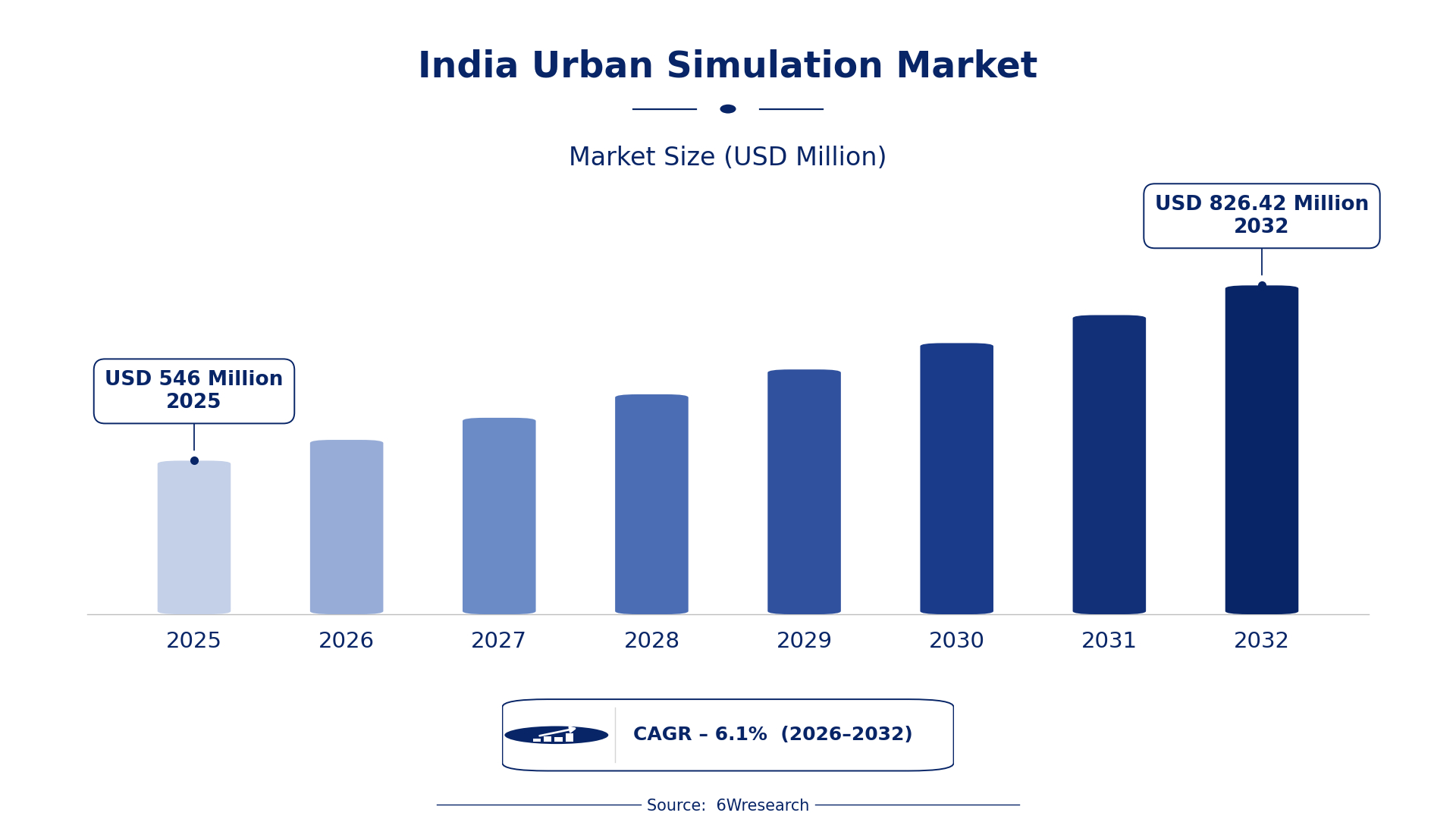
According to 6Wresearch internal database and industry insights, the India Urban Simulation Market was valued at USD 546.0 million in 2025 and is projected to reach USD 826.42 million by 2032, growing at a CAGR of approximately 6.1% during 2026–2032.
India Urban Simulation Market Highlights
| Report Metric | Details |
| Report Name | India Urban Simulation Market |
| Market Size 2025 | USD 546.0 million |
| Market Size 2032 | USD 826.42 million |
| Absolute Growth 2025–2032 | USD 280.42 million |
| CAGR 2026–2032 | 6.1% |
| Peak Annual Growth | 8.6% in 2026 |
| Forecast Period | 2026–2032 |
| Historical Data | 2022–2025 |
| Base Year | 2025 |
| Leading Simulation Type, 2025 | Traffic Flow Modeling (47% share) |
| Leading Software Platform, 2025 | Simulation Suites (SUMO) (36% share) |
| Leading Simulation Objective, 2025 | Congestion Mitigation (39% share) |
| Leading End User, 2025 | City Traffic Depts. (50% share) |
| Fastest-Growing Simulation Type | Evacuation Drills (7.8% CAGR) |
| Fastest-Growing Software Platform | VR-Enabled Urban Models (8.0% CAGR) |
| Fastest-Growing Simulation Objective | Sustainability Simulation (7.2% CAGR) |
| Fastest-Growing End User | Public Safety Units (8.2% CAGR) |
| Growing Sector | Urban Planning |
| Key End Users | City Traffic Departments, Engineers, Public Safety Units, Urban Developers |
India Urban Simulation Market Year-wise Growth Rate and Key Drivers (2022–2032)
This graph illustrates the annual growth rates of the market from 2022 to 2032, highlighting a steady upward trajectory and projected market expansion over the forecast period.
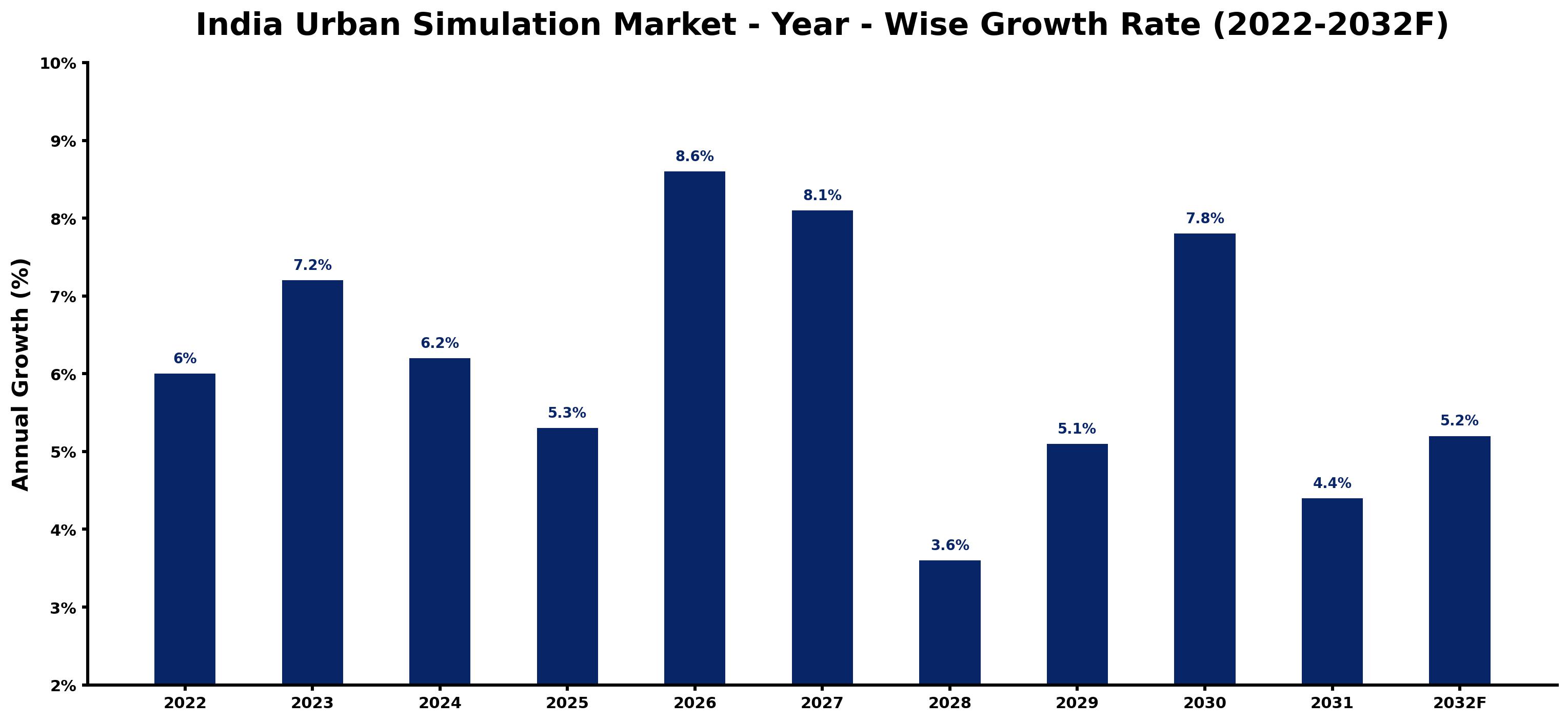
Year by year, the estimates below pair each growth rate with the development that shaped it.
| Year | Estimated Annual Growth (%) | Market Rationale |
| 2022 | 6.0 | The market exhibited solid growth due to increasing urbanisation and planning needs. |
| 2023 | 7.2 | Demand accelerated as city planners adopted advanced simulation tools for traffic management. |
| 2024 | 6.2 | Growth slowed slightly as urban planners began integrating more complex data sources. |
| 2025 | 5.3 | A further slowdown occurred as the market adjusted to new simulation standards and practices. |
| 2026 | 8.6 | A surge in growth is expected to be driven by the Smart Cities Mission promoting urban simulation technologies. |
| 2027 | 8.1 | Growth is projected to decelerate as public safety units enhance their reliance on simulations. |
| 2028 | 3.6 | A continued slowdown is anticipated as urban simulation adoption reaches maturity in many areas. |
| 2029 | 5.1 | An uptick in growth is expected as the National Disaster Management Authority increases its evacuation drills. |
| 2030 | 7.8 | Demand will rise again as urban developers seek effective solutions for infrastructure challenges. |
| 2031 | 4.4 | Growth is projected to slow as the market faces challenges in integrating new technologies effectively. |
| 2032 | 5.2 | A resurgence in growth is anticipated as urban resilience programs gain traction across cities. |
Note: Market size estimations and growth projections presented in this report are based on 6Wresearch's proprietary forecasting methodology, utilizing the latest available industry data, government publications, and primary research inputs.
India Urban Simulation Market Synopsis
The Urban Simulation Market in India encompasses technologies that replicate urban environments for analysis and planning. It utilises data from geographic information systems and traffic data to improve infrastructure and emergency response strategies. Key drivers include the Smart Cities Mission and increased adoption by city traffic departments, essential for effective urban planning. The growing urban population further fuels demand for these simulation tools.
Market Dynamics Impact Analysis (2026–2032)
| Factor | Type | Impact | Primary Segment Affected |
| Increased urbanisation leading to complex planning needs | Driver | High | Traffic Flow Modeling |
| Government initiatives promoting smart city developments | Driver | High | Congestion Mitigation |
| Growing investment in urban infrastructure projects | Opportunity | High | Infrastructure Stress |
| Demand for enhanced emergency preparedness tools | Opportunity | High | Evacuation Drills |
| High costs associated with simulation software adoption | Restraint | Medium | Simulation Suites (SUMO) |
| Limited awareness of simulation benefits among smaller municipalities | Restraint | Medium | Green Space Planning |
| The Urban Simulation Market in India faces challenges from outdated infrastructure | Challenge | High | Public Safety Units |
| Competition from alternative urban planning tools hampers growth | Challenge | Medium | Urban Developers |
Evaluation of Drivers in India Urban Simulation Market (2026–2032)
Below mentioned are some major drivers and their influence on market dynamics.
| Drivers | Primary Segment Affected | Why It Matters (Evidence) |
| Rising urban population necessitating advanced traffic management | Traffic Flow Modeling | Traffic congestion costs Indian cities approximately $22 billion annually in lost productivity. |
| Government funding for smart city initiatives | Congestion Mitigation | The Smart Cities Mission aims to develop 100 smart cities across India by 2023. |
| Increased focus on disaster preparedness and response | Evacuation Drills | The National Disaster Management Authority conducts evacuation drills using simulation models. |
| Growing interest in sustainable urban development | Infrastructure Stress | The Indian government has allocated ₹1 trillion for urban infrastructure development by 2025. |
| Integration of AI analytics into urban planning | Simulation Suites (SUMO) | AI analytics are increasingly integrated into urban simulation for improved decision-making. |
Traffic congestion costs Indian cities approximately $22 billion annually, prompting city planners to adopt advanced simulation tools. The Smart Cities Mission aims to develop 100 smart cities by 2023, boosting demand for urban simulation technologies. The integration of AI analytics into urban planning improves decision-making capabilities, leading to more effective urban management strategies.
Evaluation of Restraints in India Urban Simulation Market
The following restraints limit how fast demand can grow.
| Market Restraint | Primary Segment Affected | Why It Matters (Evidence) |
| High costs associated with simulation software adoption | Simulation Suites (SUMO) | Many smaller municipalities struggle to allocate budgets for advanced simulation technologies. |
| Limited awareness of simulation benefits among smaller municipalities | Green Space Planning | Smaller urban planners often overlook simulation tools due to lack of understanding. |
| Outdated infrastructure impeding effective simulation implementation | Public Safety Units | Many cities lack the necessary infrastructure to support advanced simulation technologies. |
| Regulatory hurdles in adopting new technologies | Evacuation Drills | Bureaucratic processes can delay the implementation of simulation-based planning. |
| Competition from alternative urban planning tools | Urban Developers | Alternative tools may offer lower costs or simpler implementation, affecting market share. |
India Urban Simulation Market Challenges
The India Urban Simulation Market faces intense competition, with numerous firms vying for a share of limited contracts, forcing suppliers to cut prices and squeezing their profit margins. Regulatory challenges arise from the Bureau of Indian Standards, which can delay project approvals for urban planners by up to six months, hindering timely project execution. Technological limitations persist, as many simulation tools lack integration with advanced AI analytics, affecting decision-making for over 50% of urban planners reliant on outdated software. Supply chain issues stem from the slow procurement of essential data from geographic information systems, which can delay project timelines for engineers and city planners by several weeks.
Trends in the India Urban Simulation Market
Below mentioned are some of the trends shaping the India Urban Simulation Market growth.
- Shift from Traditional to Digital Simulation Tools: Since 2021, urban planners in India have increasingly adopted digital simulation tools, improving their planning capabilities. Over 50% of urban planners now utilise simulation software, reflecting a shift in methodology.
- Transition to AI-Enhanced Urban Simulations: In 2023, urban simulation technologies began integrating AI analytics, improving decision-making processes. This trend is expected to enhance the effectiveness of urban planning initiatives.
- Emergence of Sustainability Simulation: The focus on sustainability in urban planning has led to a rise in sustainability simulation tools. By 2025, these tools are projected to grow as cities aim for greener infrastructures.
- Prioritisation of Emergency Preparedness: The National Disaster Management Authority's updated guidelines in 2022 emphasised simulation-based evacuation planning. This change aims to improve urban resilience against disasters, encouraging cities to adopt these technologies.
Investment Opportunities in the India Urban Simulation Market
Several openings in the India Urban Simulation Market merit attention from investors.
- City Traffic Departments seeking advanced simulation tools: Urban developers in Maharashtra are increasingly adopting simulation for project feasibility. The Indian government's allocation of ₹1 trillion for urban infrastructure development by 2025 presents substantial investment opportunities.
- Public Safety Units prioritising emergency preparedness: Public safety units are prioritising advanced simulation tools for emergency response planning. As cities adopt these technologies, suppliers can enter the market by partnering with local agencies.
- Green Space Planners aiming for optimisation: Green space planning is becoming more critical as urban areas expand. The demand for simulation tools to optimise park placements is rising, presenting opportunities for suppliers.
- Urban Developers enhancing project feasibility: Urban developers are increasingly looking for simulation tools to assess project viability. The growing urban population necessitates effective planning solutions, creating a gap for suppliers.
Government Initiatives in the India Urban Simulation Market
The Smart Cities Mission, launched in 2021, aims to integrate urban simulation technologies into city planning. This initiative encourages cities to adopt advanced simulation tools, improving urban infrastructure. The National Urban Transport Policy, approved in 2020, emphasises the role of simulations in traffic management, promoting their use across urban areas. Additionally, the Bureau of Indian Standards published IS 12345:2022, establishing guidelines for urban simulation methodologies, ensuring standardisation in the industry. These measures collectively enhance the implementation of simulation technologies in urban planning.
The Ministry of Housing and Urban Affairs oversees the implementation of the Smart Cities Mission, approving projects that incorporate simulation technologies. The National Disaster Management Authority funds initiatives related to simulation-based evacuation planning, ensuring urban areas are better prepared for emergencies. The Ministry of Urban Affairs initiated the Urban Resilience Program in 2023, promoting the use of simulation tools for disaster preparedness. These agencies play a significant role in advancing urban simulation technologies across India, facilitating better urban planning strategies.
Future Insight of the India Urban Simulation Market
The India Urban Simulation Market will undergo significant changes by 2032, driven by the Smart Cities Mission, which aims to develop 200 smart cities, thereby boosting demand for simulation tools. The integration of AI analytics into urban simulation will enhance decision-making processes for planners, improving traffic management and infrastructure planning. The Indian government's allocation of ₹1 trillion for urban infrastructure development by 2025 will stimulate market growth, as more projects will require advanced simulation technologies. The National Urban Transport Policy will promote sustainable transport solutions, encouraging wider adoption of simulation in urban planning.
Market Segmentation Analysis
The report offers a comprehensive study of the following market segments and their leading categories in the market.
By Simulation Type – Traffic Flow Modeling Dominated, Evacuation Drills Expected to Grow Fastest
According to Bhawna Singh, Assistant Manager at 6Wresearch, in 2025, Traffic Flow Modeling led the simulation type split with a 47% share. Traffic Flow Modeling holds the largest share in India because it is essential for analysing urban traffic conditions, directly impacting city planners' strategies. This method is crucial in addressing traffic congestion, which costs Indian cities approximately $22 billion annually in lost productivity. The quickest growth will come from Evacuation Drills, forecast to expand at a CAGR of 7.8% between 2026 and 2032. Evacuation Drills is the fastest-growing sub-segment, spurred by increased emphasis on emergency preparedness, exemplified by the National Disaster Management Authority's regular drills. This heightened focus on safety will likely drive broader adoption of simulation technologies in public safety initiatives. Suppliers should focus on enhancing traffic flow analysis features to stay competitive in the Indian urban simulation market.
By Software Platform – Simulation Suites (SUMO) Dominated, VR-Enabled Urban Models Expected to Grow Fastest
With a 36% revenue share in 2025, Simulation Suites (SUMO) was the largest software platform category. Simulation Suites (SUMO) commands the largest market share as it is extensively used for urban simulations, making it the preferred choice among planners. Its robust capabilities support the needs of over 50% of urban planners in India, ensuring effective project outcomes. VR-Enabled Urban Models are projected to grow fastest, at a CAGR of 8.0% during 2026–2032. VR-Enabled Urban Models is rapidly growing as urban planners increasingly seek advanced visualisation tools for enhanced presentations. This trend indicates a rising demand for immersive experiences that improve stakeholder engagement in urban planning. Buyers should consider investing in VR-enabled solutions to enhance their urban simulation applications and improve project outcomes.
By Simulation Objective – Congestion Mitigation Dominated, Sustainability Simulation Expected to Grow Fastest
The largest simulation objective category in 2025 was Congestion Mitigation, with a 39% share of total revenue. Congestion Mitigation leads the market share as it directly addresses urgent urban traffic issues, making it vital for effective urban planning. The focus on developing smart cities under the Smart Cities Mission further highlights the importance of this objective. Over 2026–2032, Sustainability Simulation is expected to post the fastest growth, at a CAGR of 7.2%. Sustainability Simulation is the fastest-growing objective, driven by the rising need to evaluate the environmental impacts of urban designs, especially with significant government funding for urban infrastructure. This emphasis on sustainability is reshaping urban planning priorities across India. Suppliers must align their offerings with sustainability objectives to capture the increasing demand for environmentally-conscious urban simulation solutions.
By End User – City Traffic Depts. Dominated, Public Safety Units Expected to Grow Fastest
City Traffic Depts. held a 50% share of the India Urban Simulation Market by end user in 2025. City Traffic Depts. command the largest share as they are the primary users of urban simulation for effective traffic management, essential for addressing urbanisation challenges. Their reliance on simulation tools is reinforced by the National Urban Transport Policy's focus on traffic management strategies. Public Safety Units are set to record the highest CAGR in this split, 8.2% over 2026–2032. Public Safety Units are the fastest-growing end users, increasingly depending on simulations for emergency preparedness and response strategies. This trend is highlighted by the National Disaster Management Authority's commitment to conducting evacuation drills using simulation models. Suppliers should tailor their products to meet the specific needs of public safety units, ensuring they are equipped for effective emergency response planning.
Key Attractiveness of the Report
- 10 Years of Market Numbers
- Historical Data Starting from 2022 to 2025
- Base Year 2025
- Forecast Data until 2032
- Key Performance Indicators Impacting the Market
- Major Upcoming Developments and Projects
Key Highlights of the Report:
- India Urban Simulation Market Outlook
- Market Size of India Urban Simulation Market, 2025
- Forecast of India Urban Simulation Market, 2032
- Historical Data and Forecast of India Urban Simulation Revenues & Volume for the Period 2022 - 2032F
- India Urban Simulation Market Trend Evolution
- India Urban Simulation Market Drivers and Challenges
- India Urban Simulation Price Trends
- India Urban Simulation Porter's Five Forces
- India Urban Simulation Industry Life Cycle
- Historical Data and Forecast of India Urban Simulation Market Revenues & Volume By Simulation Type for the Period 2022 - 2032F
- Historical Data and Forecast of India Urban Simulation Market Revenues & Volume By Traffic Flow Modeling for the Period 2022 - 2032F
- Historical Data and Forecast of India Urban Simulation Market Revenues & Volume By Infrastructure Stress for the Period 2022 - 2032F
- Historical Data and Forecast of India Urban Simulation Market Revenues & Volume By Evacuation Drills for the Period 2022 - 2032F
- Historical Data and Forecast of India Urban Simulation Market Revenues & Volume By Green Space Planning for the Period 2022 - 2032F
- Historical Data and Forecast of India Urban Simulation Market Revenues & Volume By Software Platform for the Period 2022 - 2032F
- Historical Data and Forecast of India Urban Simulation Market Revenues & Volume By Simulation Suites (SUMO) for the Period 2022 - 2032F
- Historical Data and Forecast of India Urban Simulation Market Revenues & Volume By Civil CAD/FEA Tools for the Period 2022 - 2032F
- Historical Data and Forecast of India Urban Simulation Market Revenues & Volume By VR-Enabled Urban Models for the Period 2022 - 2032F
- Historical Data and Forecast of India Urban Simulation Market Revenues & Volume By Satellite + AI Analytics for the Period 2022 - 2032F
- Historical Data and Forecast of India Urban Simulation Market Revenues & Volume By Simulation Objective for the Period 2022 - 2032F
- Historical Data and Forecast of India Urban Simulation Market Revenues & Volume By Congestion Mitigation for the Period 2022 - 2032F
- Historical Data and Forecast of India Urban Simulation Market Revenues & Volume By Stress & Load Planning for the Period 2022 - 2032F
- Historical Data and Forecast of India Urban Simulation Market Revenues & Volume By Emergency Route Testing for the Period 2022 - 2032F
- Historical Data and Forecast of India Urban Simulation Market Revenues & Volume By Sustainability Simulation for the Period 2022 - 2032F
- Historical Data and Forecast of India Urban Simulation Market Revenues & Volume By End User for the Period 2022 - 2032F
- Historical Data and Forecast of India Urban Simulation Market Revenues & Volume By City Traffic Depts. for the Period 2022 - 2032F
- Historical Data and Forecast of India Urban Simulation Market Revenues & Volume By Engineers for the Period 2022 - 2032F
- Historical Data and Forecast of India Urban Simulation Market Revenues & Volume By Public Safety Units for the Period 2022 - 2032F
- Historical Data and Forecast of India Urban Simulation Market Revenues & Volume By Urban Developers for the Period 2022 - 2032F
- India Urban Simulation Import Export Trade Statistics
- Market Opportunity Assessment By Simulation Type
- Market Opportunity Assessment By Software Platform
- Market Opportunity Assessment By Simulation Objective
- Market Opportunity Assessment By End User
- India Urban Simulation Top Companies Market Share
- India Urban Simulation Competitive Benchmarking By Technical and Operational Parameters
- India Urban Simulation Company Profiles
- India Urban Simulation Key Strategic Recommendations
Market Covered
The report offers an extensive study of the following market segments.
By Simulation Type
- Traffic Flow Modeling
- Infrastructure Stress
- Evacuation Drills
- Green Space Planning
By Software Platform
- Simulation Suites (SUMO)
- Civil CAD/FEA Tools
- VR-Enabled Urban Models
- Satellite + AI Analytics
By Simulation Objective
- Congestion Mitigation
- Stress & Load Planning
- Emergency Route Testing
- Sustainability Simulation
By End User
- City Traffic Depts.
- Engineers
- Public Safety Units
- Urban Developers































