China Urban Simulation Market Size & Growth Rate
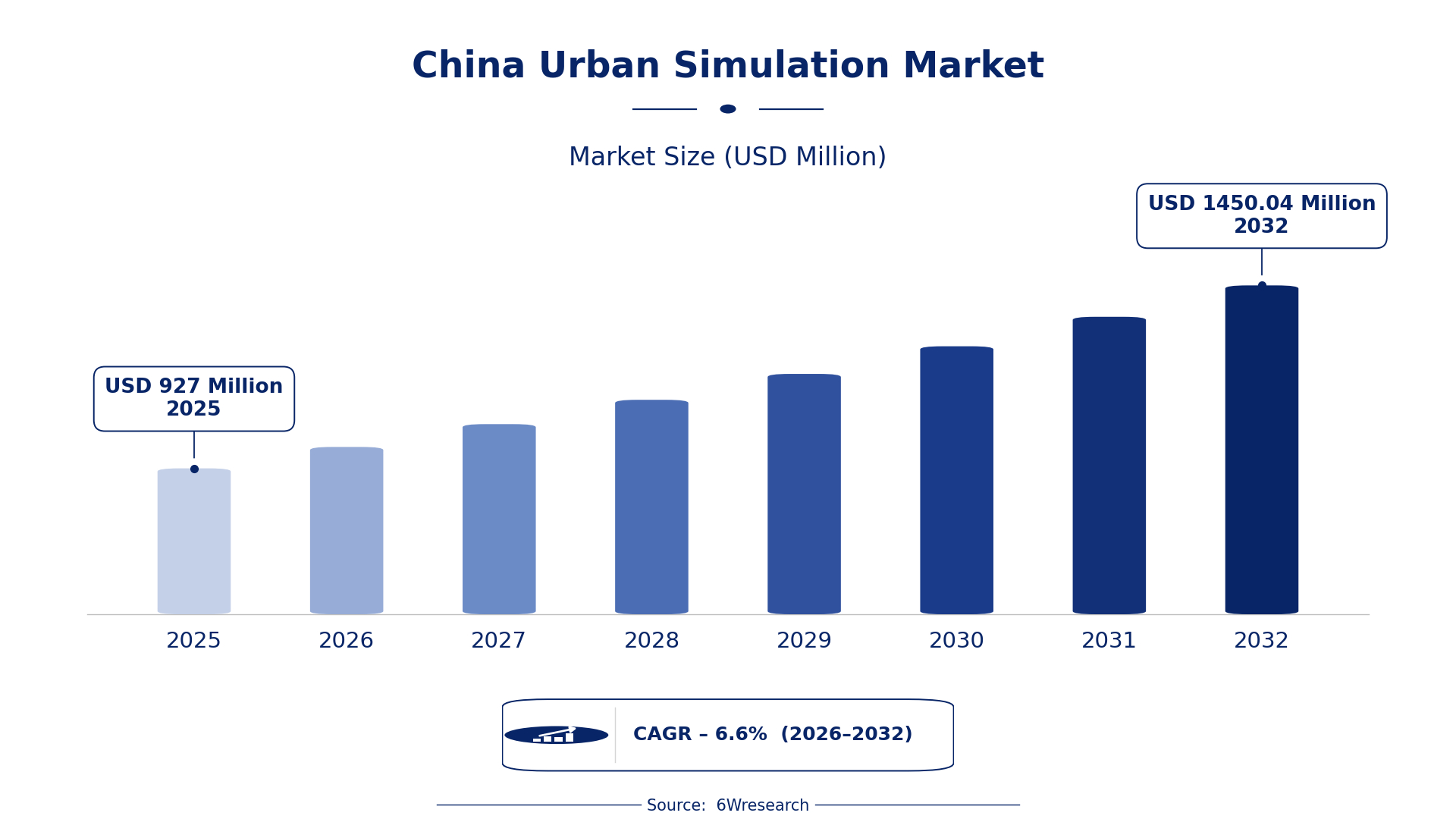
According to 6Wresearch internal database and industry insights, the China Urban Simulation Market was valued at USD 927.0 million in 2025 and is projected to reach USD 1,450.04 million by 2032, growing at a CAGR of approximately 6.6% during 2026–2032.
China Urban Simulation Market Highlights
| Report Metric | Details |
| Report Name | China Urban Simulation Market |
| Market Size 2025 | USD 927.0 million |
| Market Size 2032 | USD 1,450.04 million |
| Absolute Growth 2025–2032 | USD 523.04 million |
| CAGR 2026–2032 | 6.6% |
| Peak Annual Growth | 9.2% in 2026 |
| Forecast Period | 2026–2032 |
| Historical Data | 2022–2025 |
| Base Year | 2025 |
| Leading Simulation Type, 2025 | Traffic Flow Modeling (36% share) |
| Leading Software Platform, 2025 | Simulation Suites (SUMO) (46% share) |
| Leading Simulation Objective, 2025 | Congestion Mitigation (39% share) |
| Leading End User, 2025 | City Traffic Depts. (43% share) |
| Fastest-Growing Simulation Type | Evacuation Drills (7.6% CAGR) |
| Fastest-Growing Software Platform | VR-Enabled Urban Models (8.9% CAGR) |
| Fastest-Growing Simulation Objective | Sustainability Simulation (8.5% CAGR) |
| Fastest-Growing End User | Public Safety Units (8.1% CAGR) |
| Growing Sector | Urban Planning and Development |
| Key End Users | City Traffic Departments, Urban Developers, Public Safety Units, Engineers |
China Urban Simulation Market Year-wise Growth Rate and Key Drivers (2022–2032)
This graph illustrates the annual growth rates of the market from 2022 to 2032, highlighting a steady upward trajectory and projected market expansion over the forecast period.
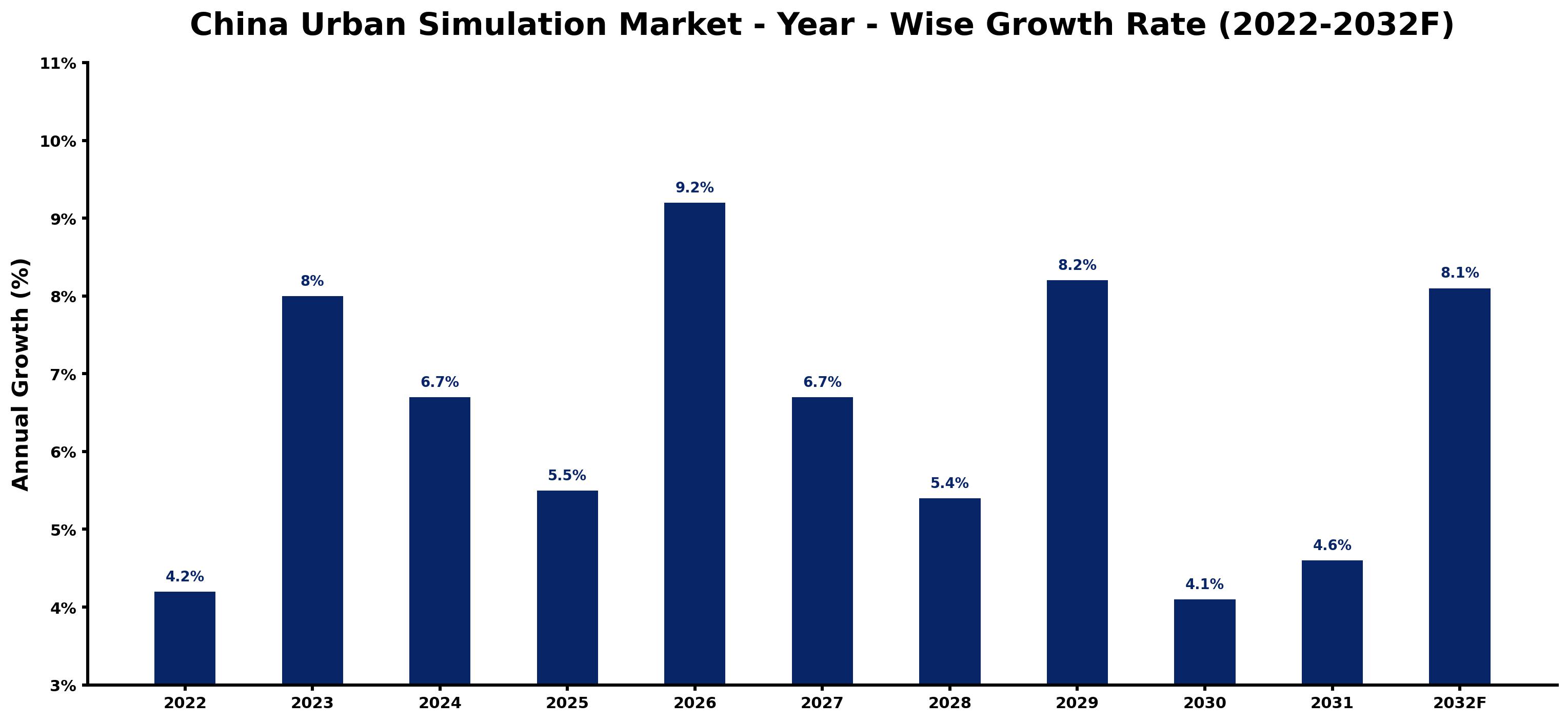
Annual growth estimates for each year appear below with the principal reason behind them, explaining the shifts that set the pace of the market.
| Year | Estimated Annual Growth (%) | Market Rationale |
| 2022 | 4.2 | The market experienced steady growth due to the National Standard for Urban Traffic Simulation established in 2021. |
| 2023 | 8.0 | Demand surged as urban developers and city traffic departments sought advanced simulation technologies. |
| 2024 | 6.7 | Growth slowed as urban planning projects faced budget constraints and resource allocation challenges. |
| 2025 | 5.5 | The market continued to grow, albeit at a slower pace, due to ongoing urbanisation efforts. |
| 2026 | 9.2 | A surge in demand is expected as new regulations mandate the use of simulation tools for urban planning. |
| 2027 | 6.7 | The market is projected to slow again as firms adapt to new standards and project timelines. |
| 2028 | 5.4 | The market is expected to see further slowdown as urban developers face increasing competition and resource limitations. |
| 2029 | 8.2 | Demand is projected to rebound as cities recognise the importance of simulation in traffic management and planning. |
| 2030 | 4.1 | Growth is expected to slow again as urban planning projects face delays and funding issues. |
| 2031 | 4.6 | The market is projected to experience a slight uptick as new projects begin to materialise in urban areas. |
| 2032 | 8.1 | Demand is expected to surge again as cities focus on sustainable urban development and smart city initiatives. |
Note: Market size estimations and growth projections presented in this report are based on 6Wresearch's proprietary forecasting methodology, utilizing the latest available industry data, government publications, and primary research inputs.
China Urban Simulation Market Synopsis
Urban Simulation in China involves sophisticated technologies designed to model urban environments for effective planning and management. This includes traffic flow analysis and infrastructure stress testing, crucial for urban development. The China Urban Simulation Market is growing swiftly, propelled by a burgeoning urban population of 1.4 billion in 2023 and heightened demand from city traffic departments and urban developers. The government's commitment to sustainable urban planning and smart city initiatives further accelerates this growth, with over 300 registered urban planning firms utilising simulation tools.
Market Dynamics Impact Analysis (2026–2032)
| Factor | Type | Impact | Primary Segment Affected |
| Increasing urban population drives demand for effective traffic management solutions. | Driver | High | Traffic Flow Modeling |
| Government mandates for simulation tools in urban planning create a consistent demand. | Driver | High | Congestion Mitigation |
| Investment in smart city initiatives presents opportunities for simulation technology suppliers. | Opportunity | High | Traffic Flow Modeling |
| Growing need for effective emergency preparedness solutions opens new markets for simulation tools. | Opportunity | Medium | Evacuation Drills |
| Budget constraints in urban planning limit the adoption of advanced simulation technologies. | Restraint | High | Infrastructure Stress |
| Competition among urban planning firms may restrict market entry for new players. | Restraint | Medium | Green Space Planning |
| Integration challenges arise when adopting new technologies into existing systems. | Challenge | High | VR-Enabled Urban Models |
| Delays in project approvals can hinder the timely deployment of simulation tools. | Challenge | Medium | Emergency Route Testing |
Evaluation of Drivers in China Urban Simulation Market (2026–2032)
The main growth drivers and the segments they affect most are set out below.
| Drivers | Primary Segment Affected | Why It Matters (Evidence) |
| Rising urban population necessitates advanced traffic management solutions. | Traffic Flow Modeling | With 1.4 billion people in urban areas, city traffic departments require effective simulation tools. |
| Government regulations mandate the use of simulation tools for urban planning. | Congestion Mitigation | The National Urban Planning Standards require simulations for new urban development projects. |
| Investment in smart city initiatives boosts demand for urban simulation technologies. | Traffic Flow Modeling | The government allocated 1 billion CNY for smart city projects, increasing simulation tool adoption. |
| Increasing focus on emergency preparedness drives demand for evacuation simulations. | Evacuation Drills | Local governments mandate evacuation drills, increasing the need for simulation tools. |
| Sustainability initiatives promote the use of simulations in urban planning. | Sustainability Simulation | The Green Urban Development Initiative encourages sustainability simulations in urban projects. |
With 1.4 billion people living in urban areas, city traffic departments are increasingly adopting simulation tools for traffic management. The National Urban Planning Standards mandate the use of simulation models for all new urban development projects, driving further demand. Local governments also require evacuation drills, which boosts the need for simulation tools in emergency preparedness.
Evaluation of Restraints in China Urban Simulation Market
The key brakes on demand, and where they bite hardest, are shown below.
| Market Restraint | Primary Segment Affected | Why It Matters (Evidence) |
| Budget limitations restrict the adoption of advanced simulation technologies. | Infrastructure Stress | Many urban planning firms face budget constraints, hindering their ability to invest in simulation tools. |
| Intense competition among urban planning firms may limit market entry for new players. | Green Space Planning | Over 300 registered urban planning firms compete for projects, making it difficult for newcomers. |
| Integration challenges arise when adopting new technologies into existing systems. | VR-Enabled Urban Models | Many firms struggle to incorporate VR-enabled models into their current workflows. |
| Delays in project approvals can hinder the timely deployment of simulation tools. | Emergency Route Testing | Local governments often face bureaucratic delays that affect project timelines. |
| Limited awareness of the benefits of simulation tools may slow market growth. | Congestion Mitigation | Some urban developers remain unaware of the advantages of using simulation for traffic management. |
China Urban Simulation Market Challenges
Buyers in the China Urban Simulation Market face regulatory hurdles, as the Ministry of Housing and Urban-Rural Development enforces strict planning standards that can delay project approvals by up to six months. Urban developers encounter high costs, with simulation software often exceeding 1 million CNY, which limits access for smaller firms and hampers their competitiveness. Supply issues arise from reliance on a few key technology providers, leading to delays in software updates that impact over 100 cities needing prompt traffic management solutions. A shortage of skilled professionals in advanced simulation techniques complicates project execution, with over 300 firms competing for a limited talent pool, resulting in further delays.
Trends in the China Urban Simulation Market
Four trends stand out in the China Urban Simulation Market.
- Green Urban Development Initiative Promotes Sustainability Simulations: The Green Urban Development Initiative, launched in 2023, encourages the use of sustainability simulations in urban planning. This initiative aims to improve ecological balance in urban projects and has seen a 40% increase in simulation applications since 2020.
- National Urban Planning Standards Mandate Simulation Tools: In 2023, the updated National Urban Planning Standards require the use of simulation models for all new urban development projects. This regulation is expected to boost the adoption of urban simulation technologies across the country.
- Growth in VR-Enabled Urban Models: The use of VR-enabled urban models is expanding among urban developers in major cities. This trend is supported by an 8.9% CAGR projected for this sub-segment from 2026 to 2032.
- Emergency Management Law Drives Evacuation Drill Simulations: The revised Emergency Management Law, implemented in 2020, mandates evacuation drills for public safety units. This has increased the demand for evacuation simulation tools among local governments.
Investment Opportunities in the China Urban Simulation Market
The following opportunities in the China Urban Simulation Market pair current demand with a clear way in.
- Investment in Smart City Initiatives: With the Chinese government allocating 1 billion CNY for smart city projects, there is an opportunity for suppliers of urban simulation technologies to engage with city traffic departments and urban developers.
- Growing Demand for Emergency Preparedness Solutions: The need for effective emergency preparedness solutions is rising, particularly among public safety units. Suppliers can enter this market by partnering with local governments to provide simulation tools.
- Focus on Sustainable Urban Planning: As cities prioritise sustainability, there is an increasing demand for sustainability simulations. Urban developers are encouraged to adopt these tools to improve their project proposals and meet regulatory requirements.
- Expansion of Simulation Applications in Major Cities: The increasing use of simulation tools in over 100 cities across China presents a lucrative opportunity for technology providers to expand their market presence and collaborate with urban planning firms.
Government Initiatives in the China Urban Simulation Market
The National Smart City Development Plan, issued by the Ministry of Housing and Urban-Rural Development in 2021, aims to integrate advanced urban simulation technologies with a budget of 1 billion CNY over five years. This plan builds upon previous regulations by incorporating simulation tools into urban planning processes, ensuring that cities can effectively manage growth and sustainability.
In 2023, the Chinese government allocated 500 million CNY for smart city initiatives, overseen by the Ministry of Housing and Urban-Rural Development. This funding supports the development and implementation of urban simulation technologies, enabling cities to optimise traffic management and infrastructure planning.
Future Insight of the China Urban Simulation Market
Several forward-looking factors should support the China Urban Simulation Market over the coming years. The National Standard for Urban Traffic Simulation, established in 2021, will enhance consistency across projects, building trust among buyers and suppliers. Increased government funding for smart city initiatives, with 500 million CNY allocated in 2023, will drive demand for advanced simulation tools. The growing use of VR-enabled urban models will revolutionise planning practices, while the 40% rise in green space planning applications since 2020 will promote sustainable urban development.
Market Segmentation Analysis
Each segment group is reviewed below, with the leader by share and the fastest grower by CAGR.
By Simulation Type – Traffic Flow Modeling Dominated, Evacuation Drills Expected to Grow Fastest
According to Bhawna Singh, Assistant Manager at 6Wresearch, with a 36% revenue share in 2025, Traffic Flow Modeling was the largest simulation type category. Traffic Flow Modeling holds the largest share as it is essential for managing urban traffic efficiently, particularly in major cities like Beijing and Shanghai. With over 100 cities employing this simulation type, it addresses the pressing need for effective traffic management solutions. Evacuation Drills are projected to grow fastest, at a CAGR of 7.6% during 2026–2032. Evacuation Drills is experiencing rapid growth due to increasing mandates from local governments for disaster preparedness, highlighting the critical need for effective emergency response strategies. The heightened focus on safety has led to a surge in simulation applications in this area. This trend indicates that suppliers should prioritise developing advanced evacuation simulation tools to meet the growing demand from public safety units.
By Software Platform – Simulation Suites (SUMO) Dominated, VR-Enabled Urban Models Expected to Grow Fastest
Simulation Suites (SUMO) held a 46% share of the China Urban Simulation Market by software platform in 2025. The largest share in the Software Platform segment is attributed to Simulation Suites, which are extensively used for comprehensive urban simulations crucial for traffic flow analysis and infrastructure stress testing. Their integration into over 300 registered urban planning firms in China highlights their pivotal role in urban management. Over 2026–2032, VR-Enabled Urban Models are expected to post the fastest growth, at a CAGR of 8.9%. The growth of VR-Enabled Urban Models is propelled by the rising interest in immersive technology among urban developers, who seek to enhance visualisation in their projects. This shift towards interactive simulation experiences is expected to further accelerate as urban planning becomes more tech-centric. Suppliers should prioritise the development of advanced visualisation features to align with the increasing demand from urban developers.
By Simulation Objective – Congestion Mitigation Dominated, Sustainability Simulation Expected to Grow Fastest
Congestion Mitigation took a 39% share of simulation objective in 2025, more than any other category. Congestion Mitigation is the leading objective, representing a key focus for urban traffic management, particularly in densely populated areas. With 60% of urban simulations aimed at alleviating traffic congestion, it underscores the urgency of addressing urban mobility challenges. The quickest growth will come from Sustainability Simulation, forecast to expand at a CAGR of 8.5% between 2026 and 2032. Sustainability Simulation is rapidly growing as cities increasingly prioritise eco-friendly urban designs, reflecting a shift towards sustainable development practices. This trend is driven by government initiatives promoting green spaces and sustainable infrastructure. This indicates that suppliers should align their solutions with sustainability goals to appeal to urban planners focused on eco-friendly projects.
By End User – City Traffic Depts. Dominated, Public Safety Units Expected to Grow Fastest
The largest end user category in 2025 was City Traffic Depts., with a 43% share of total revenue. City Traffic Departments hold the largest market share as they are the primary users of urban simulation tools, vital for managing traffic in over 100 cities across China. Their essential role in urban planning ensures a continuous demand for these simulation technologies. Public Safety Units are set to record the highest CAGR in this split, 8.1% over 2026–2032. Public Safety Units are witnessing the fastest growth due to their increasing reliance on simulation tools for emergency preparedness, which is becoming increasingly important in urban settings. This trend is further reinforced by government mandates for effective disaster response planning. Suppliers should concentrate on creating customised solutions that bolster the emergency preparedness capabilities of public safety units.
Key Attractiveness of the Report
- 10 Years of Market Numbers
- Historical Data Starting from 2022 to 2025
- Base Year 2025
- Forecast Data until 2032
- Key Performance Indicators Impacting the Market
- Major Upcoming Developments and Projects
Key Highlights of the Report:
- China Urban Simulation Market Outlook
- Market Size of China Urban Simulation Market, 2025
- Forecast of China Urban Simulation Market, 2032
- Historical Data and Forecast of China Urban Simulation Revenues & Volume for the Period 2022 - 2032F
- China Urban Simulation Market Trend Evolution
- China Urban Simulation Market Drivers and Challenges
- China Urban Simulation Price Trends
- China Urban Simulation Porter's Five Forces
- China Urban Simulation Industry Life Cycle
- Historical Data and Forecast of China Urban Simulation Market Revenues & Volume By Simulation Type for the Period 2022 - 2032F
- Historical Data and Forecast of China Urban Simulation Market Revenues & Volume By Traffic Flow Modeling for the Period 2022 - 2032F
- Historical Data and Forecast of China Urban Simulation Market Revenues & Volume By Infrastructure Stress for the Period 2022 - 2032F
- Historical Data and Forecast of China Urban Simulation Market Revenues & Volume By Evacuation Drills for the Period 2022 - 2032F
- Historical Data and Forecast of China Urban Simulation Market Revenues & Volume By Green Space Planning for the Period 2022 - 2032F
- Historical Data and Forecast of China Urban Simulation Market Revenues & Volume By Software Platform for the Period 2022 - 2032F
- Historical Data and Forecast of China Urban Simulation Market Revenues & Volume By Simulation Suites (SUMO) for the Period 2022 - 2032F
- Historical Data and Forecast of China Urban Simulation Market Revenues & Volume By Civil CAD/FEA Tools for the Period 2022 - 2032F
- Historical Data and Forecast of China Urban Simulation Market Revenues & Volume By VR-Enabled Urban Models for the Period 2022 - 2032F
- Historical Data and Forecast of China Urban Simulation Market Revenues & Volume By Satellite + AI Analytics for the Period 2022 - 2032F
- Historical Data and Forecast of China Urban Simulation Market Revenues & Volume By Simulation Objective for the Period 2022 - 2032F
- Historical Data and Forecast of China Urban Simulation Market Revenues & Volume By Congestion Mitigation for the Period 2022 - 2032F
- Historical Data and Forecast of China Urban Simulation Market Revenues & Volume By Stress & Load Planning for the Period 2022 - 2032F
- Historical Data and Forecast of China Urban Simulation Market Revenues & Volume By Emergency Route Testing for the Period 2022 - 2032F
- Historical Data and Forecast of China Urban Simulation Market Revenues & Volume By Sustainability Simulation for the Period 2022 - 2032F
- Historical Data and Forecast of China Urban Simulation Market Revenues & Volume By End User for the Period 2022 - 2032F
- Historical Data and Forecast of China Urban Simulation Market Revenues & Volume By City Traffic Depts. for the Period 2022 - 2032F
- Historical Data and Forecast of China Urban Simulation Market Revenues & Volume By Engineers for the Period 2022 - 2032F
- Historical Data and Forecast of China Urban Simulation Market Revenues & Volume By Public Safety Units for the Period 2022 - 2032F
- Historical Data and Forecast of China Urban Simulation Market Revenues & Volume By Urban Developers for the Period 2022 - 2032F
- China Urban Simulation Import Export Trade Statistics
- Market Opportunity Assessment By Simulation Type
- Market Opportunity Assessment By Software Platform
- Market Opportunity Assessment By Simulation Objective
- Market Opportunity Assessment By End User
- China Urban Simulation Top Companies Market Share
- China Urban Simulation Competitive Benchmarking By Technical and Operational Parameters
- China Urban Simulation Company Profiles
- China Urban Simulation Key Strategic Recommendations
Market Covered
This report examines the market across the segments below.
By Simulation Type
- Traffic Flow Modeling
- Infrastructure Stress
- Evacuation Drills
- Green Space Planning
By Software Platform
- Simulation Suites (SUMO)
- Civil CAD/FEA Tools
- VR-Enabled Urban Models
- Satellite + AI Analytics
By Simulation Objective
- Congestion Mitigation
- Stress & Load Planning
- Emergency Route Testing
- Sustainability Simulation
By End User
- City Traffic Depts.
- Engineers
- Public Safety Units
- Urban Developers































