India Urban Transport Automation Market Size & Growth Rate
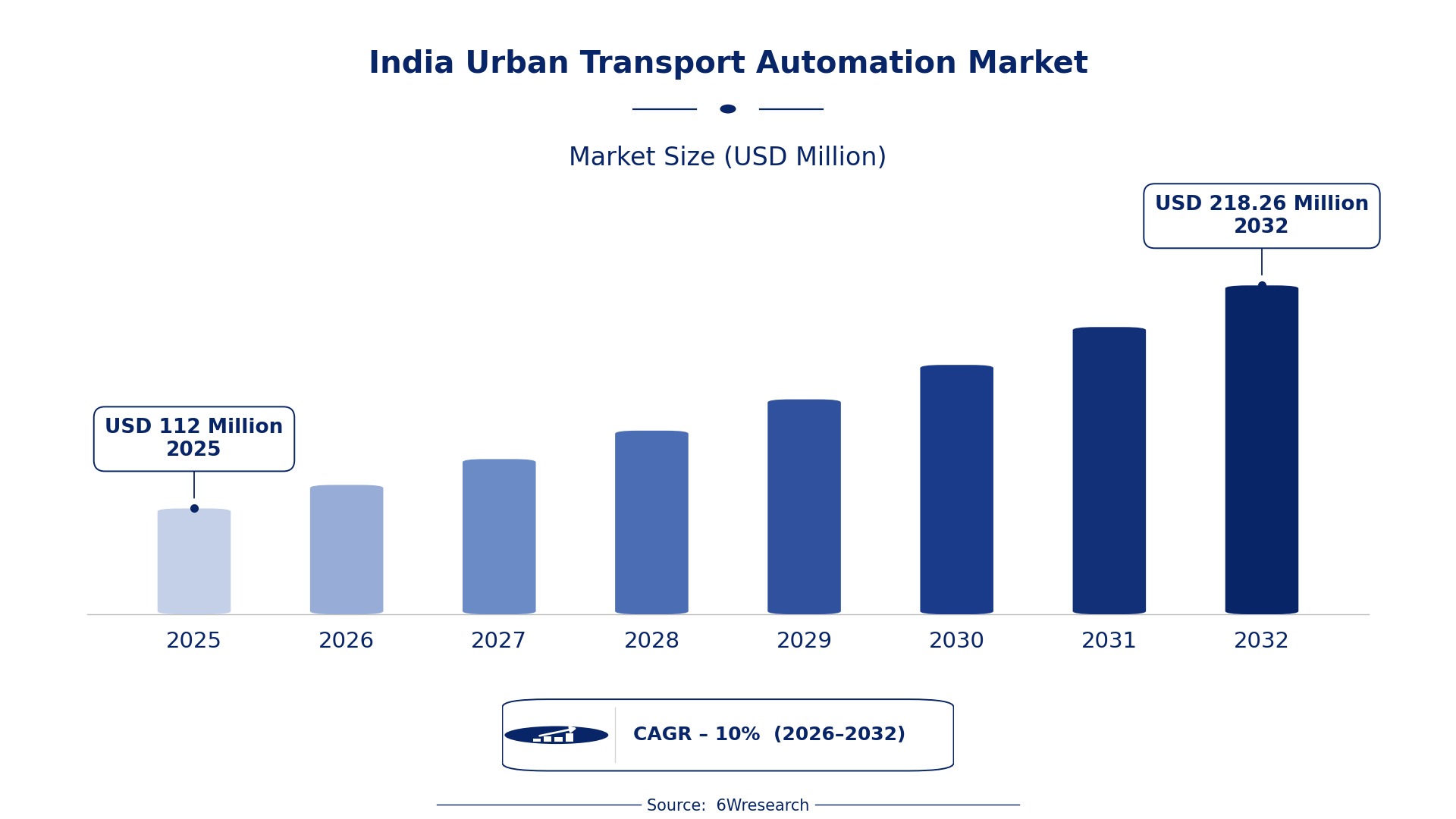
According to 6Wresearch internal database and industry insights, the India Urban Transport Automation Market was valued at USD 112.0 million in 2025 and is projected to reach USD 218.26 million by 2032, growing at a CAGR of approximately 10% during 2026–2032.
India Urban Transport Automation Market Highlights
| Report Metric | Details |
| Report Name | India Urban Transport Automation Market |
| Market Size 2025 | USD 112.0 million |
| Market Size 2032 | USD 218.26 million |
| Absolute Growth 2025–2032 | USD 106.26 million |
| CAGR 2026–2032 | 10% |
| Peak Annual Growth | 12.4% in 2030 |
| Forecast Period | 2026–2032 |
| Historical Data | 2022–2025 |
| Base Year | 2025 |
| Leading Automation Type, 2025 | Smart Traffic Systems (40% share) |
| Leading Transport Mode, 2025 | Electric Vehicles (41% share) |
| Leading System Integration, 2025 | AI + IoT (46% share) |
| Leading End User, 2025 | Public Transit Depts. (40% share) |
| Fastest-Growing Automation Type | Real-Time Scheduling (12.7% CAGR) |
| Fastest-Growing System Integration | Cloud-Based Platforms (11.7% CAGR) |
| Fastest-Growing End User | Transit Agencies (12.0% CAGR) |
| Growing Sector | Public Transport |
| Key End Users | Public Transit Departments, City Governments, Transit Agencies, Urban Planners |
India Urban Transport Automation Market Year-wise Growth Rate and Key Drivers (2022–2032)
This graph illustrates the annual growth rates of the market from 2022 to 2032, highlighting a steady upward trajectory and projected market expansion over the forecast period.
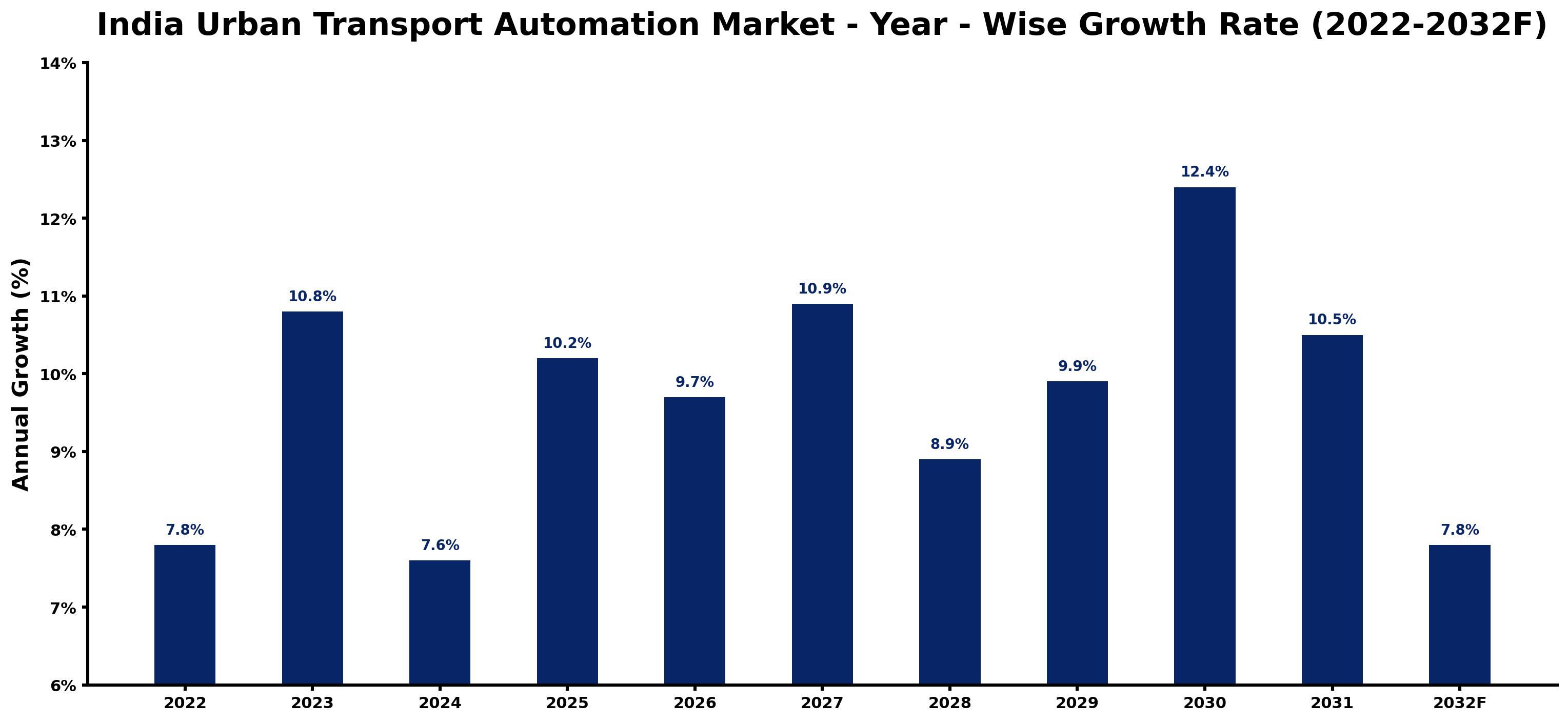
Annual growth estimates for each year appear below with the principal reason behind them, explaining the shifts that set the pace of the market.
| Year | Estimated Annual Growth (%) | Market Rationale |
| 2022 | 7.8 | Urban transport systems in India required enhancements for efficiency and safety. |
| 2023 | 10.8 | The Smart Cities Mission accelerated investments in urban transport automation technologies. |
| 2024 | 7.6 | Market growth slowed as some projects faced implementation challenges and delays. |
| 2025 | 10.2 | Increased funding for smart traffic management systems spurred demand for automation solutions. |
| 2026 | 9.7 | A slight slowdown occurred as new smart traffic management projects were rolled out. |
| 2027 | 10.9 | Demand surged again with new projects initiated by public transit departments. |
| 2028 | 8.9 | Growth decelerated as the market began to stabilise after previous expansions. |
| 2029 | 9.9 | Renewed interest in automation technologies led to increased investments from city governments. |
| 2030 | 12.4 | Peak growth was driven by the approval of major urban transport automation projects. |
| 2031 | 10.5 | The market experienced a slowdown as some initiatives reached maturity and required evaluation. |
| 2032 | 7.8 | Growth continued but at a reduced pace as the market matured and stabilised. |
Note: Market size estimations and growth projections presented in this report are based on 6Wresearch's proprietary forecasting methodology, utilizing the latest available industry data, government publications, and primary research inputs.
India Urban Transport Automation Market Synopsis
Urban Transport Automation in India integrates advanced technologies to improve public transportation efficiency and safety. This includes systems like autonomous buses and smart traffic management. The India Urban Transport Automation Market is expanding due to urbanisation, with the urban population expected to reach 600 million by 2031. Government initiatives like the Smart Cities Mission, aimed at developing 100 smart cities, are driving substantial investments. The allocation of ₹1,000 crore for smart traffic management in 2022 further illustrates this trend.
Market Dynamics Impact Analysis (2026–2032)
| Factor | Type | Impact | Primary Segment Affected |
| Urban population growth is increasing the need for efficient transport solutions. | Driver | High | Smart Traffic Systems |
| Government funding for smart transport initiatives is boosting automation deployment. | Driver | High | Real-Time Scheduling |
| The demand for efficient urban transport solutions is rising. | Opportunity | High | Public Transit Depts. |
| Investment in smart traffic management systems is currently underfunded. | Opportunity | Medium | Smart Traffic Systems |
| Implementation challenges can delay project timelines and increase costs. | Restraint | High | Autonomous Buses |
| Limited awareness of automation benefits may hinder adoption rates. | Restraint | Medium | Fare Automation |
| Urban Transport Automation in India faces a few practical problems, including funding issues. | Challenge | High | Real-Time Scheduling |
| Technological integration can be complex and costly for public transit departments. | Challenge | Medium | Smart Traffic Systems |
Evaluation of Drivers in India Urban Transport Automation Market (2026–2032)
The factors lifting demand, and the evidence behind each, are summarised below.
| Drivers | Primary Segment Affected | Why It Matters (Evidence) |
| Urban population growth drives demand for efficient public transport solutions. | Smart Traffic Systems | India's urban population is expected to reach 600 million by 2031, increasing the need for automation. |
| Government funding supports the deployment of smart transport technologies. | Real-Time Scheduling | In 2022, ₹1,000 crore was allocated for smart traffic management systems. |
| The Smart Cities Mission encourages cities to adopt automation technologies. | Public Transit Depts. | The mission aims to develop 100 smart cities, integrating urban transport automation. |
| Investment in automated ticketing systems improves passenger experience. | Fare Automation | The Indian Railways is investing in automated ticketing systems to enhance efficiency. |
| AI-based traffic management systems improve operational efficiency. | Autonomous Buses | AI-based systems in Bengaluru improved traffic flow by 30%, showcasing their effectiveness. |
The urban population is projected to reach 600 million by 2031, creating a pressing demand for efficient transport solutions. The Smart Cities Mission aims to develop 100 smart cities, further encouraging the adoption of automation technologies. AI-based traffic management systems implemented in Bengaluru have shown marked improvements in traffic flow, demonstrating their effectiveness and attracting further investment.
Evaluation of Restraints in India Urban Transport Automation Market
The key brakes on demand, and where they bite hardest, are shown below.
| Market Restraint | Primary Segment Affected | Why It Matters (Evidence) |
| Funding issues can delay the implementation of automation projects. | Real-Time Scheduling | Limited financial resources can hinder the timely rollout of smart scheduling systems. |
| Awareness of automation benefits is still limited among stakeholders. | Fare Automation | This lack of understanding can slow down the adoption of automated fare collection systems. |
| Complex technological integration can increase costs for public transit departments. | Smart Traffic Systems | The need for specialised skills and infrastructure can create financial burdens. |
| Regulatory hurdles may slow down project approvals and implementations. | Autonomous Buses | Compliance with safety standards can delay the deployment of autonomous vehicles. |
| Market competition may lead to price wars, affecting profitability. | Smart Traffic Systems | Intense competition among providers can drive down prices, impacting margins. |
India Urban Transport Automation Market Challenges
The India Urban Transport Automation market encounters several practical problems, starting with high implementation costs that strain public transit authorities. The ₹1,000 crore allocated for smart traffic management systems in 2022 is insufficient for necessary upgrades, forcing authorities to delay projects. Buyers, particularly city governments, face challenges in project execution due to a lack of skilled personnel, which can extend timelines by months. Additionally, competition from traditional transport methods persists, making it difficult for suppliers of automation technologies to gain traction in a sector still reliant on established practices.
Trends in the India Urban Transport Automation Market
Below mentioned are some of the trends shaping the India Urban Transport Automation Market growth.
- Shift towards Smart Traffic Management Systems: In 2023, the Indian government approved ₹500 crore for real-time scheduling systems, reflecting a shift towards advanced traffic management solutions. This trend is set to improve efficiency in urban transport.
- Emergence of AI + IoT in Urban Transport: AI + IoT technologies are becoming increasingly important in urban transport automation. The integration of these technologies in cities like Delhi is expected to improve operational efficiency and data management.
- Public Transit Departments Prioritising Automation: Public Transit Departments are increasingly adopting automation technologies to enhance service reliability. This trend is driven by the need for better user experiences and operational efficiency in major cities.
- Increased Focus on Sustainability in Urban Transport: The National Urban Transport Policy emphasises sustainable transport solutions. This policy shift began in 2022, promoting environmentally friendly technologies in urban transport systems.
Investment Opportunities in the India Urban Transport Automation Market
Some of the investment opportunities in the India Urban Transport Automation Market are mentioned below.
- Growing Demand for Smart Traffic Management: With the urban population projected to reach 600 million by 2031, there is a strong opportunity to invest in smart traffic management solutions. Public Transit Departments are key buyers, and partnerships with local governments can facilitate entry.
- Investment in Real-Time Scheduling Systems: The allocation of ₹500 crore for real-time scheduling systems presents a timely investment opportunity. Transit Agencies are looking for efficient solutions, and establishing joint ventures can enhance market presence.
- Automation in Fare Collection Systems: The need for efficient fare collection systems is growing, driven by urbanisation. Public Transit Departments are seeking innovative solutions, and local partnerships can assist in technology deployment.
- Expansion of Electric Vehicle Infrastructure: The National Electric Mobility Mission Plan promotes electric vehicles, creating a demand for related automation technologies. Collaborating with city governments can provide access to funding and support.
Government Initiatives in the India Urban Transport Automation Market
The National Electric Mobility Mission Plan, initiated by the Ministry of Road Transport and Highways in 2021, aims to promote electric vehicles and related automation technologies. This initiative supports the growth of urban transport automation by encouraging the adoption of cleaner transport solutions. In 2023, a ₹1,500 crore fund was announced to support cities in implementing smart transport technologies under the Smart Cities Mission. This funding will directly benefit public transit departments and city governments, enabling them to adopt advanced automation solutions. The updated National Policy on Urban Transport in 2022 further encourages the integration of smart traffic management systems, ensuring a comprehensive approach to urban transport automation.
The Ministry of Housing and Urban Affairs oversees the Smart Cities Mission, approving funding for various urban transport projects. This agency plays a vital role in facilitating the deployment of smart transport technologies. Additionally, the Ministry of Road Transport and Highways supports initiatives under the National Electric Mobility Mission Plan, which promotes electric vehicles and related automation technologies. By approving projects and allocating funds, these agencies significantly impact the growth of urban transport automation in India. Their efforts ensure that cities can access the necessary resources to implement innovative transport solutions.
Future Insight of the India Urban Transport Automation Market
The India Urban Transport Automation market is set for significant changes by 2032, driven by initiatives like the Smart Cities Mission and the National Electric Mobility Mission Plan. Urban populations are projected to reach 600 million by 2031, intensifying the demand for efficient transport solutions. The Indian government's ₹500 crore investment in real-time scheduling systems will enhance operational efficiency. As new standards from the Bureau of Indian Standards are implemented, suppliers will have opportunities to innovate and meet the growing needs for advanced public transport solutions.
Market Segmentation Analysis
Each segment group is reviewed below, with the leader by share and the fastest grower by CAGR.
By Automation Type – Smart Traffic Systems Dominated, Real-Time Scheduling Expected to Grow Fastest
According to Bhawna Singh, Assistant Manager at 6Wresearch, Smart Traffic Systems held a 40% share of the India Urban Transport Automation Market by automation type in 2025. Smart Traffic Systems hold the largest market share as they are crucial for managing traffic flow and reducing delays in major cities like Delhi and Mumbai. The substantial ₹1,000 crore investment from the Indian government for smart traffic management systems reinforces this segment's growth trajectory. Real-Time Scheduling is set to record the highest CAGR in this split, 12.7% over 2026–2032. Real-Time Scheduling is experiencing rapid growth as urban centres implement systems that improve service reliability and user experience, exemplified by the ₹500 crore project approved for real-time scheduling in key cities. As Smart Traffic Systems continue to lead, their dominance will expand with ongoing investments and urbanisation initiatives. Suppliers should focus on developing smart traffic solutions to meet the increasing demand from urban transit departments.
By Transport Mode – Electric Vehicles Dominated and Is Expected to Record the Fastest Growth
The largest transport mode category in 2025 was Electric Vehicles, with a 41% share of total revenue. Electric Vehicles capture the largest market share as they are integral to India's urban transport strategy, supported by initiatives like the National Electric Mobility Mission Plan. This segment benefits from a strong push towards sustainable transport solutions, appealing to both government and consumers. Electric Vehicles are also forecast to expand faster than any other category, at a CAGR of 12.4% over 2026–2032. Electric Vehicles are also the fastest-growing segment, driven by increasing urbanisation and government incentives for electric mobility. As this segment expands, its market share will continue to grow, reinforcing its leadership position. Buyers should prioritise electric vehicle adoption to align with government initiatives and urban sustainability goals.
By System Integration – AI + IoT Dominated, Cloud-Based Platforms Expected to Grow Fastest
With a 46% revenue share in 2025, AI + IoT was the largest system integration category. AI + IoT captures the largest market share due to its ability to significantly enhance data collection and operational insights, which are essential for efficient urban transport systems. This integration is critical for cities aiming to improve traffic management and public transport efficiency. Over 2026–2032, Cloud-Based Platforms are expected to post the fastest growth, at a CAGR of 11.7%. Cloud-Based Platforms are rapidly growing as they offer vital data storage and processing capabilities for urban transport systems, leading to enhanced management and operational efficiency. While AI + IoT remains the market leader, the rise of cloud solutions will complement and strengthen existing frameworks. Suppliers must prioritise the development of cloud-based solutions to address the increasing demand for effective data management in urban transport.
By End User – Public Transit Depts. Dominated, Transit Agencies Expected to Grow Fastest
Public Transit Depts. accounted for a 40% market share by end user in 2025. Public Transit Departments represent the largest market share as they are the primary users of automation technologies aimed at improving public transport services. Their focus on enhancing operational efficiency and service quality drives substantial investments in urban transport automation. Transit Agencies are projected to grow fastest, at a CAGR of 12.0% during 2026–2032. Transit Agencies are the fastest-growing segment, utilising automation to boost operational efficiency and meet the rising demands of urban transport. As Public Transit Departments continue to invest heavily, the growth of Transit Agencies will further propel overall market expansion. Suppliers should tailor their products to meet the specific needs of transit agencies, ensuring alignment with operational objectives.
Key Attractiveness of the Report
- 10 Years of Market Numbers
- Historical Data Starting from 2022 to 2025
- Base Year 2025
- Forecast Data until 2032
- Key Performance Indicators Impacting the Market
- Major Upcoming Developments and Projects
Key Highlights of the Report:
- India Urban Transport Automation Market Outlook
- Market Size of India Urban Transport Automation Market, 2025
- Forecast of India Urban Transport Automation Market, 2032
- Historical Data and Forecast of India Urban Transport Automation Revenues & Volume for the Period 2022 - 2032F
- India Urban Transport Automation Market Trend Evolution
- India Urban Transport Automation Market Drivers and Challenges
- India Urban Transport Automation Price Trends
- India Urban Transport Automation Porter's Five Forces
- India Urban Transport Automation Industry Life Cycle
- Historical Data and Forecast of India Urban Transport Automation Market Revenues & Volume By Automation Type for the Period 2022 - 2032F
- Historical Data and Forecast of India Urban Transport Automation Market Revenues & Volume By Autonomous Buses for the Period 2022 - 2032F
- Historical Data and Forecast of India Urban Transport Automation Market Revenues & Volume By Smart Traffic Systems for the Period 2022 - 2032F
- Historical Data and Forecast of India Urban Transport Automation Market Revenues & Volume By Fare Automation for the Period 2022 - 2032F
- Historical Data and Forecast of India Urban Transport Automation Market Revenues & Volume By Real-Time Scheduling for the Period 2022 - 2032F
- Historical Data and Forecast of India Urban Transport Automation Market Revenues & Volume By Transport Mode for the Period 2022 - 2032F
- Historical Data and Forecast of India Urban Transport Automation Market Revenues & Volume By Electric Vehicles for the Period 2022 - 2032F
- Historical Data and Forecast of India Urban Transport Automation Market Revenues & Volume By Road Vehicles for the Period 2022 - 2032F
- Historical Data and Forecast of India Urban Transport Automation Market Revenues & Volume By Rail/Metro for the Period 2022 - 2032F
- Historical Data and Forecast of India Urban Transport Automation Market Revenues & Volume By Multi-Modal for the Period 2022 - 2032F
- Historical Data and Forecast of India Urban Transport Automation Market Revenues & Volume By System Integration for the Period 2022 - 2032F
- Historical Data and Forecast of India Urban Transport Automation Market Revenues & Volume By GPS, LIDAR, AI for the Period 2022 - 2032F
- Historical Data and Forecast of India Urban Transport Automation Market Revenues & Volume By AI + IoT for the Period 2022 - 2032F
- Historical Data and Forecast of India Urban Transport Automation Market Revenues & Volume By RFID + Mobile App for the Period 2022 - 2032F
- Historical Data and Forecast of India Urban Transport Automation Market Revenues & Volume By Cloud-Based Platforms for the Period 2022 - 2032F
- Historical Data and Forecast of India Urban Transport Automation Market Revenues & Volume By End User for the Period 2022 - 2032F
- Historical Data and Forecast of India Urban Transport Automation Market Revenues & Volume By Public Transit Depts. for the Period 2022 - 2032F
- Historical Data and Forecast of India Urban Transport Automation Market Revenues & Volume By City Governments for the Period 2022 - 2032F
- Historical Data and Forecast of India Urban Transport Automation Market Revenues & Volume By Transit Agencies for the Period 2022 - 2032F
- Historical Data and Forecast of India Urban Transport Automation Market Revenues & Volume By Urban Planners for the Period 2022 - 2032F
- India Urban Transport Automation Import Export Trade Statistics
- Market Opportunity Assessment By Automation Type
- Market Opportunity Assessment By Transport Mode
- Market Opportunity Assessment By System Integration
- Market Opportunity Assessment By End User
- India Urban Transport Automation Top Companies Market Share
- India Urban Transport Automation Competitive Benchmarking By Technical and Operational Parameters
- India Urban Transport Automation Company Profiles
- India Urban Transport Automation Key Strategic Recommendations
Market Covered
This report examines the market across the segments below.
By Automation Type
- Autonomous Buses
- Smart Traffic Systems
- Fare Automation
- Real-Time Scheduling
By Transport Mode
- Electric Vehicles
- Road Vehicles
- Rail/Metro
- Multi-Modal
By System Integration
- GPS
- LIDAR
- AI
- AI + IoT
- RFID + Mobile App
- Cloud-Based Platforms
By End User
- Public Transit Depts.
- City Governments
- Transit Agencies
- Urban Planners































