China Urban Transport Automation Market Size & Growth Rate
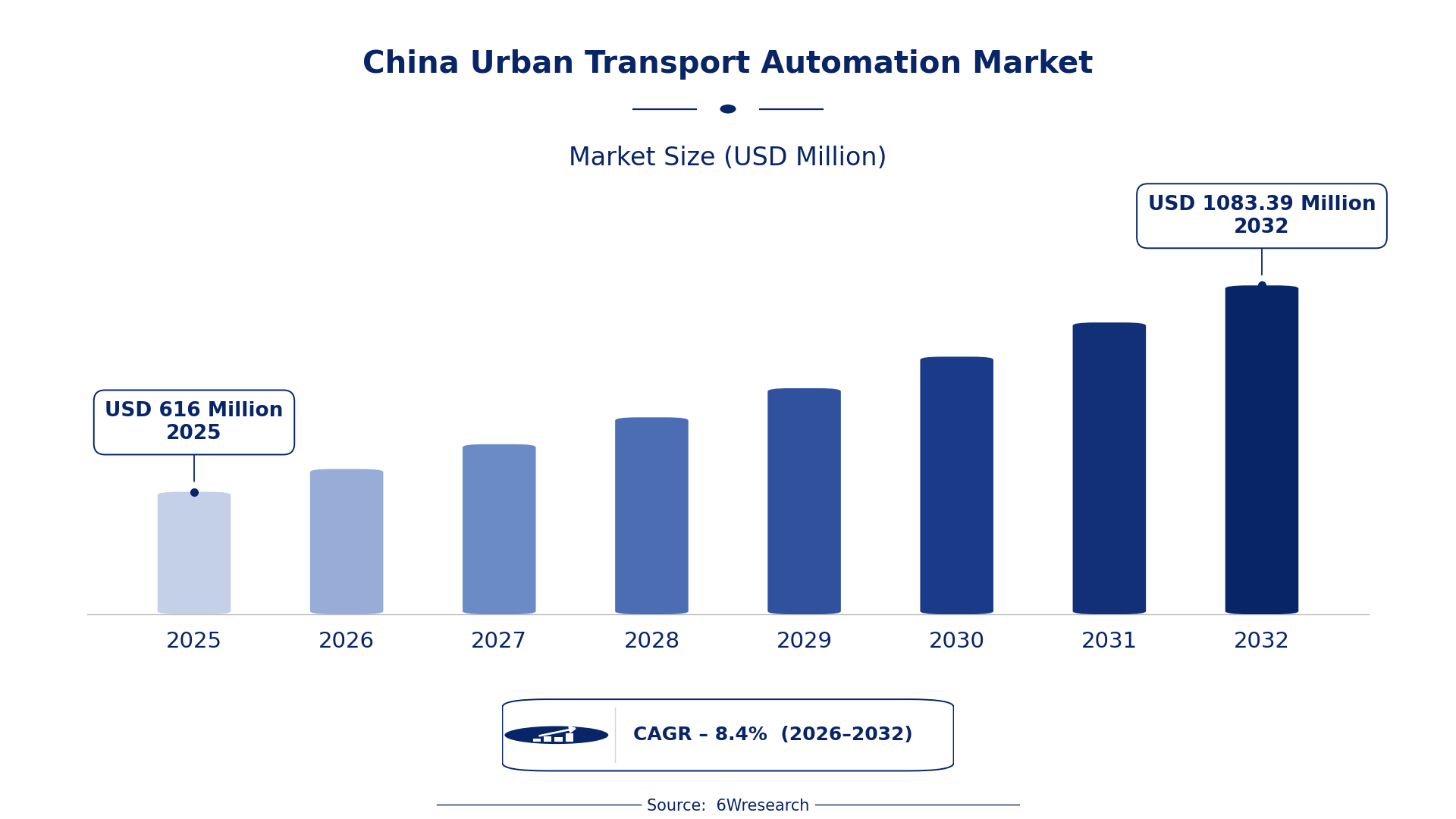
According to 6Wresearch internal database and industry insights, the China Urban Transport Automation Market was valued at USD 616.0 million in 2025 and is projected to reach USD 1,083.39 million by 2032, growing at a CAGR of approximately 8.4% during 2026–2032.
China Urban Transport Automation Market Highlights
| Report Metric | Details |
| Report Name | China Urban Transport Automation Market |
| Market Size 2025 | USD 616.0 million |
| Market Size 2032 | USD 1,083.39 million |
| Absolute Growth 2025–2032 | USD 467.39 million |
| CAGR 2026–2032 | 8.4% |
| Peak Annual Growth | 10.9% in 2030 |
| Forecast Period | 2026–2032 |
| Historical Data | 2022–2025 |
| Base Year | 2025 |
| Leading Automation Type, 2025 | Fare Automation (46% share) |
| Leading Transport Mode, 2025 | Electric Vehicles (43% share) |
| Leading System Integration, 2025 | AI + IoT (29% share) |
| Leading End User, 2025 | Public Transit Depts. (47% share) |
| Fastest-Growing Automation Type | Smart Traffic Systems (11.1% CAGR) |
| Fastest-Growing System Integration | Cloud-Based Platforms (10.1% CAGR) |
| Fastest-Growing End User | Transit Agencies (9.7% CAGR) |
| Growing Sector | Public Transit |
| Key End Users | Public Transit Departments, City Governments, Transit Agencies, Urban Planners |
China Urban Transport Automation Market Year-wise Growth Rate and Key Drivers (2022–2032)
This graph illustrates the annual growth rates of the market from 2022 to 2032, highlighting a steady upward trajectory and projected market expansion over the forecast period.
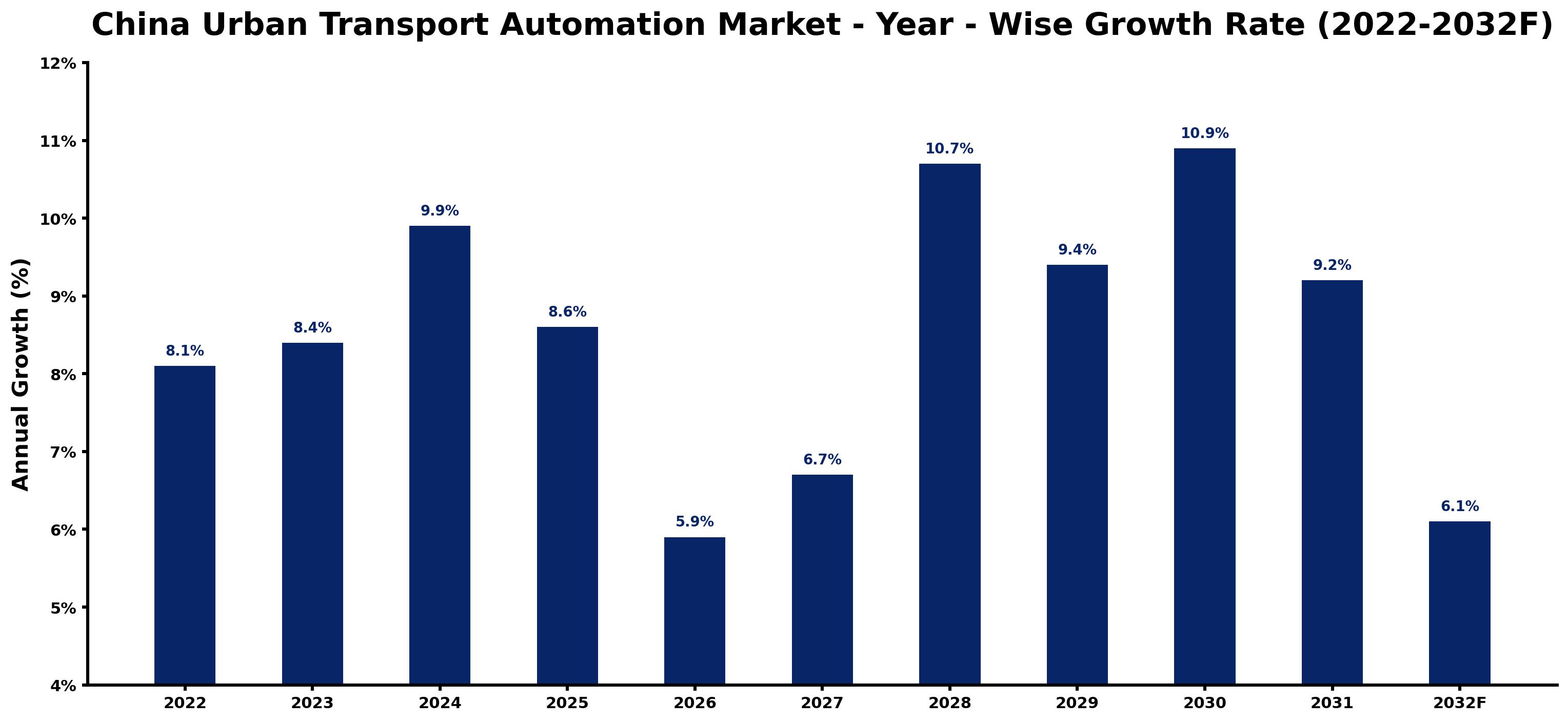
The following table presents the estimated annual growth rate for each year together with the principal factor influencing market performance.
| Year | Estimated Annual Growth (%) | Market Rationale |
| 2022 | 8.1 | The urban transport sector experienced steady demand due to population growth. |
| 2023 | 8.4 | Investment in smart traffic systems increased as cities sought efficiency improvements. |
| 2024 | 9.9 | The deployment of autonomous buses accelerated, improving public transport options. |
| 2025 | 8.6 | Growth slowed as cities focused on integrating existing technologies. |
| 2026 | 5.9 | Demand is expected to stabilise as the market adjusts to the National Smart Transport Plan. |
| 2027 | 6.7 | Public Transit Departments will expand automation initiatives to improve service delivery. |
| 2028 | 10.7 | Smart Traffic Systems will gain traction, driven by urban congestion challenges. |
| 2029 | 9.4 | Growth is projected to moderate as competition among technology providers intensifies. |
| 2030 | 10.9 | The market will peak as cities implement ambitious automation projects. |
| 2031 | 9.2 | Demand is expected to slow as urban planners assess the impact of automation. |
| 2032 | 6.1 | Growth will continue but at a reduced rate as projects reach maturity. |
Note: Market size estimations and growth projections presented in this report are based on 6Wresearch's proprietary forecasting methodology, utilizing the latest available industry data, government publications, and primary research inputs.
China Urban Transport Automation Market Synopsis
Urban Transport Automation in China includes technologies that boost the efficiency and safety of urban transportation systems, such as autonomous vehicles and smart traffic management. These advancements find their primary application in public transit and urban planning. The China Urban Transport Automation Market is growing due to the rapid rise in urban population and supportive government initiatives like the National Smart Transport Plan. By 2032, demand from city governments and transit agencies is driving investments in automation technologies, projected to reach USD 1,083.39 million.
Market Dynamics Impact Analysis (2026–2032)
| Factor | Type | Impact | Primary Segment Affected |
| Urban population growth drives demand for efficient transport solutions. | Driver | High | Smart Traffic Systems |
| Government initiatives promote the adoption of autonomous vehicles. | Driver | High | Autonomous Buses |
| Investment in smart transit projects presents opportunities for technology providers. | Opportunity | High | Public Transit Depts. |
| The push for sustainable transport solutions opens new market avenues. | Opportunity | High | Electric Vehicles |
| Regulatory challenges may delay the deployment of new technologies. | Restraint | High | Autonomous Buses |
| High costs associated with advanced technology integration can limit growth. | Restraint | Medium | Smart Traffic Systems |
| The Urban Transport Automation Market in China faces challenges with technology adoption rates. | Challenge | High | Fare Automation |
| Competition among technology providers can hinder market entry for new players. | Challenge | Medium | Real-Time Scheduling |
Evaluation of Drivers in China Urban Transport Automation Market (2026–2032)
The main growth drivers and the segments they affect most are set out below.
| Drivers | Primary Segment Affected | Why It Matters (Evidence) |
| Urban population growth increases demand for efficient transport solutions. | Smart Traffic Systems | China's urban population reached 1.4 billion in 2023, necessitating better traffic management. |
| Government initiatives promote the adoption of autonomous vehicles. | Autonomous Buses | The Green Transport Initiative aims to promote electric and automated vehicles. |
| Increased investment in smart transit projects boosts automation capabilities. | Public Transit Depts. | Beijing and Shanghai are leading regions with over 1,000 intersections equipped with smart traffic systems. |
| Growing efficiency in public transport systems drives automation adoption. | Fare Automation | Public Transit Departments report a 30% increase in efficiency due to automation technologies. |
| Integration of AI and IoT improves operational efficiency in transport systems. | AI + IoT | The National Intelligent Transport System Development Plan focuses on AI and IoT integration. |
The rapid urban population growth creates a pressing need for efficient transport solutions. In major cities, the implementation of smart traffic systems at over 1,000 intersections is improving traffic management. Public Transit Departments are reporting a 30% increase in efficiency due to these automation technologies, encouraging further investment in the sector.
Evaluation of Restraints in China Urban Transport Automation Market
The main factors holding the market back are set out below.
| Market Restraint | Primary Segment Affected | Why It Matters (Evidence) |
| Regulatory challenges may delay the deployment of new technologies. | Autonomous Buses | The national standard GB/T 34590-2017 regulates the safety of autonomous vehicles, impacting timelines. |
| High costs associated with advanced technology integration can limit growth. | Smart Traffic Systems | The urban transport sector is expected to invest over 200 billion CNY in automation technologies by 2025. |
| Limited public awareness of automation benefits can hinder adoption rates. | Fare Automation | Many users remain unfamiliar with automated fare collection systems, affecting usage. |
| Infrastructure limitations can restrict the implementation of smart systems. | Real-Time Scheduling | Over 60% of city governments are adopting real-time scheduling, but infrastructure must catch up. |
| Technological interoperability issues can complicate system integration. | AI + IoT | Integration of various technologies often faces compatibility challenges, slowing progress. |
China Urban Transport Automation Market Challenges
The China Urban Transport Automation market faces a pronounced skills shortage, as many workers lack the necessary training in advanced automation technologies, which delays project timelines for transit agencies. Compliance with the national standard GB/T 34590-2017 incurs costs that can exceed 15% of project budgets for suppliers, creating financial strain. Rapid technological advancements outpace existing regulations, leading to uncertainty for producers who must navigate shifting compliance requirements. Additionally, supply chain disruptions can extend project timelines by up to six months for urban planners, complicating the implementation of new systems.
Trends in the China Urban Transport Automation Market
The trends below show where the China Urban Transport Automation Market is heading.
- Shift towards Smart Traffic Systems in Major Cities: Beijing and Shanghai are leading the implementation of smart traffic systems, with over 1,000 intersections equipped. This trend reflects a growing recognition of the need for efficient traffic management, improving urban mobility.
- Increased Focus on Autonomous Buses: The Green Transport Initiative aims to promote electric and automated vehicles, highlighting a shift towards automated public transport solutions. This initiative will improve the efficiency and safety of urban transport.
- Public Transit Departments Embracing Automation: Public Transit Departments are increasingly adopting automation technologies, reporting a 30% increase in efficiency. This trend indicates a commitment to modernising urban transport systems and improving service delivery.
- Integration of AI and IoT in Urban Transport: The National Intelligent Transport System Development Plan focuses on integrating AI and IoT in urban transport. This integration is essential for improving connectivity and operational efficiency in transportation systems.
Investment Opportunities in the China Urban Transport Automation Market
Several openings in the China Urban Transport Automation Market merit attention from investors.
- Investment in Smart Transit Projects: With over 200 billion CNY expected to be invested in automation technologies by 2025, there is an opportunity for suppliers of smart transit solutions. Public Transit Departments in major cities are actively seeking innovative technologies.
- Expansion of Autonomous Vehicle Fleet: The push to promote electric and automated vehicles creates a demand for technology providers. Partnerships with local governments can facilitate entry into this growing market segment.
- Development of Real-Time Scheduling Systems: As over 60% of city governments adopt real-time scheduling systems, there is a clear opportunity for software developers to provide tailored solutions. Collaborating with local transit agencies can enhance market access.
- Growth in Electric Vehicle Adoption: The Electric Vehicle Promotion Plan aims to increase electric bus share to 30% by 2025, presenting an opportunity for manufacturers. Engaging with public transit departments can help secure contracts.
Government Initiatives in the China Urban Transport Automation Market
The 'National Smart Transport Plan' launched in 2021 aims to improve urban mobility through automation technologies. This measure builds on previous initiatives by promoting the deployment of autonomous vehicles and smart traffic systems. It sets a target to promote electric and automated vehicles, impacting urban transport efficiency. Additionally, the 'Green Transport Initiative' introduced in the same year encourages the adoption of electric vehicles, aligning with sustainability goals. This initiative aims to integrate automated solutions into existing transport frameworks, driving innovation in the sector.
The Ministry of Transport approves funding for projects under the 'National Smart Transport Plan', facilitating the implementation of automation technologies. In 2022, the Ministry of Housing and Urban-Rural Development updated the 'Urban Transport Development Strategy' to include automation and smart technologies. This strategy supports urban planners and public transit departments in integrating advanced solutions into their systems. Furthermore, the 'Smart City Development Plan' initiated by the State Council in 2020 promotes the integration of intelligent transport systems, ensuring comprehensive urban planning.
Future Insight of the China Urban Transport Automation Market
The China Urban Transport Automation market will transform by 2032, driven by government initiatives aimed at improving urban mobility and safety. The deployment of 50,000 autonomous buses by 2025 will enhance public transit efficiency, while investments in automation technologies are projected to exceed 200 billion CNY. The integration of smart traffic management systems will optimise urban transport operations, benefiting both buyers and suppliers as they adapt to these advancements.
Market Segmentation Analysis
The report offers a comprehensive study of the following market segments and their leading categories in the market.
By Automation Type – Fare Automation Dominated, Smart Traffic Systems Expected to Grow Fastest
According to Bhawna Singh, Assistant Manager at 6Wresearch, with a 46% revenue share in 2025, Fare Automation was the largest automation type category. Fare automation holds the largest share due to its critical role in streamlining fare collection processes across urban transport systems. Major cities have adopted these systems to enhance user experience and operational efficiency. The quickest growth will come from Smart Traffic Systems, forecast to expand at a CAGR of 11.1% between 2026 and 2032. Smart traffic systems are experiencing rapid growth as cities like Beijing and Shanghai upgrade over 1,000 intersections to improve traffic management. This expansion addresses the urgent need for effective congestion solutions in densely populated areas. Suppliers should focus on developing advanced fare automation technologies to meet the increasing demand from public transit departments.
By Transport Mode – Electric Vehicles Dominated and Is Expected to Record the Fastest Growth
Electric Vehicles held a 43% share of the China Urban Transport Automation Market by transport mode in 2025. Electric vehicles dominate the market share as they align with China's sustainability objectives, supported by initiatives like the Electric Vehicle Promotion Plan aiming for a 30% share of electric buses by 2025. This governmental backing ensures a steady demand for electric vehicles. Electric Vehicles are also forecast to expand faster than any other category, at a CAGR of 10.1% over 2026–2032. Electric vehicles are also the fastest-growing segment, driven by rising investments and a shift in consumer preferences towards sustainable transport options. The government's commitment to deploying more electric buses will further accelerate this segment's growth. Buyers should prioritise electric vehicle solutions to align with national sustainability goals and enhance operational efficiency.
By System Integration – AI + IoT Dominated, Cloud-Based Platforms Expected to Grow Fastest
AI + IoT accounted for a 29% market share by system integration in 2025. AI and IoT lead the market share as they significantly improve connectivity and data analysis within urban transport systems. Their integration is essential for the successful implementation of smart transport technologies across various cities. Cloud-Based Platforms are set to record the highest CAGR in this split, 10.1% over 2026–2032. Cloud-based platforms are rapidly growing as they enable effective data management and system integration, which are vital for modern urban transport solutions. The increasing demand for real-time data accessibility propels this trend. Suppliers must invest in cloud-based solutions to meet the rising need for efficient data management in urban transport automation.
By End User – Public Transit Depts. Dominated, Transit Agencies Expected to Grow Fastest
In 2025, Public Transit Depts. led the end user split with a 47% share. Public transit departments represent the largest share as they are the primary users of automation technologies, benefiting directly from enhanced operational efficiency. Their substantial investments in automation underscore their pivotal role in improving urban transport systems. Transit Agencies are projected to grow fastest, at a CAGR of 9.7% during 2026–2032. Transit agencies are the fastest-growing segment, actively adopting automation solutions to enhance service delivery and operational efficiency. Their proactive embrace of new technologies is reshaping urban transport dynamics to meet rising passenger expectations. Suppliers should tailor their offerings to address the specific needs of transit agencies to capture this expanding market segment.
Key Attractiveness of the Report
- 10 Years of Market Numbers
- Historical Data Starting from 2022 to 2025
- Base Year 2025
- Forecast Data until 2032
- Key Performance Indicators Impacting the Market
- Major Upcoming Developments and Projects
Key Highlights of the Report:
- China Urban Transport Automation Market Outlook
- Market Size of China Urban Transport Automation Market, 2025
- Forecast of China Urban Transport Automation Market, 2032
- Historical Data and Forecast of China Urban Transport Automation Revenues & Volume for the Period 2022 - 2032F
- China Urban Transport Automation Market Trend Evolution
- China Urban Transport Automation Market Drivers and Challenges
- China Urban Transport Automation Price Trends
- China Urban Transport Automation Porter's Five Forces
- China Urban Transport Automation Industry Life Cycle
- Historical Data and Forecast of China Urban Transport Automation Market Revenues & Volume By Automation Type for the Period 2022 - 2032F
- Historical Data and Forecast of China Urban Transport Automation Market Revenues & Volume By Autonomous Buses for the Period 2022 - 2032F
- Historical Data and Forecast of China Urban Transport Automation Market Revenues & Volume By Smart Traffic Systems for the Period 2022 - 2032F
- Historical Data and Forecast of China Urban Transport Automation Market Revenues & Volume By Fare Automation for the Period 2022 - 2032F
- Historical Data and Forecast of China Urban Transport Automation Market Revenues & Volume By Real-Time Scheduling for the Period 2022 - 2032F
- Historical Data and Forecast of China Urban Transport Automation Market Revenues & Volume By Transport Mode for the Period 2022 - 2032F
- Historical Data and Forecast of China Urban Transport Automation Market Revenues & Volume By Electric Vehicles for the Period 2022 - 2032F
- Historical Data and Forecast of China Urban Transport Automation Market Revenues & Volume By Road Vehicles for the Period 2022 - 2032F
- Historical Data and Forecast of China Urban Transport Automation Market Revenues & Volume By Rail/Metro for the Period 2022 - 2032F
- Historical Data and Forecast of China Urban Transport Automation Market Revenues & Volume By Multi-Modal for the Period 2022 - 2032F
- Historical Data and Forecast of China Urban Transport Automation Market Revenues & Volume By System Integration for the Period 2022 - 2032F
- Historical Data and Forecast of China Urban Transport Automation Market Revenues & Volume By GPS, LIDAR, AI for the Period 2022 - 2032F
- Historical Data and Forecast of China Urban Transport Automation Market Revenues & Volume By AI + IoT for the Period 2022 - 2032F
- Historical Data and Forecast of China Urban Transport Automation Market Revenues & Volume By RFID + Mobile App for the Period 2022 - 2032F
- Historical Data and Forecast of China Urban Transport Automation Market Revenues & Volume By Cloud-Based Platforms for the Period 2022 - 2032F
- Historical Data and Forecast of China Urban Transport Automation Market Revenues & Volume By End User for the Period 2022 - 2032F
- Historical Data and Forecast of China Urban Transport Automation Market Revenues & Volume By Public Transit Depts. for the Period 2022 - 2032F
- Historical Data and Forecast of China Urban Transport Automation Market Revenues & Volume By City Governments for the Period 2022 - 2032F
- Historical Data and Forecast of China Urban Transport Automation Market Revenues & Volume By Transit Agencies for the Period 2022 - 2032F
- Historical Data and Forecast of China Urban Transport Automation Market Revenues & Volume By Urban Planners for the Period 2022 - 2032F
- China Urban Transport Automation Import Export Trade Statistics
- Market Opportunity Assessment By Automation Type
- Market Opportunity Assessment By Transport Mode
- Market Opportunity Assessment By System Integration
- Market Opportunity Assessment By End User
- China Urban Transport Automation Top Companies Market Share
- China Urban Transport Automation Competitive Benchmarking By Technical and Operational Parameters
- China Urban Transport Automation Company Profiles
- China Urban Transport Automation Key Strategic Recommendations
Market Covered
Segments analysed in this report are listed below.
By Automation Type
- Autonomous Buses
- Smart Traffic Systems
- Fare Automation
- Real-Time Scheduling
By Transport Mode
- Electric Vehicles
- Road Vehicles
- Rail/Metro
- Multi-Modal
By System Integration
- GPS
- LIDAR
- AI
- AI + IoT
- RFID + Mobile App
- Cloud-Based Platforms
By End User
- Public Transit Depts.
- City Governments
- Transit Agencies
- Urban Planners































