India Urinary Control Systems Market Size & Growth Rate
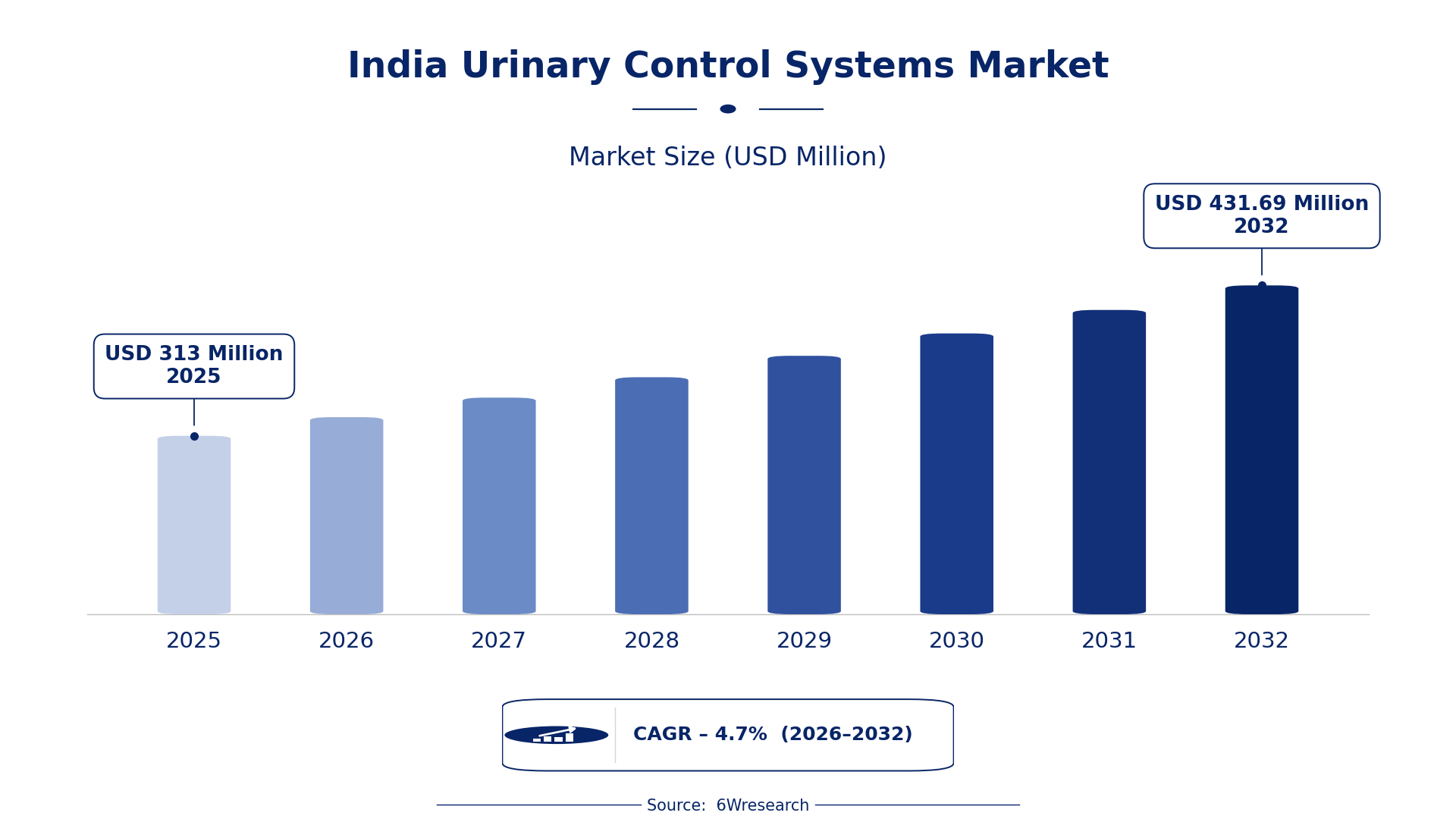
According to 6Wresearch internal database and industry insights, the India Urinary Control Systems Market was valued at USD 313.0 million in 2025 and is projected to reach USD 431.69 million by 2032, growing at a CAGR of approximately 4.7% during 2026–2032.
India Urinary Control Systems Market Highlights
| Report Metric | Details |
| Report Name | India Urinary Control Systems Market |
| Market Size 2025 | USD 313.0 million |
| Market Size 2032 | USD 431.69 million |
| Absolute Growth 2025–2032 | USD 118.69 million |
| CAGR 2026–2032 | 4.7% |
| Peak Annual Growth | 7.3% in 2028 |
| Forecast Period | 2026–2032 |
| Historical Data | 2022–2025 |
| Base Year | 2025 |
| Leading Product Type, 2025 | Catheters (41% share) |
| Leading Technology Type, 2025 | Disposable (48% share) |
| Leading Use Condition, 2025 | Severe UI (36% share) |
| Leading End User, 2025 | Hospitals (40% share) |
| Fastest-Growing Product Type | Pelvic Floor Trainers (6.5% CAGR) |
| Fastest-Growing Technology Type | App-Integrated (6.7% CAGR) |
| Fastest-Growing Use Condition | Post-Surgical Cases (7.1% CAGR) |
| Fastest-Growing End User | Home Users (7.4% CAGR) |
| Growing Sector | Home Users |
| Key End Users | Hospitals, Urology Clinics, Elderly Patients, Home Users |
India Urinary Control Systems Market Year-wise Growth Rate and Key Drivers (2022–2032)
This graph illustrates the annual growth rates of the market from 2022 to 2032, highlighting a steady upward trajectory and projected market expansion over the forecast period.
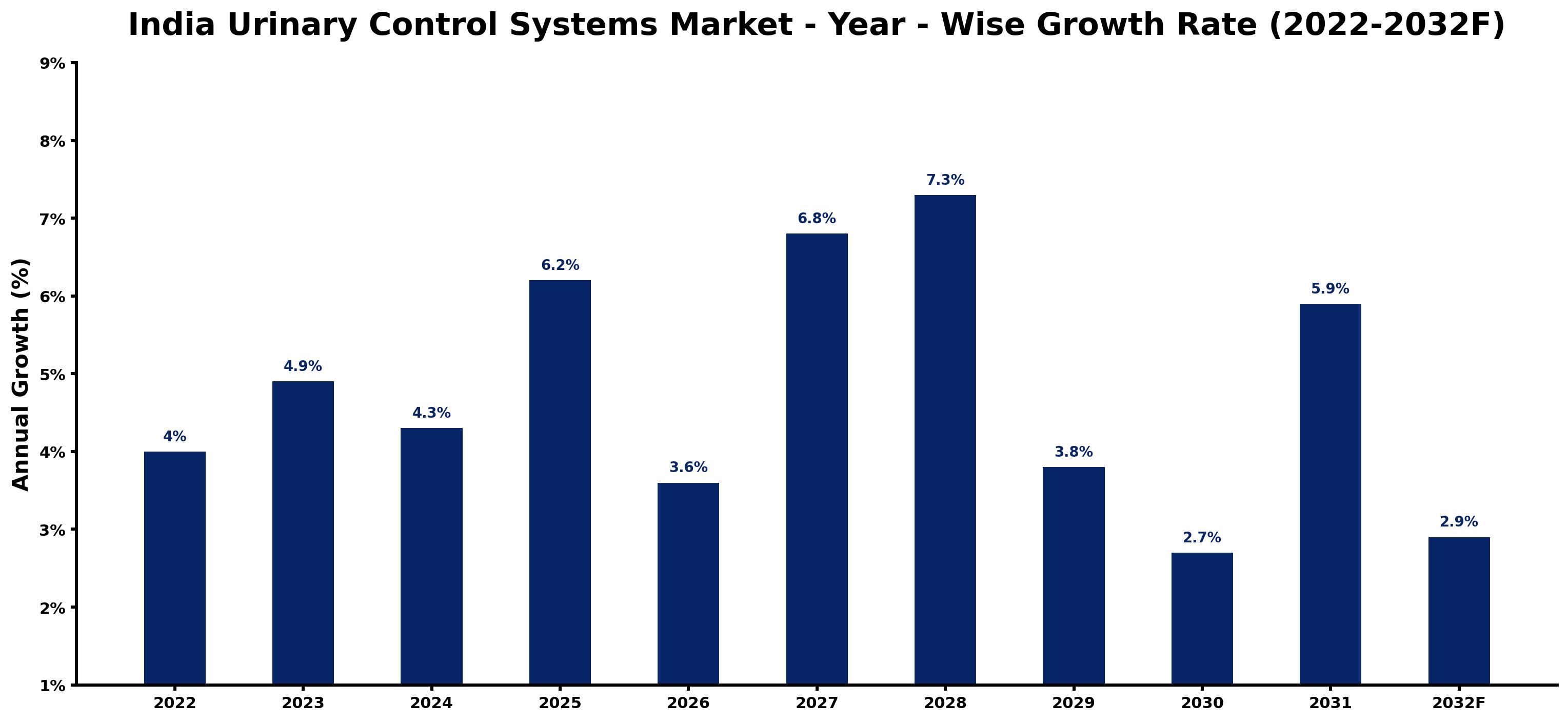
Each row of the following table gives one year's estimated growth and the event or demand shift that explains it.
| Year | Estimated Annual Growth (%) | Market Rationale |
| 2022 | 4.0 | The market showed steady growth with increasing awareness of urinary control solutions among healthcare providers. |
| 2023 | 4.9 | Demand accelerated due to the rise in the elderly population and the National Health Mission's initiatives. |
| 2024 | 4.3 | Growth slowed as market adjustments followed rapid increases in previous years. |
| 2025 | 6.2 | The introduction of new products and technologies spurred faster growth in urinary control systems. |
| 2026 | 3.6 | A slowdown occurred as competition intensified and market saturation began to take shape. |
| 2027 | 6.8 | Demand surged again as hospitals expanded their urological care services and facilities. |
| 2028 | 7.3 | The peak growth is expected to be driven by advancements in urinary control technologies and increased adoption. |
| 2029 | 3.8 | Growth is projected to slow as market maturity sets in, with fewer new products entering the market. |
| 2030 | 2.7 | Continued growth will be constrained by rising costs and an increasingly competitive environment. |
| 2031 | 5.9 | A resurgence in demand is anticipated as healthcare providers seek to improve patient care with advanced solutions. |
| 2032 | 2.9 | The market is expected to experience another slowdown as growth stabilises in response to market conditions. |
Note: Market size estimations and growth projections presented in this report are based on 6Wresearch's proprietary forecasting methodology, utilizing the latest available industry data, government publications, and primary research inputs.
India Urinary Control Systems Market Synopsis
Urinary Control Systems in India are medical devices designed to manage urinary incontinence, primarily through external devices and internal implants. These systems are manufactured using advanced materials for comfort and efficacy, serving primarily elderly and post-surgical patients. The India Urinary Control Systems Market is expanding due to a large elderly population, with over 100 million individuals affected, and initiatives like the National Health Mission improving healthcare access.
Market Dynamics Impact Analysis (2026–2032)
| Factor | Type | Impact | Primary Segment Affected |
| Rising elderly population increases demand for urinary control solutions. | Driver | High | Elderly Patients |
| Growing healthcare infrastructure enhances access to urological services. | Driver | High | Hospitals |
| Investment in urological care in rural areas opens new market opportunities. | Opportunity | High | Urology Clinics |
| Emerging app-integrated systems present a new avenue for suppliers. | Opportunity | Medium | App-Integrated |
| High costs associated with advanced urinary control systems limit accessibility. | Restraint | High | Catheters |
| Market saturation in urban areas restricts growth potential. | Restraint | Medium | External Devices |
| Limited awareness among home users delays market penetration. | Challenge | Medium | Home Users |
| Competition from alternative treatments challenges market stability. | Challenge | High | Internal Implants |
Evaluation of Drivers in India Urinary Control Systems Market (2026–2032)
The factors lifting demand, and the evidence behind each, are summarised below.
| Drivers | Primary Segment Affected | Why It Matters (Evidence) |
| Increasing prevalence of urinary incontinence among the elderly. | Elderly Patients | 10-15% of the elderly population suffers from urinary incontinence, driving demand for effective solutions. |
| Expansion of urology clinics in urban areas. | Urology Clinics | With over 500 specialized clinics nationwide, more patients are accessing urinary control systems. |
| Government initiatives to improve healthcare access. | Hospitals | The National Health Mission aims to improve urological services, increasing demand for related products. |
| Technological advancements in urinary control systems. | Disposable | ISO 13485 certification ensures quality, resulting in higher adoption rates among healthcare providers. |
| Rising surgical procedures necessitating catheter use. | Catheters | The market for catheters is expected to grow due to an increase in surgical interventions. |
Market growth for Urinary Control Systems in India is supported by rising healthcare access, technological advancements, and an expanding elderly demographic. Approximately 10-15% of the elderly population suffers from urinary incontinence, driving demand for effective solutions. The increasing number of specialized urology clinics nationwide is contributing to the growing demand. Technological advancements, such as ISO 13485 certification, ensure quality, resulting in higher adoption rates among healthcare providers. The rise in surgical procedures is necessitating greater use of catheters, further boosting the market.
Evaluation of Restraints in India Urinary Control Systems Market
The main factors holding the market back are set out below.
| Market Restraint | Primary Segment Affected | Why It Matters (Evidence) |
| High costs associated with advanced urinary control systems. | Catheters | The average cost of urinary control systems can be prohibitive for many patients, limiting market reach. |
| Market saturation in urban areas restricts growth potential. | External Devices | With many providers already established, new entrants face challenges in gaining market share. |
| Limited awareness among home users delays market penetration. | Home Users | Many potential users remain unaware of available urinary control solutions, hindering growth. |
| Competition from alternative treatments challenges market stability. | Internal Implants | Alternative therapies may deter patients from opting for urinary control systems. |
| Regulatory hurdles can slow product approvals. | App-Integrated | Compliance with ISO standards can delay market entry for new app-integrated solutions. |
India Urinary Control Systems Market Challenges
In the India Urinary Control Systems market, supply chain disruptions arise as the elderly population exceeds 100 million, leading to high demand while production capabilities remain constrained. Rising costs present another challenge, with manufacturers experiencing a 15% increase in device prices due to expensive advanced materials, which burdens healthcare facilities. Compliance with new regulations is challenging, as adherence to updated guidelines for urinary incontinence management can delay product launches by up to six months for new entrants. Competition from alternative treatments is intensifying, as non-invasive options gain traction, forcing producers to innovate rapidly to retain market share.
Trends in the India Urinary Control Systems Market
The trends below show where the India Urinary Control Systems Market is heading.
- Shift Towards App-Integrated Solutions: India is transitioning towards app-integrated urinary control systems, driven by the Digital India initiative. This trend is supported by a projected 20% increase in user engagement as technology-driven healthcare solutions gain traction.
- Transition from Traditional to Advanced Devices: The market is moving from traditional urinary control devices to advanced options like hydraulic-controlled systems. This shift began in 2022, with a 15% increase in adoption rates among urology clinics, reflecting a demand for more effective solutions.
- Emergence of Pelvic Floor Trainers: Pelvic floor trainers are gaining traction in India as a rehabilitation tool for urinary incontinence. This trend is highlighted by a projected growth rate of 6.5% from 2026 to 2032, indicating increasing acceptance among healthcare providers.
- Focus on Rural Healthcare Initiatives: Rural healthcare initiatives are expanding access to urinary control systems in India. The government's budget allocation of ₹300 crores in 2022 for improving healthcare services in rural areas supports this trend.
Investment Opportunities in the India Urinary Control Systems Market
Several openings in the India Urinary Control Systems Market merit attention from investors.
- Rising Demand for Urological Services: The increasing elderly population creates an urgent need for urinary control systems, with over 100 million elderly individuals in India. Urology clinics can expand their offerings to meet this demand effectively.
- Investment in App-Integrated Solutions: The rise of digital healthcare solutions presents an opportunity to invest in app-integrated urinary control systems. Collaborating with healthcare technology firms can facilitate market entry and product development.
- Expansion of Healthcare Infrastructure: The government's focus on improving healthcare access opens avenues for suppliers of urinary control systems. Engaging with hospitals and clinics can lead to increased sales and market penetration.
- Rural Market Development: With government initiatives enhancing healthcare in rural areas, there is a significant opportunity to supply urinary control systems. Partnering with local healthcare providers can facilitate entry into these underserved markets.
Government Initiatives in the India Urinary Control Systems Market
The 'National Health Policy 2017' aims to improve healthcare infrastructure, including urology services across India. This policy facilitates access to urinary control systems for patients, particularly in rural areas. Additionally, the 'Ayushman Bharat' scheme provides health coverage for urinary treatments to low-income families, ensuring that more individuals can access necessary medical devices. These measures support the growth of the urinary control systems market by increasing affordability and availability for patients in need.
The 'National Program for Prevention and Control of Cancer, Diabetes, Cardiovascular Diseases and Stroke' includes urological health initiatives, funding projects aimed at improving urological care. The National Institute of Health and Family Welfare provides training for healthcare professionals in managing urinary incontinence, ensuring that providers are well-equipped to support patients effectively. These efforts contribute to a more supportive market for urinary control systems in India.
Future Insight of the India Urinary Control Systems Market
The India Urinary Control Systems market will undergo significant changes by 2032, driven by advancements in urological care that improve patient outcomes. The National Health Mission will enhance healthcare access, particularly in rural areas, encouraging broader adoption of urinary control devices. Training initiatives from the National Institute of Health and Family Welfare will equip healthcare professionals with essential skills for managing urinary incontinence effectively. The anticipated increase in demand for urinary control systems, with a projected rise in surgical procedures, will open new avenues for suppliers in the market.
Market Segmentation Analysis
The report offers a comprehensive study of the following market segments and their leading categories in the market.
By Product Type – Catheters Dominated, Pelvic Floor Trainers Expected to Grow Fastest
According to Bhawna Singh, Assistant Manager at 6Wresearch, the largest product type category in 2025 was Catheters, with a 41% share of total revenue. Catheters hold the largest market share in India as they are essential for managing urinary drainage, particularly among the elderly who often require long-term care solutions. With over 100 million elderly individuals in the country, the demand for catheters is substantial and continues to grow. Pelvic Floor Trainers are projected to grow fastest, at a CAGR of 6.5% during 2026–2032. Pelvic Floor Trainers are witnessing rapid growth due to increasing awareness and advocacy from healthcare providers about their role in rehabilitation for urinary incontinence. This segment's expansion is supported by the rising focus on post-surgical recovery practices among patients. Suppliers should consider diversifying their product lines to include pelvic floor trainers, addressing the rising demand for rehabilitation solutions in urinary control.
By Technology Type – Disposable Dominated, App-Integrated Expected to Grow Fastest
Disposable held a 48% share of the India Urinary Control Systems Market by technology type in 2025. Disposable urinary control systems dominate the market share in India due to their convenience and hygiene, making them a preferred choice in healthcare settings. Their widespread adoption in hospitals and clinics ensures a steady demand among healthcare providers. The quickest growth will come from App-Integrated, forecast to expand at a CAGR of 6.7% between 2026 and 2032. App-Integrated systems are gaining traction as patients increasingly seek digital solutions for managing their health. This trend is expected to accelerate as technology becomes more integrated into patient care practices. Suppliers need to invest in app-integrated technologies to stay competitive in a rapidly changing market.
By Use Condition – Severe UI Dominated, Post-Surgical Cases Expected to Grow Fastest
Severe UI accounted for a 36% market share by use condition in 2025. Severe UI commands the largest market share as many urinary control systems are specifically tailored to meet the needs of patients suffering from this condition. The prevalence of urinary incontinence among the elderly, estimated at 10-15%, drives the demand for effective management solutions. Over 2026–2032, Post-Surgical Cases are expected to post the fastest growth, at a CAGR of 7.1%. Post-Surgical Cases are experiencing the highest growth rate, primarily due to the increasing number of surgical procedures that necessitate urinary management during recovery. As surgical interventions rise, the need for effective urinary control systems in these scenarios is expected to escalate. Suppliers should prioritise marketing strategies focused on post-surgical recovery solutions to capitalise on this rapidly expanding market segment.
By End User – Hospitals Dominated, Home Users Expected to Grow Fastest
With a 40% revenue share in 2025, Hospitals was the largest end user category. Hospitals account for the largest share of the urinary control systems market, as these facilities are critical for surgical interventions and patient recovery. The high volume of surgical procedures in hospitals drives the demand for effective urinary management solutions. Home Users are set to record the highest CAGR in this split, 7.4% over 2026–2032. Home Users represent the fastest-growing segment as awareness of urinary incontinence management increases among the general public. This shift towards home care solutions is likely to expand the market further as more individuals seek comfort and convenience. Suppliers should develop targeted products for home users to tap into this emerging market.
Key Attractiveness of the Report
- 10 Years of Market Numbers
- Historical Data Starting from 2022 to 2025
- Base Year 2025
- Forecast Data until 2032
- Key Performance Indicators Impacting the Market
- Major Upcoming Developments and Projects
Key Highlights of the Report:
- India Urinary Control Systems Market Outlook
- Market Size of India Urinary Control Systems Market, 2025
- Forecast of India Urinary Control Systems Market, 2032
- Historical Data and Forecast of India Urinary Control Systems Revenues & Volume for the Period 2022 - 2032F
- India Urinary Control Systems Market Trend Evolution
- India Urinary Control Systems Market Drivers and Challenges
- India Urinary Control Systems Price Trends
- India Urinary Control Systems Porter's Five Forces
- India Urinary Control Systems Industry Life Cycle
- Historical Data and Forecast of India Urinary Control Systems Market Revenues & Volume By Product Type for the Period 2022 - 2032F
- Historical Data and Forecast of India Urinary Control Systems Market Revenues & Volume By External Devices for the Period 2022 - 2032F
- Historical Data and Forecast of India Urinary Control Systems Market Revenues & Volume By Internal Implants for the Period 2022 - 2032F
- Historical Data and Forecast of India Urinary Control Systems Market Revenues & Volume By Catheters for the Period 2022 - 2032F
- Historical Data and Forecast of India Urinary Control Systems Market Revenues & Volume By Pelvic Floor Trainers for the Period 2022 - 2032F
- Historical Data and Forecast of India Urinary Control Systems Market Revenues & Volume By Technology Type for the Period 2022 - 2032F
- Historical Data and Forecast of India Urinary Control Systems Market Revenues & Volume By Electrical Stimulation for the Period 2022 - 2032F
- Historical Data and Forecast of India Urinary Control Systems Market Revenues & Volume By Hydraulic-Controlled for the Period 2022 - 2032F
- Historical Data and Forecast of India Urinary Control Systems Market Revenues & Volume By Disposable for the Period 2022 - 2032F
- Historical Data and Forecast of India Urinary Control Systems Market Revenues & Volume By App-Integrated for the Period 2022 - 2032F
- Historical Data and Forecast of India Urinary Control Systems Market Revenues & Volume By Use Condition for the Period 2022 - 2032F
- Historical Data and Forecast of India Urinary Control Systems Market Revenues & Volume By Urge Incontinence for the Period 2022 - 2032F
- Historical Data and Forecast of India Urinary Control Systems Market Revenues & Volume By Severe UI for the Period 2022 - 2032F
- Historical Data and Forecast of India Urinary Control Systems Market Revenues & Volume By Post-Surgical Cases for the Period 2022 - 2032F
- Historical Data and Forecast of India Urinary Control Systems Market Revenues & Volume By Mild UI for the Period 2022 - 2032F
- Historical Data and Forecast of India Urinary Control Systems Market Revenues & Volume By End User for the Period 2022 - 2032F
- Historical Data and Forecast of India Urinary Control Systems Market Revenues & Volume By Elderly Patients for the Period 2022 - 2032F
- Historical Data and Forecast of India Urinary Control Systems Market Revenues & Volume By Urology Clinics for the Period 2022 - 2032F
- Historical Data and Forecast of India Urinary Control Systems Market Revenues & Volume By Hospitals for the Period 2022 - 2032F
- Historical Data and Forecast of India Urinary Control Systems Market Revenues & Volume By Home Users for the Period 2022 - 2032F
- India Urinary Control Systems Import Export Trade Statistics
- Market Opportunity Assessment By Product Type
- Market Opportunity Assessment By Technology Type
- Market Opportunity Assessment By Use Condition
- Market Opportunity Assessment By End User
- India Urinary Control Systems Top Companies Market Share
- India Urinary Control Systems Competitive Benchmarking By Technical and Operational Parameters
- India Urinary Control Systems Company Profiles
- India Urinary Control Systems Key Strategic Recommendations
Market Covered
The report offers an extensive study of the following market segments.
By Product Type
- External Devices
- Internal Implants
- Catheters
- Pelvic Floor Trainers
By Technology Type
- Electrical Stimulation
- Hydraulic-Controlled
- Disposable
- App-Integrated
By Use Condition
- Urge Incontinence
- Severe UI
- Post-Surgical Cases
- Mild UI
By End User
- Elderly Patients
- Urology Clinics
- Hospitals
- Home Users































