China Urinary Control Systems Market Size & Growth Rate
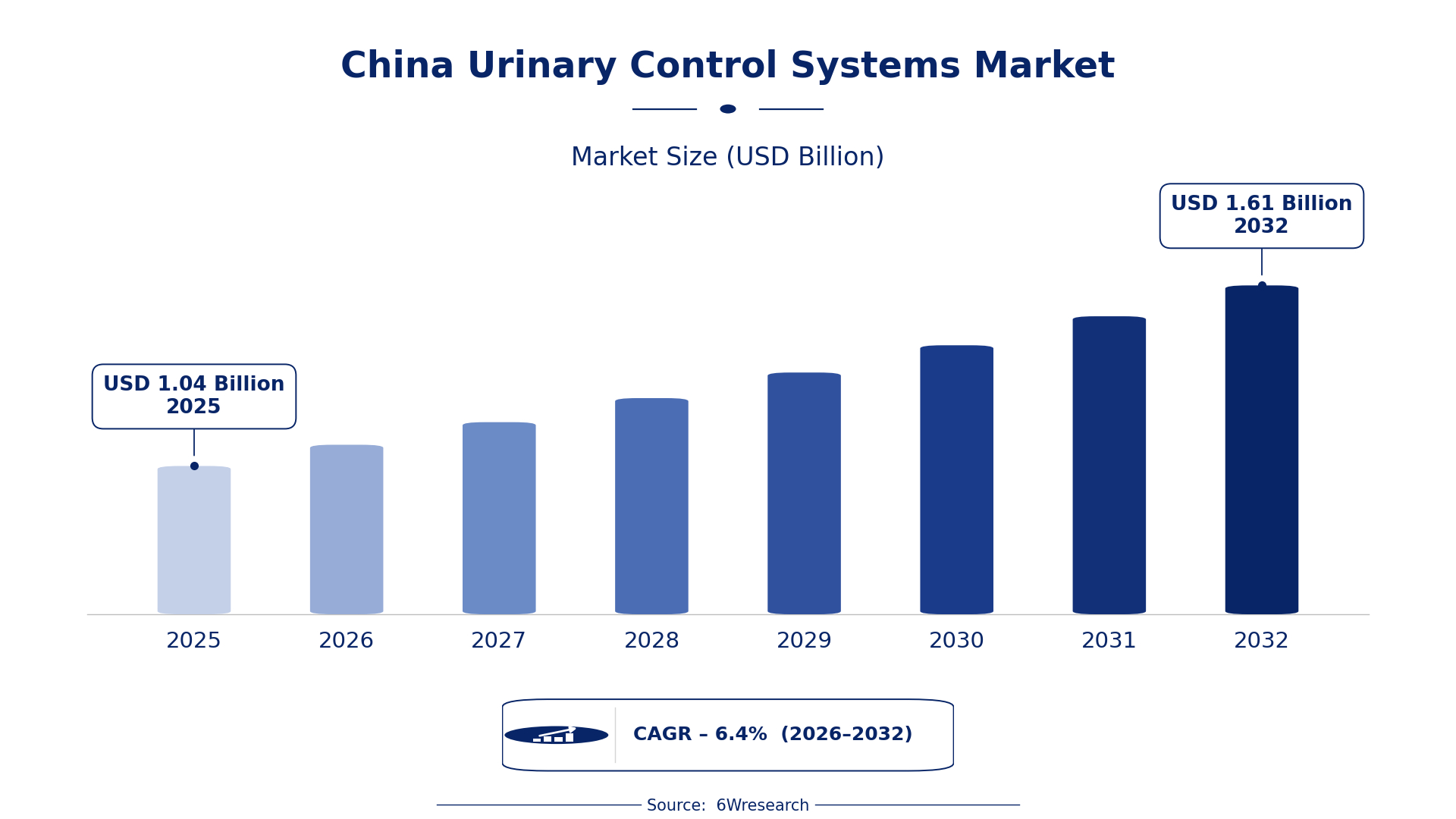
According to 6Wresearch internal database and industry insights, the China Urinary Control Systems Market was valued at USD 1.04 billion in 2025 and is projected to reach USD 1.61 billion by 2032, growing at a CAGR of approximately 6.4% during 2026–2032.
China Urinary Control Systems Market Highlights
| Report Metric | Details |
| Report Name | China Urinary Control Systems Market |
| Market Size 2025 | USD 1.04 billion |
| Market Size 2032 | USD 1.61 billion |
| Absolute Growth 2025–2032 | USD 0.57 billion |
| CAGR 2026–2032 | 6.4% |
| Peak Annual Growth | 9.0% in 2030 |
| Forecast Period | 2026–2032 |
| Historical Data | 2022–2025 |
| Base Year | 2025 |
| Leading Product Type, 2025 | Catheters (49% share) |
| Leading Technology Type, 2025 | Disposable (43% share) |
| Leading Use Condition, 2025 | Urge Incontinence (47% share) |
| Leading End User, 2025 | Hospitals (42% share) |
| Fastest-Growing Product Type | Pelvic Floor Trainers (8.0% CAGR) |
| Fastest-Growing Technology Type | App-Integrated (7.5% CAGR) |
| Fastest-Growing Use Condition | Post-Surgical Cases (8.8% CAGR) |
| Fastest-Growing End User | Home Users (8.7% CAGR) |
| Growing Sector | Elderly Care |
| Key End Users | Hospitals, Urology Clinics, Home Users, Elderly Patients |
China Urinary Control Systems Market Year-wise Growth Rate and Key Drivers (2022–2032)
This graph illustrates the annual growth rates of the market from 2022 to 2032, highlighting a steady upward trajectory and projected market expansion over the forecast period.
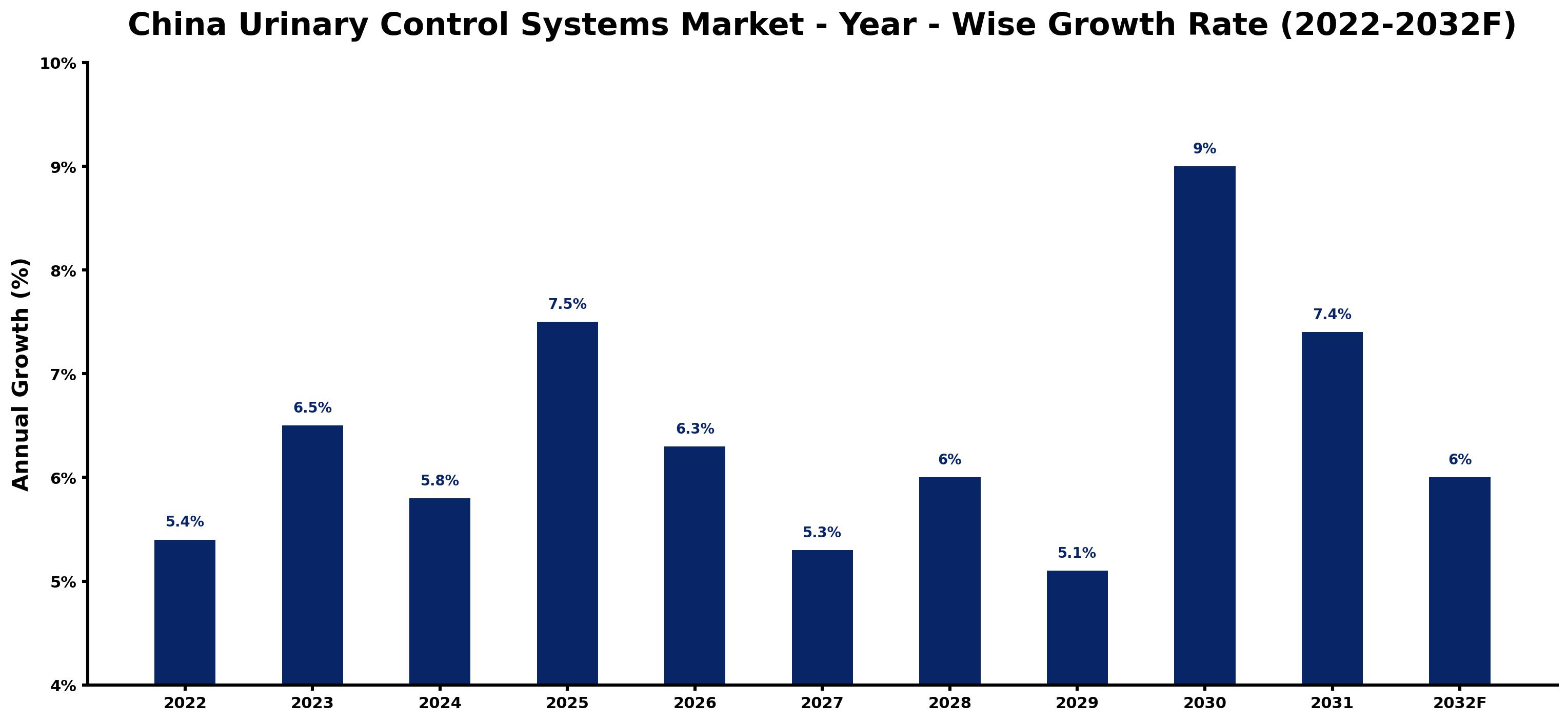
Each row of the following table gives one year's estimated growth and the event or demand shift that explains it.
| Year | Estimated Annual Growth (%) | Market Rationale |
| 2022 | 5.4 | The population of elderly individuals reached 260 million, increasing demand for urinary control systems. |
| 2023 | 6.5 | The launch of the 'Elderly Health Promotion Plan' improved access to urinary health products. |
| 2024 | 5.8 | The market experienced a slowdown due to adjustments in consumer purchasing patterns. |
| 2025 | 7.5 | Higher adoption rates in urban areas contributed to a faster growth rate. |
| 2026 | 6.3 | The market growth is expected to slow as hospitals adjust to new product integrations. |
| 2027 | 5.3 | Demand will continue to rise, but at a slower pace as competition intensifies. |
| 2028 | 6.0 | Increased awareness of urinary health is projected to lead to a faster growth rate. |
| 2029 | 5.1 | The market is expected to slow again as consumers become more selective in their purchases. |
| 2030 | 9.0 | The introduction of app-integrated devices is expected to spur rapid growth. |
| 2031 | 7.4 | Growth is projected to slow as the market matures and competition increases. |
| 2032 | 6.0 | The market is expected to stabilise with consistent demand from the elderly population. |
Note: Market size estimations and growth projections presented in this report are based on 6Wresearch's proprietary forecasting methodology, utilizing the latest available industry data, government publications, and primary research inputs.
China Urinary Control Systems Market Synopsis
Urinary Control Systems in China include devices aimed at helping individuals manage urinary incontinence, such as catheters and electrical stimulation systems. These products utilise advanced materials and technologies to address conditions like urge incontinence. The China Urinary Control Systems Market is growing due to an aging population and heightened awareness of urinary health. In 2022, the elderly population reached 260 million, driving demand for effective management solutions. Government initiatives, such as the 'Elderly Health Promotion Plan', further support this expanding market.
Market Dynamics Impact Analysis (2026–2032)
| Factor | Type | Impact | Primary Segment Affected |
| Aging population leading to increased urinary incontinence cases. | Driver | High | Urge Incontinence |
| Rising adoption of disposable products for hygiene and convenience. | Driver | High | Disposable |
| Growing demand for app-integrated devices in urban healthcare settings. | Opportunity | High | App-Integrated |
| Expansion of home care services for elderly patients. | Opportunity | Medium | Home Users |
| Limited awareness of urinary health among the general population. | Restraint | Medium | Urge Incontinence |
| High costs associated with advanced urinary control systems. | Restraint | High | Internal Implants |
| Challenges in integrating new technologies into existing healthcare systems. | Challenge | High | Urology Clinics |
| Competition from alternative therapies and lifestyle changes. | Challenge | Medium | Home Users |
Evaluation of Drivers in China Urinary Control Systems Market (2026–2032)
Below mentioned are some major drivers and their influence on market dynamics.
| Drivers | Primary Segment Affected | Why It Matters (Evidence) |
| The elderly population, which reached 260 million in 2022, drives demand for urinary control systems. | Urge Incontinence | This demographic has a higher incidence of urinary incontinence, prompting increased purchases. |
| The rise of disposable urinary products accounts for 43% market share in 2025, providing convenience. | Disposable | Consumers prefer these products for their hygiene benefits, leading to higher sales. |
| The integration of app-based solutions in urology clinics is increasing, improving patient management. | App-Integrated | This technology enhances patient management, encouraging clinics to invest in new devices. |
| The average hospital stay for post-surgical patients is around 5 days, necessitating effective urinary control solutions. | Catheters | Hospitals require reliable products to manage patients' needs during recovery. |
| The growing prevalence of urge incontinence, reported at 25% in urban women, indicates strong market potential. | Urge Incontinence | This condition drives demand for effective management solutions among healthcare providers. |
Growth in the Urinary Control Systems market in China comes from an aging population, rising adoption of disposable products, and the integration of app-based solutions in healthcare. The elderly population reached 260 million in 2022, leading to increased demand for effective urinary management. The average hospital stay for post-surgical patients is around 5 days, necessitating reliable urinary control products. The prevalence of urge incontinence in urban women is reported at 25%, highlighting substantial market potential for these systems. Urology clinics are increasingly adopting app-integrated solutions, which improve patient management capabilities.
Evaluation of Restraints in China Urinary Control Systems Market
The table below lists the restraints and the evidence behind each.
| Market Restraint | Primary Segment Affected | Why It Matters (Evidence) |
| Limited awareness of urinary health among the general population restricts market growth. | Urge Incontinence | This lack of knowledge leads to underutilisation of available products. |
| High costs associated with advanced urinary control systems deter potential buyers. | Internal Implants | Many patients are unable to afford these solutions, limiting market reach. |
| Regulatory challenges in introducing new technologies can delay product launches. | App-Integrated | Strict compliance requirements may slow down the adoption of new solutions. |
| Competition from alternative therapies and lifestyle changes affects market share. | Home Users | Consumers may opt for non-device-based solutions, impacting sales. |
| Limited distribution channels for urinary control products in rural areas restrict access. | Catheters | Patients in these regions may struggle to find necessary products. |
China Urinary Control Systems Market Challenges
Buyers in the China urinary control systems market encounter high costs, with some devices exceeding 5,000 yuan, restricting access for many elderly individuals. This financial burden arises from the use of advanced materials and technologies, which inflate production costs for suppliers. Manufacturers also face skills shortages, as only 20% of them have staff trained in the latest medical device standards, limiting innovation. Importers grapple with intense competition from domestic products, leading to price undercutting that complicates market entry for foreign brands.
Trends in the China Urinary Control Systems Market
The trends below show where the China Urinary Control Systems Market is heading.
- Shift towards App-Integrated Solutions: Urology clinics in major cities are increasingly adopting app-based solutions for patient management. In 2023, over 30% of clinics reported using such systems, which improve patient engagement.
- Growing Preference for Disposable Products: The demand for disposable urinary products is on the rise, particularly in home care settings. In 2023, the China Medical Device Industry Association noted a significant increase in usage, reflecting a shift towards convenience.
- Increased Focus on Elderly Health: The 'Elderly Health Promotion Plan' launched in 2022 aims to improve access to urinary health products for the aging population. This initiative is expected to boost product availability and awareness among elderly patients.
- Expansion of Home User Segment: The home user segment for urinary control systems is expanding rapidly, driven by increased product availability. In 2023, the market for home-use devices is projected to grow as more products become accessible.
Investment Opportunities in the China Urinary Control Systems Market
Some of the investment opportunities in the China Urinary Control Systems Market are mentioned below.
- Market Gap for App-Integrated Devices: With 25% of urban women experiencing urge incontinence, there is a gap for app-integrated urinary control devices. Investing in this technology can address the growing demand in urban healthcare settings.
- Timing for Home Care Expansion: The current trend towards home care services presents an opportunity to supply urinary control systems. With the elderly population expected to rise, targeting home users can yield substantial returns.
- Investment in Education and Awareness: There is a pressing need to educate the public about urinary health, creating an opportunity for investment in awareness campaigns. Collaborating with healthcare providers can improve product visibility and adoption.
- Development of Affordable Solutions: The high costs of advanced urinary control systems create an opportunity for developing more affordable alternatives. Targeting hospitals and clinics can help meet the needs of budget-conscious buyers.
Government Initiatives in the China Urinary Control Systems Market
The regulation of urinary control systems in China is shaped by several key policies. The 'Regulations on the Supervision and Administration of Medical Devices' updated by the National Medical Products Administration in 2021 established stricter safety standards for these devices. In 2022, the Ministry of Health launched the 'Elderly Health Promotion Plan', aimed at improving access to urinary health products for the aging population. This initiative is part of a broader effort to enhance healthcare services for the elderly, who represent a significant user group for urinary control systems. Additionally, guidelines implemented by the National Health Commission in 2022 focus on improving the management of urinary incontinence in elderly care facilities, ensuring better treatment outcomes.
In 2023, the State Council approved the 'Healthy China 2030' initiative, which allocates funds to enhance urinary health services and products, benefiting both producers and consumers. The Ministry of Industry and Information Technology supports the development of smart health technologies, including app-integrated urinary devices, through various funding programmes. This initiative encourages innovation in the urinary control sector, facilitating the introduction of advanced solutions. Furthermore, the Ministry of Health oversees the implementation of health promotion campaigns, which aim to raise awareness about urinary incontinence treatment options among the elderly population.
Future Insight of the China Urinary Control Systems Market
The China urinary control systems market will undergo significant transformations by 2032, driven by the government's 'Healthy China 2030' initiative and advances in telehealth services. The installed base of urinary control devices in hospitals is expected to surpass 1 million units, indicating rising demand. Increased awareness campaigns will encourage elderly individuals to seek treatment options, while app-integrated solutions will improve patient management in urban areas. Ongoing government support for medical device innovation will facilitate the creation of more efficient urinary control systems.
Market Segmentation Analysis
Each segment group is reviewed below, with the leader by share and the fastest grower by CAGR.
By Product Type – Catheters Dominated, Pelvic Floor Trainers Expected to Grow Fastest
According to Bhawna Singh, Assistant Manager at 6Wresearch, with a 49% revenue share in 2025, Catheters was the largest product type category. Catheters hold the largest share in the China Urinary Control Systems Market due to their essential role in managing both short-term and long-term urinary needs. Their widespread use in hospitals, with an installed base exceeding 1 million units, underscores their importance in effective patient care. The quickest growth will come from Pelvic Floor Trainers, forecast to expand at a CAGR of 8.0% between 2026 and 2032. Pelvic Floor Trainers are witnessing rapid growth as healthcare providers increasingly recommend them for rehabilitation after urinary issues, particularly in urology clinics. This trend is driven by heightened awareness of their benefits, leading to greater adoption among patients and practitioners. Suppliers should focus on improving accessibility and education regarding pelvic floor trainers to meet the growing demand in rehabilitation.
By Technology Type – Disposable Dominated, App-Integrated Expected to Grow Fastest
The largest technology type category in 2025 was Disposable, with a 43% share of total revenue. Disposable products dominate the market as they are widely preferred for their hygiene and convenience across various healthcare settings. Their ease of use and availability significantly enhance their market share, making them a staple in urinary control solutions. App-Integrated is projected to grow fastest, at a CAGR of 7.5% during 2026–2032. App-Integrated devices are set for substantial growth as telehealth services expand, particularly in urban areas where technology adoption is high. This shift towards connected healthcare solutions indicates a growing consumer preference for integrated health management tools. Suppliers must prioritise investments in app-integrated technologies to align with the evolving preferences of consumers towards digital health solutions.
By Use Condition – Urge Incontinence Dominated, Post-Surgical Cases Expected to Grow Fastest
Urge Incontinence accounted for a 47% market share by use condition in 2025. Urge Incontinence is the primary condition addressed by many urinary control products, significantly driving its market share. The reported prevalence of urge incontinence in women at 25% in urban areas highlights the urgent need for effective management solutions. Post-Surgical Cases are set to record the highest CAGR in this split, 8.8% over 2026–2032. Post-Surgical Cases are experiencing rapid growth as they play a crucial role in recovery following urological surgeries, indicating a strong need for effective urinary control systems in hospital settings. This segment's significance in patient recovery is likely to attract increased investments. Manufacturers should concentrate on developing products tailored for post-surgical recovery to capitalise on this rising demand.
By End User – Hospitals Dominated, Home Users Expected to Grow Fastest
Hospitals held a 42% share of the China Urinary Control Systems Market by end user in 2025. Hospitals are the leading end user in the China Urinary Control Systems Market, serving as critical environments for the treatment and management of urinary conditions. Their established infrastructure for patient care ensures a steady demand for urinary control products. Over 2026–2032, Home Users are expected to post the fastest growth, at a CAGR of 8.7%. Home Users represent the fastest-growing segment as more products become accessible for personal use, reflecting a shift towards at-home management of urinary health. This trend is fuelled by the increasing availability of user-friendly devices designed for home care. Companies should refine their marketing strategies to effectively target home users, leveraging the growing trend of at-home healthcare.
Key Attractiveness of the Report
- 10 Years of Market Numbers
- Historical Data Starting from 2022 to 2025
- Base Year 2025
- Forecast Data until 2032
- Key Performance Indicators Impacting the Market
- Major Upcoming Developments and Projects
Key Highlights of the Report:
- China Urinary Control Systems Market Outlook
- Market Size of China Urinary Control Systems Market, 2025
- Forecast of China Urinary Control Systems Market, 2032
- Historical Data and Forecast of China Urinary Control Systems Revenues & Volume for the Period 2022 - 2032F
- China Urinary Control Systems Market Trend Evolution
- China Urinary Control Systems Market Drivers and Challenges
- China Urinary Control Systems Price Trends
- China Urinary Control Systems Porter's Five Forces
- China Urinary Control Systems Industry Life Cycle
- Historical Data and Forecast of China Urinary Control Systems Market Revenues & Volume By Product Type for the Period 2022 - 2032F
- Historical Data and Forecast of China Urinary Control Systems Market Revenues & Volume By External Devices for the Period 2022 - 2032F
- Historical Data and Forecast of China Urinary Control Systems Market Revenues & Volume By Internal Implants for the Period 2022 - 2032F
- Historical Data and Forecast of China Urinary Control Systems Market Revenues & Volume By Catheters for the Period 2022 - 2032F
- Historical Data and Forecast of China Urinary Control Systems Market Revenues & Volume By Pelvic Floor Trainers for the Period 2022 - 2032F
- Historical Data and Forecast of China Urinary Control Systems Market Revenues & Volume By Technology Type for the Period 2022 - 2032F
- Historical Data and Forecast of China Urinary Control Systems Market Revenues & Volume By Electrical Stimulation for the Period 2022 - 2032F
- Historical Data and Forecast of China Urinary Control Systems Market Revenues & Volume By Hydraulic-Controlled for the Period 2022 - 2032F
- Historical Data and Forecast of China Urinary Control Systems Market Revenues & Volume By Disposable for the Period 2022 - 2032F
- Historical Data and Forecast of China Urinary Control Systems Market Revenues & Volume By App-Integrated for the Period 2022 - 2032F
- Historical Data and Forecast of China Urinary Control Systems Market Revenues & Volume By Use Condition for the Period 2022 - 2032F
- Historical Data and Forecast of China Urinary Control Systems Market Revenues & Volume By Urge Incontinence for the Period 2022 - 2032F
- Historical Data and Forecast of China Urinary Control Systems Market Revenues & Volume By Severe UI for the Period 2022 - 2032F
- Historical Data and Forecast of China Urinary Control Systems Market Revenues & Volume By Post-Surgical Cases for the Period 2022 - 2032F
- Historical Data and Forecast of China Urinary Control Systems Market Revenues & Volume By Mild UI for the Period 2022 - 2032F
- Historical Data and Forecast of China Urinary Control Systems Market Revenues & Volume By End User for the Period 2022 - 2032F
- Historical Data and Forecast of China Urinary Control Systems Market Revenues & Volume By Elderly Patients for the Period 2022 - 2032F
- Historical Data and Forecast of China Urinary Control Systems Market Revenues & Volume By Urology Clinics for the Period 2022 - 2032F
- Historical Data and Forecast of China Urinary Control Systems Market Revenues & Volume By Hospitals for the Period 2022 - 2032F
- Historical Data and Forecast of China Urinary Control Systems Market Revenues & Volume By Home Users for the Period 2022 - 2032F
- China Urinary Control Systems Import Export Trade Statistics
- Market Opportunity Assessment By Product Type
- Market Opportunity Assessment By Technology Type
- Market Opportunity Assessment By Use Condition
- Market Opportunity Assessment By End User
- China Urinary Control Systems Top Companies Market Share
- China Urinary Control Systems Competitive Benchmarking By Technical and Operational Parameters
- China Urinary Control Systems Company Profiles
- China Urinary Control Systems Key Strategic Recommendations
Market Covered
Segments analysed in this report are listed below.
By Product Type
- External Devices
- Internal Implants
- Catheters
- Pelvic Floor Trainers
By Technology Type
- Electrical Stimulation
- Hydraulic-Controlled
- Disposable
- App-Integrated
By Use Condition
- Urge Incontinence
- Severe UI
- Post-Surgical Cases
- Mild UI
By End User
- Elderly Patients
- Urology Clinics
- Hospitals
- Home Users































