India Utility Automation Market Size & Growth Rate
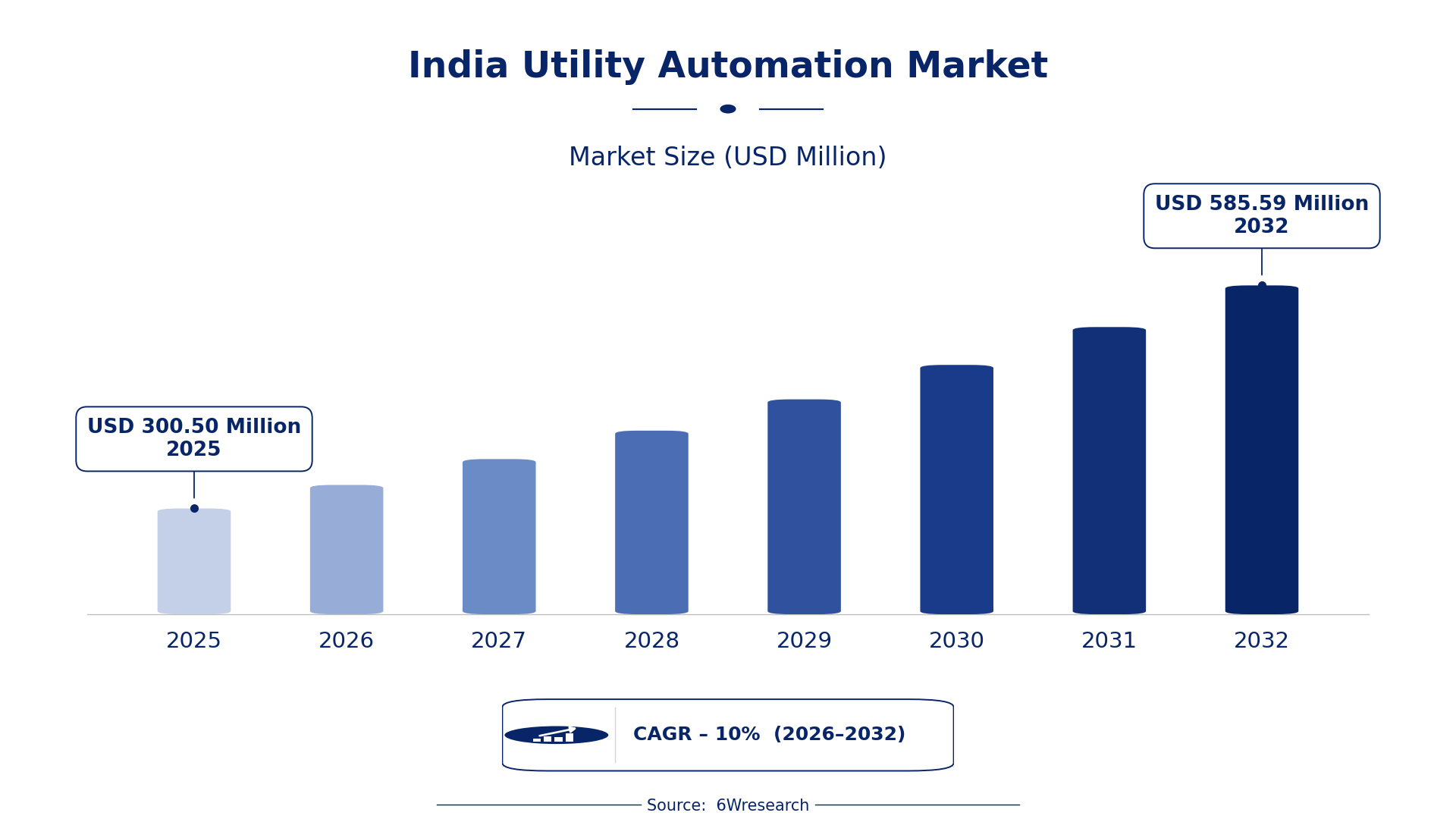
According to 6Wresearch internal database and industry insights, the India Utility Automation Market was valued at USD 300.5 million in 2025 and is projected to reach USD 585.59 million by 2032, growing at a CAGR of approximately 10% during 2026–2032.
India Utility Automation Market Highlights
| Report Metric | Details |
| Report Name | India Utility Automation Market |
| Market Size 2025 | USD 300.5 million |
| Market Size 2032 | USD 585.59 million |
| Absolute Growth 2025–2032 | USD 285.09 million |
| CAGR 2026–2032 | 10% |
| Peak Annual Growth | 12.2% in 2027 |
| Forecast Period | 2026–2032 |
| Historical Data | 2022–2025 |
| Base Year | 2025 |
| Leading Automation Segment, 2025 | Distribution Automation (33% share) |
| Leading Utility Area, 2025 | Electric Grids (44% share) |
| Leading Control System, 2025 | SCADA + DMS (55% share) |
| Leading End User, 2025 | Utility Companies (47% share) |
| Fastest-Growing Automation Segment | Meter Data Automation (11.2% CAGR) |
| Fastest-Growing Control System | IoT-Based Systems (12.1% CAGR) |
| Fastest-Growing End User | Grid Operators (11.4% CAGR) |
| Growing Sector | Utility Services |
| Key End Users | Utility Companies, Grid Operators, Municipal Authorities, Utility Contractors |
India Utility Automation Market Year-wise Growth Rate and Key Drivers (2022–2032)
This graph illustrates the annual growth rates of the market from 2022 to 2032, highlighting a steady upward trajectory and projected market expansion over the forecast period.
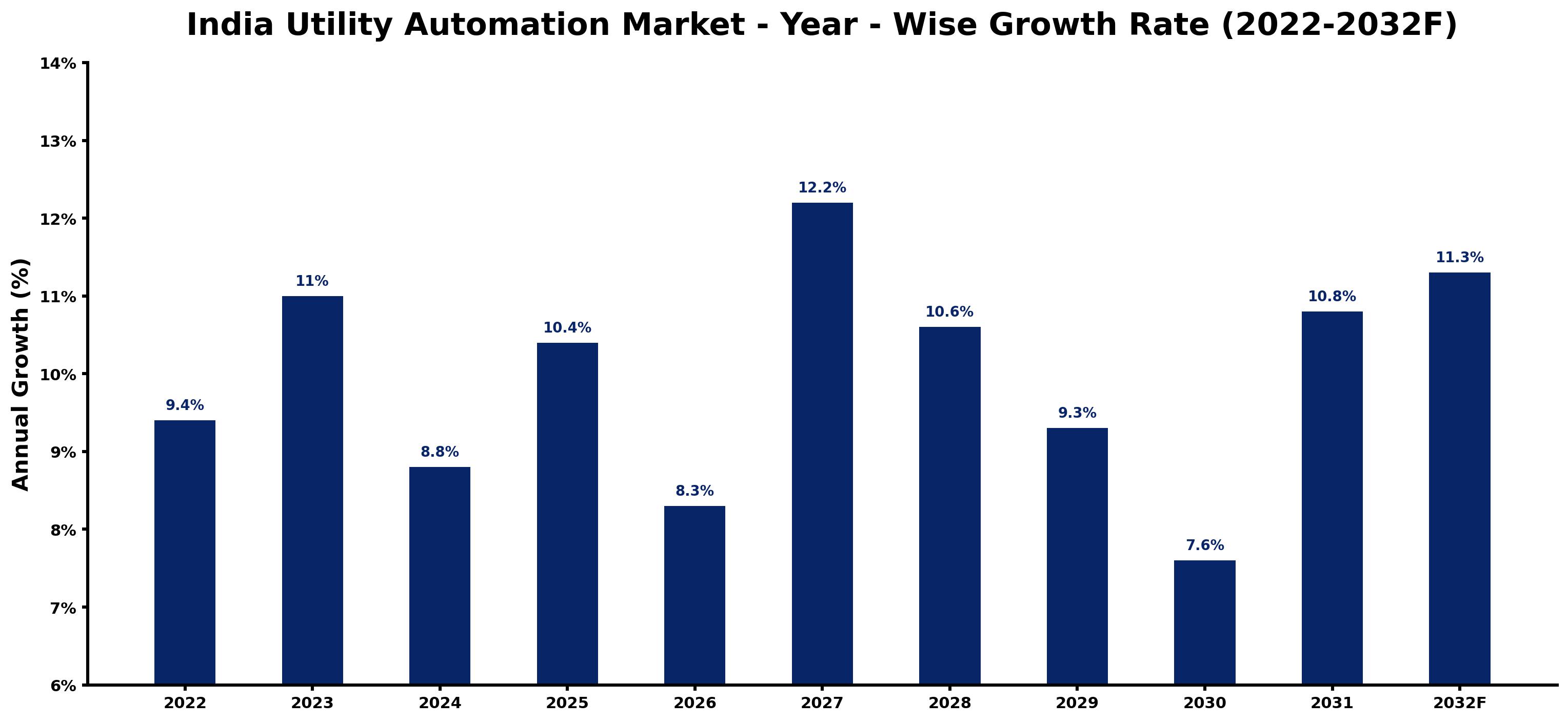
Annual growth estimates for each year appear below with the principal reason behind them, explaining the shifts that set the pace of the market.
| Year | Estimated Annual Growth (%) | Market Rationale |
| 2022 | 9.4 | The market experienced steady growth driven by the National Smart Grid Mission's objectives. |
| 2023 | 11.0 | Growth accelerated due to increased investments in smart grid technologies and infrastructure projects. |
| 2024 | 8.8 | A slowdown occurred as the Smart Meter National Programme faced delays in implementation due to regulatory compliance issues. |
| 2025 | 10.4 | Demand rebounded with new automation initiatives in urban utilities, particularly in smart metering. |
| 2026 | 8.3 | Growth slowed as market adjustments took place amid evolving standards from the Bureau of Energy Efficiency. |
| 2027 | 12.2 | A surge in demand was driven by the Smart Grid Mission's objectives to modernize electricity infrastructure. |
| 2028 | 10.6 | Growth decelerated slightly as the market adjusted after rapid expansion in automation technologies. |
| 2029 | 9.3 | The market continued to grow, supported by urban population increases and rising utility demands. |
| 2030 | 7.6 | A further slowdown was observed as the market adjusted to new norms in utility management. |
| 2031 | 10.8 | Demand increased again as utility companies adopted advanced solutions for service delivery. |
| 2032 | 11.3 | Growth continued as automation technologies became more integral to utility operations. |
Note: Market size estimations and growth projections presented in this report are based on 6Wresearch's proprietary forecasting methodology, utilizing the latest available industry data, government publications, and primary research inputs.
India Utility Automation Market Synopsis
Utility Automation in India includes technologies that enhance the efficiency of utility services such as electricity, water, and gas. This encompasses advanced software and hardware integration aimed at optimising grid management and improving meter reading accuracy. The India Utility Automation Market is growing, fuelled by substantial investments in smart grid technologies and ongoing infrastructure development projects. The Smart Grid Mission seeks to boost electric grid efficiency by 2025, further driving market expansion. With over 1,000 operational substations employing automation technologies, the demand for utility automation solutions is projected to increase significantly in the coming years.
Market Dynamics Impact Analysis (2026–2032)
| Factor | Type | Impact | Primary Segment Affected |
| Increased investment in smart grid technologies is driving demand for automation solutions. | Driver | High | Electric Grids |
| The implementation of the Smart Grid Mission enhances the efficiency of utility operations. | Driver | High | Distribution Automation |
| The growing urban population is creating higher demands for utility services. | Opportunity | High | Utility Companies |
| The push for renewable energy sources is increasing automation needs in utilities. | Opportunity | High | Electric Grids |
| Challenges in regulatory compliance can hinder the adoption of automation technologies. | Restraint | Medium | Meter Data Automation |
| Limited awareness about the benefits of automation may slow market growth. | Restraint | Medium | Substation Automation |
| The Utility Automation market in India faces significant regulatory hurdles. | Challenge | High | Utility Companies |
| Competition from traditional utility management practices poses a challenge. | Challenge | Medium | Distribution Automation |
Evaluation of Drivers in India Utility Automation Market (2026–2032)
The main growth drivers and the segments they affect most are set out below.
| Drivers | Primary Segment Affected | Why It Matters (Evidence) |
| Investments in smart grid technology are improving utility efficiency. | Electric Grids | The Indian government plans to invest $20 billion in smart grid technology by 2025, prompting utility companies to adopt automation. |
| The Smart Grid Mission aims to modernize electricity infrastructure. | Distribution Automation | This initiative will improve grid reliability and efficiency, leading to increased demand for automation solutions. |
| The urban population is projected to reach 600 million by 2031, raising utility demands. | Utility Companies | As urban areas expand, utility companies are investing in automation to meet rising service expectations. |
| The National Electric Mobility Mission Plan promotes electric vehicle infrastructure. | Electric Grids | This initiative drives the need for enhanced utility automation to manage increased electricity demand. |
| The Electricity Act of 2003 encourages automation adoption in utilities. | Meter Data Automation | This regulatory framework supports the implementation of advanced technologies for efficient utility management. |
The Utility Automation market in India is expanding as investments in smart grid technology and infrastructure development drive demand. The Smart Grid Mission aims to modernize electricity infrastructure, improving grid reliability and efficiency. Urban population growth, projected to reach 600 million by 2031, raises utility demands, leading companies to invest in automation solutions. The push for electric vehicle infrastructure necessitates advanced utility automation systems to manage increased electricity demand.
Evaluation of Restraints in India Utility Automation Market
Below mentioned are some major restraints and their influence on market dynamics.
| Market Restraint | Primary Segment Affected | Why It Matters (Evidence) |
| Regulatory compliance challenges can delay automation implementation. | Meter Data Automation | Utility companies face hurdles in meeting regulatory standards, which can slow the adoption of automation technologies. |
| Limited awareness about automation benefits may hinder market growth. | Substation Automation | Many utility companies are not fully aware of how automation can improve efficiency and reliability. |
| High initial investment costs can deter smaller utilities from adopting automation. | Distribution Automation | Smaller utility companies often lack the capital required for significant automation investments. |
| Inconsistent regulatory frameworks can create uncertainty for utility companies. | Electric Grids | Varying regulations across states can complicate the implementation of uniform automation solutions. |
| Resistance to change from traditional utility management practices can slow adoption. | Utility Companies | Established practices may prevent companies from embracing new automation technologies. |
India Utility Automation Market Challenges
The India Utility Automation market encounters high implementation costs, which impede producers from adopting necessary technologies. This challenge stems from the substantial investments required to upgrade existing infrastructure, resulting in delays in automation projects for utility companies. Buyers face inefficiencies in service delivery as competition among providers escalates, leading to inconsistent service quality. Furthermore, a shortage of skilled professionals in automation technologies complicates matters, forcing utilities to depend on outdated systems, which reduces operational efficiency and raises maintenance costs.
Trends in the India Utility Automation Market
Buyers and suppliers in the India Utility Automation Market are adjusting to the following trends.
- Shift from Traditional to Smart Metering: India is transitioning from traditional metering systems to smart metering solutions. The Indian Smart Meter National Programme aims to install 250 million smart meters by 2025, improving data accuracy and operational efficiency.
- Emergence of IoT-Based Utility Management: The adoption of IoT-based systems for utility management is on the rise. With a projected CAGR of 12.1% for IoT-Based Systems, utilities are using these technologies for real-time monitoring and management.
- Increased Focus on Renewable Energy Integration: The push for renewable energy sources is reshaping utility automation. The Ministry of Power's target of 175 GW of renewable energy by 2022 is driving automation needs in grid management.
- Growth in Field Force Automation Adoption: Field Force Automation tools are increasingly being adopted by utility contractors. Currently, 60% of utility contractors are using these tools to improve operational efficiency and service delivery.
Investment Opportunities in the India Utility Automation Market
Below are the investment opportunities with the strongest case in the India Utility Automation Market.
- Investment in Smart Grid Technologies: Investing in smart grid technologies presents a timely opportunity. With a projected $20 billion investment by 2025, utility companies can improve service delivery and operational efficiency.
- Supply of Advanced Metering Infrastructure: The demand for advanced metering infrastructure is growing rapidly. Utility companies across urban areas are seeking solutions to enhance meter reading accuracy and data management.
- Partnerships for Renewable Energy Projects: Forming partnerships for renewable energy projects is a strategic opportunity. The push for 175 GW of renewable energy by 2022 creates a need for automation in grid management.
- Expansion of IoT-Based Solutions: Expanding IoT-based solutions for utility management is essential now. As utilities seek real-time monitoring, suppliers can provide innovative IoT technologies to meet this demand.
Government Initiatives in the India Utility Automation Market
The Electricity (Amendment) Bill, proposed in 2020, aims to strengthen the regulatory framework for utility automation, facilitating the implementation of advanced technologies by utilities. The Smart Grid Mission, initiated by the Ministry of Power in 2015, has a budget of $4 billion to modernise India's electricity infrastructure, encouraging utility companies to adopt automation technologies. This initiative is expected to improve grid efficiency and reliability, aiding the integration of smart technologies in utility operations.
The Bureau of Energy Efficiency promotes standards for energy-efficient utilities, ensuring compliance and encouraging the adoption of automation technologies. The Ministry of Power oversees the Smart Grid Mission, approving projects that enhance grid efficiency. These agencies play a crucial role in funding and approving initiatives that propel utility automation across the country, enabling producers to implement advanced solutions and improve service delivery.
Future Insight of the India Utility Automation Market
The India Utility Automation market will develop by 2032, propelled by the Smart Grid Mission and the Indian Smart Meter National Programme. These initiatives are set to enable the installation of 250 million smart meters, improving service reliability across the country. Government investments of $20 billion in smart grid technology will further accelerate automation adoption. As urban populations grow, reaching 600 million by 2031, the demand for efficient utility services will drive suppliers to innovate and integrate advanced technologies into their operations.
Market Segmentation Analysis
The report offers a comprehensive study of the following market segments and their leading categories in the market.
By Automation Segment – Distribution Automation Dominated, Meter Data Automation Expected to Grow Fastest
According to Bhawna Singh, Assistant Manager at 6Wresearch, the largest automation segment category in 2025 was Distribution Automation, with a 33% share of total revenue. Distribution Automation captures the largest market share as it directly improves the reliability and efficiency of electricity distribution across India. With over 1,000 operational substations employing these technologies, it has become indispensable for utility operations. Meter Data Automation is projected to grow fastest, at a CAGR of 11.2% during 2026–2032. Meter Data Automation is witnessing rapid growth driven by its implementation in over 100 cities, highlighting the demand for accurate meter reading and data processing. This segment's expansion is expected to continue as utilities aim to optimise their operations. Suppliers should focus on enhancing Meter Data Automation solutions to meet the increasing demand from utilities.
By Utility Area – Electric Grids Dominated and Is Expected to Record the Fastest Growth
Electric Grids took a 44% share of utility area in 2025, more than any other category. Electric Grids dominate the market share because they are essential for managing and optimising electric grid operations, which are critical to utility services in India. The total installed capacity of electric grids stands at approximately 400 GW, highlighting their importance. Electric Grids are also forecast to expand faster than any other category, at a CAGR of 12.0% over 2026–2032. Electric Grids are also the fastest-growing segment, as ongoing infrastructure development and the government's push for renewable energy are driving automation needs. This dual role reinforces the segment's position and ensures sustained growth. Buyers must invest in advanced technologies for Electric Grids to keep pace with the evolving demands of the utility sector.
By Control System – SCADA + DMS Dominated, IoT-Based Systems Expected to Grow Fastest
SCADA + DMS accounted for a 55% market share by control system in 2025. SCADA + DMS leads in market share due to its crucial role in real-time monitoring and control of utility operations, which is essential for maintaining service reliability. Its widespread use among major utility companies underscores its importance in the sector. The quickest growth will come from IoT-Based Systems, forecast to expand at a CAGR of 12.1% between 2026 and 2032. IoT-Based Systems are experiencing swift growth as they enable smart monitoring and management of utilities, addressing the rising demand for efficiency and data integration. This trend indicates a shift towards more interconnected utility operations. Suppliers should prioritise the development of IoT-Based Systems to leverage the growing interest in advanced utility management solutions.
By End User – Utility Companies Dominated, Grid Operators Expected to Grow Fastest
Utility Companies held a 47% share of the India Utility Automation Market by end user in 2025. Utility Companies hold the largest market share as they implement automation to enhance service delivery and operational efficiency across their networks. Their significant investments in technology highlight their critical role in the utility automation market. Grid Operators are set to record the highest CAGR in this split, 11.4% over 2026–2032. Grid Operators are the fastest-growing end user segment, relying on automation for effective grid management amidst increasing urban populations and electricity demands. This trend suggests that their operational needs will drive further advancements in automation technologies. Suppliers should tailor their offerings to meet the specific requirements of Grid Operators as they seek to improve their management practices.
Key Attractiveness of the Report
- 10 Years of Market Numbers
- Historical Data Starting from 2022 to 2025
- Base Year 2025
- Forecast Data until 2032
- Key Performance Indicators Impacting the Market
- Major Upcoming Developments and Projects
Key Highlights of the Report:
- India Utility Automation Market Outlook
- Market Size of India Utility Automation Market, 2025
- Forecast of India Utility Automation Market, 2032
- Historical Data and Forecast of India Utility Automation Revenues & Volume for the Period 2022 - 2032F
- India Utility Automation Market Trend Evolution
- India Utility Automation Market Drivers and Challenges
- India Utility Automation Price Trends
- India Utility Automation Porter's Five Forces
- India Utility Automation Industry Life Cycle
- Historical Data and Forecast of India Utility Automation Market Revenues & Volume By Automation Segment for the Period 2022 - 2032F
- Historical Data and Forecast of India Utility Automation Market Revenues & Volume By Distribution Automation for the Period 2022 - 2032F
- Historical Data and Forecast of India Utility Automation Market Revenues & Volume By Substation Automation for the Period 2022 - 2032F
- Historical Data and Forecast of India Utility Automation Market Revenues & Volume By Meter Data Automation for the Period 2022 - 2032F
- Historical Data and Forecast of India Utility Automation Market Revenues & Volume By Field Force Automation for the Period 2022 - 2032F
- Historical Data and Forecast of India Utility Automation Market Revenues & Volume By Utility Area for the Period 2022 - 2032F
- Historical Data and Forecast of India Utility Automation Market Revenues & Volume By Electric Grids for the Period 2022 - 2032F
- Historical Data and Forecast of India Utility Automation Market Revenues & Volume By Power Transmission for the Period 2022 - 2032F
- Historical Data and Forecast of India Utility Automation Market Revenues & Volume By Gas/Water Meters for the Period 2022 - 2032F
- Historical Data and Forecast of India Utility Automation Market Revenues & Volume By Inspection & Repair for the Period 2022 - 2032F
- Historical Data and Forecast of India Utility Automation Market Revenues & Volume By Control System for the Period 2022 - 2032F
- Historical Data and Forecast of India Utility Automation Market Revenues & Volume By SCADA + DMS for the Period 2022 - 2032F
- Historical Data and Forecast of India Utility Automation Market Revenues & Volume By PLC/RTU/IED Integration for the Period 2022 - 2032F
- Historical Data and Forecast of India Utility Automation Market Revenues & Volume By IoT-Based Systems for the Period 2022 - 2032F
- Historical Data and Forecast of India Utility Automation Market Revenues & Volume By Mobile + GPS for the Period 2022 - 2032F
- Historical Data and Forecast of India Utility Automation Market Revenues & Volume By End User for the Period 2022 - 2032F
- Historical Data and Forecast of India Utility Automation Market Revenues & Volume By Grid Operators for the Period 2022 - 2032F
- Historical Data and Forecast of India Utility Automation Market Revenues & Volume By Utility Companies for the Period 2022 - 2032F
- Historical Data and Forecast of India Utility Automation Market Revenues & Volume By Municipal Authorities for the Period 2022 - 2032F
- Historical Data and Forecast of India Utility Automation Market Revenues & Volume By Utility Contractors for the Period 2022 - 2032F
- India Utility Automation Import Export Trade Statistics
- Market Opportunity Assessment By Automation Segment
- Market Opportunity Assessment By Utility Area
- Market Opportunity Assessment By Control System
- Market Opportunity Assessment By End User
- India Utility Automation Top Companies Market Share
- India Utility Automation Competitive Benchmarking By Technical and Operational Parameters
- India Utility Automation Company Profiles
- India Utility Automation Key Strategic Recommendations
Market Covered
The report offers an extensive study of the following market segments.
By Automation Segment
- Distribution Automation
- Substation Automation
- Meter Data Automation
- Field Force Automation
By Utility Area
- Electric Grids
- Power Transmission
- Gas/Water Meters
- Inspection & Repair
By Control System
- SCADA + DMS
- PLC/RTU/IED Integration
- IoT-Based Systems
- Mobile + GPS
By End User
- Grid Operators
- Utility Companies
- Municipal Authorities
- Utility Contractors































