China Utility Automation Market Size & Growth Rate
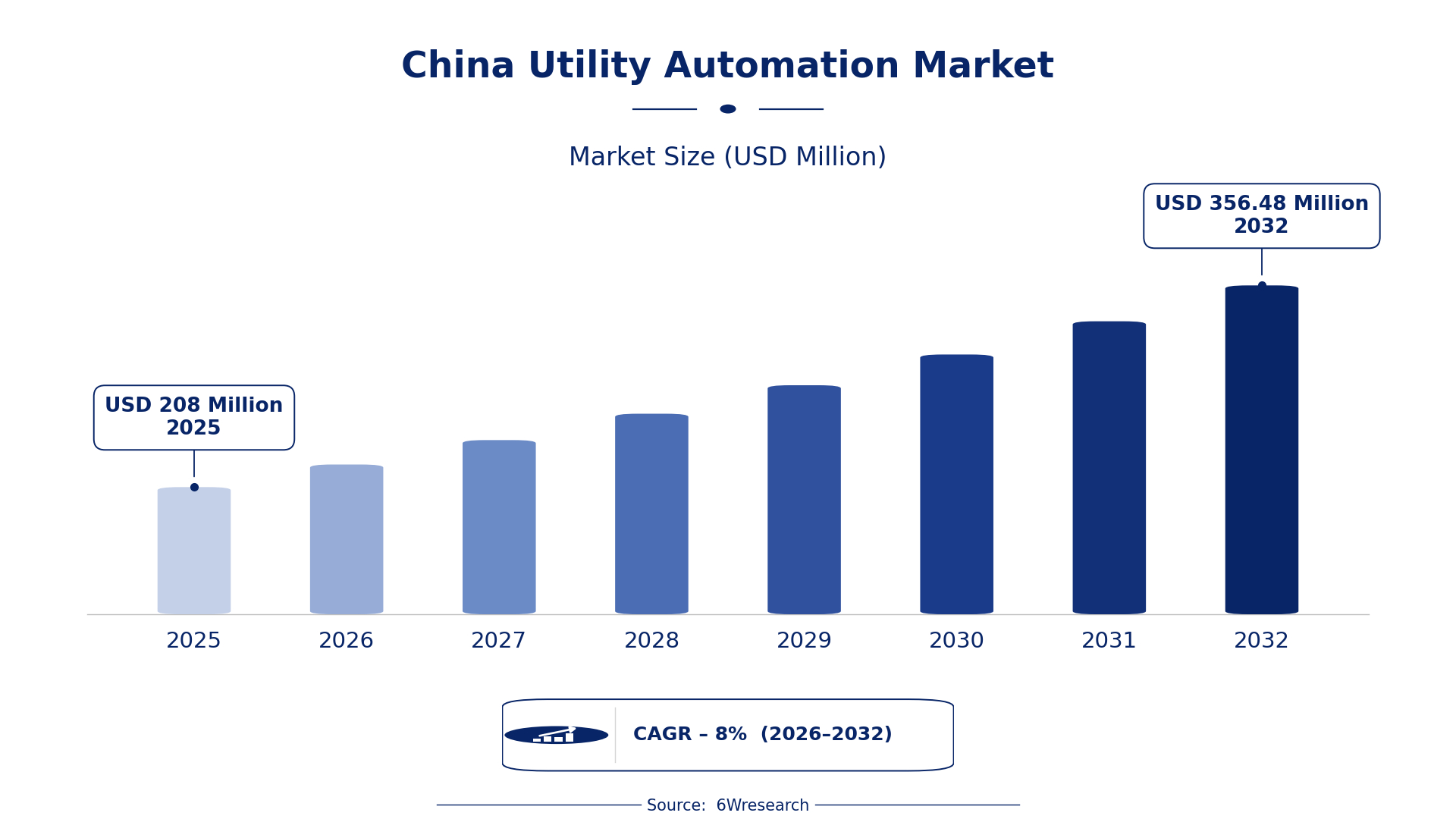
According to 6Wresearch internal database and industry insights, the China Utility Automation Market was valued at USD 208.0 million in 2025 and is projected to reach USD 356.48 million by 2032, growing at a CAGR of approximately 8% during 2026–2032.
China Utility Automation Market Highlights
| Report Metric | Details |
| Report Name | China Utility Automation Market |
| Market Size 2025 | USD 208.0 million |
| Market Size 2032 | USD 356.48 million |
| Absolute Growth 2025–2032 | USD 148.48 million |
| CAGR 2026–2032 | 8% |
| Peak Annual Growth | 10.5% in 2027 |
| Forecast Period | 2026–2032 |
| Historical Data | 2022–2025 |
| Base Year | 2025 |
| Leading Automation Segment, 2025 | Distribution Automation (44% share) |
| Leading Utility Area, 2025 | Electric Grids (47% share) |
| Leading Control System, 2025 | SCADA + DMS (38% share) |
| Leading End User, 2025 | Utility Companies (39% share) |
| Fastest-Growing Automation Segment | Meter Data Automation (10.5% CAGR) |
| Fastest-Growing Utility Area | Gas/Water Meters (9.1% CAGR) |
| Fastest-Growing Control System | IoT-Based Systems (9.3% CAGR) |
| Fastest-Growing End User | Utility Contractors (9.5% CAGR) |
| Growing Sector | Utility Contractors |
| Key End Users | Utility Companies, Grid Operators, Municipal Authorities, Utility Contractors |
China Utility Automation Market Year-wise Growth Rate and Key Drivers (2022–2032)
This graph illustrates the annual growth rates of the market from 2022 to 2032, highlighting a steady upward trajectory and projected market expansion over the forecast period.
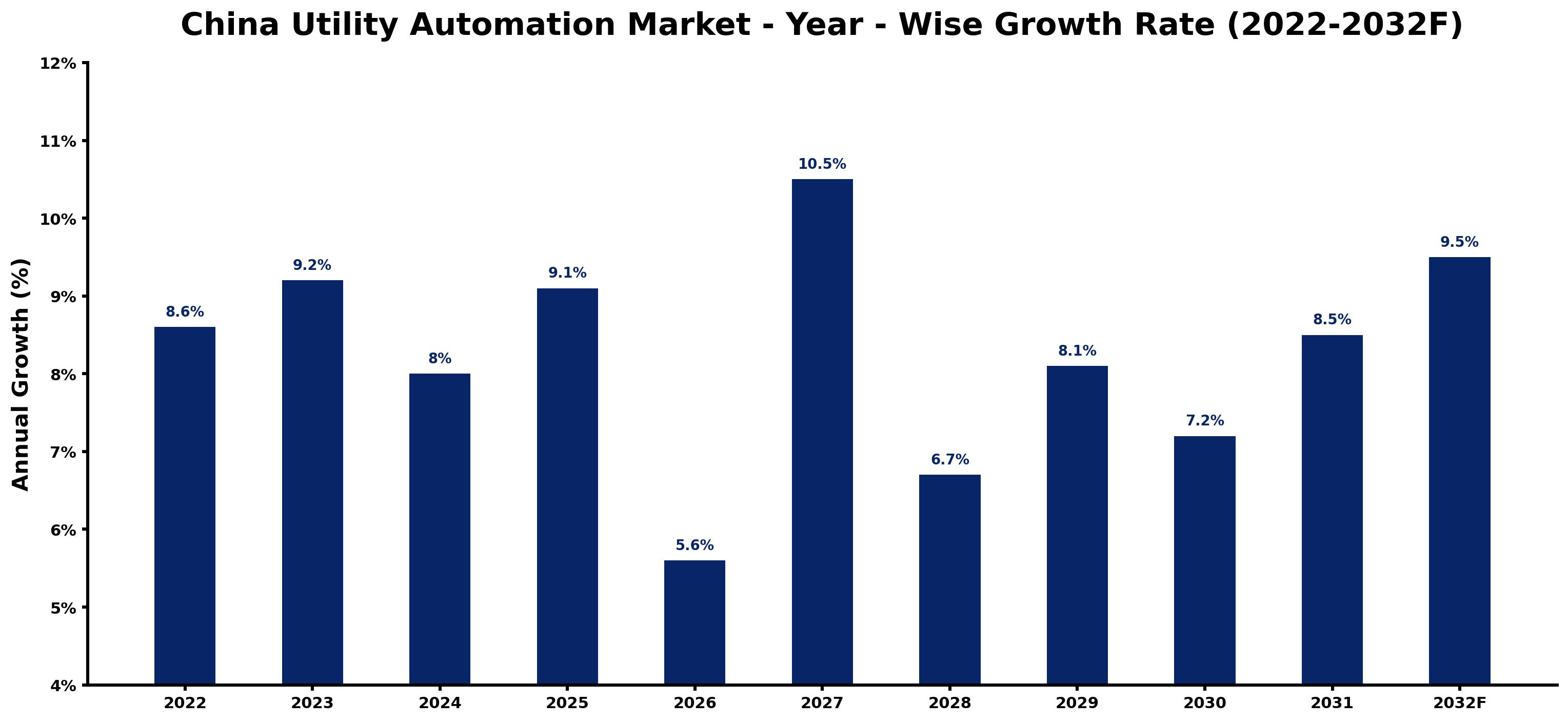
Below, each year's estimated growth is shown next to the factor that most influenced it.
| Year | Estimated Annual Growth (%) | Market Rationale |
| 2022 | 8.6 | The market experienced solid demand from utility companies and municipal authorities, driven by ongoing investments in smart grid technologies. |
| 2023 | 9.2 | Increased investments in smart grid technologies drove faster growth than the previous year, particularly under the Smart Grid Development Plan. |
| 2024 | 8.0 | A slight slowdown occurred as utility companies adjusted to recent technology implementations, including the integration of smart meters. |
| 2025 | 9.1 | Demand for smart meters surged, reflecting growing utility automation needs, with expectations of 300 million units needed by 2025. |
| 2026 | 5.6 | Growth is expected to slow as companies face challenges in integrating new systems and technologies, particularly in urban areas. |
| 2027 | 10.5 | A peak in growth is expected due to heightened investments in automation technologies, supported by government funding initiatives. |
| 2028 | 6.7 | The market will see a slowdown as companies consolidate their automation strategies, focusing on efficiency and cost reduction. |
| 2029 | 8.1 | Increased demand for efficient utility services will drive growth faster than before, particularly in populous regions like Guangdong. |
| 2030 | 7.2 | Growth will slow as the market matures and companies focus on optimization, especially in the Electric Grids sector. |
| 2031 | 8.5 | A resurgence in demand from utility companies will lead to faster growth again, particularly in the Meter Data Automation segment. |
| 2032 | 9.5 | Continued investments in smart grid initiatives will sustain positive growth, particularly in urban areas where utility needs are rising. |
Note: Market size estimations and growth projections presented in this report are based on 6Wresearch's proprietary forecasting methodology, utilizing the latest available industry data, government publications, and primary research inputs.
China Utility Automation Market Synopsis
Utility Automation in China covers technologies that improve the efficiency of utility services, including electricity, water, and gas. The market was valued at approximately $5 billion in 2022, driven by strong demand from domestic utility companies and municipal authorities. Investments in smart grid technologies and initiatives under the Smart Grid Development Plan are key growth factors. With a population exceeding 1.4 billion, the need for reliable utility services continues to rise, further propelling market expansion. The ongoing integration of advanced systems enhances operational efficiency across the sector.
Market Dynamics Impact Analysis (2026–2032)
| Factor | Type | Impact | Primary Segment Affected |
| Increased investment in smart grid technologies is driving demand for automation solutions. | Driver | High | Distribution Automation |
| Growing adoption of smart meters among utility companies enhances operational efficiency. | Driver | High | Meter Data Automation |
| Utility companies are seeking advanced automation solutions to meet rising demand. | Opportunity | High | Utility Companies |
| The integration of IoT-based systems in utilities presents new investment avenues. | Opportunity | Medium | IoT-Based Systems |
| Integration challenges with existing systems can hinder market growth. | Restraint | High | Substation Automation |
| High initial investment costs for automation technologies may deter smaller utilities. | Restraint | Medium | Field Force Automation |
| The Utility Automation market in China faces regulatory compliance challenges. | Challenge | High | Electric Grids |
| Competition from traditional utility management methods poses a significant challenge. | Challenge | Medium | Power Transmission |
Evaluation of Drivers in China Utility Automation Market (2026–2032)
Key forces behind demand, with the segment each one moves most, are listed below.
| Drivers | Primary Segment Affected | Why It Matters (Evidence) |
| Increased investment in smart grid technologies | Utility Companies | This investment enhances operational efficiency and reliability, with the National Development and Reform Commission supporting smart grid initiatives. |
| Rising demand for smart meters | Meter Data Automation | The anticipated demand for 300 million smart meters by 2025 drives automation capabilities among utility providers. |
| Focus on operational efficiency | Distribution Automation | Utility companies are adopting automation solutions to improve grid reliability, supported by the Smart Grid Development Plan. |
| Government funding for renewable energy integration | Electric Grids | The government allocated $200 million for projects that enhance integration, prompting utilities to invest in automation technologies. |
| Adoption of advanced technologies | Substation Automation | The need for remote monitoring and control drives utilities to implement automation solutions, ensuring efficient service delivery. |
Growth in the Utility Automation market in China comes from increased investment in smart grid technologies, rising demand for smart meters, and a focus on operational efficiency. By 2025, the demand for smart meters will reach 300 million units, leading to improved automation capabilities among utilities. The National Development and Reform Commission's support for smart grid investments drives further demand for automation technologies. With a population exceeding 1.4 billion, the need for efficient utility management continues to rise, driving market growth.
Evaluation of Restraints in China Utility Automation Market
The following restraints limit how fast demand can grow.
| Market Restraint | Primary Segment Affected | Why It Matters (Evidence) |
| High technology integration costs | Utility Companies | Producers face costs reaching $5 billion this year, delaying project implementations for utility providers. |
| Increased competition among suppliers | Meter Data Automation | Pricing pressures force buyers to negotiate lower costs, which may lead to suboptimal technology choices. |
| Dependable supply chain challenges | Distribution Automation | The projected demand for smart meters strains resources, extending procurement timelines for utility companies. |
| Complex regulatory compliance | Substation Automation | Utilities must navigate multiple regulations, increasing operational costs and delaying technology adoption. |
| Limited skilled workforce | Field Force Automation | A shortage of skilled professionals hampers the implementation of advanced automation technologies in utility operations. |
China Utility Automation Market Challenges
Utility automation in China confronts high technology integration costs, which can reach $5 billion this year for producers. This financial burden arises from the need for advanced software and hardware systems, causing delays in project implementations for utility companies. Increased competition among suppliers drives pricing pressures, forcing buyers to negotiate lower costs that may lead to suboptimal technology choices. Additionally, buyers face challenges in securing dependable supply chains, as the demand for smart meters is projected to hit 300 million units by 2025, straining resources and extending procurement timelines.
Trends in the China Utility Automation Market
Several trends are reshaping the China Utility Automation Market; the most important are set out below.
- Shift from Traditional to Smart Grids: Since 2021, utility companies have been transitioning to smart grid technologies, improving operational efficiency. The National Energy Administration's Smart Grid Development Plan promotes this shift, aiming for a 30% increase in smart grid deployment by 2025.
- Emergence of IoT-Based Systems: In 2022, utilities began adopting IoT-based systems for real-time monitoring. This trend is illustrated by the Guangdong province, where IoT integration is expected to improve data accuracy by 25%.
- Prioritisation of Renewable Energy Integration: In 2023, the emphasis on renewable energy integration intensified, with the government allocating $200 million for related projects. This funding assists utility companies in enhancing their automation capabilities.
- Transition to Advanced Meter Data Automation: Starting in 2025, meter data automation is gaining traction among utility companies. The demand for 300 million smart meters is driving this trend, which will improve billing accuracy and resource management.
Investment Opportunities in the China Utility Automation Market
The following opportunities in the China Utility Automation Market pair current demand with a clear way in.
- Utility Companies seeking automation solutions: With the demand for smart meters projected to reach 300 million units by 2025, utility companies require advanced automation technologies. Investing in smart grid solutions will enable suppliers to meet this growing demand.
- Municipal Authorities focusing on smart utilities: In 2023, urban utility automation capabilities are set to improve significantly, driven by government programs. Suppliers can enter this market by forming partnerships with local authorities.
- Electric Grids investing in distribution automation: The Guangdong province is implementing advanced distribution automation systems, creating a $208 million market opportunity. Suppliers can collaborate with local utilities to enhance service delivery.
- Field Force Automation for Utility Contractors: With a projected 9.5% CAGR for utility contractors, there is a growing need for field force automation solutions. Suppliers can engage with contractors to provide tailored automation technologies.
Government Initiatives in the China Utility Automation Market
In 2021, the National Energy Administration launched the 'Smart Grid Development Plan (2021-2025)' to promote utility automation technologies. This plan builds on previous regulations by providing a structured approach to integrating smart grid solutions across the country. It aims to improve the efficiency and reliability of utility services by encouraging investments in advanced technologies and infrastructure. The plan sets specific targets for smart grid deployment, ensuring that utility companies can access the necessary resources to modernise their operations.
The Ministry of Industry and Information Technology oversees the implementation of the 'Digital Economy Development Plan', which funds initiatives aimed at modernising utility services. This plan supports the development of smart utilities and automation technologies, ensuring that utility companies receive the necessary resources and approvals to adopt innovative solutions. In 2023, the ministry allocated funding to facilitate the integration of smart technologies in urban utilities, enhancing operational efficiency.
Future Insight of the China Utility Automation Market
Several forward-looking factors should support the utility automation market in China over the coming years. The government's endorsement of smart grid initiatives under the 13th Five-Year Plan will catalyse technological progress. The Ministry of Housing and Urban-Rural Development's new program will enhance urban utility automation capabilities. By 2025, the anticipated demand for smart meters will necessitate substantial upgrades in infrastructure, enabling suppliers to better address the growing utility needs.
Market Segmentation Analysis
The report offers a comprehensive study of the following market segments and their leading categories in the market.
By Automation Segment – Distribution Automation Dominated, Meter Data Automation Expected to Grow Fastest
According to Bhawna Singh, Assistant Manager at 6Wresearch, Distribution Automation accounted for a 44% market share by automation segment in 2025. Distribution Automation commands the largest share due to its essential role in enhancing grid reliability and efficiency, particularly for utility companies in China. The extensive implementation of these systems in Jiangsu province illustrates their significance in operational performance. Meter Data Automation is projected to grow fastest, at a CAGR of 10.5% during 2026–2032. Meter Data Automation is experiencing rapid growth driven by the urgent need for accurate billing and resource management, with a projected demand for 300 million smart meters by 2025. As Distribution Automation continues to lead, its growth will further solidify its market position. Suppliers should focus on developing advanced Meter Data Automation solutions to capture the expanding market share.
By Utility Area – Electric Grids Dominated, Gas/Water Meters Expected to Grow Fastest
Electric Grids held a 47% share of the China Utility Automation Market by utility area in 2025. Electric Grids hold the leading share as they are fundamental to the management and distribution of electricity throughout China. Continuous investments in smart grid technologies further solidify their dominant market position. Over 2026–2032, Gas/Water Meters are expected to post the fastest growth, at a CAGR of 9.1%. Gas/Water Meters are growing rapidly, propelled by the critical need for accurate measurement and billing of utilities. Government initiatives aimed at enhancing urban utility services are accelerating this segment's growth. Buyers should prioritise acquiring advanced metering solutions to align with the market's growth trajectory.
By Control System – SCADA + DMS Dominated, IoT-Based Systems Expected to Grow Fastest
With a 38% revenue share in 2025, SCADA + DMS was the largest control system category. SCADA + DMS systems are the preferred choice for utility providers, acting as the backbone for real-time monitoring and control of utility operations. Their widespread use is vital for ensuring effective management across the sector. The quickest growth will come from IoT-Based Systems, forecast to expand at a CAGR of 9.3% between 2026 and 2032. IoT-Based Systems are gaining momentum as they enable smart monitoring and data collection, which are increasingly important for modern utilities. This trend suggests that integrating IoT technologies will significantly improve operational efficiency. Suppliers must enhance their offerings in IoT technologies to meet the rising demand for smart utility solutions.
By End User – Utility Companies Dominated, Utility Contractors Expected to Grow Fastest
In 2025, Utility Companies led the end user split with a 39% share. Utility Companies are the primary users of automation technologies, relying on them for effective service delivery and operational efficiency. Their substantial market share highlights their crucial role in the utility automation sector. Utility Contractors are set to record the highest CAGR in this split, 9.5% over 2026–2032. Utility Contractors are experiencing the fastest growth as they increasingly adopt automation for project execution and management. This trend is driven by the need for improved efficiency and cost-effectiveness in utility projects. Suppliers should tailor their products to meet the specific needs of Utility Contractors to capitalise on this growth opportunity.
Key Attractiveness of the Report
- 10 Years of Market Numbers
- Historical Data Starting from 2022 to 2025
- Base Year 2025
- Forecast Data until 2032
- Key Performance Indicators Impacting the Market
- Major Upcoming Developments and Projects
Key Highlights of the Report:
- China Utility Automation Market Outlook
- Market Size of China Utility Automation Market, 2025
- Forecast of China Utility Automation Market, 2032
- Historical Data and Forecast of China Utility Automation Revenues & Volume for the Period 2022 - 2032F
- China Utility Automation Market Trend Evolution
- China Utility Automation Market Drivers and Challenges
- China Utility Automation Price Trends
- China Utility Automation Porter's Five Forces
- China Utility Automation Industry Life Cycle
- Historical Data and Forecast of China Utility Automation Market Revenues & Volume By Automation Segment for the Period 2022 - 2032F
- Historical Data and Forecast of China Utility Automation Market Revenues & Volume By Distribution Automation for the Period 2022 - 2032F
- Historical Data and Forecast of China Utility Automation Market Revenues & Volume By Substation Automation for the Period 2022 - 2032F
- Historical Data and Forecast of China Utility Automation Market Revenues & Volume By Meter Data Automation for the Period 2022 - 2032F
- Historical Data and Forecast of China Utility Automation Market Revenues & Volume By Field Force Automation for the Period 2022 - 2032F
- Historical Data and Forecast of China Utility Automation Market Revenues & Volume By Utility Area for the Period 2022 - 2032F
- Historical Data and Forecast of China Utility Automation Market Revenues & Volume By Electric Grids for the Period 2022 - 2032F
- Historical Data and Forecast of China Utility Automation Market Revenues & Volume By Power Transmission for the Period 2022 - 2032F
- Historical Data and Forecast of China Utility Automation Market Revenues & Volume By Gas/Water Meters for the Period 2022 - 2032F
- Historical Data and Forecast of China Utility Automation Market Revenues & Volume By Inspection & Repair for the Period 2022 - 2032F
- Historical Data and Forecast of China Utility Automation Market Revenues & Volume By Control System for the Period 2022 - 2032F
- Historical Data and Forecast of China Utility Automation Market Revenues & Volume By SCADA + DMS for the Period 2022 - 2032F
- Historical Data and Forecast of China Utility Automation Market Revenues & Volume By PLC/RTU/IED Integration for the Period 2022 - 2032F
- Historical Data and Forecast of China Utility Automation Market Revenues & Volume By IoT-Based Systems for the Period 2022 - 2032F
- Historical Data and Forecast of China Utility Automation Market Revenues & Volume By Mobile + GPS for the Period 2022 - 2032F
- Historical Data and Forecast of China Utility Automation Market Revenues & Volume By End User for the Period 2022 - 2032F
- Historical Data and Forecast of China Utility Automation Market Revenues & Volume By Grid Operators for the Period 2022 - 2032F
- Historical Data and Forecast of China Utility Automation Market Revenues & Volume By Utility Companies for the Period 2022 - 2032F
- Historical Data and Forecast of China Utility Automation Market Revenues & Volume By Municipal Authorities for the Period 2022 - 2032F
- Historical Data and Forecast of China Utility Automation Market Revenues & Volume By Utility Contractors for the Period 2022 - 2032F
- China Utility Automation Import Export Trade Statistics
- Market Opportunity Assessment By Automation Segment
- Market Opportunity Assessment By Utility Area
- Market Opportunity Assessment By Control System
- Market Opportunity Assessment By End User
- China Utility Automation Top Companies Market Share
- China Utility Automation Competitive Benchmarking By Technical and Operational Parameters
- China Utility Automation Company Profiles
- China Utility Automation Key Strategic Recommendations
Market Covered
This report examines the market across the segments below.
By Automation Segment
- Distribution Automation
- Substation Automation
- Meter Data Automation
- Field Force Automation
By Utility Area
- Electric Grids
- Power Transmission
- Gas/Water Meters
- Inspection & Repair
By Control System
- SCADA + DMS
- PLC/RTU/IED Integration
- IoT-Based Systems
- Mobile + GPS
By End User
- Grid Operators
- Utility Companies
- Municipal Authorities
- Utility Contractors































