India Variable Air Volume (VAV) Market Size & Growth Rate
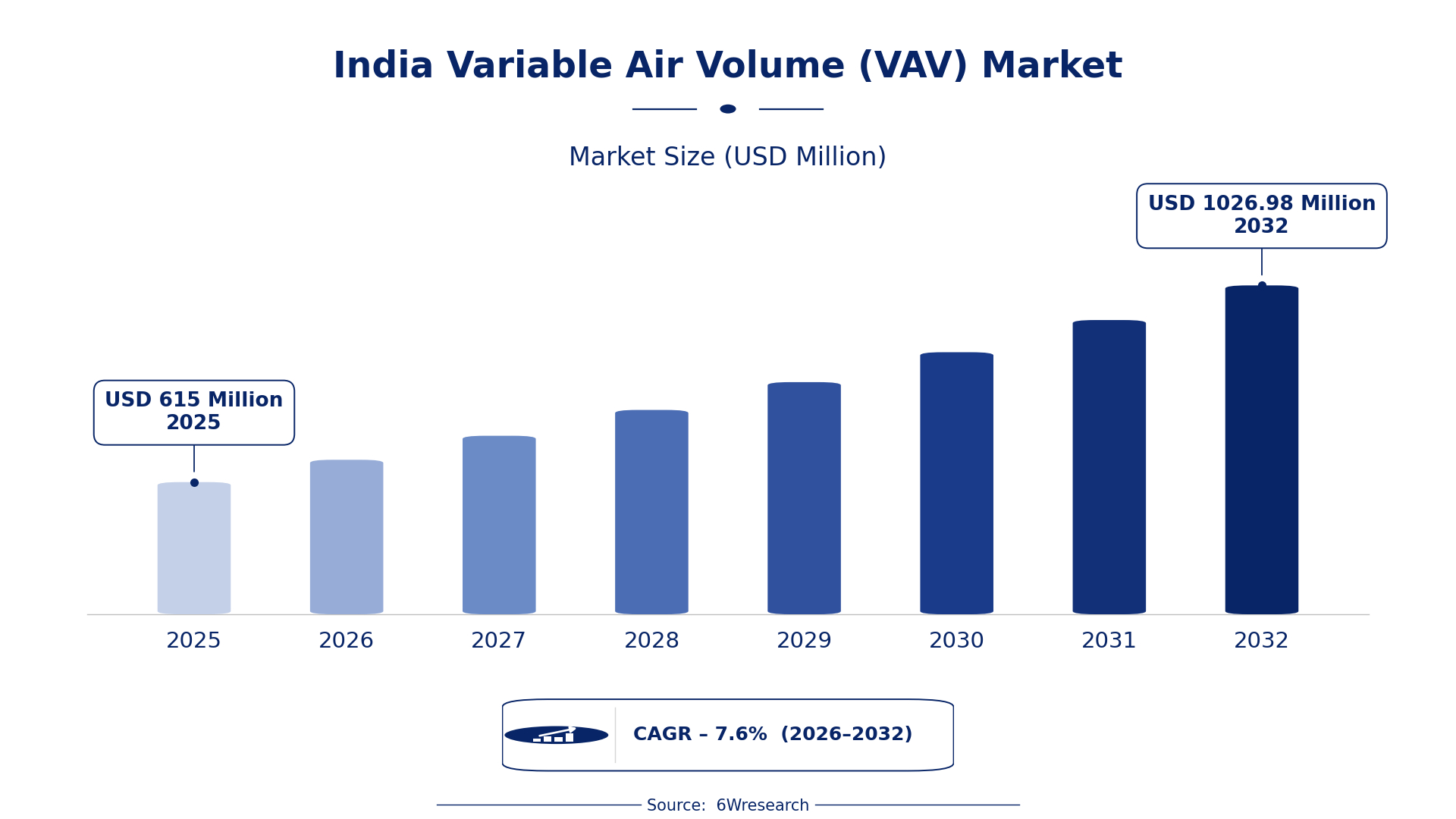
According to 6Wresearch internal database and industry insights, the India Variable Air Volume (VAV) Market was valued at USD 615.0 million in 2025 and is projected to reach USD 1,026.98 million by 2032, growing at a CAGR of approximately 7.6% during 2026–2032.
India Variable Air Volume (VAV) Market Highlights
| Report Metric | Details |
| Report Name | India Variable Air Volume (VAV) Market |
| Market Size 2025 | USD 615.0 million |
| Market Size 2032 | USD 1,026.98 million |
| Absolute Growth 2025–2032 | USD 411.98 million |
| CAGR 2026–2032 | 7.6% |
| Peak Annual Growth | 10.0% in 2026 |
| Forecast Period | 2026–2032 |
| Historical Data | 2022–2025 |
| Base Year | 2025 |
| Leading Box Type, 2025 | Single Duct VAV (48% share) |
| Leading Control Type, 2025 | Analog/Digital (42% share) |
| Leading Application Area, 2025 | Commercial Buildings (45% share) |
| Leading End User, 2025 | HVAC Contractors (40% share) |
| Fastest-Growing Box Type | Fan-Powered VAV (8.8% CAGR) |
| Fastest-Growing Control Type | Programmable (9.9% CAGR) |
| Fastest-Growing Application Area | Hospitals (9.6% CAGR) |
| Growing Sector | Commercial Buildings |
| Key End Users | HVAC Contractors, Mechanical Engineers, Facility Managers, Energy Consultants |
India Variable Air Volume (VAV) Market Year-wise Growth Rate and Key Drivers (2022–2032)
This graph illustrates the annual growth rates of the market from 2022 to 2032, highlighting a steady upward trajectory and projected market expansion over the forecast period.
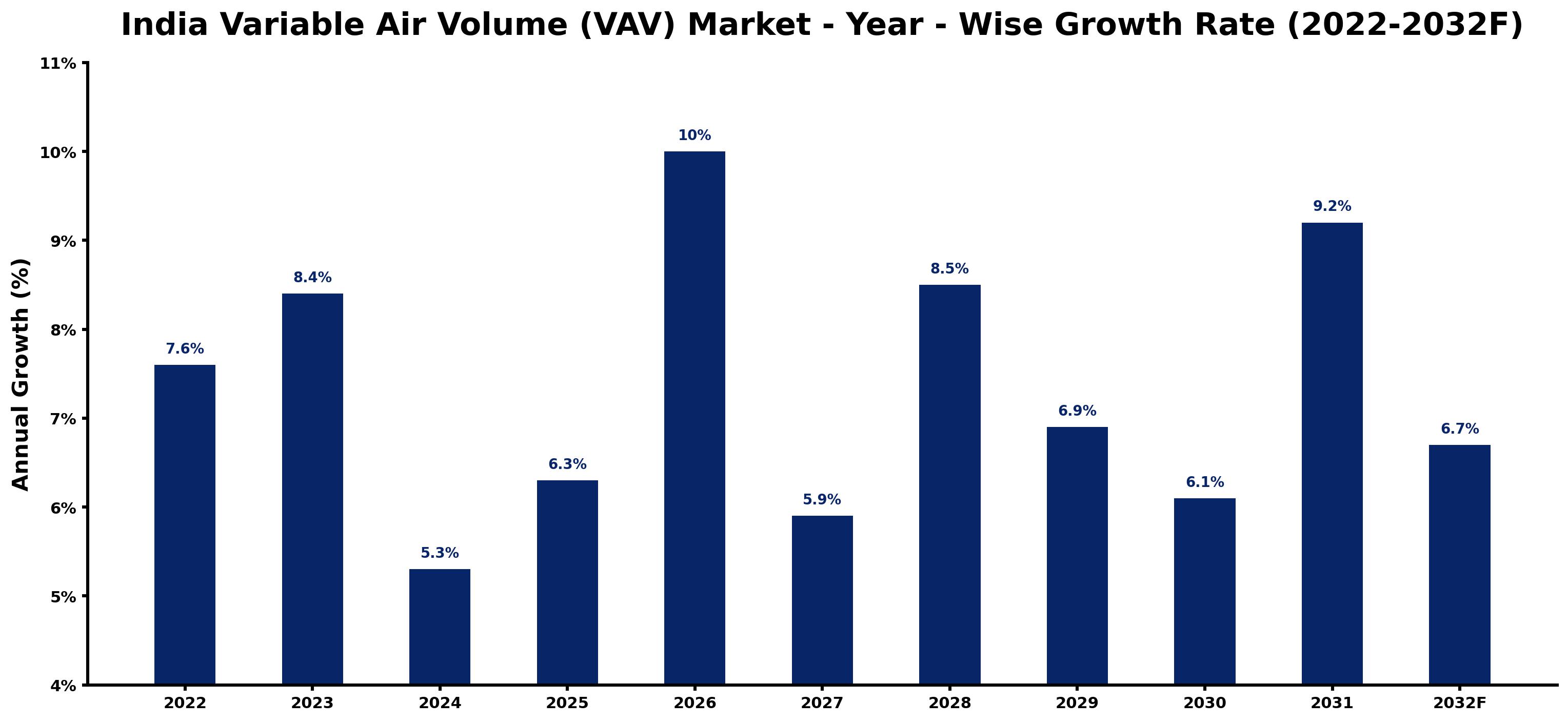
Each row of the following table gives one year's estimated growth and the event or demand shift that explains it.
| Year | Estimated Annual Growth (%) | Market Rationale |
| 2022 | 7.6 | The market saw steady demand from ongoing construction projects and energy efficiency initiatives. |
| 2023 | 8.4 | Growth accelerated due to increased installations in commercial buildings across major urban areas. |
| 2024 | 5.3 | A slowdown occurred as projects faced delays amid rising material costs and supply chain issues. |
| 2025 | 6.3 | Demand picked up again with renewed investments in energy-efficient HVAC systems. |
| 2026 | 10.0 | Peak growth is expected to be driven by the National Energy Conservation Mission promoting VAV technologies. |
| 2027 | 5.9 | Growth is projected to slow as market saturation begins to affect new installations in urban centres. |
| 2028 | 8.5 | An increase in healthcare facility developments is expected to boost demand for VAV systems in hospitals. |
| 2029 | 6.9 | Growth is anticipated to decelerate as competition intensifies among HVAC contractors in metropolitan areas. |
| 2030 | 6.1 | A further slowdown is likely as regulatory compliance costs impact project timelines. |
| 2031 | 9.2 | Demand is expected to surge again due to rising awareness of energy efficiency in commercial spaces. |
| 2032 | 6.7 | Growth is projected to slow as the market stabilises amid mature adoption rates of VAV technologies. |
Note: Market size estimations and growth projections presented in this report are based on 6Wresearch's proprietary forecasting methodology, utilizing the latest available industry data, government publications, and primary research inputs.
India Variable Air Volume (VAV) Market Synopsis
The India Variable Air Volume (VAV) Market includes HVAC components that manage airflow to optimise energy efficiency and indoor comfort. These systems play a crucial role in maintaining ideal temperature and air quality in commercial buildings, hospitals, and schools. The market is growing due to increasing demand from ongoing construction projects and the enforcement of energy efficiency standards. In 2022, the Indian HVAC market was valued at around $4 billion, with substantial investments in energy-efficient technologies propelling further expansion. The National Energy Conservation Mission and the Indian Standard IS 659:2020 are pivotal initiatives advancing VAV systems in the country.
Market Dynamics Impact Analysis (2026–2032)
| Factor | Type | Impact | Primary Segment Affected |
| Increasing installations in commercial buildings driven by urbanisation and construction growth. | Driver | High | Commercial Buildings |
| Rising healthcare facility developments enhancing air quality standards. | Driver | High | Hospitals |
| Growing demand for energy-efficient technologies in urban areas. | Opportunity | High | HVAC Contractors |
| Expansion of green building certifications promoting VAV systems. | Opportunity | Medium | Energy Consultants |
| High initial investment costs for VAV system installations. | Restraint | High | HVAC Contractors |
| Regulatory compliance costs impacting project timelines. | Restraint | Medium | Mechanical Engineers |
| Skilled labour shortages affecting installation and maintenance. | Challenge | High | Facility Managers |
| Supply chain disruptions delaying project completions. | Challenge | Medium | HVAC Contractors |
Evaluation of Drivers in India Variable Air Volume (VAV) Market (2026–2032)
The factors lifting demand, and the evidence behind each, are summarised below.
| Drivers | Primary Segment Affected | Why It Matters (Evidence) |
| Rising investments in energy-efficient HVAC technologies. | Commercial Buildings | The Indian HVAC market was valued at approximately $4 billion in 2022, prompting increased purchases by contractors. |
| Increased focus on indoor air quality in healthcare facilities. | Hospitals | Healthcare developments are driving demand for VAV systems to maintain air quality standards. |
| Urbanisation leading to new construction projects. | HVAC Contractors | The rapid development of commercial real estate in Delhi has resulted in increased VAV installations. |
| Government initiatives promoting energy efficiency. | Energy Consultants | The National Energy Conservation Mission encourages energy-efficient technologies, boosting demand. |
| Technological advancements in VAV systems improving efficiency. | Programmable | New control technologies are improving system performance, attracting more buyers. |
The Variable Air Volume (VAV) market in India is expanding as rising investments in energy-efficient HVAC technologies, a greater emphasis on indoor air quality, and urbanisation drive demand. The Indian HVAC market was valued at approximately $4 billion in 2022, prompting contractors to increase their purchases. Technological advancements in VAV systems are improving efficiency, attracting more buyers. These factors contribute to a vibrant market for VAV systems in India.
Evaluation of Restraints in India Variable Air Volume (VAV) Market
Below mentioned are some major restraints and their influence on market dynamics.
| Market Restraint | Primary Segment Affected | Why It Matters (Evidence) |
| High initial investment costs for VAV system installations. | HVAC Contractors | Investments can exceed ₹500 crores, deterring smaller contractors from entering the market. |
| Regulatory compliance costs impacting project timelines. | Mechanical Engineers | New standards under the National Building Code increase project costs and delays. |
| Limited availability of skilled labour for installation and maintenance. | Facility Managers | The HVAC industry employs over 500,000 professionals, but shortages persist in key areas. |
| Supply chain disruptions delaying project completions. | HVAC Contractors | Ongoing global supply chain issues have resulted in increased lead times for essential components. |
| Market saturation affecting new installations in urban centres. | Commercial Buildings | As the market matures, competition intensifies, resulting in slower growth rates. |
India Variable Air Volume (VAV) Market Challenges
Buyers in the India Variable Air Volume (VAV) market face challenges with regulatory compliance, as meeting the Indian Standard IS 659:2020 can increase project costs by 15%. Suppliers encounter technological limitations, with many VAV systems lacking modern control mechanisms, resulting in energy waste of up to 30% in large commercial buildings. The HVAC sector grapples with a skills gap, where a shortage of qualified technicians delays installations and maintenance for hospitals, leading to higher operational costs. Supply chain issues also create hurdles, as sourcing delays can prolong project timelines by several weeks, affecting budgets for buyers.
Trends in the India Variable Air Volume (VAV) Market
The trends below show where the India Variable Air Volume (VAV) Market is heading.
- National Energy Conservation Mission Driving Efficiency: The National Energy Conservation Mission, launched in 2020, promotes energy-efficient HVAC technologies, including VAV systems. In 2022, the Indian government allocated ₹500 crores for energy efficiency projects, resulting in increased installations.
- Shift Towards Programmable Controls: Since 2021, the trend towards programmable VAV systems has gained momentum, improving operational efficiency. With a projected CAGR of 9.9% from 2026 to 2032, this shift is reshaping the market.
- Urban Development Boosting VAV Installations: Delhi has seen a rise in VAV installations due to increasing commercial real estate developments. The city's expanding market is expected to grow substantially, with over 45% of the HVAC market share.
- Healthcare Sector Prioritising Indoor Air Quality: Hospitals are increasingly adopting VAV systems to meet stringent air quality standards. With a projected CAGR of 9.6% from 2026 to 2032, this trend reflects the sector's growing focus on patient safety.
Investment Opportunities in the India Variable Air Volume (VAV) Market
Several openings in the India Variable Air Volume (VAV) Market merit attention from investors.
- Growing Demand for Energy-Efficient Systems: With the Indian HVAC market valued at around $4 billion in 2022, there is a strong demand for energy-efficient VAV systems. HVAC contractors are key buyers, and local partnerships can facilitate market entry.
- Expansion of Green Building Certifications: The push for green building certifications is creating opportunities for VAV system suppliers. Energy consultants are seeking effective solutions to meet these standards, presenting a chance for new entrants.
- Healthcare Facility Developments: The ongoing construction of healthcare facilities is driving demand for VAV systems. As hospitals prioritise air quality, suppliers can effectively target this sector to meet rising needs.
- Urbanisation and Commercial Real Estate Growth: Rapid urbanisation in cities like Delhi is generating a need for efficient HVAC systems. Targeting commercial buildings with VAV solutions can yield substantial returns for suppliers.
Government Initiatives in the India Variable Air Volume (VAV) Market
The National Energy Conservation Mission, initiated by the Bureau of Energy Efficiency in 2020, aims to promote energy efficiency in HVAC systems with a focus on VAV technologies. This initiative encourages the adoption of energy-efficient practices among producers and buyers, improving overall system performance. The revised Perform, Achieve and Trade (PAT) scheme in 2021 incentivises the adoption of VAV technologies across industries, further supporting energy efficiency goals. The updated National Building Code of India in 2022 includes new standards for VAV system installations, enhancing compliance requirements and promoting energy savings.
The Energy Efficiency Financing Platform (EEFP), established in 2021 by the Ministry of Power, facilitates funding for energy-efficient HVAC projects, targeting ₹1,000 crores in financial support. This platform aims to assist producers in adopting advanced technologies while providing buyers with access to necessary funding. Furthermore, the Smart Cities Mission, initiated by the Ministry of Housing and Urban Affairs in 2020, promotes energy-efficient building technologies, including VAV systems, in urban development projects, ensuring sustainable growth.
Future Insight of the India Variable Air Volume (VAV) Market
The India Variable Air Volume (VAV) market is set to evolve by 2032, driven by the National Energy Conservation Mission, which aims to improve energy efficiency standards in buildings. The Energy Efficiency Financing Platform will enable investments in advanced VAV technologies, encouraging broader adoption among commercial users. With Delhi's commercial real estate expanding, VAV installations are expected to rise significantly, supported by government initiatives that allocated ₹1,000 crores for energy efficiency projects. The Indian Green Building Council's push for green building certifications will further encourage the integration of VAV systems in new constructions.
Market Segmentation Analysis
The analysis below covers each segmentation, its leading category in 2025 and its fastest-growing category through 2032.
By Box Type – Single Duct VAV Dominated, Fan-Powered VAV Expected to Grow Fastest
According to Bhawna Singh, Assistant Manager at 6Wresearch, Single Duct VAV held a 48% share of the India Variable Air Volume (VAV) Market by box type in 2025. Single Duct VAV systems hold the largest market share due to their widespread application in commercial buildings, particularly in regions like Maharashtra and Delhi. Their effectiveness in providing efficient air distribution solidifies their position as the preferred choice among users. Over 2026–2032, Fan-Powered VAV is expected to post the fastest growth, at a CAGR of 8.8%. Fan-Powered VAV systems are experiencing rapid growth as they significantly improve airflow and comfort levels, which are crucial in modern building designs. The increasing emphasis on maintaining high indoor air quality in commercial spaces is propelling this segment's expansion. Suppliers should focus on promoting Fan-Powered VAV systems to cater to the growing demand for enhanced comfort in commercial buildings.
By Control Type – Analog/Digital Dominated, Programmable Expected to Grow Fastest
Analog/Digital accounted for a 42% market share by control type in 2025. Analog/Digital controls are the leading choice for managing VAV systems, providing precise operation that meets the needs of various applications. Their reliability in regulating airflow contributes to their substantial share in the market. The quickest growth will come from Programmable, forecast to expand at a CAGR of 9.9% between 2026 and 2032. Programmable controls are on the rise, driven by their ability to automate airflow management, which aligns with the increasing focus on energy efficiency in HVAC systems. Initiatives such as the National Energy Conservation Mission further support this growth trend. Buyers should consider investing in programmable controls to boost energy efficiency and optimise operations within their HVAC systems.
By Application Area – Commercial Buildings Dominated, Hospitals Expected to Grow Fastest
In 2025, Commercial Buildings led the application area split with a 45% share. Commercial buildings represent the largest application area for VAV systems, driven by ongoing construction and renovation projects across urban areas. Their role in maintaining optimal air quality and temperature in these settings solidifies their market share. Hospitals are set to record the highest CAGR in this split, 9.6% over 2026–2032. Hospitals are the fastest-growing application area as they require stringent air quality standards to ensure patient safety and comfort. The increasing number of healthcare facilities in urban regions is a key factor in this growth. Suppliers must tailor their offerings to meet the specific needs of hospitals, focusing on air quality and energy efficiency to capture this growing segment.
By End User – HVAC Contractors Dominated and Is Expected to Record the Fastest Growth
HVAC Contractors took a 40% share of end user in 2025, more than any other category. HVAC Contractors are the dominant end users of VAV systems, responsible for overseeing installation and maintenance across numerous projects. Their expertise and reliance on dependable systems fuel significant market activity. The same category are also set to grow fastest, at a CAGR of 8.8% during 2026–2032. HVAC Contractors are also the fastest-growing end users, as the rising complexity of HVAC systems demands skilled professionals for effective implementation. Their dual role as users and installers amplifies their influence in the market. Suppliers should build strong partnerships with HVAC Contractors to ensure their products meet the industry's changing requirements.
Key Attractiveness of the Report
- 10 Years of Market Numbers
- Historical Data Starting from 2022 to 2025
- Base Year 2025
- Forecast Data until 2032
- Key Performance Indicators Impacting the Market
- Major Upcoming Developments and Projects
Key Highlights of the Report:
- India Variable Air Volume (VAV) Market Outlook
- Market Size of India Variable Air Volume (VAV) Market, 2025
- Forecast of India Variable Air Volume (VAV) Market, 2032
- Historical Data and Forecast of India Variable Air Volume (VAV) Revenues & Volume for the Period 2022 - 2032F
- India Variable Air Volume (VAV) Market Trend Evolution
- India Variable Air Volume (VAV) Market Drivers and Challenges
- India Variable Air Volume (VAV) Price Trends
- India Variable Air Volume (VAV) Porter's Five Forces
- India Variable Air Volume (VAV) Industry Life Cycle
- Historical Data and Forecast of India Variable Air Volume (VAV) Market Revenues & Volume By Box Type for the Period 2022 - 2032F
- Historical Data and Forecast of India Variable Air Volume (VAV) Market Revenues & Volume By Single Duct VAV for the Period 2022 - 2032F
- Historical Data and Forecast of India Variable Air Volume (VAV) Market Revenues & Volume By Dual Duct VAV for the Period 2022 - 2032F
- Historical Data and Forecast of India Variable Air Volume (VAV) Market Revenues & Volume By Fan-Powered VAV for the Period 2022 - 2032F
- Historical Data and Forecast of India Variable Air Volume (VAV) Market Revenues & Volume By Series/Parallel VAV for the Period 2022 - 2032F
- Historical Data and Forecast of India Variable Air Volume (VAV) Market Revenues & Volume By Control Type for the Period 2022 - 2032F
- Historical Data and Forecast of India Variable Air Volume (VAV) Market Revenues & Volume By Analog/Digital for the Period 2022 - 2032F
- Historical Data and Forecast of India Variable Air Volume (VAV) Market Revenues & Volume By Pneumatic for the Period 2022 - 2032F
- Historical Data and Forecast of India Variable Air Volume (VAV) Market Revenues & Volume By ECM Motor for the Period 2022 - 2032F
- Historical Data and Forecast of India Variable Air Volume (VAV) Market Revenues & Volume By Programmable for the Period 2022 - 2032F
- Historical Data and Forecast of India Variable Air Volume (VAV) Market Revenues & Volume By Application Area for the Period 2022 - 2032F
- Historical Data and Forecast of India Variable Air Volume (VAV) Market Revenues & Volume By Commercial Buildings for the Period 2022 - 2032F
- Historical Data and Forecast of India Variable Air Volume (VAV) Market Revenues & Volume By Hospitals for the Period 2022 - 2032F
- Historical Data and Forecast of India Variable Air Volume (VAV) Market Revenues & Volume By Schools for the Period 2022 - 2032F
- Historical Data and Forecast of India Variable Air Volume (VAV) Market Revenues & Volume By Office Spaces for the Period 2022 - 2032F
- Historical Data and Forecast of India Variable Air Volume (VAV) Market Revenues & Volume By End User for the Period 2022 - 2032F
- Historical Data and Forecast of India Variable Air Volume (VAV) Market Revenues & Volume By HVAC Contractors for the Period 2022 - 2032F
- Historical Data and Forecast of India Variable Air Volume (VAV) Market Revenues & Volume By Mechanical Engineers for the Period 2022 - 2032F
- Historical Data and Forecast of India Variable Air Volume (VAV) Market Revenues & Volume By Facility Managers for the Period 2022 - 2032F
- Historical Data and Forecast of India Variable Air Volume (VAV) Market Revenues & Volume By Energy Consultants for the Period 2022 - 2032F
- India Variable Air Volume (VAV) Import Export Trade Statistics
- Market Opportunity Assessment By Box Type
- Market Opportunity Assessment By Control Type
- Market Opportunity Assessment By Application Area
- Market Opportunity Assessment By End User
- India Variable Air Volume (VAV) Top Companies Market Share
- India Variable Air Volume (VAV) Competitive Benchmarking By Technical and Operational Parameters
- India Variable Air Volume (VAV) Company Profiles
- India Variable Air Volume (VAV) Key Strategic Recommendations
Market Covered
Segments analysed in this report are listed below.
By Box Type
- Single Duct VAV
- Dual Duct VAV
- Fan-Powered VAV
- Series/Parallel VAV
By Control Type
- Analog/Digital
- Pneumatic
- ECM Motor
- Programmable
By Application Area
- Commercial Buildings
- Hospitals
- Schools
- Office Spaces
By End User
- HVAC Contractors
- Mechanical Engineers
- Facility Managers
- Energy Consultants































